Definitive Healthcare vs GrowMeOrganic: 2026 Data Showdown
One is a five-figure healthcare commercial intelligence platform. The other is a sub-$100/month all-purpose prospecting tool. They get compared constantly and they should not be. Here is the honest breakdown of which one fits your pipeline.
TL;DR
- Definitive Healthcare is a healthcare commercial intelligence platform — provider networks, claims-derived affiliations, IDN hierarchies, NPI-level detail. It is priced as an enterprise data subscription, typically five figures per year on an annual contract.
- GrowMeOrganic is an all-purpose B2B prospecting suite — email finding, LinkedIn scraping, and a built-in cold email sender — at entry pricing under $100/month.
- They are not really competitors. They overlap on one narrow job: "get me contact details for people I want to sell to." Everything else about them is different.
- If you sell into hospitals, payers, or life sciences and need to understand referral patterns and org hierarchies, Definitive Healthcare is the only one of the two that answers your actual question.
- If you need verified work emails at volume across any industry, both Definitive Healthcare and GrowMeOrganic are the wrong shape of tool — a dedicated email finder does that job cheaper and with a cleaner API.
What is Definitive Healthcare, and what does it actually sell?#
Definitive Healthcare sells market intelligence about the U.S. healthcare system, not a contact list. That distinction is the whole post.
Think of it like the difference between a phone book and a map of a city's road network. The phone book tells you who exists and how to reach them. The map tells you how traffic actually flows — which neighborhoods feed which highways, which intersections are bottlenecks. Definitive Healthcare is the map. Contacts are a byproduct.
What you get inside the platform, per their own product pages:
- Provider and facility profiles — hospitals, physician groups, ambulatory surgery centers, long-term care, imaging centers, with bed counts, procedure volumes, and technology installed.
- Claims-derived intelligence — diagnosis and procedure volumes, referral patterns between providers, and where patients actually flow.
- Affiliation and hierarchy data — which physician belongs to which group, which group rolls up into which IDN or health system. This is the part nobody else does well.
- Technology install base — which EHR, PACS, or revenue cycle system a facility runs, which is gold if you sell healthcare IT.
- Contact records — names, titles, and business contact details for executives and clinicians, attached to the above.
The buyer is a healthcare-specific GTM team: med device, healthcare IT, pharma services, staffing, revenue cycle management. If your total addressable market is "3,100 acute care hospitals and the 400 systems that own them," Definitive Healthcare is doing something no generic B2B database does.
What is GrowMeOrganic, and who is it built for?#
GrowMeOrganic is a prospecting-and-outreach bundle. One subscription gets you a B2B contact database, a LinkedIn/Sales Navigator extractor, an email finder and verifier, and a cold email sending engine with sequences — see their site for the current feature list.
The pitch is consolidation: instead of paying for a data tool, a scraper, and a sequencer separately, you pay once. For a two-person agency or a solo founder doing outbound, that math is genuinely attractive.
The trade-off is depth. A tool that does five things at a mid-market price point is not going to beat the best-in-class tool at any one of them. GrowMeOrganic's data is broad and shallow: firmographics, job titles, emails, some phone numbers, across all industries. There is no claims data, no provider affiliation graph, no NPI-keyed anything.

How do Definitive Healthcare and GrowMeOrganic compare head-to-head?#
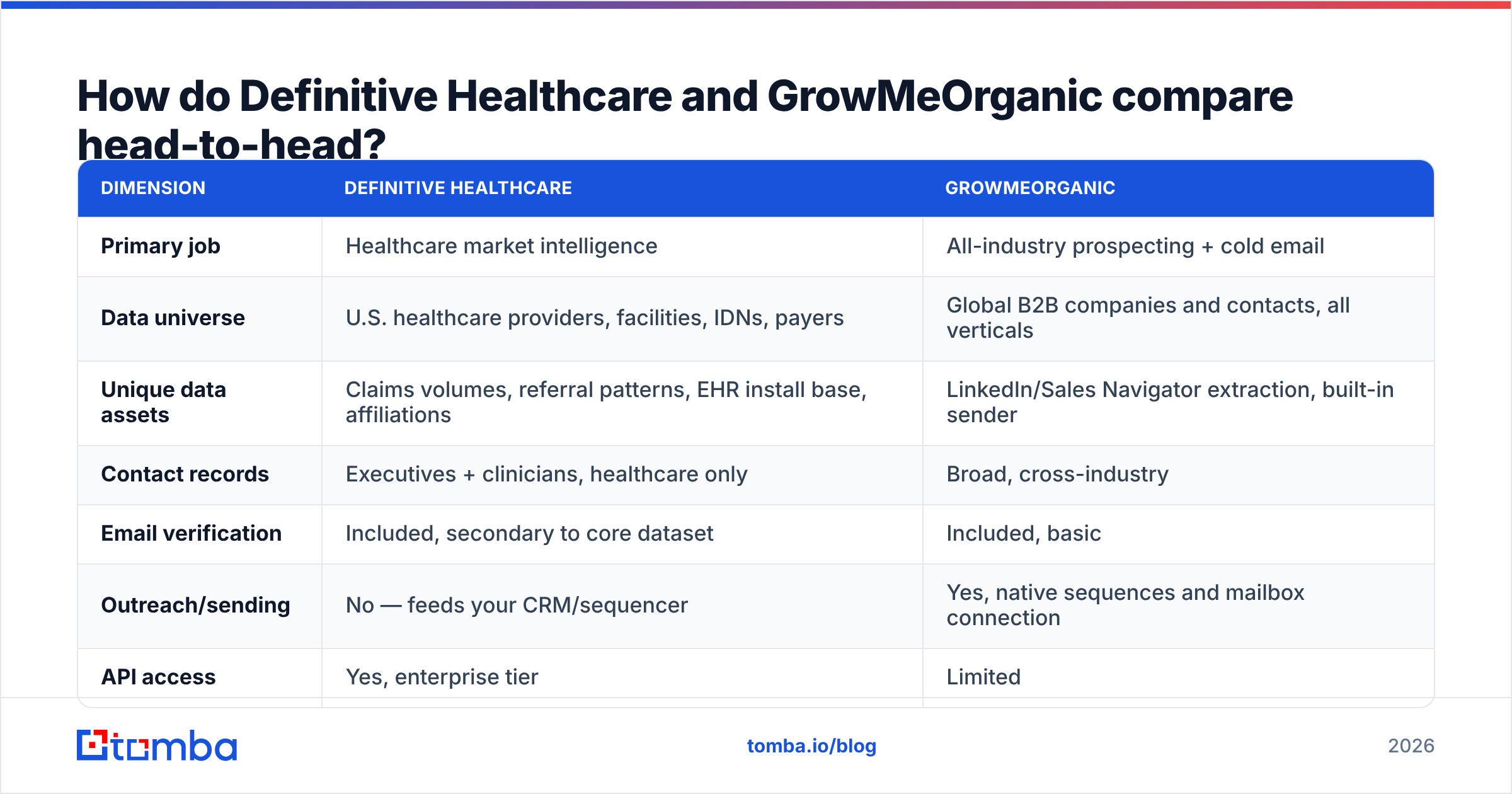
| Dimension | Definitive Healthcare | GrowMeOrganic |
|---|---|---|
| Primary job | Healthcare market intelligence | All-industry prospecting + cold email |
| Data universe | U.S. healthcare providers, facilities, IDNs, payers | Global B2B companies and contacts, all verticals |
| Unique data assets | Claims volumes, referral patterns, EHR install base, affiliations | LinkedIn/Sales Navigator extraction, built-in sender |
| Contact records | Executives + clinicians, healthcare only | Broad, cross-industry |
| Email verification | Included, secondary to core dataset | Included, basic |
| Outreach/sending | No — feeds your CRM/sequencer | Yes, native sequences and mailbox connection |
| API access | Yes, enterprise tier | Limited |
| Pricing model | Annual contract, quote-only | Public self-serve plans |
| Typical entry cost | Five figures per year | Under $100/month |
| Contract term | Annual, seat-based | Monthly or annual |
| Best for | Healthcare-specific enterprise GTM | SMB/agency generalist outbound |
| Worst for | Non-healthcare, small teams, quick tests | Anyone needing vertical depth or clean API data |
The table makes the point better than any paragraph: these tools sit at opposite ends of the price/depth axis. There is no scenario where you seriously evaluate both unless your requirements document is unfinished.
Which one has better data accuracy?#
Wrong question — but here is the honest answer anyway.
Definitive Healthcare is more accurate on the things it specializes in. Facility attributes, bed counts, system ownership, and NPI-linked provider records come from structured sources (CMS filings, claims clearinghouses, licensure data) and are refreshed on a defined cadence. When it says a hospital is part of a given IDN, that is usually right.
Definitive Healthcare's email accuracy is a different story. Contact records inside enterprise vertical databases decay the same way everyone else's do — healthcare has heavy role turnover, and a clinician who moved practices in Q1 will still show a dead address in a lot of platforms in Q3. Vendors rarely publish per-field freshness.
GrowMeOrganic's accuracy is mid-pack for its price class. Independent reviews on G2 consistently flag the same pattern users report for most bundled prospecting tools: usable hit rates on well-known domains, noticeably worse on small companies, non-English domains, and catch-all servers. If you run cold email at any volume, you should assume you need a second verification pass before sending — which is exactly why standalone email verification still exists as a category.
The practical rule: never trust a bundled tool's "verified" flag as your only gate. Run your export through a dedicated verifier, and handle catch-all domains explicitly with a catch-all verifier rather than deleting or blindly sending to them. Catch-all domains are often 20-30% of a B2B list, and both guessing and discarding are expensive mistakes.
What does each one actually cost in 2026?#
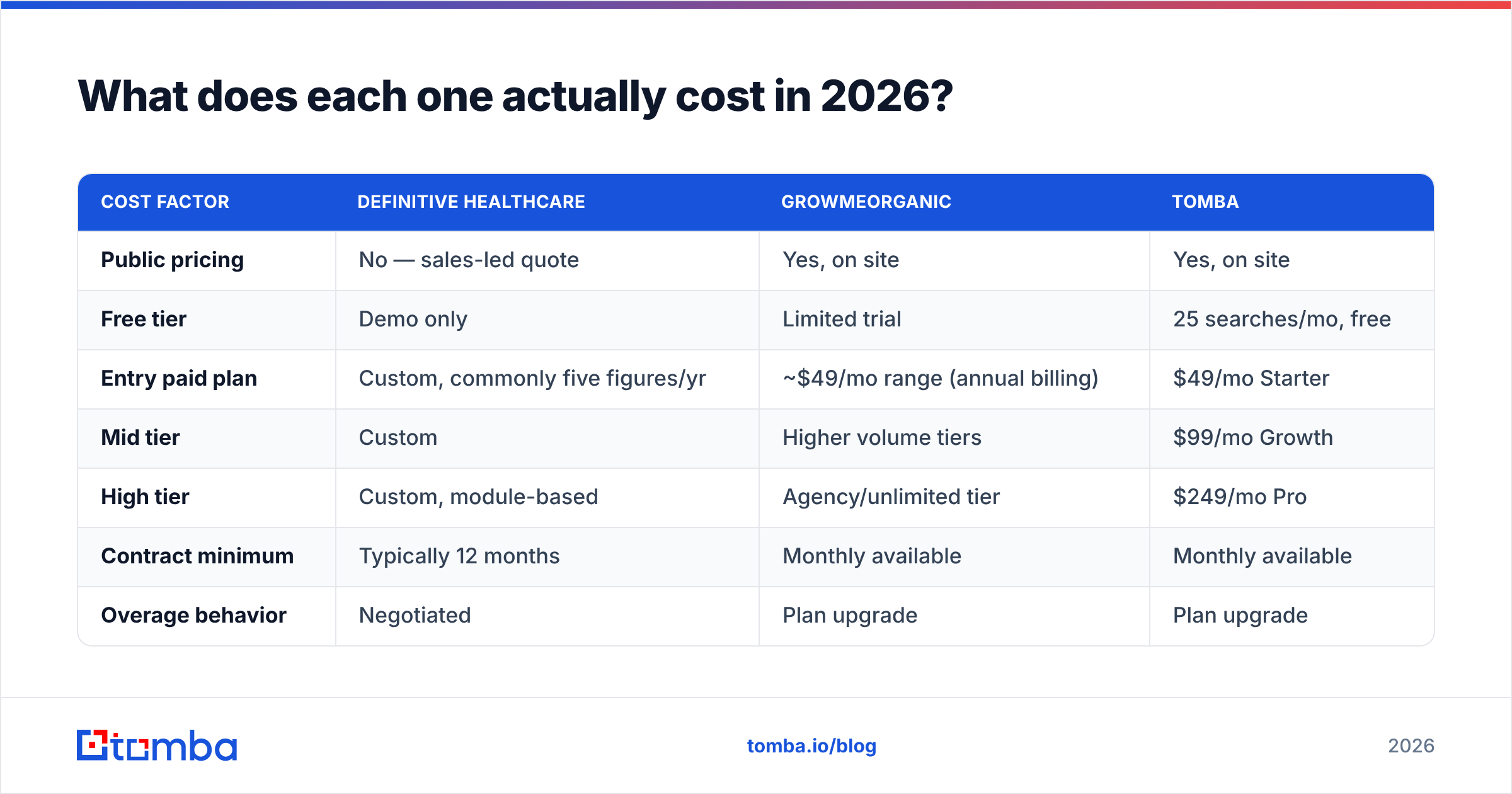
| Cost factor | Definitive Healthcare | GrowMeOrganic | Tomba |
|---|---|---|---|
| Public pricing | No — sales-led quote | Yes, on site | Yes, on site |
| Free tier | Demo only | Limited trial | 25 searches/mo, free |
| Entry paid plan | Custom, commonly five figures/yr | ~$49/mo range (annual billing) | $49/mo Starter |
| Mid tier | Custom | Higher volume tiers | $99/mo Growth |
| High tier | Custom, module-based | Agency/unlimited tier | $249/mo Pro |
| Contract minimum | Typically 12 months | Monthly available | Monthly available |
| Overage behavior | Negotiated | Plan upgrade | Plan upgrade |
| API included | Enterprise add-on | Limited | Yes, all paid plans |
Two caveats before you quote these numbers to your CFO. First, Definitive Healthcare's pricing is genuinely custom — it scales with modules, seats, and data export rights, and the range people report publicly spans an order of magnitude. Get your own quote. Second, self-serve vendors change list prices often; check GrowMeOrganic's pricing page and Tomba pricing rather than trusting any blog post, including this one.
The structural difference that matters more than the sticker: Definitive Healthcare is a budget line item you defend annually; GrowMeOrganic is an expense you can cancel next month. For a team still validating whether outbound works at all, that reversibility is worth real money.
Who should buy Definitive Healthcare?#
Buy it if three things are true at once:
- Your ICP is defined by healthcare structure, not firmographics. "Cardiology practices affiliated with systems running Epic, doing over 500 caths a year" is a Definitive Healthcare query. "SaaS companies, 50-200 employees" is not.
- Deal sizes justify the subscription. A $30K/year data platform needs to influence roughly one mid-six-figure deal to pay back. If your ACV is $8K, the math is hard.
- Someone owns the data. Enterprise vertical platforms reward teams with a RevOps function that builds territories, scores accounts, and syncs to CRM. Without an owner, you buy a very expensive search box that three reps use twice.
If all three hold, nothing in the generalist tier — GrowMeOrganic included — comes close. You are not paying for contacts. You are paying for the claims graph.
Who should buy GrowMeOrganic?#
Buy it if you are optimizing for fewest tools at lowest cost, and you are fine with good-enough data.
The strongest case: a small agency or a founder-led sales motion where one person does everything from list-building to sending. Having extraction, enrichment, and sequencing in one login removes real friction. The LinkedIn extraction is the sticky part — it is why most users stay.
The weakest case: you already own a sequencer you like (Instantly, Smartlead, Lemlist, HubSpot Sequences). Then you are paying for a sending engine you will never turn on, and evaluating GrowMeOrganic purely as a data source — where it competes against tools that do data only, and do it better. If that is you, it is worth reading through Apollo alternatives and similar comparisons before committing, because the bundled-tool premium stops making sense the moment you unbundle.

Is there a better option if you just need verified emails?#
Yes — and this is the honest part of the comparison that most versus posts skip.
A large share of teams googling "definitive healthcare vs growmeorganic" do not need either. They need to turn a list of companies or people into deliverable work email addresses, at a predictable cost, without an annual contract or a bundled sender they will not use.
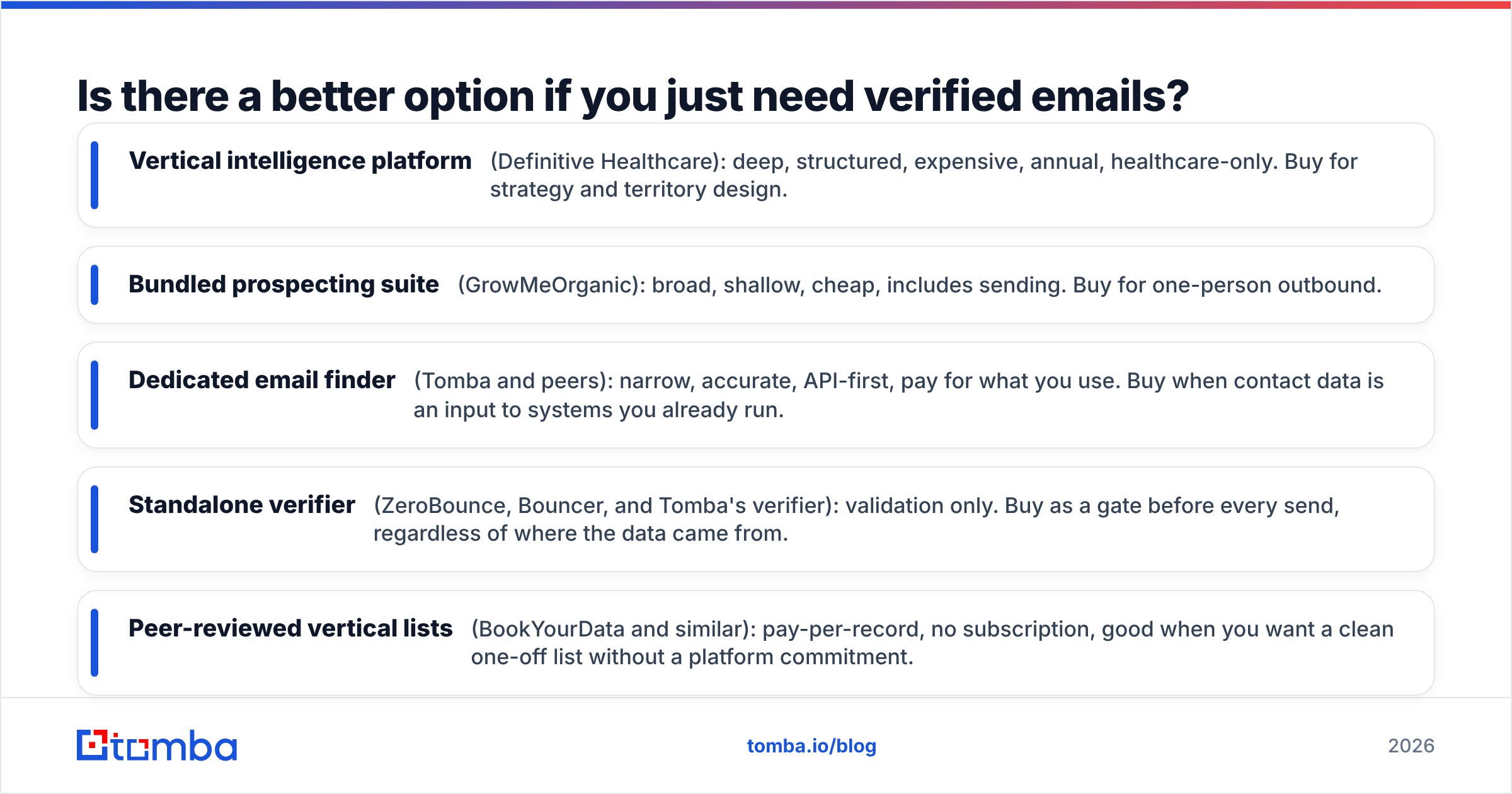
That is a different product category. Here is how the shapes differ:
- Vertical intelligence platform (Definitive Healthcare): deep, structured, expensive, annual, healthcare-only. Buy for strategy and territory design.
- Bundled prospecting suite (GrowMeOrganic): broad, shallow, cheap, includes sending. Buy for one-person outbound.
- Dedicated email finder (Tomba and peers): narrow, accurate, API-first, pay for what you use. Buy when contact data is an input to systems you already run.
- Standalone verifier (ZeroBounce, Bouncer, and Tomba's verifier): validation only. Buy as a gate before every send, regardless of where the data came from.
- Peer-reviewed vertical lists (BookYourData and similar): pay-per-record, no subscription, good when you want a clean one-off list without a platform commitment.
Tomba sits squarely in the third bucket. The free tier gives you 25 searches a month to test hit rates on your own domains before spending anything — which is the only benchmark that matters, since every vendor's published accuracy number was measured on a list you did not choose. Paid plans start at $49/month, and the Tomba API is included on every paid tier rather than gated behind an enterprise conversation.
The workflow most teams end up with looks like this: use a vertical source (or your own research) to decide who to target, use domain search to pull the right people at each account, verify before sending, and push the result into whatever sequencer you already pay for. Three specialized tools, each replaceable, none locked to a twelve-month term.
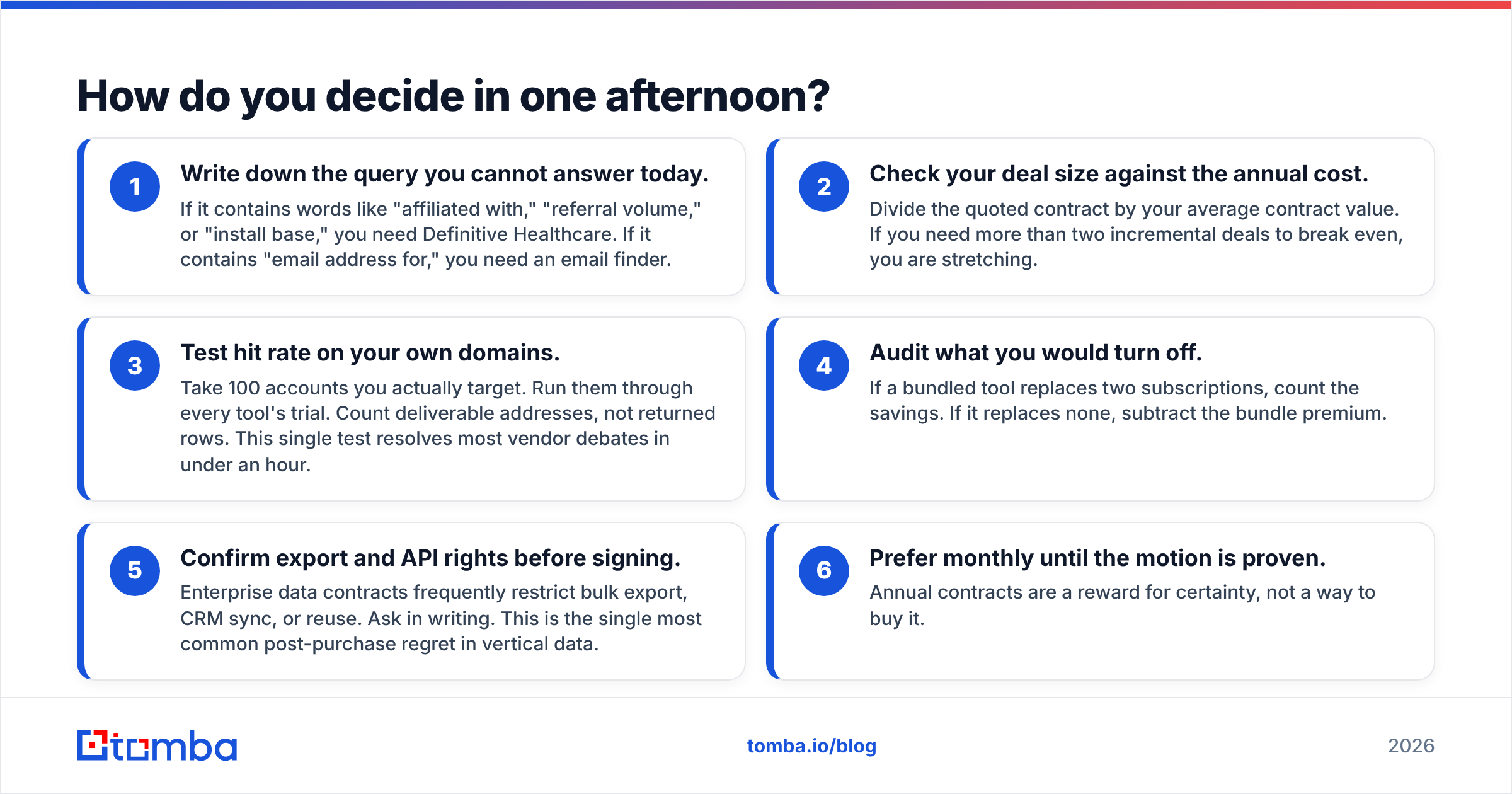
How do you decide in one afternoon?#
- Write down the query you cannot answer today. If it contains words like "affiliated with," "referral volume," or "install base," you need Definitive Healthcare. If it contains "email address for," you need an email finder.
- Check your deal size against the annual cost. Divide the quoted contract by your average contract value. If you need more than two incremental deals to break even, you are stretching.
- Test hit rate on your own domains. Take 100 accounts you actually target. Run them through every tool's trial. Count deliverable addresses, not returned rows. This single test resolves most vendor debates in under an hour.
- Audit what you would turn off. If a bundled tool replaces two subscriptions, count the savings. If it replaces none, subtract the bundle premium.
- Confirm export and API rights before signing. Enterprise data contracts frequently restrict bulk export, CRM sync, or reuse. Ask in writing. This is the single most common post-purchase regret in vertical data.
- Prefer monthly until the motion is proven. Annual contracts are a reward for certainty, not a way to buy it.
Frequently asked questions#
Is GrowMeOrganic a Definitive Healthcare alternative? Not meaningfully. It can supply contacts in healthcare, but it has none of the claims, affiliation, or facility intelligence that people buy Definitive Healthcare for. Treating them as substitutes usually means the requirements were never written down.
Does Definitive Healthcare include email addresses? Yes, contact records with business email are part of the platform. Freshness varies by role and region, and most teams still run a verification pass before sending.
Can I use both? Sometimes that is the right answer: Definitive Healthcare for account selection and territory design, a cheaper finder plus your existing sequencer for contact-level execution. That combination usually costs less than expanding seats on the enterprise platform.
What about non-U.S. healthcare? Definitive Healthcare's strength is U.S. claims and facility data. If your market is EMEA or APAC healthcare, its core advantage largely disappears, and a general-purpose data stack becomes competitive again.
The bottom line#
Pick by the question you are trying to answer, not by the price tag. Definitive Healthcare wins decisively when your go-to-market depends on understanding how U.S. healthcare is wired — and it is expensive precisely because that data is hard to assemble. GrowMeOrganic wins when you are one person who needs to find people and email them today without a procurement cycle.
If what you actually need is a reliable stream of verified work emails feeding tools you already own, skip the versus debate entirely. Start with the Tomba Email Finder — 25 free searches a month, $49/month when you outgrow it, a documented API on every paid plan, and no annual contract to defend. Run your own hundred-domain test this week and let the hit rate decide instead of a sales deck.
Related guides#
Ready to find emails that actually work?
Join 150,000+ professionals who stopped guessing and started sending. Free credits on signup — no credit card required.
Get the Tomba newsletter
Practical outbound tactics and product updates — once every two weeks.
About the author