Definitive Healthcare vs Zintlr: Which B2B Data Tool Wins?
One is a healthcare commercial intelligence suite built for provider networks. The other is a horizontal B2B contact database with personality scoring. They rarely belong on the same shortlist — here is how to pick, and what to do when neither fits.
TL;DR
- These two tools are not really competitors. Definitive Healthcare is a healthcare-specific commercial intelligence platform built around providers, facilities, claims and affiliations. Zintlr is a horizontal B2B contact database with a personality-profiling layer. If both are on your shortlist, your requirements doc probably needs a rewrite.
- Price gap is enormous. Definitive Healthcare sells annual enterprise contracts that commonly land in the five figures. Zintlr sells self-serve seats at consumer-SaaS prices. You are not comparing like with like.
- Definitive Healthcare wins on depth: NPI-level provider records, claims-derived procedure volumes, IDN and health-system hierarchy. Nothing horizontal replicates that.
- Zintlr wins on speed and cost: sign up, search, export, start sending this week — with the usual caveat that broad databases decay fast and need verification before you send.
- Most teams need a third thing anyway: a dedicated finder and verifier to turn "this person exists" into "this inbox accepts mail." That is where a tool like Tomba sits, at $49/mo rather than $30k/yr.
What are Definitive Healthcare and Zintlr, exactly?#
Start with the category, because the category decides the answer.
Definitive Healthcare is a healthcare commercial intelligence platform. Its core asset is a curated map of the US healthcare delivery system: hospitals, physician groups, ambulatory surgery centers, long-term care facilities, imaging centers, plus the individual clinicians attached to them. That map is stitched together from public NPI registrations, Medicare and commercial claims data, cost reports, quality filings, and human curation on top. The sales pitch is not "here are emails." The pitch is "here is which surgeon performs 400 of your target procedures a year, at which facility, under which health system, and who signs the purchase order."
Zintlr is a horizontal B2B prospecting database. It indexes companies and business contacts across industries, exposes search filters (title, industry, geography, headcount, tech signals), and adds a distinctive twist: a personality-intelligence layer that tries to infer a prospect's communication style from their public footprint so you can tailor your opener. It ships a Chrome extension, list export, and self-serve pricing.
One is a research instrument for a regulated vertical. The other is a volume prospecting tool. Both call themselves "data platforms," which is how they ended up in the same comparison query.

How do their data models actually differ?#
This is where the comparison stops being abstract. The two products model the world in incompatible ways.
- The atomic unit. Definitive Healthcare's atomic unit is a provider or facility with an identifier — an NPI, a CCN, a health-system parent. Zintlr's atomic unit is a person at a company, the standard B2B contact row. A cardiologist with admitting privileges at three hospitals is one record with three affiliations in the first model, and roughly one job title in the second.
- The provenance. Definitive Healthcare leans on regulated filings and claims: the NPPES registry, Medicare cost reports, quality measures. Zintlr, like most horizontal databases, leans on web crawling, public profiles, contributed data and pattern inference. Regulated filings update slowly but are auditable. Web-derived data updates fast but decays fast.
- The refresh cadence. Claims data arrives with a lag — often quarters, not days. Contact data goes stale at roughly 25-30% a year as people change jobs. So Definitive is late but stable, while Zintlr is current but volatile. Neither property is a defect; they are different trade-offs.
- The scoring layer. Definitive scores institutions on things like procedure volume, payer mix, and technology installs. Zintlr scores individuals on inferred personality and buying disposition. One helps you pick the account. The other helps you write the first line.
- The export path. Definitive is built for analysts and CRM syncs inside an annual contract with seat limits. Zintlr is built for a rep exporting a CSV or pushing to a sequencer this afternoon.
- The email question. Neither platform's core promise is deliverable email. Definitive surfaces contacts as an attribute of the account map; Zintlr surfaces them at scale but with the accuracy variance every broad database has. Both cases end the same way: you verify before you send, or you burn a domain.
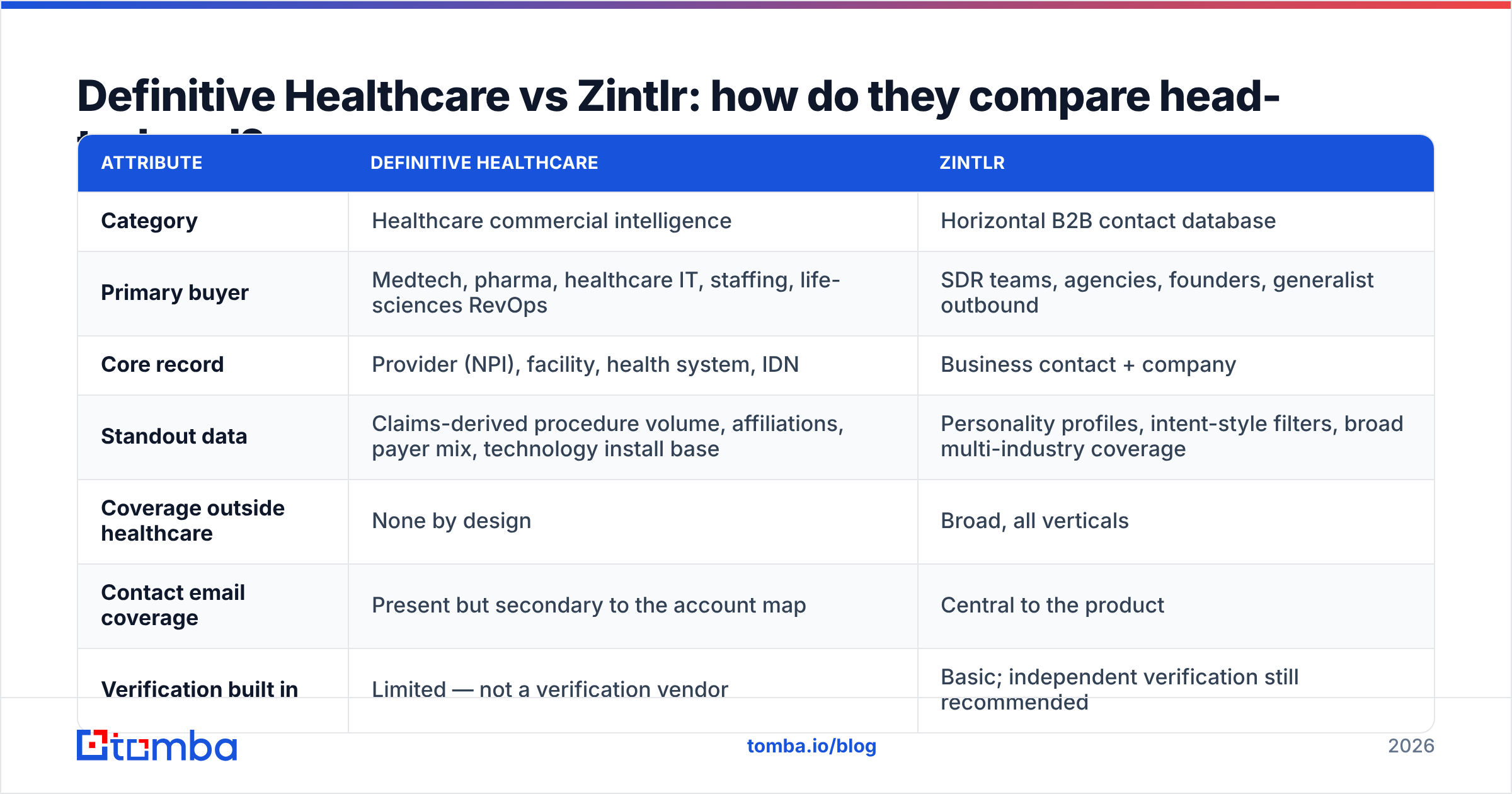
Definitive Healthcare vs Zintlr: how do they compare head-to-head?#
| Attribute | Definitive Healthcare | Zintlr |
|---|---|---|
| Category | Healthcare commercial intelligence | Horizontal B2B contact database |
| Primary buyer | Medtech, pharma, healthcare IT, staffing, life-sciences RevOps | SDR teams, agencies, founders, generalist outbound |
| Core record | Provider (NPI), facility, health system, IDN | Business contact + company |
| Standout data | Claims-derived procedure volume, affiliations, payer mix, technology install base | Personality profiles, intent-style filters, broad multi-industry coverage |
| Coverage outside healthcare | None by design | Broad, all verticals |
| Contact email coverage | Present but secondary to the account map | Central to the product |
| Verification built in | Limited — not a verification vendor | Basic; independent verification still recommended |
| Buying motion | Sales-led, demo, annual contract | Self-serve signup, monthly or annual |
| Typical time to first list | Weeks (procurement + onboarding) | Same day |
| API access | Yes, enterprise tier | Yes, on paid plans |
| Best analogy | A land registry for US healthcare | A very large, fast-moving phone book |
The pattern is consistent. Definitive Healthcare is a depth purchase for one vertical. Zintlr is a breadth purchase for any vertical. If you sell surgical robotics, breadth is noise. If you sell payroll software to 200-person companies in eleven industries, depth on hospital payer mix is irrelevant.
What does each one actually cost?#
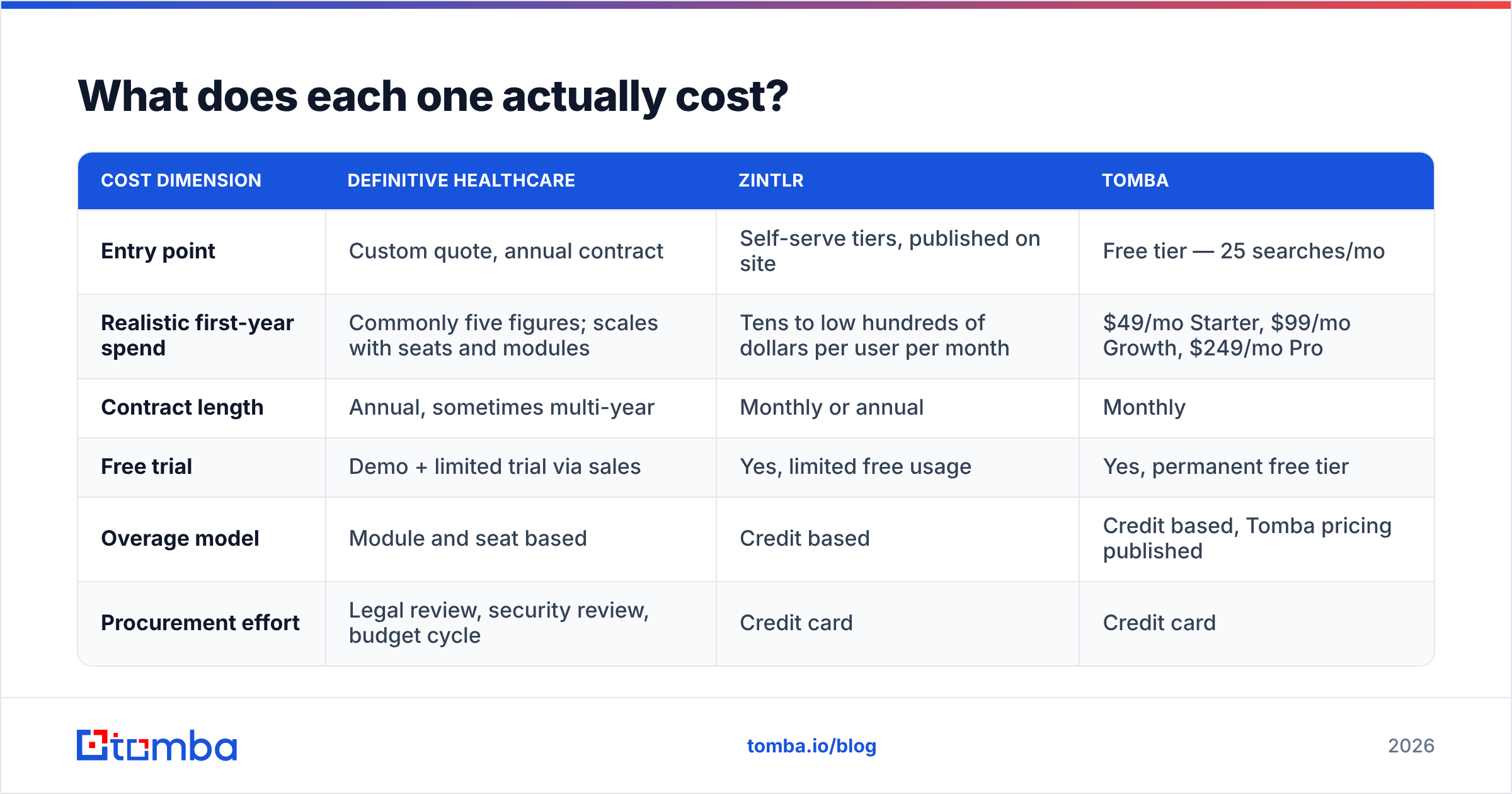
Neither vendor makes an apples-to-apples number easy to find, so treat this as a shape rather than a quote.
| Cost dimension | Definitive Healthcare | Zintlr | Tomba |
|---|---|---|---|
| Entry point | Custom quote, annual contract | Self-serve tiers, published on site | Free tier — 25 searches/mo |
| Realistic first-year spend | Commonly five figures; scales with seats and modules | Tens to low hundreds of dollars per user per month | $49/mo Starter, $99/mo Growth, $249/mo Pro |
| Contract length | Annual, sometimes multi-year | Monthly or annual | Monthly |
| Free trial | Demo + limited trial via sales | Yes, limited free usage | Yes, permanent free tier |
| Overage model | Module and seat based | Credit based | Credit based, Tomba pricing published |
| Procurement effort | Legal review, security review, budget cycle | Credit card | Credit card |
Two honest observations here.
First, Definitive Healthcare's price is not unreasonable if you are the right buyer. A medtech territory rep who closes one incremental account because they knew which hospital had the install base and which surgeon drove volume has paid for the seat several times over. The failure mode is buying it for a generalist team who will use it as an expensive contact list.
Second, self-serve pricing has its own trap. Cheap credits encourage volume, volume encourages sloppy list hygiene, and sloppy list hygiene ends in spam folders. The line item you should compare is not "cost per record" but "cost per record that actually reaches a human." Check current published pricing on both vendor sites before you commit — self-serve tiers change quarterly, and enterprise quotes vary by module bundle more than by list size.
Which one is more accurate?#
Accuracy is two different questions wearing one word.
Entity accuracy — is this the right organization, with the right hierarchy, doing the right volume? Definitive Healthcare wins this decisively inside healthcare. Its records are anchored to identifiers that exist in federal registries, and the affiliation graph is the product. Zintlr, like every horizontal provider, is working from softer signals.
Contact reachability — will an email to this address land in a monitored inbox? This is where both platforms sit in the same boat as every other database on G2's data category. Contact records are a snapshot of a moving target. A record scraped in March is not a promise about July. Job changes, mailbox retirements, catch-all domains and per-mailbox filtering all sit between "record exists" and "message delivered."
The practical consequence: whichever platform you buy, you still need a verification step. Bounce rates above roughly 3% start damaging sender reputation, and by the time you notice, you have already trained mailbox providers to distrust your domain. Run exports through an email verifier before they reach your sequencer, and treat catch-all domains as their own bucket rather than pretending they are valid.
Who should buy Definitive Healthcare?#
Buy it if two things are true at once.
You sell into US healthcare delivery, and the account structure is the hard part of your job. Medtech reps mapping surgical volume, healthcare IT vendors targeting systems with a specific EHR install, staffing firms tracking facility bed counts, life-sciences commercial teams building territory models — for all of these, the account map is the product and the contact is an afterthought.
You have a budget cycle and a data owner. Enterprise healthcare intelligence rewards teams that assign someone to own the workspace, build saved searches, and sync to CRM. Bought and abandoned, it is the most expensive unused tab in the company.
Do not buy it if you sell horizontally, if healthcare is one of several segments, or if what you actually need is 5,000 verified emails by Friday.
Who should buy Zintlr?#
Buy it if you need breadth cheaply and you are honest about the trade-off.
Zintlr fits founder-led sales, agencies running outbound for several clients at once, and SDR teams that need to test a dozen segments before committing. The personality layer is a genuine differentiator for teams that write bespoke openers rather than blasting one template — used well, it is a research shortcut; used lazily, it is horoscope-grade personalization that prospects see through instantly.
Its limits are the limits of the category. Coverage varies sharply by geography and company size. Small-business and non-English markets are thinner than the marketing implies, as they are for nearly every horizontal provider. And the export-to-sequencer path makes it very easy to send before you verify.
If Zintlr's coverage falls short in a region you care about, that is a coverage problem, not a tooling problem — you fix it by layering a second source at the point of need, not by re-buying the same shape of database.
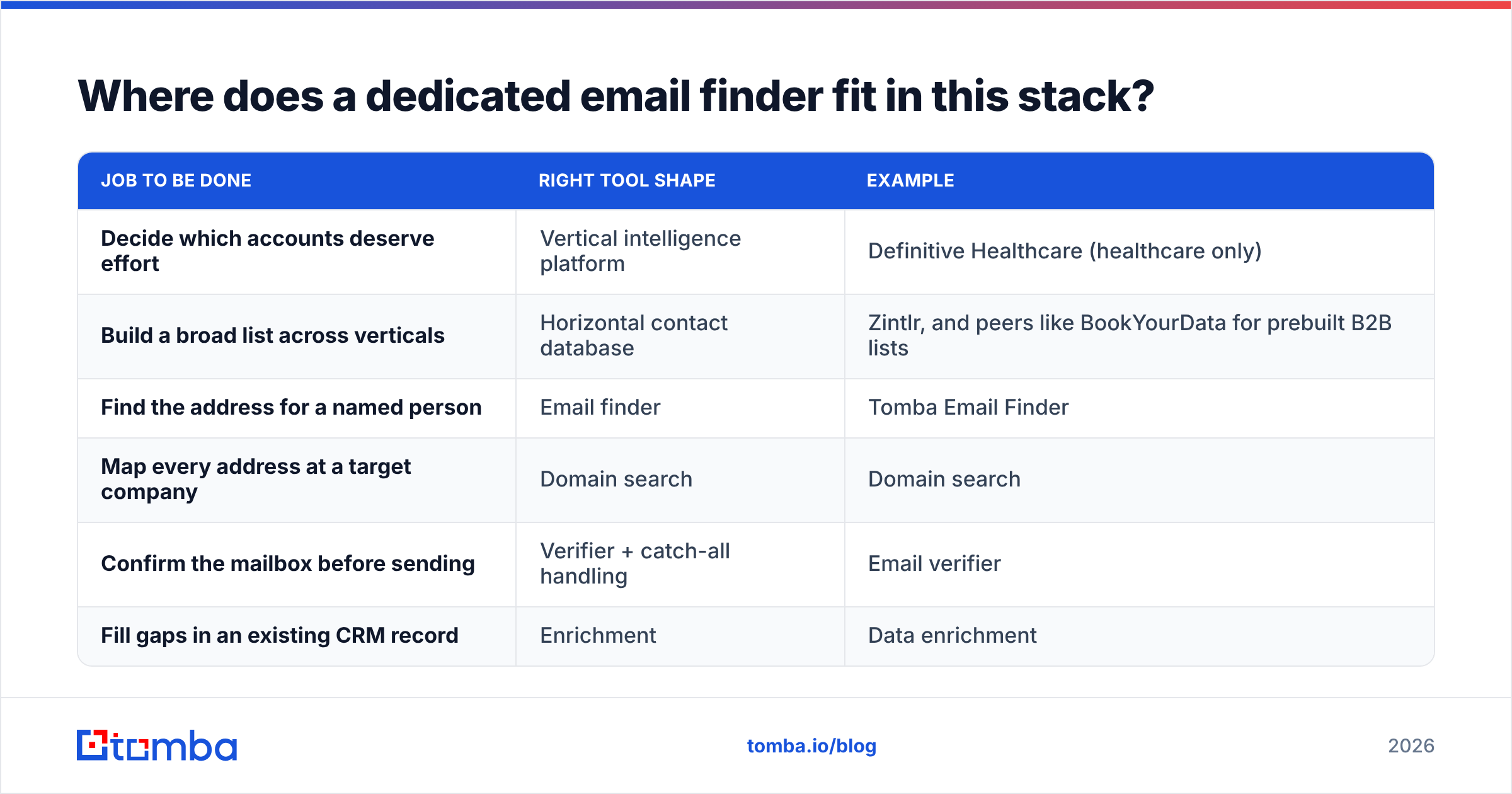
Where does a dedicated email finder fit in this stack?#
Between the two, and underneath both.
Neither Definitive Healthcare nor Zintlr is trying to be a deliverability tool. Definitive's job ends when you know which account and which clinician matter. Zintlr's job ends when you have a list. The gap in the middle — turning a named person at a known company into a verified, deliverable address — is a separate discipline with its own failure modes.
That is the layer a finder-and-verifier occupies:
| Job to be done | Right tool shape | Example |
|---|---|---|
| Decide which accounts deserve effort | Vertical intelligence platform | Definitive Healthcare (healthcare only) |
| Build a broad list across verticals | Horizontal contact database | Zintlr, and peers like BookYourData for prebuilt B2B lists |
| Find the address for a named person | Email finder | Tomba Email Finder |
| Map every address at a target company | Domain search | Domain search |
| Confirm the mailbox before sending | Verifier + catch-all handling | Email verifier |
| Fill gaps in an existing CRM record | Enrichment | Data enrichment |
This layered approach is usually cheaper than it looks. A healthcare team can keep Definitive Healthcare for the account map and spend $49/mo to resolve contacts, rather than paying for extra enterprise seats purely to get email fields. A generalist team can run a lean list source and put the savings into verification, which is the step that actually protects the sending domain.
If you are engineering this rather than clicking through a UI, the Tomba API handles find-and-verify in the same call path, which is how you keep a CRM clean continuously instead of in quarterly panic cleanups.
What's the verdict for 2026?#
There is no head-to-head winner, because there is no head-to-head.
- If your ICP is US healthcare providers and facilities, Definitive Healthcare is the stronger platform and there is no meaningful substitute for its claims-derived depth. Budget accordingly and assign an owner.
- If your ICP is anything else, Definitive Healthcare is the wrong purchase at any price, and Zintlr is a reasonable, low-commitment starting point — provided you verify everything before it hits a sequencer.
- If your real problem is that you already know who to contact and just cannot reach them, neither platform is your bottleneck. Your bottleneck is finding and verifying addresses, and that costs a fraction of either subscription.
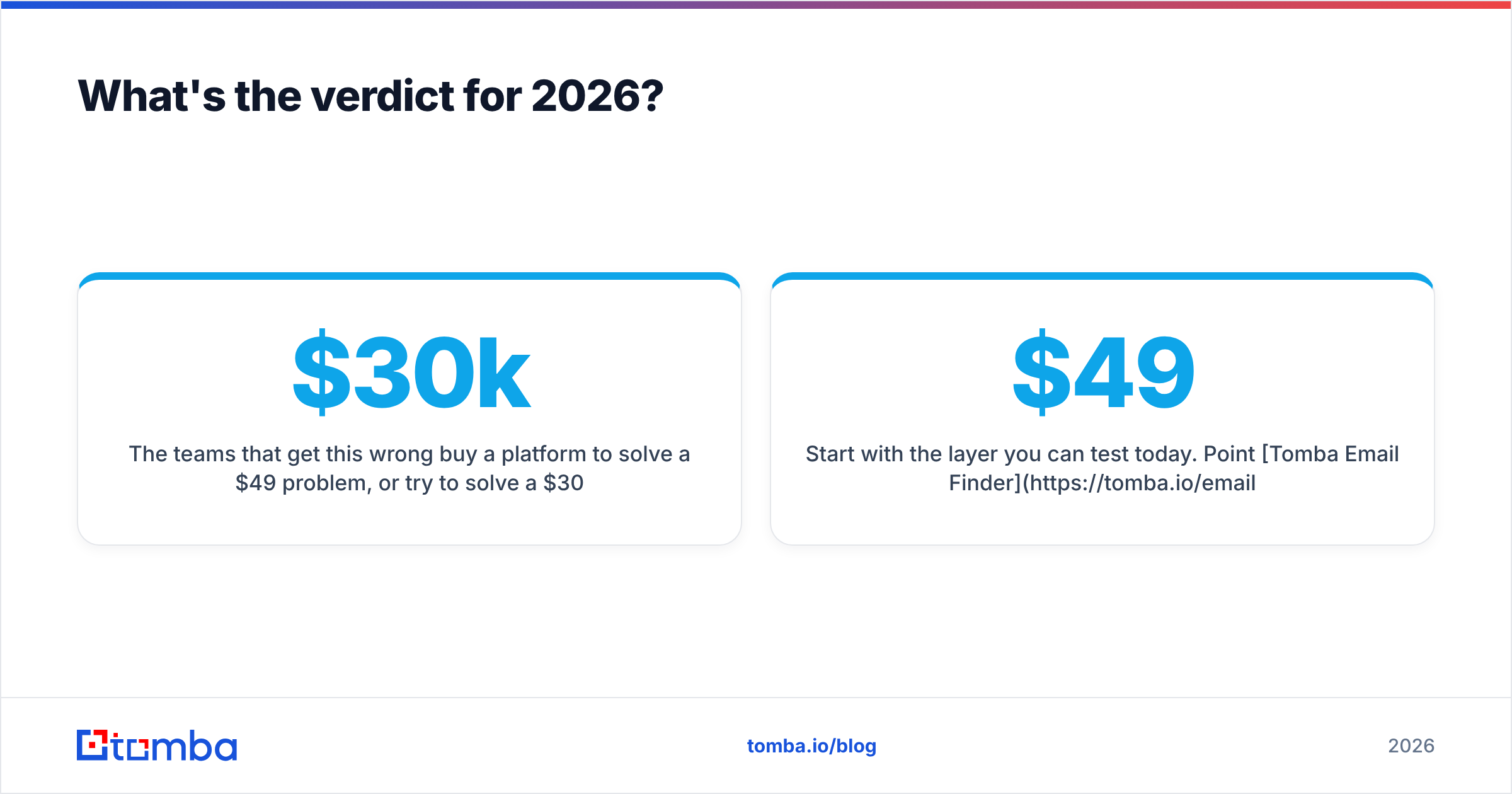
The teams that get this wrong buy a $30k platform to solve a $49 problem, or try to solve a $30k account-mapping problem with a CSV export. Diagnose which problem you actually have first. That single decision matters more than any feature row in the tables above.
Start with the layer you can test today. Point Tomba Email Finder at the accounts you already care about, verify the results, and see how many of your existing "contacts" are actually reachable. The free tier gives you 25 searches a month with no card, Starter is $49/mo, and you will know within an afternoon whether your problem is data coverage or data quality — before you sign anything annual.
Related guides#
Ready to find emails that actually work?
Join 150,000+ professionals who stopped guessing and started sending. Free credits on signup — no credit card required.
Get the Tomba newsletter
Practical outbound tactics and product updates — once every two weeks.
About the author