Delivr.ai Pricing, Reviews, Pros and Cons: 2026 Breakdown
Delivr.ai sells person-level identity resolution on annual contracts that reportedly start around $35K/yr — with a one-time onboarding fee on every tier. Here is what you actually get, where it breaks, and when a cheaper stack does the same job.
Delivr.ai pricing is quote-only. There is no public price list, no free plan, and no way to buy with a card. Buyers report entry deals near $35,000 a year, plus a one-time onboarding fee. This guide covers Delivr.ai pricing in 2026: what you get, what it costs, and when a cheaper stack wins.
TL;DR
- Delivr.ai is a deterministic identity and intent platform. It names the people who visit your site. It is not a cold email tool and not an email finder.
- Delivr.ai pricing is quote-only. Reported contracts run $25,000–$60,000 a year. The entry tier sits near $35,000, plus a one-time onboarding fee.
- The best reason to buy is person-level match on your own traffic. The worst part is the annual lock-in.
- Match rates swing by country and traffic mix. US traffic scores best.
- A reveal tool plus an email finder covers much of the same job for a small share of Delivr.ai pricing.
- Buy it if you run mature ABM with six-figure deals. Skip it if you are still testing channels.
One warning first. Several products share the name. There is a QR-code tool, an email marketing suite called Delivra, and a restaurant ordering widget. Much of the "Delivrai pricing" content online reviews the wrong company. This post is about the identity resolution platform at delivr.ai.
What is Delivr.ai, and what does it actually sell?#
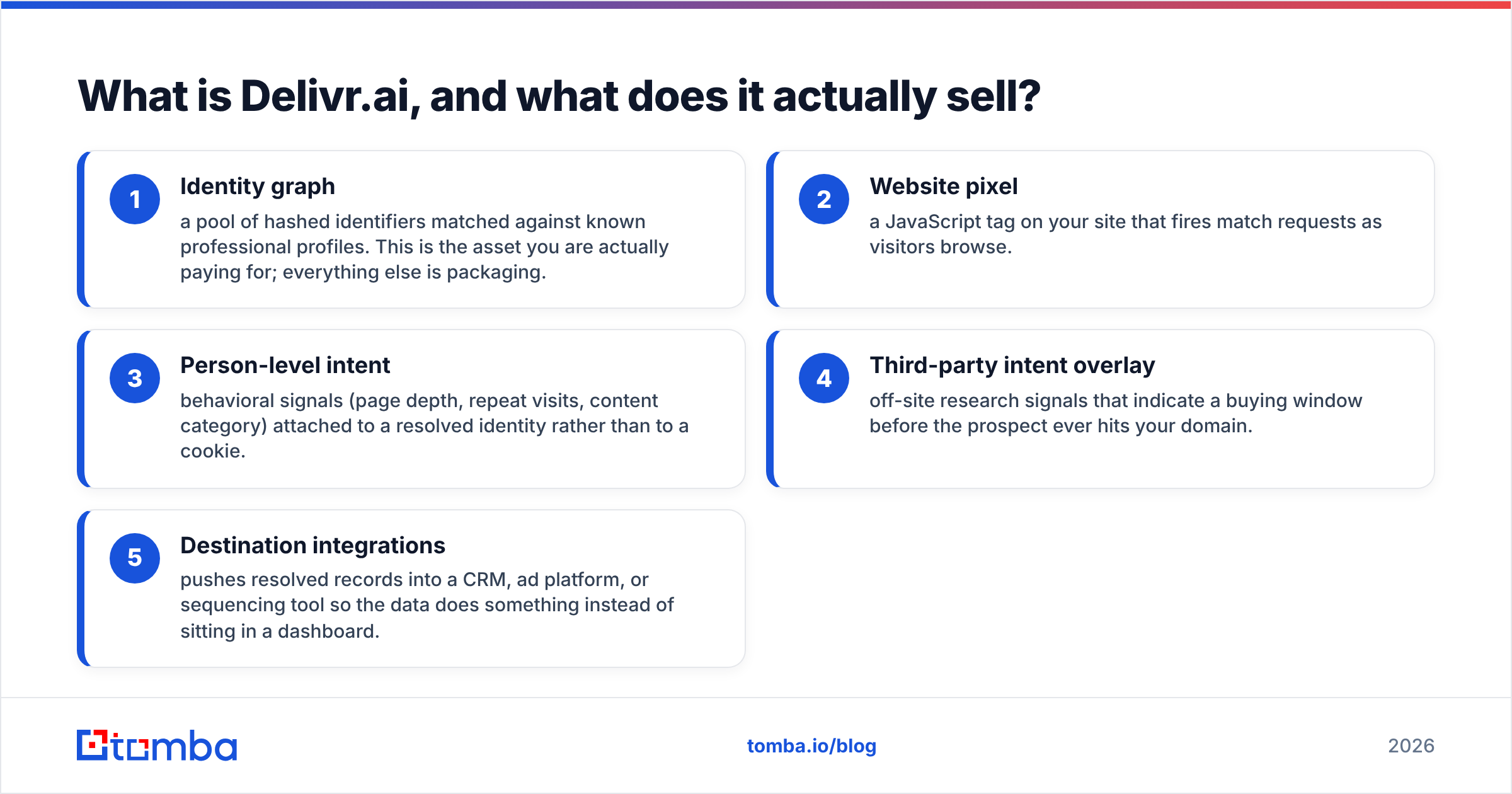
Delivr.ai sells deterministic identity resolution. In plain terms: a stranger lands on your site, and the tool tries to name them. You get a name, a work email, a company, and a role.
That is a real gap from the norm. Most visitor tools do reverse-IP lookup. They map an IP block to a company and say "someone from Acme viewed pricing." Delivr.ai aims one level deeper: "Dana Whitfield, VP Ops at Acme, viewed pricing twice this week."
The stack breaks down like this:
- Identity graph — hashed identifiers matched to known work profiles. This is the asset you pay for.
- Website pixel — a tag that fires match requests as people browse.
- Person-level intent — page depth, repeat visits, and topic, tied to a person instead of a cookie.
- Third-party intent — off-site research signals that flag a buying window early.
- Integrations — pushes records into your CRM, ad platform, or sequencer.
The category is crowded. Clearbit-style reveal tools, 6sense, Demandbase, Vector, RB2B, and Warmly all chase the same budget. The Clearbit alternative and 6sense alternative guides cover nearby options.

Why is Delivr.ai pricing so hard to find?#
Because it is built that way. There is no pricing page and no card field. You book a demo, you get scoped, then you get a quote.
That is normal for identity graph vendors. Three reasons hold up:
- Data costs scale with traffic. A site with 500,000 monthly visits costs the vendor far more to serve than one with 5,000.
- Match rate is unknown before a trial. A public "$X per resolution" price invites fights over what counts.
- Quotes flex by buyer. A rep can price to your funding stage. That cuts both ways.
The real cost shows up in your calendar. Your first three weeks go to discovery calls. You cannot compare Delivr.ai pricing to rivals without entering three sales cycles. Compare that with the public Tomba pricing page, where a $49/mo Starter plan is a two-minute decision.
What does Delivr.ai pricing look like in 2026?#
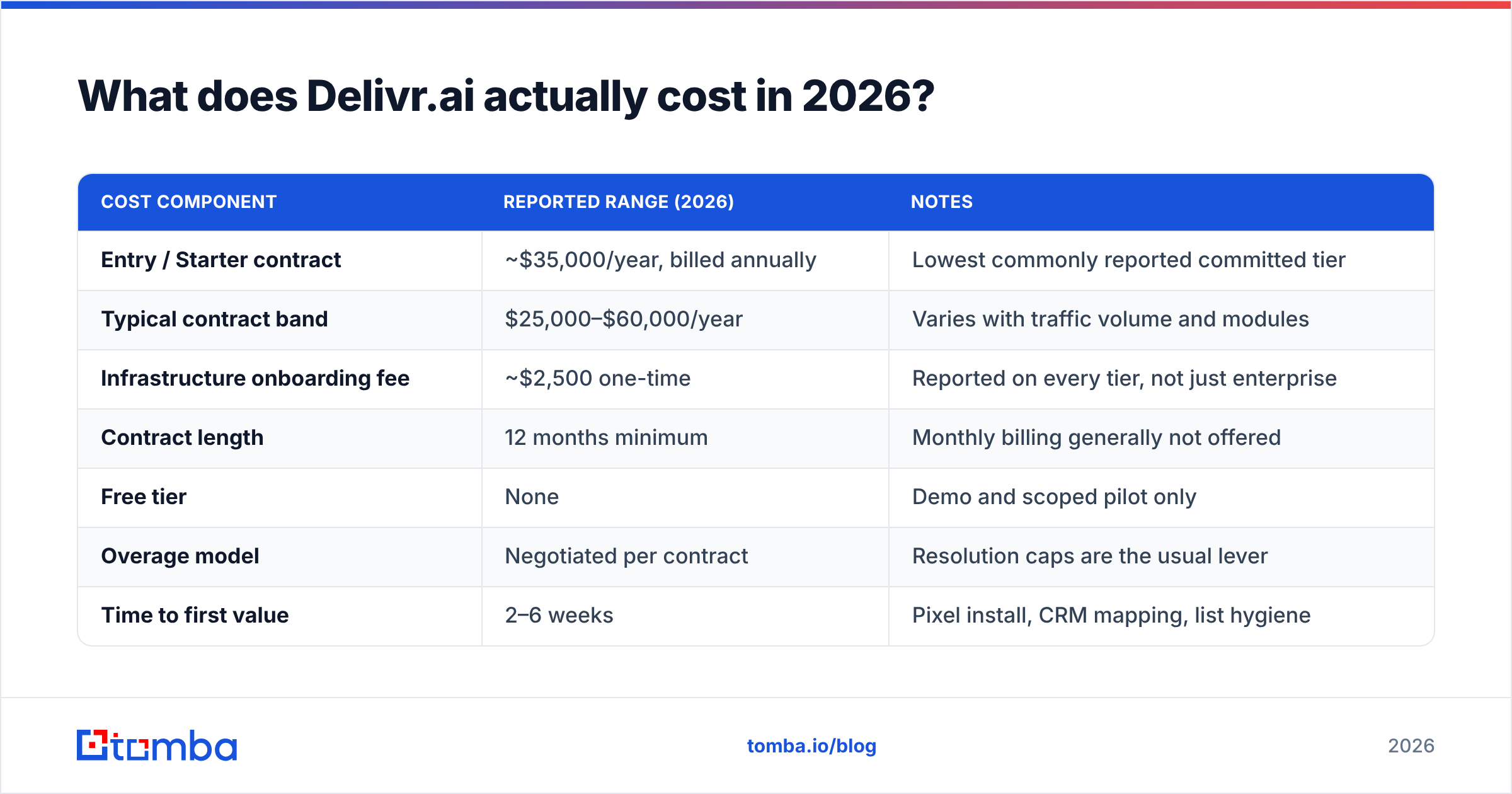
Here is the honest version. Nobody outside the company can quote a firm number. Any neat tier table you see is built from procurement chatter and review-site notes. The figures below come from third-party listings and buyer reports. Use them to set expectations, not to build a budget.
| Cost component | Reported range (2026) | Notes |
|---|---|---|
| Entry / Starter contract | ~$35,000/year, billed annually | Lowest commonly reported committed tier |
| Typical contract band | $25,000–$60,000/year | Varies with traffic volume and modules |
| Infrastructure onboarding fee | ~$2,500 one-time | Reported on every tier, not just enterprise |
| Contract length | 12 months minimum | Monthly billing generally not offered |
| Free tier | None | Demo and scoped pilot only |
| Overage model | Negotiated per contract | Resolution caps are the usual lever |
| Time to first value | 2–6 weeks | Pixel install, CRM mapping, list hygiene |
Two things stand out. First, the onboarding fee applies at the entry tier, so year-one Delivr.ai pricing lands well above the headline. Second, there is no self-serve path. No free tier, no $500/mo plan, no card test. For a seed-stage team, that rules the product out on its own.
Want a sanity check? Pull the vendor listings on G2 and Capterra before your first call. Those numbers are self-reported and noisy, but they set a floor for talks.
What are the pros and cons of Delivr.ai?#
Pros
- Person-level beats company-level. Knowing the human, not just the logo, changes the first touch.
- Deterministic matching cuts false positives. A narrow, clean graph beats a plausible guess.
- Intent sticks to a person, not a cookie. Cookie data decays and splits across devices.
- Real onboarding and support. Annual deals buy a named contact and CRM mapping help.
- One contract, not four. Reveal, enrichment, intent, and routing in one place is easier to govern.
Cons
- The price gate is brutal below Series B. A $35K floor plus onboarding beats most whole outbound budgets.
- Match rates skew US. If your traffic is EU, LATAM, or APAC, expect weaker results and a worse cost per record.
- The privacy risk is yours. Naming individual visitors sits in contested ground under GDPR and US state law. Bring legal to the first call.
- No trial means no evidence. You commit a year of budget on a scoped pilot.
- A resolved identity is not a usable address. The graph may hand you a stale or personal email.
That last point bites. Identity tells you who. It does not tell you which address will land. That is why an email verifier ends up in the stack anyway.
How does Delivr.ai pricing compare to cheaper tools?#
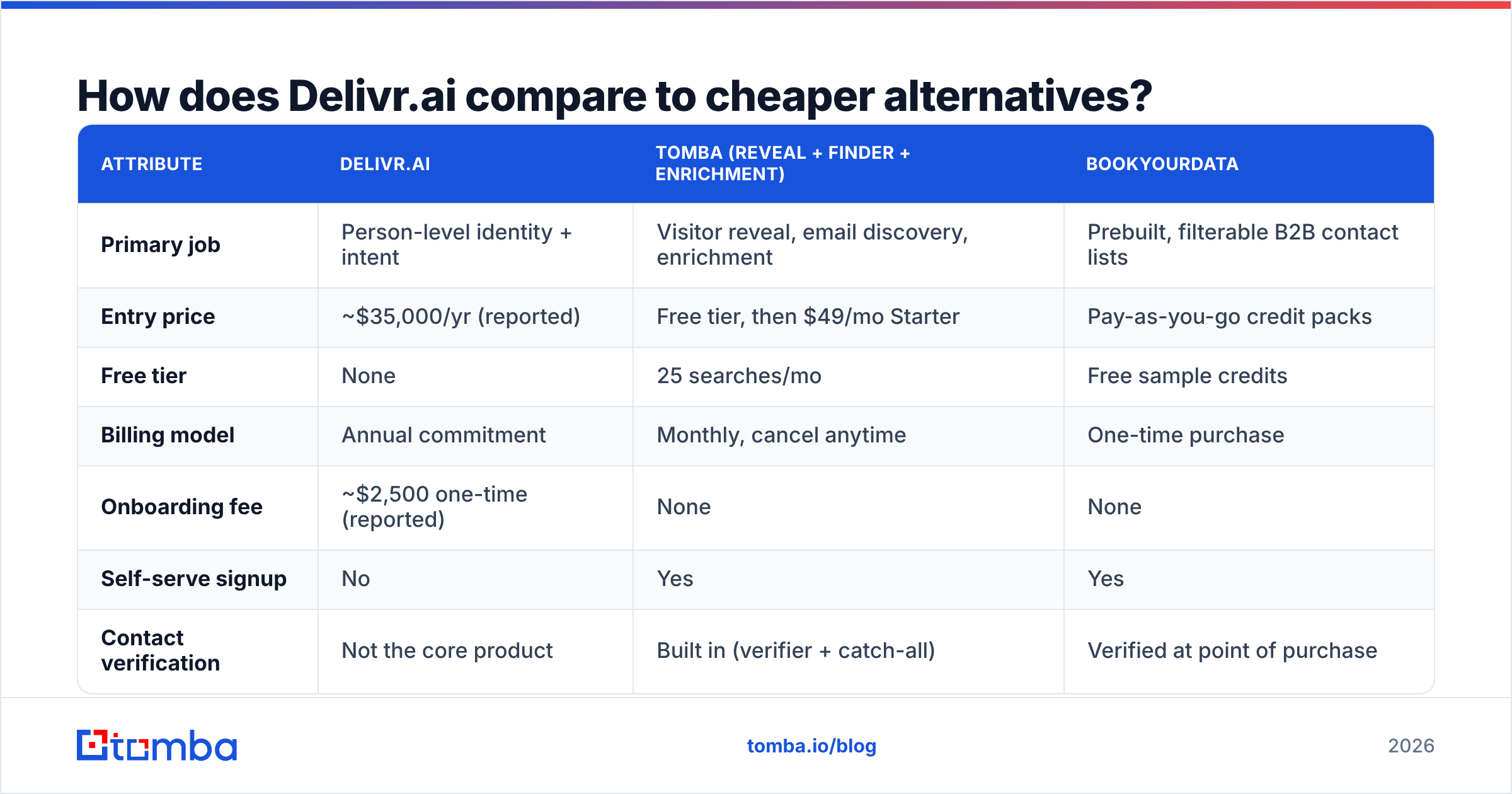
The fair comparison is not one rival. It is an assembled stack that does 70–80% of the job for a small share of Delivr.ai pricing.
| Attribute | Delivr.ai | Tomba (Reveal + Finder + Enrichment) | BookYourData |
|---|---|---|---|
| Primary job | Person-level identity + intent | Visitor reveal, email discovery, enrichment | Prebuilt, filterable B2B contact lists |
| Entry price | ~$35,000/yr (reported) | Free tier, then $49/mo Starter | Pay-as-you-go credit packs |
| Free tier | None | 25 searches/mo | Free sample credits |
| Billing model | Annual commitment | Monthly, cancel anytime | One-time purchase |
| Onboarding fee | ~$2,500 one-time (reported) | None | None |
| Self-serve signup | No | Yes | Yes |
| Contact verification | Not the core product | Built in (verifier + catch-all) | Verified at point of purchase |
| API access | Enterprise contract | Included from Starter | Available |
| Best fit | Mature ABM, six-figure ACV | Teams that need reachable contacts fast | Teams that want a clean list now |
BookYourData fits a different need. If your problem is "I need 5,000 verified ops directors in manufacturing," a list beats a live signal. For many outbound teams, that is the faster path to pipeline.

Who is Delivr.ai actually worth it for?#
Run this filter honestly. The tool makes sense when all four are true:
- Your average deal is $50K+. At $35K a year, one extra won deal pays for it. At a $12K ACV, you need three or four.
- You already get real qualified traffic. Identity tools multiply traffic; they do not create it. Below 10,000 relevant visits a month, you pay a lot to name a trickle.
- Your traffic is US-heavy. This is the biggest hidden driver of match rate.
- Someone works the signal within hours. A resolved visitor goes stale fast.
If one of those is false, a cheaper reveal layer plus strong contact data serves you better. Start with website visitor reveal and see if it moves anything at all. Then decide whether Delivr.ai pricing is the upgrade you need.
What do reviews say about Delivr.ai?#
Public review volume is thin. That is a signal by itself. Quote-only vendors gather reviews slowly because the customer base is small. Buyer comments cluster into three groups:
- Positive: match quality on US B2B traffic, quick onboarding, and person-level records.
- Mixed: promised match rates versus what production delivers, mostly outside the US.
- Negative: pricing opacity, annual lock-in, and the onboarding fee surfacing late.
Read ratings for "Delivr" with care. The name clash with Delivra and Delivr means some scores belong to other products. Check the vendor URL on any listing first.
How do you get a similar result for less?#
The job is simple: spot buying interest, then reach the right human. Here is a stack that costs low hundreds a month instead of five figures a year.
- Reveal the traffic. Turn anonymous sessions into company and, where possible, person signals. Test for 60 days first.
- Find the decision-maker. Use domain search to pull the right roles at the account.
- Verify before you send. Check every address, catch-all domains included, so you protect sender reputation.
- Enrich for context. Add firmographics, tech stack, and role data with data enrichment.
- Automate the handoff. Push verified records into your CRM or sequencer by API.
- Measure cost per meeting. That one number settles the Delivr.ai pricing question. Run the cheap stack, get a baseline, then compare.
This stack gives you no identity graph. It gives you most of the outcome, at a price you can cancel next month.
The verdict on Delivr.ai pricing#
Delivr.ai is a real product in a real category. It is priced for firms whose deal sizes absorb five figures without a debate. If that is you, the person-level match is useful and the intent layer earns its keep.
If that is not you, the annual lock-in and the missing trial make Delivr.ai pricing an expensive way to test a hunch you can test for $49.
Start where the risk is lowest. Turn interest into verified contacts. The Tomba Email Finder finds work emails by domain, name, or company, verifies them before you send, and pushes them to your CRM through the API. The free tier gives you 25 searches a month. Starter is $49/mo with no onboarding fee and no annual lock-in. Prove the motion first. Buy the identity graph second.
Related guides#
// get started
Find, verify and enrich your first contacts today
Start on the free plan with 25 searches a month, then scale when your team is ready.
Free plan · No credit card required · GDPR & CCPA
// about the author