Demand Creation: How to Build B2B Pipeline That Doesn't Exist Yet
Most B2B teams fight over the 3% of buyers already searching. Demand creation builds the other 97% into future pipeline — here's the model, the metrics, and where it breaks.
TL;DR
- Demand creation makes buyers want a category or solution before they search for it. Demand capture converts the ones already searching. You need both, but most B2B teams over-invest in capture because it's easier to measure.
- Only about 3-5% of your total addressable market is in-market at any moment. Capture-only programs fight for that slice with every competitor and pay rising CPCs to do it.
- The measurable output of demand creation isn't MQLs — it's branded search volume, direct traffic, self-reported attribution on demo forms, and win rate on inbound deals.
- The operational bottleneck is almost always data: you can create demand for a category, but if you can't reach the right 4,000 accounts with accurate contact data, the demand leaks.
- Budget split that works for most mid-market B2B: 60-70% creation, 30-40% capture — inverted from what most teams run today.
What is demand creation?#
Demand creation is the work of making a buyer aware they have a problem worth solving, and shaping how they think about solving it, before they type anything into Google.
Think of it like a restaurant on a quiet side street. Demand capture is buying the top slot on a food-delivery app so hungry people who already decided to order tonight see you first. Demand creation is the smell of bread drifting down the block at 4pm — it makes people hungry who weren't. One competes for existing appetite. The other manufactures it.
Technically: demand creation is top-of-funnel and mid-funnel activity aimed at the ~95% of your addressable market that is not currently evaluating vendors. It works on problem awareness, solution framing, and category positioning. Its outputs are lagging and diffuse. Demand capture is bottom-of-funnel activity aimed at active evaluators — paid search on high-intent keywords, review-site presence, comparison pages, retargeting. Its outputs are immediate and trackable.
The confusion in most orgs comes from calling both "demand gen" and then measuring both with the same MQL dashboard. That single mistake kills more creation programs than any budget cut.
Why does demand capture stop working at scale?#
Because the pool is fixed and the price isn't.
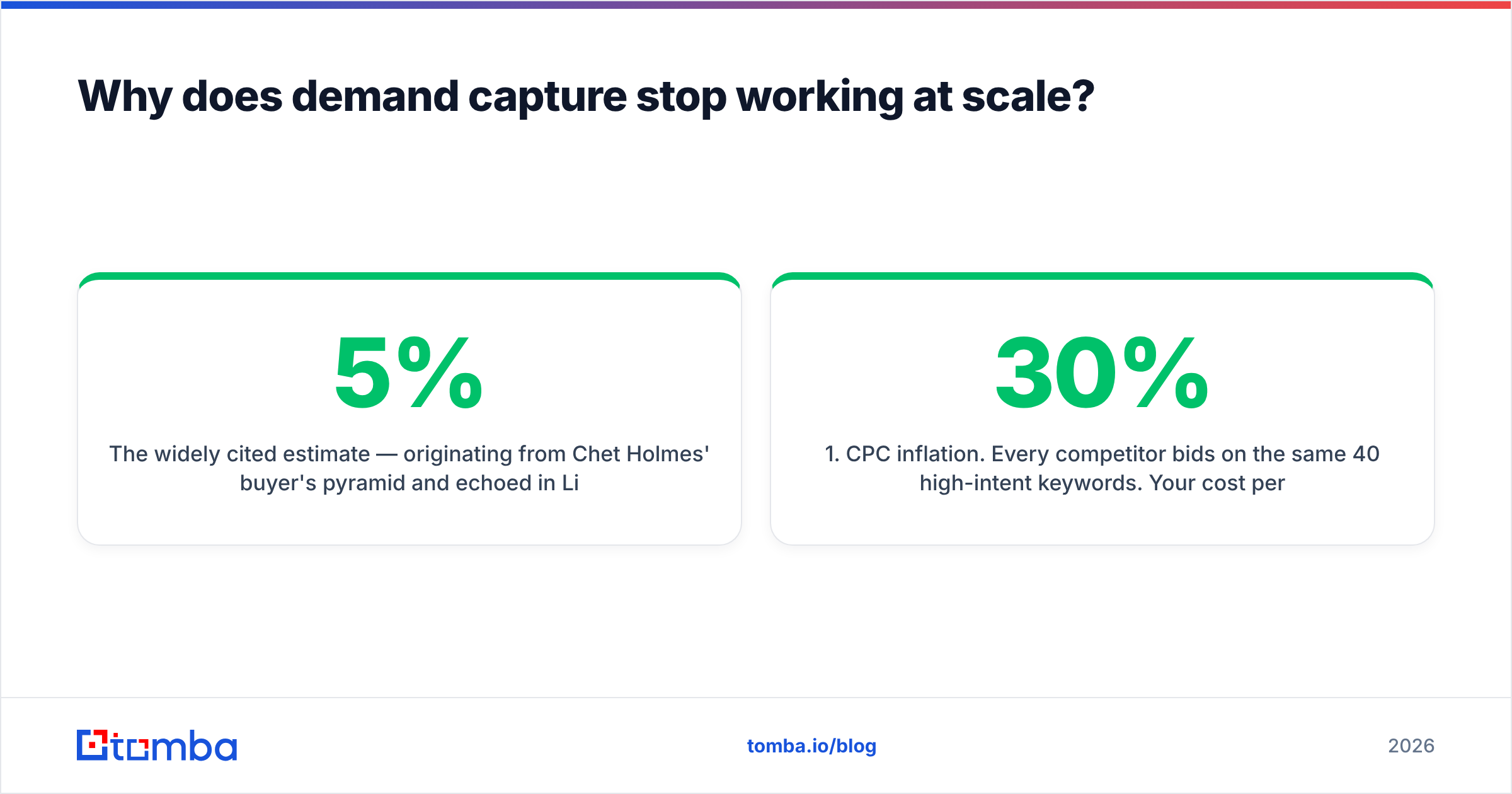
The widely cited estimate — originating from Chet Holmes' buyer's pyramid and echoed in LinkedIn's B2B Institute research with Professor John Dawes at the Ehrenberg-Bass Institute — is that roughly 5% of business buyers are in-market at any given time. The other 95% are out-of-market: they'll buy eventually, just not this quarter.
When your entire GTM engine is tuned to capture, three things happen predictably:
- CPC inflation. Every competitor bids on the same 40 high-intent keywords. Your cost per opportunity climbs 15-30% year over year with no change in your product.
- Late-stage arrival. You enter the deal after the buyer built their shortlist and requirements — often from a competitor's content. You're now the vendor being compared against, not the one setting the criteria.
- Price pressure. Buyers who found you via a comparison page have three quotes. Buyers who've followed your point of view for eight months have one.

The fix isn't abandoning capture. Capture converts. The fix is recognizing that capture harvests a field somebody has to plant.
How is demand creation different from lead generation?#
Lead generation is a mechanism. Demand creation is a strategy. Gating an ebook to collect 300 emails is lead gen — and if nobody wanted the ebook's subject before they saw the ad, you generated contact records, not demand.
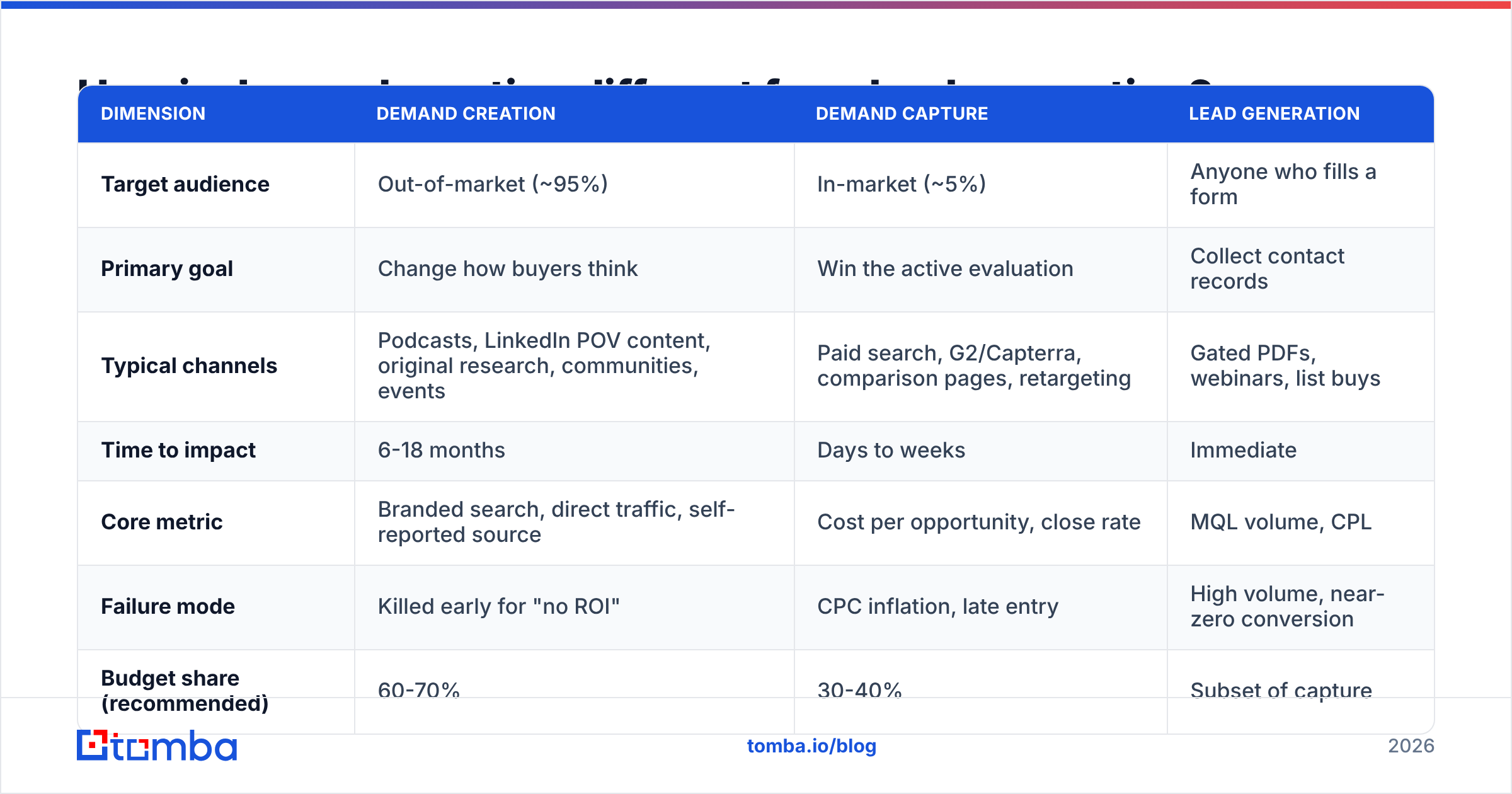
Here's the practical split most teams need to internalize:
| Dimension | Demand creation | Demand capture | Lead generation |
|---|---|---|---|
| Target audience | Out-of-market (~95%) | In-market (~5%) | Anyone who fills a form |
| Primary goal | Change how buyers think | Win the active evaluation | Collect contact records |
| Typical channels | Podcasts, LinkedIn POV content, original research, communities, events | Paid search, G2/Capterra, comparison pages, retargeting | Gated PDFs, webinars, list buys |
| Time to impact | 6-18 months | Days to weeks | Immediate |
| Core metric | Branded search, direct traffic, self-reported source | Cost per opportunity, close rate | MQL volume, CPL |
| Failure mode | Killed early for "no ROI" | CPC inflation, late entry | High volume, near-zero conversion |
| Budget share (recommended) | 60-70% | 30-40% | Subset of capture |
The row that matters most is failure mode. Demand creation programs almost never fail because the content was bad. They fail because a CFO looked at a 90-day attribution report in month four and pulled the budget.
What does a demand creation program actually look like?#
Four components, in build order.
1. A defensible point of view. Not "we help sales teams work smarter." A specific, falsifiable claim about how your market should operate that a reasonable person could disagree with. Gong built a company on "your reps' calls contain the data your forecast is missing." Drift built one on "forms are hostile." You need a sentence that makes half your ICP nod and the other half argue.
2. Original data. The cheapest credibility you can buy is your own numbers. Run a survey of 400 people in your ICP, or analyze anonymized product data, and publish it with the methodology visible. Original research gets cited, and citations are distribution you don't pay for. Gartner and Forrester built entire businesses on this mechanic.
3. Consistent distribution on channels where buyers already are. LinkedIn posts from named humans outperform company pages by a wide margin. Industry podcasts. Slack and Discord communities. Newsletter sponsorships in your vertical. The rule: show up in the feed weekly, not in the inbox quarterly.
4. A reachable account list. This is where the strategy meets operations and where most programs quietly break. You can create demand for a category, but if your target list is stale — wrong titles, bounced emails, people who left 14 months ago — the demand you created lands on nobody. Building a clean list of the 2,000-5,000 accounts that matter, with verified contacts at the right seniority, is the unglamorous prerequisite. A domain search across your target accounts plus a pass through an email verifier before any send is the minimum hygiene bar.
How do you measure demand creation without lying to yourself?#
Stop asking "which touchpoint closed the deal." Start asking "is the market moving."
Five signals, ranked by how hard they are to game:
- Self-reported attribution. Add one open-text field to your demo form: "How did you hear about us?" Multi-touch attribution models will credit the last paid click. Buyers will tell you they heard you on a podcast. Trust the buyer.
- Branded search volume. Month-over-month growth in people searching your company name is the cleanest proxy for demand you created. It's also nearly impossible to fake.
- Direct traffic and dark-social referrals. People who type your URL or arrive with no referrer heard about you somewhere untrackable. That "somewhere" is your creation program working.
- Win rate and cycle length on inbound. Deals from demand-created buyers close faster and at higher win rate than capture deals. If your inbound win rate is climbing while volume holds, creation is working.
- Blended CAC over trailing 12 months. Not per-channel CAC. Blended. Creation lowers the cost of capture by making your brand the default answer.
The measurement trap is running a 90-day pilot. Demand creation compounds on a 12-18 month curve. Judge it on quarterly trendlines of the five signals above, not on a monthly MQL count.
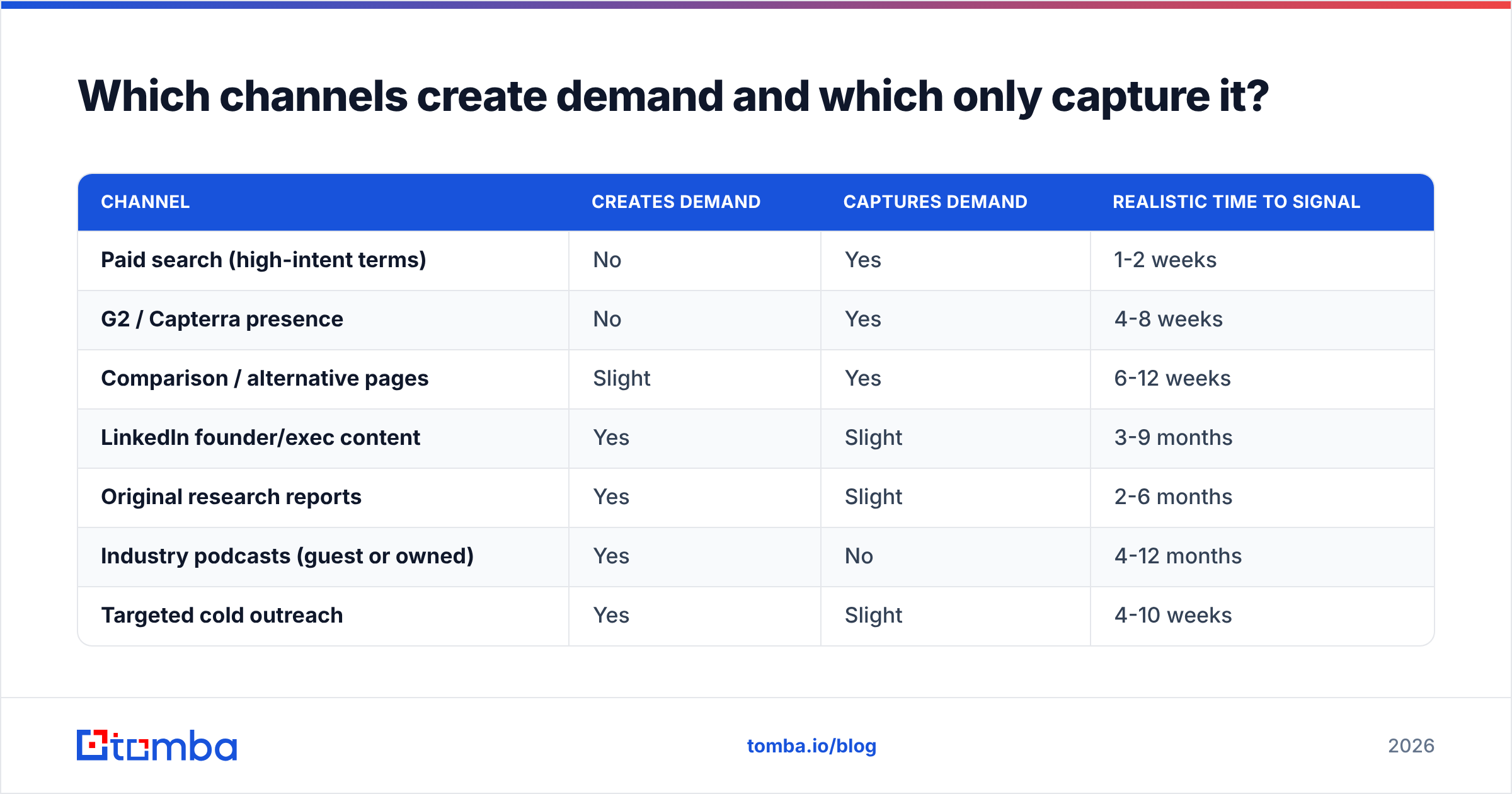
Which channels create demand and which only capture it?#
| Channel | Creates demand | Captures demand | Realistic time to signal |
|---|---|---|---|
| Paid search (high-intent terms) | No | Yes | 1-2 weeks |
| G2 / Capterra presence | No | Yes | 4-8 weeks |
| Comparison / alternative pages | Slight | Yes | 6-12 weeks |
| LinkedIn founder/exec content | Yes | Slight | 3-9 months |
| Original research reports | Yes | Slight | 2-6 months |
| Industry podcasts (guest or owned) | Yes | No | 4-12 months |
| Targeted cold outreach | Yes | Slight | 4-10 weeks |
| Community participation | Yes | No | 6-12 months |
| Retargeting | No | Yes | 1-3 weeks |
| Field events / dinners | Yes | Slight | 3-6 months |
Notice cold outreach sits in the creation column. Done badly it's spam. Done well — a specific, researched message to a person whose company just hit a trigger event — it's the fastest way to introduce a problem framing to an out-of-market buyer. The difference is entirely in targeting precision and data quality, which is why data enrichment belongs in a demand creation stack, not just a sales one.
Where do demand creation programs break?#
Five failure points, in order of how often they show up.
Impatience. A VP promises pipeline impact in one quarter to get the budget approved, then gets measured against that promise. Set expectations at 3-4 quarters at approval time or don't take the budget.
Attribution theater. Forcing a compounding, multi-touch strategy through a last-click model. It will always look worse than paid search. Always. Change the measurement framework before you change the strategy.
Bad list hygiene. You spend six months building a point of view, then push it to a list with a 22% bounce rate. Your sender reputation craters and the emails that would have converted land in spam. Verify before you scale, not after.
Generic POV. "We help companies grow faster" creates nothing. If your positioning statement could appear on a competitor's homepage with the logo swapped, you have a tagline, not a point of view.
Sales misalignment. Marketing creates demand, a buyer raises a hand nine months later mentioning a podcast episode, and an SDR treats them like a cold MQL from a gated PDF. The handoff has to carry context. Route self-reported-source leads differently.
Should you buy a list or build one?#
Build, then enrich. Bought lists are the fastest way to convert a demand creation budget into a spam complaint.
That said, "build" doesn't mean manual research. The workflow that holds up:
- Define the account list from firmographics you can defend — industry, headcount band, tech stack, funding stage. 2,000-5,000 accounts, not 50,000.
- Map the buying committee per account — usually 3-6 people across an economic buyer, a champion, and a technical evaluator.
- Find and verify contact data. Tools like BookYourData, Apollo, and Tomba occupy different points on the coverage-vs-accuracy curve. BookYourData leans on a large pre-verified B2B database with pay-as-you-go credits; Tomba's email finder and API lean on real-time pattern detection plus SMTP verification, which suits ongoing enrichment workflows.
- Re-verify quarterly. B2B contact data decays roughly 2-2.5% per month from job changes alone. A list built in January is meaningfully wrong by July.
- Segment by demand stage, not just firmographics. An account that downloaded your research report gets different treatment than one that has never heard of you.
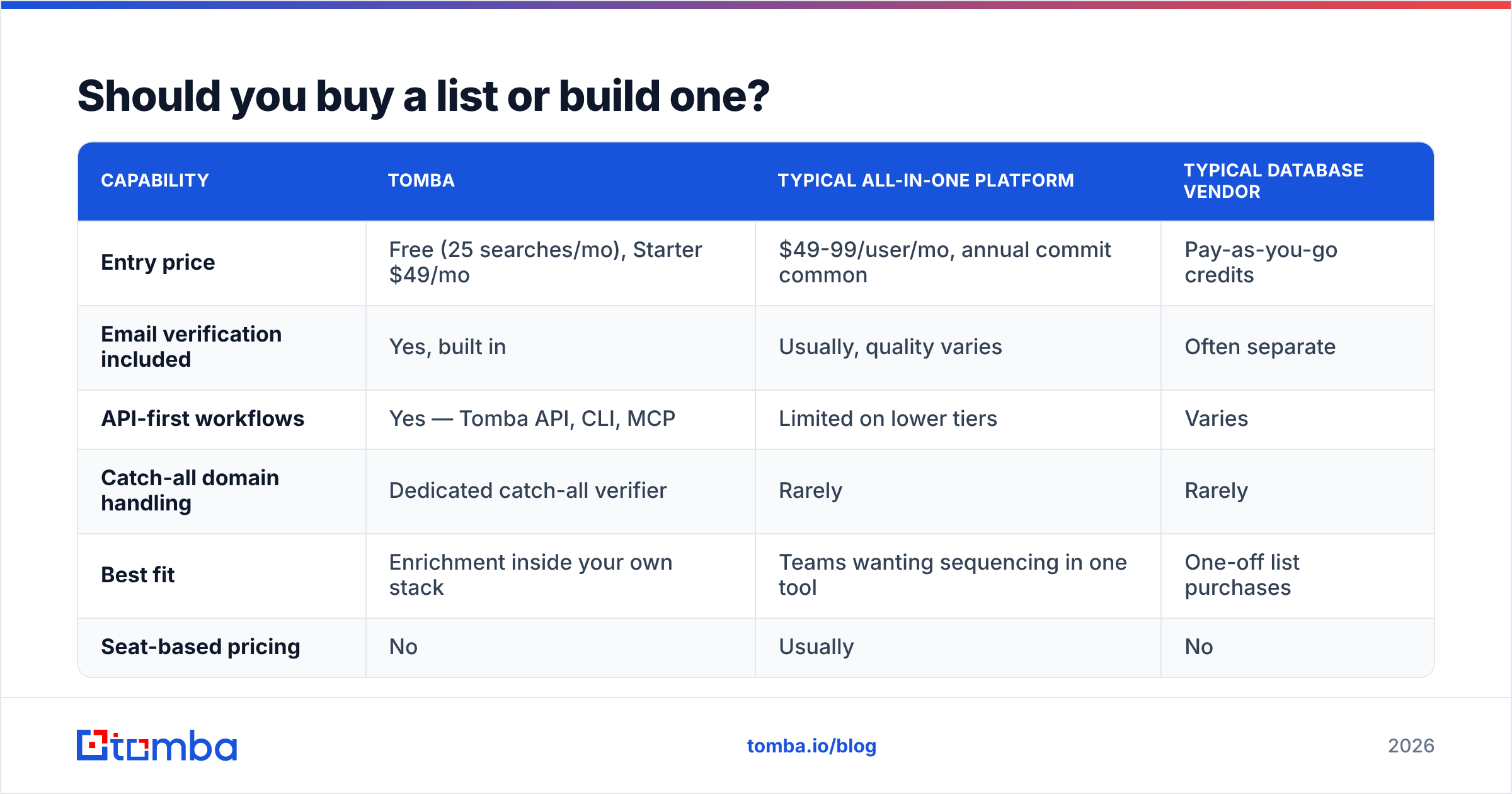
Here's how the tooling layer typically compares for a demand creation motion:
| Capability | Tomba | Typical all-in-one platform | Typical database vendor |
|---|---|---|---|
| Entry price | Free (25 searches/mo), Starter $49/mo | $49-99/user/mo, annual commit common | Pay-as-you-go credits |
| Email verification included | Yes, built in | Usually, quality varies | Often separate |
| API-first workflows | Yes — Tomba API, CLI, MCP | Limited on lower tiers | Varies |
| Catch-all domain handling | Dedicated catch-all verifier | Rarely | Rarely |
| Best fit | Enrichment inside your own stack | Teams wanting sequencing in one tool | One-off list purchases |
| Seat-based pricing | No | Usually | No |
See Tomba pricing for the full tier breakdown — Growth is $99/mo and Pro is $249/mo, with Enterprise quoted per volume.
How should you split budget between creation and capture?#
Start from your growth stage, not from a blog post's default.
- Pre-product-market-fit: 80% capture. You need conversations now, and you don't yet know what point of view to argue. Capture teaches you what buyers already believe.
- Post-PMF, under $5M ARR: 50/50. Begin the creation flywheel while capture still pays the bills.
- $5M-$50M ARR: 60-70% creation. Your capture CPCs are climbing and category ownership is now the cheapest long-term CAC lever you have.
- $50M+: 70%+ creation, plus a defensive capture floor. At this size you're protecting a category position, and the competitor bidding on your brand name is a rounding error compared to the buyers who never consider anyone else.
The single most useful reallocation for most mid-market teams: take 20% out of gated-PDF lead gen and put it into original research plus consistent executive content. Gated PDFs produce MQL volume that sales ignores. Research produces citations, and citations produce inbound that closes.
One caveat on the numbers above — they're directional heuristics from observed B2B GTM patterns, not from a controlled study. Treat them as a starting hypothesis you test against your own blended CAC, not as benchmarks.
What's the 90-day starting plan?#
Days 1-30 — foundation. Write the point of view in one paragraph. Get sales and product to argue with it until it's specific enough to be wrong. Build the target account list and verify contact data. Add the self-reported-source field to every form.
Days 31-60 — production. Ship one piece of original research. Start weekly executive LinkedIn posting from two named people. Book three podcast guest slots. Launch a small, precisely-targeted outbound motion — 150 accounts, deeply researched, not 5,000 blasted. Use a bulk email finder to populate contacts and verify the whole list before the first send.
Days 61-90 — measurement baseline. Record baseline branded search volume, direct traffic, and inbound win rate. Do not judge the program yet. You're establishing the line you'll measure against in month nine. Report the baseline to leadership explicitly framed as a baseline.
Then repeat months 4 through 12 without flinching. The teams that win at demand creation aren't smarter — they just didn't quit in month five.
Get the data layer right before you scale the message#
Demand creation fails on operations more often than on strategy. A brilliant point of view delivered to bounced addresses is a brilliant point of view nobody read.
Start with a clean, verified list of the accounts and people you're trying to move. Tomba Email Finder finds professional email addresses by domain, name, or company, with verification built into the same workflow — free tier gives you 25 searches a month to test the data quality against accounts you already know, and Starter runs $49/mo when you're ready to scale the list behind your demand program.
Related guides#
Ready to find emails that actually work?
Join 150,000+ professionals who stopped guessing and started sending. Free credits on signup — no credit card required.
Get the Tomba newsletter
Practical outbound tactics and product updates — once every two weeks.
About the author