The Demand Creation Process: A 7-Stage Framework for 2026
Demand creation is not lead generation with a bigger budget. Here is the seven-stage demand creation process — how it differs from demand capture, what to measure, and where most B2B teams quietly break it.
TL;DR
- Demand creation makes buyers want a solution they weren't shopping for. Demand capture converts buyers who are already looking. Most B2B teams fund the second and call it the first.
- The process has seven stages: define the problem space, pick the audience, build a point of view, distribute it where buyers actually are, seed the message with data, capture the hand-raise, and measure with lagging pipeline metrics — not clicks.
- Demand creation is slow (60–180 days to first pipeline impact) and demand capture is fast. You need both, budgeted separately, measured separately.
- The single most common failure is measuring creation activity with capture metrics — judging a podcast or a LinkedIn point of view by last-touch attribution.
- Contact data quality is the hidden dependency. A brilliant message sent to a 40% bounce list produces zero demand and a damaged sending domain.
What is the demand creation process?#
The demand creation process is the repeatable set of activities that makes a defined audience aware of a problem they have, convinced it's worth solving, and biased toward your category and your company — before they ever type a query into Google.
Think of it like a restaurant that opens on a street where nobody eats out. Demand capture is putting up a sign that says "Open" and buying the top spot on the delivery app. Demand creation is throwing a free tasting event, teaching a cooking class, and getting the neighborhood used to the idea of eating dinner out at all. One harvests a market. The other builds one.
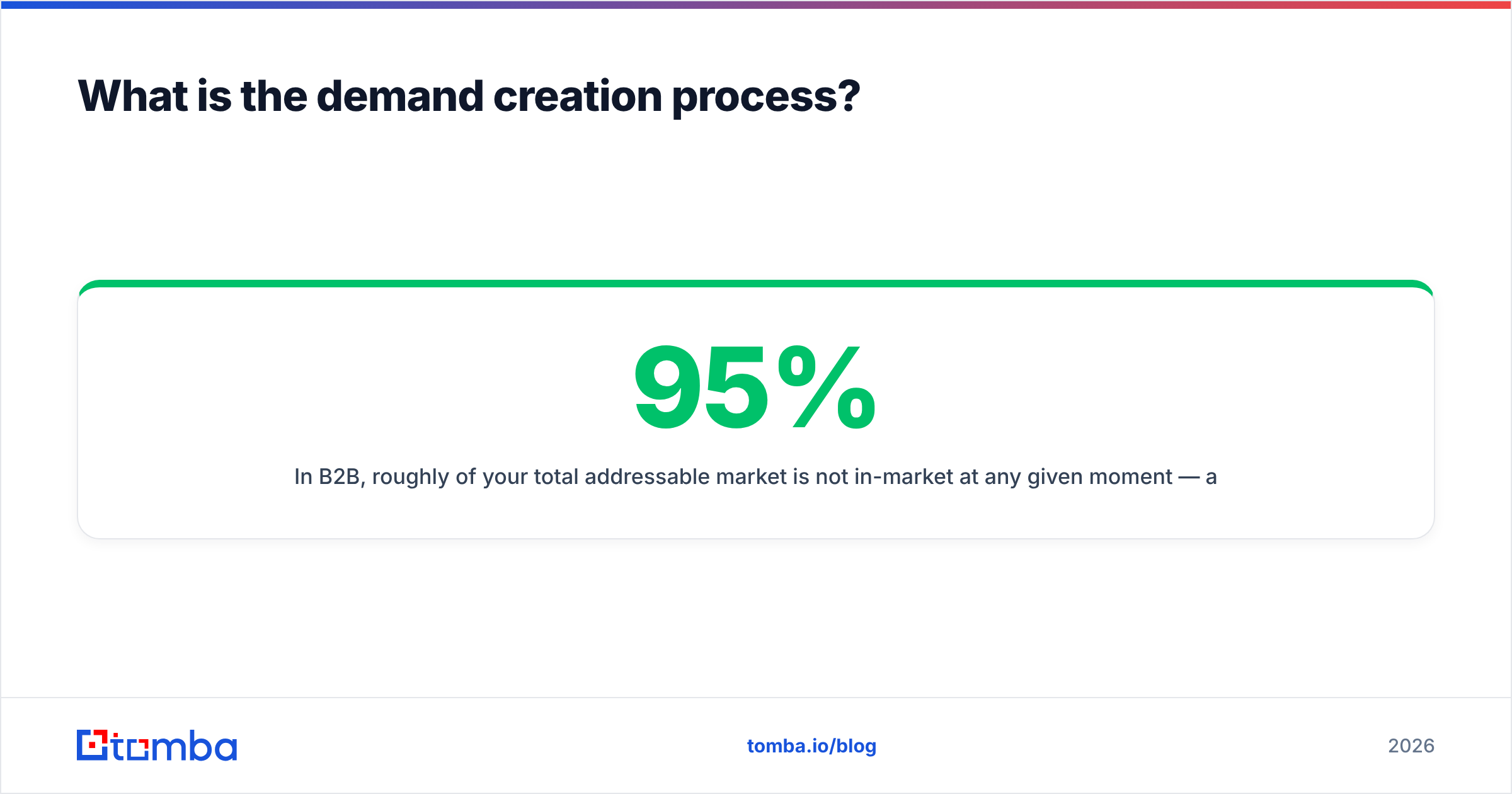
In B2B, roughly 95% of your total addressable market is not in-market at any given moment — a number popularized by the Ehrenberg-Bass Institute and widely cited in B2B marketing since. Demand capture competes over the 5%. Demand creation plants a flag in the memory of the other 95% so that when they enter the market, your name is already the default.
How is demand creation different from demand capture and lead generation?#
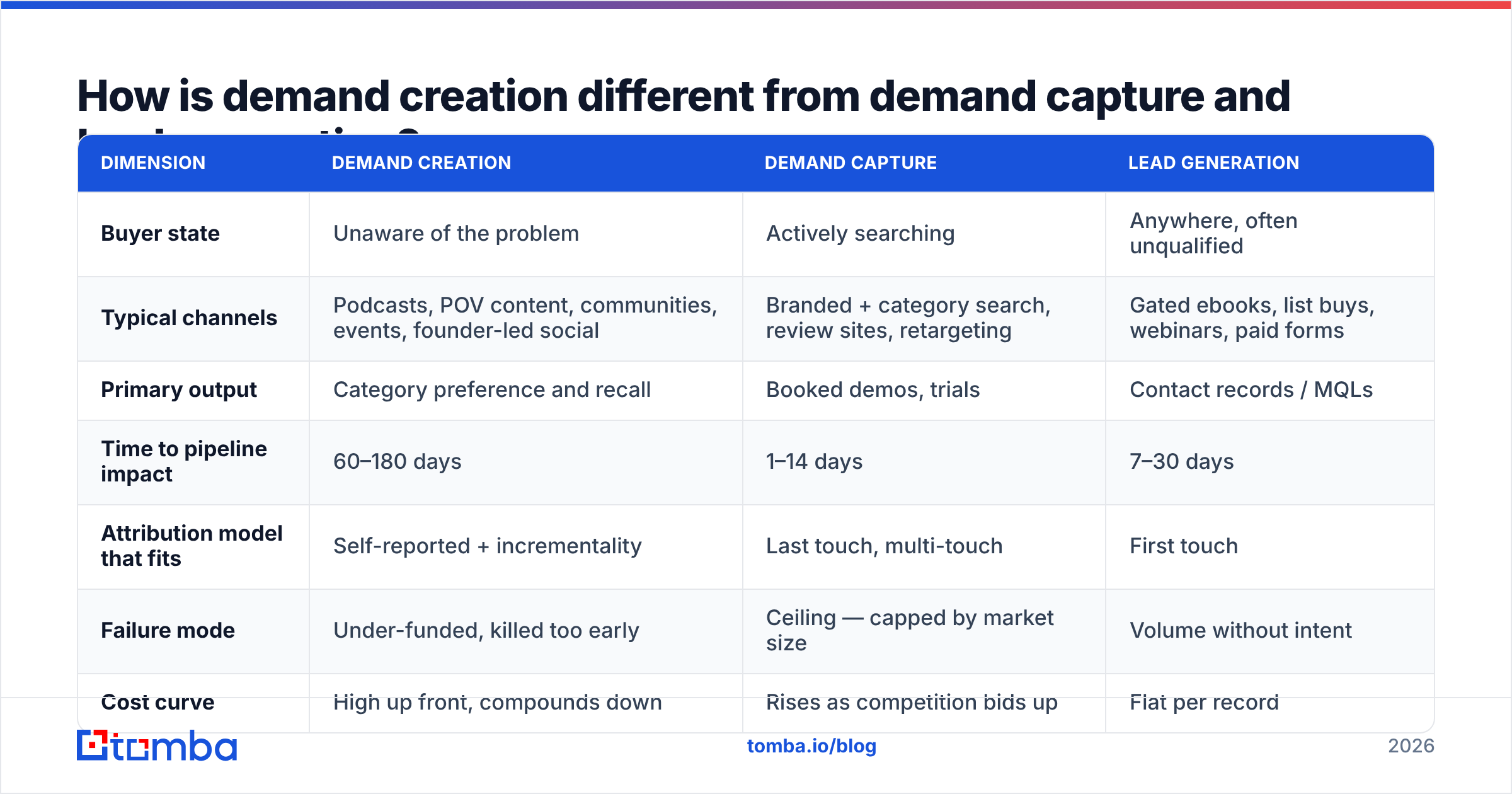
These three terms get used interchangeably in pipeline meetings, and that's exactly why budgets get misallocated. Here's the honest separation:
| Dimension | Demand creation | Demand capture | Lead generation |
|---|---|---|---|
| Buyer state | Unaware of the problem | Actively searching | Anywhere, often unqualified |
| Typical channels | Podcasts, POV content, communities, events, founder-led social | Branded + category search, review sites, retargeting | Gated ebooks, list buys, webinars, paid forms |
| Primary output | Category preference and recall | Booked demos, trials | Contact records / MQLs |
| Time to pipeline impact | 60–180 days | 1–14 days | 7–30 days |
| Attribution model that fits | Self-reported + incrementality | Last touch, multi-touch | First touch |
| Failure mode | Under-funded, killed too early | Ceiling — capped by market size | Volume without intent |
| Cost curve | High up front, compounds down | Rises as competition bids up | Flat per record |
The practical read: capture has a hard ceiling. Once you own the top three positions for every commercial keyword in your category, spending more buys nothing. Growth after that point comes from making more people want the category — which is demand creation. Firms like Forrester and Gartner have been documenting this shift for years as buying committees grow and self-serve research replaces the traditional discovery call.

What are the seven stages of the demand creation process?#
Define the problem space, not the product. Write one sentence describing the pain your best customers had before they knew software existed for it. If your sentence contains your product category, you've written a capture message, not a creation message. "Our reps waste three hours a day hunting for contact details" is a problem. "We need an email finder" is a query.
Pick a painfully narrow audience. Demand creation dilutes fast. One role, one company size band, one trigger. "RevOps leads at 50–500 employee B2B SaaS companies who just hired their third SDR" beats "sales teams." Narrow lets you say specific things, and specific things get remembered.
Build a defensible point of view. A POV is a claim your competitors would be uncomfortable making. It needs a stance, evidence, and an implication. Weak: "Data quality matters." Strong: "Half your outbound spend is wasted on contacts that no longer exist, and your CRM is hiding it — here's the audit that proves it." A POV is what turns content into demand instead of noise.
Distribute where attention already lives. Do not build an audience from zero if you can borrow one. Guest podcasts, partner newsletters, community AMAs, customer webinars, LinkedIn comment sections under industry posts. Owned channels compound later; borrowed channels start today.
Seed the message with proprietary data. The fastest way to earn attention in a crowded category is to publish a number nobody else has. Aggregate your own product telemetry, run a survey of 200 customers, or benchmark something publicly measurable. Data gets cited; opinions get scrolled past.
Capture the hand-raise cleanly. Demand creation ends the moment someone signals interest. From there it's capture: a fast-loading page, no 11-field form, a clear next step, and routing that gets a human involved within minutes. Everything you did in stages 1–5 dies here if the handoff is slow.
Measure on lagging indicators. Track branded search volume, direct traffic, self-reported attribution ("How did you hear about us?" on the demo form), win rate on inbound versus outbound, and sales cycle length. These move slowly and honestly. Click-through rate on a POV post tells you almost nothing.
Why do most demand creation programs fail?#
They fail on measurement, not on creativity.
A team publishes a strong POV, runs a podcast tour, and seeds a data study. Ninety days later, someone builds a dashboard showing the podcast produced eleven form fills. The program gets cut. Meanwhile, branded search rose 40%, inbound win rate improved, and three of the quarter's biggest deals mentioned the podcast in discovery notes — none of which showed up in the dashboard, because last-touch attribution credited the Google branded-search click.
Four other recurring failure modes:
- Treating demand creation as a content calendar. Publishing weekly is not a strategy. A single claim, repeated across twenty surfaces for two quarters, outperforms twenty unrelated posts.
- Handing it to a junior writer. Demand creation requires a defensible POV, which requires domain authority. It usually starts with a founder, a head of product, or your best AE.
- Skipping the marketing qualified lead definition reset. If your MQL definition still counts an ebook download, creation-sourced interest will look identical to a tire-kicker in the funnel and get treated the same way.
- Ignoring the data layer. You can create demand beautifully and still fail to reach anyone, because your contact list decayed 25–30% over the last year.
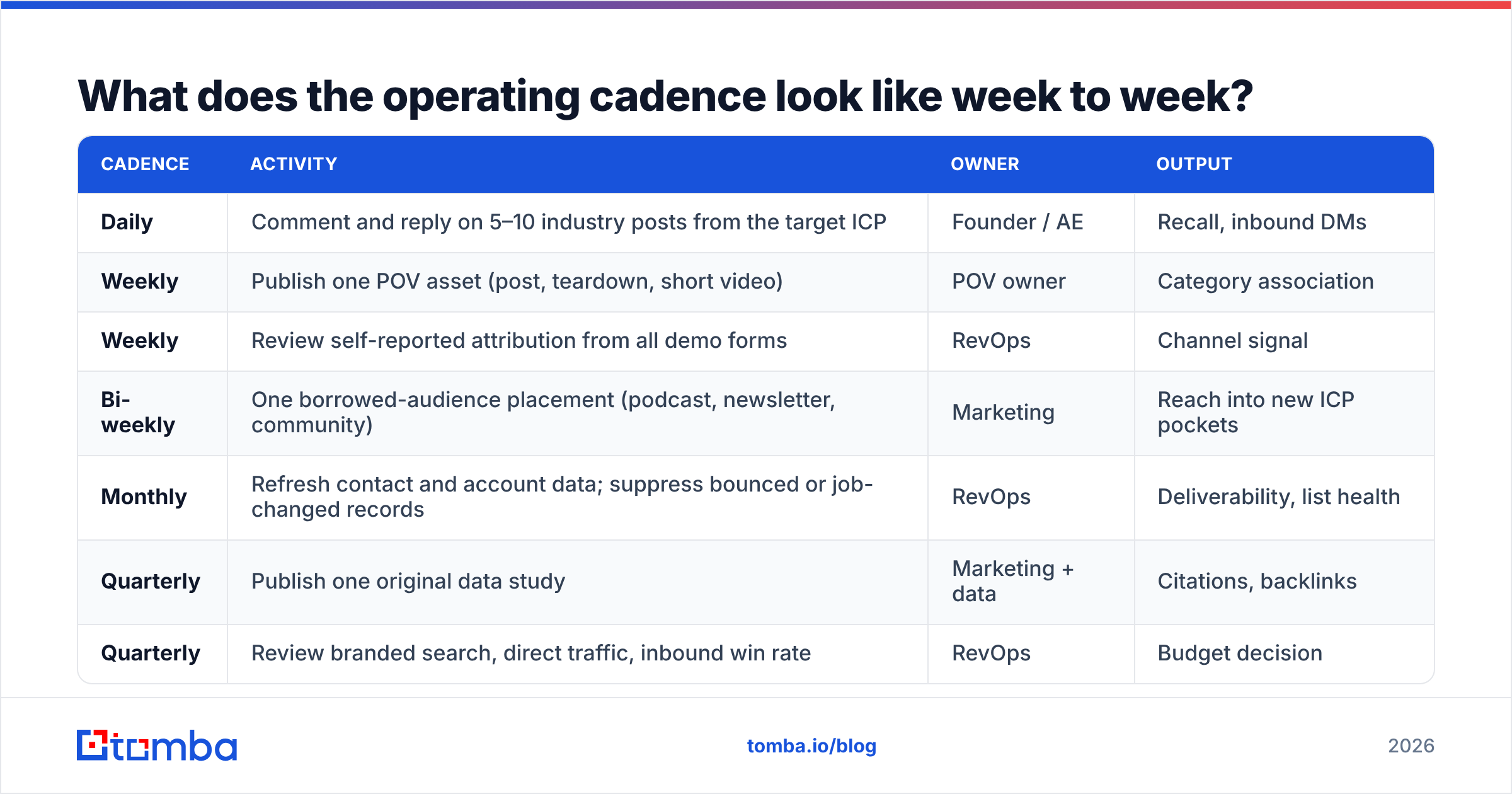
What does the operating cadence look like week to week?#
Demand creation only compounds if it's on a rhythm. A workable cadence for a team of two to four people:
| Cadence | Activity | Owner | Output |
|---|---|---|---|
| Daily | Comment and reply on 5–10 industry posts from the target ICP | Founder / AE | Recall, inbound DMs |
| Weekly | Publish one POV asset (post, teardown, short video) | POV owner | Category association |
| Weekly | Review self-reported attribution from all demo forms | RevOps | Channel signal |
| Bi-weekly | One borrowed-audience placement (podcast, newsletter, community) | Marketing | Reach into new ICP pockets |
| Monthly | Refresh contact and account data; suppress bounced or job-changed records | RevOps | Deliverability, list health |
| Quarterly | Publish one original data study | Marketing + data | Citations, backlinks |
| Quarterly | Review branded search, direct traffic, inbound win rate | RevOps | Budget decision |
Notice that the data-hygiene line is on the same table as the creative work. That's deliberate. In practice, the teams that sustain demand creation are the ones whose operational base doesn't rot underneath them.
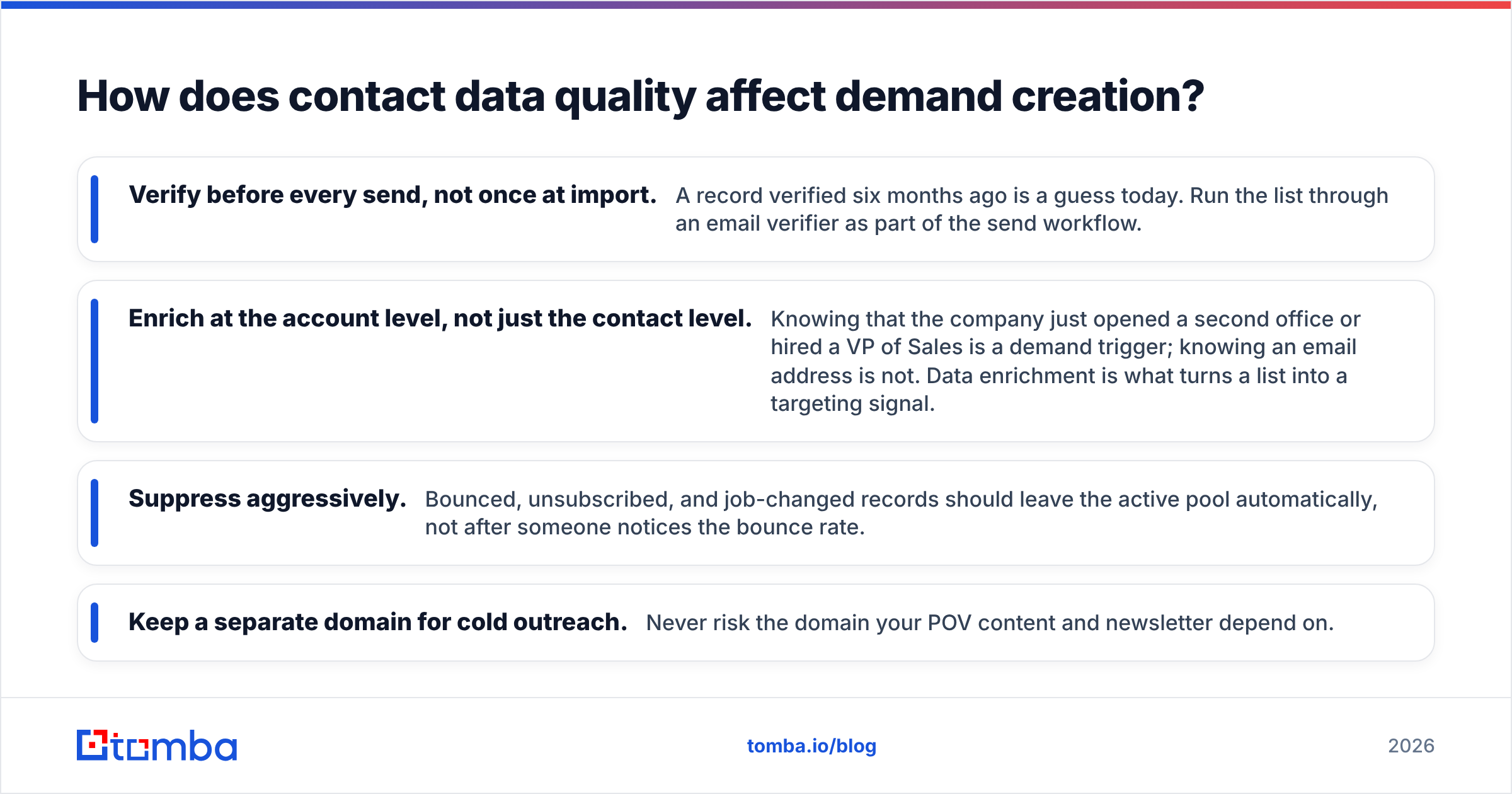
How does contact data quality affect demand creation?#
It sets the ceiling on everything else.
Demand creation is not purely inbound. The strongest programs pair a public POV with direct, one-to-one outreach to the exact people that POV was written for — the "surround sound" effect where a prospect sees your teardown on LinkedIn on Monday and gets a relevant, non-templated email on Wednesday. That only works if the email lands.
B2B contact data decays fast. People change roles, companies rebrand domains, and role-based inboxes get retired. When your list is stale, three things happen at once: your bounce rate climbs, your sending domain reputation falls, and the well-crafted message you spent a quarter developing gets filtered before a human reads it. The creative work is fine. The pipes are clogged.
Practical guardrails:
- Verify before every send, not once at import. A record verified six months ago is a guess today. Run the list through an email verifier as part of the send workflow.
- Enrich at the account level, not just the contact level. Knowing that the company just opened a second office or hired a VP of Sales is a demand trigger; knowing an email address is not. Data enrichment is what turns a list into a targeting signal.
- Suppress aggressively. Bounced, unsubscribed, and job-changed records should leave the active pool automatically, not after someone notices the bounce rate.
- Keep a separate domain for cold outreach. Never risk the domain your POV content and newsletter depend on.
Vendor documentation from major CRMs — HubSpot's blog is a good open reference here — consistently puts B2B database decay in the 22–30% annual range. Plan your refresh cadence against that number, not against optimism.
How do you budget and prove demand creation ROI?#
Split the budget explicitly, then judge each half on its own terms.
A defensible starting split for a company past product-market fit is roughly 60% capture / 40% creation, shifting toward creation as capture saturates. If you're bidding against five competitors for the same 200 monthly commercial searches, you're already saturated — shift.
For proof, use three lenses together and stop looking for one perfect number:
- Self-reported attribution. A single open-text field on the demo form: "How did you first hear about us?" It's the most honest signal you'll get, and it's the one channel that reliably surfaces podcasts, communities, and word of mouth.
- Incrementality tests. Turn a creation channel off in one region or segment for six weeks. Watch branded search and direct demo requests. This is the closest thing to a controlled experiment most B2B teams can run.
- Deal-quality deltas. Compare win rate, average contract value, and sales cycle length for creation-influenced deals versus pure capture deals. Creation-influenced deals typically close faster and discount less, because the buyer arrived pre-sold on the problem. That delta is often worth more than the volume difference.
If those three lenses point the same direction over two quarters, the program works. If they contradict, you have a distribution problem, not a message problem.
What's the fastest way to start if you have no audience?#
Run a 90-day pilot with a deliberately small scope:
- Weeks 1–2. Interview eight recent customers. Ask what they believed before they bought and what changed their mind. Your POV is hiding in those transcripts.
- Weeks 3–4. Build the target list. Define the narrow ICP, then use domain search to map every relevant contact at the accounts that fit, and verify before anything goes out.
- Weeks 5–10. Publish the POV weekly on one owned channel and place it on two borrowed channels. Pair it with direct, individually relevant outreach to 50 accounts per week — not 5,000.
- Weeks 11–12. Measure branded search, self-reported attribution, and reply quality. Kill or scale on evidence, not vibes.
Ninety days won't produce a category. It will produce enough signal to know whether your POV lands with the audience you chose — which is the only question a pilot needs to answer.
Where should you start?#
Demand creation is a message problem and a distribution problem stacked on top of a data problem. The message and the distribution are yours to build. The data layer you can just solve.
If your demand creation process depends on reaching a narrow, well-defined audience — and it should — start by making sure you can actually reach them. The Tomba Email Finder maps verified contacts by domain, name, or company so your POV lands in real inboxes instead of bouncing off dead records. The free tier gives you 25 searches a month to test the workflow, with Starter at $49/mo and Growth at $99/mo when you're ready to scale the list-building side of the program. Full Tomba pricing is public, so you can budget the data layer before you commit to the content one.
Build the point of view first. Then make sure it arrives.
Related guides#
Ready to find emails that actually work?
Join 150,000+ professionals who stopped guessing and started sending. Free credits on signup — no credit card required.
Get the Tomba newsletter
Practical outbound tactics and product updates — once every two weeks.
About the author