What Is a Demand Funnel? The 2026 Guide for RevOps Teams
A demand funnel is the shared map marketing, sales, and RevOps use to trace an anonymous click all the way to closed revenue. Here are the six stages, realistic conversion benchmarks, and the leaks that quietly eat your pipeline.
TL;DR
- A demand funnel is the end-to-end model that tracks demand from anonymous interest through to closed revenue, with agreed stage definitions that marketing, sales, and RevOps all use.
- It differs from a sales funnel: the sales funnel starts at the opportunity; the demand funnel starts before anyone knows who the buyer is.
- Six stages work for most B2B teams: Inquiry → Engaged → MQL → SAL → SQO → Closed-Won. Median inquiry-to-close lands somewhere between 0.5% and 3% depending on motion.
- Most funnels leak at handoff (MQL → SAL) and at data quality, not at top-of-funnel volume. Fixing contact accuracy is usually cheaper than buying more traffic.
- Instrument it with a single source of truth, timestamped stage transitions, and verified contact data — otherwise your conversion rates measure your CRM hygiene, not your market.
What is a demand funnel?#
A demand funnel is a staged model of how anonymous market interest becomes revenue. Think of it like the plumbing diagram for a building: it doesn't tell you how much water you have, it tells you where the water enters, where it's supposed to go, and exactly which joint is dripping into the basement.
The concept was popularized by SiriusDecisions (now part of Forrester) as the "Demand Waterfall," and the modern version has been rebuilt for account-based and product-led motions. But the core promise is unchanged: one shared vocabulary so that when marketing says "we sent you 400 leads" and sales says "there was nothing in there," both teams can point at the same row in the same table and find out who's right.
The distinguishing feature of a demand funnel — versus the generic marketing funnel you've seen in a hundred slide decks — is that every stage has three things:
- An entry definition. What exactly must be true for a record to enter this stage? "Downloaded a whitepaper" is a definition. "Seems interested" is not.
- An owner. One team is accountable for moving records out of the stage. Shared ownership means no ownership.
- A service-level agreement. How fast must the owner act, and what happens when they don't? Most SLAs are measured in hours at the top and days at the bottom.
- A conversion target. The expected pass-through rate, benchmarked against your own trailing four quarters — not against a blog post average.
If a stage in your funnel is missing any of those four, it isn't a stage. It's a label.
How is a demand funnel different from a sales funnel?#
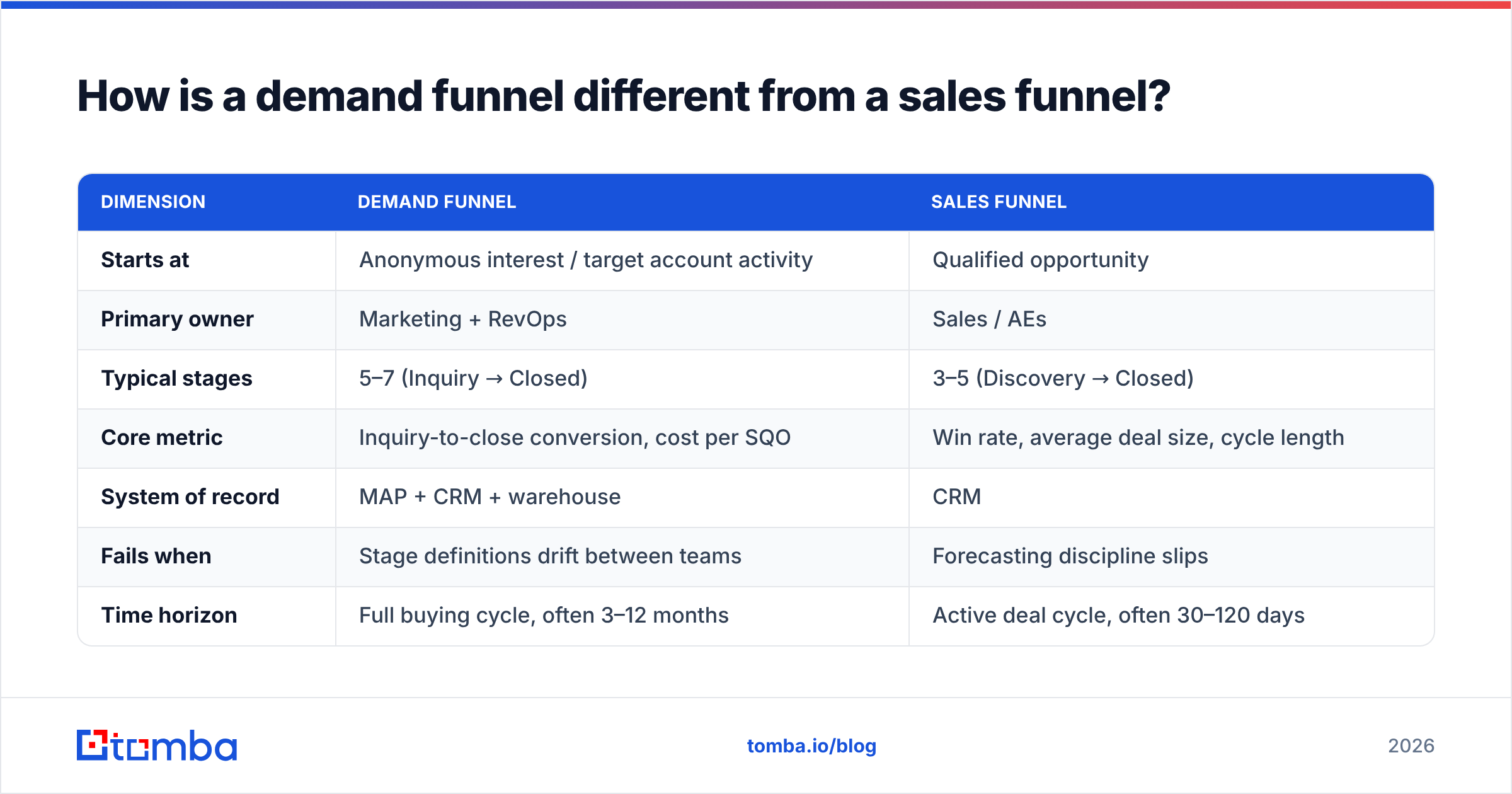
The sales funnel is a subset. It picks up once a human has qualified a buying opportunity and follows it to signature. The demand funnel wraps around it, covering everything from the first anonymous page view to the renewal conversation.
| Dimension | Demand funnel | Sales funnel |
|---|---|---|
| Starts at | Anonymous interest / target account activity | Qualified opportunity |
| Primary owner | Marketing + RevOps | Sales / AEs |
| Typical stages | 5–7 (Inquiry → Closed) | 3–5 (Discovery → Closed) |
| Core metric | Inquiry-to-close conversion, cost per SQO | Win rate, average deal size, cycle length |
| System of record | MAP + CRM + warehouse | CRM |
| Fails when | Stage definitions drift between teams | Forecasting discipline slips |
| Time horizon | Full buying cycle, often 3–12 months | Active deal cycle, often 30–120 days |
The practical consequence: if you only run a sales funnel, you can't diagnose whether a bad quarter came from weak demand creation, a broken handoff, or poor closing. You'll blame whichever team is least able to defend itself in the QBR.
What are the stages of a demand funnel?#
Here's the six-stage model that fits most B2B teams selling a considered purchase. Adapt the names to your CRM, but keep the logic.
- Inquiry — A known contact record exists with a name, a company, and a reachable email. Source can be inbound content, an event scan, a webinar, or outbound sourcing. This is the widest ring and the least meaningful one; treat it as inventory, not achievement.
- Engaged — The contact has taken a second, non-trivial action inside a rolling window (typically 30 days): a pricing page visit, a second content download, a reply to a sequence, a demo video watched past 50%. Engagement filters out the people who wanted the ebook and nothing else.
- MQL — The contact clears an agreed scoring threshold combining fit (firmographics, title, tech stack) and intent (behavior). A marketing qualified lead is a prediction, not a promise, and everyone should say so out loud.
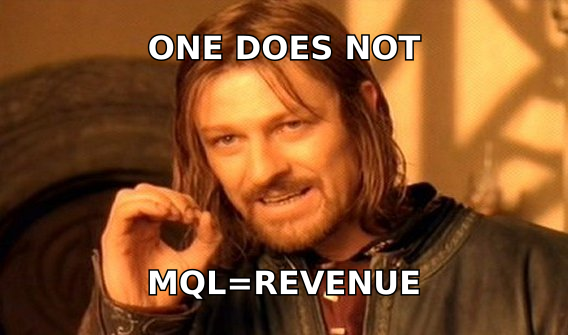
- SAL (Sales Accepted Lead) — A rep has looked at the record and agreed it's worth working. This is the single most diagnostic stage in the whole funnel. A low MQL→SAL rate means your scoring model is wrong or your data is dirty. A high SAL→nothing rate means your reps are accepting to keep the peace.
- SQO (Sales Qualified Opportunity) — Budget, authority, need, and timing are confirmed enough to forecast. This is where the sales funnel formally begins and where pipeline dollars appear.
- Closed-Won — Contract signed. Feed the outcome back into the scoring model, or the funnel stops learning.
Two optional stages worth adding if your motion warrants it: Target Account Engagement above Inquiry (for ABM programs where account-level signals matter more than individual contacts) and Onboarded/Activated below Closed-Won (for PLG or land-and-expand motions where the first renewal is the real win).
What conversion rates should you expect at each stage?#
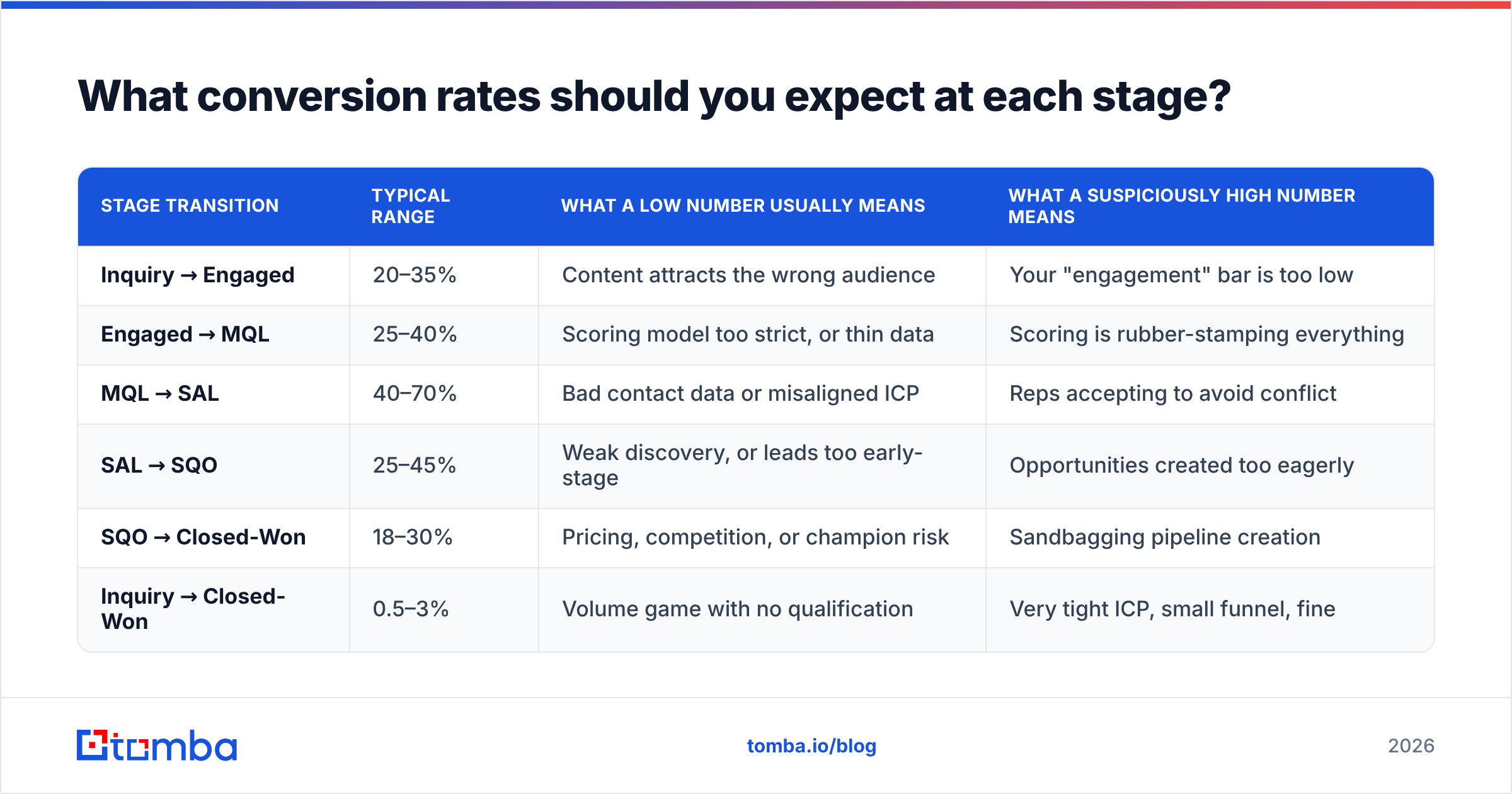
Benchmarks are dangerous — they vary wildly by ACV, motion, and category. Use these as a sanity range, not a target. Anything wildly outside the range is worth investigating, in either direction.
| Stage transition | Typical range | What a low number usually means | What a suspiciously high number means |
|---|---|---|---|
| Inquiry → Engaged | 20–35% | Content attracts the wrong audience | Your "engagement" bar is too low |
| Engaged → MQL | 25–40% | Scoring model too strict, or thin data | Scoring is rubber-stamping everything |
| MQL → SAL | 40–70% | Bad contact data or misaligned ICP | Reps accepting to avoid conflict |
| SAL → SQO | 25–45% | Weak discovery, or leads too early-stage | Opportunities created too eagerly |
| SQO → Closed-Won | 18–30% | Pricing, competition, or champion risk | Sandbagging pipeline creation |
| Inquiry → Closed-Won | 0.5–3% | Volume game with no qualification | Very tight ICP, small funnel, fine |
The compounding math is the point. A funnel with 10,000 inquiries and a 1.2% end-to-end rate produces 120 customers. Lift each of five transitions by just five percentage points and you land near 200 — with zero additional traffic. That's why RevOps teams who chase mid-funnel conversion generally beat teams who chase top-of-funnel volume.
Why do most demand funnels leak?#
Almost never because of a lack of leads. In practice, four failure modes account for the majority of the damage.
- Undeliverable contact data. If 18% of your inquiry records bounce, you didn't lose 18% of a stage — you lost 18% of every stage downstream, plus you damaged your sender reputation on the way. This is the cheapest leak to fix and the most commonly ignored.
- Definition drift. Marketing quietly loosens the MQL threshold in Q3 to hit a number. Sales notices lead quality dropped but can't prove it because the definition changed without a changelog. Six months later nobody trusts the funnel at all.
- Handoff latency. HubSpot's research on lead response and a long line of similar studies keep finding the same thing: contact speed dominates almost every other variable at the MQL→SAL step. An MQL worked in five minutes and an MQL worked in five days are not the same asset.
- No feedback loop. Closed-won and closed-lost reasons never make it back to the scoring model, so the funnel keeps optimizing for a definition of "good lead" that was written by a committee two years ago.
- Attribution theater. Teams spend more energy arguing about which touch gets credit than about which stage is converting badly. Attribution is a budgeting tool; the funnel is a diagnostic tool. Don't confuse them.
What data do you need to make a demand funnel work?#
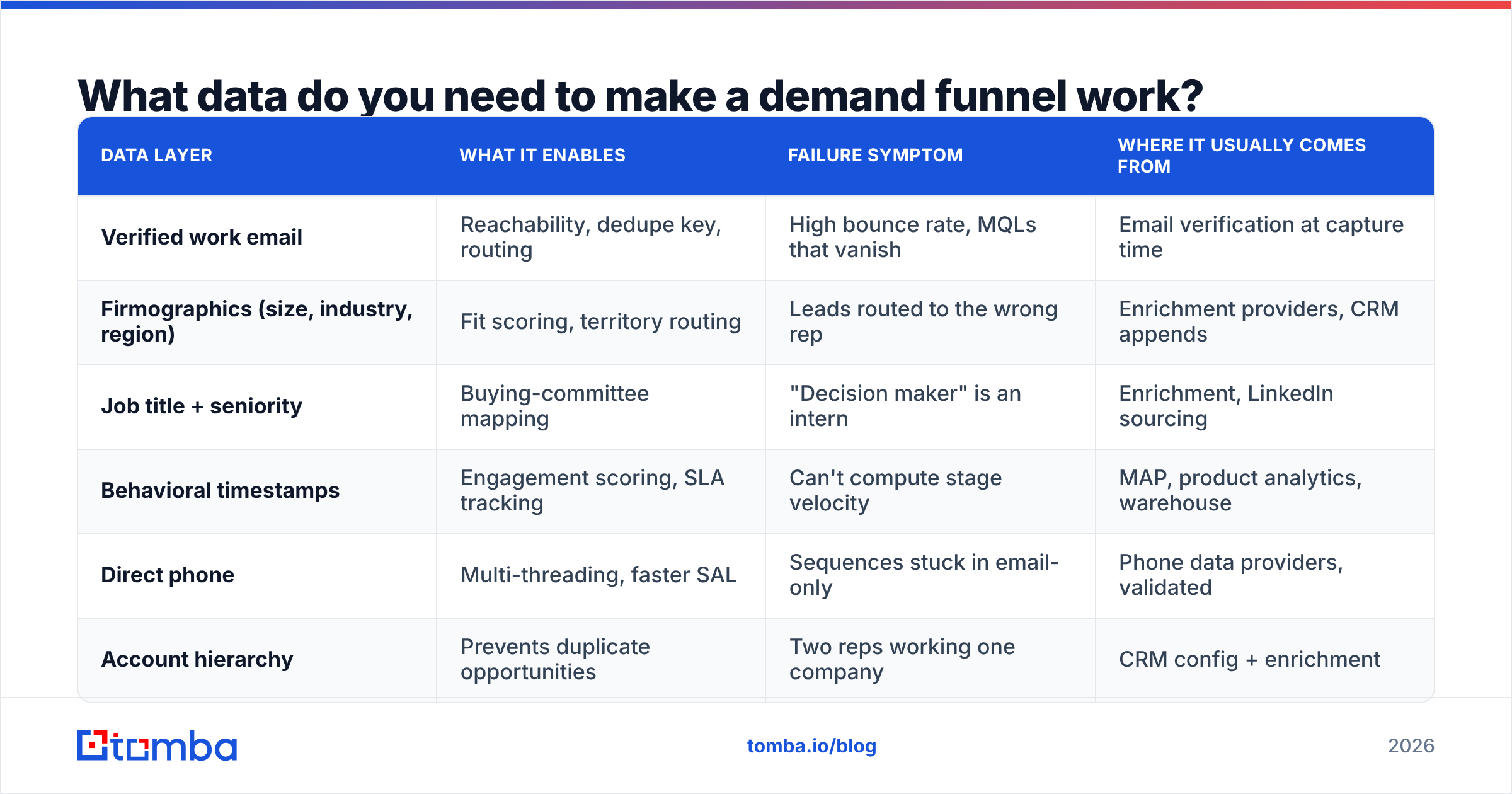
A demand funnel is only as reliable as the contact records flowing through it. Here's the practical data layer, ranked by how much damage a gap causes.
| Data layer | What it enables | Failure symptom | Where it usually comes from |
|---|---|---|---|
| Verified work email | Reachability, dedupe key, routing | High bounce rate, MQLs that vanish | Email verification at capture time |
| Firmographics (size, industry, region) | Fit scoring, territory routing | Leads routed to the wrong rep | Enrichment providers, CRM appends |
| Job title + seniority | Buying-committee mapping | "Decision maker" is an intern | Enrichment, LinkedIn sourcing |
| Behavioral timestamps | Engagement scoring, SLA tracking | Can't compute stage velocity | MAP, product analytics, warehouse |
| Direct phone | Multi-threading, faster SAL | Sequences stuck in email-only | Phone data providers, validated |
| Account hierarchy | Prevents duplicate opportunities | Two reps working one company | CRM config + enrichment |
For sourced (outbound) inquiries, the quality of that first column determines everything downstream. Tools like an email finder that return a confidence score with each result let you set an entry gate — for example, only records above a 90% confidence threshold enter the Inquiry stage at all. Peers in the space including BookYourData take a similar position on pre-verified data, and it's the right instinct: gate on quality at the top and every downstream conversion rate becomes interpretable.

If you're sourcing at volume, run enrichment as a batch step rather than a per-record scramble — data enrichment applied before records hit the CRM keeps routing rules simple and stops reps from doing manual research that a job should have done.
Should you use a funnel, a waterfall, or a flywheel?#
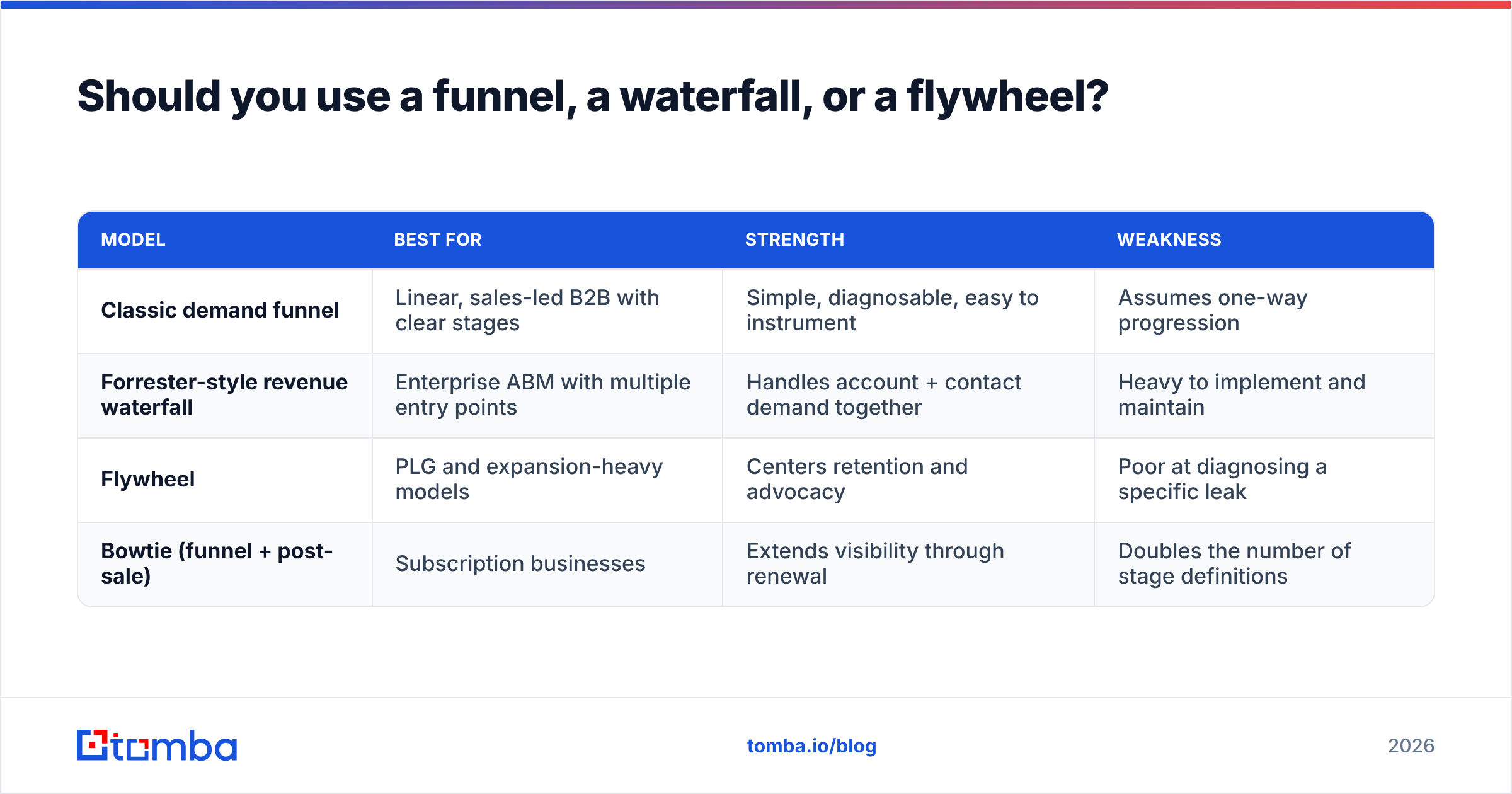
These get argued about like they're rival religions. They're not — they answer different questions, and mature teams run more than one.
| Model | Best for | Strength | Weakness |
|---|---|---|---|
| Classic demand funnel | Linear, sales-led B2B with clear stages | Simple, diagnosable, easy to instrument | Assumes one-way progression |
| Forrester-style revenue waterfall | Enterprise ABM with multiple entry points | Handles account + contact demand together | Heavy to implement and maintain |
| Flywheel | PLG and expansion-heavy models | Centers retention and advocacy | Poor at diagnosing a specific leak |
| Bowtie (funnel + post-sale) | Subscription businesses | Extends visibility through renewal | Doubles the number of stage definitions |
Practical guidance: start with the six-stage funnel because it's the only one you can instrument in a week. Add the post-sale half of the bowtie once your net revenue retention becomes a board metric. Adopt a full waterfall only if you genuinely run account-level demand programs where an account can be "in market" while no individual contact is. Gartner's sales research is worth reading before you commit to the heavier models — the implementation cost is real.
What KPIs actually matter?#
Five numbers, reviewed monthly, will tell you more than a 40-tile dashboard nobody opens.
- Stage conversion rate (each transition). Trended over four quarters, not month-over-month. Monthly noise in B2B funnels is mostly noise.
- Stage velocity. Median days in stage. A stage that's converting fine but slowing down is an early warning that a competitor changed something.
- Cost per SQO. The single most honest efficiency metric in demand generation, because it survives all attribution arguments.
- Data decay rate. What percentage of your contact database goes stale per quarter? B2B contact data commonly decays in the 20–30% per year range as people change jobs. If you're not re-verifying, your funnel's denominator is fiction.
- SAL acceptance rate by source. Break MQL→SAL down by channel. You will almost always find one source producing volume that reps quietly reject, and killing it frees budget immediately.
Deliberately not on the list: MQL count as a standalone goal. The moment MQL volume becomes a compensated target, the definition erodes and the funnel stops measuring anything. Report it, don't comp on it.
How do you build one in 30 days?#
- Week 1 — Agree definitions. Get marketing, sales, and revenue operations in one room. Write each stage's entry criteria in a shared doc. Ship nothing until all three teams sign.
- Week 2 — Instrument transitions. Add timestamped stage-change tracking in the CRM. Without transition timestamps you cannot compute velocity, and velocity is half the diagnostic value.
- Week 3 — Clean the data layer. Verify every existing contact record, dedupe, and set an entry gate on new records. Expect to delete more than you're comfortable with; do it anyway.
- Week 4 — Baseline and publish. Compute the trailing four quarters of stage conversion. Publish the baseline where everyone can see it. Do not set improvement targets until you have two clean quarters of data.
The temptation in week 4 is to immediately declare a target ("we'll lift MQL→SAL by 15 points"). Resist it. A baseline computed on dirty historical data will move on its own as the cleanup takes effect, and you'll spend a quarter taking credit for hygiene.
Get the data layer right first#
Every conversion rate in this article is a ratio, and every ratio has contact data in the denominator. If a fifth of your records are wrong, your demand funnel isn't measuring your market — it's measuring your database.
Start there. Use Tomba Email Finder to source verified work emails with a confidence score attached, so only records that clear your quality bar ever enter the Inquiry stage. The free tier covers 25 searches a month if you want to test accuracy against a sample of your existing list before committing; paid plans start at $49/mo, with full Tomba pricing available if you need bulk or API volume. Clean the input, and every stage below it finally starts telling you the truth.
Related guides#
Ready to find emails that actually work?
Join 150,000+ professionals who stopped guessing and started sending. Free credits on signup — no credit card required.
Get the Tomba newsletter
Practical outbound tactics and product updates — once every two weeks.
About the author