Demand Gen in 2026: The Complete B2B Playbook and Metrics
Demand gen is not lead gen with better branding. Here is how the 2026 model actually works: the channel mix, the metrics that survive scrutiny, the budget splits, and the data layer that makes any of it measurable.
TL;DR
- Demand gen is the full motion of creating and capturing buyer interest. Lead gen is only the capture half — the form fill at the end.
- The 2026 version is dominated by dark-social and self-directed research: most of the buying committee's evaluation happens before anyone fills out a form.
- Budget benchmark that holds up in practice: roughly 60% creation (content, community, podcasts, paid social), 40% capture (search, retargeting, outbound, review sites).
- MQL count is a vanity metric on its own. Pipeline created, pipeline velocity, and self-reported attribution are the three you defend in a board meeting.
- None of it is measurable without a clean contact layer. Enrichment and verified email data are the plumbing under every demand gen dashboard.
What is demand gen, exactly?#
Demand generation is the whole system that makes a company want your product and then makes it easy for them to raise a hand. It has two halves that most teams collapse into one:
- Demand creation — you make people aware they have a problem worth solving. Podcasts, LinkedIn posts from real humans, original research, YouTube teardowns, communities, paid social that teaches rather than gates.
- Demand capture — you catch the intent that already exists. Branded and category search, comparison pages, G2 category listings, retargeting, and outbound to accounts already showing signals.
Here is the everyday analogy: demand creation is the smell of bread on the street. Demand capture is the sign on the door that says open. A bakery with only a sign starves. A bakery with only the smell watches people walk past the entrance.
Technically, demand gen sits above both marketing and sales in the GTM stack — it owns the pipeline number, not the lead number. That reporting line is the actual difference between a demand gen team and a lead gen team, and it changes every decision downstream.
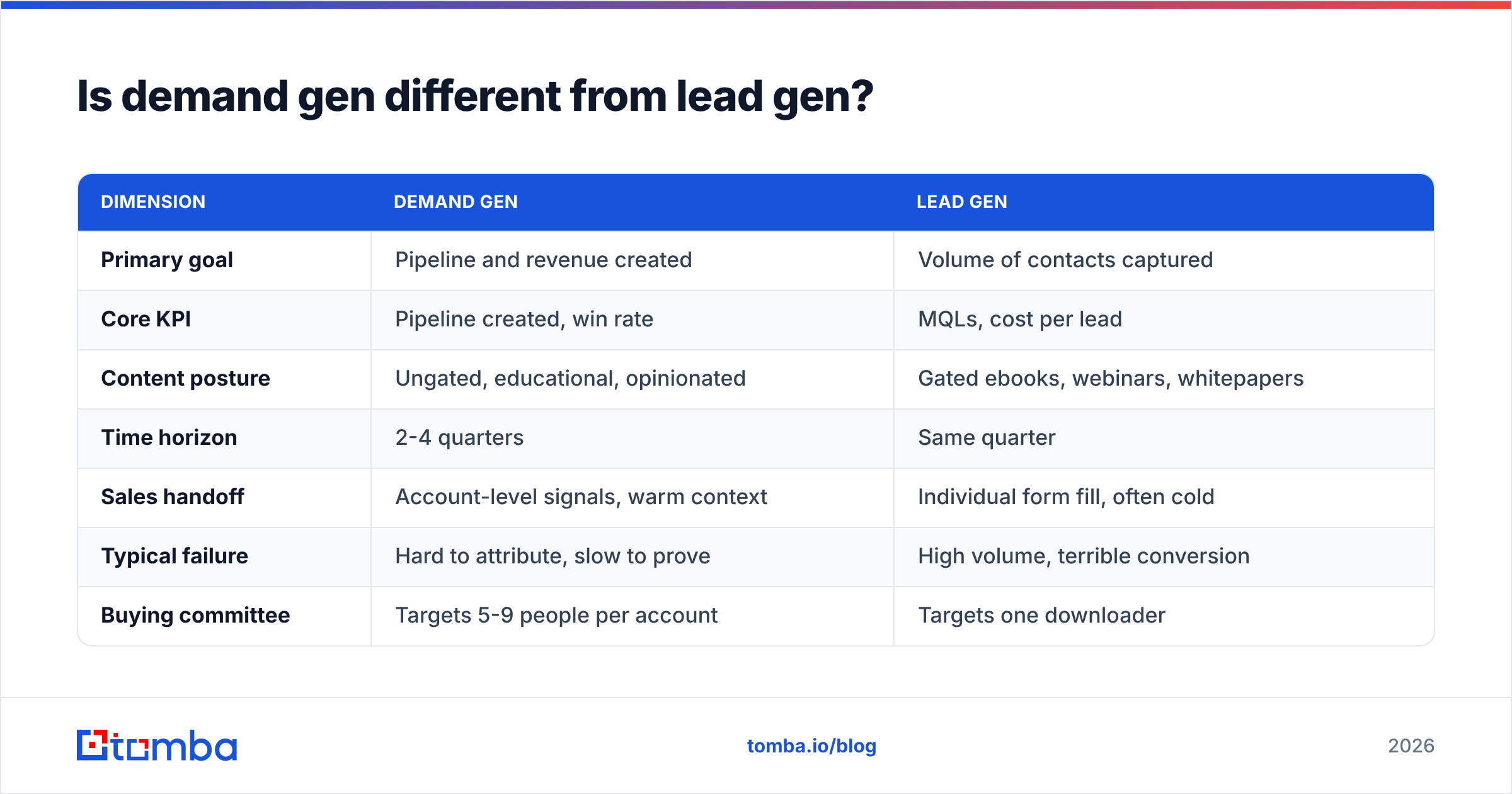
Is demand gen different from lead gen?#
Yes, and the difference is not semantic. They optimise for different objects.
| Dimension | Demand gen | Lead gen |
|---|---|---|
| Primary goal | Pipeline and revenue created | Volume of contacts captured |
| Core KPI | Pipeline created, win rate | MQLs, cost per lead |
| Content posture | Ungated, educational, opinionated | Gated ebooks, webinars, whitepapers |
| Time horizon | 2-4 quarters | Same quarter |
| Sales handoff | Account-level signals, warm context | Individual form fill, often cold |
| Typical failure | Hard to attribute, slow to prove | High volume, terrible conversion |
| Buying committee | Targets 5-9 people per account | Targets one downloader |
The trap most teams fall into: they rename the lead gen team "demand gen," keep the same gated PDF machine, and wonder why sales still complains about lead quality. If the incentive is still cost-per-lead, you have a lead gen team with a new Slack channel name.
That said, lead gen is not the enemy. Demand capture is lead gen, done at the moment intent is highest. The mistake is running capture tactics against people who never had demand created in the first place — that's what produces a CRM full of marketing qualified leads that never take a meeting.
Why has demand gen changed so much by 2026?#
Three shifts, all pointing the same direction.
Buyers finish their research before they talk to you. Gartner's B2B buying research has been consistent for years: buyers spend the majority of the journey in independent research, and only a small slice of total buying time with any one vendor's sales rep. By 2026 that gap has widened — the committee has read your G2 reviews, watched a competitor teardown, and asked a Slack community before your SDR knows they exist.
The measurable channels got expensive and the effective ones got dark. Paid search on high-intent B2B terms keeps climbing. Meanwhile the channels that actually move opinion — a founder's LinkedIn, a niche podcast, a private community — are invisible to your attribution model. This is the "dark social" problem, and it's why self-reported attribution ("How did you hear about us?") has become a standard field on demand form fills.
AI-assisted search collapsed the middle of the funnel. Generic "what is X" content no longer earns clicks; an assistant summarises it. What survives is content with something the model cannot synthesise — original data, real pricing, real product screenshots, opinionated verdicts. That has pushed demand gen budgets toward primary research and product-led content and away from SEO filler.
What does a demand gen engine actually look like?#
Six components. If one is missing, the rest leak.
- A narrative — a specific point of view on why the status quo fails. Not a feature list. This is what people repeat to a colleague when you're not in the room.
- Creation surface — 2-3 channels where you publish that narrative consistently. Pick fewer than you think. A weekly podcast plus daily founder LinkedIn beats six half-run channels.
- Capture surface — comparison pages, alternatives pages, review-site presence, branded search, free tools. This is where existing intent converts.
- Signal layer — website visitor identification, product usage, review-site activity, job changes, hiring signals. This tells you which accounts are warming.
- Contact layer — verified emails, direct dials, enriched firmographics. Signals are useless if you can't reach the six people on the committee.
- Measurement layer — pipeline created by source, self-reported attribution, and a holdout or geo test when you need to prove the unattributable channels work.
Most B2B teams are strong on 1-3 and thin on 4-6. That's why the CFO conversation goes badly: the engine works, but nobody can show the wiring.
Which demand gen channels are worth the budget in 2026?#
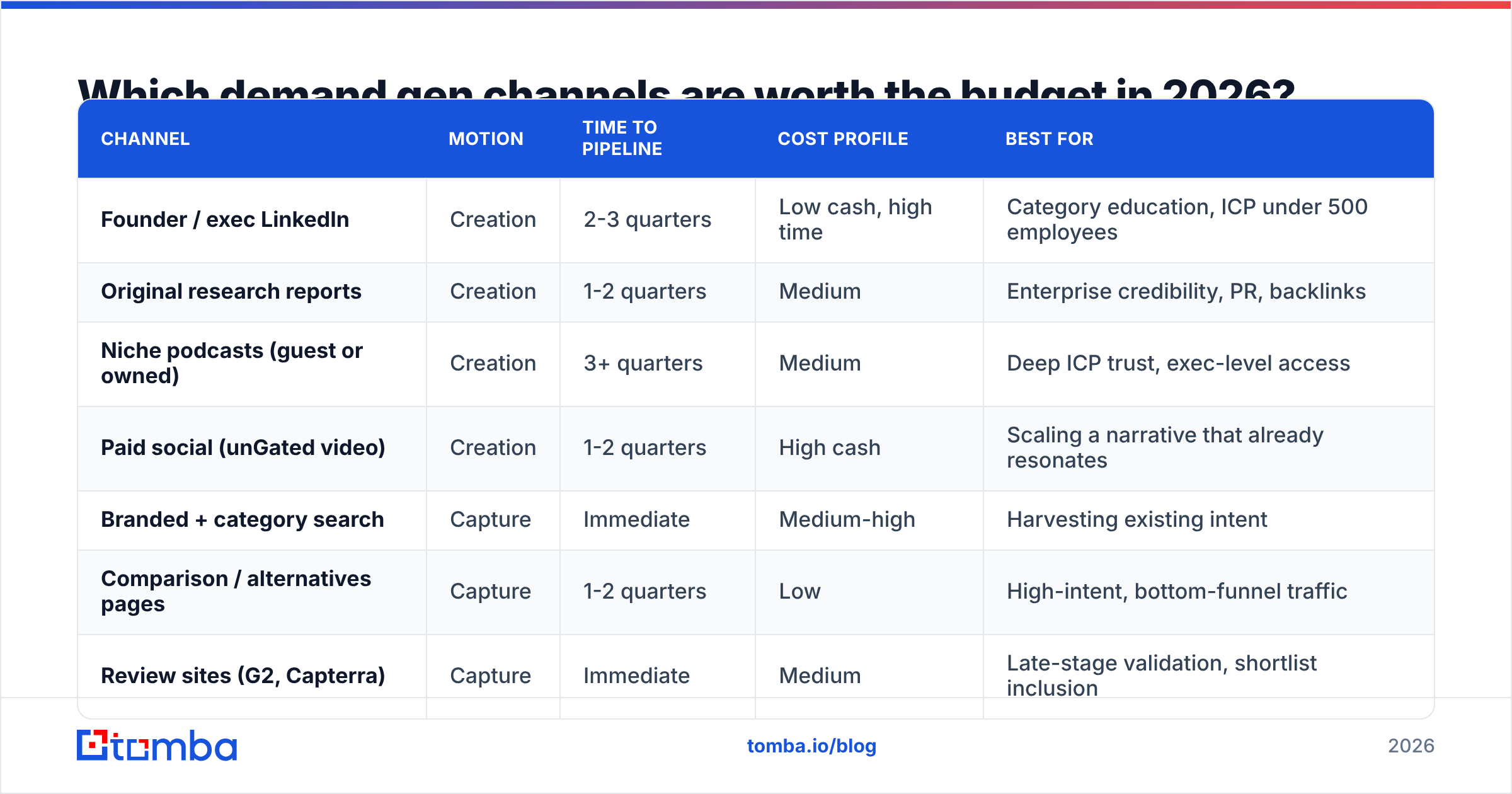
Channel value depends on whether you're creating or capturing. Blending them into one "marketing spend" line is how good channels get killed.
| Channel | Motion | Time to pipeline | Cost profile | Best for |
|---|---|---|---|---|
| Founder / exec LinkedIn | Creation | 2-3 quarters | Low cash, high time | Category education, ICP under 500 employees |
| Original research reports | Creation | 1-2 quarters | Medium | Enterprise credibility, PR, backlinks |
| Niche podcasts (guest or owned) | Creation | 3+ quarters | Medium | Deep ICP trust, exec-level access |
| Paid social (unGated video) | Creation | 1-2 quarters | High cash | Scaling a narrative that already resonates |
| Branded + category search | Capture | Immediate | Medium-high | Harvesting existing intent |
| Comparison / alternatives pages | Capture | 1-2 quarters | Low | High-intent, bottom-funnel traffic |
| Review sites (G2, Capterra) | Capture | Immediate | Medium | Late-stage validation, shortlist inclusion |
| Outbound to signal-warmed accounts | Capture | Immediate | Medium | Named-account and ABM motions |
| Free tools / calculators | Both | 2 quarters | Medium build | Repeatable, compounding, self-serve intent |
A practical rule: never let capture channels take credit for creation channels' work. If your comparison page converts at 12% while your podcast "converts" at 0.2%, the honest reading is usually that the podcast created the demand the comparison page harvested.
Reviewing your own presence on G2's category pages is a five-minute audit most teams skip. If you're not in the grid your buyers are reading, your capture layer has a hole in it.
How do you measure demand gen without lying to yourself?#
Pick metrics your CFO can audit. Here is the hierarchy that survives scrutiny:
- Pipeline created — the only number that matters at the top. Segment by creation vs capture source.
- Pipeline velocity — deals sourced by strong demand creation close faster and discount less. If your "warm" channel doesn't move velocity, it isn't warm.
- Self-reported attribution — an open text field on every form. Noisy, biased, and still more honest than last-touch. Compare it against your platform attribution quarterly; the delta is your dark-social contribution.
- Win rate by first-touch channel — separates channels that produce buyers from channels that produce downloads.
- Cost per opportunity (not cost per lead) — reprices every channel instantly.
Two metrics to explicitly demote: raw MQL count and gated-asset downloads. Both are trivially gameable. A team can double MQLs in a week by loosening a form and destroy sales' quarter in the process. HubSpot's own research on B2B marketing benchmarks has repeatedly shown the gap between volume metrics and revenue outcomes, and most in-house teams find the same thing the moment they segment by close rate.
What data infrastructure does demand gen need?#
This is the part nobody puts on the conference slide, and it's the part that breaks first.
Every demand gen motion eventually reduces to: we know this account is interested — now reach the right humans inside it. That requires three data jobs done well.
Job 1 — Identify the account. Anonymous traffic is the largest pool of warm demand most companies own. Visitor identification turns "3,400 sessions on the pricing page" into a list of companies you can actually work. Tools like website visitor reveal sit here, alongside intent data providers.
Job 2 — Find the committee. A modern B2B deal involves multiple stakeholders. One contact per account is not enough. This is where a domain search pass matters: you pull every reachable role at the account, then filter to the 4-6 people who actually decide.
Job 3 — Keep the data alive. B2B contact data decays fast — role changes, layoffs, acquisitions. Unverified sends damage sender reputation and quietly reduce the deliverability of your entire domain, which then makes every downstream channel look worse than it is. Running lists through an email verifier before a campaign is the cheapest insurance in the stack.
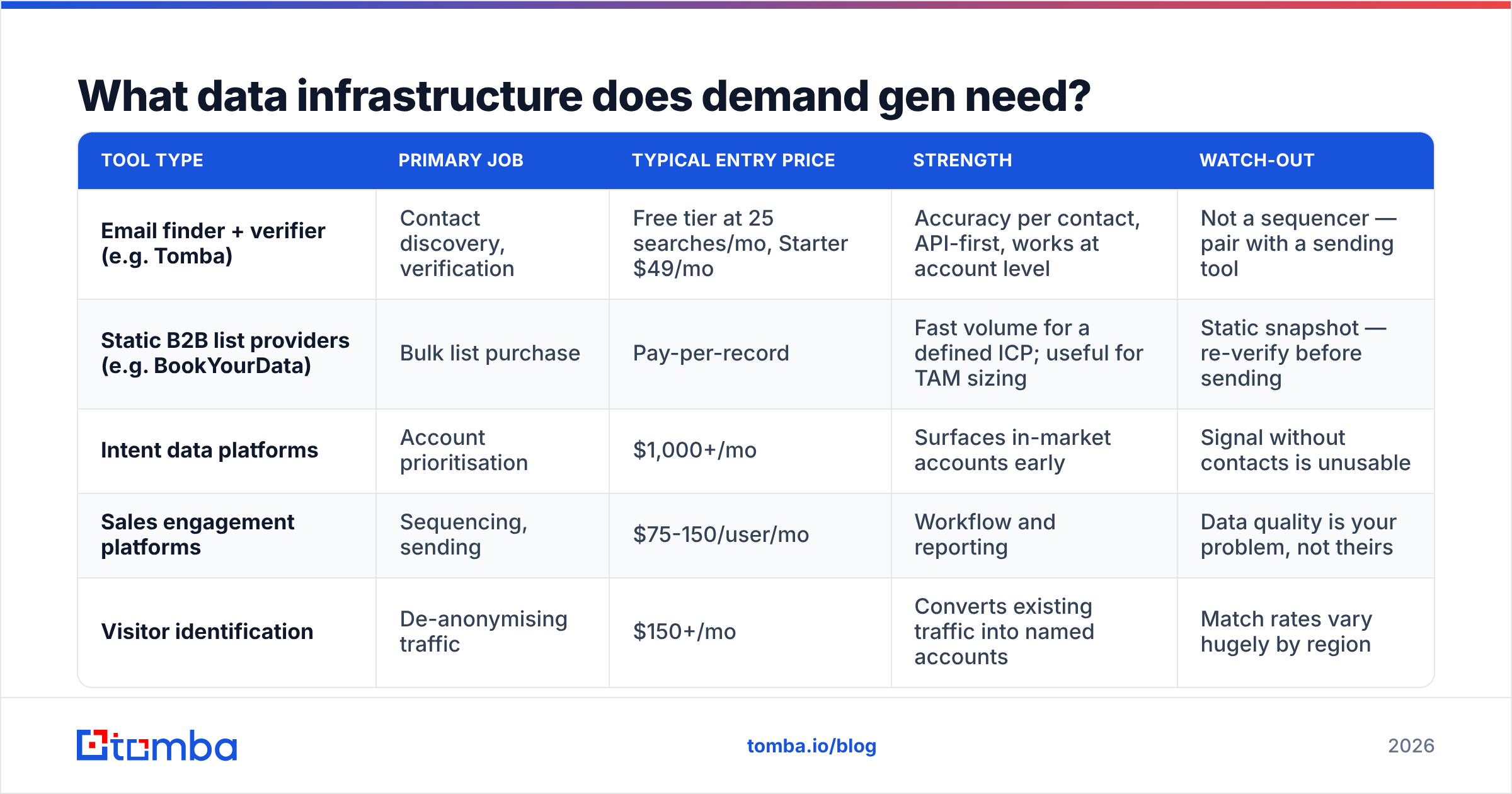
Here is how the common tooling categories compare on the jobs demand gen actually needs:
| Tool type | Primary job | Typical entry price | Strength | Watch-out |
|---|---|---|---|---|
| Email finder + verifier (e.g. Tomba) | Contact discovery, verification | Free tier at 25 searches/mo, Starter $49/mo | Accuracy per contact, API-first, works at account level | Not a sequencer — pair with a sending tool |
| Static B2B list providers (e.g. BookYourData) | Bulk list purchase | Pay-per-record | Fast volume for a defined ICP; useful for TAM sizing | Static snapshot — re-verify before sending |
| Intent data platforms | Account prioritisation | $1,000+/mo | Surfaces in-market accounts early | Signal without contacts is unusable |
| Sales engagement platforms | Sequencing, sending | $75-150/user/mo | Workflow and reporting | Data quality is your problem, not theirs |
| Visitor identification | De-anonymising traffic | $150+/mo | Converts existing traffic into named accounts | Match rates vary hugely by region |
The pattern: signal tools tell you who is interested, contact tools tell you how to reach them. Teams that buy only the first half end up with a beautiful dashboard and no outreach.
For teams operating at volume, this is usually an API problem rather than a UI problem — enriching accounts as they enter the CRM, not in a monthly batch. That's why the email finder API route tends to win once a demand gen program matures past its first year.
How do you build a 90-day demand gen plan?#
A realistic sequence for a team starting from a lead gen baseline:
- Days 1-15 — Fix measurement. Add self-reported attribution to every form. Rebuild reporting around pipeline created, not MQLs. Establish the baseline you'll be judged against.
- Days 16-30 — Audit capture. Are your comparison pages, alternatives pages, and review-site profiles complete? This is the fastest pipeline you will find, and it's usually half-built.
- Days 31-60 — Launch one creation channel properly. One. Weekly cadence, one clear point of view, distributed by real people rather than the company page.
- Days 61-75 — Wire the data layer. Visitor identification into a warm-account list, data enrichment on every inbound record, verification before every send.
- Days 76-90 — Run a holdout test. Pause your least-attributable creation channel in one geo or segment. Measure pipeline delta. This is how you earn the budget for year two.
Resist the urge to run all five in parallel. Demand gen fails more often from spreading thin than from picking the wrong channel.
What are the most common demand gen mistakes?#
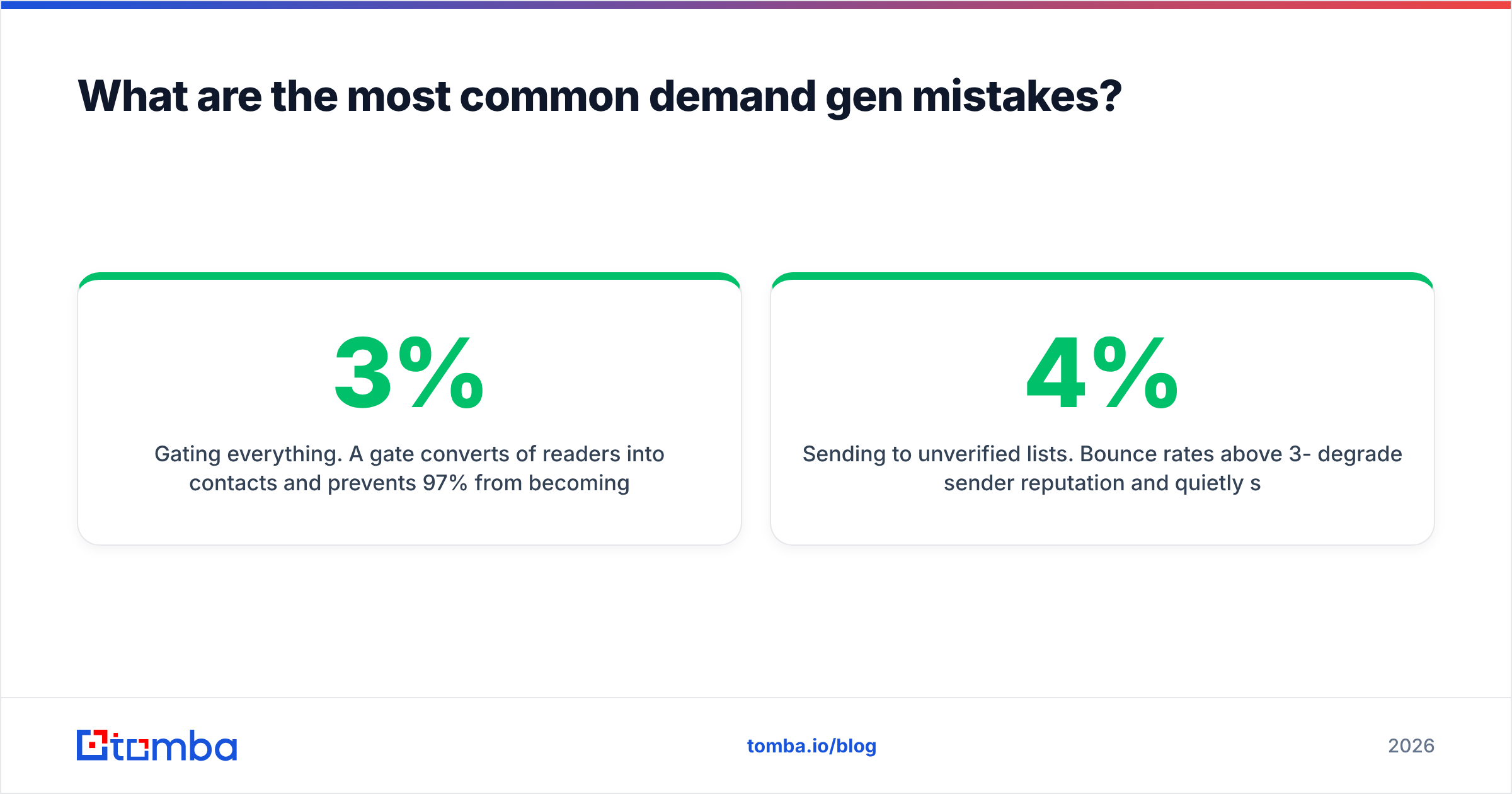
- Gating everything. A gate converts 3% of readers into contacts and prevents 97% from becoming advocates. Gate the tool, not the idea.
- Measuring creation with capture metrics. Judging a podcast on last-touch conversion is like judging a billboard on how many people pull over.
- Buying signal without contacts. Intent data that identifies 400 in-market accounts is worthless if you can't reach the six people who matter in each one.
- Sending to unverified lists. Bounce rates above 3-4% degrade sender reputation and quietly suppress everything else you send.
- Killing channels at 90 days. Creation channels compound on a 2-4 quarter lag. Most get cut at month three, right before they work.
- One contact per account. B2B buying is a committee sport. Single-threaded deals stall when your champion changes jobs.
Where should you start?#
Start with the half of the engine that's already broken. For most teams, that's not the narrative and it's not the channel mix — it's the contact layer underneath. You cannot run account-based demand capture if you can't reliably reach the buying committee, and you cannot prove any of it worked if half your sends bounce.
The Tomba Email Finder is built for exactly that job: find verified professional emails by domain, name, or company, at the account level rather than one contact at a time, with an API for teams that want enrichment to happen automatically as accounts enter the CRM. The free tier gives you 25 searches a month to test accuracy against a domain you already know, and paid plans start at $49/mo — full Tomba pricing is public, no demo required. Get the data layer right first; the rest of the demand gen engine finally becomes measurable.
Related guides#
Ready to find emails that actually work?
Join 150,000+ professionals who stopped guessing and started sending. Free credits on signup — no credit card required.
Get the Tomba newsletter
Practical outbound tactics and product updates — once every two weeks.
About the author