Demand Gen Best Practices: The 2026 Playbook That Works
Most demand gen programs still optimize for MQL volume and wonder why pipeline is flat. Here are the demand gen best practices that hold up in 2026, with budget splits, channel benchmarks, and the metrics worth reporting.
TL;DR
- Demand generation is not lead generation with a bigger budget. Demand gen creates the want; lead gen captures the people who already have it. Most teams fund the second and expect the first.
- Split your budget roughly 60/40 between demand creation (content, community, podcasts, paid social with no gate) and demand capture (search, review sites, retargeting, outbound). Adjust by category maturity, not by what attribution reports.
- MQL count is the worst KPI in B2B. Report pipeline created, pipeline per channel, and self-reported attribution instead.
- Your contact data quality caps everything downstream. A 30% bounce rate turns a good campaign into a domain reputation problem.
- The best-performing 2026 programs run a tight loop: intent signal → enriched contact record → relevant human outreach within 48 hours.
What is demand generation, really?#
Demand generation is the work of making a market want what you sell before they're shopping for it. Lead generation is the work of collecting contact details from people who already are.
Think of it like a restaurant. Demand gen is the smell drifting down the street and the review your friend won't shut up about. Lead gen is the person at the door handing you a menu. The menu only works if the smell got there first — otherwise you're handing menus to people walking somewhere else.
Technically: demand gen spans brand awareness, category education, product-led content, community, and events, and its output is unmeasured interest. Lead gen spans forms, gated assets, outbound, and paid search, and its output is a contact record in your CRM. Both are necessary. The mistake is running only the second and calling it a demand gen program.
Here's the split that matters most:
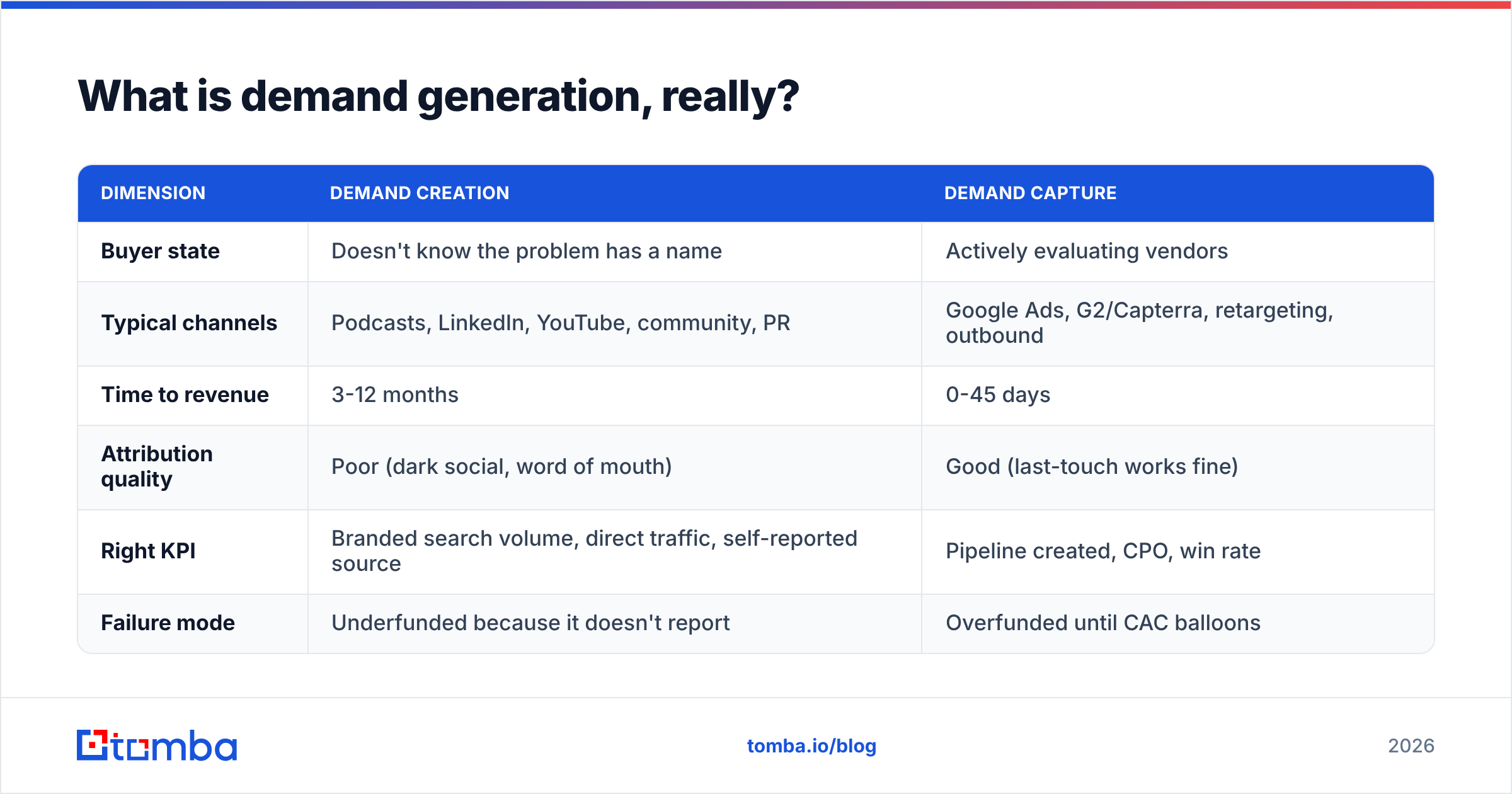
| Dimension | Demand creation | Demand capture |
|---|---|---|
| Buyer state | Doesn't know the problem has a name | Actively evaluating vendors |
| Typical channels | Podcasts, LinkedIn, YouTube, community, PR | Google Ads, G2/Capterra, retargeting, outbound |
| Time to revenue | 3-12 months | 0-45 days |
| Attribution quality | Poor (dark social, word of mouth) | Good (last-touch works fine) |
| Right KPI | Branded search volume, direct traffic, self-reported source | Pipeline created, CPO, win rate |
| Failure mode | Underfunded because it doesn't report | Overfunded until CAC balloons |
Capture channels report beautifully, which is exactly why they get overfunded. Creation channels are the ones that make capture cheap, and they are almost invisible in a last-touch model.
Why do most demand gen programs stall?#
Four reasons, in order of how often they show up.
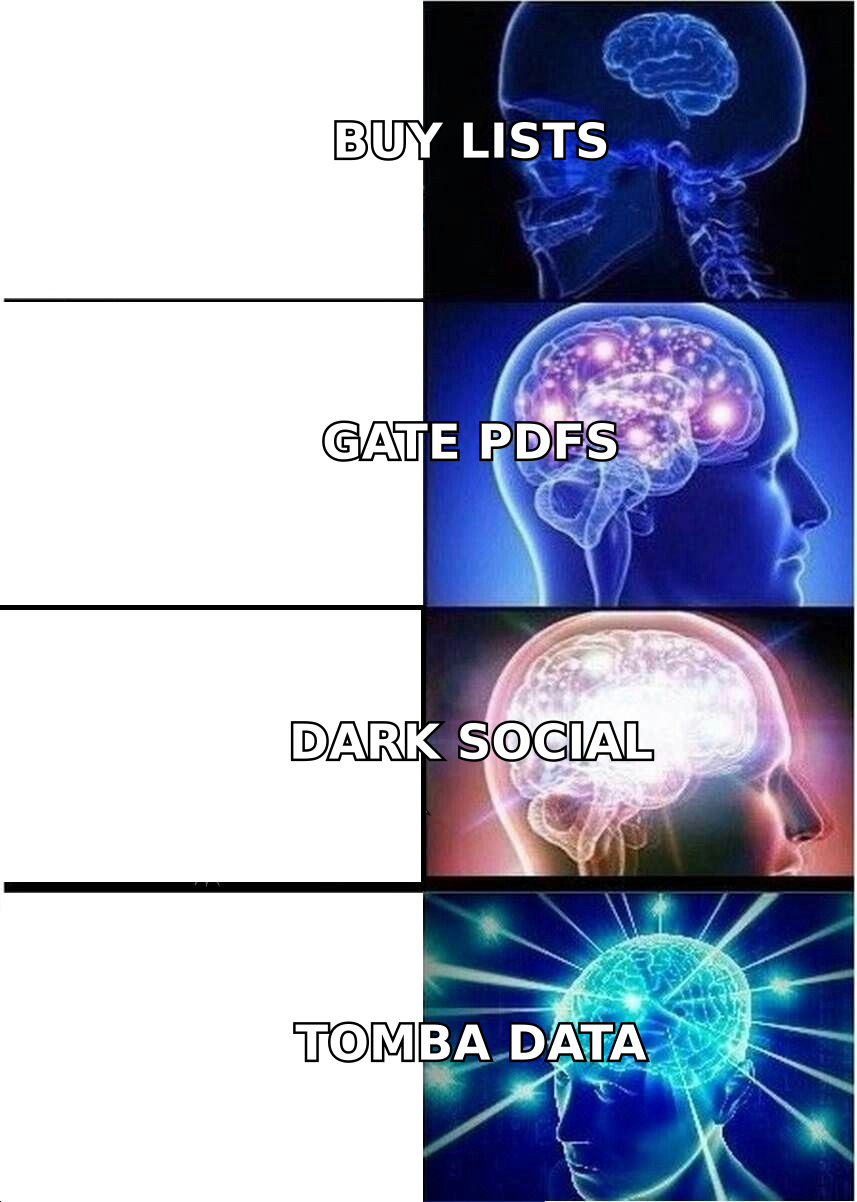
- They confuse volume with demand. Ten thousand ebook downloads from a $4 CPL campaign is not demand. It's a list of people who wanted a PDF. If a lead never comes back on their own, you generated a download, not a buyer.
- They report on the wrong unit. Once your board sees an MQL number, that number becomes the target, and every incentive bends toward inflating it. Report pipeline created from day one and the tactics change on their own.
- They gate everything. Gating your best content behind a form trades reach for records. In a category where nobody knows you yet, that's a terrible trade. Ungate the education, gate the tools and templates.
- Their data decays faster than they refresh it. B2B contact data goes stale at roughly 25-30% a year through job changes alone. If nobody owns re-verification, your "demand" is bouncing off dead inboxes.
The fourth one is the quietest killer. Marketing writes the campaign, sales works the list, half the sends bounce, sender reputation drops, and the next campaign underperforms for reasons nobody traces back to the data.
How should you split your demand gen budget in 2026?#
Start at 60% creation / 40% capture and move from there based on how mature your category is. If buyers already search for what you sell by name, shift toward capture. If you're teaching the market a new term, shift toward creation.
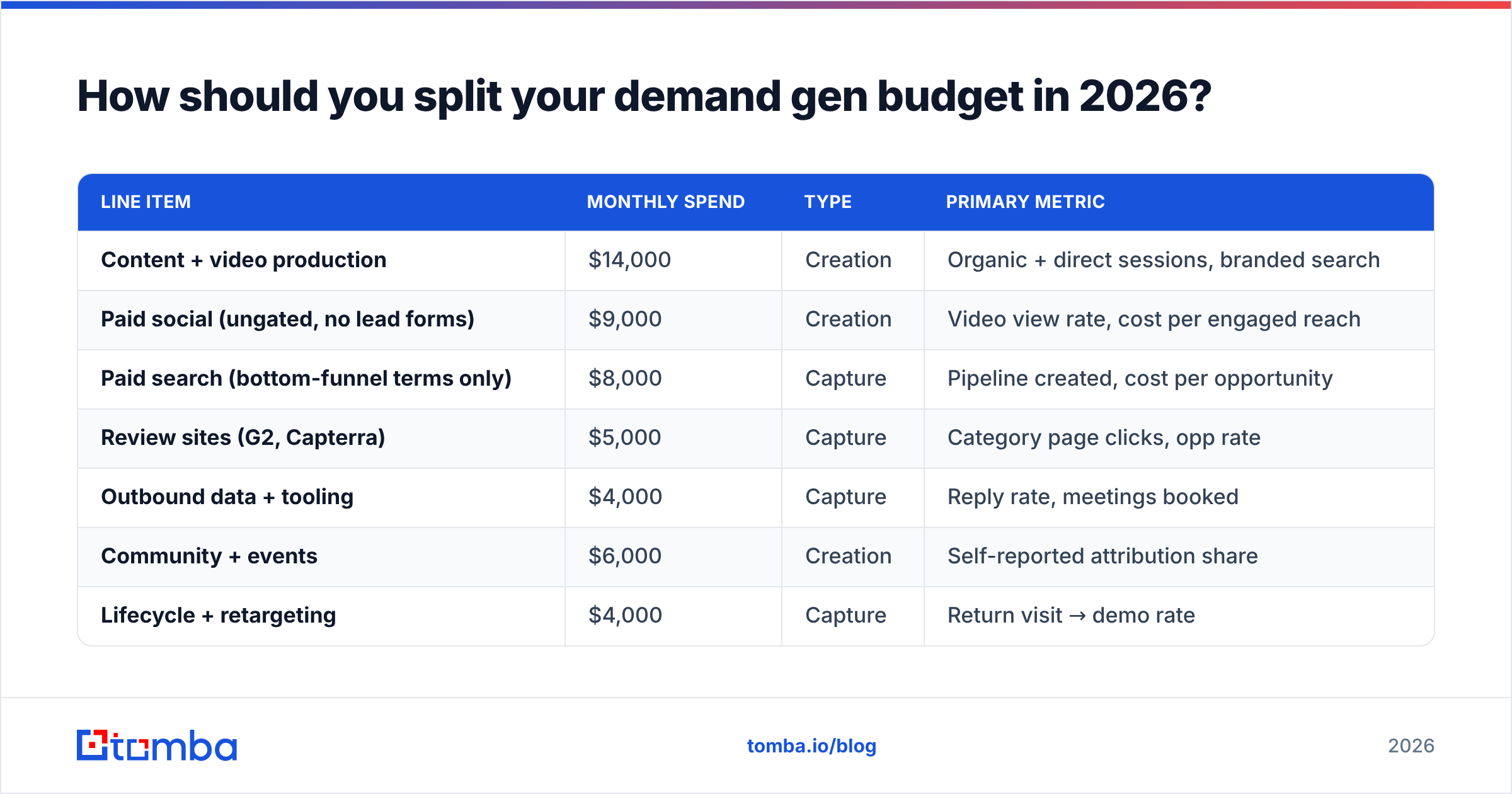
Here's a reference allocation for a $50k/month program in a semi-mature category:
| Line item | Monthly spend | Type | Primary metric |
|---|---|---|---|
| Content + video production | $14,000 | Creation | Organic + direct sessions, branded search |
| Paid social (ungated, no lead forms) | $9,000 | Creation | Video view rate, cost per engaged reach |
| Paid search (bottom-funnel terms only) | $8,000 | Capture | Pipeline created, cost per opportunity |
| Review sites (G2, Capterra) | $5,000 | Capture | Category page clicks, opp rate |
| Outbound data + tooling | $4,000 | Capture | Reply rate, meetings booked |
| Community + events | $6,000 | Creation | Self-reported attribution share |
| Lifecycle + retargeting | $4,000 | Capture | Return visit → demo rate |
Two rules keep this honest. First, never let paid search bid on top-of-funnel informational terms — that's creation work priced as capture. Second, cap review-site spend at the point where incremental clicks stop converting; G2 category traffic is high-intent, but it is finite.
What are the demand gen best practices that actually move pipeline?#
These are the ones that survive contact with a real quarter.
- Publish for the 95% who aren't in market. Most of your addressable market is not buying this quarter. Content that only speaks to active evaluators reaches a sliver of the audience. Write the "how does this category work" piece, not just the "us vs. them" piece.
- Ungate everything except tools. Reports, guides, and benchmarks go public. Calculators, templates, and audits stay gated — those signal active work, not idle interest.
- Add a self-reported attribution field. One open text field on your demo form: "How did you hear about us?" It will disagree with your analytics, and it will be closer to the truth. Gartner's marketing research has been flagging multi-touch model drift for years; self-reported data is the cheap correction.
- Run outbound on enriched, verified data — not scraped lists. Every campaign should start with a fresh verification pass. Bounces above 3% put your domain at risk, and you'll pay for it across every send for weeks.
- Route intent signals in under 48 hours. A pricing-page visit is worth something on Tuesday and nothing the following Monday. Speed beats sophistication here.
- Kill a channel every quarter. If you never sunset anything, you're not measuring. Pick the worst performer by pipeline-per-dollar and cut it.
How do you turn demand into contactable pipeline?#
Demand you can't reach is just brand awareness. The bridge from "someone is interested" to "someone is in a conversation" is a data problem, and it has four steps.
- Capture the signal. Site visits, ad engagement, community posts, podcast listens, review-site category views. Use website visitor reveal to convert anonymous high-intent traffic into named accounts before it disappears.
- Resolve the account to people. Identify the two or three roles who actually decide. For a mid-market SaaS purchase that's typically a champion, an economic buyer, and one skeptic in ops or security.
- Find and verify the contact details. Use a domain search to pull the pattern and the people at the account, then push every address through an email verifier before it enters a sequence. Non-negotiable.
- Enrich for relevance. Title, seniority, tech stack, headcount band, and recent funding turn a generic sequence into one worth replying to. Data enrichment is what makes personalization scalable instead of artisanal.
- Hand off with context, not just a name. The rep should see what the person did, not just that they exist. "Read your pricing page twice and the security doc" is a different opener than "downloaded an ebook."
Skipping step three is the most common shortcut and the most expensive. HubSpot's marketing research consistently finds data quality among the top reported blockers for marketing teams, and it compounds: bad data lowers deliverability, lower deliverability lowers reply rates, lower reply rates make good campaigns look like bad ones.
Which demand gen metrics should you report?#
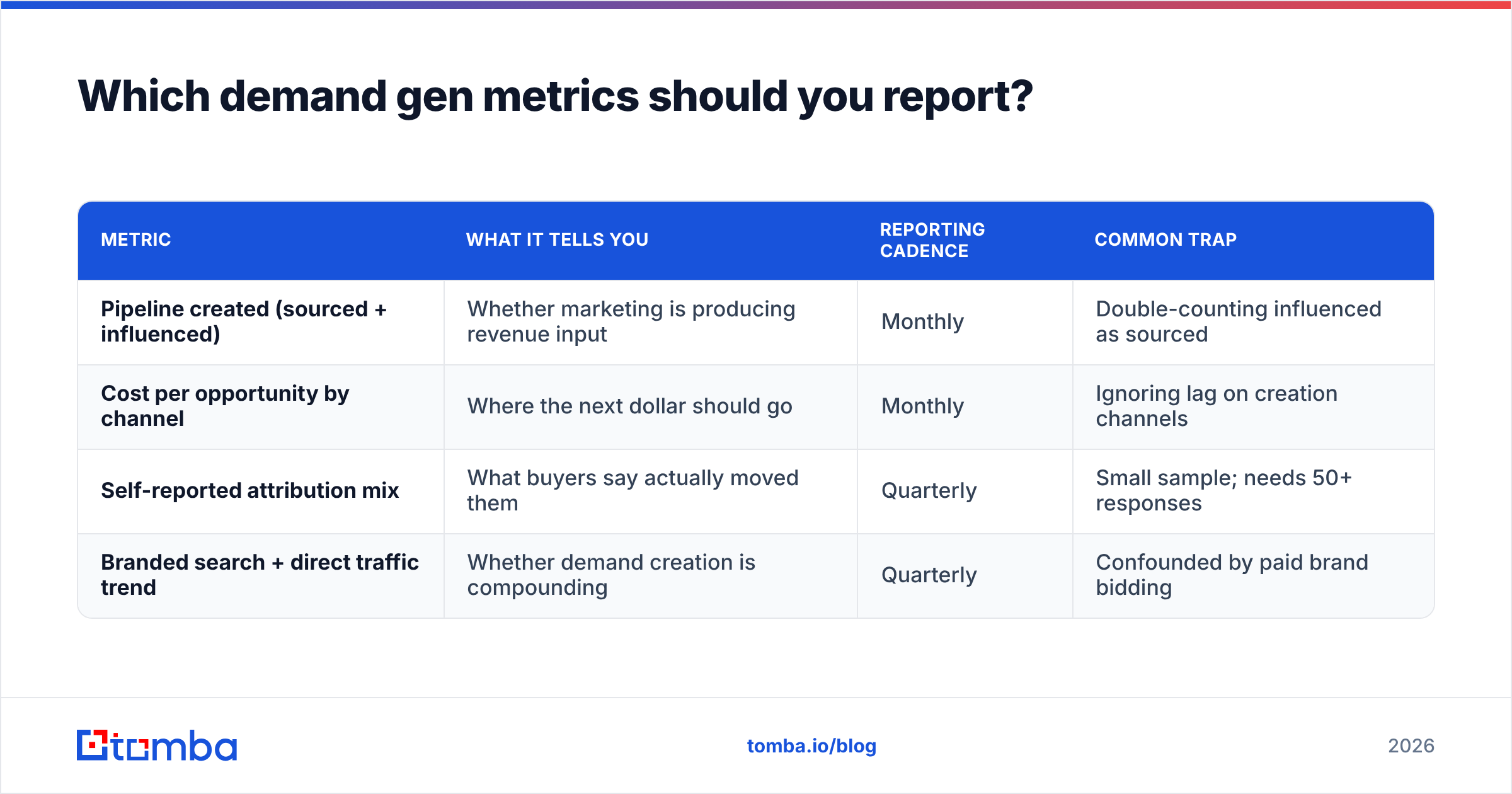
Report four numbers to leadership and keep the rest for the team.
| Metric | What it tells you | Reporting cadence | Common trap |
|---|---|---|---|
| Pipeline created (sourced + influenced) | Whether marketing is producing revenue input | Monthly | Double-counting influenced as sourced |
| Cost per opportunity by channel | Where the next dollar should go | Monthly | Ignoring lag on creation channels |
| Self-reported attribution mix | What buyers say actually moved them | Quarterly | Small sample; needs 50+ responses |
| Branded search + direct traffic trend | Whether demand creation is compounding | Quarterly | Confounded by paid brand bidding |
Notice what's missing: MQLs, form fills, ebook downloads, webinar registrants, impressions. Those are diagnostics for the team, not decisions for the board. The moment a diagnostic becomes a target, someone will hit it in a way that doesn't produce revenue.
One nuance on cost per opportunity: creation channels will always look worse on a 30-day window and better on a 180-day window. If you evaluate a podcast sponsorship on the same clock as a search campaign, you will cancel the podcast every time, and your search costs will quietly climb for the next two years.
Is demand gen different for PLG vs. sales-led motions?#
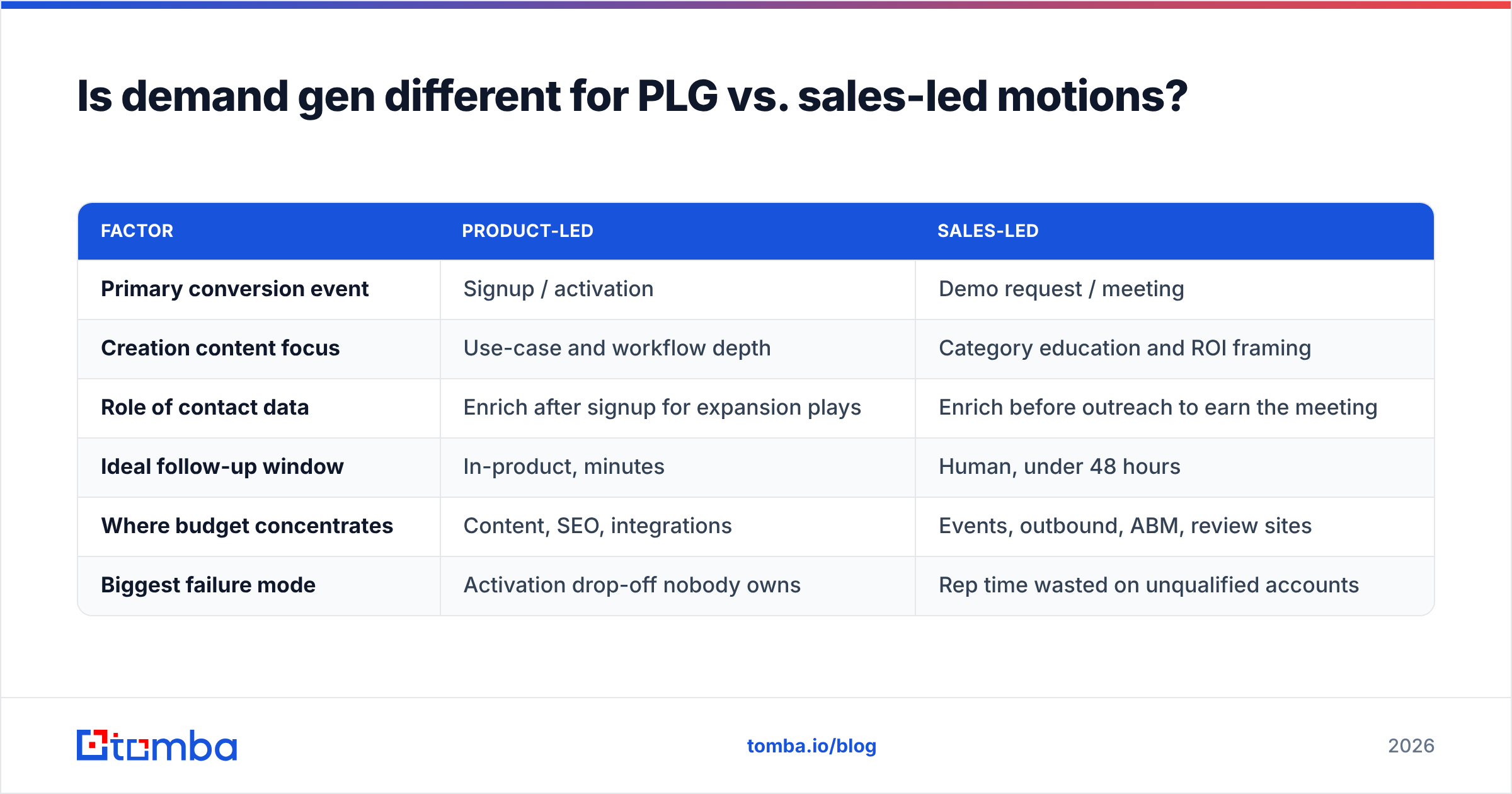
Yes, mostly in where the conversion happens and what data you need.
| Factor | Product-led | Sales-led |
|---|---|---|
| Primary conversion event | Signup / activation | Demo request / meeting |
| Creation content focus | Use-case and workflow depth | Category education and ROI framing |
| Role of contact data | Enrich after signup for expansion plays | Enrich before outreach to earn the meeting |
| Ideal follow-up window | In-product, minutes | Human, under 48 hours |
| Where budget concentrates | Content, SEO, integrations | Events, outbound, ABM, review sites |
| Biggest failure mode | Activation drop-off nobody owns | Rep time wasted on unqualified accounts |
Product-led teams still need contact data — just later in the sequence, for expansion and multi-threading inside accounts that already signed up. Sales-led teams need it at the front, because the meeting has to be earned before any product experience exists.
Hybrid motions are now the norm, which means most teams need both patterns running without arguing over the same budget line. Split the plan, split the metrics, and let each one be judged on its own timeline.
What does a 90-day demand gen plan look like?#
Days 1-30 — Fix the foundation. Audit your CRM data and re-verify every contact older than six months. Add the self-reported attribution field. Ungate your top three assets and measure the traffic change. Define pipeline-created as the primary KPI in writing, and get the CRO to co-sign it.
Days 31-60 — Build the creation engine. Ship one recurring content format you can sustain weekly — a newsletter, a show, a teardown series. Start paid social with no lead forms, optimizing for engaged reach. Turn on visitor identification and route named accounts into a daily review queue. Build the verified contact workflow so any account can go from "identified" to "contactable" in one step.
Days 61-90 — Close the loop. Layer capture on top: bottom-funnel search, review-site presence, and outbound to the accounts your creation work already warmed. Report the first pipeline numbers by channel. Kill the worst performer. Document what self-reported attribution says versus what your analytics says, and start trusting the former for creation channels.
Ninety days won't compound a brand. It will tell you whether your funnel leaks at the top, in the middle, or in the handoff — and that's the difference between the next quarter of spend being an investment and being a guess.
Start with data you can actually reach#
Every demand gen best practice on this page assumes one thing: when someone raises their hand, or when your visitor-reveal tool surfaces an account worth chasing, you can reach a real person there. That assumption breaks more often than teams realize.
The Tomba Email Finder closes that gap. Pull verified professional addresses by domain, name, or company, push them through verification before they ever hit a sequence, and hand your reps contacts that connect instead of bounce. Start free with 25 searches a month, or check Tomba pricing — Starter is $49/mo and Growth is $99/mo — and stop losing hard-won demand at the last step.
Related guides#
Ready to find emails that actually work?
Join 150,000+ professionals who stopped guessing and started sending. Free credits on signup — no credit card required.
Get the Tomba newsletter
Practical outbound tactics and product updates — once every two weeks.
About the author