Demand Gen Content in 2026: What Actually Drives Pipeline
Most demand gen content produces traffic, not pipeline. Here's the 2026 playbook: the four content tiers that map to buying stages, how to measure them honestly, and where lead capture still belongs.
TL;DR
- Demand gen content creates and captures buying intent; lead gen content trades a file for an email address. Confusing the two is why most content programs report traffic growth and flat pipeline.
- The formats that actually move deals in 2026 are ungated: pricing transparency pages, comparison and alternatives pages, product-led teardowns, and practitioner POV content. Gated ebooks are now a capture mechanism, not a demand mechanism.
- You need four content tiers — problem-aware, solution-aware, vendor-aware, and expansion — each with a different success metric. Measuring all four by form fills is the core reporting bug.
- Self-reported attribution ("How did you hear about us?") plus a dark-social-aware model beats last-touch by a wide margin. Last-touch systematically over-credits branded search.
- Content only turns into pipeline when someone actually reaches the buyer. Pair your distribution plan with a clean contact layer — enrichment and verified emails — or your best asset dies in a spreadsheet.
What is demand gen content, exactly?#
Demand gen content is content designed to create awareness of a problem, shape how buyers evaluate solutions, and stay in front of them until they're ready — without requiring a form fill as the price of entry.
Think of it like a restaurant's smell drifting onto the sidewalk. You're not asking passersby for their phone number before they can smell the bread. You're making them hungry. The reservation comes later, and it comes willingly.
The technical distinction matters because it changes what you build and how you score it:
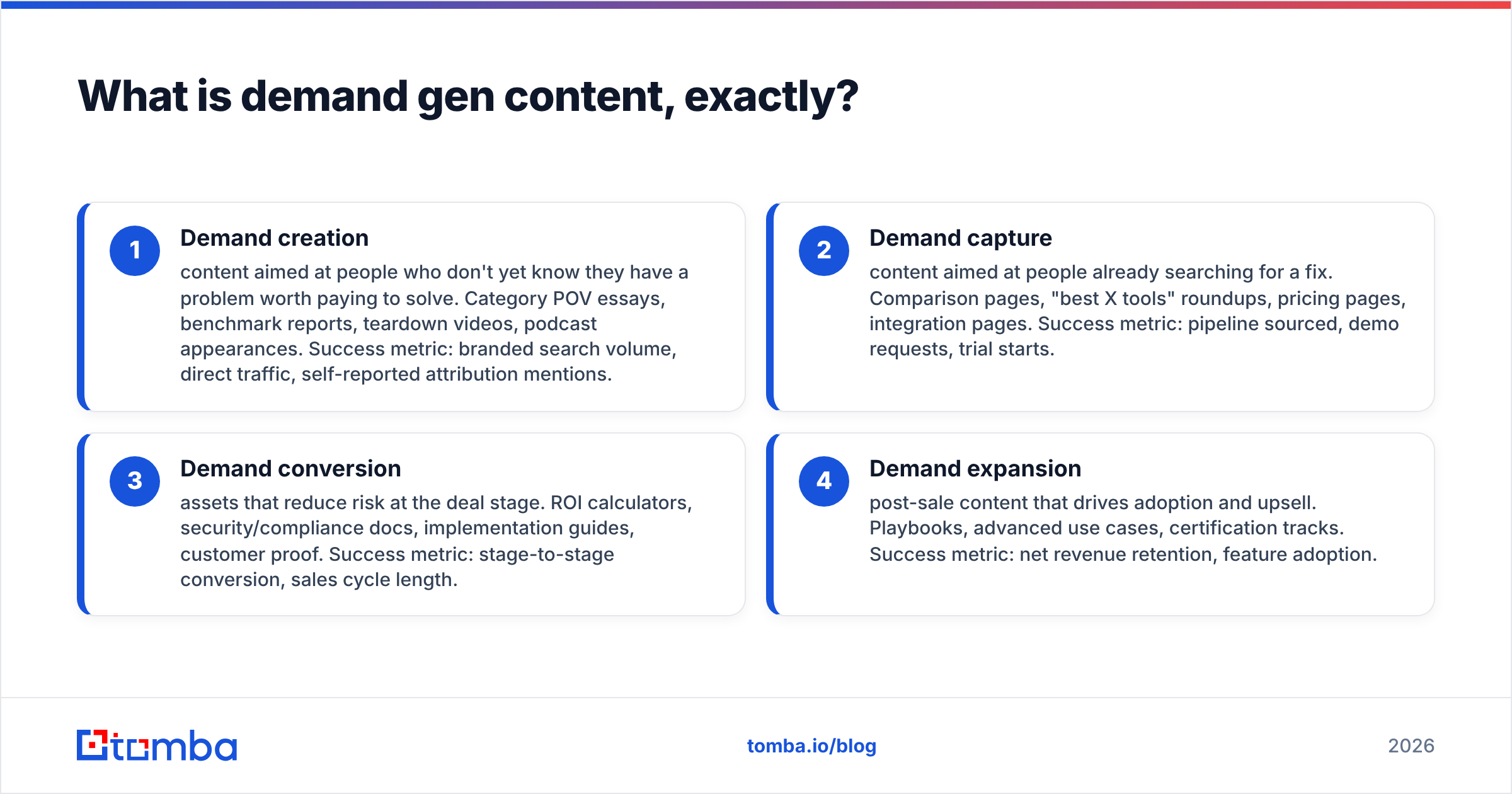
- Demand creation — content aimed at people who don't yet know they have a problem worth paying to solve. Category POV essays, benchmark reports, teardown videos, podcast appearances. Success metric: branded search volume, direct traffic, self-reported attribution mentions.
- Demand capture — content aimed at people already searching for a fix. Comparison pages, "best X tools" roundups, pricing pages, integration pages. Success metric: pipeline sourced, demo requests, trial starts.
- Demand conversion — assets that reduce risk at the deal stage. ROI calculators, security/compliance docs, implementation guides, customer proof. Success metric: stage-to-stage conversion, sales cycle length.
- Demand expansion — post-sale content that drives adoption and upsell. Playbooks, advanced use cases, certification tracks. Success metric: net revenue retention, feature adoption.
Most teams build tier 2 obsessively, publish a little of tier 1, and ignore tiers 3 and 4 entirely. That's a pipeline problem dressed up as a content problem.
Why did gated ebooks stop working?#
Because the trade stopped being fair. In 2015, a 30-page PDF on "the state of X" contained information you genuinely could not get elsewhere. In 2026, an AI assistant will synthesize the same content in eleven seconds without asking for your work email.
What died isn't the ebook. It's the gate as a demand mechanism. Here's the honest split:

The gate still works as a capture mechanism for people already convinced. It fails as a creation mechanism, because you can't create demand in someone who never read the thing.
The practical fix most teams land on: publish the asset ungated, then offer a genuinely additive companion behind a form — the raw dataset, a template pack, a calculator, a live teardown session. You capture a smaller number of far more qualified contacts, and the ungated version keeps compounding in search, LinkedIn shares, and LLM citations.
One number worth internalizing: Gartner's B2B buying research has consistently found that buyers spend a small minority of the buying cycle with any vendor's sales team. The rest is independent research. Gated content removes you from the majority of the journey you're trying to influence.
Which demand gen content formats actually drive pipeline in 2026?#
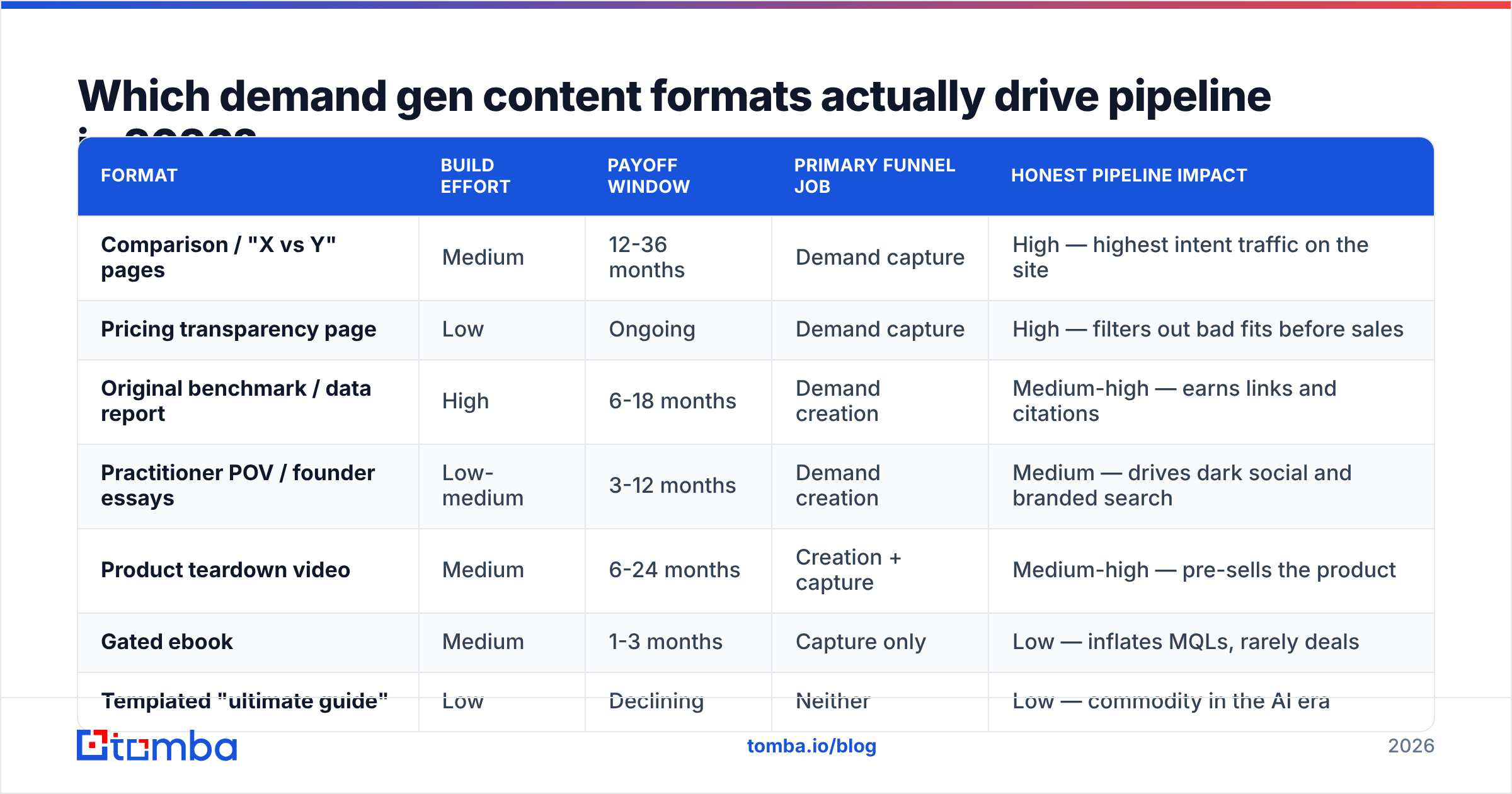
Here's how the major formats compare on the things that matter — time to build, how long the payoff lasts, and whether it produces pipeline or just impressions.
| Format | Build effort | Payoff window | Primary funnel job | Honest pipeline impact |
|---|---|---|---|---|
| Comparison / "X vs Y" pages | Medium | 12-36 months | Demand capture | High — highest intent traffic on the site |
| Pricing transparency page | Low | Ongoing | Demand capture | High — filters out bad fits before sales |
| Original benchmark / data report | High | 6-18 months | Demand creation | Medium-high — earns links and citations |
| Practitioner POV / founder essays | Low-medium | 3-12 months | Demand creation | Medium — drives dark social and branded search |
| Product teardown video | Medium | 6-24 months | Creation + capture | Medium-high — pre-sells the product |
| Gated ebook | Medium | 1-3 months | Capture only | Low — inflates MQLs, rarely deals |
| Templated "ultimate guide" | Low | Declining | Neither | Low — commodity in the AI era |
| Customer implementation story | Medium | 12+ months | Conversion | High — best late-stage asset in the library |
The pattern is consistent: content that reveals something specific — a real price, a real benchmark, a real deployment — outperforms content that summarizes what everyone already knows. Summaries are free now. Specifics aren't.
The comparison page deserves special attention#
Every buyer evaluating you is already searching "[your product] vs [competitor]" and "[competitor] alternatives." If you don't publish an honest version, a review aggregator or an affiliate site will publish a worse one and monetize your brand name.
Write it neutrally. Name the cases where the other tool genuinely wins. Buyers can tell when a comparison page is a rigged fight, and the credibility hit costs more than the honest concession. G2 and Capterra listings should complement these pages, not replace them — you control the narrative on your own domain.
How do you build a demand gen content engine without a big team?#
Four moving parts. Run them as a loop, not a waterfall.
1. Mine the source material you already have. Sales call recordings, support tickets, lost-deal reasons, and your own churn interviews contain more usable content angles than any keyword tool. Pull the exact language buyers use — including the objections. A post that names an objection out loud outperforms three posts that dodge it.
2. Build the asset once, atomize it many times. One benchmark report becomes: the report page, five LinkedIn posts with individual charts, a podcast talking point, three comparison-page updates, a newsletter issue, and a sales-enablement one-pager. Teams that publish once and move on leave most of the value on the table.
3. Distribute deliberately. Publishing is not distribution. Every asset needs a named channel plan before it ships: which communities, which newsletters, which partners, which specific people get a direct message about it. This is where most content programs quietly fail — not at the writing stage.
4. Close the loop with real contact data. The distribution plan that includes "email 40 relevant practitioners and analysts" only works if you can actually reach them. A bulk email finder turns a target account list into deliverable contacts, and an email verifier keeps your bounce rate low enough that your domain reputation survives the campaign. Sending a great asset from a burned domain is a self-inflicted wound.
That fourth step is where content and outbound stop being separate departments. Your best-performing asset is also your best cold-email hook — but only if the send lands in a primary inbox.
What metrics should you use for demand gen content?#
Stop reporting MQLs as if they were a business outcome. They're a workflow artifact.

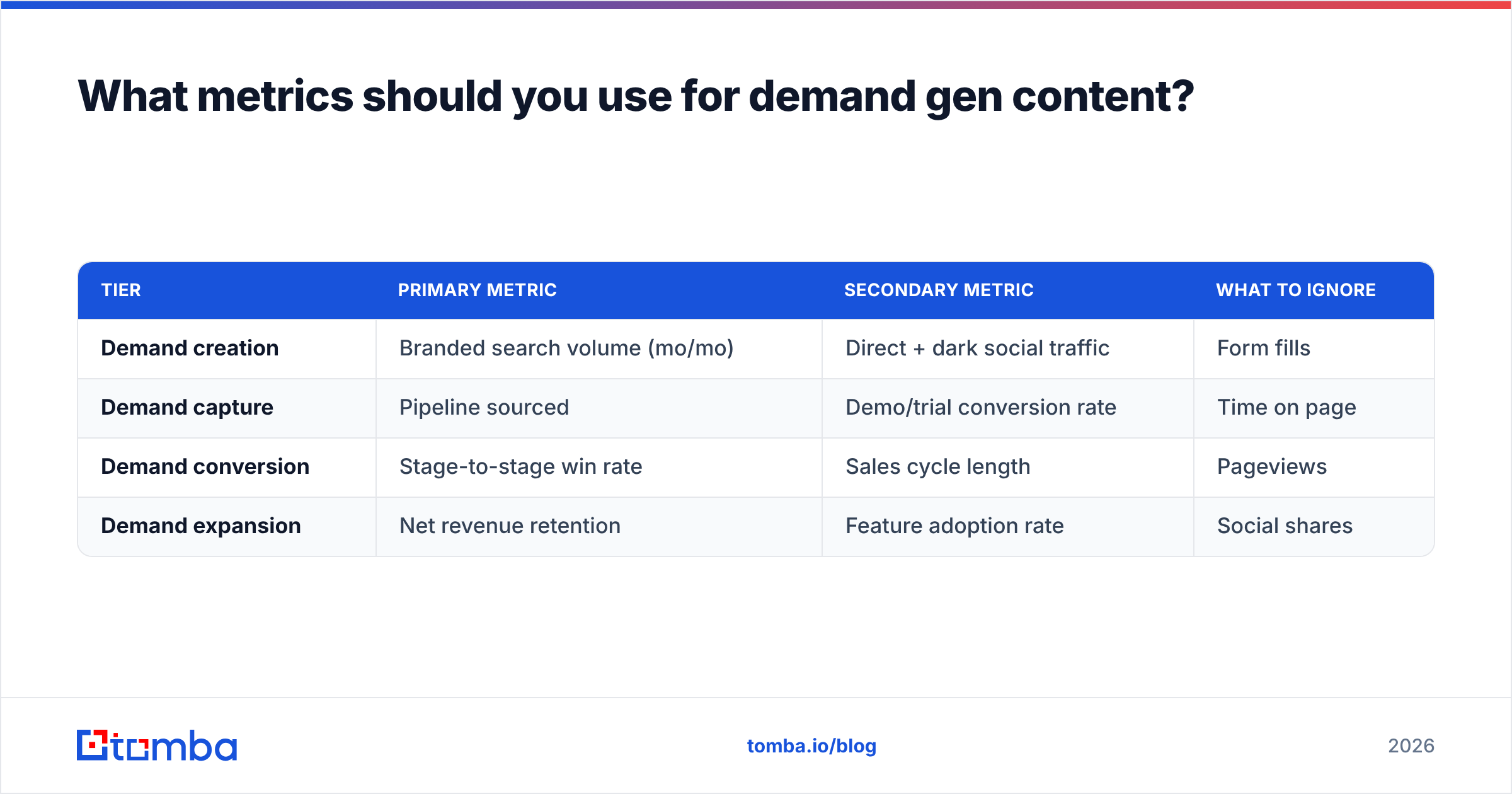
Use tier-specific metrics instead:
| Tier | Primary metric | Secondary metric | What to ignore |
|---|---|---|---|
| Demand creation | Branded search volume (mo/mo) | Direct + dark social traffic | Form fills |
| Demand capture | Pipeline sourced | Demo/trial conversion rate | Time on page |
| Demand conversion | Stage-to-stage win rate | Sales cycle length | Pageviews |
| Demand expansion | Net revenue retention | Feature adoption rate | Social shares |
Three measurement practices separate teams that can defend a content budget from teams that can't:
- Add a self-reported attribution field to your demo form ("How did you hear about us?" as a free-text or semi-structured field). It routinely surfaces podcasts, communities, and word-of-mouth that no analytics tool sees. Compare it against your last-touch model quarterly — the gap is your dark social volume.
- Track branded search as a content KPI. If demand creation is working, more people search your company name each month. It's the cleanest available proxy for "we made someone aware of us."
- Measure pipeline, not leads. A tier-2 comparison page producing 12 demos a quarter beats a gated report producing 400 downloads and 3 demos. Report the revenue number and the argument ends.
If you're building a scoring model on top of this, the standard framing around marketing qualified lead definitions still applies — just make sure the qualification criteria are behavioral (pricing page visits, comparison page visits, integration doc views) rather than "downloaded a PDF." HubSpot's research on content ROI is a reasonable external benchmark if you need to calibrate expectations with a skeptical CFO.
How does demand gen content connect to outbound?#
The two functions borrow from each other constantly, and pretending otherwise creates duplicated work.
Demand gen content gives outbound something worth sending. A cold email offering "a quick chat" gets ignored. A cold email offering "we benchmarked 40 tools in your category and your current stack ranked 12th on X — here's the data" gets opened, because it leads with a specific artifact.
Outbound gives demand gen its distribution muscle. Your first hundred readers won't arrive from search. They arrive because someone put the asset in front of them.
The mechanics look like this:
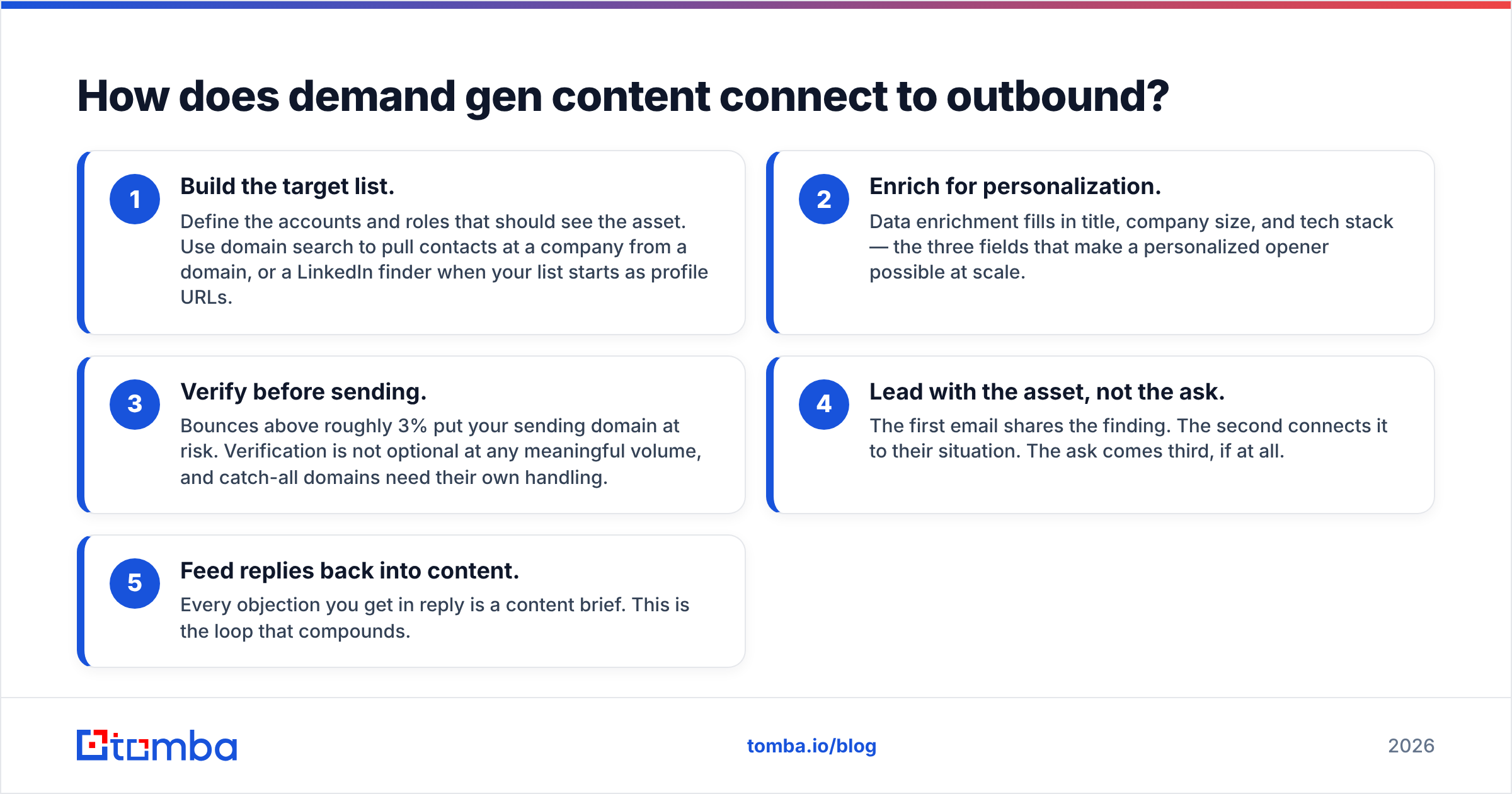
- Build the target list. Define the accounts and roles that should see the asset. Use domain search to pull contacts at a company from a domain, or a LinkedIn finder when your list starts as profile URLs.
- Enrich for personalization. Data enrichment fills in title, company size, and tech stack — the three fields that make a personalized opener possible at scale.
- Verify before sending. Bounces above roughly 3% put your sending domain at risk. Verification is not optional at any meaningful volume, and catch-all domains need their own handling.
- Lead with the asset, not the ask. The first email shares the finding. The second connects it to their situation. The ask comes third, if at all.
- Feed replies back into content. Every objection you get in reply is a content brief. This is the loop that compounds.
For teams comparing data providers on this layer, options range from broad platforms to focused email-finding tools. Tomba sits in the focused camp — deep on finding and verifying work emails at a domain — while providers like BookYourData take a database-first approach with pre-built, downloadable B2B lists. Both are legitimate strategies; the right pick depends on whether your motion is "find contacts at these 200 specific accounts" (search-first) or "give me 5,000 contacts matching this filter" (database-first). Check current Tomba pricing against your monthly contact volume before committing — the Free tier's 25 searches a month is enough to test accuracy on a domain you already know well.
What does a 90-day demand gen content plan look like?#
Days 1-30 — Audit and capture. Inventory everything you've published. Kill or consolidate the templated guides that get no traffic. Publish or fix three high-intent capture assets: a transparent pricing page, one comparison page against your most-encountered competitor, and one integration page for your most common stack partner. These pay back fastest because the demand already exists.
Days 31-60 — Create one thing worth citing. Pick a question your market argues about and answer it with original data. A survey of 300 practitioners, an analysis of your own anonymized product data, a hands-on benchmark of eight tools. One real dataset beats twelve opinion posts. Publish it ungated.
Days 61-90 — Distribute and instrument. Build the target list, run the outreach, place the asset in the communities and newsletters your buyers read. Simultaneously, install self-reported attribution on your forms and start a monthly branded-search report. By day 90 you should be able to answer "did this create demand?" with a number rather than a vibe.
Repeat quarterly. The capture assets from quarter one keep compounding while quarter two's creation asset builds. That overlap is the entire mechanism — there is no single post that does both jobs well.
Common mistakes that quietly kill demand gen content#
- Publishing without a distribution owner. If nobody's name is next to "get this in front of people," it doesn't happen. Assign it before the draft is finished.
- Gating the demand-creation asset. You cannot create awareness in someone who never saw the content. Gate the companion, not the core.
- Writing for the keyword instead of the buyer. AI-generated summaries have made generic keyword content worthless. Specificity is now the only durable moat.
- Reporting volume metrics upward. Pageviews to a CFO is how content budgets get cut. Pipeline sourced is how they get defended.
- Treating content and outbound as separate budgets. They share source material, target lists, and messaging. Run them from one plan.
- Skipping data hygiene. A brilliant campaign sent to a stale list produces bounces, spam complaints, and a damaged domain — three problems that take months to unwind.
Get the contact layer right before you scale distribution#
Demand gen content compounds only when it reaches people. That means an accurate, deliverable contact layer sitting underneath every campaign you run — verified work emails, enriched company context, and no bounce-driven reputation damage.
Start with the Tomba Email Finder. Pull contacts by domain, name, or company, verify them before you send, and connect the results to your CRM through the existing integrations. The Free tier gives you 25 searches a month to test accuracy against a company you already know, and paid plans start at $49/mo when you're ready to run real volume. Your content deserves an audience that actually receives it.
Related guides#
Ready to find emails that actually work?
Join 150,000+ professionals who stopped guessing and started sending. Free credits on signup — no credit card required.
Get the Tomba newsletter
Practical outbound tactics and product updates — once every two weeks.
About the author