Demand Gen Team Structure: How to Build One in 2026
Most demand gen teams are org charts copied from a Series B deck. Here's how the roles actually break down by company stage, what each hire owns, and when to hire whom.
Your demand gen team structure should track your pipeline target, not your funding round. Here is the order that works.
TL;DR
- A demand gen team structure is not one org chart. It is four, and ARR picks which one you need.
- The first three hires that matter, in order: a generalist demand gen manager, a marketing ops person, then a paid specialist. Content comes fourth.
- The classic mistake is hiring channel experts before anyone owns the data. Five people then chase numbers nobody can tie to revenue.
- Ratios that hold up: about 1 demand gen FTE per $2–3M in new ARR, and 1 ops person per 4–6 marketers.
- Every structure rests on clean contact data. A team of six with a 30% bounce rate wastes a third of its budget.
What is a demand gen team structure?#
A demand gen team structure sets who owns what. Who owns channels. Who owns content. Who owns the data. Who owns the number.
Think of it like a kitchen. A two-person diner has one cook doing prep, grill, and plating. A busy kitchen has stations, plus an expo who makes sure plates leave together. Nobody staffs a full brigade on day one. Nobody runs a packed service with one cook. Most B2B teams get this wrong in one of two ways. They staff the brigade too early, or they ask one generalist to run a full house.
Demand gen covers a lot: paid media, content, SEO, events, webinars, email, ABM, and the outbound support around it. That is a wide surface. So the real question is simple. Which slices do you split, and when?
One split matters more than the rest. Demand creation makes people want the category. Demand capture converts people who are already looking. Early teams should sit almost entirely on capture. Teams that chase creation first often burn a year on awareness they cannot measure.
What roles belong on a demand gen team?#
Here are the five core roles, ranked by how much a demand gen team structure needs them.
Demand Gen Manager (generalist) — Owns the pipeline number. Runs paid, email, and landing pages in person at first. This is hire one, and often the only one until $5M ARR. Look for someone who has built campaigns, not just briefed agencies.
Marketing Ops / RevOps — Owns the plumbing: CRM hygiene, lead routing, attribution, MQL rules, and the data enrichment pipeline. Almost every team hires this role too late. Without it, every number gets argued over in every pipeline meeting.
Paid Acquisition Specialist — Owns spend efficiency across search, paid social, and retargeting. Worth it once monthly spend passes about $25–30K. Below that, an agency or the generalist is cheaper.
Content / SEO Lead — Owns organic pipeline and the asset library every other channel pulls from. Payback takes 6–12 months. Hire too early and faster channels lose budget.
Lifecycle / Email Marketer — Owns nurture, win-back, and the handoff to sales. Needed once your database passes about 50K contacts and manual sends stop scaling.
A sixth role, ABM Manager, shows up later. It fits when average deal size clears about $50K and the target list is under 1,000 accounts. Below that, ABM is a tactic the generalist runs. It is not a job title.

How should the team structure change by company stage?#
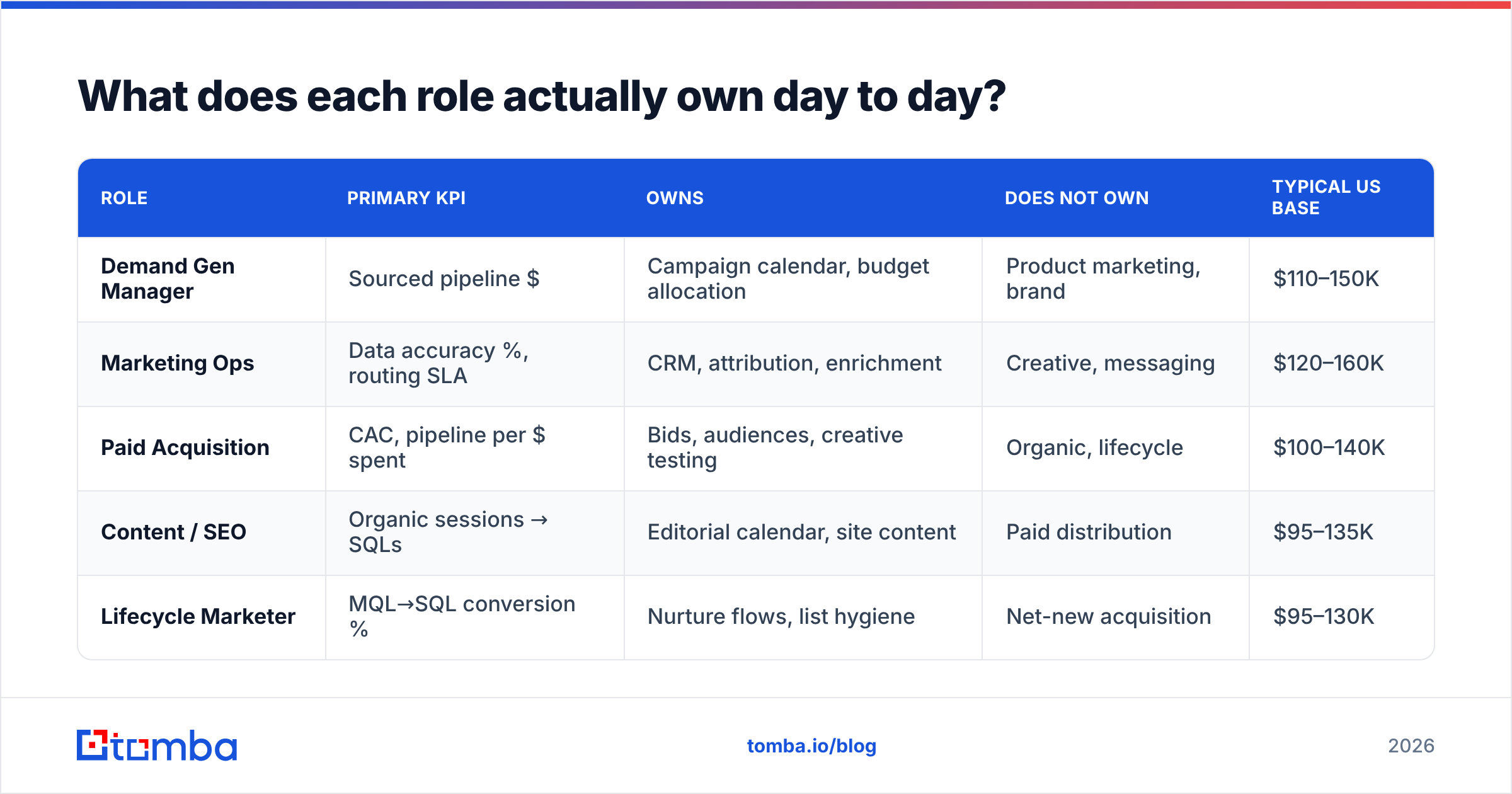
| Stage | ARR | Team size | Structure | Reports to | First thing that breaks |
|---|---|---|---|---|---|
| Seed | <$1M | 0–1 | Founder + contractors | CEO | No one owns follow-up |
| Series A | $1–5M | 2–3 | Generalist DG + ops (part-time) | Head of Marketing | Attribution disputes |
| Series B | $5–20M | 4–8 | Channel pods (paid, content, lifecycle) + full-time ops | VP Marketing | Channel silos, duplicate audiences |
| Series C+ | $20–75M | 9–20 | Segment pods (SMB / mid-market / enterprise) | CMO or VP Demand Gen | Coordination overhead, slow launches |
| Scale | $75M+ | 20+ | Regional + segment matrix, centralized ops | CMO | Local relevance vs. global consistency |
The big shift lands between Series B and Series C. Teams stop sorting by channel and start sorting by segment. In a channel pod, one paid marketer runs ads for SMB and enterprise at once. The same creative logic hits a $5K deal and a $200K deal. That works until segment economics split apart. Then it fails fast.
Segment pods fix relevance. They also cost more. Each pod wants its own budget, its own content, and its own email cadence. That is why central ops becomes a must at this stage. Someone has to own the shared data layer, so three pods do not each buy the same contact lists.
Stage is the single best predictor of the right demand gen team structure.
What does each role actually own day to day?#
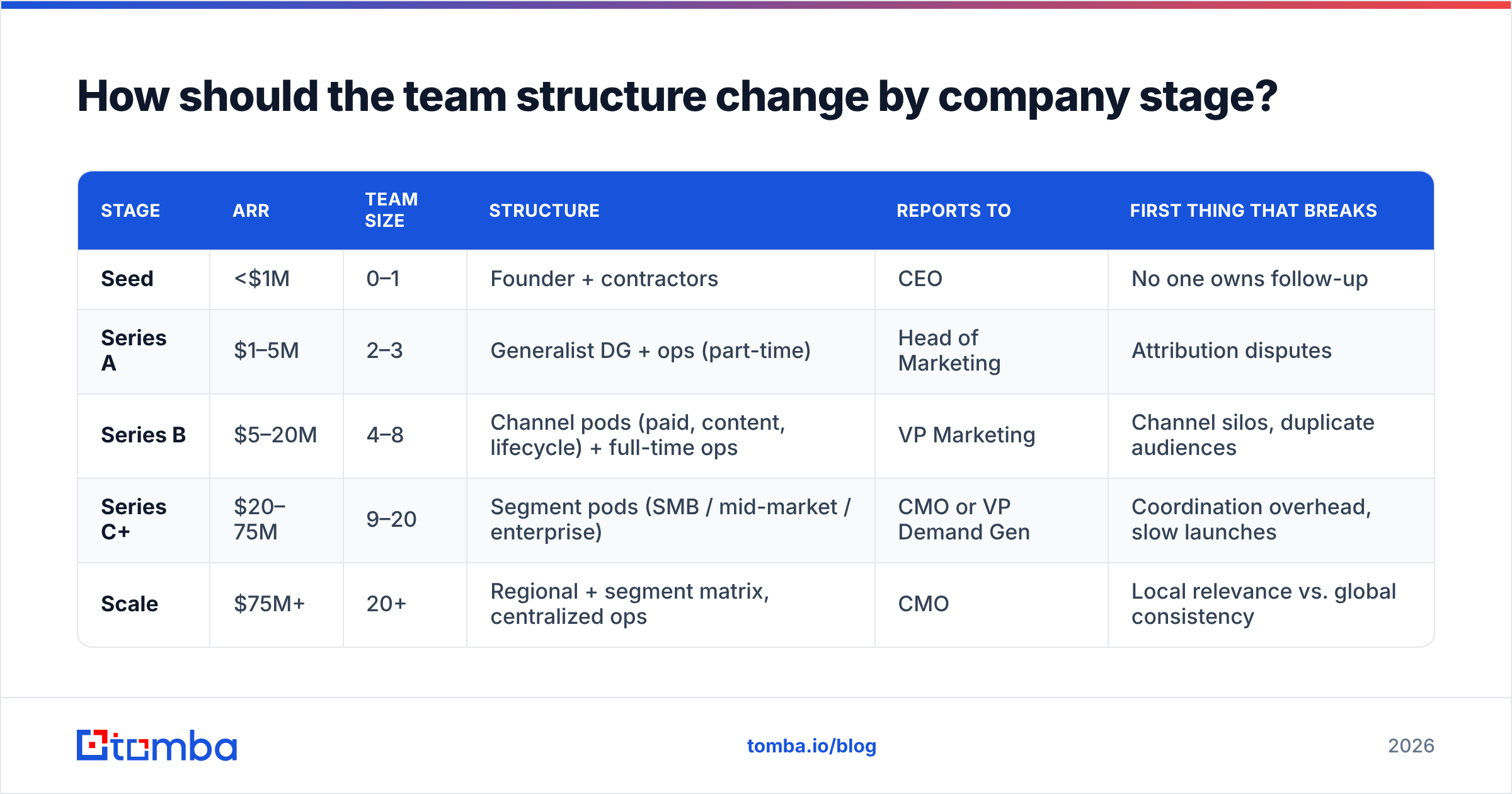
| Role | Primary KPI | Owns | Does not own | Typical US base |
|---|---|---|---|---|
| Demand Gen Manager | Sourced pipeline $ | Campaign calendar, budget allocation | Product marketing, brand | $110–150K |
| Marketing Ops | Data accuracy %, routing SLA | CRM, attribution, enrichment | Creative, messaging | $120–160K |
| Paid Acquisition | CAC, pipeline per $ spent | Bids, audiences, creative testing | Organic, lifecycle | $100–140K |
| Content / SEO | Organic sessions → SQLs | Editorial calendar, site content | Paid distribution | $95–135K |
| Lifecycle Marketer | MQL→SQL conversion % | Nurture flows, list hygiene | Net-new acquisition | $95–130K |
Two things stand out. First, only one role owns the total pipeline number: the Demand Gen Manager. When two roles both own pipeline, neither does. Second, Marketing Ops is the only role judged on data quality rather than output volume. That is why it gets cut first in a budget freeze. It is also why cutting it hurts so much. Clear ownership is what makes a demand gen team structure work.
Salary bands here are US mid-market. Adjust for your region. G2's marketing software category data is a fair sanity check on the tools each role runs. Tool scope tracks pay band closely.
Why does marketing ops belong in the first three hires?#
Because nothing else can be measured without it.
Say you hire a paid specialist first. They report 400 leads at $85 each. Then sales digs in. 140 emails bounced. 90 were students or rivals. 60 were already in the CRM under a different address. Your real cost per lead is $272. You spend the quarter arguing instead of fixing the leak.
Ops prevents three failures:
- Slow routing. Leads that sit unassigned for over an hour convert far worse. HubSpot's research on response time has shown this again and again. The gap between 5 minutes and 60 minutes is huge.
- Drifting rules. "MQL" means one thing on the dashboard and another in the sales meeting. Then the forecast is fiction.
- Data decay. B2B contact data rots 25–30% a year from job changes alone. Skip re-enrichment, and a clean January list is 15% junk by summer.
Tooling matters more than headcount here. One good ops person with an email verifier wired into the CRM saves more money than two extra campaign managers make. The same goes for bulk verify runs on any list from an event, a webinar, or a purchased file.
How do you decide between channel pods and segment pods?#
Run three tests on your current demand gen team structure.
Test 1 — Do your segments buy in different ways? SMB may buy through one user. Enterprise may buy through a committee of seven. If so, you need segment pods. The message, the assets, and the sales cycle share nothing.
Test 2 — Does one channel drive more than 60% of pipeline? If yes, keep channel pods and staff that channel deeper. Splitting early spreads your one working motion across two half-skilled teams.
Test 3 — Can you afford ops twice? Segment pods need a strong shared ops team, or one ops person per pod. If ops is one person today, segment pods will break them.
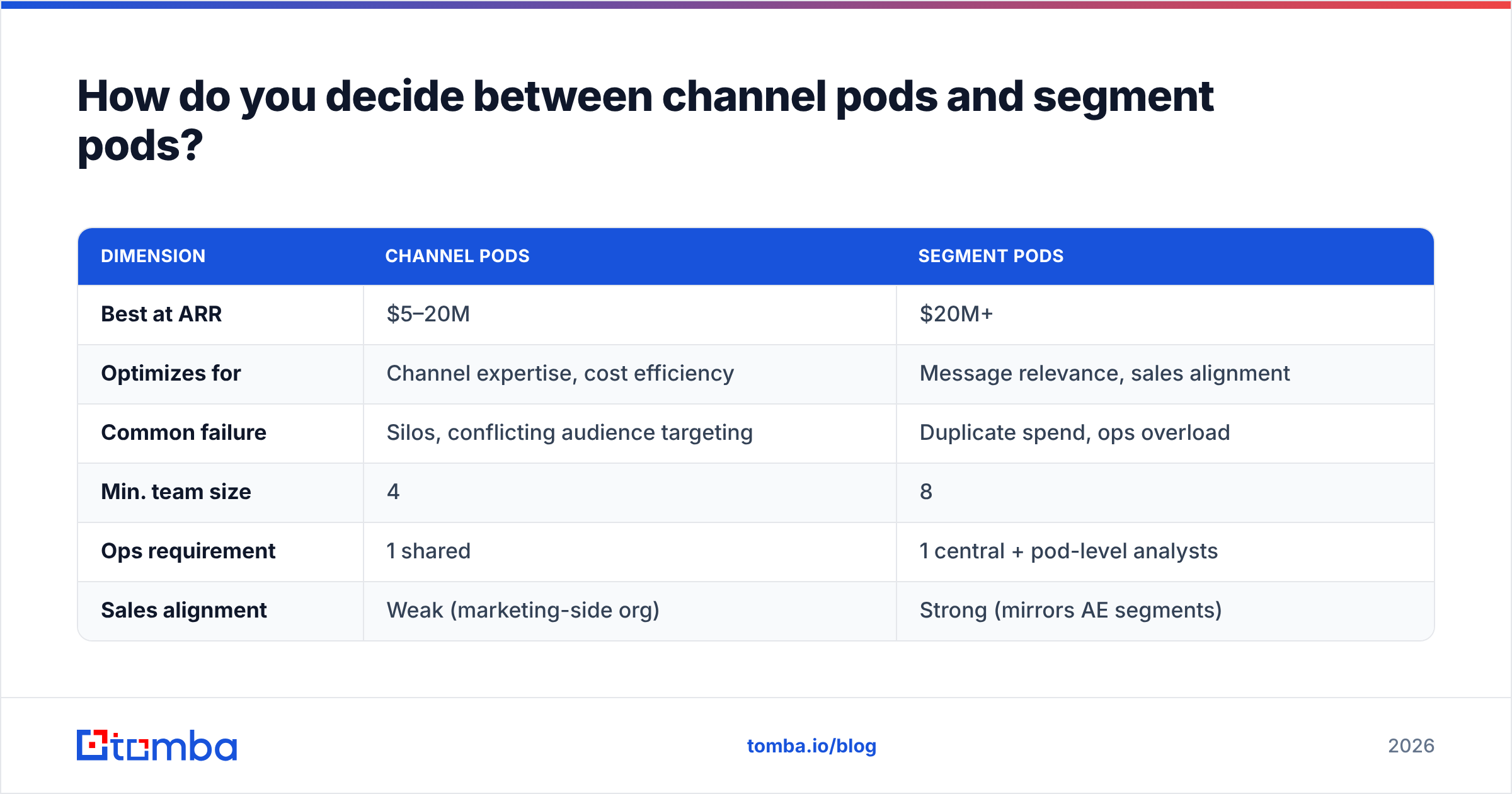
| Dimension | Channel pods | Segment pods |
|---|---|---|
| Best at ARR | $5–20M | $20M+ |
| Optimizes for | Channel expertise, cost efficiency | Message relevance, sales alignment |
| Common failure | Silos, conflicting audience targeting | Duplicate spend, ops overload |
| Min. team size | 4 | 8 |
| Ops requirement | 1 shared | 1 central + pod-level analysts |
| Sales alignment | Weak (marketing-side org) | Strong (mirrors AE segments) |

How many people do you actually need?#
Start from the pipeline target, not the org chart. Your demand gen team structure follows the math.
Work it backwards. Say you need $12M in sourced pipeline and your average deal is $30K. That is 400 opportunities. At a 12% MQL-to-opportunity rate, you need about 3,300 MQLs. At a 3% landing page conversion rate, plus organic and events, one generalist cannot run that volume alone.
Ratios that hold up in mid-market B2B:
- 1 demand gen FTE per $2–3M in new ARR target. High deal sizes can stretch it. Product-led and SMB motions need it tighter.
- 1 ops person per 4–6 marketers. Below that, ops turns into a ticket queue and strategy stops.
- 1 content producer per 2 active channels that use assets. Paid, SEO, email, and sales all pull from the same library. One writer for four consumers is a bottleneck.
- Paid specialist at $25–30K a month in spend. Below that, use an agency. Above $150K a month, you likely need two.
Be honest about the other options. A contractor, an agency, or better tools may beat a hire. A $6K a month retainer plus a $99 a month data tool often beats a $130K junior hire in year one. The agency shows up with a working process. The new hire has to build one.
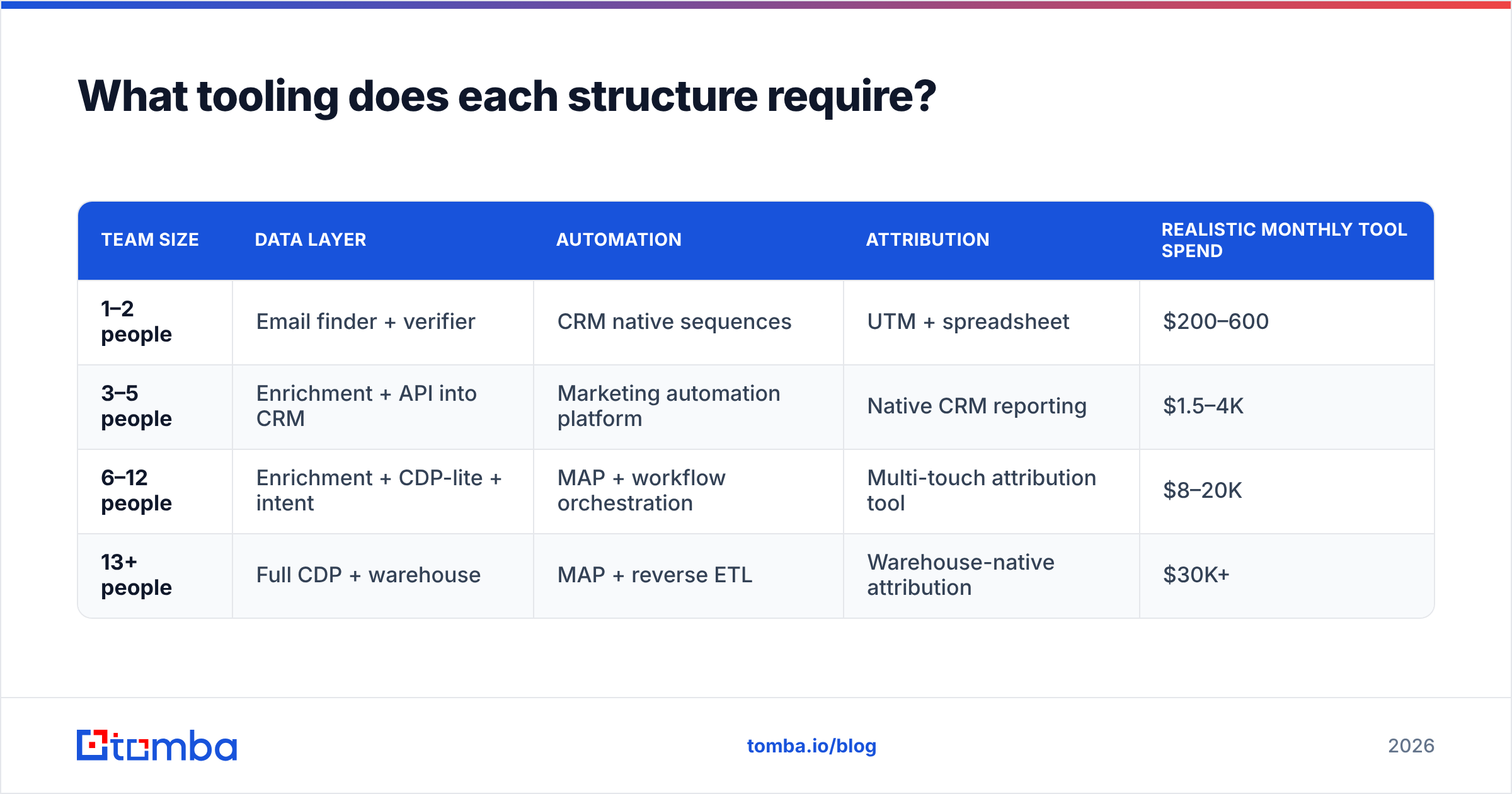
What tooling does each demand gen team structure require?#
| Team size | Data layer | Automation | Attribution | Realistic monthly tool spend |
|---|---|---|---|---|
| 1–2 people | Email finder + verifier | CRM native sequences | UTM + spreadsheet | $200–600 |
| 3–5 people | Enrichment + API into CRM | Marketing automation platform | Native CRM reporting | $1.5–4K |
| 6–12 people | Enrichment + CDP-lite + intent | MAP + workflow orchestration | Multi-touch attribution tool | $8–20K |
| 13+ people | Full CDP + warehouse | MAP + reverse ETL | Warehouse-native attribution | $30K+ |
Notice that the data layer sits in the very first row. That order is on purpose. A one-person team with clean data and a spreadsheet beats a five-person team with a $40K attribution stack on a database where a third of the emails bounce.
For small teams, the setup is simple. Use a domain search to build target account lists. Verify every import. Add an email finder API call inside the CRM to enrich inbound form fills before routing. That combo costs less than one day of a marketer's pay each month. It also removes the most common source of pipeline fights.
Worth a look on the data side: BookYourData for bulk list purchase when you need volume fast, next to self-serve finders for precision work. Different jobs. Mature teams run both.
What breaks when you get the structure wrong?#
Four failures show up again and again when a demand gen team structure is off.
Everyone owns pipeline, so nobody does. Three managers each report their share. The attribution overlaps. The total beats actual closed revenue. Fix: one owner of the number. Everyone else owns an input.
Specialists before generalists. A great paid specialist joins a company with no landing page process, no routing, and no content library. They spend six months building plumbing they were not hired for. Fix: hire the generalist who can do four things badly before the expert who does one thing well.
Ops reports into demand gen. When ops reports to the person whose numbers they check, attribution turns rosy. Fix: ops reports to the VP or CMO, not to the campaign owner.
Content hired first because it feels safe. Content has the longest payback on the team. Hiring it first when you need pipeline this quarter is a 9-month bet with 3 months of runway. Fix: contract content until capture channels work.
How do you hire in the right order?#
This sequence works for most B2B SaaS teams:
- Generalist demand gen manager ($1–3M ARR) — can run paid, build pages, write decent copy, and read a CRM report.
- Marketing ops ($3–6M ARR) — before the third marketer, not after the fifth.
- Paid acquisition specialist ($5–10M ARR) — when spend efficiency beats spend volume as a lever.
- Content/SEO lead ($8–15M ARR) — when you can wait 9 months for payback.
- Lifecycle marketer ($12–20M ARR) — when win-back beats new acquisition on cost.
- Segment leads / ABM ($20M+) — when segment economics have clearly split.
Deviate when your motion is odd. PLG companies pull lifecycle up to slot two. Enterprise teams with 20 target accounts pull ABM up, and may never hire a paid specialist at all. But if you are a standard mid-market B2B company hiring content before ops, your demand gen team structure came from someone else's company.
One note on the ops hire. Give them budget control over the data stack on day one. An ops person who must beg for every enrichment credit will settle for whatever the CRM ships with. CRM-native data is the weakest link in most stacks. Compare that with Tomba pricing tiers. A $49/mo Starter plan or $99/mo Growth plan covers most teams under 10 people. That is a rounding error next to one misrouted enterprise lead.
Build the structure on data you can trust#
Every demand gen team structure here assumes one thing. The contacts moving through it are real. A four-person team at a 6% bounce rate will out-produce a nine-person team at 28%. The bigger team burns a quarter of its budget, its sending time, and its sender reputation on addresses that do not exist.
Start there. Wire the Tomba Email Finder into your enrichment and inbound capture flow. Then every contact entering the CRM gets verified before it hits a routing rule. The free tier gives you 25 searches a month to test the fit. Starter runs $49/mo. Growth at $99/mo covers most teams up to about ten marketers. Get the data layer right first. Then hire against it.
Related guides#
Ready to find emails that actually work?
Join 150,000+ professionals who stopped guessing and started sending. Free credits on signup — no credit card required.
Get the Tomba newsletter
Practical outbound tactics and product updates — once every two weeks.
About the author