Demand Gen vs Brand Awareness: Where to Spend in 2026
Demand gen fills this quarter's pipeline. Brand awareness decides whether next year's pipeline is cheap or expensive. Here's how the two actually differ, how to budget across both, and which one to fund first.
TL;DR
- Demand generation creates and captures measurable buying intent this quarter. Brand awareness makes people recognize and trust you before they have intent, which lowers your cost per opportunity later.
- They are not competing budgets. They are different time horizons on the same revenue line — one pays out in 30–90 days, the other in 6–24 months.
- If you are under $3M ARR with a short sales cycle, fund demand gen first and treat brand as a byproduct. Above that, or with a 6+ month cycle and a buying committee, underfunding brand makes every demand-gen dollar more expensive over time.
- The measurement trap: demand gen is attributable and brand is not, so brand gets cut in every budget review. Fix it with leading indicators (branded search volume, direct traffic, win rate, sales-cycle length), not last-touch attribution.
- Both programs die without contact data. A 60/40 split means nothing if half your target-account list has no reachable email address.
What is the actual difference between demand gen and brand awareness?#
Demand generation is the set of programs that produce identifiable, contactable, in-market buyers you can route to sales. Brand awareness is the set of programs that make buyers recognize and prefer you before they enter a buying cycle at all.
The cleanest way to tell them apart: look at what happens when the program stops.
Turn off paid search, and inbound demos drop within a week. That's demand capture — you were harvesting intent that already existed. Turn off your podcast, your executive LinkedIn posting, and your category-defining research report, and nothing happens for two quarters. Then your paid search gets more expensive, your cold email reply rate drops, and sales starts complaining that nobody has heard of you. That's brand.
Analogy: demand gen is fishing, brand awareness is stocking the lake. You can fish an unstocked lake and catch something. You just work harder each year for fewer fish, and eventually a better-stocked competitor outfishes you with half the effort.
Gartner's research on the B2B buying journey makes the structural point plainly: buyers spend the large majority of their process independent of vendors, and a big chunk of that independent research happens before any vendor is contacted. Whatever they believe about you at the moment they start that research was built by brand work, not by a retargeting ad.
Which one actually drives pipeline?#
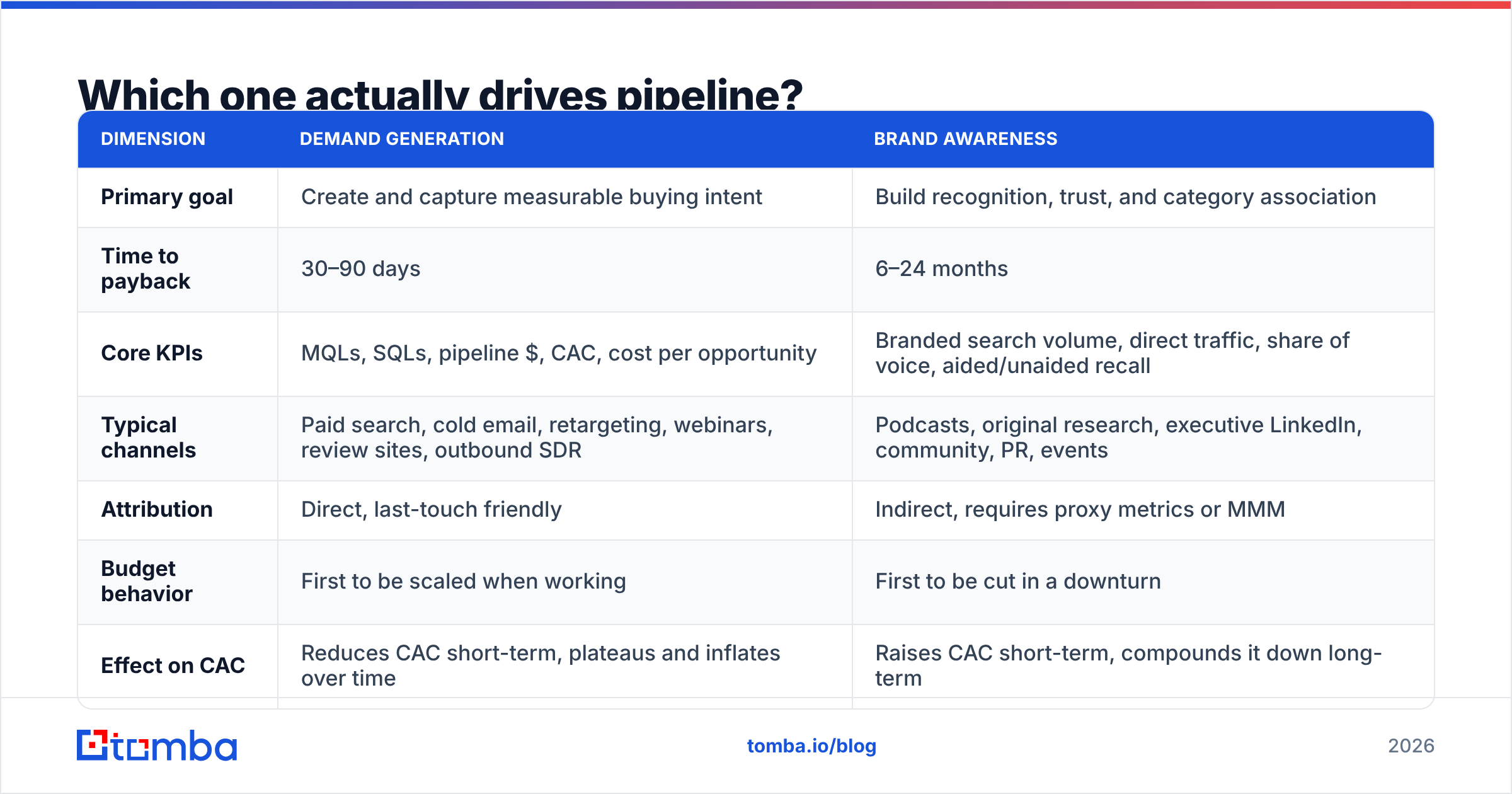
Both do, on different clocks. Here is the practical breakdown.
| Dimension | Demand generation | Brand awareness |
|---|---|---|
| Primary goal | Create and capture measurable buying intent | Build recognition, trust, and category association |
| Time to payback | 30–90 days | 6–24 months |
| Core KPIs | MQLs, SQLs, pipeline $, CAC, cost per opportunity | Branded search volume, direct traffic, share of voice, aided/unaided recall |
| Typical channels | Paid search, cold email, retargeting, webinars, review sites, outbound SDR | Podcasts, original research, executive LinkedIn, community, PR, events |
| Attribution | Direct, last-touch friendly | Indirect, requires proxy metrics or MMM |
| Budget behavior | First to be scaled when working | First to be cut in a downturn |
| Effect on CAC | Reduces CAC short-term, plateaus and inflates over time | Raises CAC short-term, compounds it down long-term |
| Sales feedback | "These leads convert" | "Prospects reply because they've heard of us" |
| Who owns it | Demand gen / growth / RevOps | Brand / comms / founder |
| Failure mode | Fishing an empty lake — rising CPCs, falling reply rates | Everyone loves you, nobody buys this quarter |
The row that matters most is effect on CAC. Demand-gen-only companies see a predictable curve: cheap acquisition in year one as they harvest the obvious intent, then steadily rising costs as they exhaust the in-market segment and start competing on price for the same clicks. Companies that fund brand in parallel push that curve out because a share of their pipeline arrives already convinced.
When should you fund demand gen first?#
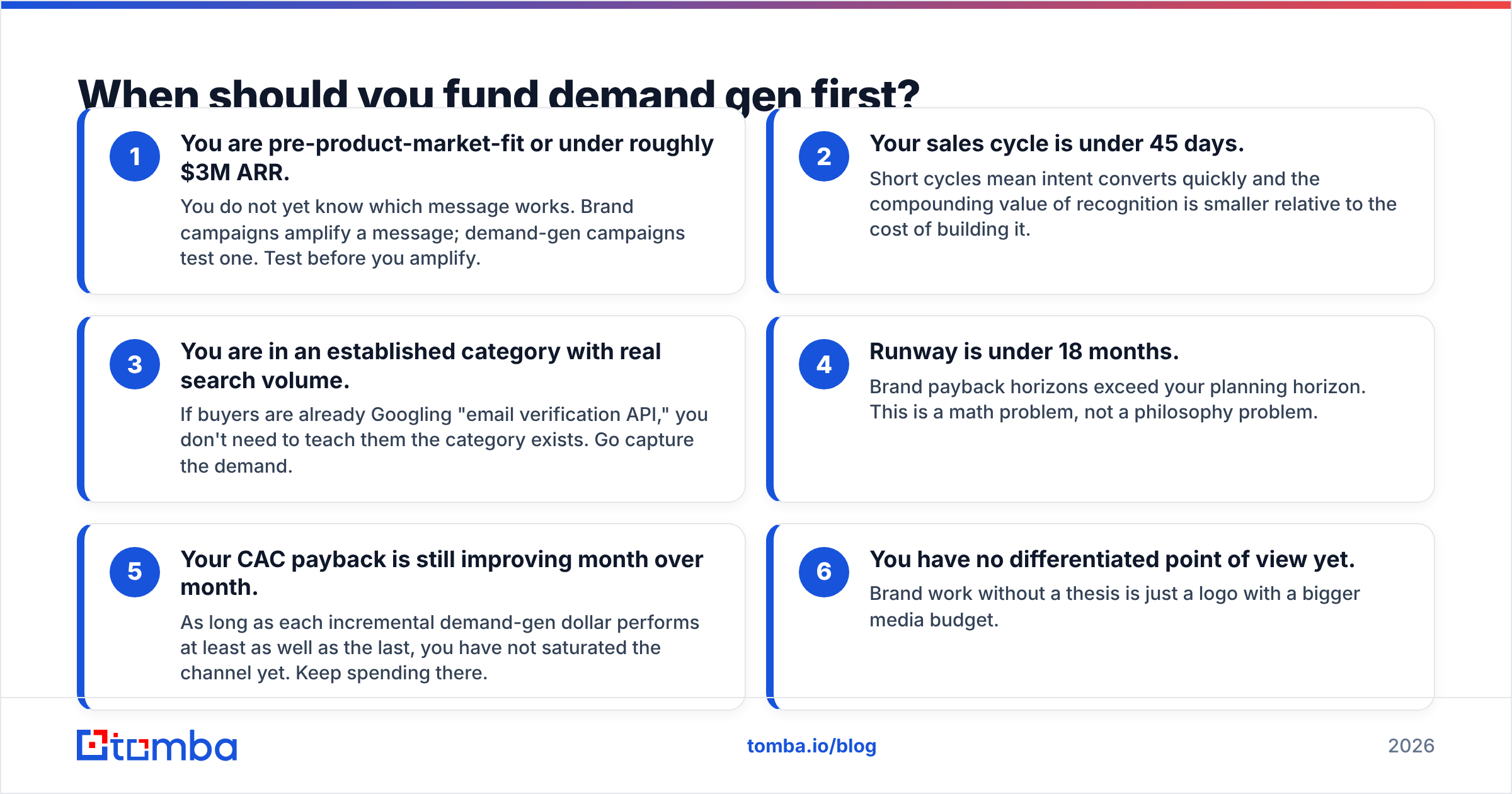
Fund demand gen first when you need proof faster than you need preference. Concretely:
- You are pre-product-market-fit or under roughly $3M ARR. You do not yet know which message works. Brand campaigns amplify a message; demand-gen campaigns test one. Test before you amplify.
- Your sales cycle is under 45 days. Short cycles mean intent converts quickly and the compounding value of recognition is smaller relative to the cost of building it.
- You are in an established category with real search volume. If buyers are already Googling "email verification API," you don't need to teach them the category exists. Go capture the demand.
- Runway is under 18 months. Brand payback horizons exceed your planning horizon. This is a math problem, not a philosophy problem.
- Your CAC payback is still improving month over month. As long as each incremental demand-gen dollar performs at least as well as the last, you have not saturated the channel yet. Keep spending there.
- You have no differentiated point of view yet. Brand work without a thesis is just a logo with a bigger media budget.
When does brand awareness become the higher-ROI investment?#
Brand becomes the better marginal dollar the moment demand gen starts showing diminishing returns — and that shows up in specific, boring metrics before it shows up in revenue.
Watch for these four signals:
- Rising cost per opportunity on flat spend. You're bidding against more competitors for the same finite in-market pool.
- Falling cold outbound reply rates on unchanged copy. Recognition is doing work in your inbox that you can't see until it's gone. A prospect who has heard your name replies at a multiple of one who hasn't.
- Lengthening sales cycles and more "we're evaluating three vendors" deals. Low preference means every deal is a bake-off.
- Branded search volume flat while non-branded rises. You're buying attention but not keeping it.
HubSpot's demand generation guidance frames demand gen as the full-funnel program rather than a lead-capture tactic, and that framing is the useful one. Once you accept demand gen spans awareness through conversion, the "demand gen vs brand awareness" debate resolves into a sequencing question: how much of your budget buys demand you can convert this quarter, and how much buys demand that doesn't exist yet?
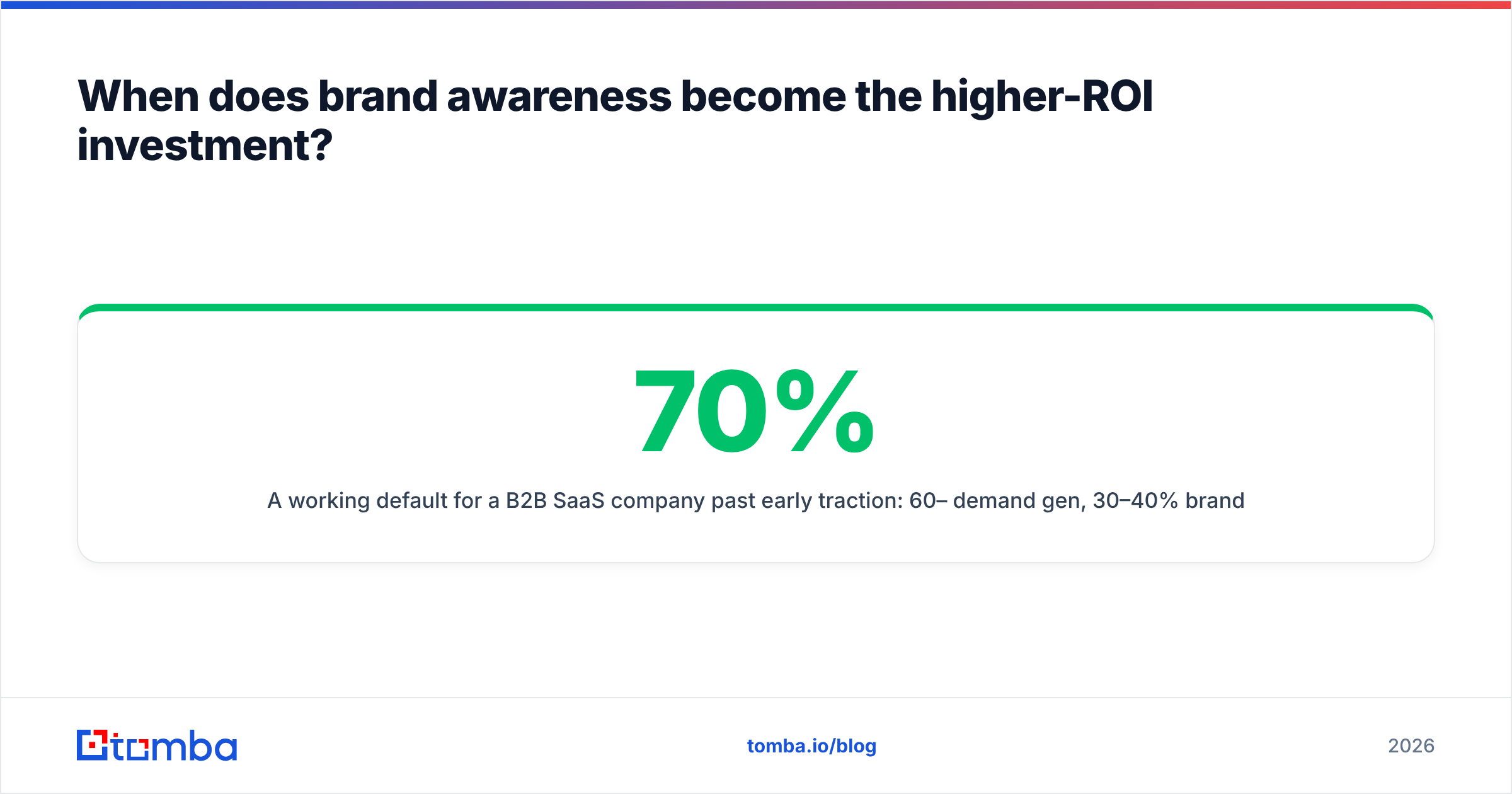
A working default for a B2B SaaS company past early traction: 60–70% demand gen, 30–40% brand, revisited quarterly. Under $3M ARR, shift toward 80/20. Above $20M ARR in a competitive category, 50/50 is defensible and often correct. Forrester's B2B research is worth tracking here — the recurring finding across their coverage is that buying groups, not individuals, make B2B decisions, and brand is what gets you considered by the members of that group your SDRs never emailed.
How do you measure brand awareness without lying to yourself?#
This is where most teams lose the argument internally. Demand gen produces a dashboard; brand produces a vibe. The vibe loses the budget meeting.
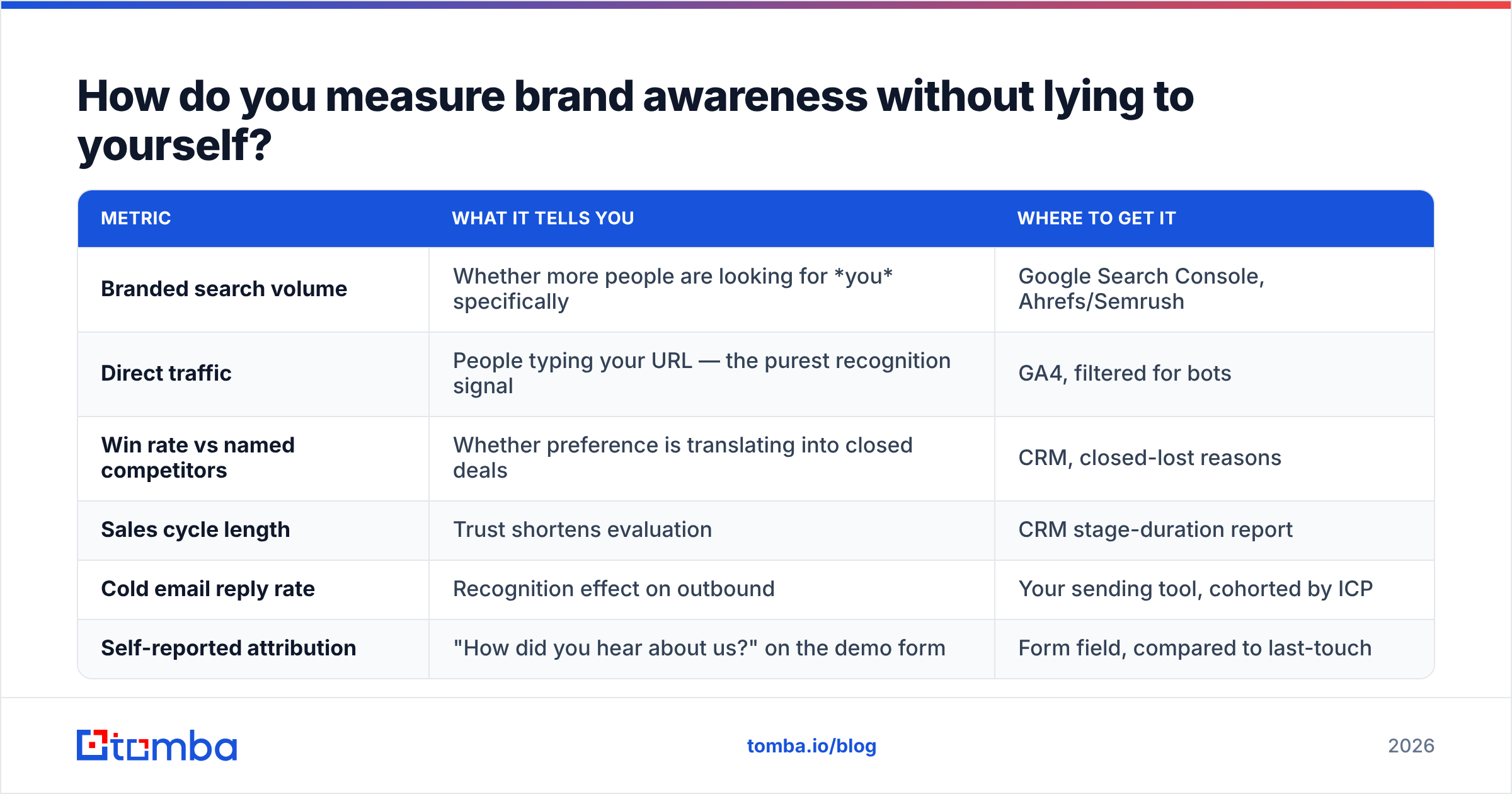
Replace the vibe with proxies you can trend:
| Metric | What it tells you | Where to get it |
|---|---|---|
| Branded search volume | Whether more people are looking for you specifically | Google Search Console, Ahrefs/Semrush |
| Direct traffic | People typing your URL — the purest recognition signal | GA4, filtered for bots |
| Win rate vs named competitors | Whether preference is translating into closed deals | CRM, closed-lost reasons |
| Sales cycle length | Trust shortens evaluation | CRM stage-duration report |
| Cold email reply rate | Recognition effect on outbound | Your sending tool, cohorted by ICP |
| Self-reported attribution | "How did you hear about us?" on the demo form | Form field, compared to last-touch |
The last row deserves emphasis. Self-reported attribution routinely surfaces sources — a podcast, a LinkedIn post, a peer recommendation — that last-touch models attribute entirely to branded search. If you only trust your attribution tool, you will conclude brand does nothing and cut it, then watch your paid-search efficiency degrade six months later without ever connecting the two events.
None of this requires a new platform. It requires one spreadsheet, updated monthly, that a RevOps owner defends in the budget review.
What does a combined program actually look like?#
Here is the pattern that works, in order of operation.
1. Define the target account list first. Not personas — accounts. A finite, named list of companies that could plausibly buy. Everything downstream is scoped to this list.
2. Run brand programs against the list's people. Original research they'd cite, executive LinkedIn content their VPs follow, a podcast their peers appear on. The goal is not reach. The goal is being recognized by roughly 100–500 specific humans.
3. Run demand gen against the list's intent signals. Website visits, review-site activity, hiring signals, tech-stack changes. When an account on your list shows a signal, it moves from brand nurture to active outreach. Tools like website visitor reveal close the gap between "an account is researching us" and "we know who to contact" — which is exactly where most brand investment leaks away unconverted.
4. Resolve accounts to contactable people. This is the step that quietly kills combined programs. You identified the account, you have the intent signal, and you have no verified email for the person who matters. An email finder plus data enrichment turns "Acme Corp visited pricing three times" into a named VP of Engineering with a deliverable address and a phone number.
5. Feed sales the context, not just the lead. Which brand asset did they touch? What signal fired? A rep who opens with "you downloaded our benchmark report last month" converts at a different rate than one who opens with "just checking in." Get your MQL definition to carry that context, not just a score.
6. Report both horizons in the same deck. One slide for pipeline created this quarter. One slide for the six brand proxies above, trended over 12 months. Never present them separately — separate presentations lead to separate budget decisions, and the brand one loses.
Is one better than the other for cold outbound specifically?#
Brand awareness is the cheapest reply-rate optimization available to an outbound team, and almost nobody treats it that way.
Consider two identical cold emails. Same offer, same deliverability setup, same list quality. One comes from a company the recipient has seen three times on LinkedIn this month. The other comes from a name they've never encountered. The recognition premium on reply rate is substantial and consistent — recipients aren't evaluating your offer in isolation, they're deciding in about two seconds whether you're a real company or a spam risk.
That's why "demand gen vs brand awareness" is a false split at the tactical level too. Brand isn't the thing you do instead of outbound. It's the thing that makes outbound work at all once inboxes get crowded.
Three practical moves to link them:
- Retarget your target account list on LinkedIn for 30–60 days before outbound touches them. Cheap, small audience, measurable lift in reply rate when you cohort it.
- Have the person whose name is on the content send the email. If your VP of Product wrote the research report, the outreach referencing it should come from her, not from a generic sales alias.
- Cohort your reply-rate reporting by brand exposure. Exposed vs unexposed. If the gap isn't there after 90 days, your brand program isn't reaching the right people — that's a targeting problem, not a proof that brand doesn't work.
What's the verdict?#
Fund demand gen for the quarter you're in. Fund brand for the quarter you'll be in two years from now. The ratio depends on your stage, cycle length, and category maturity — but the answer is never zero on either side.
The failure mode on one end is a company with beautiful brand recognition and no pipeline. The failure mode on the other is a company that has to buy every single customer, forever, at a price that rises every year. Most B2B teams are much closer to the second failure than the first, because demand gen is easier to defend in a spreadsheet.
And both fail identically when the contact data underneath them is bad. You can build the best category-defining research report in your market, generate a perfect intent signal from it, and still lose the deal because the email you sent the VP of Engineering bounced.
Start with the data layer. Use the Tomba Email Finder to turn your target account list into verified, reachable contacts before you spend another dollar on either side of the demand gen vs brand awareness question. The free tier covers 25 searches a month so you can test list quality on your own accounts first; paid plans start at $49/mo on Tomba pricing when you're ready to run the full list. Pipeline is downstream of contactability — fix that first, then argue about the budget split.
Related guides#
Ready to find emails that actually work?
Join 150,000+ professionals who stopped guessing and started sending. Free credits on signup — no credit card required.
Get the Tomba newsletter
Practical outbound tactics and product updates — once every two weeks.
About the author