Demand Generation in 2026: How It Actually Drives Pipeline
Most demand generation programs generate reports, not demand. Here's how creation, capture, and conversion actually connect in 2026 — with the metrics, channels, and stack that hold up under CFO scrutiny.
TL;DR
- Demand generation is the full motion of creating awareness of a problem, capturing the buyers who act on it, and converting that intent into pipeline. Lead generation is only the middle step.
- The 2026 version of the discipline is dark-funnel heavy: most influence happens in podcasts, communities, peer reviews, and LinkedIn feeds you cannot attribute cleanly.
- Measure pipeline created, win rate by source, and self-reported attribution. MQL volume is the vanity metric that hides a broken engine.
- Your stack needs three things it usually lacks: visitor identification, contact-level data enrichment, and a verified email layer so outbound off demand signals actually lands.
- Budget split that works for most B2B teams: roughly 40% creation, 30% capture, 30% conversion — and never let capture eat the creation budget just because it reports better.
What is demand generation, exactly?#
Demand generation is the coordinated effort to make a market aware it has a problem, then to route the people who feel that problem into your revenue process.
Think of it like a restaurant on a quiet street. Lead generation is the sign on the door catching people already walking past looking for lunch. Demand generation is the smell of the kitchen drifting three blocks over, the food critic's review, and the regulars telling their coworkers. One captures existing appetite. The other creates it.
That distinction matters because the vast majority of your total addressable market is not in-market right now. The widely cited 95-5 rule from the Ehrenberg-Bass Institute holds that roughly 95% of business buyers are not actively shopping at any given moment. If your entire budget chases the 5%, you are bidding against every competitor for the same handful of high-intent keywords and the same review-site placements, with predictable cost-per-acquisition inflation.
Demand generation covers three linked jobs:
- Demand creation — content, podcasts, community, events, and paid social that teach a market why a problem is expensive. Almost none of it converts on first touch, and it is not supposed to.
- Demand capture — search ads, review sites, comparison pages, and category-level SEO that catch the buyer at the moment they start looking. High intent, high cost, low volume.
- Demand conversion — the offer, the form, the sales handoff, the follow-up sequence. This is where demand becomes pipeline or evaporates.
Programs fail when a team runs one of the three and calls it demand gen. Creation without capture builds an audience that buys from someone else. Capture without creation means you are only harvesting demand your competitors created.
Is demand generation different from lead generation?#
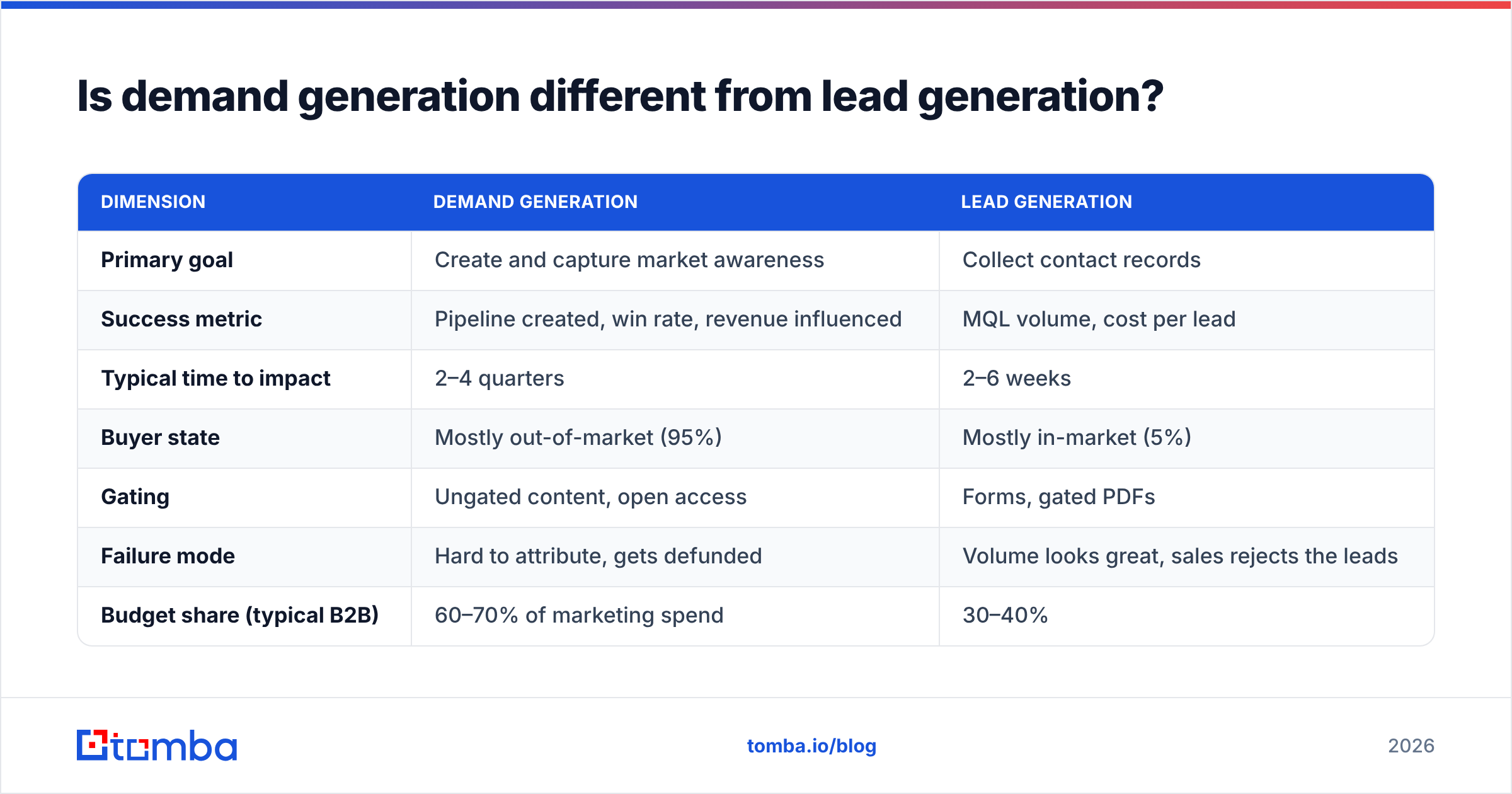
Yes — and the difference is not semantic. They optimize for different things, report different numbers, and break in different ways.
| Dimension | Demand generation | Lead generation |
|---|---|---|
| Primary goal | Create and capture market awareness | Collect contact records |
| Success metric | Pipeline created, win rate, revenue influenced | MQL volume, cost per lead |
| Typical time to impact | 2–4 quarters | 2–6 weeks |
| Buyer state | Mostly out-of-market (95%) | Mostly in-market (5%) |
| Gating | Ungated content, open access | Forms, gated PDFs |
| Failure mode | Hard to attribute, gets defunded | Volume looks great, sales rejects the leads |
| Budget share (typical B2B) | 60–70% of marketing spend | 30–40% |
| Owner | CMO / GTM leadership | Demand capture or growth team |
The classic dysfunction: marketing hits its MQL target, sales says the leads are garbage, and both teams are correct. Marketing counted form fills from an ebook titled "The Ultimate Guide to Anything." Sales measured whether those people had budget, authority, or a problem. Nothing in the system connected the two.
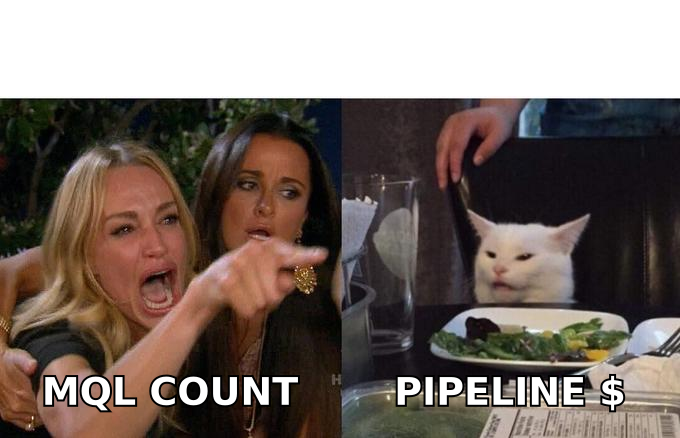
The fix is not a better scoring model. It is agreeing, in writing, that the shared number is pipeline created — sourced and influenced — and that every channel gets judged against it.
What does a working demand generation engine look like?#
A functioning engine has five components. Miss one and the others compensate badly.
- A problem thesis, not a product pitch. You need one sentence describing the expensive problem your buyer has whether or not they know your category exists. Every piece of creation content ladders to it. If your content only makes sense to people who already know what you sell, it is capture content wearing a creation costume.
- Always-on distribution. A blog nobody reads is not demand creation. Distribution means a repeatable set of channels — LinkedIn, a podcast, a newsletter, partner communities, paid social — that reaches the same audience weekly. Consistency beats production value.
- A capture layer that catches intent fast. Comparison pages, alternative pages, category keywords, and G2-style review presence. When someone finally searches, you should already be there. G2's category pages are frequently the second or third result buyers see for software evaluations.
- Signal instrumentation. Website visitor identification, content engagement tracking, review-site intent feeds, and job-change alerts. Signals are what let you act on demand you did not directly capture — the anonymous director who read three pages and left.
- A conversion motion with human follow-up. Someone must reach out within hours, not days, with context. That means an enriched contact record and a deliverable email address, not a first-name-only form fill.
Most teams have one, two, and five. They skip three and four, then wonder why their content "does not convert."
Which demand generation channels actually produce pipeline in 2026?#
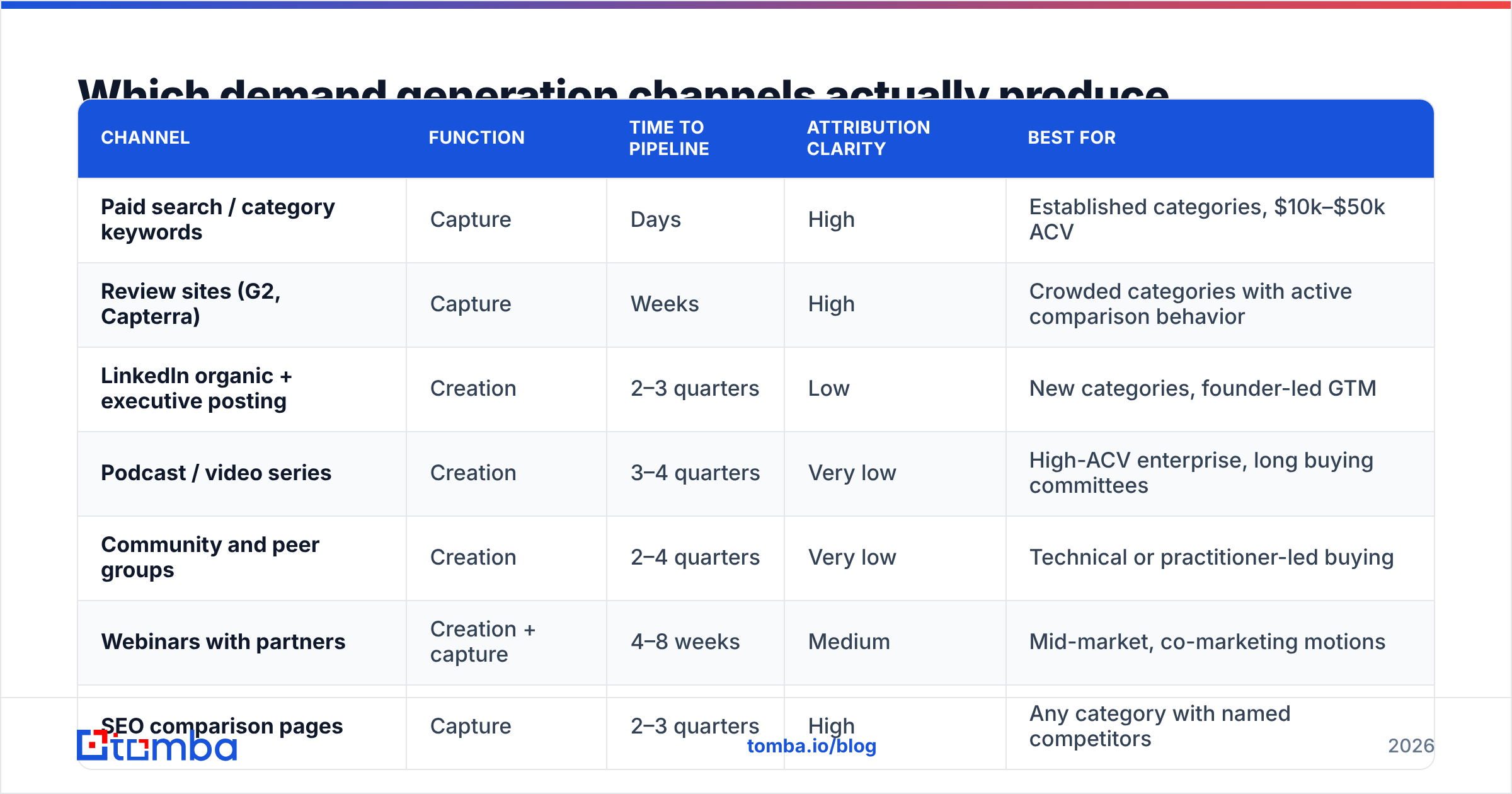
Channel performance varies wildly by ACV and buyer, but the structural pattern is stable. Here is how the major channels compare on the dimensions that determine whether they belong in your mix.
| Channel | Function | Time to pipeline | Attribution clarity | Best for |
|---|---|---|---|---|
| Paid search / category keywords | Capture | Days | High | Established categories, $10k–$50k ACV |
| Review sites (G2, Capterra) | Capture | Weeks | High | Crowded categories with active comparison behavior |
| LinkedIn organic + executive posting | Creation | 2–3 quarters | Low | New categories, founder-led GTM |
| Podcast / video series | Creation | 3–4 quarters | Very low | High-ACV enterprise, long buying committees |
| Community and peer groups | Creation | 2–4 quarters | Very low | Technical or practitioner-led buying |
| Webinars with partners | Creation + capture | 4–8 weeks | Medium | Mid-market, co-marketing motions |
| SEO comparison pages | Capture | 2–3 quarters | High | Any category with named competitors |
| Outbound off intent signals | Conversion | Days | High | Anything with identifiable ICP accounts |
Two notes on this table. First, the channels with the worst attribution clarity are often the ones buyers cite most in sales calls — that is the dark funnel problem, and it is why self-reported attribution ("How did you hear about us?") on your demo form is worth more than most multi-touch models. Second, outbound is listed as a conversion channel deliberately. Cold outbound to a list with no prior awareness is not demand generation. Outbound to accounts that showed a signal is the highest-yield conversion play most teams underuse.
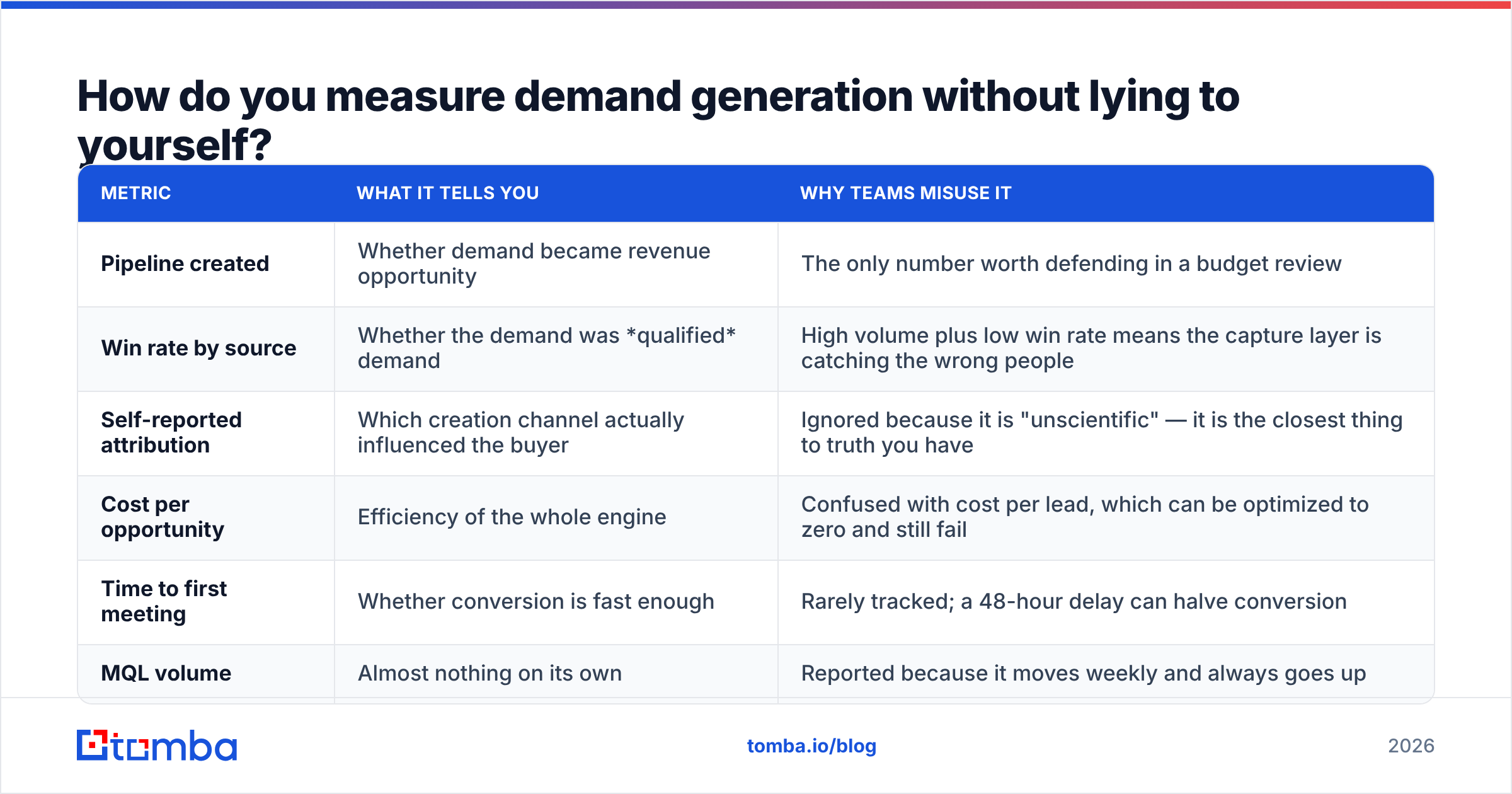
How do you measure demand generation without lying to yourself?#
Lead with the metric that survives a CFO conversation: pipeline created per channel, and win rate on that pipeline.
Here is the hierarchy that keeps teams honest.
| Metric | What it tells you | Why teams misuse it |
|---|---|---|
| Pipeline created | Whether demand became revenue opportunity | The only number worth defending in a budget review |
| Win rate by source | Whether the demand was qualified demand | High volume plus low win rate means the capture layer is catching the wrong people |
| Self-reported attribution | Which creation channel actually influenced the buyer | Ignored because it is "unscientific" — it is the closest thing to truth you have |
| Cost per opportunity | Efficiency of the whole engine | Confused with cost per lead, which can be optimized to zero and still fail |
| Time to first meeting | Whether conversion is fast enough | Rarely tracked; a 48-hour delay can halve conversion |
| MQL volume | Almost nothing on its own | Reported because it moves weekly and always goes up |
Track MQL volume if you want a leading indicator. Never report it as an outcome. HubSpot's demand generation research makes the same point from the other direction: teams that report on revenue-linked metrics get budget stability, and teams that report on activity metrics get cut first in a downturn.

One practical addition: run a quarterly "dark funnel audit." Pull every closed-won deal from the last 90 days, read the first-touch data, then ask the AE what the buyer actually said about how they found you. The gap between those two lists is your real attribution error rate. Most teams find it is 40% or higher.
What does a 2026 demand generation stack need?#
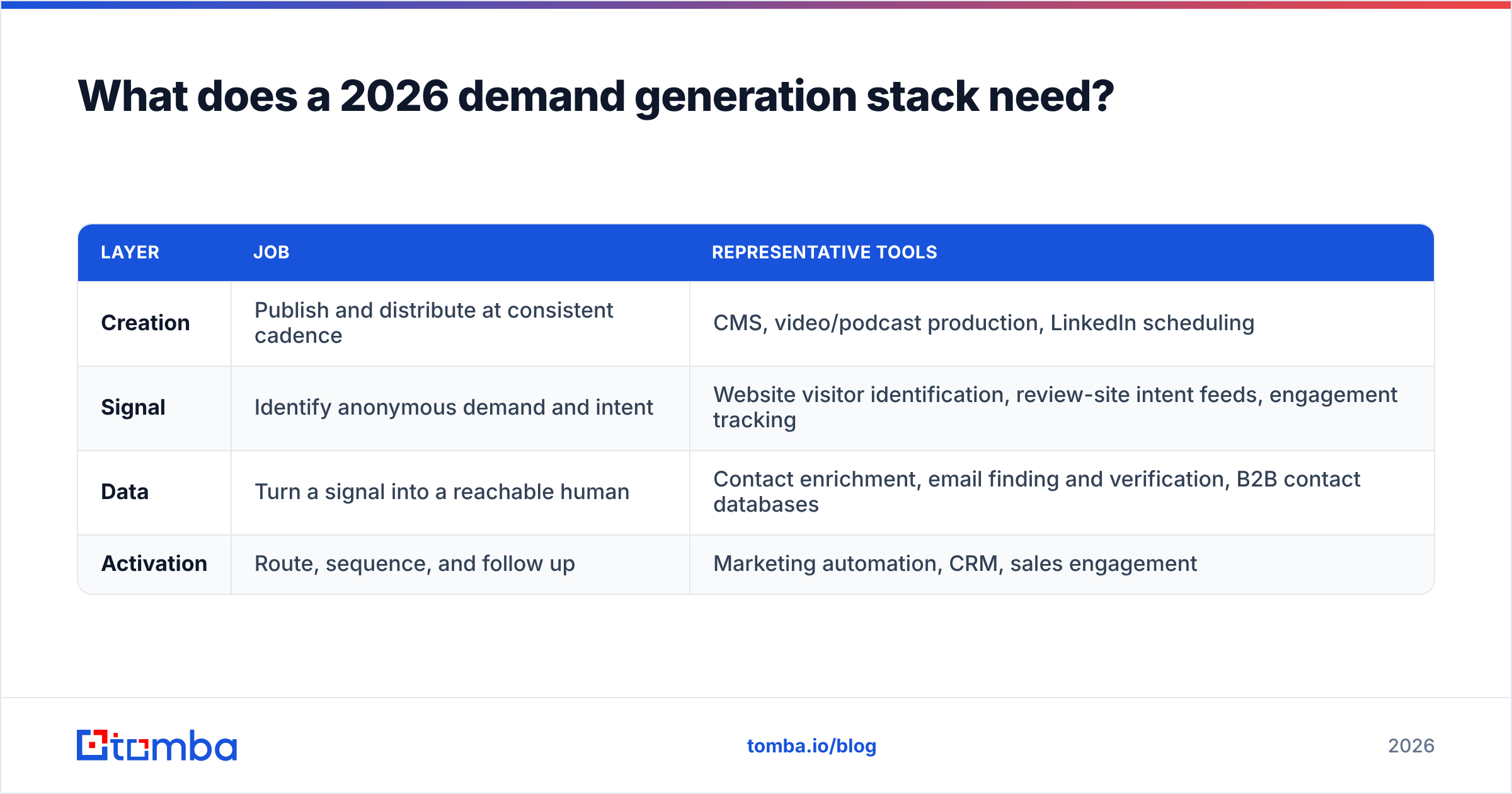
Your stack has four layers. The one teams skip is the data layer — and that is exactly the one that determines whether the other three produce anything.
| Layer | Job | Representative tools |
|---|---|---|
| Creation | Publish and distribute at consistent cadence | CMS, video/podcast production, LinkedIn scheduling |
| Signal | Identify anonymous demand and intent | Website visitor identification, review-site intent feeds, engagement tracking |
| Data | Turn a signal into a reachable human | Contact enrichment, email finding and verification, B2B contact databases |
| Activation | Route, sequence, and follow up | Marketing automation, CRM, sales engagement |
The signal-to-data handoff is where most engines leak. A visitor identification tool tells you that a mid-market logistics company read your pricing page four times this week. That is not actionable. It becomes actionable when you can name the VP of Operations at that company and reach them with a verified address.
That chain looks like this in practice:
- Reveal the account. Website visitor reveal turns anonymous traffic into named companies with firmographic context.
- Find the right person. Domain search returns the people at that company by role, so you contact the operations lead rather than a generic info@ inbox.
- Enrich the record. Data enrichment fills in title, seniority, location, and social profiles so your sequence has something to personalize against.
- Verify before you send. Bounces on a warm signal are the most expensive kind. Run every address through an email verifier before it enters a sequence.
On the database side, several vendors serve different needs well — BookYourData is a solid choice for teams that want pre-built, pay-as-you-go B2B lists, while API-first providers suit teams building enrichment into their own workflows. Pick based on whether you need volume up front or precision on demand.
What breaks most demand generation programs?#
Four failure patterns account for the bulk of it.
Defunding creation because it does not attribute. Creation channels are the ones buyers remember and the ones dashboards cannot see. When budget tightens, they get cut first, capture costs rise six months later because nobody is creating new demand, and the team concludes that "paid search stopped working."
Gating everything. Every gate is a tax on reach. Gate the things that indicate real intent — a demo, a pricing conversation, a hands-on tool — and leave your thought leadership open. You will lose form fills and gain pipeline.
Treating outbound as a volume game. Blasting 10,000 unverified addresses damages sender reputation and torches the domain you need for the signals that actually matter. Small, signal-triggered, verified sends outperform volume by a wide margin.
No agreed definition of a qualified opportunity. If marketing and sales have not written down what counts, every handoff becomes a negotiation. Write it, date it, and revisit it quarterly.
How do you build a 90-day demand generation plan?#
Start narrow. A demand engine that covers one segment well beats one that covers five segments badly.
- Days 1–15 — Define the thesis and the ICP. One problem statement. One primary segment. One list of the 300–500 accounts that matter most. Everything downstream references this list.
- Days 16–30 — Instrument signals. Get visitor identification live, connect review-site intent if you have it, and make sure your CRM can store account-level signal data. Without this, the next 60 days produce content you cannot act on.
- Days 31–60 — Ship creation at cadence. Pick two channels, not six. Publish weekly. Track engagement, not conversion — you are building recognition, and it will not show up in pipeline yet.
- Days 61–75 — Build the capture layer. Comparison pages, category keywords, and a review-site presence. This is the fastest-paying work in the plan and it compounds with creation.
- Days 76–90 — Turn on signal-triggered conversion. Every identified account that hits a high-intent page gets a named contact, an enriched record, a verified email, and a human follow-up within 24 hours.
By day 90 you will not have a mature engine. You will have a working loop with measurable inputs at each stage, which is the only thing you can actually improve. Add channels in quarter two, once the loop holds.
Where should you start?#
Start with the gap between "someone showed interest" and "someone got a relevant message." That gap is where budget dies quietly in almost every B2B program — the content worked, the signal fired, and nobody could reach the right human fast enough.
Tomba's Email Finder closes that gap. Give it a company domain and a name, and you get a verified, deliverable address with a confidence score — so the account your demand generation program warmed up gets a message from a real person instead of sitting in a dashboard. It works from the web app, a Chrome extension, Google Sheets, or the API when you want it wired directly into your signal workflow. The free tier includes 25 searches a month, and paid plans start at $49/mo; see Tomba pricing for the full breakdown. Create demand, then make sure you can actually reach the people who feel it.
Related guides#
Ready to find emails that actually work?
Join 150,000+ professionals who stopped guessing and started sending. Free credits on signup — no credit card required.
Get the Tomba newsletter
Practical outbound tactics and product updates — once every two weeks.
About the author