Demand Generation Best Practices: The 2026 Operator's Guide
Most demand gen programs fail because they measure MQLs instead of pipeline. Here are the practices that actually move revenue in 2026 — with benchmarks, a channel comparison table, and the data layer underneath it all.
TL;DR
- Demand generation is not lead generation. Lead gen captures existing demand; demand gen creates it, then captures it. Confusing the two is why most programs plateau.
- The single highest-leverage change most teams can make in 2026 is retiring the MQL as a primary KPI and reporting on pipeline created and pipeline velocity instead.
- Roughly 95% of your addressable market is not in-market at any given moment. Your budget split should reflect that — most teams overspend on the 5% and starve the 95%.
- Dark social, communities, and podcasts drive attribution-invisible demand. Self-reported attribution ("How did you hear about us?") consistently beats last-touch models for direction.
- None of it works on bad contact data. Bounces poison sender reputation, wreck ad match rates, and corrupt every downstream metric you report on.
What is demand generation, and how is it different from lead generation?#
Demand generation is the full-funnel discipline of creating awareness and intent for a category and a product, then converting that intent into revenue. Lead generation is one tactic inside it — the capture step.
The practical difference shows up in the metric. Lead generation asks "how many forms did we fill?" Demand generation asks "how many accounts moved from not knowing we exist to buying?" A gated ebook that harvests 400 emails from people who will never buy is excellent lead generation and terrible demand generation.
Here's the mental model: lead gen is fishing with a net in a pond someone else stocked. Demand gen is stocking the pond. If nobody in your market believes the problem you solve is worth solving, no amount of net-throwing helps.
That distinction drives every practice below.
Why do most demand generation programs stall?#
Four failure patterns account for most of it.
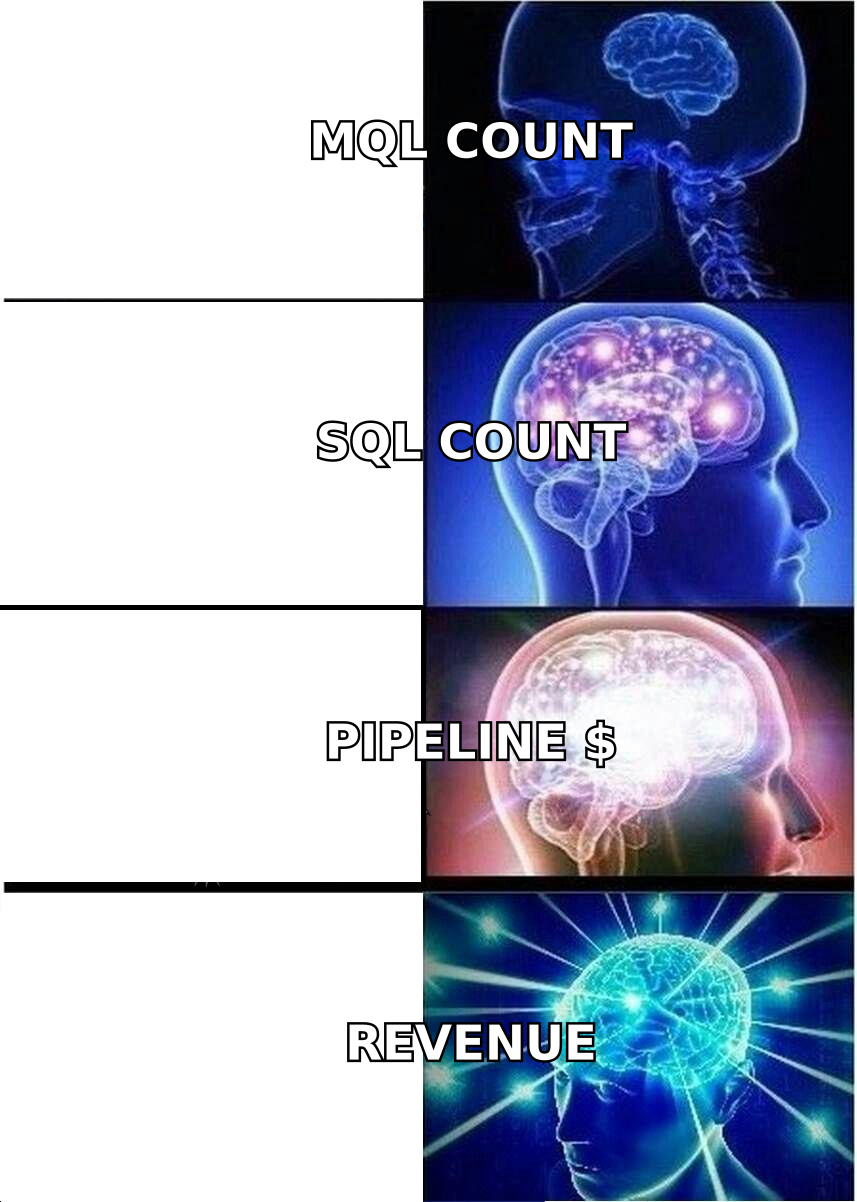
- The MQL trap. Marketing is compensated on lead volume, so it optimizes for the cheapest possible conversion — which selects for people with the lowest purchase intent. Sales rejects them. Trust breaks. The classic account-based marketing critique from Gartner on funnel misalignment holds up here.
- Attribution theater. Last-touch models credit the branded search that closed the deal and ignore the eighteen months of podcast appearances, community posts, and peer conversations that produced the search.
- Over-indexing on the in-market 5%. The 95-5 rule — popularized by the LinkedIn B2B Institute and the Ehrenberg-Bass Institute — holds that only about 5% of business buyers are actively in-market in any quarter. Spending 90% of budget on bottom-funnel capture means competing on price for a tiny slice.
- Dirty data at the foundation. You can run flawless creative into a list where 22% of the addresses bounce and still look like your messaging failed.
What are the core demand generation best practices for 2026?#
These are the practices that survive contact with a real pipeline review.
1. Report on pipeline created, not leads created. Change the dashboard first — behavior follows the scoreboard. Your primary marketing metric should be sourced and influenced pipeline in dollars, segmented by ICP fit. Secondary metrics: pipeline velocity, average deal size by channel, and win rate by first-touch source.
2. Split budget 60/40 between creating and capturing demand. Creating demand = content, podcasts, community, events, paid social with no gate. Capturing = search, retargeting, review sites, outbound. The exact ratio depends on category maturity: new category, push toward 70/30 creation; crowded category with high search volume, 50/50 is defensible.
3. Ungate everything except demos and assessments. Gating a top-of-funnel report costs you 90% of its readership to gain a list of people who wanted the PDF, not the product. Gate only what implies intent: pricing calculators, ROI tools, audits, demos.
4. Add self-reported attribution to every form. A single open-text "How did you hear about us?" field on your demo request outperforms most multi-touch models for budget decisions. It captures dark social — Slack groups, podcasts, a colleague's recommendation — that no pixel will ever see.
5. Build the ICP before the campaign. Firmographic + technographic + behavioral. Then enrich it. A target list of 800 accounts with verified contacts beats 40,000 unqualified records, every time. This is where data enrichment earns its keep — appending role, seniority, tech stack, and verified email to accounts you already believe in.
6. Treat sales and marketing as one revenue motion. Shared pipeline target, shared definition of qualified, a weekly review of rejected leads. If you have a revenue operations function, this is its job.
Which demand generation channels actually produce pipeline?#
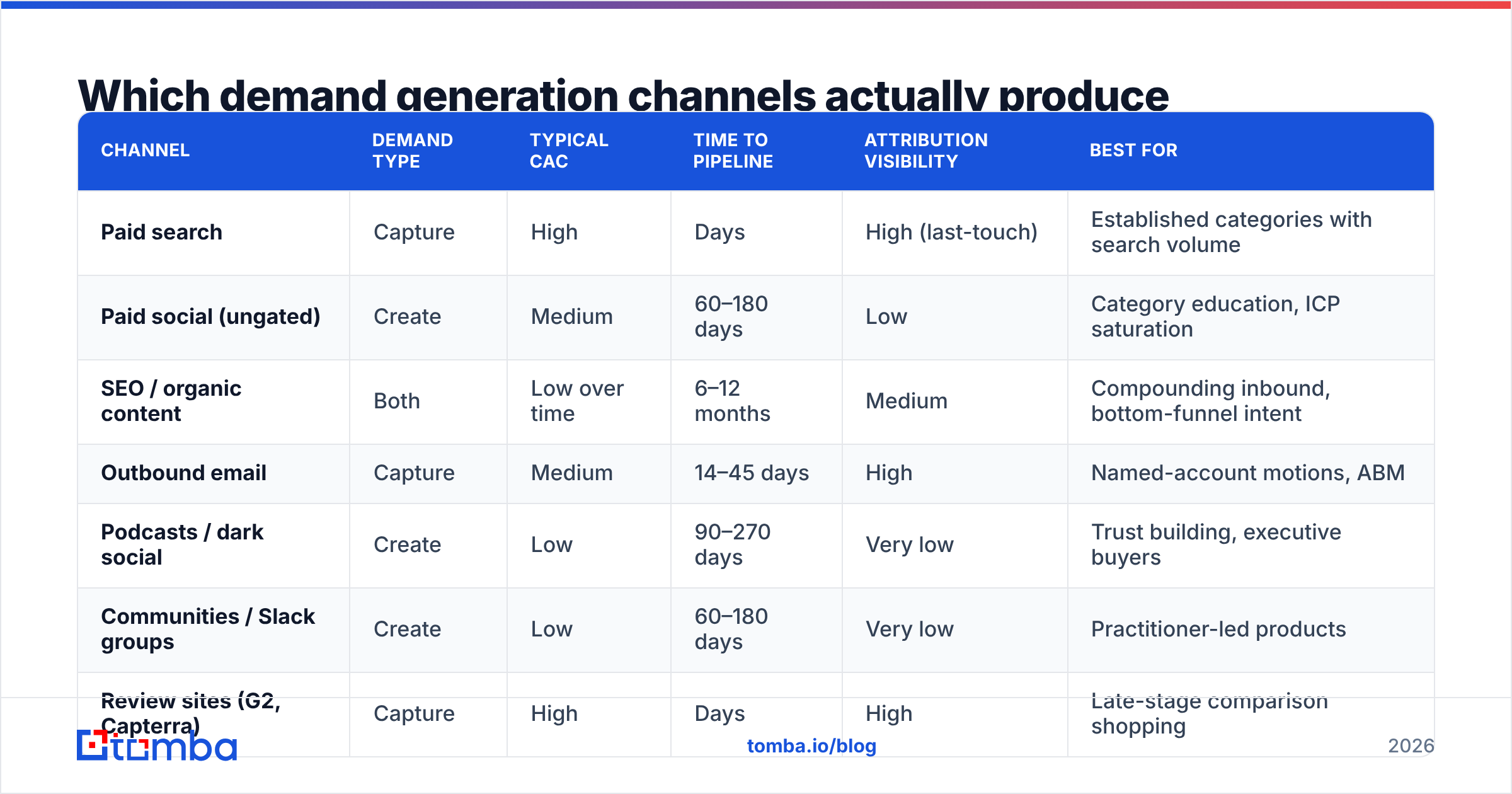
Channel performance varies wildly by category, but the structural characteristics don't. Use this as a starting allocation model, then let your own data override it.
| Channel | Demand type | Typical CAC | Time to pipeline | Attribution visibility | Best for |
|---|---|---|---|---|---|
| Paid search | Capture | High | Days | High (last-touch) | Established categories with search volume |
| Paid social (ungated) | Create | Medium | 60–180 days | Low | Category education, ICP saturation |
| SEO / organic content | Both | Low over time | 6–12 months | Medium | Compounding inbound, bottom-funnel intent |
| Outbound email | Capture | Medium | 14–45 days | High | Named-account motions, ABM |
| Podcasts / dark social | Create | Low | 90–270 days | Very low | Trust building, executive buyers |
| Communities / Slack groups | Create | Low | 60–180 days | Very low | Practitioner-led products |
| Review sites (G2, Capterra) | Capture | High | Days | High | Late-stage comparison shopping |
| Webinars / virtual events | Both | Medium | 30–90 days | High | Mid-funnel education, co-marketing |
| Field events / dinners | Create | Very high | 90–180 days | Medium | Enterprise ACV above $50k |
Two notes on reading this table. First, "very low attribution visibility" does not mean low impact — it means your reporting can't see it, which is exactly why self-reported attribution matters. Second, capture channels look efficient because they harvest demand created elsewhere. Cut your creation budget and watch your search CPCs and conversion rates degrade over the following two quarters.
Third-party validation matters more than most teams assume. G2 buyer behavior research consistently shows peer reviews influencing the shortlist before a vendor ever hears from the buyer — so treating review-site presence as a paid channel rather than an afterthought is a defensible call.
How do you build the data layer that makes demand gen work?#
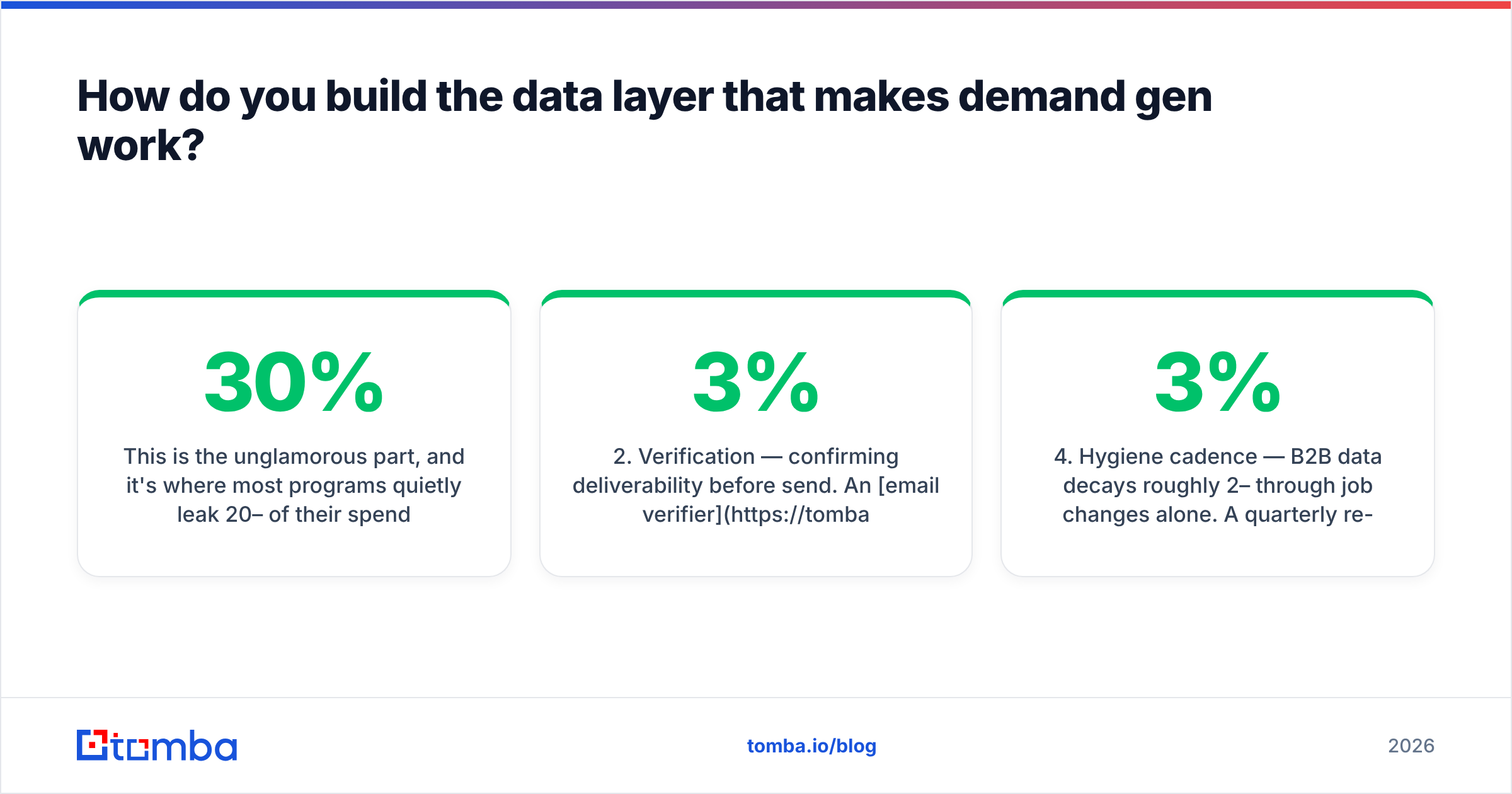
This is the unglamorous part, and it's where most programs quietly leak 20–30% of their spend.
Every demand gen motion eventually touches a contact record. Paid social audience uploads match on email. Outbound sequences send to email. CRM routing keys off domain. Account scoring depends on firmographics being right. If the record is wrong, the whole machine misfires — and you'll blame the creative.
A workable data layer has four jobs:
- Discovery — finding the right contacts at target accounts. A domain search run against your ICP account list returns the people and patterns at each company, which is faster than sourcing name-by-name.
- Verification — confirming deliverability before send. An email verifier pass on every list, every time, is non-negotiable. Bounce rates above 3% put your domain reputation at risk, and Google and Yahoo's bulk sender rules have made that threshold enforceable rather than advisory.
- Enrichment — appending seniority, department, company size, and technographics so segmentation isn't guesswork.
- Hygiene cadence — B2B data decays roughly 2–3% per month through job changes alone. A quarterly re-verification of your active database is the minimum.
Getting this right also protects email deliverability, which is the difference between a campaign that underperforms and one that never arrives.
What metrics should you actually track?#
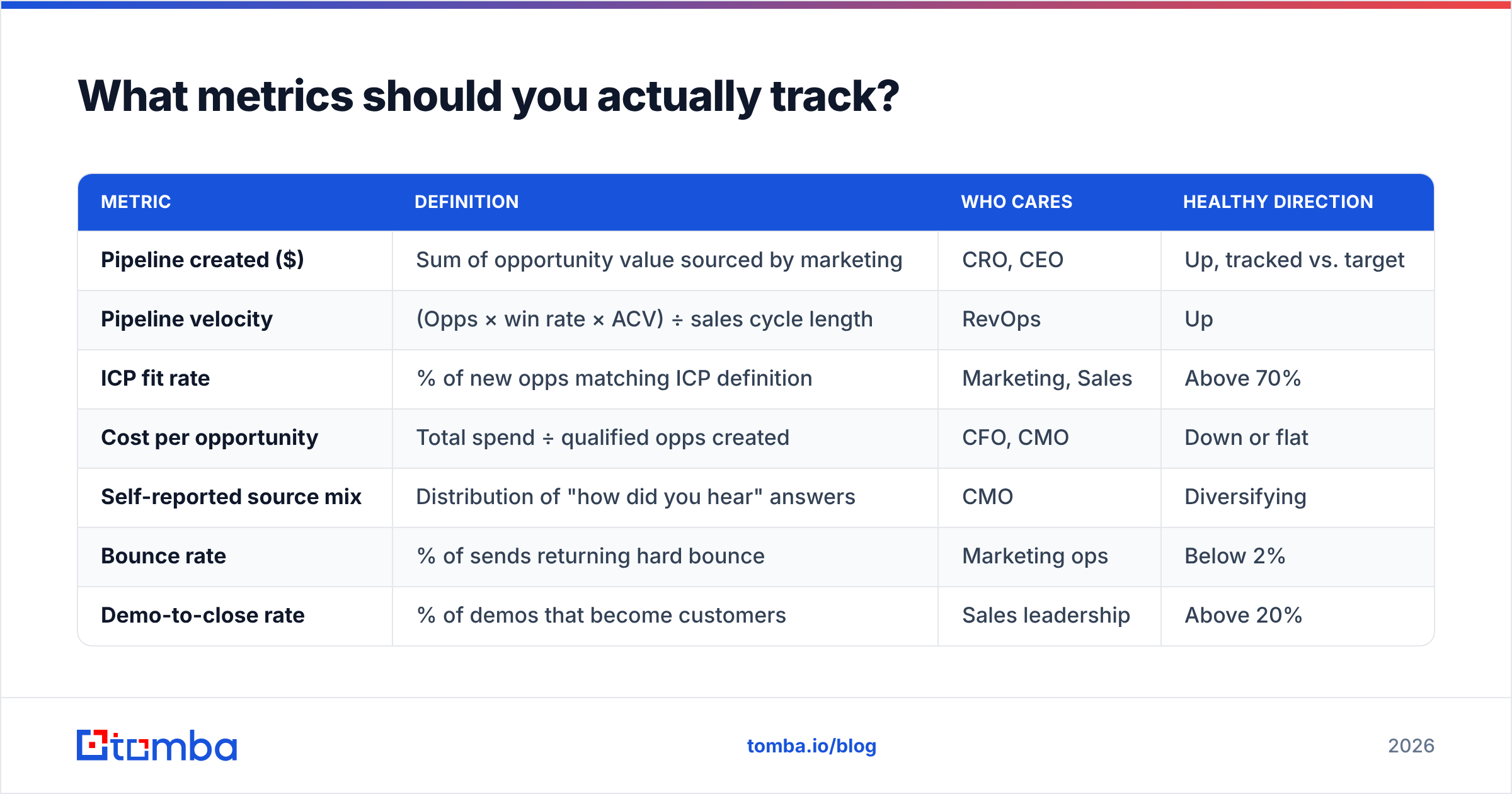
Fewer than you currently do. Here's a defensible set, organized by who consumes it.
| Metric | Definition | Who cares | Healthy direction |
|---|---|---|---|
| Pipeline created ($) | Sum of opportunity value sourced by marketing | CRO, CEO | Up, tracked vs. target |
| Pipeline velocity | (Opps × win rate × ACV) ÷ sales cycle length | RevOps | Up |
| ICP fit rate | % of new opps matching ICP definition | Marketing, Sales | Above 70% |
| Cost per opportunity | Total spend ÷ qualified opps created | CFO, CMO | Down or flat |
| Self-reported source mix | Distribution of "how did you hear" answers | CMO | Diversifying |
| Bounce rate | % of sends returning hard bounce | Marketing ops | Below 2% |
| Demo-to-close rate | % of demos that become customers | Sales leadership | Above 20% |
| Branded search volume | Monthly searches for your brand name | CMO | Up, as a demand-creation proxy |
Branded search volume deserves a specific callout. It's the closest thing to a real-time demand-creation gauge that exists — if your ungated content, podcast, and community work is landing, more people type your name into Google. If you kill creation spend, branded search flattens within a quarter or two, and pipeline follows a quarter after that.
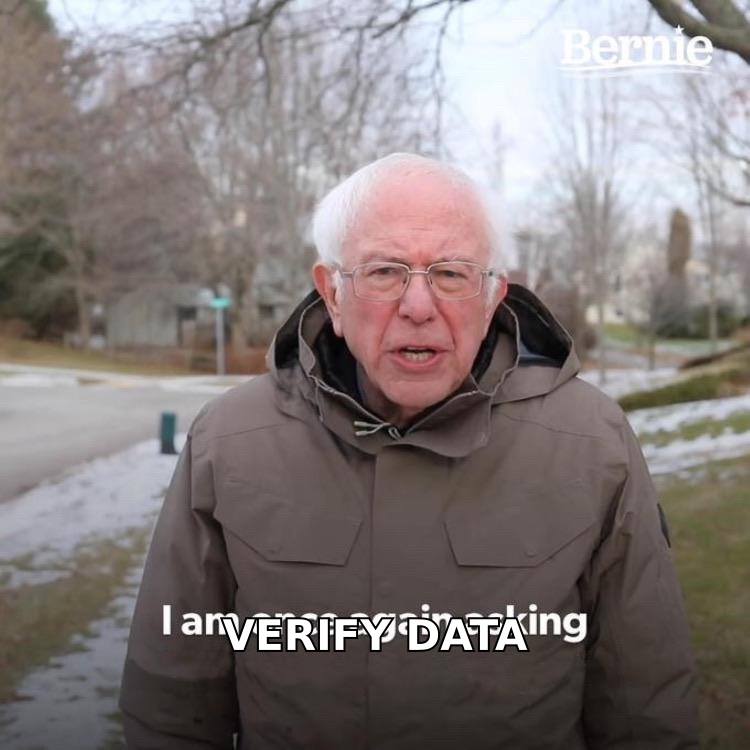
Also worth tracking: response rate on outbound sequences, segmented by data source. If one source consistently produces lower reply rates at identical messaging, that's a data quality signal, not a copy problem.
How should you sequence a demand gen program from zero?#
If you're building rather than optimizing, order matters more than intensity.
- Weeks 1–2: Define the ICP with actual data. Pull closed-won accounts from the last 18 months. Find the shared attributes. Write it down as a filter, not a persona document.
- Weeks 3–4: Build and verify the target account list. 300–1,500 accounts depending on ACV. Map contacts. Verify every address before it enters any system.
- Weeks 5–8: Ship the creation layer. One ungated flagship asset, a consistent LinkedIn or podcast cadence, and a point of view worth disagreeing with. Bland content creates no demand.
- Weeks 9–12: Turn on capture. Search on your category terms, retargeting on site visitors, an outbound sequence to the mapped accounts, review-site presence.
- Week 13 onward: Instrument and cut. Self-reported attribution live on all forms. Kill nothing before 90 days on creation channels; kill capture channels that miss cost-per-opp targets after 45.
The most common sequencing error is running step 4 before step 3. Capture with no creation behind it means you're bidding against competitors for the same 5% and converting on price alone.
What tools do you actually need?#
You need less than the martech vendor slide deck suggests. A functional stack has five layers: a CRM, a marketing automation or sequencing tool, an analytics layer, a contact data provider, and whatever channel-specific tools your motion requires.
The contact data layer is the one most teams get wrong — either by buying a giant all-in-one platform they use 8% of, or by scraping together free tools that produce unverifiable records. Reasonable options sit across a range. BookYourData is a solid choice when you need a prebuilt, pay-as-you-go list with verification included and don't want a subscription. Apollo bundles data with sequencing if you want one vendor for both. Tomba sits at the discovery-and-verification end — find, verify, and enrich contacts via UI, Tomba API, or spreadsheet add-ins, and plug them into whatever sequencing tool you already run.
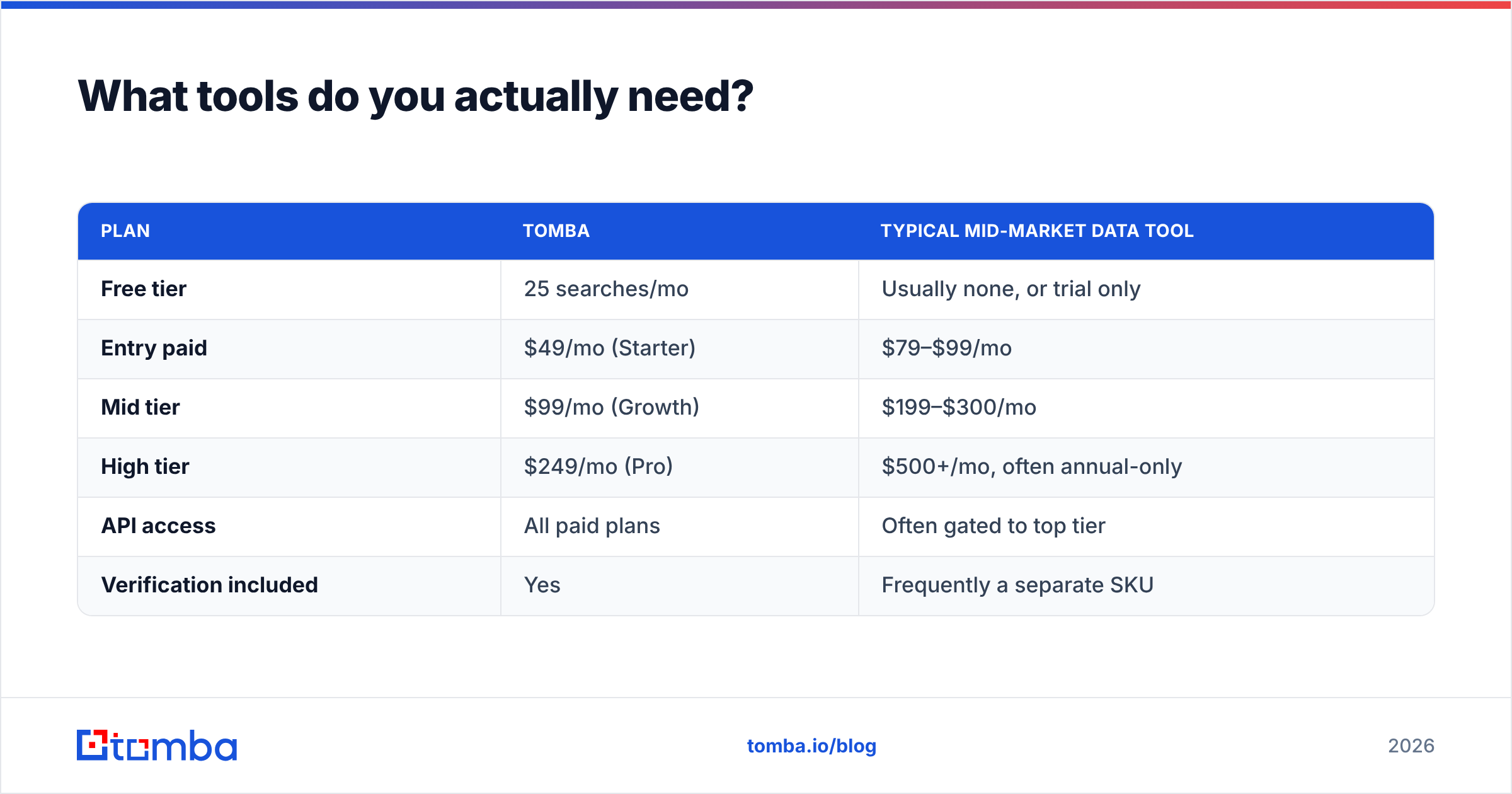
Pricing comparison, since it's usually the deciding factor:
| Plan | Tomba | Typical mid-market data tool |
|---|---|---|
| Free tier | 25 searches/mo | Usually none, or trial only |
| Entry paid | $49/mo (Starter) | $79–$99/mo |
| Mid tier | $99/mo (Growth) | $199–$300/mo |
| High tier | $249/mo (Pro) | $500+/mo, often annual-only |
| API access | All paid plans | Often gated to top tier |
| Verification included | Yes | Frequently a separate SKU |
Full Tomba pricing is public, which is worth noting: a data vendor that hides pricing behind a demo request is usually optimizing for negotiation leverage, not your evaluation speed.
What should you stop doing in 2026?#
Short list, high impact:
- Stop gating top-of-funnel content. You're trading reach for a list of PDF collectors.
- Stop reporting MQLs to the board. It teaches the board to ask the wrong questions.
- Stop buying unverified lists. One bad send can take months of domain reputation recovery.
- Stop attributing linearly across 14 touchpoints. The model is precise and wrong. Self-reported attribution is imprecise and directionally right.
- Stop running "brand awareness" campaigns with no measurable proxy. Branded search, direct traffic, and self-reported source are your proxies. Use them or don't run the campaign.
Ready to fix the data layer underneath your demand gen?#
Every practice above assumes your contact records are accurate. They usually aren't — B2B data decays continuously, and most teams discover it through bounce reports rather than audits.
Start with the Tomba Email Finder: find verified professional email addresses by domain, name, or company, then push them straight into your sequencing tool, CRM, or ad audience upload. The free tier gives you 25 searches a month to test accuracy against a list you already trust, and Starter runs $49/mo when you're ready to scale the motion. Clean inputs won't fix a bad strategy — but a good strategy on bad data will fail every time.
Related guides#
Ready to find emails that actually work?
Join 150,000+ professionals who stopped guessing and started sending. Free credits on signup — no credit card required.
Get the Tomba newsletter
Practical outbound tactics and product updates — once every two weeks.
About the author