Demand Generation Campaigns: The 2026 Playbook That Works
Most demand generation campaigns produce impressive MQL counts and almost no pipeline. Here's how the channel mix, budget splits, and measurement model actually work in 2026 — with a build order you can copy.
TL;DR
- Demand generation campaigns fail most often at the handoff, not the top of funnel. A campaign that produces 500 form fills and 4 sales conversations is a content program, not a demand program.
- Split every budget into demand creation (people who don't know they have the problem) and demand capture (people already searching). Most teams overfund capture, then wonder why it plateaus.
- The single highest-leverage fix in 2026 is contact-level data quality. Enriched, verified contacts move a campaign from "MQL volume" to "named-account pipeline."
- Measure pipeline created and cost per opportunity, not cost per lead. CPL optimizes for the cheapest form fill, which is almost never the best buyer.
- Run campaigns in 90-day cycles with a fixed review gate: kill, scale, or rebuild. No exceptions.
What is a demand generation campaign, exactly?#
A demand generation campaign is a coordinated set of activities designed to create awareness of a problem, build preference for your solution, and convert that interest into qualified sales conversations — measured end-to-end against revenue, not engagement.
Think of it like a restaurant opening in a new neighborhood. Demand capture is putting your name on the delivery apps people already scroll when they're hungry. Demand creation is the smell of bread on the street at 7am, which makes people hungry who weren't. Both matter. Only one of them scales beyond the number of people already searching.
Technically, demand generation spans everything from category education content to paid retargeting to outbound sequences to field events. What separates it from generic "marketing" is the attribution contract: a demand gen campaign commits to a pipeline number, not an impressions number.
Here's the distinction that kills most programs:
- Demand capture — search ads, review-site listings, branded SEO, comparison pages. The buyer already knows they need something. You are competing on presence and price. Cheap CPL, high intent, hard ceiling.
- Demand creation — thought leadership, podcasts, LinkedIn video, original research, partner webinars. The buyer doesn't know the category exists yet. Expensive per touch, no immediate conversion, unlimited ceiling.
- Demand conversion — the mechanics that turn either of the above into a booked meeting: forms, chat, outbound follow-up, lifecycle email, retargeting.
- Demand enablement — the collateral sales needs to close what marketing sourced: ROI calculators, security docs, reference customers, pricing transparency.
- Demand measurement — the reporting layer that tells you which of the four above to fund next quarter.
Skip any one of the five and the campaign leaks. Most teams that "tried demand gen and it didn't work" built 1, 3, and 5 — and never funded creation or enablement.
Why do most demand generation campaigns produce leads but no pipeline?#
Because the qualification bar is set by the form, not by the account.
A gated ebook converts at 8-15%. That looks healthy on a dashboard. But the people who download an ebook titled "The Ultimate Guide to X" include students, competitors, consultants, and job seekers. When marketing routes all of them to sales as MQLs, sales burns hours on non-buyers, then stops trusting the source entirely. Nine months later the CRO says "marketing leads don't convert" and the budget moves to events.
The three structural causes, in order of frequency:
- No account fit filter before routing. Anyone can fill in a form. Not everyone is in your ICP. If you're not scoring on firmographics before handoff, your MQL definition is "has a keyboard."
- Broken contact data. Roughly a third of B2B contact records decay each year as people change jobs. Campaigns that nurture stale records generate bounces, not meetings. Running a list through an email verifier before a nurture send is the cheapest fix in the entire stack.
- No follow-up compact. Speed-to-lead still decides outcomes. A lead contacted in five minutes converts at a wildly different rate than one contacted the next day, and most teams have no SLA at all.
The fix isn't more content. It's a tighter definition of who counts, enforced automatically, before a human ever sees the record.
How should you split budget across demand generation channels?#
Start from a 60/40 split — 60% capture, 40% creation — if you're under $5M ARR and need near-term pipeline. Invert toward 40/60 as you mature and your branded search volume starts flattening.
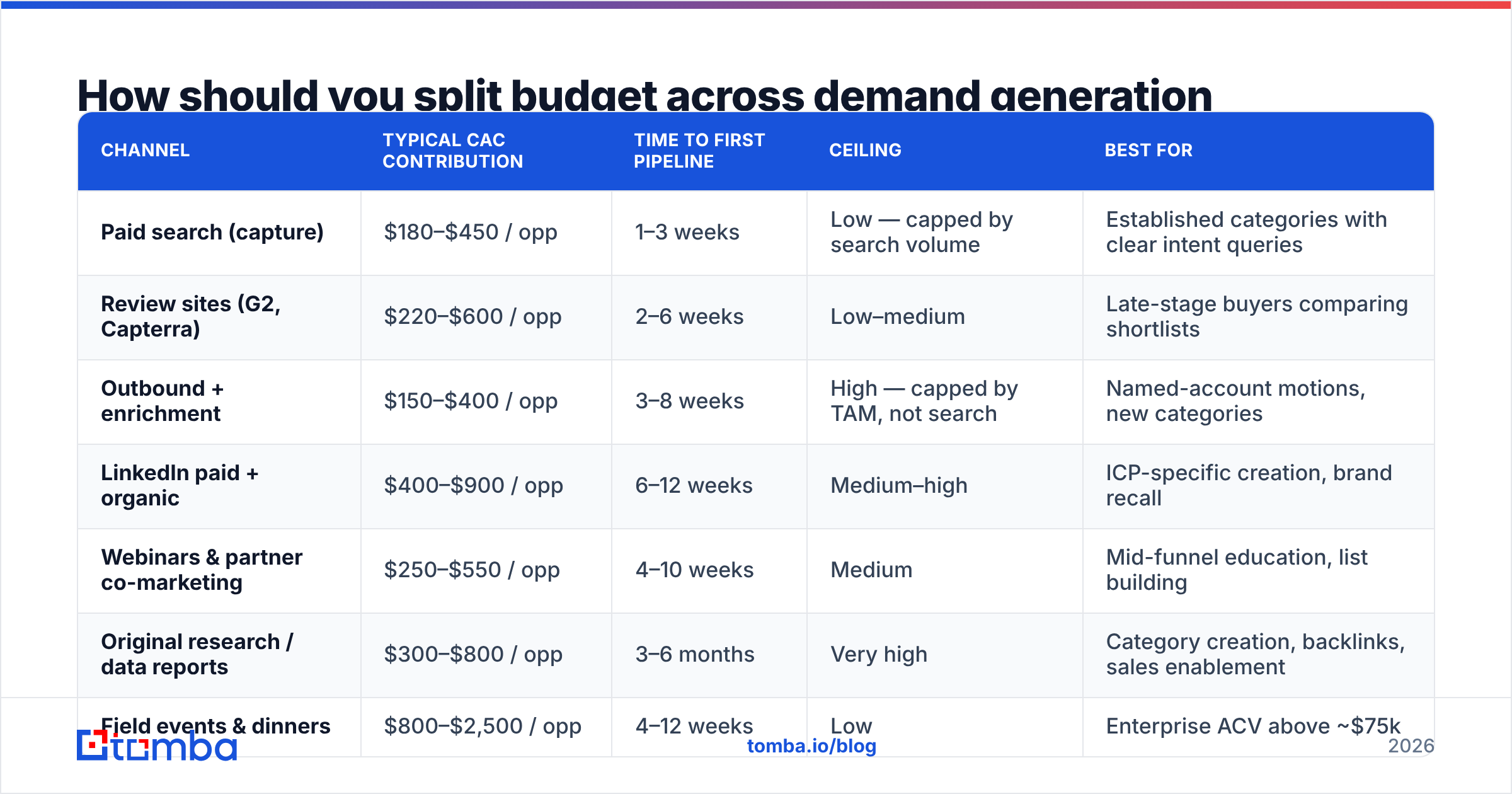
Here's how the major channel families compare on the metrics that actually drive the decision. Numbers below are representative benchmark ranges for mid-market B2B SaaS in 2026, not guarantees — your category and ACV move them substantially.
| Channel | Typical CAC contribution | Time to first pipeline | Ceiling | Best for |
|---|---|---|---|---|
| Paid search (capture) | $180–$450 / opp | 1–3 weeks | Low — capped by search volume | Established categories with clear intent queries |
| Review sites (G2, Capterra) | $220–$600 / opp | 2–6 weeks | Low–medium | Late-stage buyers comparing shortlists |
| Outbound + enrichment | $150–$400 / opp | 3–8 weeks | High — capped by TAM, not search | Named-account motions, new categories |
| LinkedIn paid + organic | $400–$900 / opp | 6–12 weeks | Medium–high | ICP-specific creation, brand recall |
| Webinars & partner co-marketing | $250–$550 / opp | 4–10 weeks | Medium | Mid-funnel education, list building |
| Original research / data reports | $300–$800 / opp | 3–6 months | Very high | Category creation, backlinks, sales enablement |
| Field events & dinners | $800–$2,500 / opp | 4–12 weeks | Low | Enterprise ACV above ~$75k |
Two things jump out of that table. First, the cheapest channels have the lowest ceilings — you can max out paid search in a quarter and then you're stuck. Second, outbound sits in a rare position: relatively low cost per opportunity and a high ceiling, because your addressable universe is your entire ICP rather than the subset typing queries this month.
That's exactly why outbound has quietly become the backbone of demand generation campaigns again, after several years of being written off. The difference in 2026 is that outbound only works when the underlying data is clean. Blasting 10,000 scraped addresses gets your domain blacklisted in a week.
What does a well-built demand generation campaign look like end to end?#
Build it in this order. Every step gates the next.
1. Define the account list before the creative. Pull 300–1,500 accounts that match your ICP on employee count, tech stack, funding stage, and geography. This is the campaign's universe. Everything else is production.
2. Build the contact layer. For each account, identify 3–5 people in the buying committee: economic buyer, champion, technical evaluator, and at least one influencer. Use domain search to pull the full contact map for each company rather than guessing at one name per account. A single-threaded campaign dies the moment your one contact goes on leave.
3. Verify and enrich. Every address gets verified. Every record gets job title, seniority, and LinkedIn URL attached. Then dedupe against your CRM so you don't cold-pitch an existing customer — a mistake that costs more credibility than the campaign will earn.
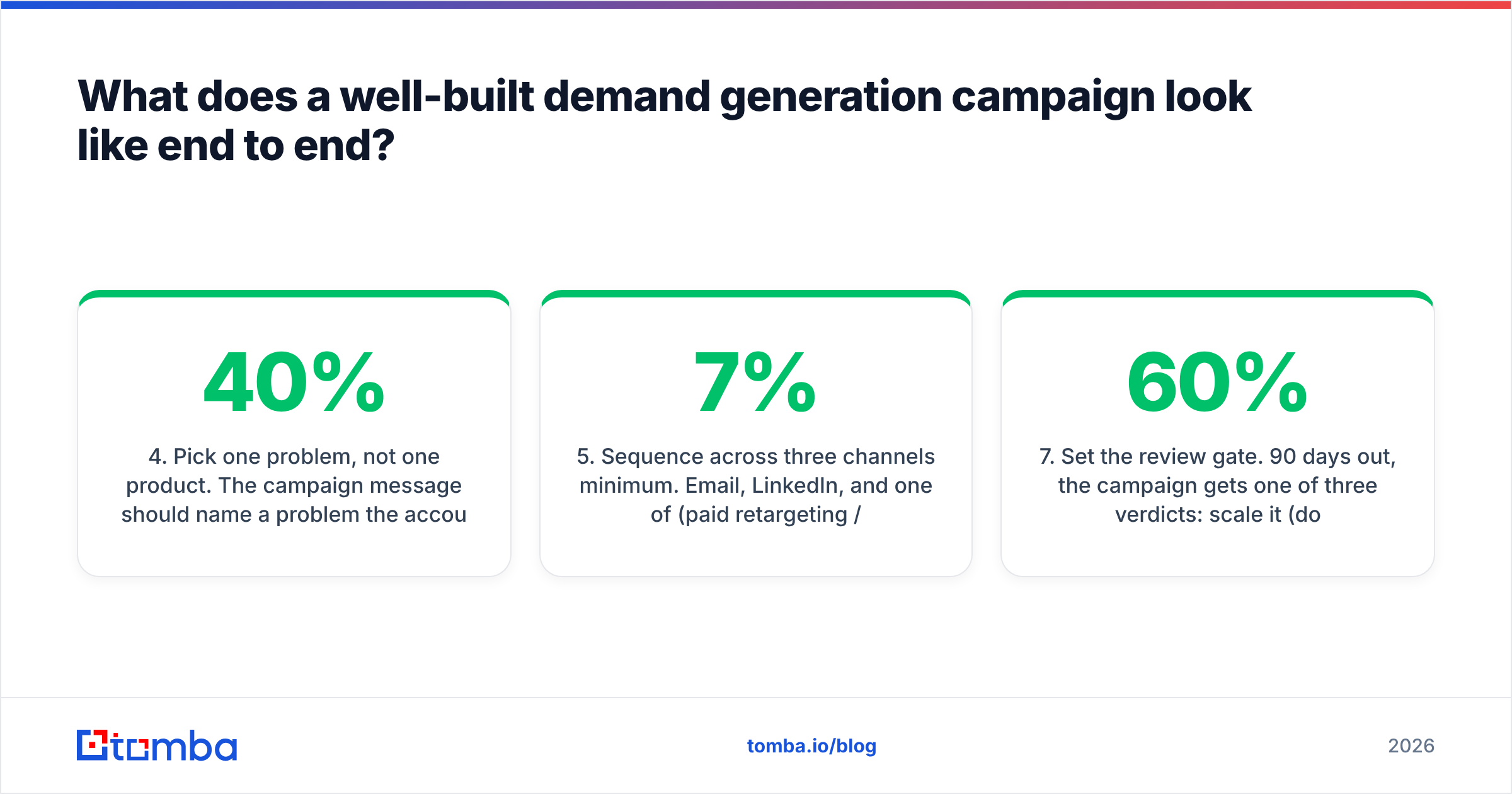
4. Pick one problem, not one product. The campaign message should name a problem the account is already experiencing. "Cut your data enrichment spend 40%" beats "Introducing our new platform" by a wide margin because the first is about them.
5. Sequence across three channels minimum. Email, LinkedIn, and one of (paid retargeting / direct mail / phone). Single-channel campaigns cap out around a 4-7% reply rate. Multi-threaded ones consistently double that because recall compounds across surfaces.
6. Instrument before launch. UTM taxonomy, CRM campaign object, opportunity source field, and a dashboard that shows pipeline created — all live before the first send, not retrofitted in week six.
7. Set the review gate. 90 days out, the campaign gets one of three verdicts: scale it (double budget), rebuild it (same audience, new message), or kill it. Campaigns that limp along at 60% of target for a year are how budgets get cut.
The teams that do this well treat the account list and contact data as infrastructure, not as a campaign asset. It's built once, maintained continuously, and every campaign draws from it. A bulk email finder run monthly against your target account list keeps that infrastructure current with maybe two hours of ops work.
Which metrics actually predict revenue?#
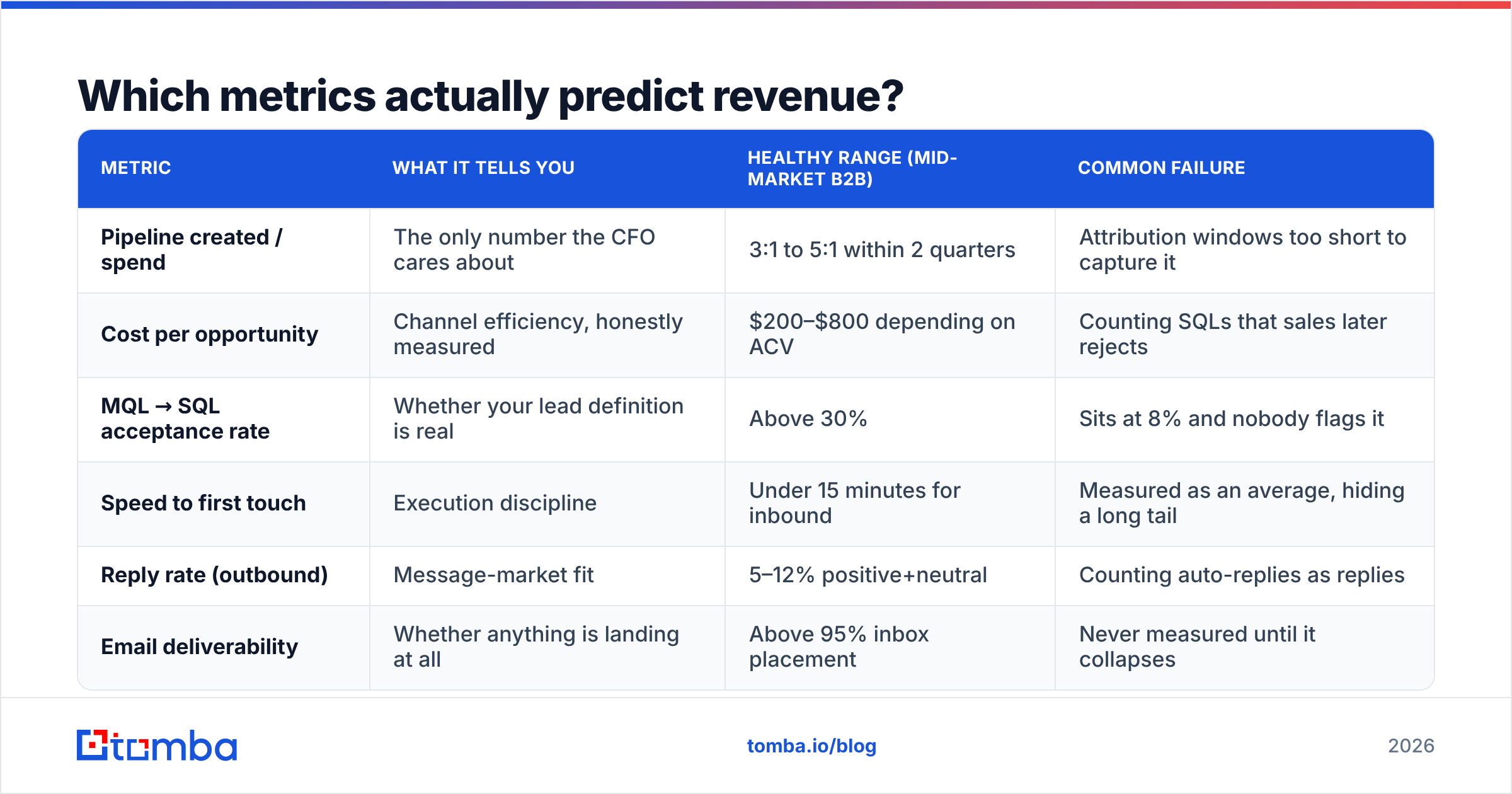
Cost per lead is the metric most likely to make your campaign worse. Optimize for it and you will systematically bid toward the cheapest audiences, which are almost never your best buyers.
Track these instead, in this hierarchy:
| Metric | What it tells you | Healthy range (mid-market B2B) | Common failure |
|---|---|---|---|
| Pipeline created / spend | The only number the CFO cares about | 3:1 to 5:1 within 2 quarters | Attribution windows too short to capture it |
| Cost per opportunity | Channel efficiency, honestly measured | $200–$800 depending on ACV | Counting SQLs that sales later rejects |
| MQL → SQL acceptance rate | Whether your lead definition is real | Above 30% | Sits at 8% and nobody flags it |
| Speed to first touch | Execution discipline | Under 15 minutes for inbound | Measured as an average, hiding a long tail |
| Reply rate (outbound) | Message-market fit | 5–12% positive+neutral | Counting auto-replies as replies |
| Email deliverability | Whether anything is landing at all | Above 95% inbox placement | Never measured until it collapses |
That last row deserves emphasis. You can execute every other step perfectly and still see zero results if your sends are landing in spam. Check your sender reputation and authentication records before you scale volume, not after replies mysteriously drop to zero.
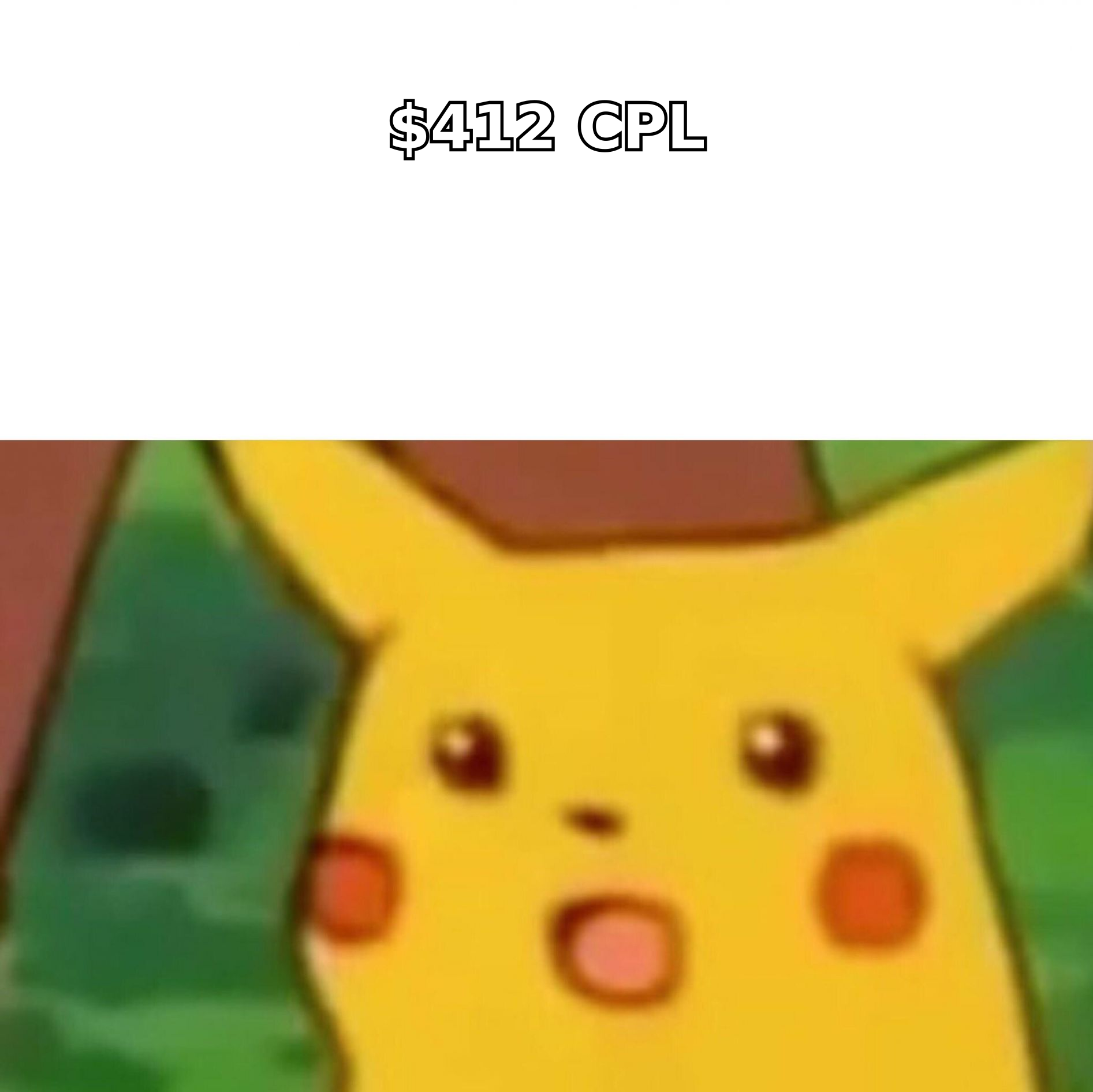
The pricing shock is real and predictable. A campaign that looked like $38 CPL in month one routinely resolves to $400+ per actual opportunity once you strip out the students, the competitors, the duplicates, and the leads sales never worked. That's not a failure — it's the true number. Budget against the true number and your forecasts stop missing.
How is demand generation different from lead generation and ABM?#
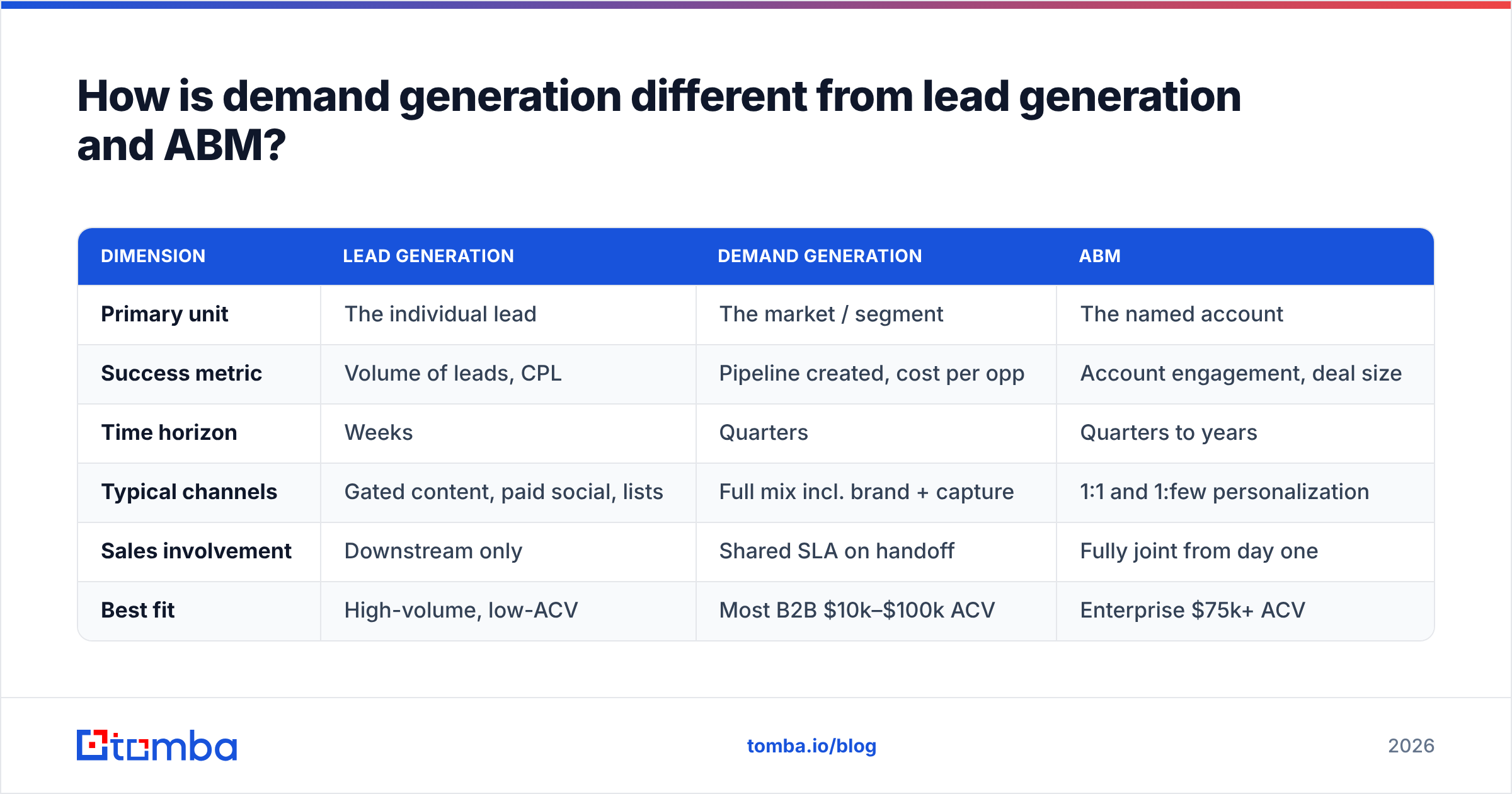
They overlap heavily, and the industry uses the terms loosely, so here's a practical separation:
| Dimension | Lead generation | Demand generation | ABM |
|---|---|---|---|
| Primary unit | The individual lead | The market / segment | The named account |
| Success metric | Volume of leads, CPL | Pipeline created, cost per opp | Account engagement, deal size |
| Time horizon | Weeks | Quarters | Quarters to years |
| Typical channels | Gated content, paid social, lists | Full mix incl. brand + capture | 1:1 and 1:few personalization |
| Sales involvement | Downstream only | Shared SLA on handoff | Fully joint from day one |
| Best fit | High-volume, low-ACV | Most B2B $10k–$100k ACV | Enterprise $75k+ ACV |
In practice, well-run programs run all three simultaneously with different budgets and different owners. The mistake is running lead gen tactics while promising demand gen outcomes — which is precisely the gap that produces those 500-MQL, 4-meeting quarters.
Analyst coverage from Gartner's marketing research has been consistent on this for several years: buying groups have grown, self-serve research now dominates the early journey, and single-threaded lead capture increasingly misses the actual decision unit. Peer reviews on G2's marketing automation category tell the same story from the practitioner side — the highest-rated programs are the ones with the tightest data hygiene, not the biggest ad budgets.
What should you do in your first 30 days?#
If you're standing up demand generation campaigns from scratch, or rebuilding a program that stalled, this is the sequence that gets to signal fastest:
- Week 1 — Audit. Pull last four quarters of closed-won deals. Find the common firmographics. That's your real ICP, not the one in the deck. Also audit your CRM for duplicate and decayed records.
- Week 2 — Build the list. 500 accounts matching the real ICP. Map 3–5 contacts per account. Verify every address. Run a catch-all verifier pass on the domains that come back ambiguous — those are often your best enterprise targets and skipping them leaves pipeline on the table.
- Week 3 — Write one message. One problem, one segment, one proof point. Three-touch email sequence plus a matching LinkedIn angle. Resist the urge to launch six variants — you won't have the volume to read them.
- Week 4 — Launch small and instrument. 150 contacts. Watch deliverability, reply rate, and meeting rate daily. Fix the biggest leak. Then scale to the full list.
Resources like HubSpot's marketing research library are useful for benchmarking your numbers against the broader market, but treat external benchmarks as a sanity check, not a target. Your category, ACV, and sales cycle move every one of them.
The bottom line#
Demand generation campaigns are not a content problem or a creative problem. They're a targeting and data problem wearing a creative costume. The teams that win in 2026 are the ones who know exactly which 800 companies matter, who inside them makes the decision, and how to reach those people with an address that actually resolves.
That last piece is where most programs quietly break. If your campaign is built on a list you can't trust, everything downstream — the message, the sequence, the retargeting, the dashboard — is measuring noise.
Start with the contact layer. Tomba Email Finder gives you verified, source-attributed professional emails by domain, name, or company, so your campaign universe is real before you spend a dollar on it. The free tier includes 25 searches a month to test it against a segment you already know, and paid plans start at $49/mo — see the full Tomba pricing breakdown to match a tier to your list volume. Build the list right, and the rest of the campaign gets dramatically easier to run.
Related guides#
Ready to find emails that actually work?
Join 150,000+ professionals who stopped guessing and started sending. Free credits on signup — no credit card required.
Get the Tomba newsletter
Practical outbound tactics and product updates — once every two weeks.
About the author