Demand Generation Channels in 2026: A Complete Ranked Guide
Most demand gen budgets are spread across nine channels and only two of them pay back. Here's how each channel actually performs on cost, speed to pipeline, and durability — plus how to pick a mix that fits your ACV.
TL;DR
- Demand generation channels split into two jobs: creating demand (people who didn't know they had a problem) and capturing it (people already shopping). Most teams overfund capture and then wonder why growth stalls.
- Paid search and review sites are the fastest to pipeline but the most expensive per opportunity, and they cap out at existing search volume.
- SEO, community, and partner co-marketing are the slowest to start and the cheapest to sustain — their compounding curve is the whole point.
- Outbound is still a demand generation channel in 2026, but only when contact data is verified first. Bad data turns a channel problem into a deliverability problem.
- The right mix is a function of ACV, sales cycle length, and how much cash you can leave in the ground for six months. There is no universal ranking.
What are demand generation channels?#
A demand generation channel is any repeatable route through which a company creates awareness of a problem, builds preference for a solution, and converts that interest into qualified pipeline. That's broader than "lead gen" — demand generation covers the top-of-funnel education work that makes someone want to buy, not just the form fill that captures them after they already do.
The practical distinction that matters for budgeting:
- Demand-creating channels — podcasts, LinkedIn thought leadership, webinars, original research, communities, partner co-marketing. Nobody was searching for you. You manufactured the interest.
- Demand-capturing channels — paid search, review sites like G2, bottom-of-funnel SEO, retargeting. The intent already existed; you're competing for it.
- Direct-contact channels — cold email, cold calling, LinkedIn outreach. You go find the buyer before they've raised a hand. These sit awkwardly between the two: outbound creates demand at the individual level, but only if targeting is precise.
- Owned-audience channels — newsletter, product-led loops, customer advocacy. Cheapest per touch, slowest to build, hardest for competitors to copy.
- Rented-audience channels — paid social, sponsorships, display, ABM ad platforms. Instant reach, zero durability. The moment you stop paying, the channel disappears.
The failure mode almost every B2B team hits: they build a plan that's 80% capture and rented reach because those channels report attribution cleanly, then discover the ceiling. Capture channels can only harvest demand that already exists. If category awareness is flat, so is your pipeline.
Which demand generation channels perform best?#
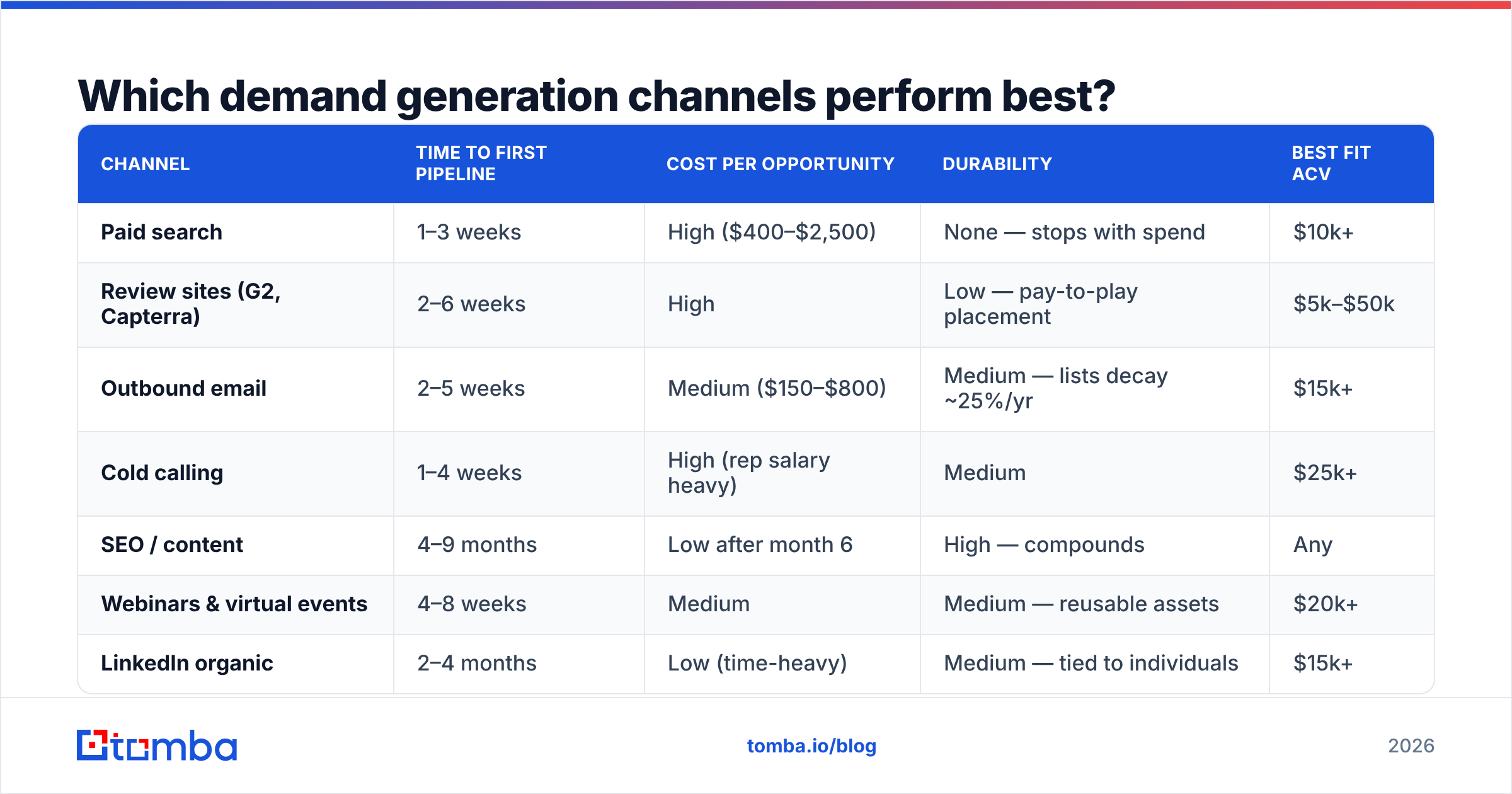
Here's the honest comparison. "Time to first pipeline" assumes a competent team starting from zero. "Durability" means what happens to the channel six months after you stop investing.
| Channel | Time to first pipeline | Cost per opportunity | Durability | Best fit ACV |
|---|---|---|---|---|
| Paid search | 1–3 weeks | High ($400–$2,500) | None — stops with spend | $10k+ |
| Review sites (G2, Capterra) | 2–6 weeks | High | Low — pay-to-play placement | $5k–$50k |
| Outbound email | 2–5 weeks | Medium ($150–$800) | Medium — lists decay ~25%/yr | $15k+ |
| Cold calling | 1–4 weeks | High (rep salary heavy) | Medium | $25k+ |
| SEO / content | 4–9 months | Low after month 6 | High — compounds | Any |
| Webinars & virtual events | 4–8 weeks | Medium | Medium — reusable assets | $20k+ |
| LinkedIn organic | 2–4 months | Low (time-heavy) | Medium — tied to individuals | $15k+ |
| Partner co-marketing | 6–12 weeks | Very low | High — relationship asset | $25k+ |
| Paid social | 2–4 weeks | Very high for B2B | None | $50k+ (ABM only) |
Two things jump out of that table. First, every fast channel is expensive and every cheap channel is slow — there is no cell that's both. Second, the channels with real durability (SEO, partnerships, owned audience) are exactly the ones that a quarterly-target culture defunds first.
Gartner's marketing research has been consistent on the underlying reason: B2B buyers spend the overwhelming majority of their buying journey without talking to a vendor. Channels that only activate after hand-raise are fighting for the last 15% of the process.
Is outbound still a demand generation channel in 2026?#
Yes — but the version that works looks nothing like 2019 outbound.
The channel didn't die; the volume strategy did. Mailbox providers tightened bulk-sender rules, spam filters got better at pattern detection, and buyers got faster at pattern-matching a template. What survived is small-volume, tightly-researched outbound to contacts you've actually verified.
The single biggest determinant of outbound performance in 2026 isn't copy. It's data hygiene. A 22% bounce rate doesn't just waste sends — it torches sender reputation across the whole domain, which then degrades every other email channel you run, including nurture and lifecycle. One sloppy list poisons the well for marketing ops too.
Practical guardrails that separate outbound-as-a-channel from outbound-as-a-liability:
- Verify before you send, not after. Run every list through an email verifier and treat anything above 3% expected bounce as unshippable.
- Handle catch-all domains explicitly. A large share of enterprise domains accept everything at the SMTP layer, so standard verification returns "unknown." A dedicated catch-all verifier is the difference between a usable enterprise list and a coin flip.
- Cap daily volume per mailbox. 30–50 sends per inbox, not 300.
- Segment by trigger, not by title. Funding rounds, job changes, tech-stack changes, and hiring signals outperform "VP of Sales at 50–200 employees" by a wide margin.
- Measure replies, not opens. Open tracking has been unreliable since privacy protections landed; positive reply rate is the only honest signal.
For sourcing, the market has split between broad database plays and precision finders. Providers like BookYourData are strong when you want a pre-built, filterable list you can pull in bulk; a domain-level tool like Tomba's domain search is better when you already know the accounts and need accurate contacts inside them. Most disciplined teams use both — a database for breadth, a finder for depth on named accounts.
How do paid channels fit into demand generation?#
Paid search is the least strategic and most reliable channel you'll run. It converts existing intent at a predictable, rising cost. Treat it as a tax on your category position, not as growth: if competitors are bidding on your brand terms, you must defend, and if you're bidding on generic category terms you're paying to educate people who may buy from someone else.
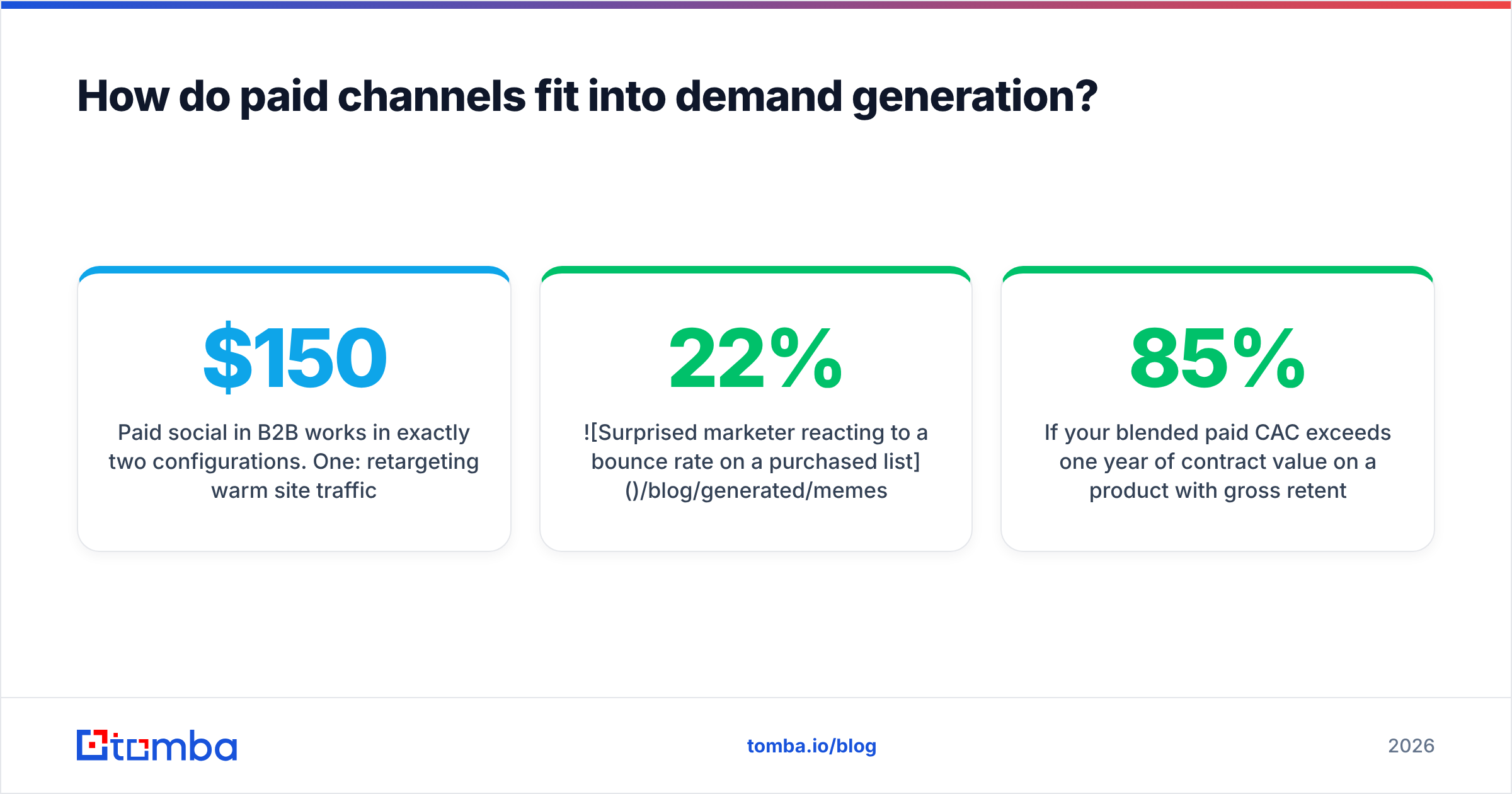
Paid social in B2B works in exactly two configurations. One: retargeting warm site traffic with a specific, dated offer. Two: tightly-scoped ABM campaigns against a named account list where the ACV justifies a $150+ cost per engaged account. Everything else — broad interest targeting, lookalikes off a 400-row customer list, "brand awareness" objectives — burns budget with no measurable pipeline effect.
The number that surprises teams is the fully-loaded cost per closed deal once you include the leads that never convert.
If your blended paid CAC exceeds one year of contract value on a product with 85% gross retention, you don't have a channel — you have a subsidy.
Which channels compound, and how long do they take?#
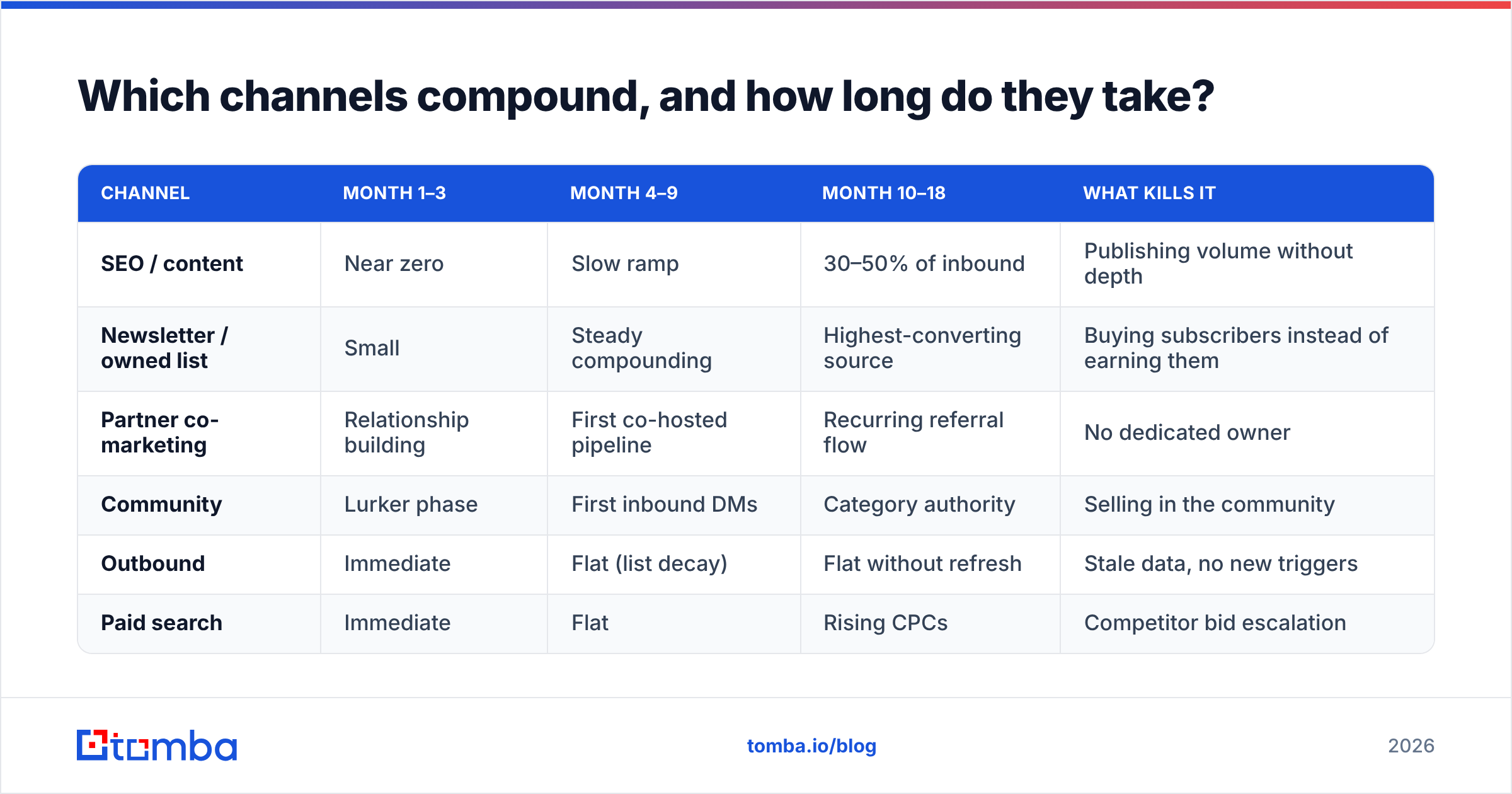
This is the table that should drive your annual plan, because it forces the honest question: how long can you fund something before it returns?
| Channel | Month 1–3 | Month 4–9 | Month 10–18 | What kills it |
|---|---|---|---|---|
| SEO / content | Near zero | Slow ramp | 30–50% of inbound | Publishing volume without depth |
| Newsletter / owned list | Small | Steady compounding | Highest-converting source | Buying subscribers instead of earning them |
| Partner co-marketing | Relationship building | First co-hosted pipeline | Recurring referral flow | No dedicated owner |
| Community | Lurker phase | First inbound DMs | Category authority | Selling in the community |
| Outbound | Immediate | Flat (list decay) | Flat without refresh | Stale data, no new triggers |
| Paid search | Immediate | Flat | Rising CPCs | Competitor bid escalation |
Compounding channels aren't better in the abstract — they're better if you can survive the ramp. A seed-stage company with nine months of runway should not be building an SEO program as its primary channel. A profitable company with a two-year horizon that isn't building one is choosing to rent its demand forever.
How do you pick the right channel mix?#
Start from three inputs, in this order:
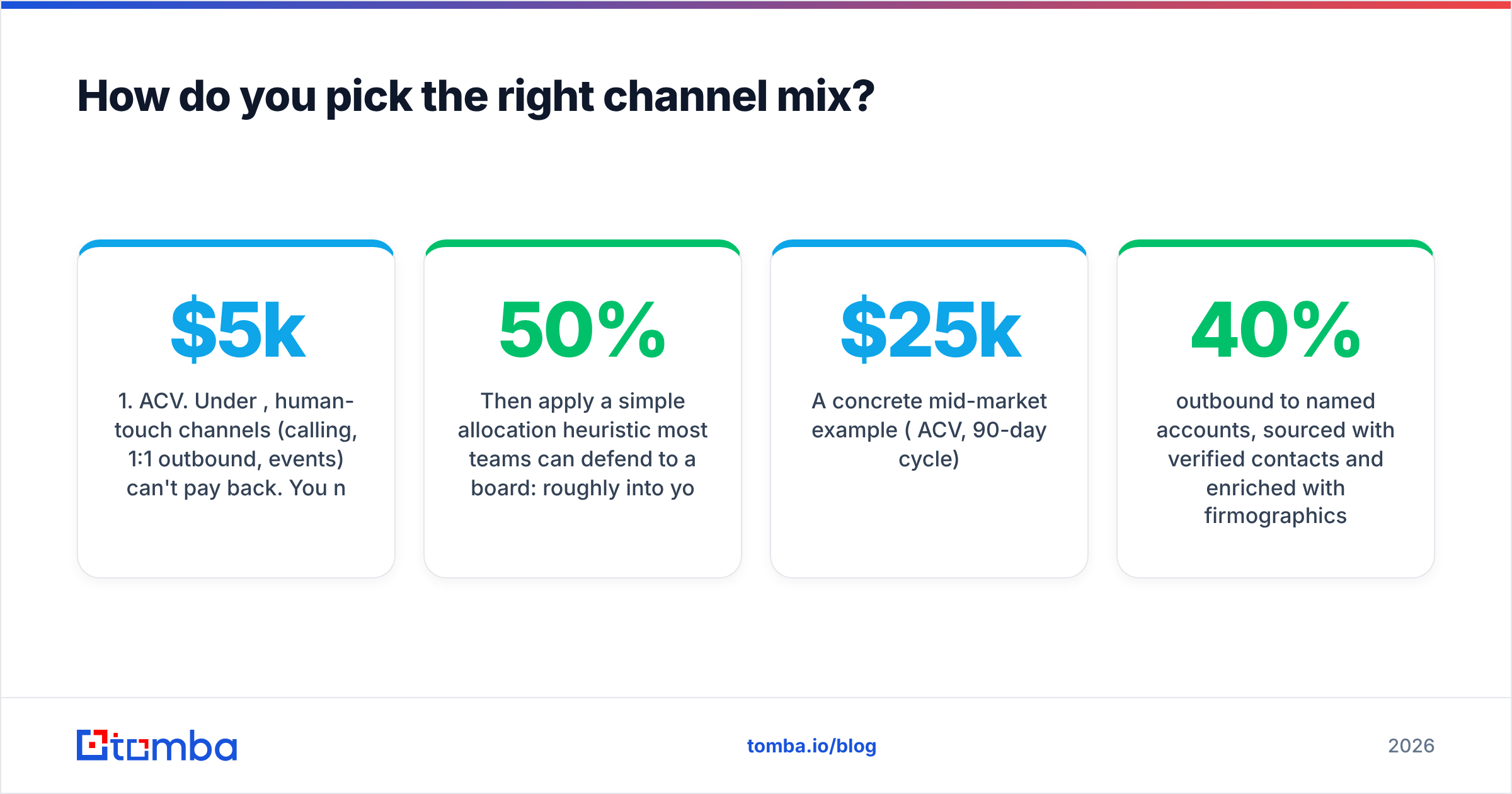
- ACV. Under $5k, human-touch channels (calling, 1:1 outbound, events) can't pay back. You need self-serve, SEO, product-led loops, and paid capture. Above $50k, the math inverts: a single closed deal justifies months of ABM and outbound effort.
- Sales cycle length. Long cycles (6+ months) demand channels that keep you present over time — newsletter, community, webinars, retargeting. Short cycles reward intent capture.
- Where your buyer already congregates. Not where you wish they were. If your ICP is facilities managers, LinkedIn thought leadership is a fantasy and trade publications plus cold calling are reality.
Then apply a simple allocation heuristic most teams can defend to a board: roughly 50% into your one proven channel, 30% into a second channel that's showing early signal, and 20% into genuine experiments you're prepared to kill in 90 days. The mistake isn't running too few channels — it's running seven at 14% each, none of which ever gets enough investment to clear its activation threshold.
A concrete mid-market example ($25k ACV, 90-day cycle):
- 40% outbound to named accounts, sourced with verified contacts and enriched with firmographics
- 25% SEO and comparison content targeting bottom-funnel queries
- 20% webinars and partner co-marketing into adjacent audiences
- 15% paid search on brand plus three high-intent category terms
What metrics actually prove a channel is working?#
Drop the vanity layer. These five tell you whether to double down or cut:
- Pipeline per dollar, by channel, at 90-day lag. Not leads. Not MQLs. Qualified pipeline, attributed at the point of creation, measured against spend from the prior quarter.
- Opportunity-to-close rate by source. Some channels produce volume that never closes. Paid social leads and gated-ebook downloads are the classic offenders; both look great in a lead report and terrible in a win rate breakdown.
- Time to first meeting. Measures how much friction the channel carries.
- Cost per closed-won, fully loaded. Include tooling, agency, and rep time — not just media spend.
- Channel decay rate. Is cost per opportunity rising quarter over quarter? Paid channels almost always are. Compounding channels should be falling.
HubSpot's ongoing marketing statistics research is a reasonable external benchmark for channel-level conversion norms, but treat any published median as a sanity check rather than a target — segment and ACV variance swamps the averages.
What are the most expensive mistakes in channel selection?#
Copying a public playbook from a company at a different stage. The Series C company writing about their demand gen engine has a brand, a customer base, and a nine-person team you don't have. Their channel mix is an output of assets you haven't built yet.
Judging a compounding channel on a capture channel's timeline. Killing content at month four is the single most common self-inflicted wound in B2B marketing. You paid the entire cost and collected none of the return.
Treating data quality as an ops problem instead of a channel problem. Every email-dependent channel — outbound, nurture, lifecycle, webinar follow-up, event recap — shares one reputation. Feeding any of them unverified contacts degrades all of them. Front-loading verification with bulk verification before a campaign costs a fraction of what a domain reputation recovery costs.
Running channels without an owner. A channel with 20% of three people's attention performs worse than a channel with 100% of one person's.
Ignoring the second-order effect of brand. Every "unattributed" direct visit and branded search is the output of channels your attribution model doesn't credit. If you optimize purely on last-touch, you will systematically defund the channels that make everything else cheaper.
Where to start#
If you're rebuilding your channel mix from scratch, sequence it: get one capture channel producing reliably (usually paid search or bottom-funnel SEO), add one direct-contact channel with clean data, then invest the surplus into one compounding channel you commit to for at least twelve months. Three channels done properly beat seven done partially, every time.
For the direct-contact leg of that plan, the input quality determines the output. The Tomba Email Finder locates verified professional addresses by domain, name, or company, so your outbound channel starts from contacts that actually exist instead of guessed patterns. It runs free for 25 searches a month, with paid plans starting at $49/mo — full details on the Tomba pricing page. Build the list correctly once, and every downstream channel metric gets easier to read.
Related guides#
Ready to find emails that actually work?
Join 150,000+ professionals who stopped guessing and started sending. Free credits on signup — no credit card required.
Get the Tomba newsletter
Practical outbound tactics and product updates — once every two weeks.
About the author