Demand Generation Content Marketing: The 2026 Playbook
Most content programs generate traffic, not pipeline. Here's how demand generation content marketing actually works in 2026 — the funnel stages, the metrics that matter, and the tooling that closes the loop.
TL;DR
- Demand generation content marketing creates and captures buying intent across the whole funnel — not just the top. Lead generation is one stage inside it, not a synonym for it.
- The single biggest failure mode in 2026: measuring content on MQL volume instead of pipeline influence. Gated ebooks still produce leads; they rarely produce buyers.
- A working program runs three content layers in parallel — demand creation (95% not in-market), demand capture (the 5% searching now), and demand conversion (sales-assist assets).
- Dark social, podcasts, and community mean most influence is unattributable. Build a self-reported attribution question into your demo form and stop pretending last-touch is truth.
- Content only becomes revenue when you can reach the people it warmed up. Enrichment and contact data are the bridge between "they read it" and "we emailed them."
What is demand generation content marketing?#
Demand generation content marketing is the practice of using content to create, capture, and convert buying intent across an entire market — including the large majority of buyers who are not currently shopping.
The distinction that matters: lead generation asks for a form fill; demand generation builds the preference that makes the form fill happen. A lead-gen program judges a blog post by how many emails it collected. A demand-gen program judges it by whether the accounts it reached later showed up in pipeline — sometimes six months later, often via a direct-to-demo visit that no attribution model will credit to the post.
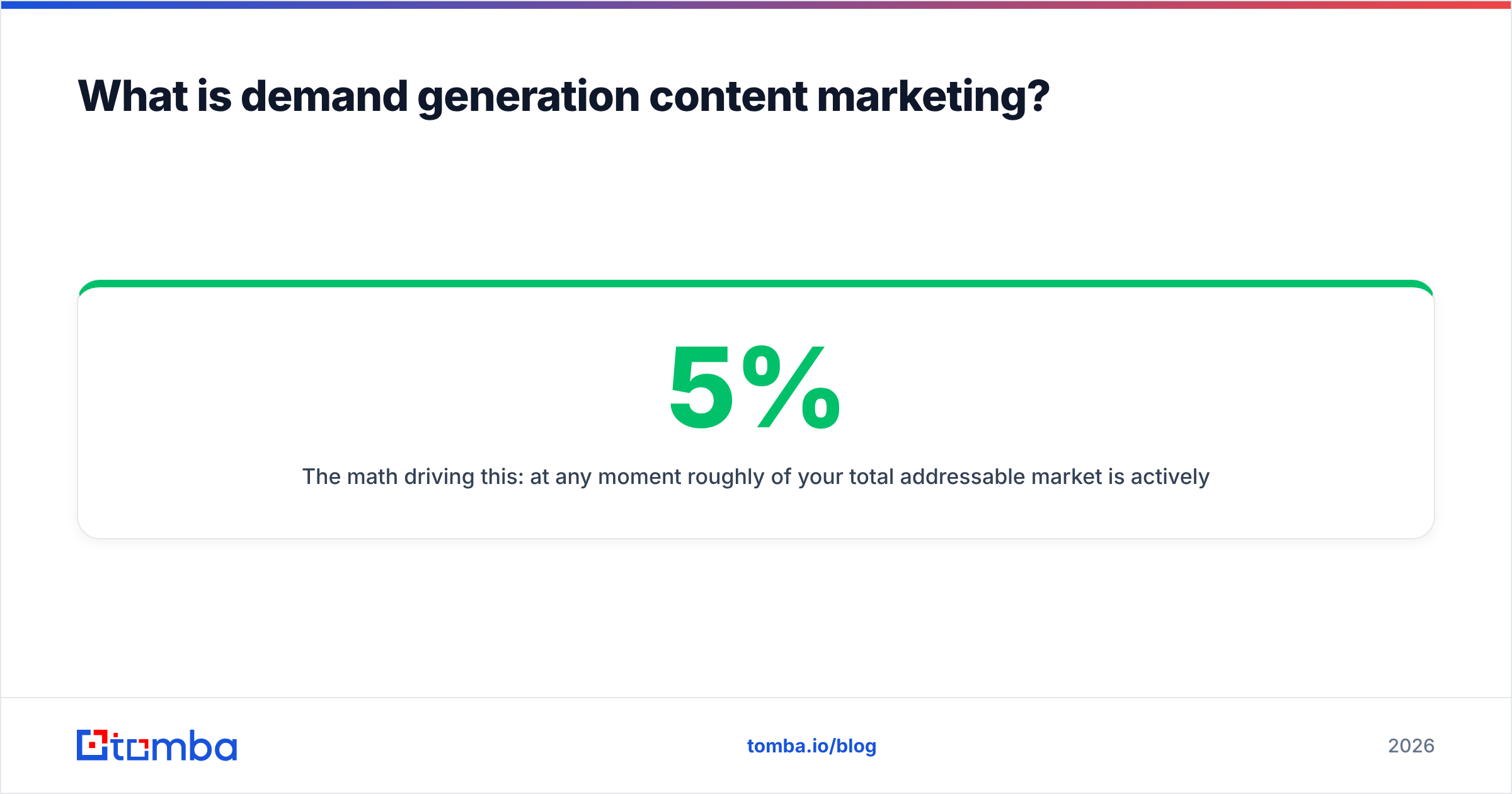
The math driving this: at any moment roughly 5% of your total addressable market is actively in-buying-mode. The other 95% is not looking, not reading vendor comparison pages, and not filling out anything. Content that only targets the 5% competes in the bloodiest part of the market. Content that reaches the 95% builds the memory structures that decide who gets the shortlist call when those buyers do enter the market.
The three layers of a demand generation content program#
- Demand creation — educational, opinionated, distribution-first content aimed at people with no active need. LinkedIn posts, podcasts, YouTube teardowns, original research. Success metric: reach and recall inside your ICP, not conversions.
- Demand capture — high-intent content that intercepts active search. Comparison pages, "best X tools" roundups, alternatives pages, pricing explainers. Success metric: qualified demo requests and assisted pipeline.
- Demand conversion — sales-assist assets used inside deals. ROI calculators, security one-pagers, implementation guides, customer proof. Success metric: stage-to-stage velocity and win rate.
- Demand retention — post-sale content that drives expansion and reduces churn. Onboarding series, advanced-use playbooks, community programming. Success metric: net revenue retention.
- Feedback loop — sales call recordings, lost-deal reasons, and support tickets feed back into layers 1–3. Without this, content strategy is guesswork dressed as a calendar.
Most teams build layer 2 only, then wonder why growth plateaus once the keyword set is exhausted.
How is demand generation different from lead generation?#
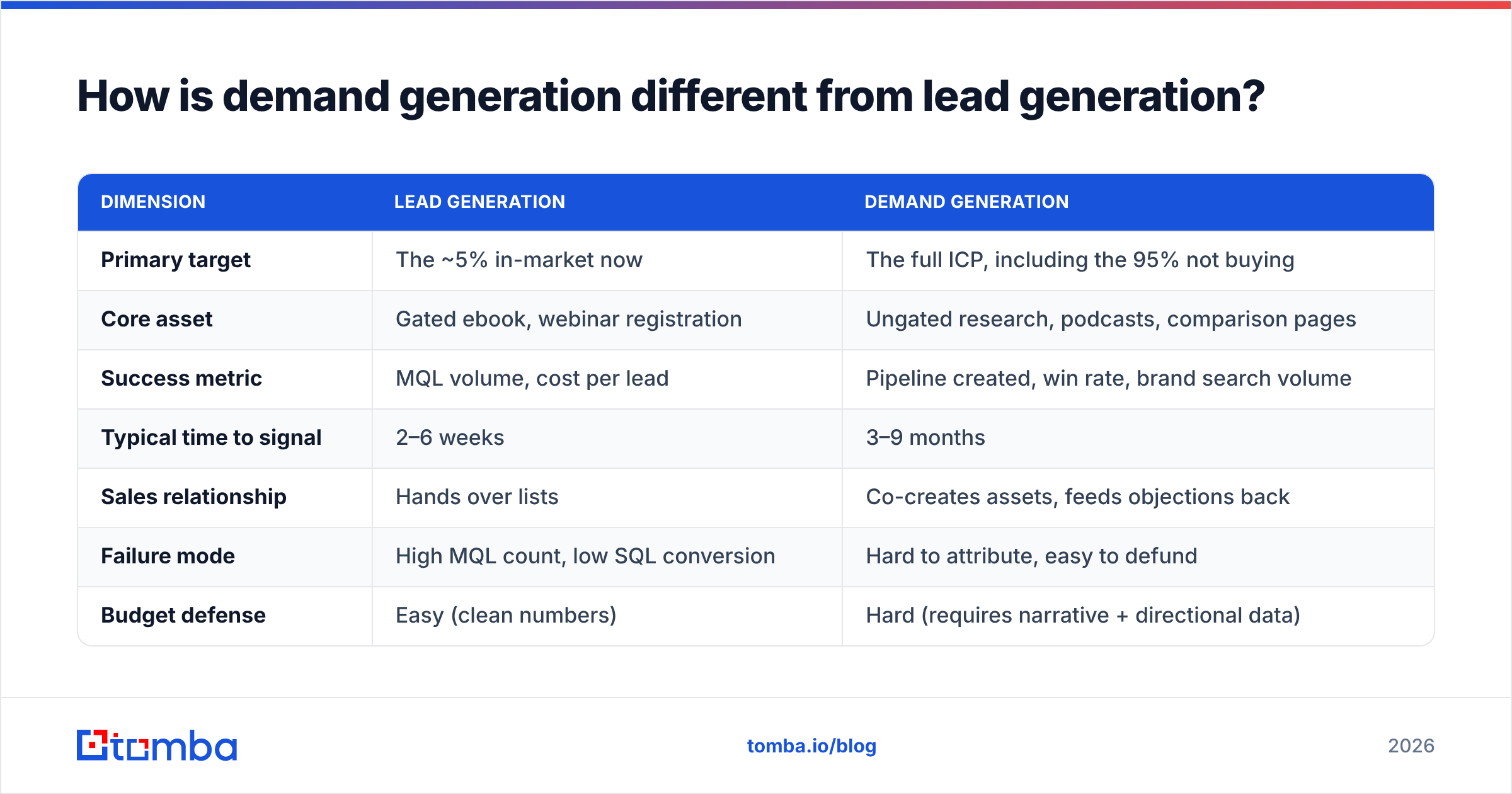
They differ in target, timeline, and what counts as success. Here's the concrete split.
| Dimension | Lead generation | Demand generation |
|---|---|---|
| Primary target | The ~5% in-market now | The full ICP, including the 95% not buying |
| Core asset | Gated ebook, webinar registration | Ungated research, podcasts, comparison pages |
| Success metric | MQL volume, cost per lead | Pipeline created, win rate, brand search volume |
| Typical time to signal | 2–6 weeks | 3–9 months |
| Sales relationship | Hands over lists | Co-creates assets, feeds objections back |
| Failure mode | High MQL count, low SQL conversion | Hard to attribute, easy to defund |
| Budget defense | Easy (clean numbers) | Hard (requires narrative + directional data) |
The uncomfortable truth in that table is the last row. Lead gen survives budget cuts because its numbers are legible. Demand gen dies in budget cuts because its numbers are honest. If you run a demand-gen program, you need a measurement story ready before the CFO asks — not after.
Which content formats actually build pipeline in 2026?#
Rank formats by how close they sit to a buying decision, then staff accordingly.
Highest pipeline yield (capture layer):
- Comparison and alternatives pages. Someone searching "[competitor] alternative" has a budget and a grievance. These convert at multiples of blog traffic. Look at how vendors structure their own comparison hubs — for example, an Apollo alternative page exists precisely because that query has commercial intent baked in.
- Pricing-transparency content. Buyers self-qualify on price before they talk to you. Publishing real numbers filters out mismatches and earns trust from the ones who fit.
- Integration and workflow guides. "How to enrich HubSpot contacts automatically" attracts people who already own the adjacent tool and are trying to solve a live problem.
Highest reach yield (creation layer):
- Original research and benchmark data. One good data study earns backlinks, conference mentions, and sales-deck citations for two years. It's the highest-leverage asset most B2B teams never build.
- Founder- and practitioner-led social. Personal accounts outperform brand accounts on reach by a wide margin. This is where the 95% actually encounters you.
- Podcasts and video teardowns. Long-form audio and video build familiarity faster than text. They're also the least attributable — which is exactly why competitors under-invest.
Lowest yield, still over-produced:
- Generic "what is X" posts with no point of view. AI Overviews now answer these directly; the click never reaches you.
- Gated PDFs on topics that are freely available elsewhere. You're trading goodwill for an email address that goes straight to unsubscribe.
How do you measure demand generation content without lying to yourself?#
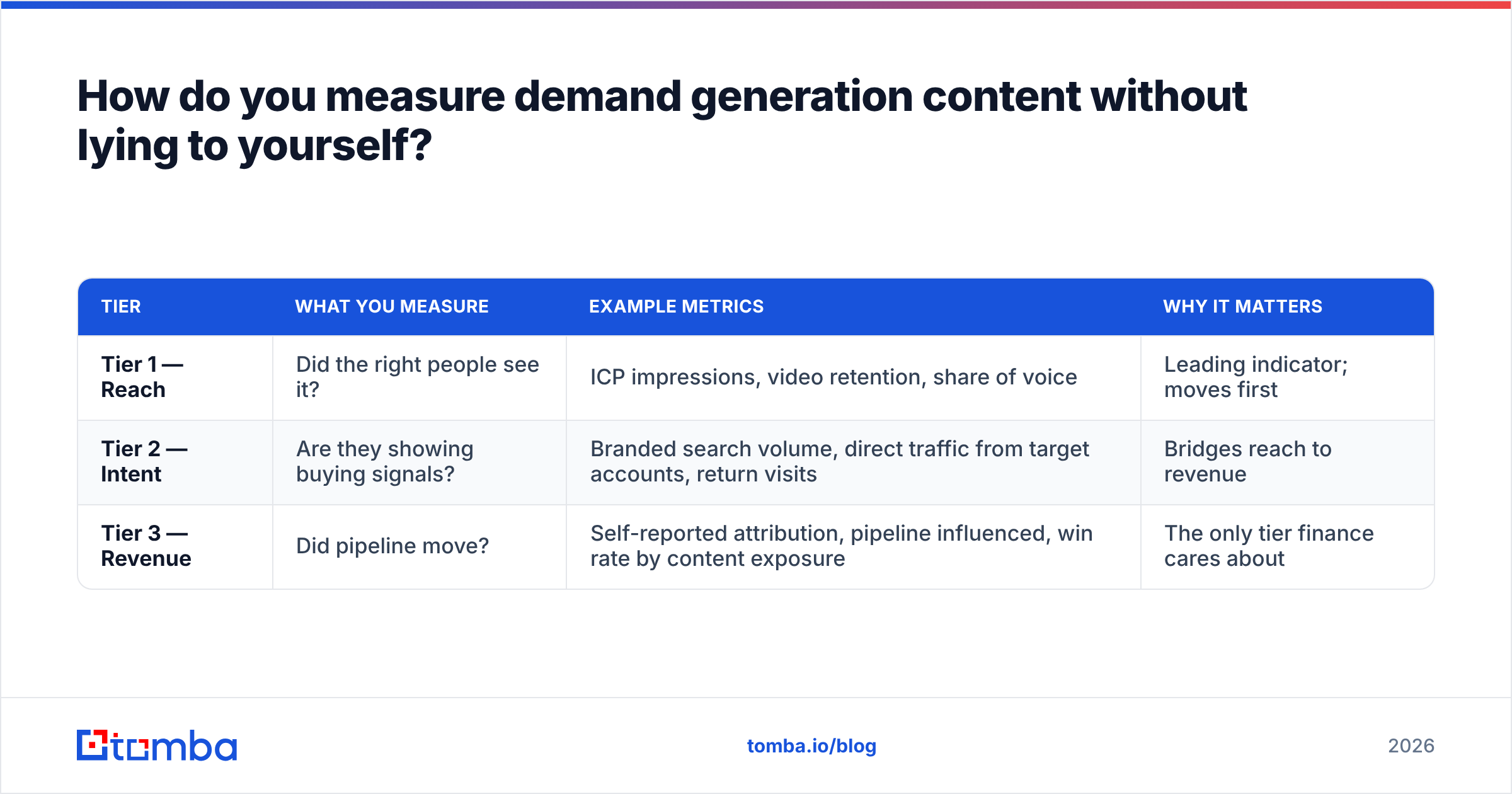
Use a three-tier measurement stack. Tier 1 is directional, tier 2 is correlational, tier 3 is causal — and you need all three.
| Tier | What you measure | Example metrics | Why it matters |
|---|---|---|---|
| Tier 1 — Reach | Did the right people see it? | ICP impressions, video retention, share of voice | Leading indicator; moves first |
| Tier 2 — Intent | Are they showing buying signals? | Branded search volume, direct traffic from target accounts, return visits | Bridges reach to revenue |
| Tier 3 — Revenue | Did pipeline move? | Self-reported attribution, pipeline influenced, win rate by content exposure | The only tier finance cares about |
Three practices that separate real measurement from theater:
1. Add a self-reported attribution field. One open-text or dropdown question on your demo form — "How did you hear about us?" — routinely explains 30–50% more pipeline than your analytics platform does. It's the single cheapest measurement upgrade available.
2. Track branded search as a content KPI. If demand creation is working, more people search your company name directly. That number is clean, free, and hard to game.
3. Stop reporting MQLs as the headline. Report pipeline created and pipeline influenced. If leadership insists on MQLs, at minimum segment them by ICP fit so the number means something. Understanding what actually qualifies a marketing qualified lead in your business prevents the most common form of self-deception — counting newsletter signups as demand.
Forrester and Gartner both moved their B2B buying frameworks toward buying-group and self-directed-journey models years ago; Forrester's B2B research is worth reading if you need external air cover for killing an MQL target.
How do you turn content readers into contactable pipeline?#
This is where most demand generation content marketing programs break. You built awareness. You have anonymous traffic from ideal accounts. Now what?
Three bridges, in order of effort:
Bridge 1 — Visitor identification. Resolve anonymous company-level traffic to accounts, then match those accounts to your ICP list. If the VP of Sales at a 200-person SaaS company read your pricing page three times this week, that's a signal worth acting on. Tools that handle website visitor reveal turn passive readership into an actionable account list.
Bridge 2 — Contact resolution. Knowing the account isn't enough; you need the human. This is where an email finder and data enrichment close the gap between "Acme Corp visited" and "here is the person who owns this problem, with a verified work email."
Bridge 3 — Warm, contextual outreach. Reference the content, not the visit. "You mentioned X in your recent post" or "our benchmark report covered the problem you're solving" beats "I saw you on our site" — which reads as surveillance.
The failure mode to avoid: buying a giant list and blasting it. That's not demand generation, that's spray-and-pray with better branding. Contact data should be applied narrowly to accounts that already demonstrated interest through your content.
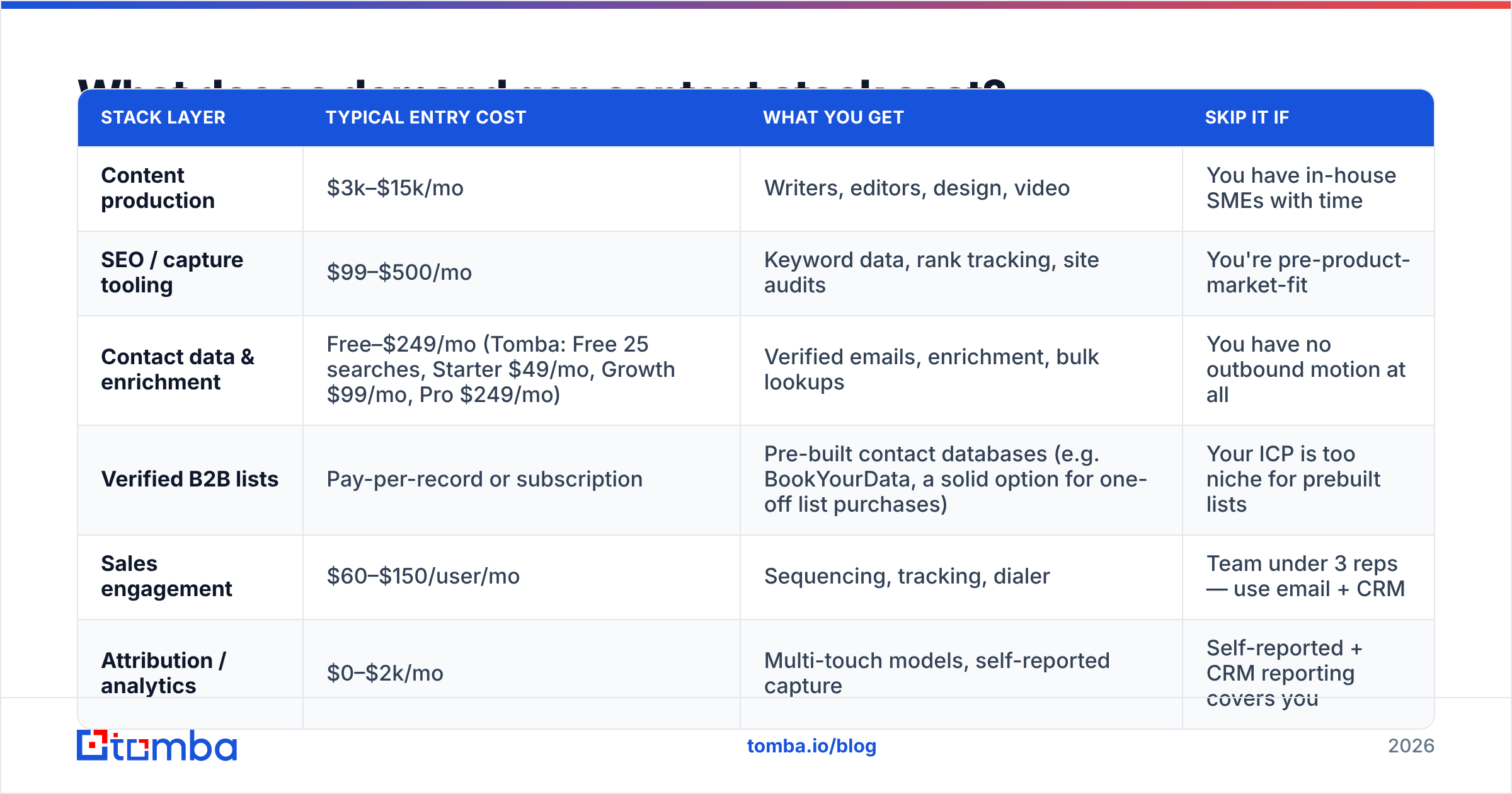
What does a demand gen content stack cost?#
Budget lines vary wildly, but the categories are stable. Here's a realistic mid-market comparison of where money goes.
| Stack layer | Typical entry cost | What you get | Skip it if |
|---|---|---|---|
| Content production | $3k–$15k/mo | Writers, editors, design, video | You have in-house SMEs with time |
| SEO / capture tooling | $99–$500/mo | Keyword data, rank tracking, site audits | You're pre-product-market-fit |
| Contact data & enrichment | Free–$249/mo (Tomba: Free 25 searches, Starter $49/mo, Growth $99/mo, Pro $249/mo) | Verified emails, enrichment, bulk lookups | You have no outbound motion at all |
| Verified B2B lists | Pay-per-record or subscription | Pre-built contact databases (e.g. BookYourData, a solid option for one-off list purchases) | Your ICP is too niche for prebuilt lists |
| Sales engagement | $60–$150/user/mo | Sequencing, tracking, dialer | Team under 3 reps — use email + CRM |
| Attribution / analytics | $0–$2k/mo | Multi-touch models, self-reported capture | Self-reported + CRM reporting covers you |
Two notes on that table. First, the cheapest measurement upgrade (self-reported attribution) costs nothing — it's a form field. Second, contact-data spend should scale after content reach is proven, not before. Enriching a list of people who've never heard of you is just cold outbound with extra steps.
Compare current Tomba pricing against what you're paying per verified contact today; the per-record math usually decides it. G2's lead intelligence category is a reasonable place to sanity-check vendor claims against reviewer volume.
What does a 90-day demand generation content plan look like?#
Days 1–30: Diagnose and instrument
- Interview 5 recent closed-won and 5 closed-lost buyers. Ask what they read, watched, or heard before the first call.
- Add the self-reported attribution field to every form. Non-negotiable.
- Audit existing content against the three layers. Most teams find 80% sits in one layer.
- Build the ICP account list and verify contact coverage. A bulk email finder run against your target account list tells you fast whether the data exists or whether you're chasing a segment you can't reach.
Days 31–60: Ship the missing layer
- If you're capture-heavy, publish one original research piece and start a founder-led social cadence.
- If you're creation-heavy, build the comparison, alternatives, and pricing pages you've been avoiding.
- Sit in on ten sales calls. Turn the three most repeated objections into three assets.
Days 61–90: Close the loop
- Match content-exposed accounts to pipeline. Report pipeline influenced, not MQLs.
- Kill the two lowest-performing content formats without sentiment.
- Set the next quarter's target on branded search volume and pipeline created — the two numbers hardest to fake.
What are the most common demand gen content mistakes?#
- Gating everything. Gating suppresses reach by 80–95%. Gate only assets with real, scarce value — original data, calculators, templates. Ungate opinion and education.
- Publishing without distribution. A post with no distribution plan is a diary entry. Budget distribution effort at parity with production effort.
- Ignoring sales. Content built without sales input answers questions nobody asked. Ten call recordings beat a hundred keyword rows.
- Chasing volume over depth. Twenty thin posts lose to four genuinely useful ones, especially now that AI Overviews absorb shallow informational queries.
- Treating attribution as truth. Last-touch attribution will tell you Google is your best channel forever, because Google is where people go after they hear about you somewhere else.
- Never enriching. You build demand, someone visits, and you have no way to contact them. Pair content reach with a working email verifier so the addresses you do collect are actually reachable.
Is demand generation content marketing worth it for small teams?#
Yes — but only if you narrow ruthlessly. A three-person team cannot run five content layers across four channels. Pick one demand-creation channel where your buyers already congregate, one capture format (usually comparison pages), and one measurement question on the demo form. Run that for two quarters before adding anything.
The advantage small teams have is speed and specificity. You can publish a genuinely opinionated take on Tuesday that an enterprise team would spend six weeks getting through legal. Use it.
The disadvantage is reach. That's what makes the contact-data bridge more important, not less — when you can't out-publish the market, you have to be more precise about who you reach out to after they engage.
Where should you start this week?#
Start with the gap between attention and contact. Pull your last 90 days of traffic, isolate the sessions from ICP-fit companies, and check how many of those accounts you can actually reach today. If the answer is "we don't know," that's your first project.
The Tomba Email Finder is built for exactly that step: turn a company domain or a name into a verified professional email so the demand your content created doesn't evaporate into anonymous traffic. Free tier gives you 25 searches a month to test the coverage on your own account list before spending anything — start there, confirm the data holds up for your segment, then scale it into your enrichment workflow.
Content builds the demand. Contact data makes it callable. Run both, or you're only doing half the job.
Related guides#
Ready to find emails that actually work?
Join 150,000+ professionals who stopped guessing and started sending. Free credits on signup — no credit card required.
Get the Tomba newsletter
Practical outbound tactics and product updates — once every two weeks.
About the author