Demand Generation Examples: 12 Campaigns That Actually Work
Twelve real demand generation examples — from dark social to product-led loops — with the mechanics, cost signals, and honest failure modes behind each one.
TL;DR
- Demand generation creates interest in a problem you solve; lead generation captures contact details from people who already have that interest. Most teams do the second and call it the first.
- The twelve examples below are grouped by budget: under $2K/month, $2K–$15K/month, and enterprise. Pick from one tier, not three.
- The highest-ROI plays in 2026 are unglamorous: a founder posting on LinkedIn, a proprietary benchmark report, and a free tool that solves one narrow job.
- Every example includes its failure mode. Most demand gen programs die from under-resourced distribution, not bad ideas.
- None of it compounds without clean contact data — a beautiful campaign that routes to bounced inboxes is just an expensive brand exercise.
What is demand generation, really?#
Demand generation is the work of making a buyer aware they have a problem worth solving, and associating your category — then your brand — with the fix. It is upstream of everything sales touches.
The distinction that matters in practice:
- Demand creation — the buyer didn't know the problem was solvable. A benchmark report showing that 34% of B2B emails bounce creates urgency where none existed.
- Demand capture — the buyer is already searching "email verification tool." Your job is to be there. This is SEO, review sites, and branded search.
- Lead capture — a form. A form is not demand generation, it is the receipt for demand you already generated somewhere else.
- Lead nurture — sequencing people who raised a hand but aren't ready. Necessary, but it converts existing demand rather than creating new demand.
Most "demand gen" job listings describe items 3 and 4. The teams that pull ahead spend at least 40% of their budget on item 1, where there is no competitive auction to lose.
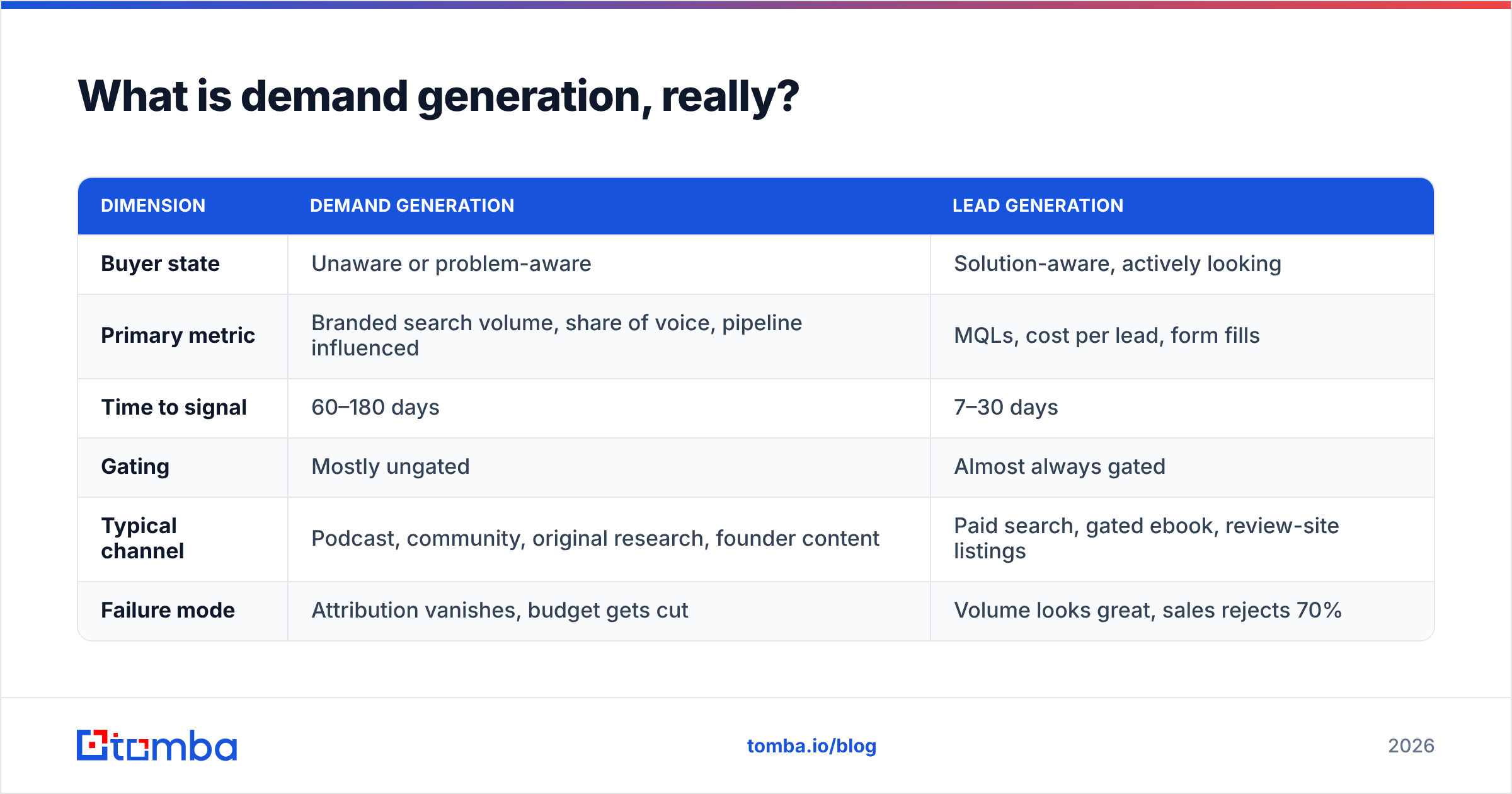
| Dimension | Demand generation | Lead generation |
|---|---|---|
| Buyer state | Unaware or problem-aware | Solution-aware, actively looking |
| Primary metric | Branded search volume, share of voice, pipeline influenced | MQLs, cost per lead, form fills |
| Time to signal | 60–180 days | 7–30 days |
| Gating | Mostly ungated | Almost always gated |
| Typical channel | Podcast, community, original research, founder content | Paid search, gated ebook, review-site listings |
| Failure mode | Attribution vanishes, budget gets cut | Volume looks great, sales rejects 70% |
What do demand generation examples look like on a small budget?#
Under roughly $2,000/month, you have no media budget worth defending. Everything has to come from labor and originality.
Example 1 — The founder-led LinkedIn cadence. A three-person data infrastructure company posts four times a week from the CEO's personal profile: two teardown posts (a public pipeline diagram with what's wrong), one customer anecdote, one contrarian take. No links in-post. Comments handle routing. The mechanic is that LinkedIn's algorithm suppresses outbound links, so the play is deliberately friction-heavy — the reader has to want it. Measurable outcome is branded search lift, not clicks.
Failure mode: the CEO gets busy in month two and a ghostwriter takes over. Engagement halves within three weeks because the specificity disappears.
Example 2 — The narrow free tool. Not a "calculator" in the generic sense. One job, done fully, with no signup. An email permutator that generates every plausible format for a name-and-domain pair is a good shape: it takes ten seconds, it solves a real recurring annoyance, and the person using it is definitionally in-market for the paid version. Free tools also earn links passively, which is the closest thing to compounding distribution a small team can buy.
Failure mode: building five mediocre tools instead of one excellent one. Tool pages need the same content depth as a blog post to rank.
Example 3 — The proprietary micro-benchmark. You don't need a 40-page State of the Industry report. Run one test, publish the number. "We verified 50,000 addresses across seven providers and recorded the bounce rate" is a citable fact. Journalists and bloggers link to numbers, not opinions. The cost is a weekend of methodology and honesty about your own result even when it isn't first.
Failure mode: rigging the test. It gets caught, and the reputational cost exceeds the traffic gain by an order of magnitude.

Example 4 — Community answer farming. Pick three places your buyer already argues: a subreddit, a Slack community, one active LinkedIn group. Answer questions with genuinely useful, unbranded detail for eight weeks before you mention what you sell. This scales badly, which is exactly why it works — your funded competitors won't do it.
Failure mode: treating it as a link-drop channel. Moderators ban you, and the community remembers the brand name for the wrong reason.
Which demand generation examples work at $2K–$15K per month?#
This tier is where most B2B SaaS companies live. You have a small budget and one or two full-time marketers.
Example 5 — The podcast guest circuit as a systematic channel. Not one appearance. Thirty, booked over six months, targeting shows with 500–5,000 listeners in your exact niche. Small shows convert better than large ones because the audience overlap is near-total. Each episode yields a transcript you can repurpose into three LinkedIn posts and one blog section. Cost is roughly $1,500/month if you use a booking service, near zero if you pitch yourself.
Example 6 — Customer-led webinars where you are not the star. You host, a customer presents their own workflow, and your product appears incidentally in a screenshot. Registration rates run 2–3x higher than vendor-led webinars because the promise is peer learning, not a demo. The recording becomes an evergreen asset.
Example 7 — Paid retargeting on ungated content. Publish genuinely useful ungated material, retarget everyone who spent 45+ seconds on it with a low-friction offer. This inverts the standard funnel: you spend media dollars on people who already demonstrated interest rather than on cold interest-based targeting. CPMs are higher, but conversion rates typically justify it by 3–5x.
Example 8 — Comparison and alternative pages built honestly. Pages like a Clearbit alternative breakdown capture buyers at the exact moment they're evaluating. The trick is writing them so a neutral reader trusts them — that means listing where the competitor genuinely wins. Pages that read like a hit piece convert worse than pages that concede two or three points.
Example 9 — The account-signal play. Identify companies visiting your site anonymously, cross-reference against your ICP, and route the fits into a light, relevant outbound sequence. Website visitor reveal makes this practical for teams without an enterprise ABM stack. The critical discipline is relevance: reference the topic they read, not the fact that you tracked them.
Failure mode: creepy outreach. "I saw you were on our pricing page" burns more goodwill than the meeting is worth.
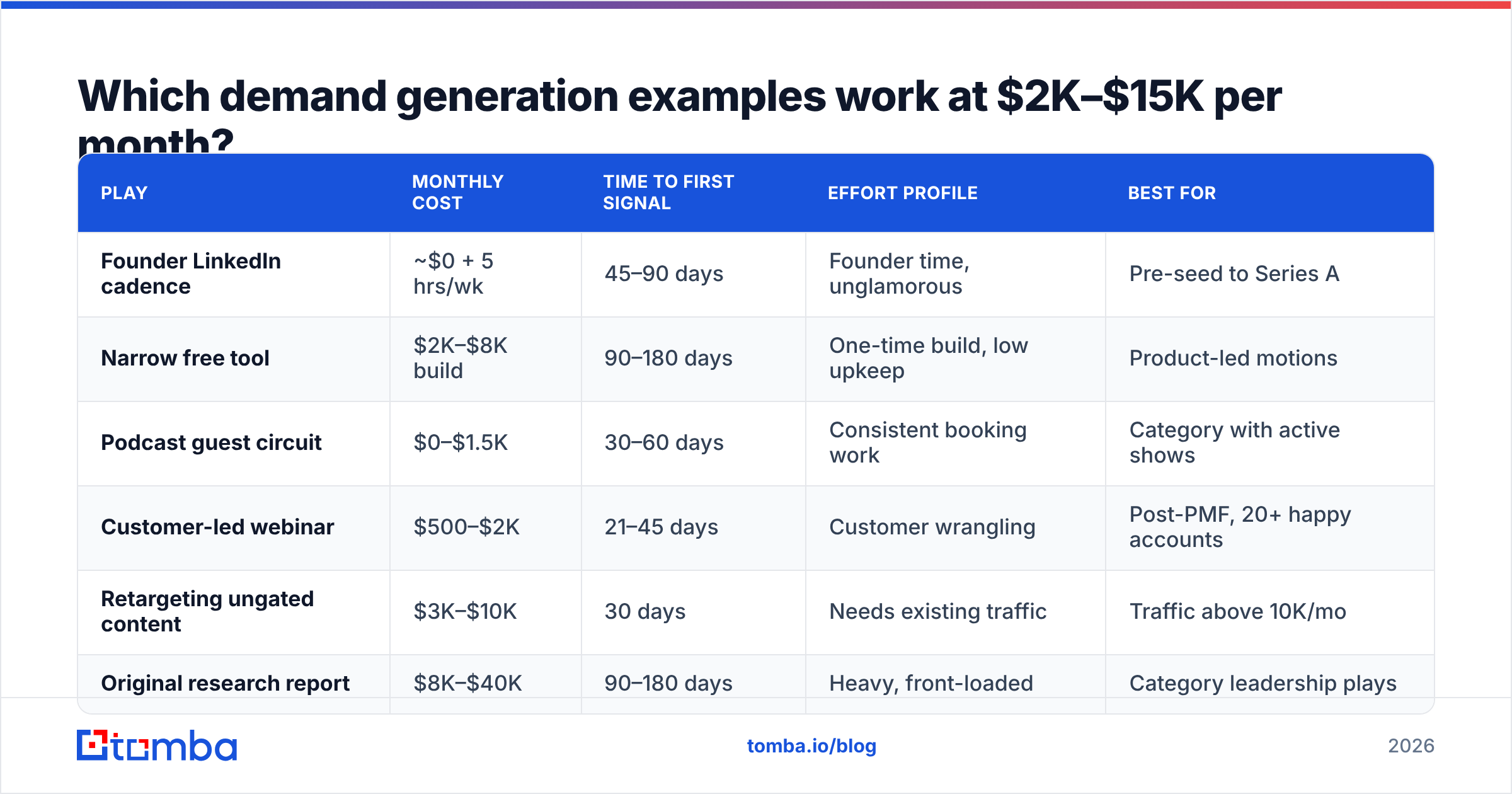
| Play | Monthly cost | Time to first signal | Effort profile | Best for |
|---|---|---|---|---|
| Founder LinkedIn cadence | ~$0 + 5 hrs/wk | 45–90 days | Founder time, unglamorous | Pre-seed to Series A |
| Narrow free tool | $2K–$8K build | 90–180 days | One-time build, low upkeep | Product-led motions |
| Podcast guest circuit | $0–$1.5K | 30–60 days | Consistent booking work | Category with active shows |
| Customer-led webinar | $500–$2K | 21–45 days | Customer wrangling | Post-PMF, 20+ happy accounts |
| Retargeting ungated content | $3K–$10K | 30 days | Needs existing traffic | Traffic above 10K/mo |
| Original research report | $8K–$40K | 90–180 days | Heavy, front-loaded | Category leadership plays |
What do enterprise demand generation examples look like?#
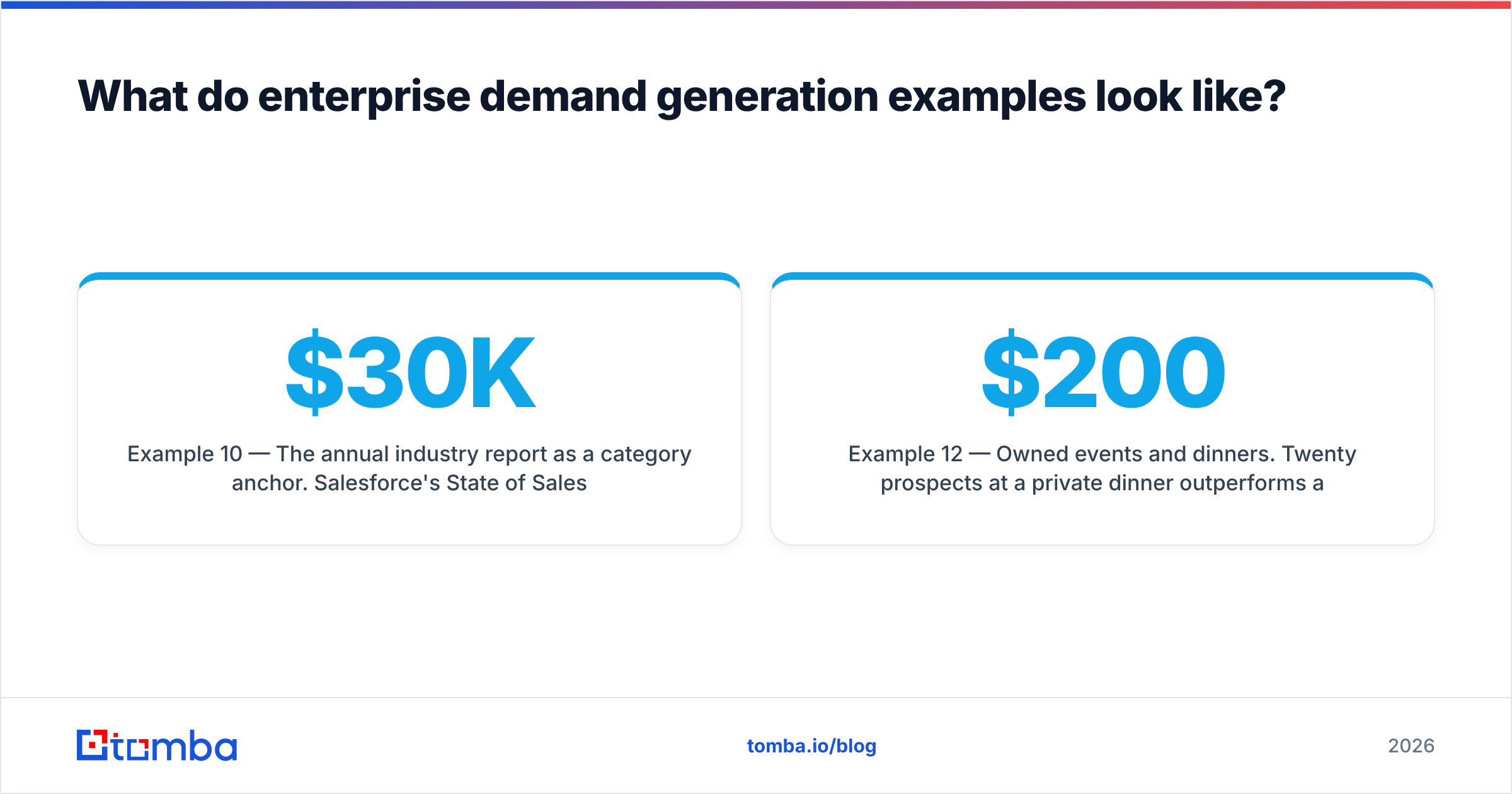
Example 10 — The annual industry report as a category anchor. Salesforce's State of Sales and HubSpot's State of Marketing exist to make those brands the default citation in their categories. The mechanic isn't the download — it's that every analyst, journalist, and competitor blog quotes the numbers with a link. Budget is typically $30K–$100K including panel recruitment and design. HubSpot's research library is the reference implementation.
Example 11 — Coordinated multi-threaded ABM. Fifty named accounts, six personas each, sequenced touches across paid social, direct mail, event invitations, and SDR outreach — all referencing a shared narrative. This only works when the account list is small enough that a human reviews each thread weekly. Beyond about 200 accounts it degrades into expensive spray.
Example 12 — Owned events and dinners. Twenty prospects at a private dinner outperforms a 2,000-person conference booth for most enterprise deals, because the conversation depth is incomparable. Cost per attendee runs $200–$600. The metric that matters is opportunity creation within 90 days, not "leads."
How do you measure demand generation without lying to yourself?#
Last-touch attribution actively punishes demand generation, because demand gen's job is to be the first touch. A buyer who read your report in March and typed your name into Google in September gets credited to "direct traffic."
Use these instead:
- Branded search volume trend. The cleanest proxy for demand you created. Track monthly in Search Console. If it rises while paid spend is flat, something upstream is working.
- Self-reported attribution. Add an open-text "How did you hear about us?" field to your demo form. It is imprecise and still more honest than your multi-touch model. Gartner's research on B2B buying behavior consistently shows buyers touching many channels before ever identifying themselves.
- Pipeline influenced. Every opportunity that touched any demand gen asset before creation. Directional, not causal — but useful for budget conversations.
- Time-lagged cohort analysis. Compare pipeline created 90 days after a spend increase against the 90 days before. Slow, but it survives scrutiny.
- Win rate and deal size by first-touch channel. Buyers who arrive through owned demand gen typically close faster and discount less than buyers acquired through paid capture. Track win rate by source and the picture clarifies fast.
Peer-review sites belong in this measurement conversation too. Presence on G2 shapes decisions you never see in your analytics, which is the whole point of demand generation.
Why do most demand generation programs fail?#
Four reasons, in order of frequency.
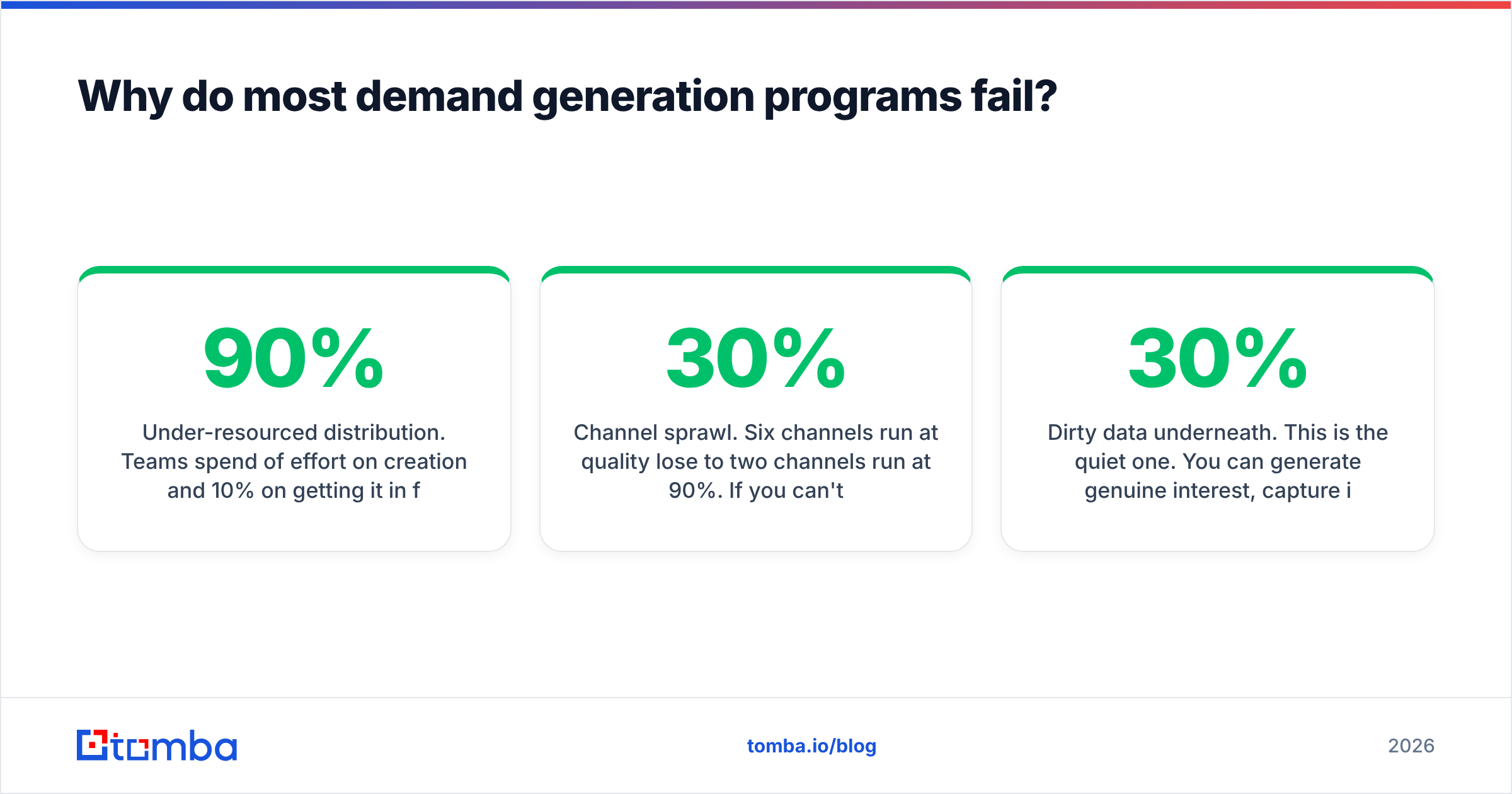
Under-resourced distribution. Teams spend 90% of effort on creation and 10% on getting it in front of people. Invert that ratio. A mediocre asset promoted relentlessly beats an excellent asset published and forgotten.
Channel sprawl. Six channels run at 30% quality lose to two channels run at 90%. If you can't name the person accountable for a channel this quarter, cut it.
Impatience. Demand generation has a 90–180 day lag. Programs killed at day 60 were killed before the data existed. Set the review date when you launch, and honor it.
Dirty data underneath. This is the quiet one. You can generate genuine interest, capture it correctly, and still lose the deal because the contact record routed to a role address that nobody reads, or the enrichment appended a title from three jobs ago. When 20–30% of a B2B database decays annually, a demand gen program built on stale records leaks at every handoff. Run new records through an email verifier before they touch a sequence, and re-verify quarterly.
Which demand generation example should you start with?#
Answer three questions honestly.
- Do you have a founder or subject-matter expert who will show up weekly? If yes, start with Example 1. Nothing else has this ratio of cost to output.
- Do you already get 10,000+ monthly visitors? If yes, Example 7 turns existing traffic into pipeline faster than any new channel.
- Do you have 20+ genuinely happy customers? If yes, Example 6 costs almost nothing and produces both demand and social proof.
If all three are no, build the narrow free tool (Example 2) and start answering questions in communities (Example 4). Those two work from zero, which is where most teams actually are — regardless of what the conference talks imply.
One sequencing note: run one play for a full quarter before adding a second. The most common failure pattern isn't picking the wrong example, it's picking four right ones and executing all of them at 25%.
Turn generated demand into contactable pipeline. Every play above produces the same downstream requirement: real people, at real addresses, that your sequences can actually reach. Tomba's Email Finder resolves verified professional emails by name, company, or domain, with a free tier at 25 searches/month and paid plans starting at $49/month — so the interest you worked six months to create doesn't die at a bounced inbox. See full Tomba pricing or wire it into your stack with the Tomba API.
Related guides#
Ready to find emails that actually work?
Join 150,000+ professionals who stopped guessing and started sending. Free credits on signup — no credit card required.
Get the Tomba newsletter
Practical outbound tactics and product updates — once every two weeks.
About the author