Demand Generation for Professional Services: 2026 Playbook
Referrals don't scale, and neither does hope. Here's how consulting, legal, accounting, and agency firms build a repeatable demand engine in 2026 — the channels that pay back, the data you need, and the metrics that matter.
TL;DR
- Demand generation for professional services is not lead generation with a nicer name. It creates the belief that a problem is worth paying to solve, then captures the people who reach that belief.
- Referrals are the highest-converting channel and the worst growth channel. They are uncapped in quality and capped in volume — you cannot forecast them.
- The channels that actually compound for firms billing $150–$800/hour are practitioner-led content, targeted outbound to a narrow ICP, and event-led follow-through. Paid search works only for commodity service lines.
- Your contact data quality caps everything. A 30% bounce rate does not just waste sends, it damages the sending domain your partners rely on for client email.
- Measure pipeline created per partner hour, not MQLs. Professional services buying cycles run 3–18 months, so leading indicators must be behavioral, not volume-based.
What is demand generation for professional services?#
Demand generation for professional services is the discipline of creating and capturing buying intent for expertise-based work — consulting, legal, accounting, architecture, engineering, agency, and advisory services — where the product is a person's judgment and the buyer is purchasing risk reduction, not features.
That definition matters because it kills most of what SaaS marketing teaches you. A software buyer can trial the product. A general counsel hiring outside litigation support cannot. They buy on evidence of prior judgment: cases you've won, industries you've served, the partner who wrote the article they read at 11pm before the board meeting.
So demand generation splits into two jobs that firms constantly conflate:
- Demand creation — making a latent problem feel urgent and expensive. A CFO who does not know their transfer-pricing exposure is a risk is not in market. Content, research, benchmarks, and events move them.
- Demand capture — being the obvious choice when they start looking. SEO, review sites, referral networks, and retargeting do this.
Most firms spend 90% of budget on capture, then complain that the market is small. The market is not small. The in-market segment is small — roughly 5% of any B2B category is actively buying at a given moment, a figure popularized by the Ehrenberg-Bass Institute's 95-5 rule and widely cited across HubSpot's demand generation research. The other 95% is where demand creation earns its keep.
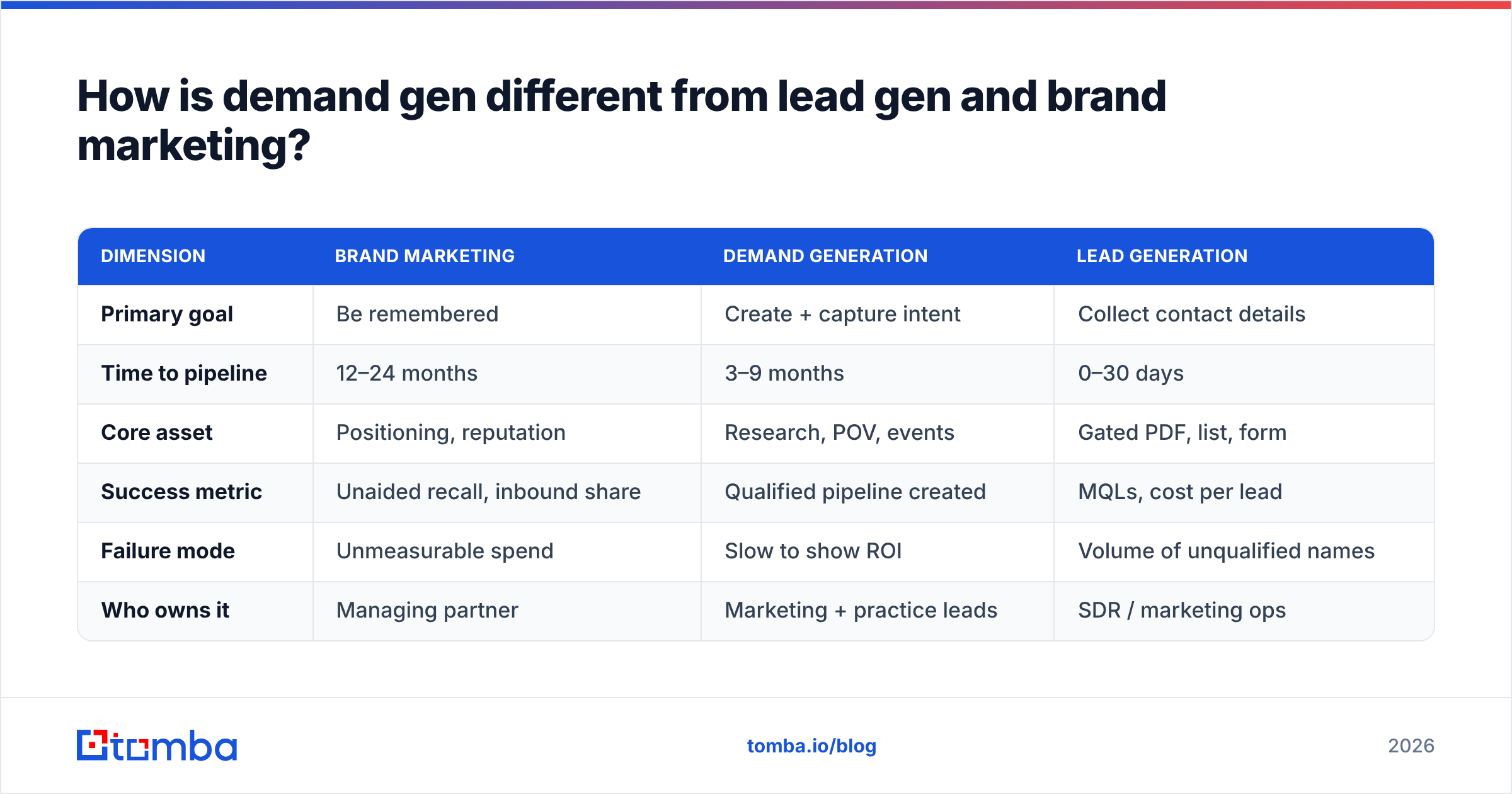
How is demand gen different from lead gen and brand marketing?#
Here is the practical split most partners find useful:
| Dimension | Brand marketing | Demand generation | Lead generation |
|---|---|---|---|
| Primary goal | Be remembered | Create + capture intent | Collect contact details |
| Time to pipeline | 12–24 months | 3–9 months | 0–30 days |
| Core asset | Positioning, reputation | Research, POV, events | Gated PDF, list, form |
| Success metric | Unaided recall, inbound share | Qualified pipeline created | MQLs, cost per lead |
| Failure mode | Unmeasurable spend | Slow to show ROI | Volume of unqualified names |
| Who owns it | Managing partner | Marketing + practice leads | SDR / marketing ops |
Lead generation sits inside demand generation. When a firm says "we need more leads," they usually mean "we need more of the right conversations" — and that is a demand problem, not a form-fill problem. A useful mental model: lead gen is fishing, demand gen is stocking the lake and then fishing.
If your firm has a marketing team of one or two, do not build all three at once. Build demand capture first (so the intent you eventually create does not leak), then demand creation.
Why do professional services firms struggle with demand generation?#
Five structural reasons, and every one of them is fixable:
- The producer-seller conflict. Your best rainmakers are also your most billable people. Every hour on business development is an hour off a client matter. This makes partner time the scarcest input in the entire system — design the program around protecting it.
- No product to demo. You cannot screenshot judgment. Firms compensate with vague "trusted advisor" language that is indistinguishable from every competitor's homepage.
- Long, committee-driven cycles. Gartner's B2B buying research puts a typical buying group at six to ten stakeholders. For a seven-figure transformation engagement, add procurement, legal, and a board sponsor.
- Conflict and confidentiality constraints. You often cannot name your best work. Anonymized case studies convert worse than named ones, so firms need proxy proof: methodology, benchmarks, published data.
- Fragmented data. Contacts live in partners' inboxes, an old CRM, a conference badge scan, and a spreadsheet from 2023. Nobody owns the list, so nobody trusts the list.
That last one is the quiet killer. You cannot run a demand program against contacts you cannot reach.
Which demand generation channels actually work for professional services?#
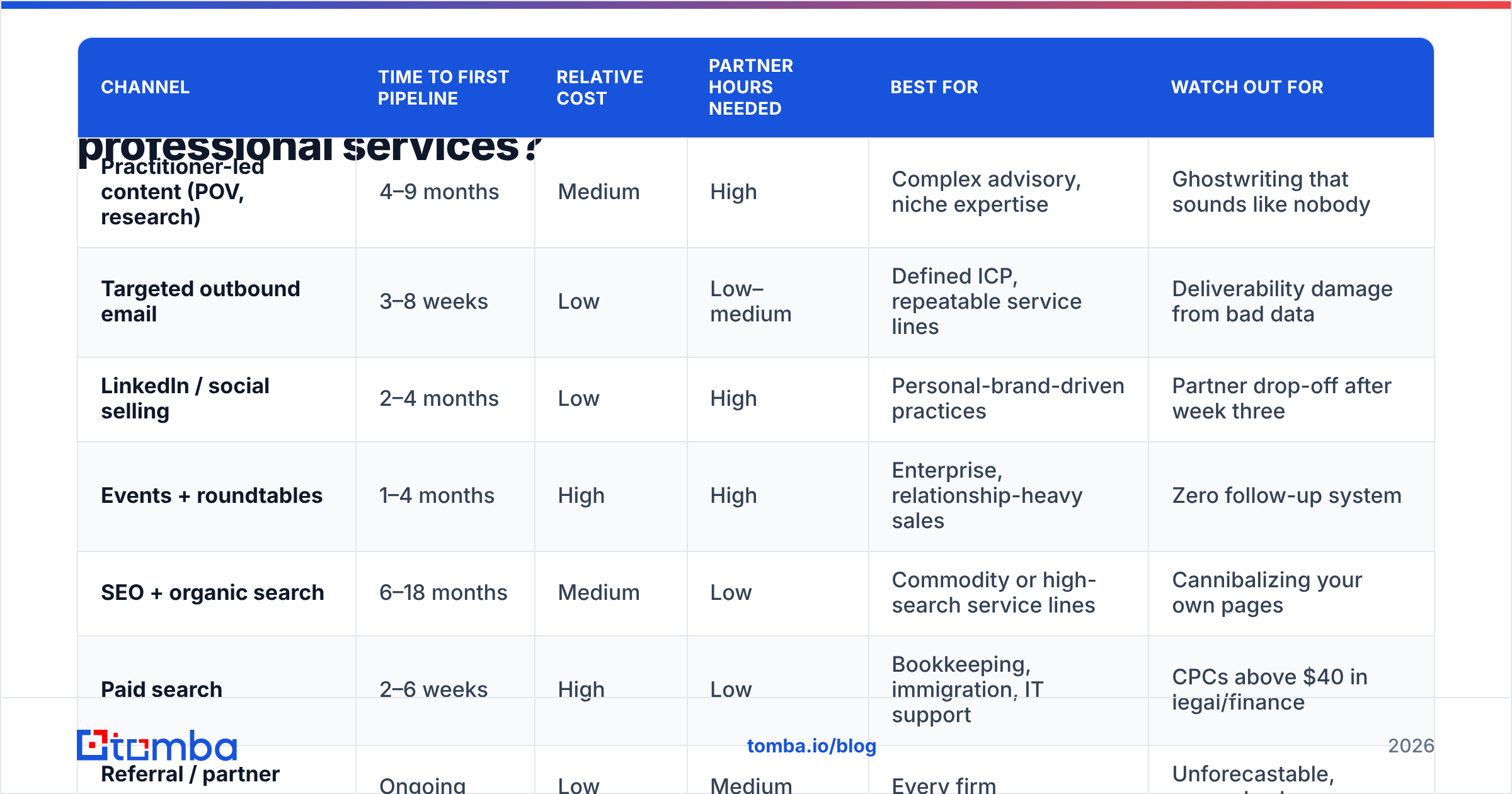
Not all channels behave the same when the average deal is $80k and the buyer is a partner-level peer. Here's a realistic scorecard based on how firms in the $5M–$150M revenue range typically perform:
| Channel | Time to first pipeline | Relative cost | Partner hours needed | Best for | Watch out for |
|---|---|---|---|---|---|
| Practitioner-led content (POV, research) | 4–9 months | Medium | High | Complex advisory, niche expertise | Ghostwriting that sounds like nobody |
| Targeted outbound email | 3–8 weeks | Low | Low–medium | Defined ICP, repeatable service lines | Deliverability damage from bad data |
| LinkedIn / social selling | 2–4 months | Low | High | Personal-brand-driven practices | Partner drop-off after week three |
| Events + roundtables | 1–4 months | High | High | Enterprise, relationship-heavy sales | Zero follow-up system |
| SEO + organic search | 6–18 months | Medium | Low | Commodity or high-search service lines | Cannibalizing your own pages |
| Paid search | 2–6 weeks | High | Low | Bookkeeping, immigration, IT support | CPCs above $40 in legal/finance |
| Referral / partner programs | Ongoing | Low | Medium | Every firm | Unforecastable, capped volume |
| Review sites (G2, Clutch) | 1–3 months | Low | Low | Agencies, IT services, dev shops | Pay-to-play placement inflation |
Two observations most firms resist.
First, outbound is faster than everything except paid, and cheaper than paid by an order of magnitude — but only when your targeting is genuinely narrow and your data is clean. "Every CFO in North America" is not a target; "CFOs at 200–800 employee SaaS companies that raised a Series C in the last 18 months" is.
Second, events are the most over-bought and under-worked channel in professional services. Firms will spend $60k on a booth and assign zero hours to structured follow-up. The booth is not the channel. The eleven conversations you had are the channel, and they decay in about nine days.
What data and tooling does the engine actually need?#
You need four layers, in this order. Skipping a layer is why programs stall.
- A defined ICP list. Firmographic filters (industry, size, geography, funding, tech stack) that produce a finite, named universe of accounts. If your ICP produces 400,000 companies, it is not an ICP.
- Verified contact data. Named decision-makers with reachable work emails and, where legal in your jurisdiction, direct phone numbers. This is where most programs quietly fail — a stale list produces bounces, bounces produce spam complaints, and complaints degrade the domain your partners send client email from.
- A system of record. One CRM, one owner, one definition of "opportunity." Whether that's HubSpot, Salesforce, or something lighter matters far less than having exactly one. This is the foundation of any functioning revenue operations motion.
- A sequencing and measurement layer. Something that tracks touches across email, LinkedIn, and phone, and attributes pipeline back to source.
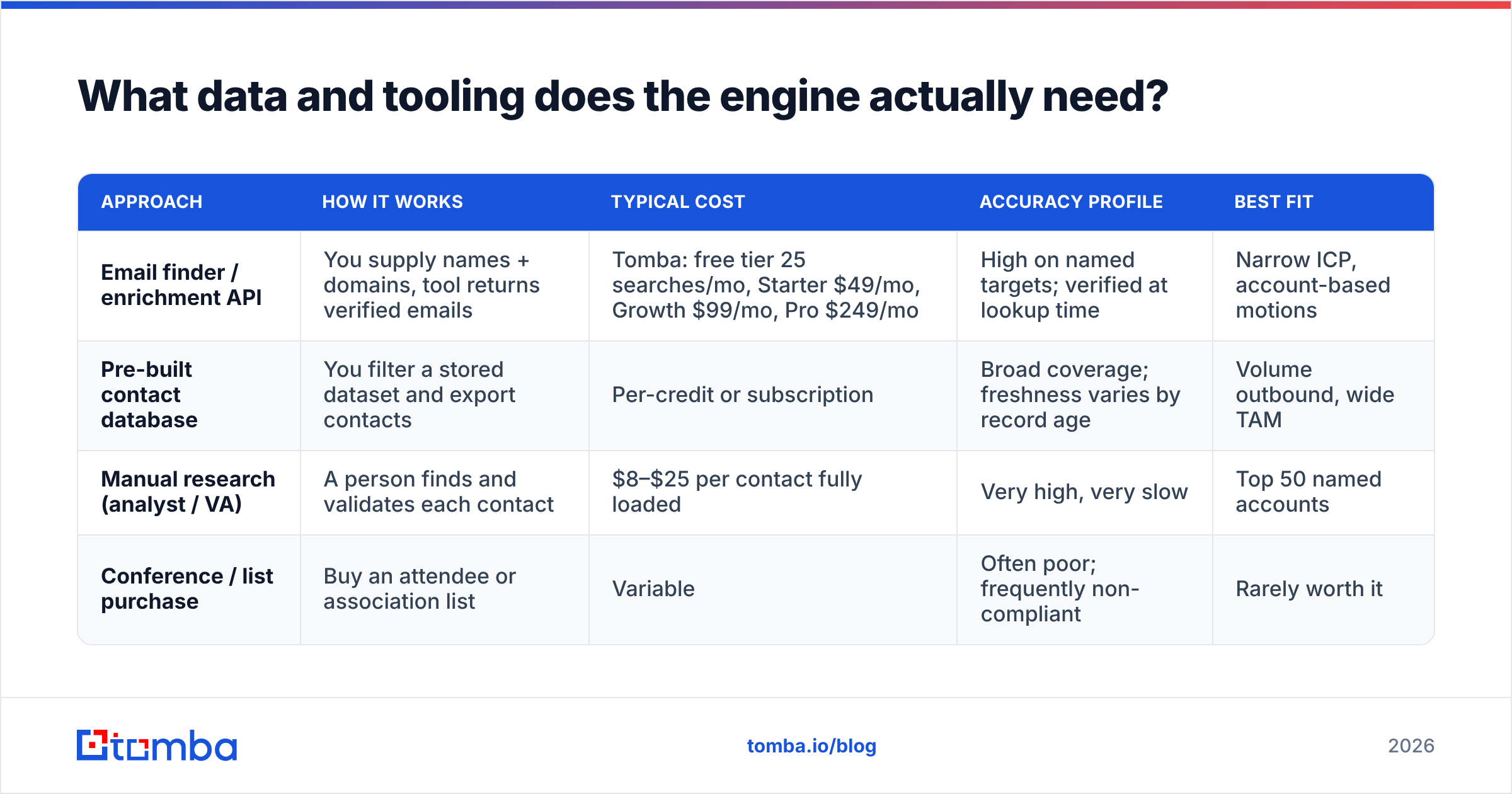
On layer two, the buying decision is between building a list from an email-finding tool and buying a pre-built database. Both are legitimate; they solve different problems:
| Approach | How it works | Typical cost | Accuracy profile | Best fit |
|---|---|---|---|---|
| Email finder / enrichment API | You supply names + domains, tool returns verified emails | Tomba: free tier 25 searches/mo, Starter $49/mo, Growth $99/mo, Pro $249/mo | High on named targets; verified at lookup time | Narrow ICP, account-based motions |
| Pre-built contact database | You filter a stored dataset and export contacts | Per-credit or subscription | Broad coverage; freshness varies by record age | Volume outbound, wide TAM |
| Manual research (analyst / VA) | A person finds and validates each contact | $8–$25 per contact fully loaded | Very high, very slow | Top 50 named accounts |
| Conference / list purchase | Buy an attendee or association list | Variable | Often poor; frequently non-compliant | Rarely worth it |
Reputable providers exist in each lane — BookYourData is a solid option when you need a pay-as-you-go pre-built database and want to avoid a subscription, while a lookup-time tool like Tomba's email finder fits better when your target list is specific and you want each address verified at the moment you use it. Many firms run both: database for breadth, finder for the named accounts that matter.
Whichever you choose, run the list through an email verifier before the first send. Bounce rate above 3% is the threshold where inbox providers start treating your domain differently, and for a firm whose partners email clients from that same domain, that is a business risk, not a marketing one.
How do you build the program in 90 days?#
A realistic sequencing for a firm starting close to zero. Partner hours in brackets are per week.
- Weeks 1–2 — Pick one service line and one ICP. Not the whole firm. One practice, one buyer, one problem. Write the problem statement in the buyer's words, not yours. [2 partner hours]
- Weeks 3–4 — Build the account list and enrich it. 300–800 named accounts, decision-maker mapped, contact data verified. Use domain search to map every reachable contact at each target account so you can reach the champion and the economic buyer, not just whoever you met once. [1 partner hour]
- Weeks 5–6 — Produce one piece of genuine POV. A benchmark, a survey of 80 peers, a teardown of a regulation nobody has read carefully. It must contain information the buyer cannot get elsewhere. This is the single highest-leverage partner contribution. [6 partner hours]
- Weeks 7–9 — Launch outbound tied to that POV. Emails that lead with the finding, not the firm. Sequence: insight → specific relevance to their situation → low-friction ask (15 minutes, or just "want the full dataset?"). [2 partner hours]
- Weeks 10–12 — Run one small roundtable. Ten people, one room or one Zoom, chaired by the partner, built on the same POV. Invite from the same account list. Conversion from roundtable attendance to opportunity routinely runs 15–30%.
- Ongoing — Instrument and prune. Kill anything that has not produced a conversation in 60 days.
The reason this works is compounding: the same research asset feeds the outbound, the event, the LinkedIn posts, and eventually the SEO page. One partner's six hours becomes four channels.
How should you measure demand generation for professional services?#
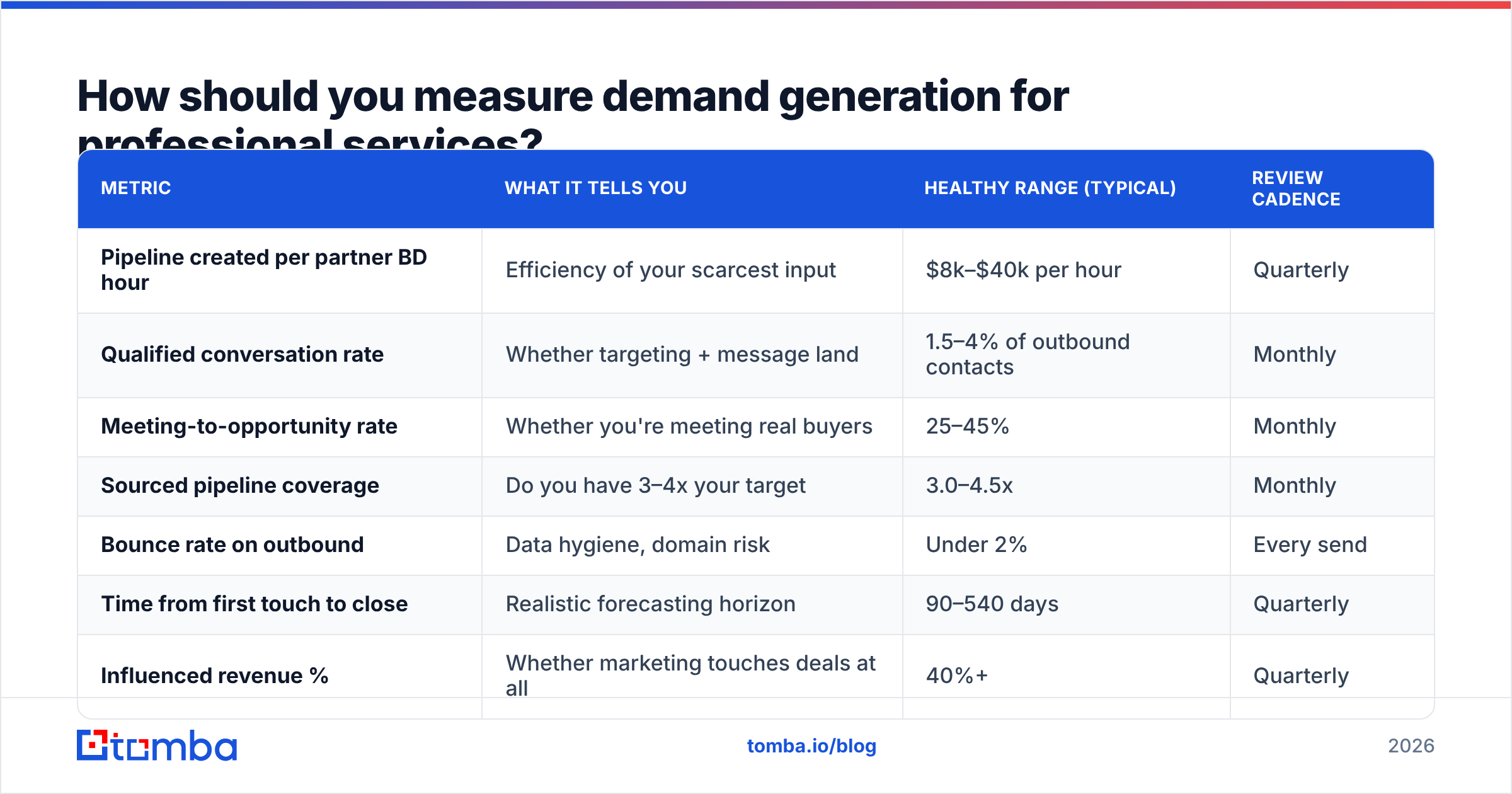
Throw out cost per MQL. It optimizes for the wrong thing when your annual deal count might be 40.
| Metric | What it tells you | Healthy range (typical) | Review cadence |
|---|---|---|---|
| Pipeline created per partner BD hour | Efficiency of your scarcest input | $8k–$40k per hour | Quarterly |
| Qualified conversation rate | Whether targeting + message land | 1.5–4% of outbound contacts | Monthly |
| Meeting-to-opportunity rate | Whether you're meeting real buyers | 25–45% | Monthly |
| Sourced pipeline coverage | Do you have 3–4x your target | 3.0–4.5x | Monthly |
| Bounce rate on outbound | Data hygiene, domain risk | Under 2% | Every send |
| Time from first touch to close | Realistic forecasting horizon | 90–540 days | Quarterly |
| Influenced revenue % | Whether marketing touches deals at all | 40%+ | Quarterly |
Two rules make these numbers honest. First, define "qualified conversation" in writing before you start counting, or the definition will drift to flatter whoever reports it. Second, track cohorts by month of first touch, not by month of close — otherwise a long cycle makes a working program look broken for two quarters.
What mistakes kill professional services demand gen?#
- Thought leadership with no thought. If a competitor could publish your article with their logo swapped in, it is not a demand creation asset. It is a brochure.
- Targeting the whole addressable market. Broad targeting produces low reply rates, which produces spam complaints, which produces deliverability collapse. Narrow beats big every time in this category.
- Buying a list and sending immediately. Unverified data at volume is the fastest way to burn a domain that took a decade to build reputation on.
- Assigning BD to the wrong people. Junior staff cannot run a peer-level conversation with a general counsel. Partners can but won't, unless the program removes the prep work.
- No follow-up architecture. A 15% reply rate is worthless if nobody has owned the next 90 days of nurture.
- Abandoning at month four. Professional services demand gen has a J-curve. Firms that quit at the bottom of it conclude "marketing doesn't work for us" and revert to referral dependence.
- Ignoring existing clients. Cross-sell to current accounts converts 3–5x better than net-new. Enrich your own client list before you buy a new one — data enrichment on your existing CRM often surfaces more reachable stakeholders inside accounts you already serve.
Where should a firm start if it has no marketing team?#
Start with the narrowest thing you can execute alone: one partner, one service line, 200 target accounts, one piece of original research, and a verified contact list. That is a program a single practice lead can run in four hours a week, and it produces measurable pipeline in a quarter rather than a year.
The bottleneck is almost never strategy. It is reachability — knowing who to contact at each of those 200 accounts and having an address that actually delivers.
That's the part worth automating first. Tomba's Email Finder turns a list of target companies and named decision-makers into verified, deliverable work emails, with a free tier at 25 searches a month to test your ICP before committing, and paid plans from $49/mo when the program proves out. Build the list, verify it, then spend your partner hours on the conversations — not on hunting for addresses.
Related guides#
Ready to find emails that actually work?
Join 150,000+ professionals who stopped guessing and started sending. Free credits on signup — no credit card required.
Get the Tomba newsletter
Practical outbound tactics and product updates — once every two weeks.
About the author