Demand Generation Framework: A Practical 2026 Playbook
Most demand gen programs are lead-capture programs wearing a costume. Here's a five-layer demand generation framework that separates demand creation from demand capture — with the metrics, budget splits, and data plumbing that actually make it run.
TL;DR
- A demand generation framework has two halves that get confused constantly: demand creation (making people want the category) and demand capture (converting people who already want it). Most teams fund capture and call it demand gen.
- The five layers that matter: audience definition, demand creation, demand capture, conversion infrastructure, and measurement. Skip a layer and the ones downstream inherit the damage.
- Budget split that works for most B2B SaaS between $2M and $50M ARR: roughly 40% creation, 35% capture, 15% infrastructure, 10% experiments.
- Attribution will lie to you. Pair a self-reported source field with pipeline-level modeling instead of trusting last-touch dashboards.
- Your data layer decides how far the framework scales. Clean firmographics, verified contact data, and enriched records are the difference between a campaign and a spreadsheet full of bounces.
What is a demand generation framework?#
A demand generation framework is the operating system that connects what you publish, who sees it, how they enter your pipeline, and how you decide what to fund next quarter. It is not a channel list and it is not a content calendar.
The useful analogy: think of it like a restaurant. Demand creation is the smell of bread drifting down the street — it makes people hungry who weren't planning to eat. Demand capture is the menu board and the door — it converts people who already decided they're hungry. Most B2B teams spend their entire budget polishing the menu board and then wonder why foot traffic is flat.
Technically, demand generation covers every activity that creates, captures, and accelerates buyer intent across the full funnel — versus lead generation, which is a subset focused on collecting contact information. The distinction matters because they are measured differently. Lead gen optimizes for volume and cost per lead. Demand gen optimizes for qualified pipeline and revenue per account.
The framework exists because the alternative — running channels independently and reconciling them in a quarterly deck — produces contradictory incentives. Paid search wants cheap conversions, so it bids on your brand name and claims credit for demand that content created six months earlier. Content wants traffic, so it writes for keywords nobody with a budget searches. A framework forces those functions to share a definition of success.
What are the five layers of the framework?#
Here is the structure. Each layer feeds the next, and each has a distinct owner, a distinct metric, and a distinct failure mode.
- Audience definition — Who you're building demand with. Owned by product marketing. Measured by ICP fit rate of new pipeline. Fails when "everyone in mid-market SaaS" passes for a segment.
- Demand creation — Making the problem visible to people who aren't searching yet. Owned by content and brand. Measured by branded search volume, direct traffic, and dark-social mentions. Fails when it's judged on MQLs.
- Demand capture — Converting existing intent efficiently. Owned by paid and SEO. Measured by cost per qualified opportunity. Fails when it scales past the ceiling of actual in-market demand.
- Conversion infrastructure — Forms, routing, enrichment, follow-up speed, and offer design. Owned by RevOps. Measured by speed-to-lead and form-to-meeting rate. Fails silently, which is why it's the most expensive layer to neglect.
- Measurement — How you decide what to fund. Owned by analytics with RevOps. Measured by forecast accuracy, not dashboard beauty. Fails when last-touch attribution becomes the budget-allocation tool.
Notice that layers 2 and 3 have opposite economics. Creation has a long payback and a high ceiling. Capture has an immediate payback and a hard ceiling — you cannot capture demand that doesn't exist. Teams that only fund capture hit that ceiling around month 14 and interpret it as a channel problem.
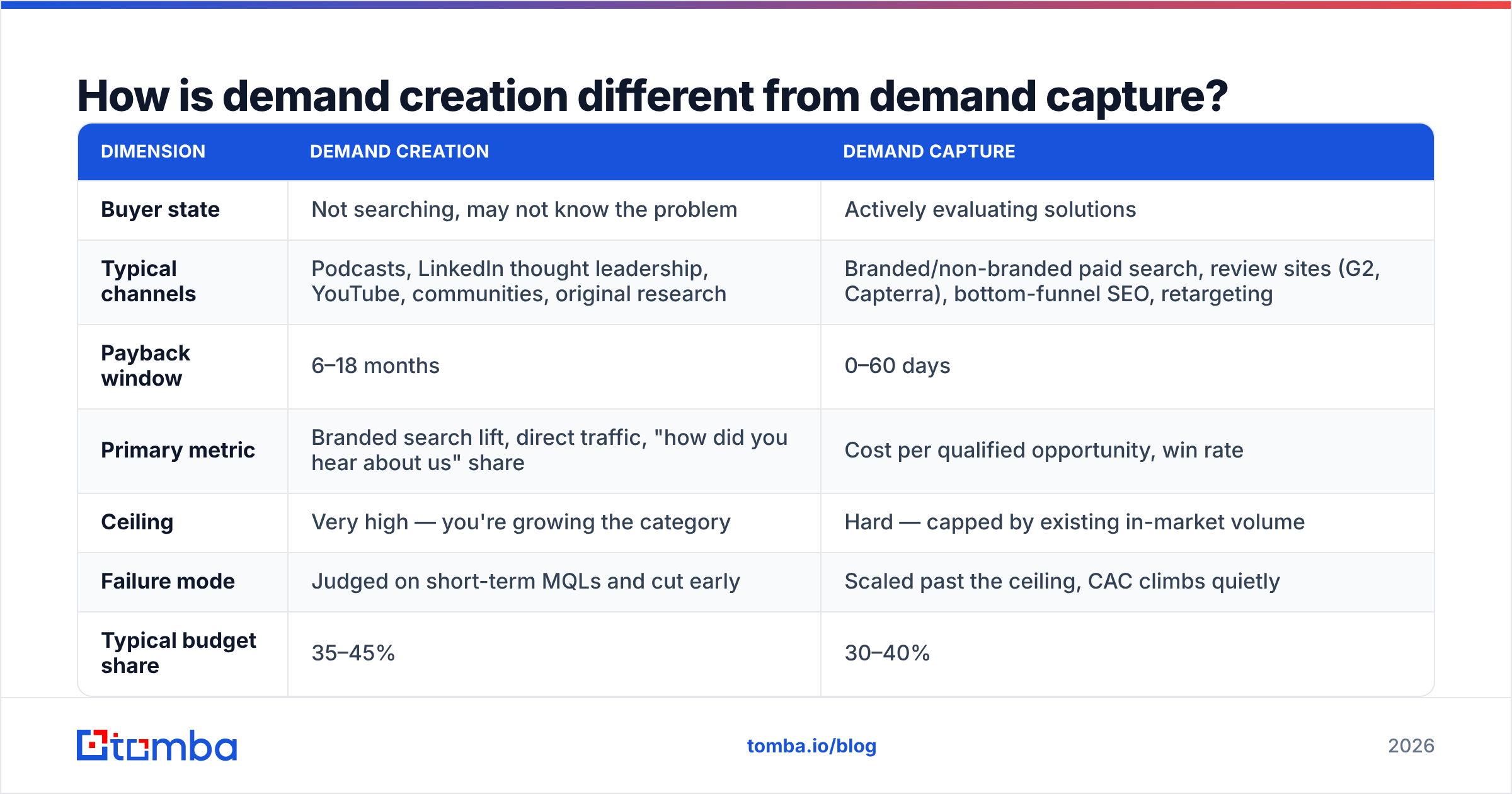
How is demand creation different from demand capture?#
They share a budget line and almost nothing else.
| Dimension | Demand creation | Demand capture |
|---|---|---|
| Buyer state | Not searching, may not know the problem | Actively evaluating solutions |
| Typical channels | Podcasts, LinkedIn thought leadership, YouTube, communities, original research | Branded/non-branded paid search, review sites (G2, Capterra), bottom-funnel SEO, retargeting |
| Payback window | 6–18 months | 0–60 days |
| Primary metric | Branded search lift, direct traffic, "how did you hear about us" share | Cost per qualified opportunity, win rate |
| Ceiling | Very high — you're growing the category | Hard — capped by existing in-market volume |
| Failure mode | Judged on short-term MQLs and cut early | Scaled past the ceiling, CAC climbs quietly |
| Typical budget share | 35–45% | 30–40% |
| Attribution behavior | Systematically under-credited | Systematically over-credited |
The under-credit/over-credit row is the one that quietly ruins programs. A prospect hears your CEO on a podcast in March, forgets the name, searches "email finder API" in July, clicks a paid ad, and converts. Last-touch gives 100% of the credit to paid search. Next quarter, budget shifts from the podcast to search. Six months later, search efficiency collapses because nothing is filling the top anymore.
That is not a hypothetical failure — it's the standard one. Research from Gartner on the buying journey has consistently shown that B2B buyers spend a small fraction of their evaluation time with any vendor's sales team, meaning most of the decision forms in places your attribution tool cannot see.
How do you build the audience layer?#
Start with the accounts you already win, not the accounts you wish you'd win.
Pull your last 40 closed-won deals. Tag each with company size, industry, tech stack, trigger event, and the job title of the person who first engaged. Now pull your last 40 closed-lost deals and do the same. The delta between those two lists is your real ICP — usually much narrower than the one in your pitch deck.
Then build the addressable list. This is where most frameworks stop being strategy and start being data work:
- Firmographic filtering — size, geography, funding stage, industry. Cheap and available from most B2B database providers.
- Technographic signals — what they already run. A company using a competing tool is a different play than a company using a spreadsheet.
- Trigger events — new funding, a relevant executive hire, a job posting that implies the pain you solve.
- Contact-level resolution — turning a target account into named humans with reachable addresses. This is where lists die. An account list without verified contacts is a wish.
For that last step, you need something better than guessing formats. A domain search returns every discoverable address pattern at a target company, which turns "we should reach ACME" into a list of named people you can actually sequence. Pair it with email verification before anything enters your sending infrastructure — bounce rate is the fastest way to destroy the sender reputation the rest of your program depends on.
What does the demand creation layer actually look like?#
Concrete, not conceptual. Demand creation is a publishing operation with a distribution plan attached.
The formats that reliably work in 2026 B2B:
- Original research — survey your own customer base or run a data study using proprietary data. This is the single highest-leverage asset because it earns links, citations, and podcast invitations without being an ad.
- Executive point of view on LinkedIn — not company-page posts. Personal accounts, published 3–5x weekly, with a genuine opinion. Company pages have a fraction of the organic reach.
- Podcast guesting — 20 appearances on shows with 2,000 engaged listeners each beats one appearance on a show with 40,000 passive ones, because the small shows attract operators, not spectators.
- Video teardowns — showing the work. A 12-minute walkthrough of how you'd fix a prospect's actual problem outperforms a polished brand film by an order of magnitude on intent.
- Community presence — Slack groups, subreddits, industry forums. Not link-dropping. Answering things.
The rule for this layer: do not gate any of it. Gating a demand creation asset converts it into a lead capture asset and destroys its reach, which was the entire point. Publish it open, and let the demand capture layer collect contact information from people who arrive already convinced.
Measure this layer with leading indicators, because the lagging ones take a year. Track branded search volume monthly in Search Console. Track direct traffic. Track the share of new opportunities where the self-reported "how did you hear about us" field names a creation channel. Those three move before revenue does.
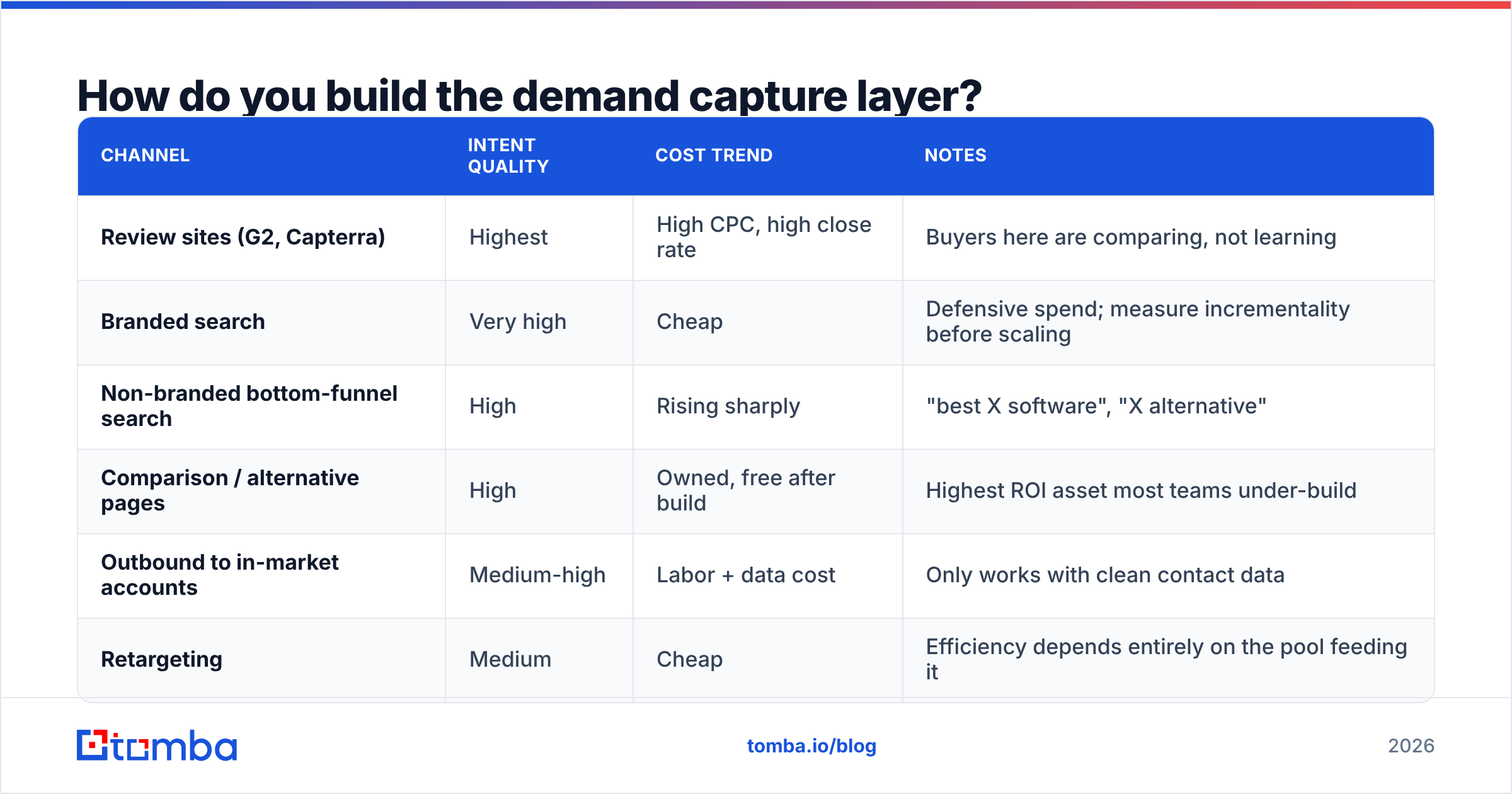
How do you build the demand capture layer?#
Capture is an efficiency game with a known ceiling, so the discipline is knowing when to stop scaling.
The core channels, ranked by typical intent quality:
| Channel | Intent quality | Cost trend | Notes |
|---|---|---|---|
| Review sites (G2, Capterra) | Highest | High CPC, high close rate | Buyers here are comparing, not learning |
| Branded search | Very high | Cheap | Defensive spend; measure incrementality before scaling |
| Non-branded bottom-funnel search | High | Rising sharply | "best X software", "X alternative" |
| Comparison / alternative pages | High | Owned, free after build | Highest ROI asset most teams under-build |
| Outbound to in-market accounts | Medium-high | Labor + data cost | Only works with clean contact data |
| Retargeting | Medium | Cheap | Efficiency depends entirely on the pool feeding it |
Comparison pages deserve a specific call-out because they're underbuilt almost everywhere. If a prospect is searching "[competitor] alternative", they have already decided to buy something in your category. That is the cheapest qualified traffic on the internet and it costs you a page. Peer review platforms like G2 tell you exactly which competitors buyers cross-shop you against — build a page for each one.
Outbound sits in this layer, not in creation, when it's targeted at accounts showing intent signals. Cold outbound to a list with no signal is neither creation nor capture; it's noise. Outbound to an account that just hired a VP of the function you serve, using a verified address from an email finder, is demand capture with a data step in front of it.

What infrastructure does the framework depend on?#
This layer is invisible until it breaks, and then it's the only thing anyone talks about.
Speed to lead. The response-time research is old but the finding holds: contact rates fall off a cliff after the first few minutes. If a demo request sits in a queue for four hours, you paid capture prices for creation-quality conversion. Route instantly, alert in Slack, and let the rep book from the confirmation page.
Form design. Every field you add reduces submissions. The fix isn't shorter forms with worse data — it's short forms with data enrichment behind them. Ask for a work email, resolve company, size, industry, and role server-side. The prospect fills two fields; your CRM gets fifteen.
Routing and dedup. Duplicate records break attribution, break routing, and produce the "two reps called me" experience that kills deals. Deduplicate on account domain, not on email string.
Deliverability hygiene. Any framework that includes outbound or nurture depends on messages arriving. That means SPF, DKIM, and DMARC configured correctly, a warmed sending domain, and list hygiene enforced before send. Google and Yahoo's bulk-sender requirements made this non-optional — the Google Postmaster documentation is the source of truth here, not your ESP's blog post. Keep spam complaints under 0.3% and verify lists continuously, not once at import.
CRM field discipline. One required field on every opportunity: self-reported source, free text or a short picklist, asked at the point of conversion. It's the single most useful attribution input you will ever collect, and it costs one field.
How should you measure a demand generation framework?#
Stop asking attribution software to answer questions it structurally cannot answer, and triangulate instead.
Use three inputs together:
- Self-reported attribution — the "how did you hear about us" field on your demo form. Noisy, biased toward the memorable, but it's the only signal that sees dark social, podcasts, and word of mouth.
- Multi-touch modeling — useful for understanding channel sequences and mid-funnel behavior, not for allocating budget. Treat it as a map, not a verdict.
- Incrementality testing — geo holdouts or scheduled pauses. Turn a channel off in three comparable regions for six weeks and watch pipeline. Expensive, slow, and the only method that produces causal answers.
The metrics worth reporting at the executive level:
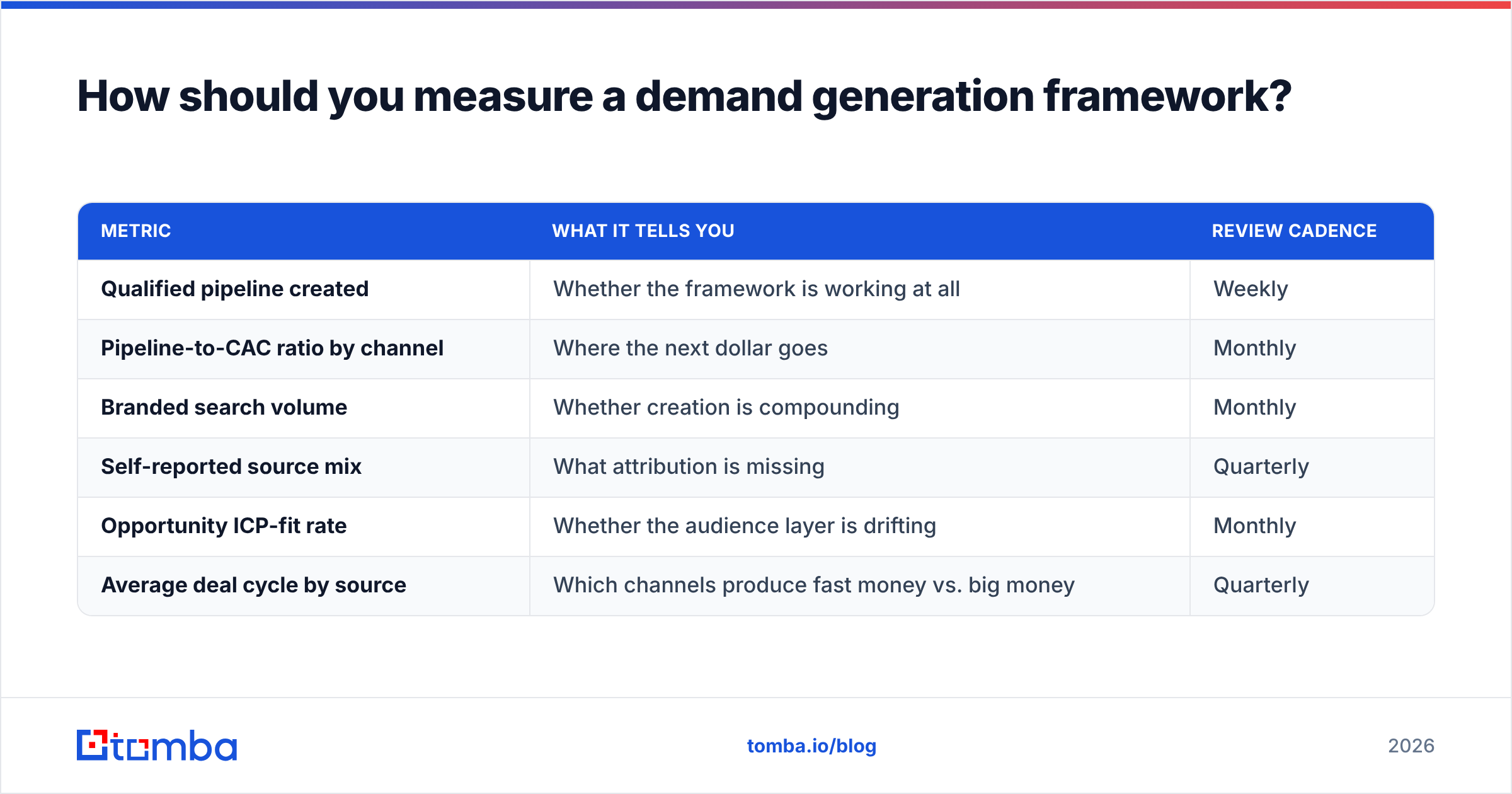
| Metric | What it tells you | Review cadence |
|---|---|---|
| Qualified pipeline created | Whether the framework is working at all | Weekly |
| Pipeline-to-CAC ratio by channel | Where the next dollar goes | Monthly |
| Branded search volume | Whether creation is compounding | Monthly |
| Self-reported source mix | What attribution is missing | Quarterly |
| Opportunity ICP-fit rate | Whether the audience layer is drifting | Monthly |
| Average deal cycle by source | Which channels produce fast money vs. big money | Quarterly |
The single number to watch across quarters: the ratio of pipeline from creation-influenced accounts to pipeline from capture-only accounts. If creation-influenced deals close faster, at higher ACV, with better win rates — and they usually do — that ratio is your argument for funding the top of the framework.
What does the budget split look like in practice?#
For a B2B SaaS company between $2M and $50M ARR with a defined ICP:
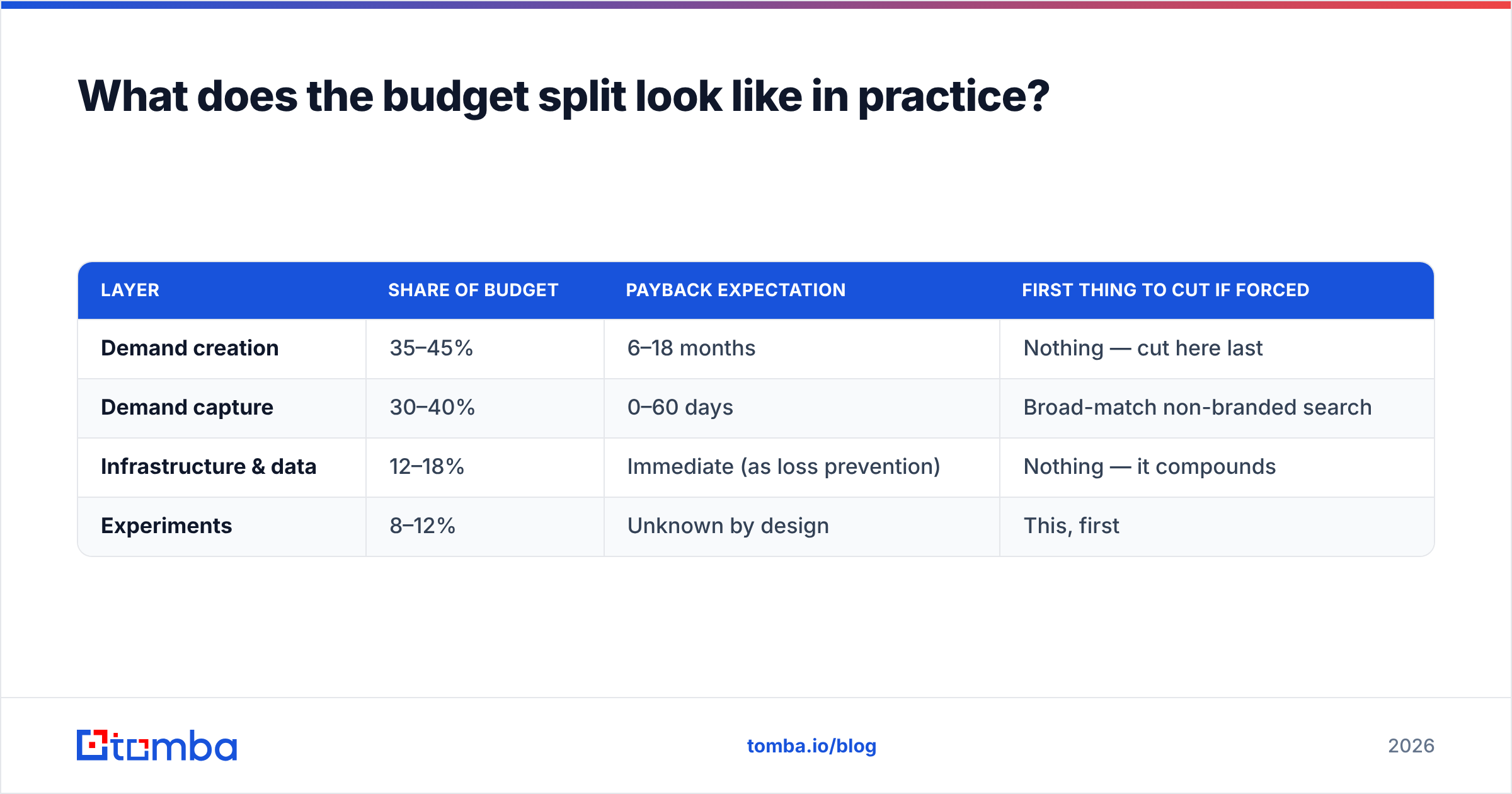
| Layer | Share of budget | Payback expectation | First thing to cut if forced |
|---|---|---|---|
| Demand creation | 35–45% | 6–18 months | Nothing — cut here last |
| Demand capture | 30–40% | 0–60 days | Broad-match non-branded search |
| Infrastructure & data | 12–18% | Immediate (as loss prevention) | Nothing — it compounds |
| Experiments | 8–12% | Unknown by design | This, first |
Two caveats. If you're pre-product-market-fit, invert it — spend on capture and outbound because you need conversations now, not category awareness in 2027. If you're in a mature category where buyers already know they need the product, capture can justifiably run to 50%, because the demand genuinely exists and the game is winning the comparison.
The infrastructure line is the one that gets cut first and shouldn't be. Contact data, verification, and enrichment are a rounding error against paid media spend, and they determine what percentage of that media spend reaches a real person. Reasonable tooling — including Tomba pricing which starts free at 25 searches per month and runs $49/mo for Starter — sits well inside the noise of a single week of paid search.
What are the most common ways this framework fails?#
- Renaming lead gen as demand gen. New slide, same gated ebooks, same MQL target. Nothing changes because the incentive didn't.
- Judging creation on capture metrics. Asking a podcast tour for a CPL number kills it in quarter two. Give creation its own scorecard with a longer horizon.
- Scaling capture past the ceiling. CAC creeps up 8% a month and everyone blames the platform. The real answer is that in-market demand is finite and you've saturated it.
- Dirty data underneath everything. A 22% bounce rate doesn't just waste sends — it degrades the domain reputation that your entire nurture program rides on.
- No self-reported source field. Without it, you are permanently blind to every channel your tracking pixel can't see, which in 2026 is most of them.
- Sales and marketing running different ICP definitions. Marketing generates what it defined as qualified; sales rejects it as junk. Both are correct within their own definition, which is the problem.
Fix them in that order. The first two are strategy problems and cost nothing but courage. The middle two are operations problems solvable with tooling. The last two are alignment problems and take the longest.
Where should you start if you have nothing?#
Ninety days, in sequence:
Days 1–30 — Define and instrument. Run the closed-won/closed-lost analysis. Write a one-page ICP with hard filters. Add the self-reported source field to every conversion point. Audit SPF/DKIM/DMARC and clean your existing lists. This month produces no pipeline and makes everything after it work.
Days 31–60 — Build capture. Ship comparison pages for your top four cross-shopped competitors. Claim and optimize your G2 and Capterra profiles. Launch branded search defense. Build the target account list with verified contacts. Capture pays back fastest, which buys political room for the slow half.
Days 61–90 — Start creation. Publish one piece of original research. Get the founder posting three times a week. Book six podcast appearances. None of this shows up in this quarter's numbers, which is exactly why it has to start now rather than next quarter.
Then run the loop: monthly channel review against pipeline-to-CAC, quarterly incrementality test on the largest capture line, quarterly ICP-drift check against actual closed-won.
Ready to build the data layer underneath it?#
Every layer of this framework sits on top of contact data. The audience layer needs accurate firmographics. Capture needs verified addresses so outbound reaches inboxes instead of bounce logs. Infrastructure needs enrichment so your forms can be two fields long. Measurement needs deduplicated records or none of the numbers mean anything.
The Tomba Email Finder handles the contact-resolution step — find professional email addresses by domain, name, or company, verify them before they hit your sequencer, and push clean records into your CRM through the Tomba API or a native integration. Start on the free tier at 25 searches a month to test it against your own target list, then scale when the framework is running. Fix the data layer first; the rest of the framework gets easier from there.
Related guides#
Ready to find emails that actually work?
Join 150,000+ professionals who stopped guessing and started sending. Free credits on signup — no credit card required.
Get the Tomba newsletter
Practical outbound tactics and product updates — once every two weeks.
About the author