Demand Generation Funnel: Stages, Metrics, and Real Fixes
Most demand gen funnels leak in the same four places. Here is the stage-by-stage model, the metrics that actually predict revenue, and the data fixes that stop the leak.
Your demand generation funnel is probably healthy at the top and broken in the middle. This guide walks the demand generation funnel one stage at a time. You get the metrics that predict revenue, the data gaps that drain pipeline, and the fixes you can ship this quarter.
TL;DR
- A demand generation funnel is not a lead funnel with better branding. It creates and captures demand across a full buying cycle. Then it hands sales a contact record that is actually reachable.
- Five stages matter: awareness, engagement, capture, qualification, and conversion. Each stage has one metric that predicts revenue. Each also has a vanity metric that does not.
- Most funnels leak at capture and qualification, not at the top. Bad contact data quietly deletes 20-35% of the pipeline you already paid for. Dead emails, missing decision-makers, and stale job titles do the damage.
- The 2026 shift: dark social and AI answers mean fewer form fills and more anonymous demand. You need identity resolution and enrichment, not more gated PDFs.
- Fix the data layer first. Verified emails and enriched company records cost far less than the ad spend you waste on leads nobody can contact.
What is a demand generation funnel?#
A demand generation funnel is the end-to-end system that creates awareness of a problem. It builds interest in a category, captures identifiable buyers, and hands qualified accounts to sales.
Think of it like a city water system. Lead generation is the tap in your kitchen. It only collects what is already flowing. Demand generation is the reservoir, the pipes, the pressure, and the treatment plant. If nobody upstream feels thirsty, your tap gives you nothing. The faucet can look great and still run dry.
Technically, a demand generation funnel spans paid and organic content, community, product-led loops, events, and outbound. You measure all of it against one revenue-attributed pipeline number instead of per-channel lead counts. HubSpot's demand generation framework frames it the same way. Demand creation and demand capture are separate budgets with separate KPIs.
That split matters because both sides get funded from the same pot. Capture always wins the short-term report. It converts existing demand at a great CPL. Creation makes the demand that capture will convert three months later. Cut creation and your capture costs quietly triple.
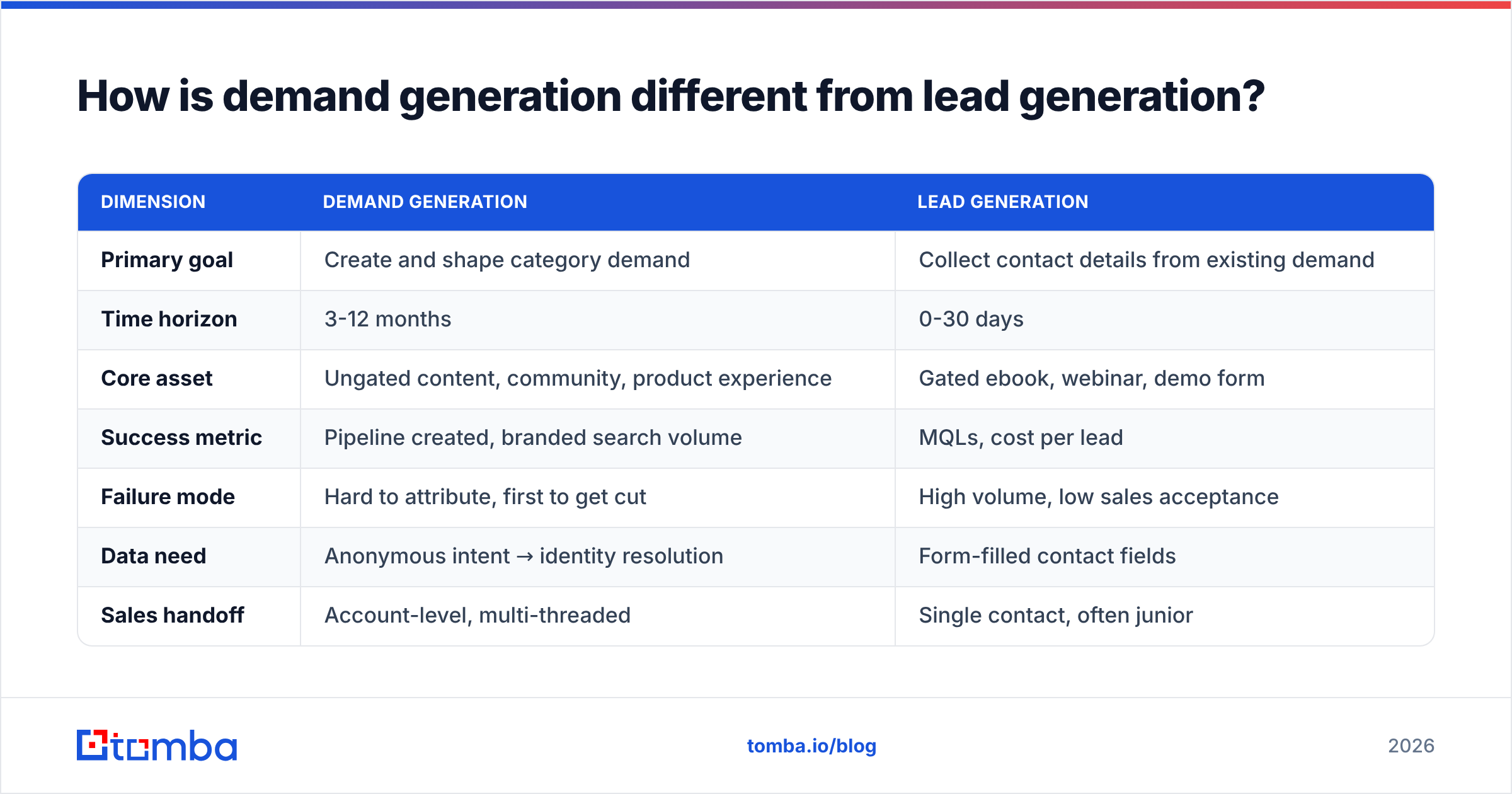
How is demand generation different from lead generation?#
| Dimension | Demand generation | Lead generation |
|---|---|---|
| Primary goal | Create and shape category demand | Collect contact details from existing demand |
| Time horizon | 3-12 months | 0-30 days |
| Core asset | Ungated content, community, product experience | Gated ebook, webinar, demo form |
| Success metric | Pipeline created, branded search volume | MQLs, cost per lead |
| Failure mode | Hard to attribute, first to get cut | High volume, low sales acceptance |
| Data need | Anonymous intent → identity resolution | Form-filled contact fields |
| Sales handoff | Account-level, multi-threaded | Single contact, often junior |
The practical read: lead gen without demand gen fills your funnel with people who grabbed a checklist and have no budget. Demand gen without lead gen builds awareness you cannot invoice. You need both, in that order.
What are the stages of the demand generation funnel?#
The demand generation funnel has five stages. Each one has a job and an exit criterion. Skip an exit criterion and the next stage inherits garbage.
- Awareness — the buyer learns the problem exists. Channels: podcasts, LinkedIn, YouTube, SEO on problem-aware queries, PR, and communities. Exit criterion: a lift in branded search and direct traffic, not impressions.
- Engagement — the buyer comes back on purpose. Repeat visits, newsletter opens, community replies, and review-site comparisons on G2. Exit criterion: two or more real touches from one account inside 30 days.
- Capture — the account becomes identifiable. A form fill, product signup, event registration, or reverse-IP match on anonymous traffic. Exit criterion: you hold a company domain plus one reachable human.
- Qualification — the account is scored and routed. Firmographic fit, buying-committee coverage, intent signals, and behavior score into one routing decision. Exit criterion: sales accepts the account, not just receives it.
- Conversion — the account enters a sales cycle. A meeting is held, an opportunity is created, and two or more contacts are in the thread. Exit criterion: an opportunity with a real close date.
Stage 3 is where most teams lose money. It is also the stage almost nobody instruments. You can have a healthy top of funnel and still starve sales. "Identifiable account" and "contactable buyer" are not the same thing. A reverse-IP tool tells you Acme Corp visited pricing four times. It does not tell you which of Acme's 900 employees owns the budget. It does not hand you an email address either.
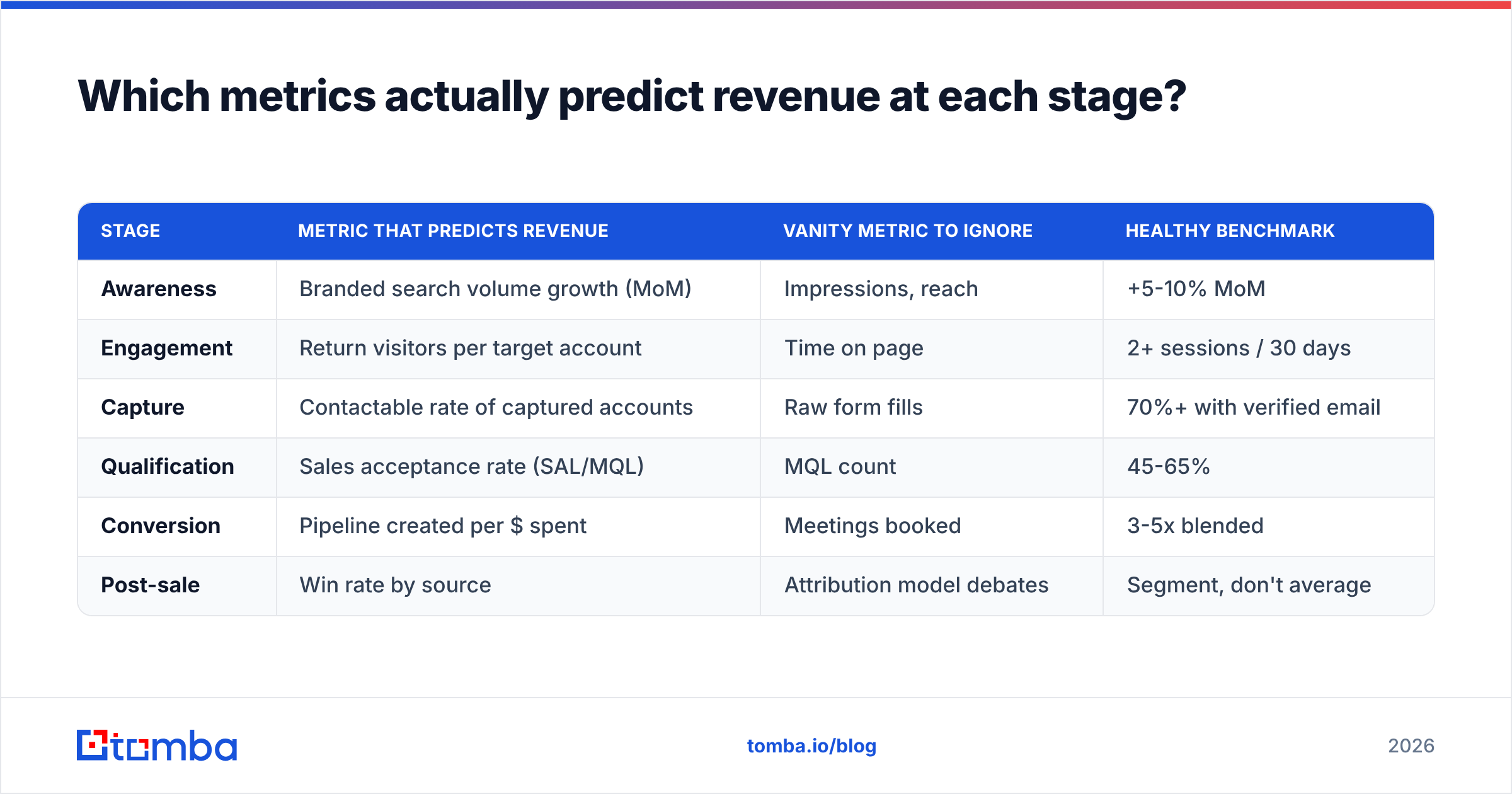
Which metrics actually predict revenue at each stage?#
| Stage | Metric that predicts revenue | Vanity metric to ignore | Healthy benchmark |
|---|---|---|---|
| Awareness | Branded search volume growth (MoM) | Impressions, reach | +5-10% MoM |
| Engagement | Return visitors per target account | Time on page | 2+ sessions / 30 days |
| Capture | Contactable rate of captured accounts | Raw form fills | 70%+ with verified email |
| Qualification | Sales acceptance rate (SAL/MQL) | MQL count | 45-65% |
| Conversion | Pipeline created per $ spent | Meetings booked | 3-5x blended |
| Post-sale | Win rate by source | Attribution model debates | Segment, don't average |
Two of these deserve extra attention.
Contactable rate is the share of captured accounts where you hold a deliverable email for someone on the buying committee. Say you capture 400 accounts a month and 240 are contactable. Your real capture number is 240. Your true cost per usable lead is 67% higher than the dashboard says. Most teams never run this math, because the CRM shows 400 rows either way.
Sales acceptance rate is the cheapest lie detector in marketing. When SAL/MQL drops below 40%, your model is scoring engagement instead of fit. Gartner's research on B2B buying behavior puts buying groups at six to ten people. A score built on one person's PDF download cannot represent that.
How do you build the top of the demand generation funnel in 2026?#
The mechanics changed. Design around three shifts.
- AI answer engines absorbed the informational query. "What is a demand generation funnel" now gets answered with no click. Your top-of-funnel content has to target decision-stage and comparison queries where buyers still click. It also has to be citable enough to appear inside AI answers.
- Dark social drives most discovery. Slack groups, private communities, podcasts, LinkedIn comments. None of it shows up in last-touch attribution. The "How did you hear about us?" field on your demo form is now a better signal than your analytics platform.
- Form fills fell and anonymous demand rose. Buyers reach your pricing page already 70% decided, and many never fill in anything. That makes website visitor reveal and enrichment infrastructure, not a growth hack.
So budget for creation channels with no trackable CPL. Then build a capture layer that turns anonymous traffic into named, reachable contacts. The second half is a data problem with a data solution.
Why does contact data quality decide funnel performance?#
Because every stage after capture multiplies against your data accuracy.
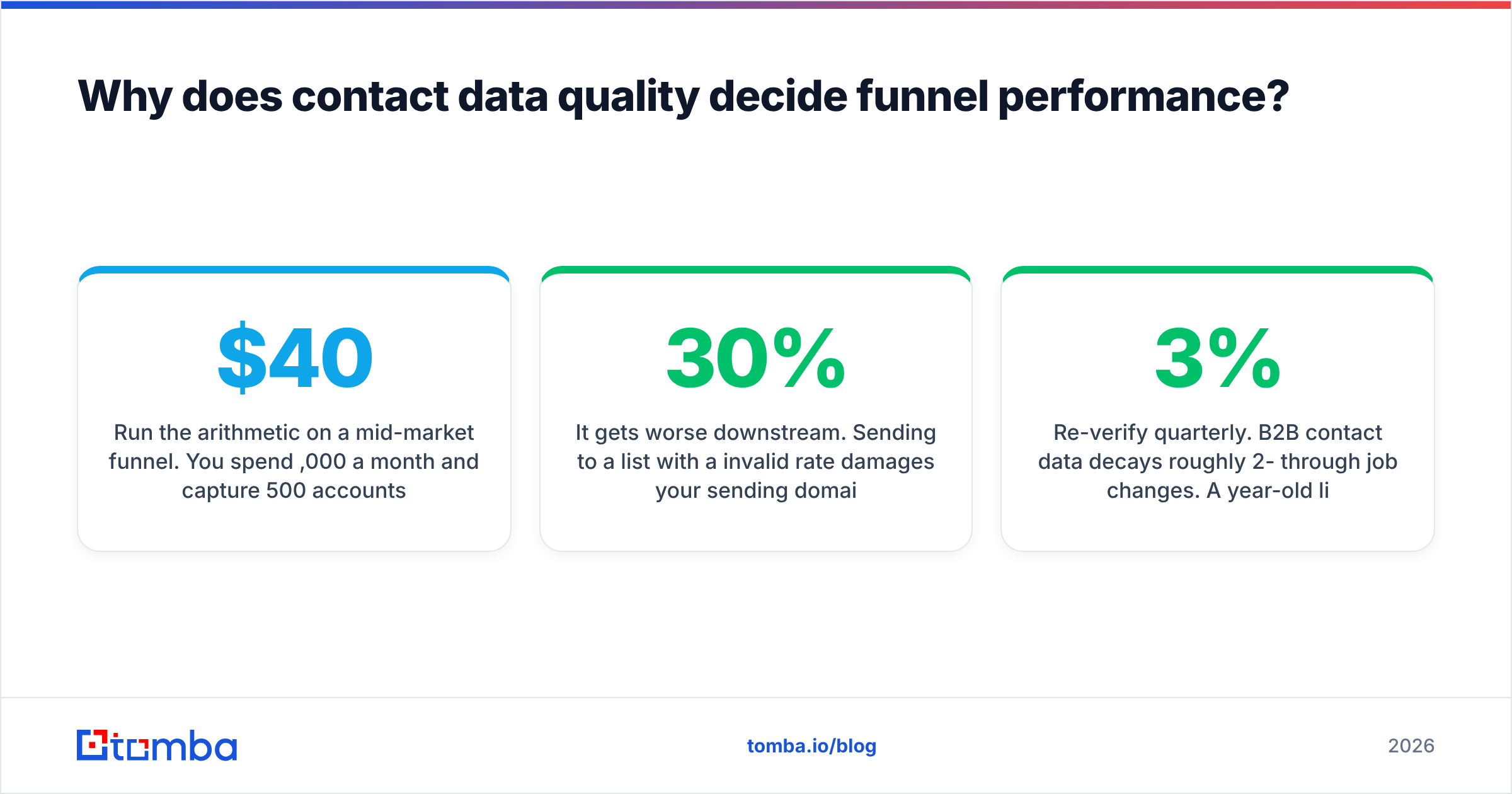
Run the math on a mid-market funnel. You spend $40,000 a month and capture 500 accounts. Say 30% of your email addresses bounce or belong to someone who left. Sales works 350 accounts, not 500. Your cost per workable account jumps from $80 to $114. Nothing about your campaigns changed. The leak is in the database.
It gets worse downstream. A list with a 30% invalid rate damages your sending domain. High bounce rates hurt sender reputation, which pushes more mail out of the inbox. That includes the 70% of addresses that were good. One bad batch degrades every campaign that follows.
The fix is dull and cheap next to media spend:
- Verify on capture, not on send. Run every new record through an email verifier at the point of entry. Bad data never reaches the CRM.
- Enrich to the buying committee. One contact per account is not a funnel. It is a coin flip. Use data enrichment to add the two or three other roles that sign off.
- Re-verify quarterly. B2B contact data decays 2-3% per month as people change jobs. A year-old list is a third fiction.
- Track a data-freshness field. Record when each contact was last verified. Let routing rules deprioritize anything older than 90 days.
What does the tooling stack look like at each stage?#
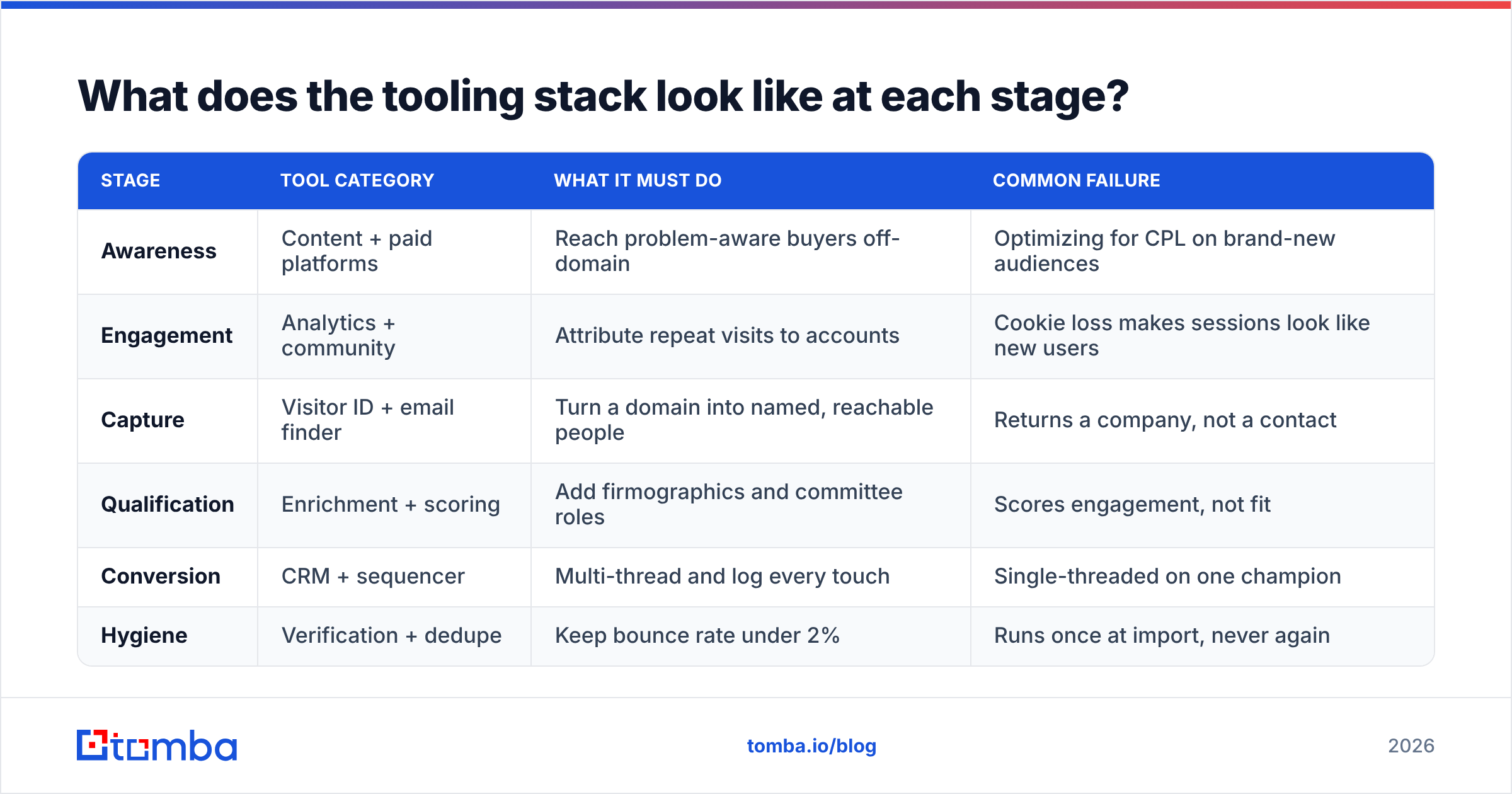
| Stage | Tool category | What it must do | Common failure |
|---|---|---|---|
| Awareness | Content + paid platforms | Reach problem-aware buyers off-domain | Optimizing for CPL on brand-new audiences |
| Engagement | Analytics + community | Attribute repeat visits to accounts | Cookie loss makes sessions look like new users |
| Capture | Visitor ID + email finder | Turn a domain into named, reachable people | Returns a company, not a contact |
| Qualification | Enrichment + scoring | Add firmographics and committee roles | Scores engagement, not fit |
| Conversion | CRM + sequencer | Multi-thread and log every touch | Single-threaded on one champion |
| Hygiene | Verification + dedupe | Keep bounce rate under 2% | Runs once at import, never again |
For the capture and qualification rows, you want an API you can call inside your existing workflow. A UI someone has to remember to open will not get used.
Tomba's email finder API and bulk email finder exist for exactly that. You pass a domain and a name. You get back a scored, verified address. Your routing logic then decides in milliseconds, instead of a rep guessing at name@company.com.
Peers like BookYourData take a database-first approach to the same problem. They fit well when you want prebuilt lists rather than on-demand lookups. The right choice depends on whether your motion is list-driven or trigger-driven.
What breaks most demand generation funnels?#
Four failure patterns show up again and again in a demand generation funnel:
- Creation budget gets cut to fund capture. Capture reports better numbers this quarter, so it wins the reallocation. Two quarters later, capture CPL doubles. Nobody is making new demand. Protect creation spend as a fixed percentage, not a leftover.
- The scoring model rewards curiosity. Whitepaper downloads and webinar signups score high. Company size, tech stack, and role score low or not at all. Rebalance so fit is at least half the score.
- The handoff loses account context. Marketing knows Acme visited pricing three times and read two comparison posts. Sales sees a name and an email. Push that history into the CRM record, not just a dashboard.
- Nobody owns data decay. Every team assumes the CRM cleans itself. Assign quarterly re-verification to one named person with one named metric: bounce rate.
How do you measure demand generation ROI honestly?#
Use three views instead of one attribution model.
Pipeline created per dollar spent, blended across channels and tracked monthly with a 90-day lag. This is the number the CFO cares about. It is also the only one that survives an attribution argument.
Self-reported attribution on every inbound form. Use free text or a short dropdown. It catches the dark-social effect that no pixel sees. It also disagrees with last-touch in useful ways.
Cohort win rate by source. Segment closed-won deals by first-touch channel. Compare win rates, not lead volume. A channel with 40 leads at a 22% win rate beats one with 200 leads at 3%. A CPL dashboard will tell you the opposite every time.
Report all three side by side. A single perfect attribution number is a fiction. Build the funnel around that fiction and creation budgets die.
Where should you start this quarter?#
Instrument contactable rate first. It takes an afternoon and costs nothing. It usually shows that 20-35% of your captured demand was never reachable. That means a third of your media spend funded rows nobody could act on.
Then close the gap. Tomba's Email Finder turns a company domain and a name into a verified, deliverable address. The accounts your demand generation funnel surfaces then reach a real human inbox. The free tier gives you 25 searches a month, so you can test the leak yourself. Paid plans start at $49/mo, and you can check full Tomba pricing first. Fix the capture layer, and every dollar you spend upstream works harder.
Related guides#
Ready to find emails that actually work?
Join 150,000+ professionals who stopped guessing and started sending. Free credits on signup — no credit card required.
Get the Tomba newsletter
Practical outbound tactics and product updates — once every two weeks.
About the author