Demand Generation in Marketing: The Complete 2026 Guide
Demand generation is not lead generation with a bigger budget. Here's how the engine actually works in 2026 — channel mix, measurement, data quality, and the handoff that quietly kills most programs.
Demand generation in marketing is the work that makes buyers want what you sell. It creates interest, then turns that interest into revenue. This guide covers demand generation in marketing in 2026: what it is, how it differs from lead gen, which channels pay off, and how to measure it.
TL;DR
- Demand generation in marketing is the full system. It creates awareness, captures intent, and turns it into revenue. Lead generation is only the capture step inside it.
- The 2026 version is measured in pipeline and revenue, not MQL counts. Teams that still report MQLs track a number nobody buys from.
- Most buying research now happens where you cannot track it: podcasts, Slack groups, LinkedIn comments, peer calls. Plan for the dark funnel.
- Gated PDFs are the most common leak. Ungate the content. Then enrich anonymous demand with accurate contact data.
- Your engine is only as good as the contact records behind it. Bad email data breaks routing, attribution, and deliverability.
What is demand generation in marketing?#
Demand generation in marketing is the set of programs that make buyers aware of a problem, build trust in your solution, and turn that interest into sales conversations.
Think of it like a restaurant. Lead generation is the host taking names at the door. Demand generation is everything that made people walk down that street. The smell from the kitchen. The reviews. The friend who said "you have to try this place." If nobody is hungry, a better clipboard at the door changes nothing.
Demand generation in marketing covers four jobs. Most teams treat them as separate departments.
- Demand creation — help a buyer see they have a problem worth solving. Podcasts, original research, paid social, community, events.
- Demand capture — meet buyers who are already searching. Category search, review sites, comparison pages, retargeting.
- Demand conversion — turn attention into a booked meeting. Offers, forms, chat, outbound follow-up, the sales handoff.
- Demand expansion — post-sale work that turns customers into advocates and repeat pipeline.
Fund only step 2 and you look efficient in a dashboard. Then the search volume runs dry and growth stops. Fund only step 1 and your rivals capture the demand you paid to create. All four need to run at once.
How is demand generation different from lead generation?#
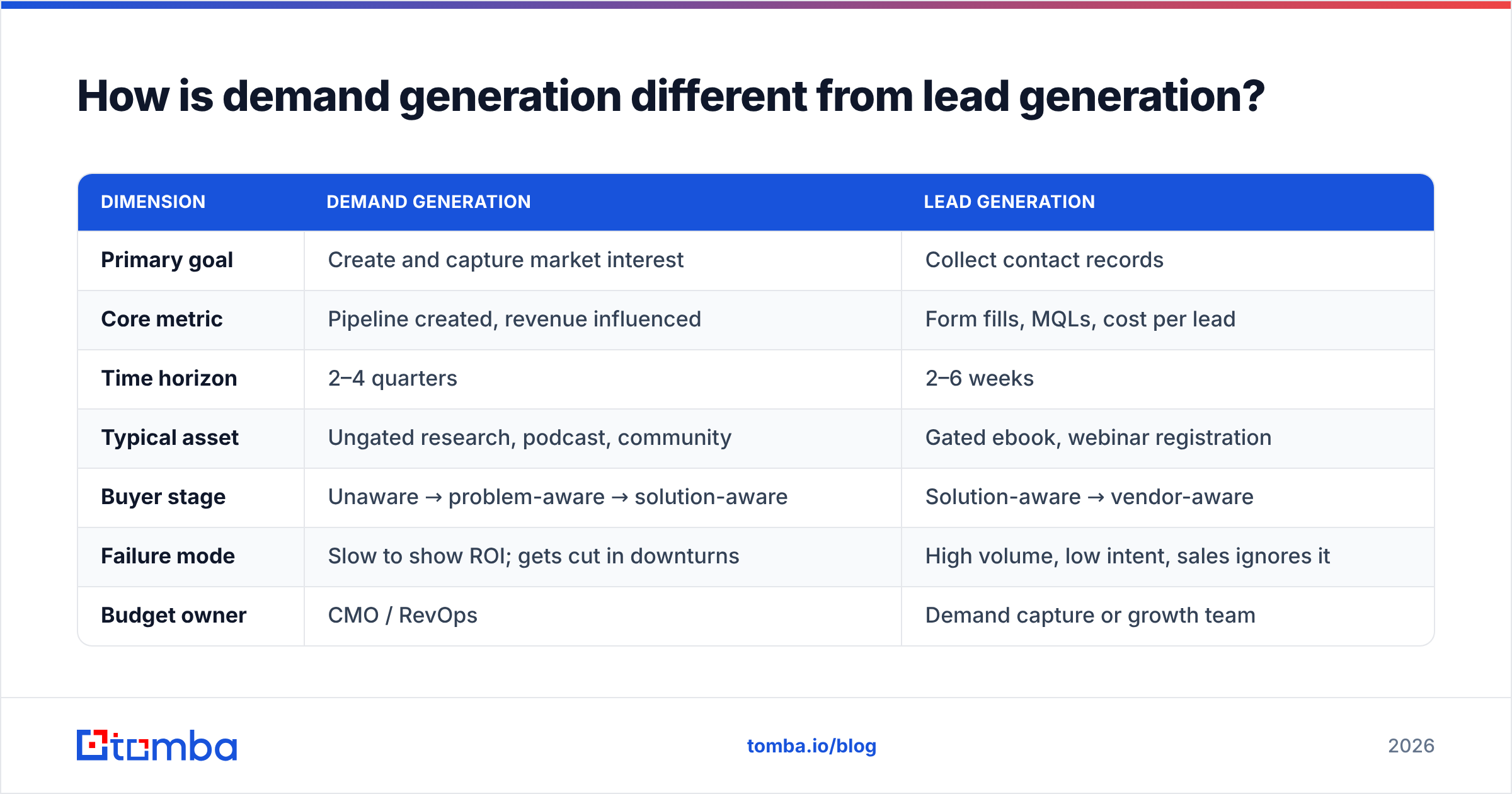
Lead generation is one part of demand generation. Mixing the two up costs real money. They are measured in different ways, and they fail in different ways.
| Dimension | Demand generation | Lead generation |
|---|---|---|
| Primary goal | Create and capture market interest | Collect contact records |
| Core metric | Pipeline created, revenue influenced | Form fills, MQLs, cost per lead |
| Time horizon | 2–4 quarters | 2–6 weeks |
| Typical asset | Ungated research, podcast, community | Gated ebook, webinar registration |
| Buyer stage | Unaware → problem-aware → solution-aware | Solution-aware → vendor-aware |
| Failure mode | Slow to show ROI; gets cut in downturns | High volume, low intent, sales ignores it |
| Budget owner | CMO / RevOps | Demand capture or growth team |
| Sales reaction | "Where did all this inbound come from?" | "These leads are junk" |
Here is a quick test. If you turned off every paid channel tomorrow, would anyone still search for your brand? If yes, you have demand generation. If no, you have a lead-buying habit.
A good program still produces leads. It just stops treating a raw marketing qualified lead as the finish line. The lead is a by-product of demand, not a substitute for it.

What does a modern demand generation engine look like?#
Five parts, in order. Skip one and the next one breaks.
- A real market, not a persona doc. List the accounts you can win: firmographics, tech stack, trigger events, deal-breakers. A 3,000-account list you can reach beats a 40,000-account list you can't.
- A point of view worth repeating. "The 5 benefits of CRM" says nothing. "Your CRM hygiene problem is a routing problem" starts arguments and earns shares.
- Always-on capture. Category search, comparison pages, G2 profiles, retargeting, and a fast path to a meeting. Capture is boring, and it pays the best.
- Clean contact and account data. Anonymous demand converts only if you can name it and reach it. Most engines break here.
- A closed measurement loop. Ask buyers on the form how they heard about you. Add CRM pipeline sourcing. Skip the 14-touch model nobody trusts.
Run these as one system, with one owner. Demand generation in marketing dies in the handoffs when creation reports to brand, capture reports to growth, and data reports to revenue operations.
Which channels actually create demand in 2026?#
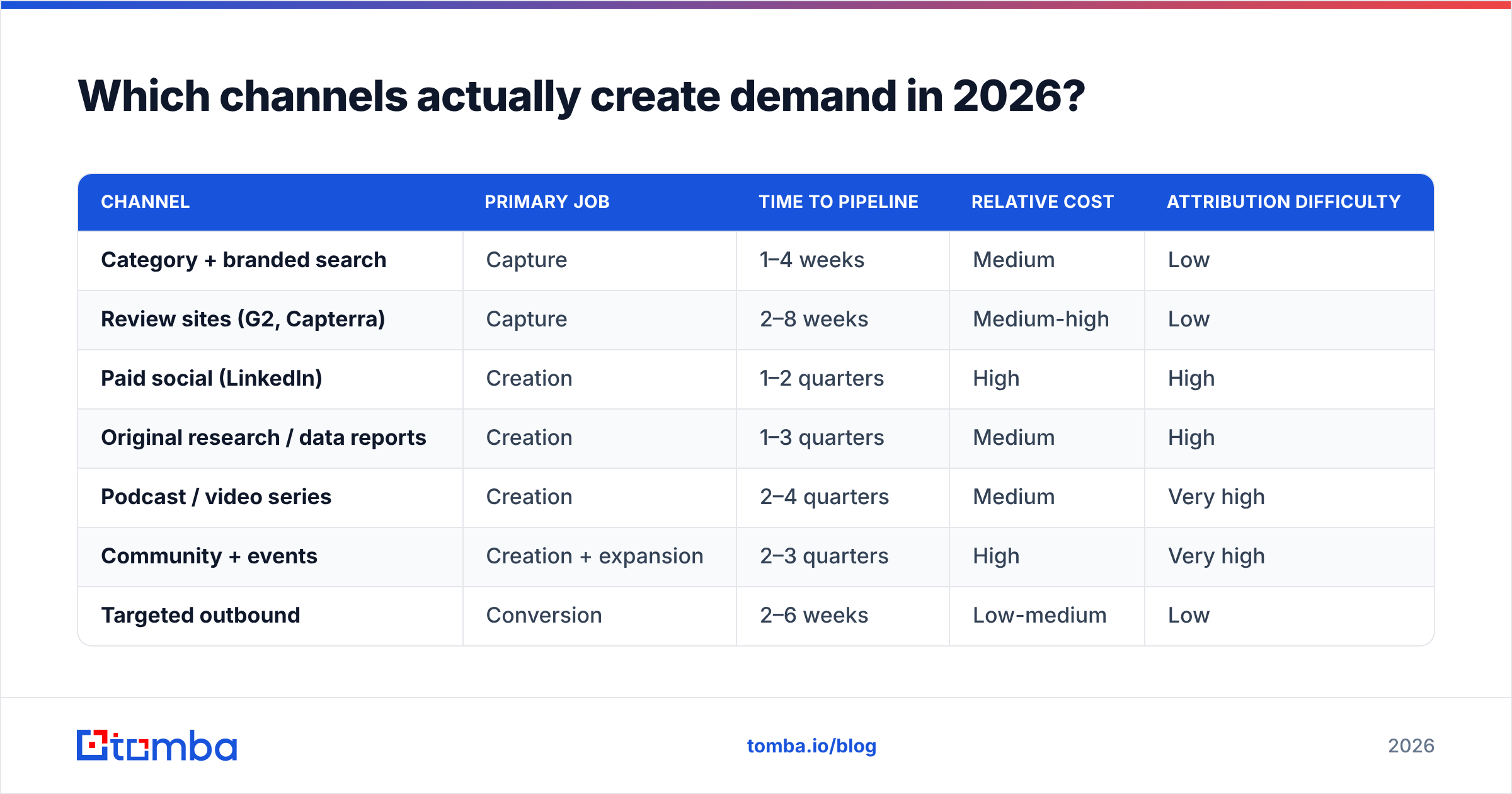
There is no universal answer. There is a reliable pattern by motion. The table below shows what mid-market B2B teams tend to see. The ranges come from vendor benchmarks and analyst coverage from firms like Gartner.
| Channel | Primary job | Time to pipeline | Relative cost | Attribution difficulty |
|---|---|---|---|---|
| Category + branded search | Capture | 1–4 weeks | Medium | Low |
| Review sites (G2, Capterra) | Capture | 2–8 weeks | Medium-high | Low |
| Paid social (LinkedIn) | Creation | 1–2 quarters | High | High |
| Original research / data reports | Creation | 1–3 quarters | Medium | High |
| Podcast / video series | Creation | 2–4 quarters | Medium | Very high |
| Community + events | Creation + expansion | 2–3 quarters | High | Very high |
| Targeted outbound | Conversion | 2–6 weeks | Low-medium | Low |
| Lifecycle email + nurture | Conversion | 2–8 weeks | Low | Low |
Two rules keep this from becoming a spreadsheet exercise.
Rule one: never fund creation without capture. If your podcast works, buyers will search your brand and your category. If page one belongs to a rival's comparison post, you funded their quarter.
Rule two: cheap capture gets crowded. Branded search is the cheapest pipeline you will ever buy. It also caps out at the demand you already have. Only creation lifts that ceiling.
How do you measure demand generation in marketing?#
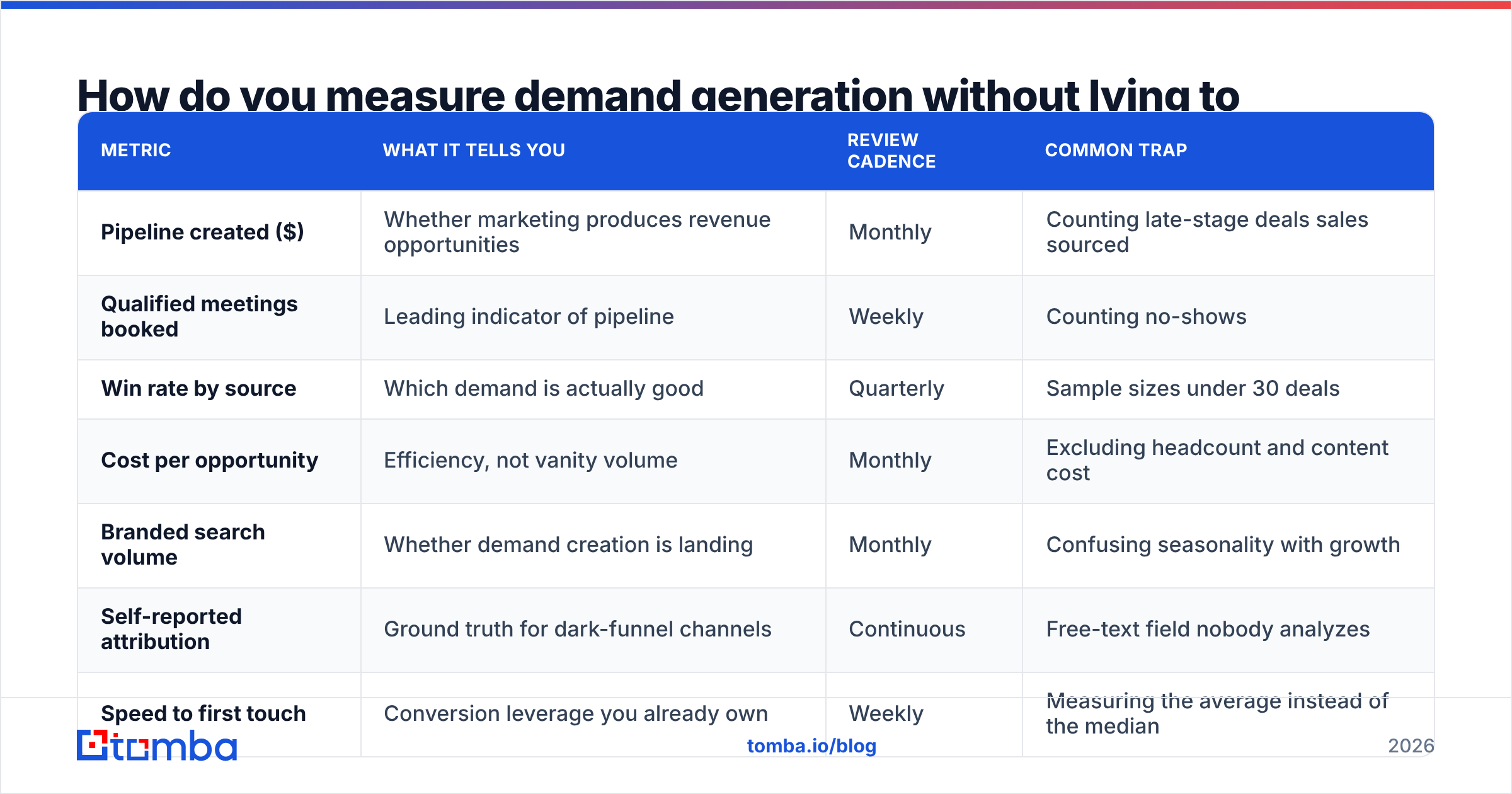
Pick a few metrics a CFO would accept. Report them on a set schedule.
| Metric | What it tells you | Review cadence | Common trap |
|---|---|---|---|
| Pipeline created ($) | Whether marketing produces revenue opportunities | Monthly | Counting late-stage deals sales sourced |
| Qualified meetings booked | Leading indicator of pipeline | Weekly | Counting no-shows |
| Win rate by source | Which demand is actually good | Quarterly | Sample sizes under 30 deals |
| Cost per opportunity | Efficiency, not vanity volume | Monthly | Excluding headcount and content cost |
| Branded search volume | Whether demand creation is landing | Monthly | Confusing seasonality with growth |
| Self-reported attribution | Ground truth for dark-funnel channels | Continuous | Free-text field nobody analyzes |
| Speed to first touch | Conversion leverage you already own | Weekly | Measuring the average instead of the median |
Notice what is missing: MQLs, form fills, and "engagement." Those are debug tools, not goals. Use them to fix a channel. Never put them on a board slide.
One habit is worth copying. Add a short "How did you first hear about us?" field to every form. Read the answers once a month. It is crude and self-reported, and it still beats your attribution model for creation channels. HubSpot's marketing research and buyer studies both show that most vendor discovery happens before any click you can track.
Why do most demand generation programs stall?#
Four failure modes, most common first.
The gated-PDF reflex. You put a good report behind a form. You get 400 emails, and 380 of them wanted the report, not your product. The report never spreads, because nobody shares a landing page. Ungate it. Let it travel. Capture demand at the moment of intent, not the moment of curiosity.
The MQL handoff. Marketing hits its MQL number. Sales ignores the list. Both teams have data proving the other one is wrong. Fix the shared goal first: qualified meetings or pipeline. A better scoring model on top of a broken definition changes nothing.
Attribution paralysis. A team spends two quarters building multi-touch attribution instead of running programs. Ship a simple model, accept 70% confidence, and move.
Dirty data. The least glamorous, and the most costly. That one is next.
How much does data quality decide whether demand gen works?#
More than channel choice does. Here is the chain. Creation produces interest. Interest becomes an anonymous visit or a partial record. Routing, enrichment, and outreach turn that record into a meeting. Every step after "interest" needs the record to be right.
Here is what bad contact data does to demand generation in marketing:
- Routing breaks. No company size or domain means the account goes to the wrong rep, or to no rep. Speed to first touch collapses.
- Attribution breaks. Duplicate records split one buying journey across three contact IDs. Now no channel looks like it works.
- Deliverability breaks. Mail sent to invalid addresses raises bounce rates and hurts your sender reputation. In time it costs you the inbox for the people who are real.
- Forecasting breaks. If 20% of your "pipeline-eligible" records are not reachable, your conversion math is wrong before a single call happens.
The fix is dull. Verify at capture. Enrich on entry. Re-verify on a schedule. Check every inbound address when the form is sent, not when the email goes out. Fill missing fields with data enrichment so routing rules have something to work with. Re-check the database every quarter, because B2B contact data decays by 2–3% a month as people change jobs.
Some accounts read three blog posts and then vanish. For those, a domain search turns a known company into named, reachable contacts. Outbound can then pick up where marketing stopped. That is not a patch for weak demand. It is the layer that makes demand pay.
What budget split makes sense for demand generation?#
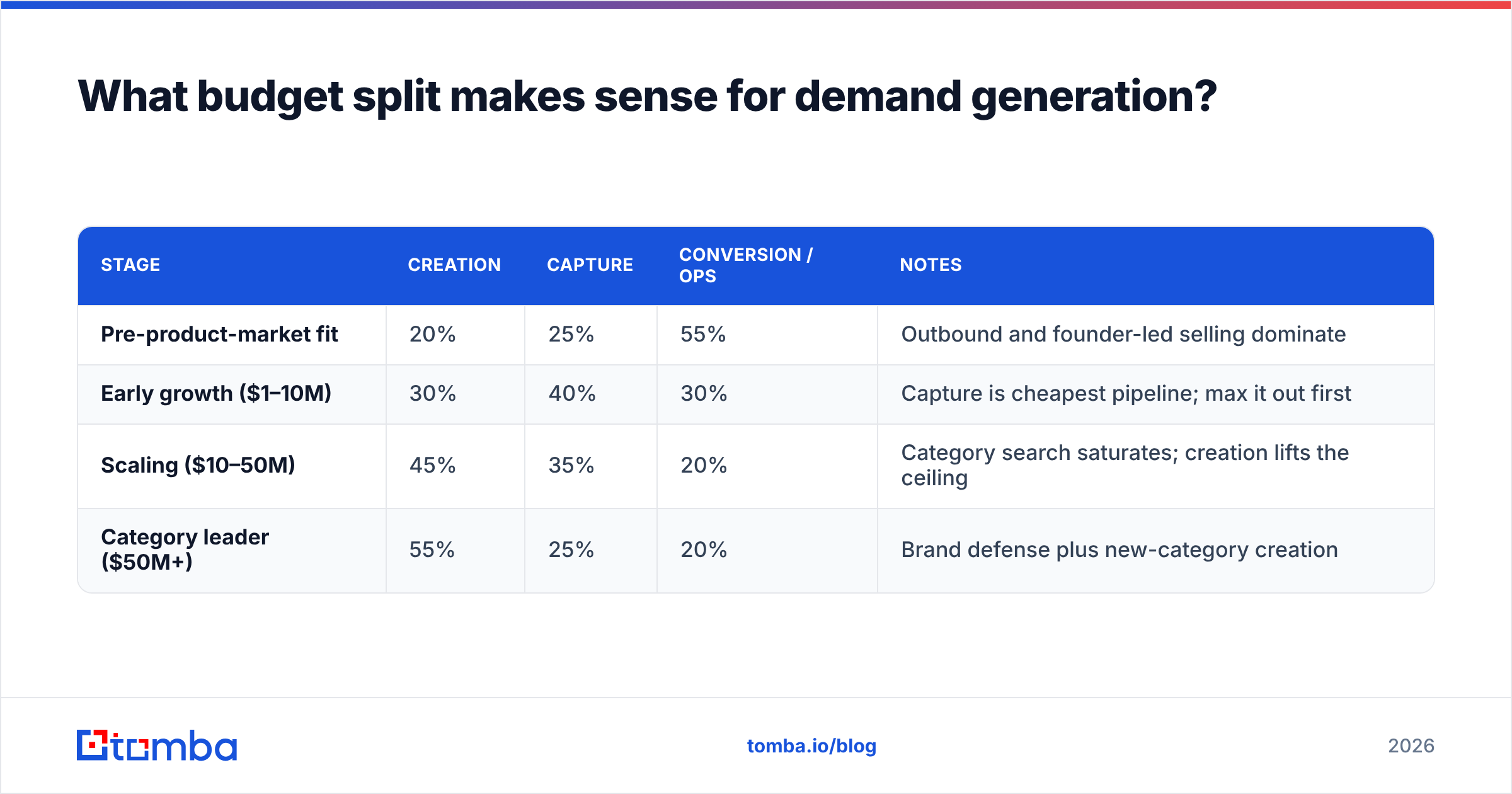
Splits change by stage. These ranges hold up for most B2B SaaS teams under $50M ARR.
| Stage | Creation | Capture | Conversion / ops | Notes |
|---|---|---|---|---|
| Pre-product-market fit | 20% | 25% | 55% | Outbound and founder-led selling dominate |
| Early growth ($1–10M) | 30% | 40% | 30% | Capture is cheapest pipeline; max it out first |
| Scaling ($10–50M) | 45% | 35% | 20% | Category search saturates; creation lifts the ceiling |
| Category leader ($50M+) | 55% | 25% | 20% | Brand defense plus new-category creation |
Two caveats. First, "conversion / ops" pays for data tooling, CRM hygiene, and enrichment. Cut it and the other two lines lose steam in ways you cannot see. Second, do not move budget to creation while your capture channels still have room. You would buy costly demand and leave cheap demand on the table.
Are you weighing tools for any of these lines? Check vendor claims against real user reviews on G2 first. Those category pages also show which rivals buyers compare you with. That is useful input for your capture content plan.
How do you start a demand generation program from zero?#
A 90-day plan that needs no new headcount:
- Weeks 1–2: Define the market you can win. Pull your last 50 closed-won deals. Find the shared traits. That is your ICP, not the one in the pitch deck.
- Weeks 3–4: Fix capture. Rewrite comparison and alternative pages. Claim your review-site profiles. Defend branded search.
- Weeks 5–6: Clean the data layer. Dedupe the CRM, verify email records, and turn on enrichment for inbound.
- Weeks 7–10: Ship one creation asset with a real point of view. Data beats opinion. Survey your customers and publish the numbers ungated.
- Weeks 11–12: Close the loop. Add self-reported attribution. Build the pipeline dashboard. Hold one weekly meeting where sales and marketing read the same number.
Then repeat. Demand generation in marketing compounds. The second quarter is cheaper than the first, as long as you did not wreck the data layer.
Where should you go from here?#
Demand generation in marketing is a systems problem, not a campaign problem. Creation without capture funds your rivals. Capture without creation caps your growth. Both fall apart when the contact records under them are stale, duplicated, or dead.
Is your bottleneck the conversion layer? You create interest, but you cannot reach the people behind it. Start there. Tomba Email Finder turns a company domain or a name into a verified, deliverable business email. The demand you spent a quarter creating then reaches a real inbox. The free tier includes 25 searches a month, so you can test accuracy on your own account list. Paid plans start at $49/mo on Starter, with $99/mo Growth and $249/mo Pro as volume grows. See Tomba pricing for the full details.
Fix the data layer first. The rest of demand generation in marketing gets cheaper after that.
Related guides#
Ready to find emails that actually work?
Join 150,000+ professionals who stopped guessing and started sending. Free credits on signup — no credit card required.
Get the Tomba newsletter
Practical outbound tactics and product updates — once every two weeks.
About the author