Demand Generation Leads: The Complete 2026 Playbook
Demand generation leads convert 3-5x better than gated-content MQLs — but only if you measure them right. Here's the full 2026 framework: models, benchmarks, tooling, and the routing rules that stop good demand from dying in a nurture track.
TL;DR
- Demand generation leads are not MQLs. An MQL is a form fill. A demand generation lead is an account showing real buying intent — the form is optional, and increasingly it's not there at all.
- The 2026 split is capture vs. creation. Demand capture harvests people already searching. Demand creation manufactures the search in the first place. Most teams overfund capture and then wonder why volume plateaus.
- Self-reported attribution beats last-touch. A single "How did you hear about us?" free-text field outperforms most multi-touch models for dark-social-heavy funnels.
- The hidden bottleneck is contact data. Ungated demand gen produces anonymous accounts, not named contacts. Without an enrichment layer, half your demand never becomes a conversation.
- Benchmark to hit: demand-gen-sourced opportunities should close at 2-4x the rate of content-gated MQLs. If they don't, your qualification model is measuring the wrong thing.
What Are Demand Generation Leads, Exactly?#
A demand generation lead is a person or account that has demonstrated buying intent for the category you sell into — regardless of whether they filled out a form.
That last clause is the entire argument. For fifteen years, "lead" meant "someone who traded an email address for a PDF." That definition made sense when the gated whitepaper was the only observable signal. It stopped making sense the moment buyers began doing 70%+ of their evaluation before contacting a vendor, most of it in places you cannot tag: podcasts, Slack communities, LinkedIn comment threads, peer DMs.
So the working definition shifted. A demand generation lead in 2026 is any of the following:
- A high-intent inbound — demo request, pricing page repeat visit, "contact sales" click. This is captured demand.
- An account with surging research behavior — multiple people from one domain hitting comparison pages, docs, or integration listings within a short window.
- A self-reported referral — someone who names your podcast, newsletter, or a specific creator in the "how did you hear about us" field.
- A community-sourced contact — an active participant in a space you own or sponsor, who has never converted on anything.
- A product-led signal — a free-tier user whose usage crosses a threshold that historically correlates with paid conversion.
Note what's missing: ebook downloads. Webinar registrants who never showed. Anyone scraped from a list and dropped into a nurture sequence. Those are contacts, not demand.
The distinction matters commercially, not semantically. When Forrester and Gartner both started publishing on buying group dynamics rather than individual leads, the underlying finding was consistent: B2B purchases involve 6-11 stakeholders, and scoring any single one of them as "the lead" mis-models the deal.
Is Demand Generation Different From Lead Generation?#
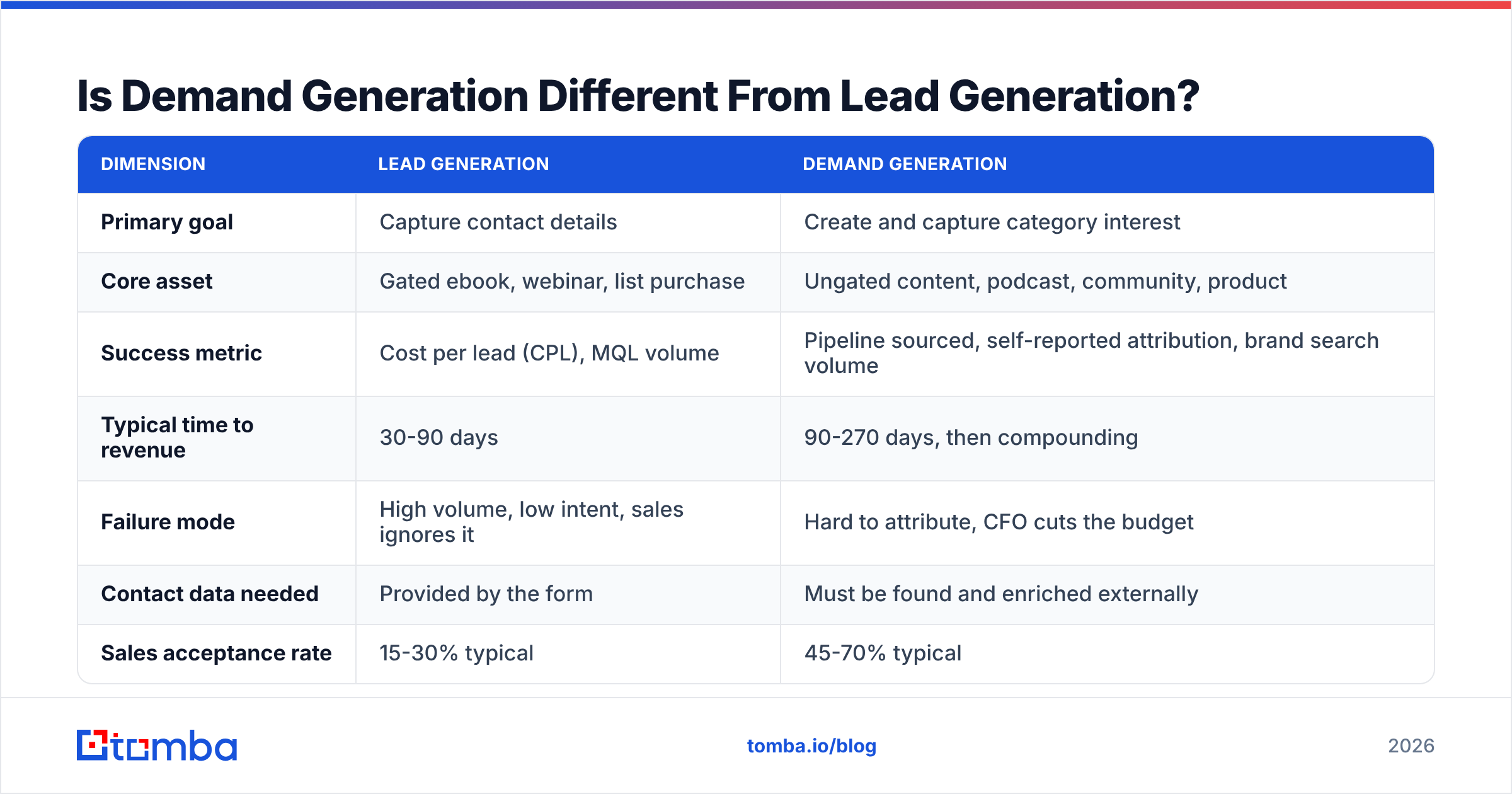
Yes, and the difference is directional. Lead generation extracts contact information from existing interest. Demand generation creates the interest that lead generation later extracts.
| Dimension | Lead Generation | Demand Generation |
|---|---|---|
| Primary goal | Capture contact details | Create and capture category interest |
| Core asset | Gated ebook, webinar, list purchase | Ungated content, podcast, community, product |
| Success metric | Cost per lead (CPL), MQL volume | Pipeline sourced, self-reported attribution, brand search volume |
| Typical time to revenue | 30-90 days | 90-270 days, then compounding |
| Failure mode | High volume, low intent, sales ignores it | Hard to attribute, CFO cuts the budget |
| Contact data needed | Provided by the form | Must be found and enriched externally |
| Sales acceptance rate | 15-30% typical | 45-70% typical |
Read the last two rows together, because they explain the operational problem nobody warns you about.
When you gate content, the buyer hands you their email. When you go ungated — which is the whole point of demand generation — you get traffic, brand lift, and eventually a surge of accounts researching you. What you do not get is a name and an inbox. That gap is why so many demand gen programs look like they're "working" in Google Analytics and like they're failing in the CRM.
Closing it requires a contact-resolution layer: identify the account from firmographic or IP signals, identify the right buying-group members, then find verified contact details. Teams that skip this step end up with a beautiful brand and an empty pipeline.

Why Do Most Demand Generation Leads Die Before Sales Sees Them?#
Because they get routed by the same rules that were written for gated-content MQLs.
Here's the typical failure chain. Marketing publishes an ungated report. It does well. Three people from a 400-person target account read it over two weeks, then one of them fills out the newsletter form with a personal Gmail address. Your scoring model sees: free email domain, no job title, one form fill, no demo request. Score: 12. Routing: nurture track, email 1 of 9.
Meanwhile the actual buyer — the VP who read the report on a phone, never converted, and forwarded it to procurement — is invisible.
Four specific breakdowns cause this:
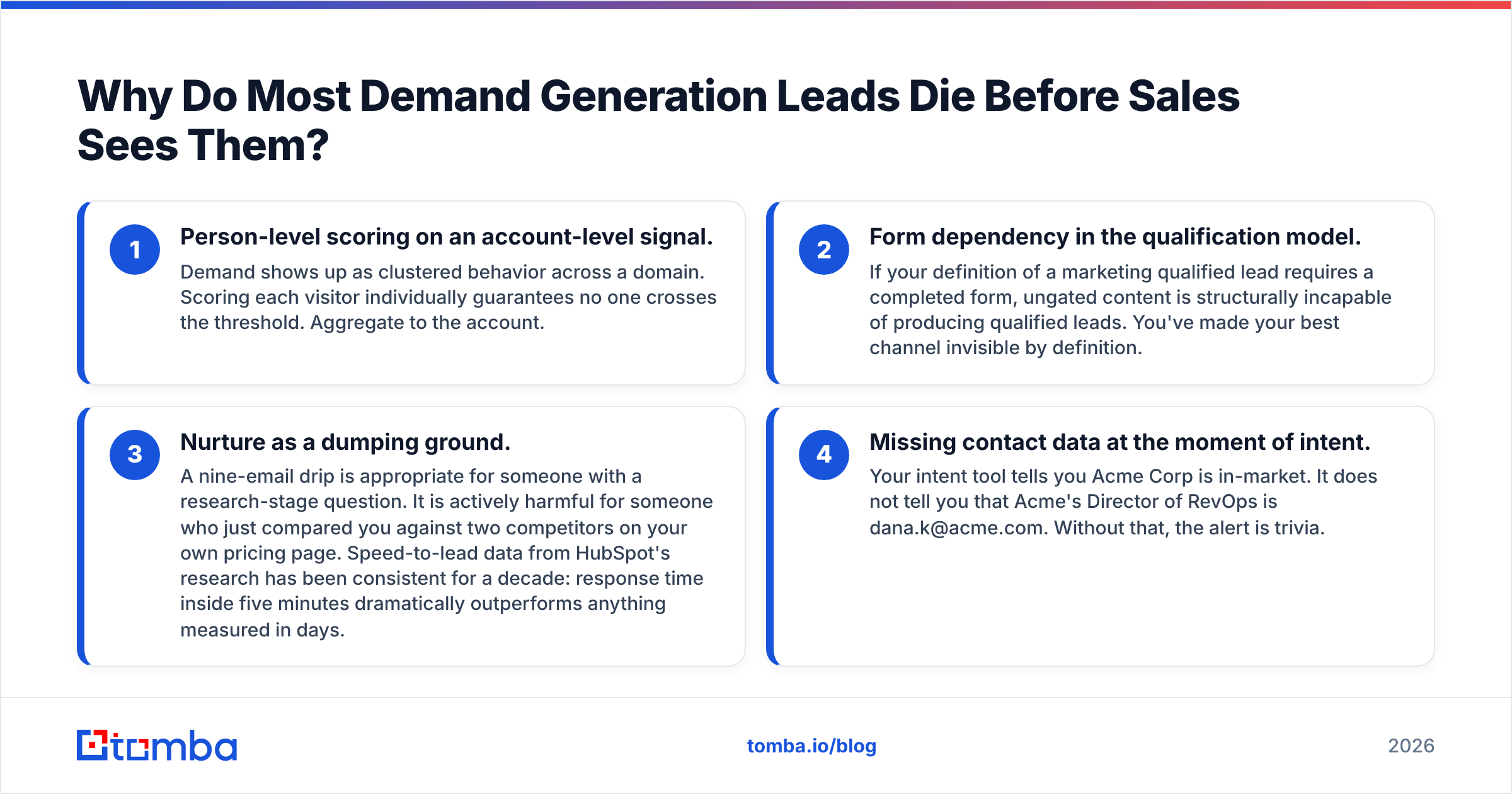
- Person-level scoring on an account-level signal. Demand shows up as clustered behavior across a domain. Scoring each visitor individually guarantees no one crosses the threshold. Aggregate to the account.
- Form dependency in the qualification model. If your definition of a marketing qualified lead requires a completed form, ungated content is structurally incapable of producing qualified leads. You've made your best channel invisible by definition.
- Nurture as a dumping ground. A nine-email drip is appropriate for someone with a research-stage question. It is actively harmful for someone who just compared you against two competitors on your own pricing page. Speed-to-lead data from HubSpot's research has been consistent for a decade: response time inside five minutes dramatically outperforms anything measured in days.
- Missing contact data at the moment of intent. Your intent tool tells you Acme Corp is in-market. It does not tell you that Acme's Director of RevOps is dana.k@acme.com. Without that, the alert is trivia.
The fix for #4 is mechanical. When an account surges, run a domain search against it to pull the relevant role-holders, then verify before anyone sends anything. It takes seconds and converts an anonymous signal into an addressable buying group.
What Does a Working Demand Generation Model Look Like in 2026?#
Three layers, in order. Skipping a layer is the most common structural mistake.
Layer 1 — Demand creation (60% of budget). Content that no one has to trade an email for: original research, opinionated podcasts, founder-led LinkedIn, YouTube teardowns, community sponsorship. The measurable output is not leads. It is branded search volume, direct traffic, and the frequency with which your name appears in self-reported attribution fields. Expect a 2-3 quarter lag before it shows up in pipeline.
Layer 2 — Demand capture (30% of budget). Paid search on high-intent terms, comparison and alternative pages, review-site presence on G2 and Capterra, and a pricing page that actually shows prices. Capture converts fast but it cannot grow beyond the demand that exists. If you are only doing capture, you are competing for a fixed pool against everyone else in your category.
Layer 3 — Demand conversion (10% of budget, 100% of the operational discipline). Routing, enrichment, contact resolution, speed-to-lead, and buying-group coverage. This is the least glamorous layer and the one that determines whether the other two produce revenue.
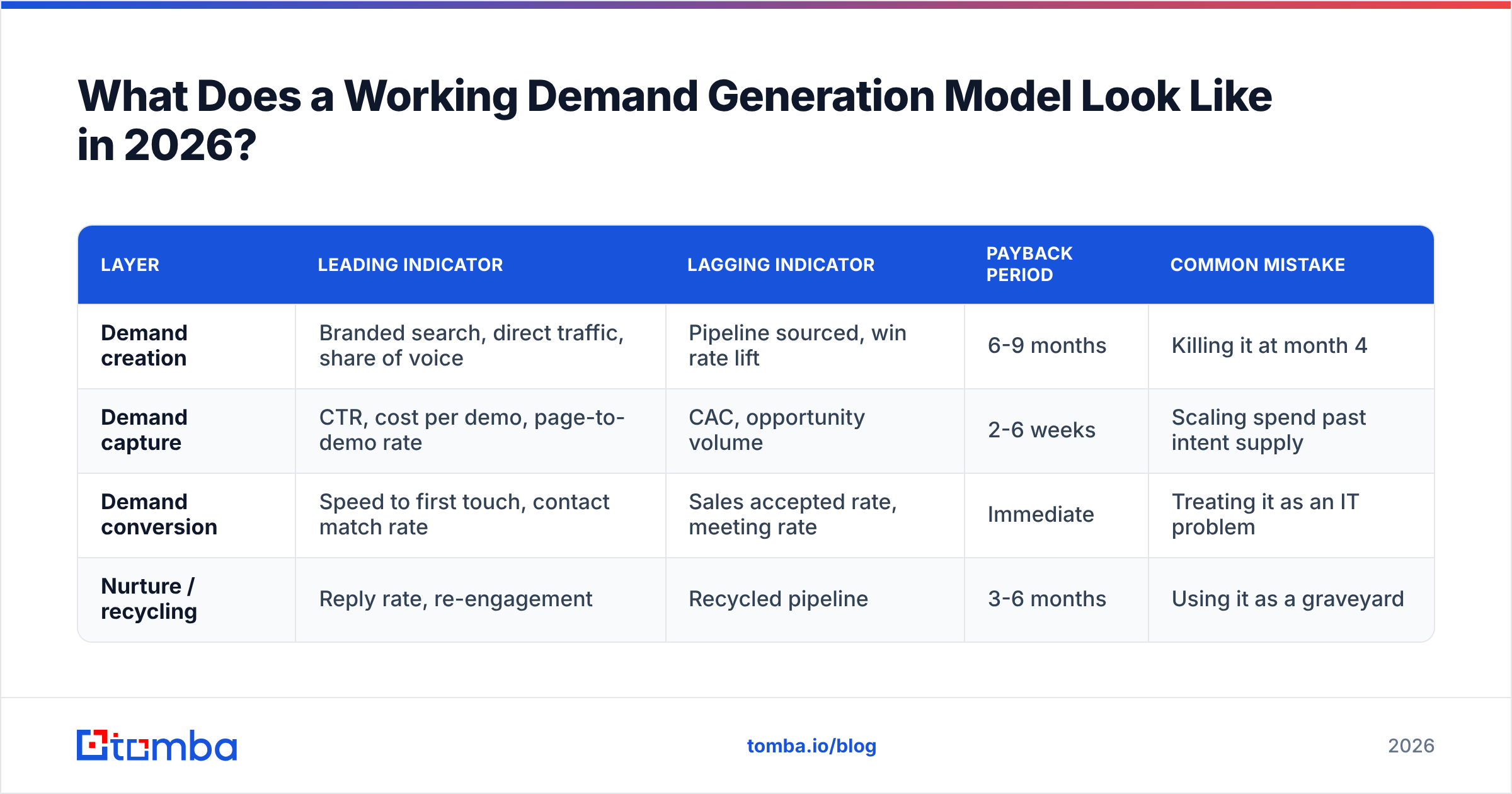
Here's how the layers compare on the metrics that get argued about in QBRs:
| Layer | Leading indicator | Lagging indicator | Payback period | Common mistake |
|---|---|---|---|---|
| Demand creation | Branded search, direct traffic, share of voice | Pipeline sourced, win rate lift | 6-9 months | Killing it at month 4 |
| Demand capture | CTR, cost per demo, page-to-demo rate | CAC, opportunity volume | 2-6 weeks | Scaling spend past intent supply |
| Demand conversion | Speed to first touch, contact match rate | Sales accepted rate, meeting rate | Immediate | Treating it as an IT problem |
| Nurture / recycling | Reply rate, re-engagement | Recycled pipeline | 3-6 months | Using it as a graveyard |
The budget split is a starting point, not gospel. A category-creating startup pushes closer to 75/15/10. A mature player in a well-defined category with heavy search volume can justify 40/50/10.
How Do You Turn Anonymous Demand Into Named Contacts?#
Five steps, and only the middle one requires tooling you might not already have.
- Identify the account. Reverse-IP and firmographic resolution turn "anonymous session from a Comcast business IP in Austin" into "Acme Corp, 400 employees, SaaS." A website visitor reveal layer handles this. Match rates vary wildly by region and by how much of your traffic is remote workers on residential IPs — treat any vendor claiming 80%+ with heavy skepticism.
- Map the buying group. For your ACV and category, who are the 3-6 roles typically involved? Write this down once. For a $40k RevOps tool, it might be: VP Sales Ops, Director of Demand Gen, CRO, and someone in IT for security review.
- Find the contacts. This is where most stacks leak. You know the company and the roles; you need the actual humans and their addresses. An email finder resolves name plus domain into a verified professional address; running it in bulk across a surging-account list is a five-minute job.
- Verify before sending. Never send to an unverified address pulled from any database, including a good one. Bounce rate is the fastest way to torch a sending domain. Run every new address through an email verifier, and handle catch-all domains separately with a catch-all verifier rather than assuming they're valid.
- Route with context, not with a score. The rep needs to know what the account did, not that it scored 78. "Three people from Acme read your pricing page and the Salesforce integration doc this week" is actionable. A number is not.
Which Metrics Actually Prove Demand Generation Leads Work?#
Four, and only four. Everything else is diagnostic.
Self-reported attribution. Add a required free-text field to your demo form: "How did you hear about us?" Do not use a dropdown — dropdowns produce whatever option is listed first. The free-text answers are the closest thing you have to ground truth on which demand creation actually lands. Track the distribution monthly.
Pipeline sourced, not leads sourced. Report the dollar value of opportunities where the first touch was a demand gen channel. If your board deck still leads with MQL count, you are optimizing for a number that no one downstream cares about.
Sales accepted rate by source. This is the honesty metric. Split acceptance rate by lead source and the gated-ebook channel usually collapses to single digits while the "asked for a demo after listening to the podcast" channel sits above 70%. Publish this split internally. It ends most arguments about budget.
Blended CAC with a lag. Demand creation spend in Q1 produces pipeline in Q3. Comparing same-quarter spend to same-quarter pipeline systematically undervalues creation and overvalues capture. Use a trailing two-quarter window.
Metrics to explicitly deprioritize: cost per lead (rewards volume of junk), MQL count (same), email open rate (unreliable since Apple MPP), and any multi-touch attribution model that assigns fractional credit to a LinkedIn impression. That last one has never survived contact with dark social.
Worth tracking as diagnostics, not goals: response rate on outbound to surging accounts, branded search volume trend, and contact match rate on your enrichment layer.
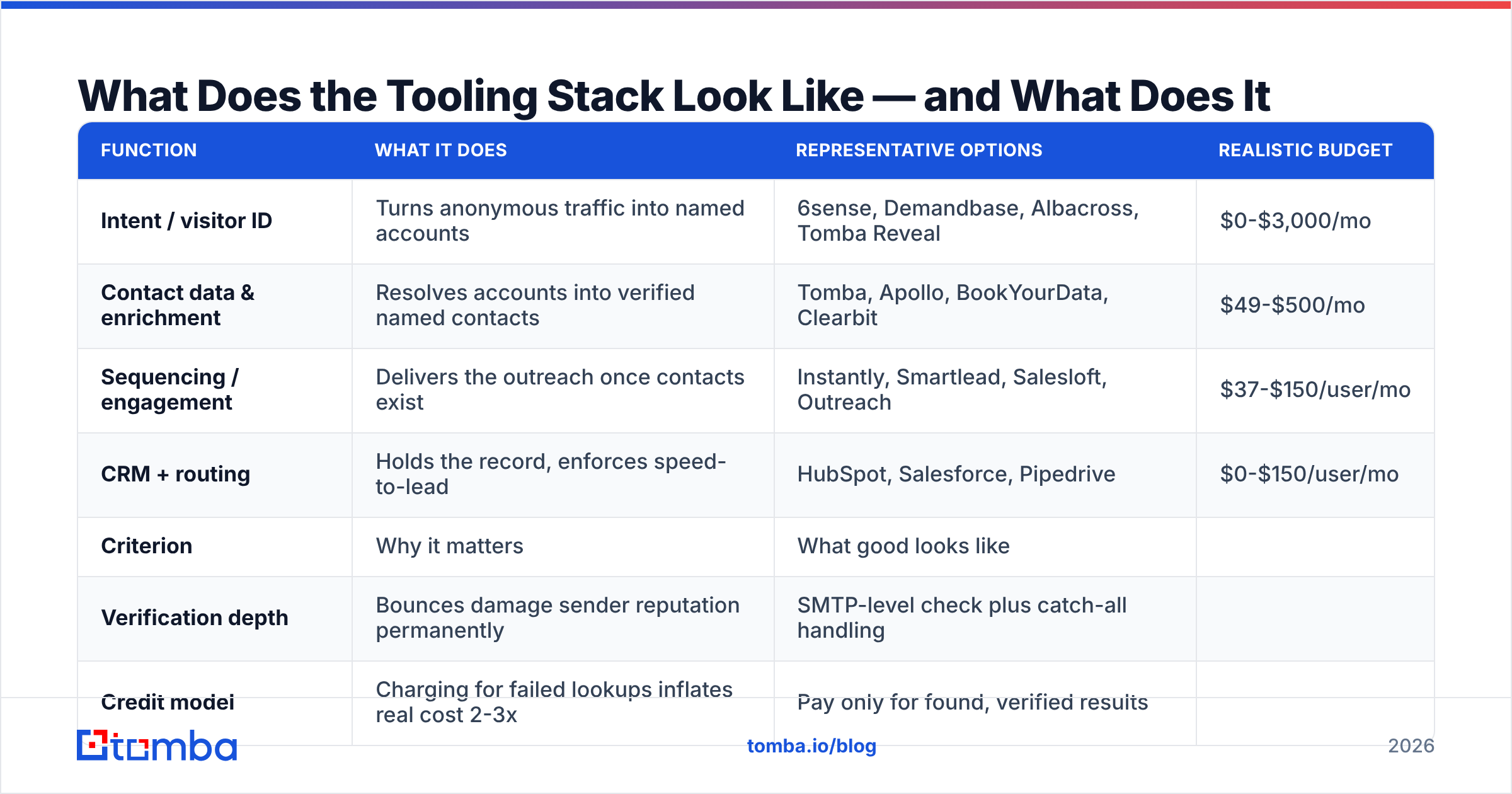
What Does the Tooling Stack Look Like — and What Does It Cost?#
You need four functions. Whether they come from four vendors or one is a budget question, not an architecture question.
| Function | What it does | Representative options | Realistic budget |
|---|---|---|---|
| Intent / visitor ID | Turns anonymous traffic into named accounts | 6sense, Demandbase, Albacross, Tomba Reveal | $0-$3,000/mo |
| Contact data & enrichment | Resolves accounts into verified named contacts | Tomba, Apollo, BookYourData, Clearbit | $49-$500/mo |
| Sequencing / engagement | Delivers the outreach once contacts exist | Instantly, Smartlead, Salesloft, Outreach | $37-$150/user/mo |
| CRM + routing | Holds the record, enforces speed-to-lead | HubSpot, Salesforce, Pipedrive | $0-$150/user/mo |
On the contact data layer specifically — the one that determines whether the rest of the stack has anything to act on — the buying criteria are narrower than vendor marketing suggests:
| Criterion | Why it matters | What good looks like |
|---|---|---|
| Verification depth | Bounces damage sender reputation permanently | SMTP-level check plus catch-all handling |
| Credit model | Charging for failed lookups inflates real cost 2-3x | Pay only for found, verified results |
| API + bulk access | Manual lookups don't scale past ~50/week | Documented REST API and CSV bulk upload |
| Entry price | Determines whether you can test before committing | Free tier, then under $100/mo |
| Coverage by region | EU and APAC coverage varies enormously by vendor | Test on your actual ICP, not a demo list |
For reference on entry pricing: Tomba pricing runs a free tier at 25 searches/month, Starter at $49/mo, Growth at $99/mo, and Pro at $249/mo, with API and bulk access included rather than upsold. BookYourData takes a different and legitimate approach — prepaid credits for a static verified database, which suits teams that want to buy a defined list once rather than run continuous lookups. Apollo bundles data with sequencing, which is convenient if you want one vendor and constraining if you want to swap the sequencing layer later.
Whatever you pick, run the same test: take 100 contacts from your actual ICP, run them through the tool, then verify the results independently. Vendor-published accuracy percentages are measured on vendor-selected samples. Yours won't match.
How Do You Fix a Demand Gen Program That Isn't Producing Pipeline?#
Diagnose in this order. Each step assumes the previous one passed.
- Check whether demand exists at all. Look at branded search volume over 12 months. Flat or declining means your creation layer isn't working, and no amount of routing fixes will help. Fix creation first.
- Check whether demand is being captured. If branded search is up but demo requests aren't, the problem is conversion path: hidden pricing, a form asking for 11 fields, no clear "talk to sales" route, or a comparison page you haven't built.
- Check whether captured demand reaches a human quickly. Instrument time-from-submission-to-first-outbound-touch. If the median is over an hour, that's your leak, and it's usually a routing rule rather than a rep problem.
- Check whether surging accounts get contacted at all. Pull last month's top 50 intent-flagged accounts. How many received a personalized touch? In most orgs the answer is under 10, because nobody owned the step between "the tool flagged it" and "someone had the contact details." Wire a bulk email finder into that handoff.
- Check whether sales trusts the source. Ask three reps what they do when a demand-gen lead lands. If the answer involves a shrug, your acceptance rate problem is cultural, and the fix is publishing the sales-accepted-rate-by-source table until the data changes the behavior.
Most programs fail at step 4. It's the least visible failure because every dashboard upstream of it looks healthy.
Where Should You Start If You're Building This From Zero?#
Pick one demand creation channel you can sustain for nine months, one capture channel with existing search volume, and build the conversion layer before either of them scales.
The sequencing matters. Building conversion infrastructure first feels premature — you have no demand to convert. But standing it up when volume is low costs a week; standing it up when demand is surging costs you the surge. Get account identification, contact resolution, verification, and routing working on ten accounts a week. Then turn up the top of the funnel.
The single highest-leverage thing you can do in the next hour: take your last 90 days of website traffic, pull the top 25 accounts that visited a pricing or comparison page without converting, and find the right contacts at each. That's a list of people who evaluated you and left without talking to anyone. It is the warmest cold outreach you will ever send.
Start there. Use Tomba Email Finder to turn those account names into verified, named contacts — free tier covers 25 searches so you can test the list before spending anything, and the Tomba API handles it programmatically once you wire it into your intent alerts. Demand generation only becomes revenue at the moment an anonymous account turns into a real conversation. Everything upstream is preparation for that step.
Related guides#
Ready to find emails that actually work?
Join 150,000+ professionals who stopped guessing and started sending. Free credits on signup — no credit card required.
Get the Tomba newsletter
Practical outbound tactics and product updates — once every two weeks.
About the author