Demand Generation Marketer: Role, Skills, and 2026 Playbook
What a demand generation marketer actually does, how the role differs from lead gen and growth, the exact metrics you own, and the 2026 tech stack that makes the job work.

TL;DR
- A demand generation marketer owns pipeline creation end to end — awareness, capture, and conversion — and is measured on sourced pipeline and revenue, not on form fills.
- The role is not lead generation. Lead gen captures existing intent; demand gen creates it, then captures it. Confusing the two is why most demand gen hires fail in the first two quarters.
- The 2026 scorecard is pipeline sourced, pipeline-to-spend ratio, win rate on demand-gen-sourced deals, and cost per opportunity — MQLs are a diagnostic, never a target.
- Salary bands in the US run roughly $95K–$135K for a mid-level demand gen manager, $150K–$210K for director, with variable comp tied to pipeline attainment.
- Your stack is smaller than vendors want you to believe: a CRM, a marketing automation platform, an ad stack, a contact data layer, and one analytics tool that everyone agrees on.
What is a demand generation marketer?#
A demand generation marketer is the person responsible for creating and capturing commercial interest in a product, then handing qualified, sales-ready pipeline to a revenue team. That is the whole job stated in one line.
The unusual thing about the role is its span. A content marketer owns assets. A paid media manager owns channels. A field marketer owns events. A demand generation marketer owns the outcome those functions feed — pipeline — and therefore has a legitimate claim on all of them. In practice, that makes it one of the few marketing roles where the scorecard is denominated in dollars rather than impressions.
Think of it like running a restaurant versus cooking a dish. A line cook is judged on the plate. The operator is judged on whether people walk in, order, come back, and whether the margin survives. Demand gen is the operator seat inside marketing.
Technically, the function splits into three motions that run continuously and overlap:
- Demand creation — educating a market that does not yet know it has a problem. Thought leadership, podcasts, original research, community, category content. Almost none of this converts on first touch, and measuring it on last-click will make you kill it.
- Demand capture — intercepting people already searching for a solution. Branded and non-branded paid search, review sites like G2 and Capterra, bottom-of-funnel SEO, comparison pages.
- Demand conversion — turning captured interest into a meeting. Lifecycle email, retargeting, lead scoring, routing rules, speed-to-lead, and the outbound handoff.
Most teams over-invest in capture because it is easiest to attribute, then wonder why growth plateaus once branded search saturates. The senior version of this role knows how to defend a creation budget with cohort data rather than last-click reports.
How is demand generation different from lead generation and growth marketing?#
The titles blur in job listings, so use responsibilities and metrics rather than names to tell them apart.
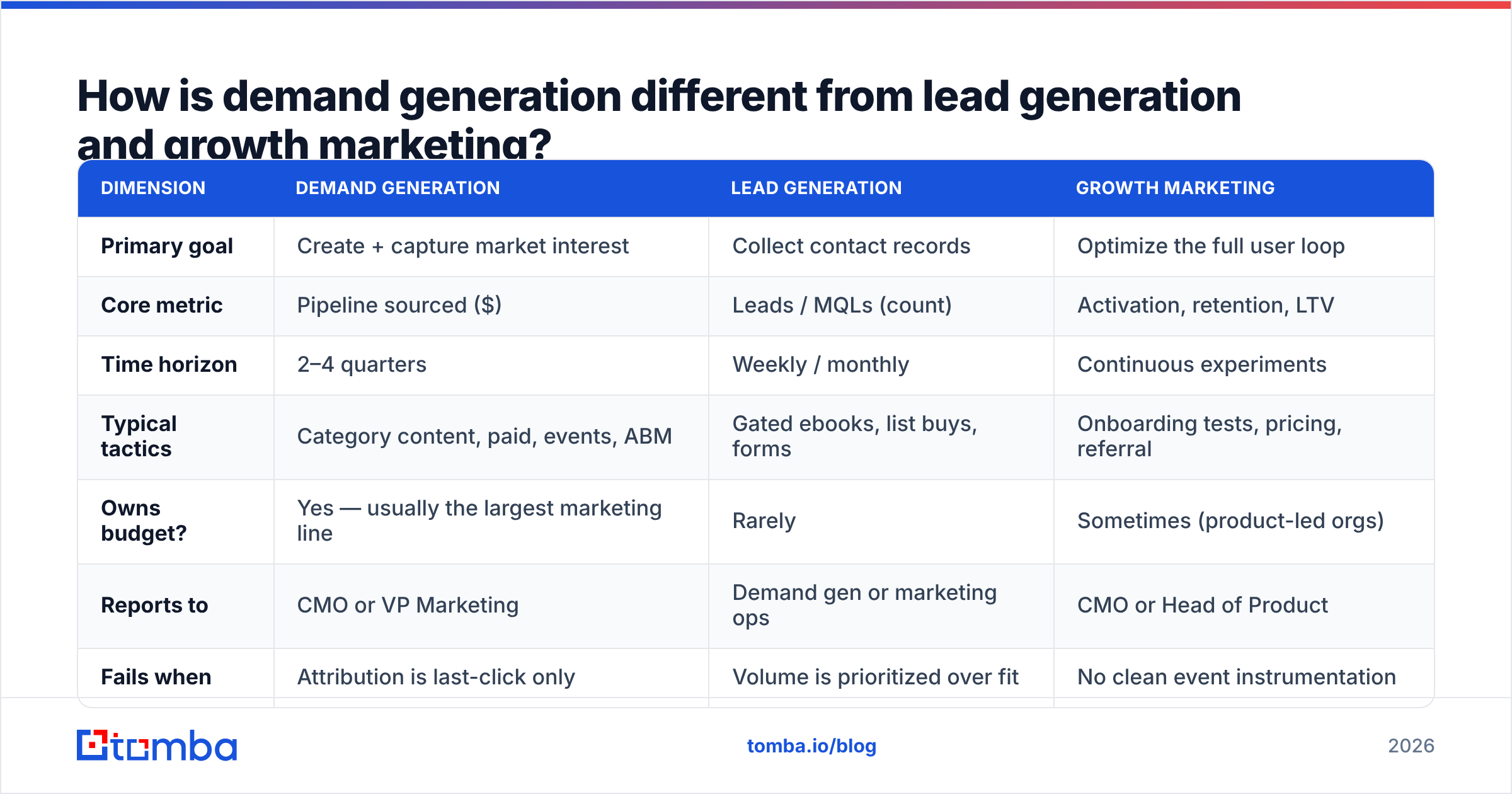
| Dimension | Demand Generation | Lead Generation | Growth Marketing |
|---|---|---|---|
| Primary goal | Create + capture market interest | Collect contact records | Optimize the full user loop |
| Core metric | Pipeline sourced ($) | Leads / MQLs (count) | Activation, retention, LTV |
| Time horizon | 2–4 quarters | Weekly / monthly | Continuous experiments |
| Typical tactics | Category content, paid, events, ABM | Gated ebooks, list buys, forms | Onboarding tests, pricing, referral |
| Owns budget? | Yes — usually the largest marketing line | Rarely | Sometimes (product-led orgs) |
| Reports to | CMO or VP Marketing | Demand gen or marketing ops | CMO or Head of Product |
| Fails when | Attribution is last-click only | Volume is prioritized over fit | No clean event instrumentation |
| Sales relationship | Joint pipeline target | Handoff at form fill | Loose, often product-mediated |
The sharpest practical distinction: lead generation asks "how many contacts did we get?" while demand generation asks "how much qualified pipeline entered the funnel, and what did it cost?" One of those questions survives a board meeting.
Wait — that image needs proper syntax:
Growth marketing overlaps most in product-led companies, where self-serve signups blur the line between marketing and product. If your company sells a $40K annual contract through a sales team, you need demand gen. If it sells a $29/month seat with a free tier, you probably need growth. Many companies now run both and let them fight over the same budget, which is healthier than it sounds.
What does a demand generation marketer actually do week to week?#
Job descriptions describe the role as "own multi-channel campaigns." Here is what the calendar actually contains.
- Pipeline forecasting and reporting. You maintain a model that converts spend into meetings into opportunities into closed revenue, with lag baked in. You update it weekly and defend it monthly. This is the single highest-leverage habit in the role.
- Campaign architecture, not campaign execution. You design the offer, the audience, the sequence, and the measurement plan. Specialists execute. If you are personally building every ad set, you are underleveraged.
- Channel budget reallocation. You move money between paid search, LinkedIn, events, sponsorships, and content every 30–60 days based on cost per opportunity, not cost per lead.
- Sales alignment. Weekly pipeline reviews with the AE and SDR leads. Not a status meeting — a working session on lead quality, routing SLAs, and disqualification reasons.
- List and data hygiene. You care obsessively about who is in your database, whether their emails are real, and whether the enrichment fields your scoring model depends on are populated.
- Lifecycle and nurture. Building the sequences that carry a contact from first touch to sales-ready, including the unglamorous re-engagement flows that resurrect 6-month-old inbound.
The data hygiene piece is the one most new demand gen hires underestimate. Your lead scoring model, your routing rules, your ABM target account lists, and your paid social match rates all depend on the same thing: accurate contact records. A model that scores on job title fails when 30% of your title fields are blank. Running your inbound list through an email verifier and filling gaps with data enrichment is not a nice-to-have — it is the input layer your entire measurement system sits on.
What metrics does a demand generation marketer own?#
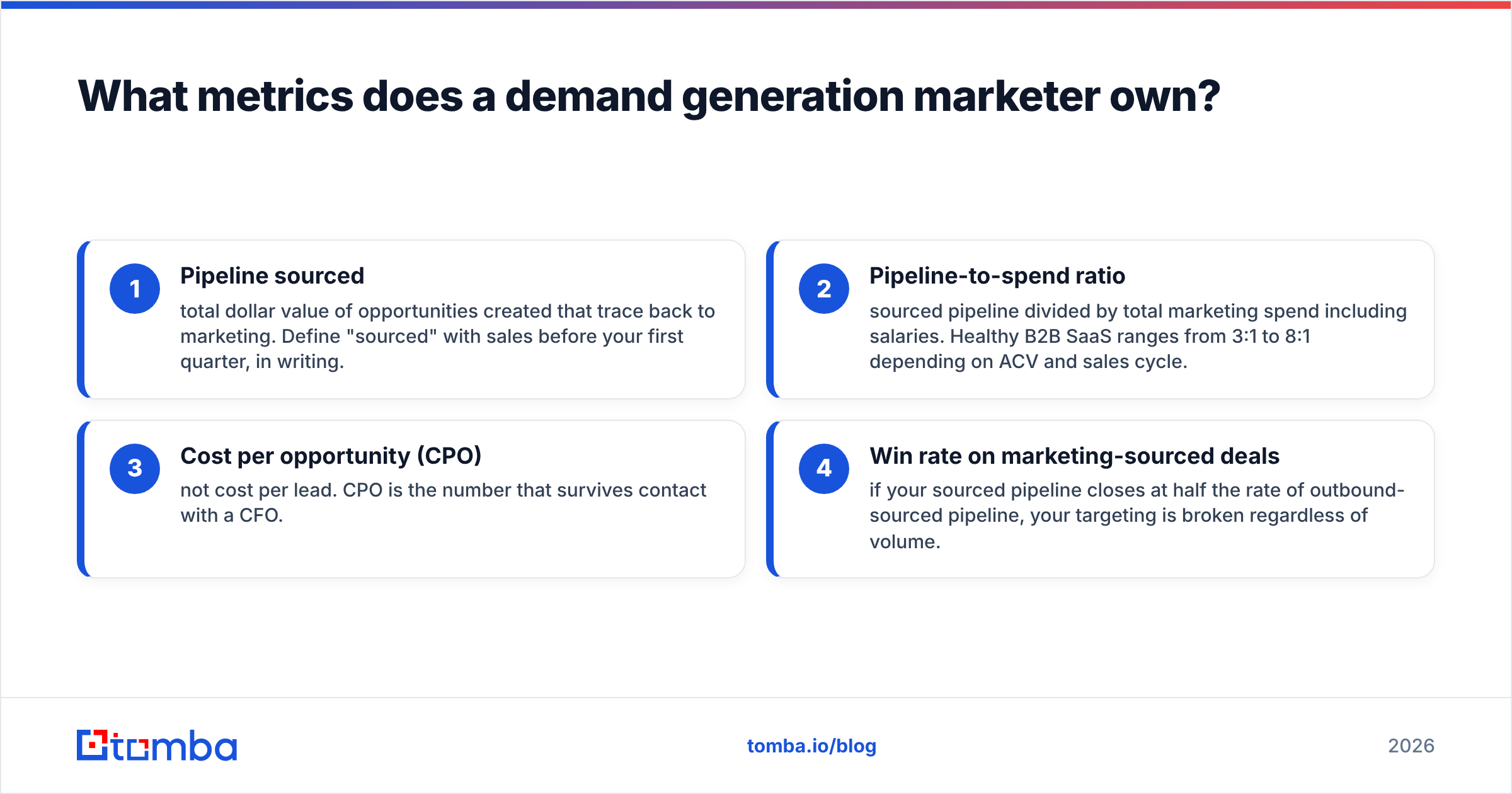
Own these four. Report on the rest.
Primary (you are hired and fired on these):
- Pipeline sourced — total dollar value of opportunities created that trace back to marketing. Define "sourced" with sales before your first quarter, in writing.
- Pipeline-to-spend ratio — sourced pipeline divided by total marketing spend including salaries. Healthy B2B SaaS ranges from 3:1 to 8:1 depending on ACV and sales cycle.
- Cost per opportunity (CPO) — not cost per lead. CPO is the number that survives contact with a CFO.
- Win rate on marketing-sourced deals — if your sourced pipeline closes at half the rate of outbound-sourced pipeline, your targeting is broken regardless of volume.
Diagnostic (useful, never a target):
- MQL volume and MQL-to-SQL conversion rate
- Speed-to-lead (minutes from form fill to first contact attempt)
- Channel-level CAC and blended CAC
- Email deliverability and reply rates on nurture flows
- Form-to-meeting conversion by traffic source
The distinction matters because targets get gamed. Set an MQL target and you will get MQLs — from a $7 ebook download that no AE will ever call. HubSpot's research on marketing benchmarks has shown for years that conversion-rate optimization at the MQL layer often just moves the definitional goalposts. Set a pipeline target and the incentive corrects itself.
One caveat on attribution: no model is correct. Multi-touch attribution over-credits the channels that touch late; first-touch over-credits the channels that touch early. Run both, look at the gap, and use self-reported attribution ("How did you hear about us?") on your demo form as a tiebreaker. It is unfashionable and it works.
What does the 2026 demand generation tech stack look like?#
The stack has consolidated. You need five layers, and you can run a $5M ARR company on tools costing under $2K/month combined.
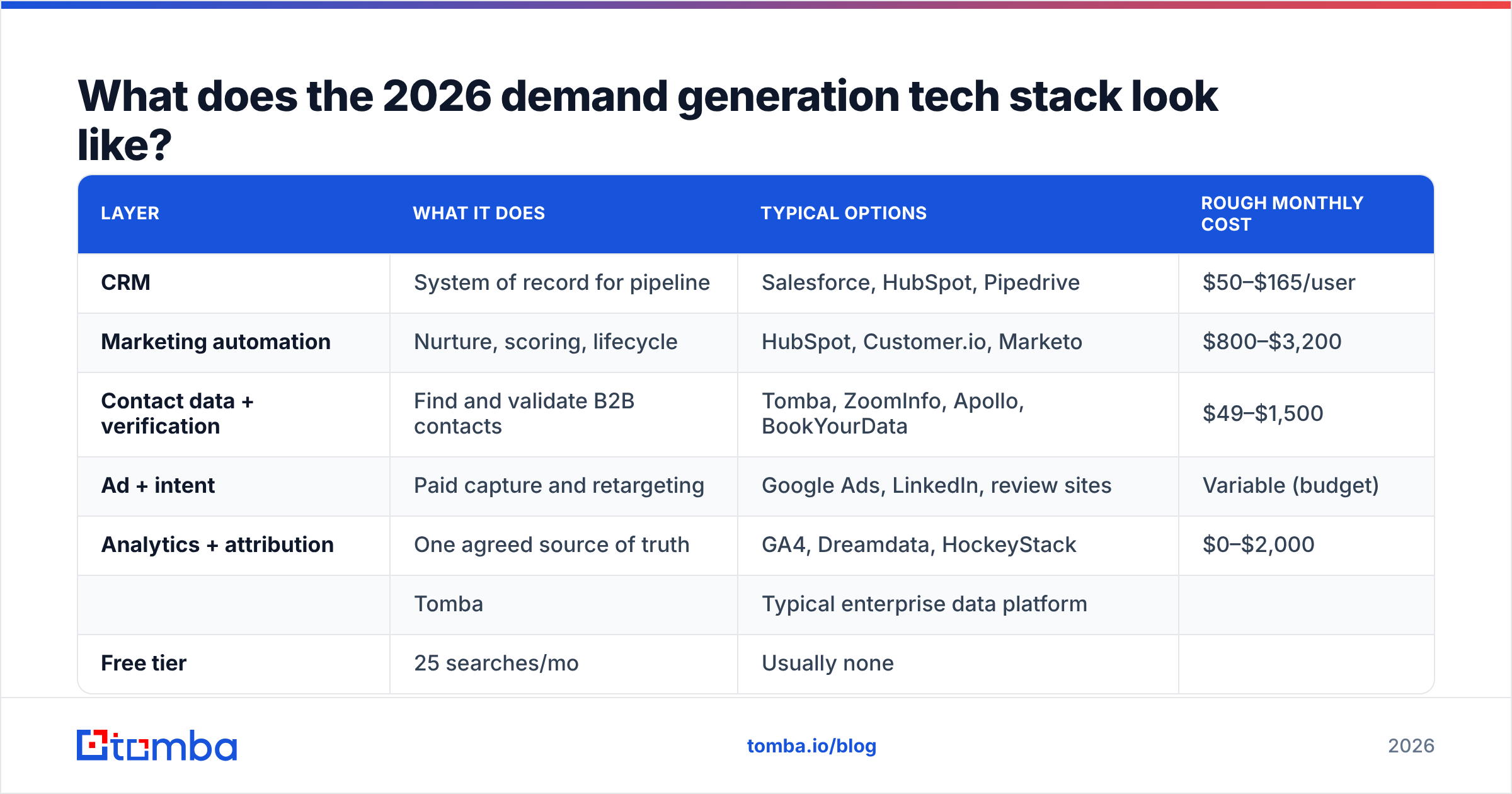
| Layer | What it does | Typical options | Rough monthly cost |
|---|---|---|---|
| CRM | System of record for pipeline | Salesforce, HubSpot, Pipedrive | $50–$165/user |
| Marketing automation | Nurture, scoring, lifecycle | HubSpot, Customer.io, Marketo | $800–$3,200 |
| Contact data + verification | Find and validate B2B contacts | Tomba, ZoomInfo, Apollo, BookYourData | $49–$1,500 |
| Ad + intent | Paid capture and retargeting | Google Ads, LinkedIn, review sites | Variable (budget) |
| Analytics + attribution | One agreed source of truth | GA4, Dreamdata, HockeyStack | $0–$2,000 |
On the contact data layer specifically, the trade-off is coverage versus accuracy versus price. Enterprise databases sell you breadth and charge for it. Purpose-built finders sell you precision on the accounts you have already targeted. BookYourData is a solid choice when you want pre-built, verified lists by geography and job function without a platform commitment. Tomba sits at the other end of that spectrum — you feed it a domain or a name and it returns verified, deliverable addresses.
| Tomba | Typical enterprise data platform | |
|---|---|---|
| Free tier | 25 searches/mo | Usually none |
| Entry paid plan | $49/mo (Starter) | $1,000+/mo, annual only |
| Mid tier | $99/mo (Growth) | Custom |
| Pro tier | $249/mo (Pro) | Custom |
| Contract | Monthly, no minimum | Annual, seat minimums |
| API access | Included | Add-on |
| Best for | Targeted lists, ABM tiers, enrichment | Broad TAM exports |
For an ABM motion, the workflow that consistently works: build your target account list from firmographics, use domain search to pull the contact map for each account, verify before import, and only then push to your CRM. Skipping verification is how you burn a sending domain in week three and spend the next quarter on email deliverability repair instead of pipeline.
Correction — the placeholder image:

How much does a demand generation marketer get paid?#
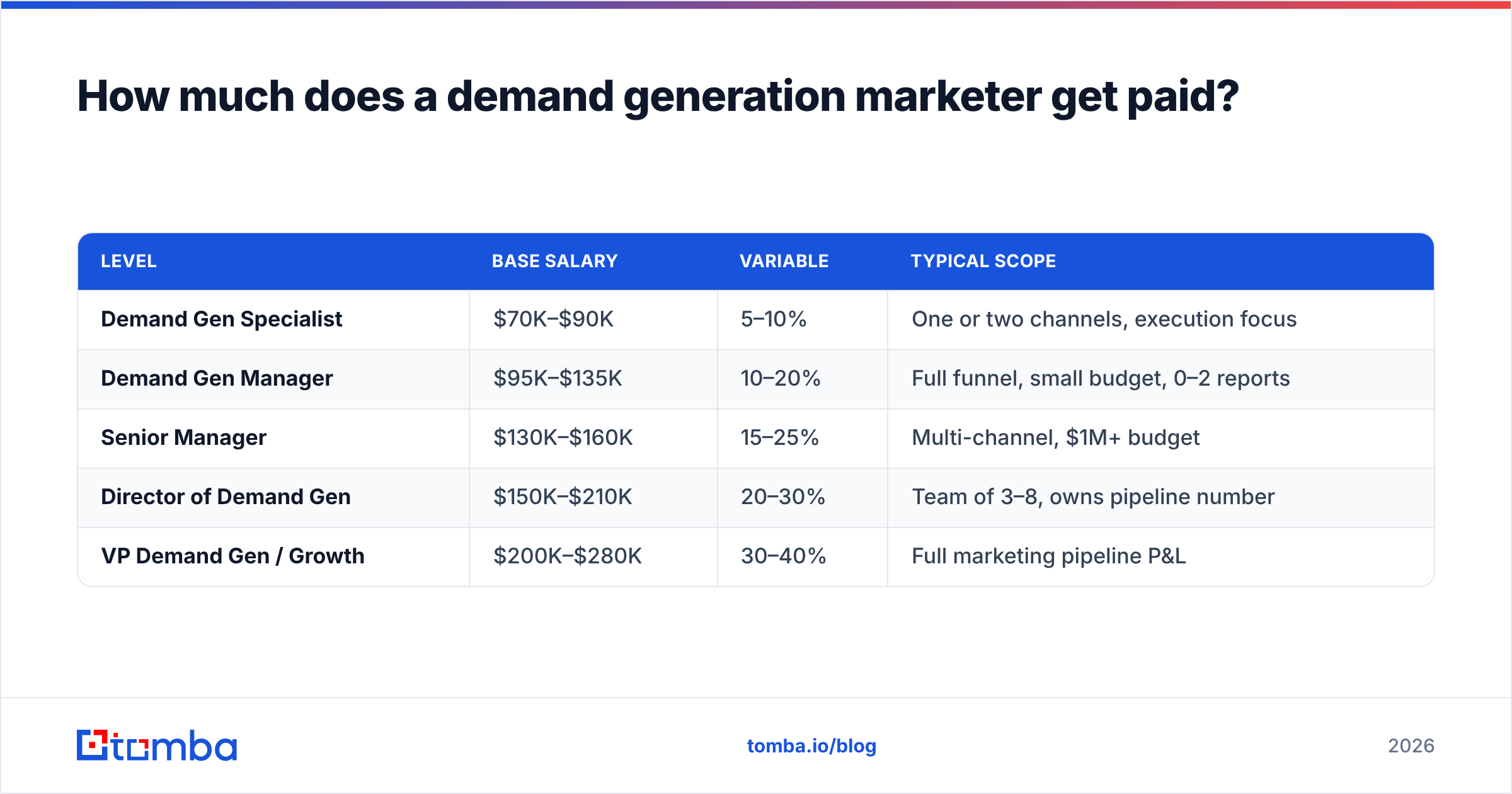
US base salary ranges as of 2026, drawn from public compensation data and job postings:
| Level | Base salary | Variable | Typical scope |
|---|---|---|---|
| Demand Gen Specialist | $70K–$90K | 5–10% | One or two channels, execution focus |
| Demand Gen Manager | $95K–$135K | 10–20% | Full funnel, small budget, 0–2 reports |
| Senior Manager | $130K–$160K | 15–25% | Multi-channel, $1M+ budget |
| Director of Demand Gen | $150K–$210K | 20–30% | Team of 3–8, owns pipeline number |
| VP Demand Gen / Growth | $200K–$280K | 30–40% | Full marketing pipeline P&L |
Two structural notes. First, variable comp is almost always tied to pipeline attainment rather than closed revenue, because demand gen cannot control sales execution. If a company offers you a bonus on closed-won only, negotiate — you are absorbing risk you cannot influence. Second, budget ownership drives compensation more than headcount does. A manager running a $3M budget alone often out-earns a director with four reports and a $600K budget.
How do you get hired as a demand generation marketer?#
The hiring bar in 2026 is specific, and it is not about tool certifications.
- Show a pipeline number, not a campaign. "I ran a webinar series" is a task. "I built a webinar motion that sourced $2.1M in pipeline at a 6:1 return over three quarters" is a candidacy. If you do not have the number, reconstruct it honestly from what you can access.
- Prove you can build the model. Bring a one-page spreadsheet in the interview showing spend → leads → opportunities → revenue with real conversion rates from a past role. Almost no candidate does this, and it ends the interview favorably.
- Demonstrate sales fluency. Hiring managers screen hard for whether you have sat in pipeline reviews and taken criticism from an AE about lead quality. Have a specific story about a time sales told you your leads were garbage and what you changed.
- Have one channel you are genuinely deep in. Generalists get hired at director level. At manager level, you need depth — paid search, lifecycle, ABM, or events — plus credible breadth.
- Understand the data layer. Being able to talk about lead routing, enrichment, dedupe, and verification separates operators from people who write briefs.
For the fifth point, hands-on experience helps. Building a small target list yourself — pull companies, find the contacts with an email finder, verify them, run a 50-person test campaign, and measure reply rate — teaches more about demand gen mechanics than any certification. It also gives you a portfolio artifact.
What are the biggest mistakes demand generation marketers make?#
- Optimizing the wrong end of the funnel. Doubling form conversion on traffic that never buys produces more junk faster. Fix targeting before you fix conversion rate.
- Killing brand spend during a down quarter. Demand creation has a 2–4 quarter lag. Cutting it produces a pipeline hole you will not see until two quarters later, at which point nobody connects the two events.
- Accepting an MQL target. Push back once, politely, with a proposed pipeline target instead. If leadership insists, at minimum negotiate a quality gate into the definition.
- Treating data quality as someone else's job. Bad contact data silently degrades scoring, routing, match rates, and deliverability all at once. It is the cheapest thing to fix and the most expensive thing to ignore.
- Building attribution before building volume. At under 100 opportunities per quarter, attribution models are noise. Get to volume, then instrument.
- Not writing down the sourced/influenced definition. Every unproductive marketing-sales conflict traces back to this document not existing.
What should your first 90 days look like?#
Days 1–30: Instrument. Get read access to the CRM. Pull the last four quarters of opportunity data. Build the spend-to-pipeline model. Write the sourced-versus-influenced definition and get sales leadership to sign it. Audit database hygiene — how many contacts have valid emails, complete titles, and matched accounts.
Days 31–60: Cut and concentrate. Identify the bottom-third of channels by cost per opportunity and stop them. Reallocate into the top two. Fix speed-to-lead if it is over 15 minutes. Clean and re-enrich the existing database so scoring and routing actually function.
Days 61–90: Build one new motion. Pick one — ABM on a 100-account tier, a comparison-content SEO play, a partner co-marketing motion — and ship it end to end with measurement attached. One shipped motion with a number beats five in progress.
Report on it in the format your CFO reads: spend in, pipeline out, ratio, trend.
Where to start#
If you are stepping into a demand generation marketer role, the fastest measurable win is almost always the data layer — because everything downstream depends on it and the fix takes days, not quarters. Clean records improve lead scoring accuracy, ad platform match rates, routing speed, and deliverability simultaneously.
Start with Tomba Email Finder. The free tier gives you 25 searches a month to test coverage on your own target accounts before spending anything, and Starter runs $49/mo when you are ready to scale a real list. Feed it your ABM tier, verify what comes back, and measure the difference in reply rate against your existing list. That comparison is your first pipeline-relevant data point in the new job — and it is the kind of number that gets you the budget for everything else.
Related guides#
Ready to find emails that actually work?
Join 150,000+ professionals who stopped guessing and started sending. Free credits on signup — no credit card required.
Get the Tomba newsletter
Practical outbound tactics and product updates — once every two weeks.
About the author