Demand Generation Pipeline: How to Build One in 2026
Most demand generation pipelines don't fail at the top — they fail at the handoff. Here's the stage model, the conversion math, the leak points, and the data layer that keeps the whole thing from quietly rotting.
TL;DR
- A demand generation pipeline is the full path from "nobody knows you exist" to "signed contract" — not just the top-of-funnel content machine most teams mean when they say "demand gen."
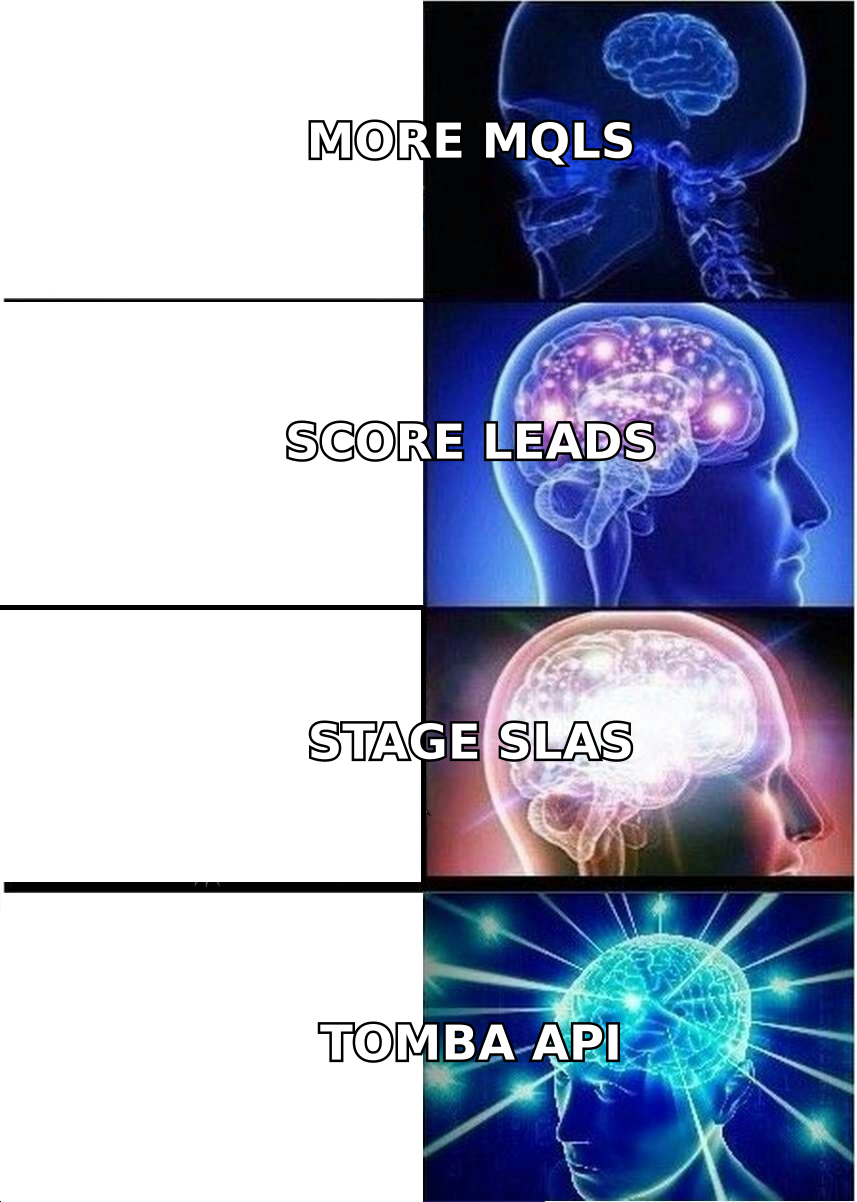
- The pipeline almost never breaks where teams look. Top-of-funnel volume is rarely the constraint; stage-to-stage conversion and the marketing-to-sales handoff are.
- Healthy B2B benchmarks land around 20-30% MQL→SQL, 40-60% SQL→opportunity, and 20-25% opportunity→closed-won. If any stage is below half the benchmark, fix that before buying more traffic.
- Your pipeline is only as good as the contact data underneath it. Bad emails, stale titles, and missing company context silently destroy 20-40% of downstream conversion.
- Build the measurement layer before the demand layer. A pipeline you cannot attribute is a pipeline you cannot fix.
What is a demand generation pipeline?#
A demand generation pipeline is the sequenced set of stages a buyer moves through from first exposure to your category, to closed revenue — plus the systems, data, and handoffs that move them along.
Think of it like a municipal water system. Demand generation is not the rain. It's the catchment, the pipes, the pumping stations, the pressure gauges, and the treatment plant. Rain (market awareness) is useful only if the infrastructure captures it, moves it without leaking, and delivers something drinkable at the tap. Most teams obsess over rainfall and ignore that 40% of their water is spilling out of a cracked joint between marketing and sales.
Technically: the pipeline is a stage model with defined entry criteria, exit criteria, owners, and SLAs at every transition. If you cannot name who owns each stage and what specifically has to be true for a record to advance, you do not have a pipeline. You have a lead list with optimism attached.
The distinction matters because of how budget gets allocated. When "demand gen" means "content and ads," the fix for a bad quarter is always "more content and ads." When demand gen means "the pipeline," the fix is diagnostic — you look at where volume enters, where it stalls, and where it dies.
How is demand generation different from lead generation?#
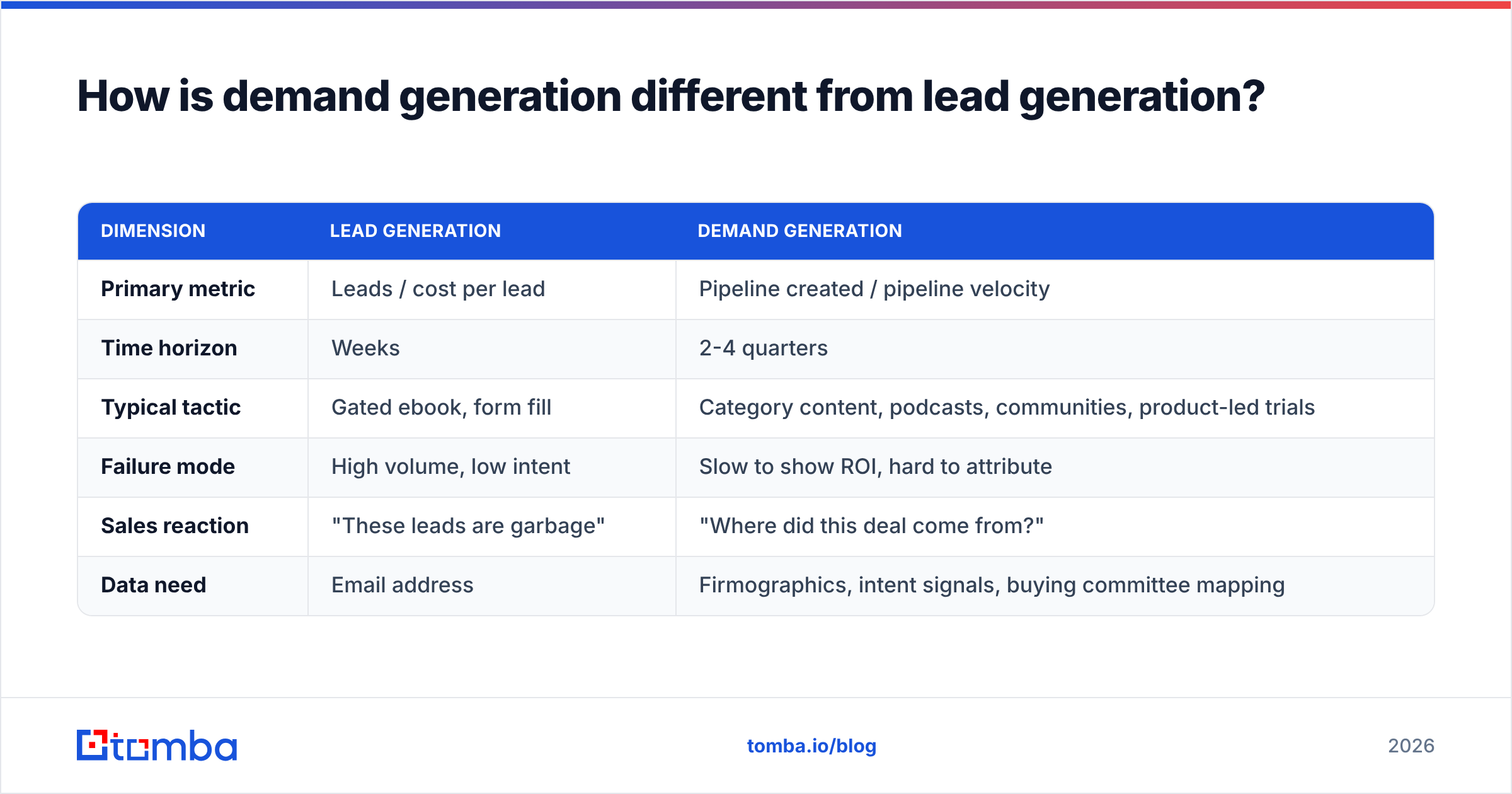
Lead generation captures contact information. Demand generation creates and captures the intent that makes contact information worth having.
The practical difference shows up in what you optimize for:
| Dimension | Lead generation | Demand generation |
|---|---|---|
| Primary metric | Leads / cost per lead | Pipeline created / pipeline velocity |
| Time horizon | Weeks | 2-4 quarters |
| Typical tactic | Gated ebook, form fill | Category content, podcasts, communities, product-led trials |
| Failure mode | High volume, low intent | Slow to show ROI, hard to attribute |
| Sales reaction | "These leads are garbage" | "Where did this deal come from?" |
| Data need | Email address | Firmographics, intent signals, buying committee mapping |
Neither is wrong. Lead generation is a subset of demand generation — the capture layer. The problem is when a team runs pure lead gen, reports leads as the headline number, and then wonders why revenue didn't move. A marketing qualified lead that downloaded a template while researching a college assignment is a lead. It is not demand.
What are the stages of a demand generation pipeline?#
Six stages cover nearly every B2B motion. Adapt the names to your CRM, but keep the transitions explicit.
- Awareness / market reach — The buyer encounters your category framing. Owned by marketing. Measured in reach, branded search volume, and share of voice. No record exists in your CRM yet, which is exactly why teams under-invest here.
- Engaged account — Multiple known or anonymous touches from the same domain within a rolling window. This is where website visitor reveal and intent data earn their keep: 95% of your traffic never fills a form, and treating that as zero is expensive.
- Marketing qualified — A named contact meets a scoring threshold combining fit (right company, right title) and behavior (pricing page, demo request, repeat visits). Entry criteria must be written down. "Felt good" is not entry criteria.
- Sales accepted — A rep has reviewed the record and agreed it's worth working. This stage exists solely to make the handoff auditable. If you skip it, you will never resolve the "marketing sends junk / sales ignores leads" argument, because neither side has data.
- Opportunity — Discovery completed, need confirmed, budget and timeline plausible. Now it lives in the sales forecast.
- Closed-won / closed-lost with reason — Loss reasons feed back into stages 1-3. A pipeline without a loss-reason taxonomy learns nothing from the 75% of deals it doesn't win.
The transitions between 3 and 4, and between 4 and 5, are where most of the value and most of the loss sit. Everything else is comparatively well-instrumented.
What does a healthy demand generation pipeline look like in numbers?#
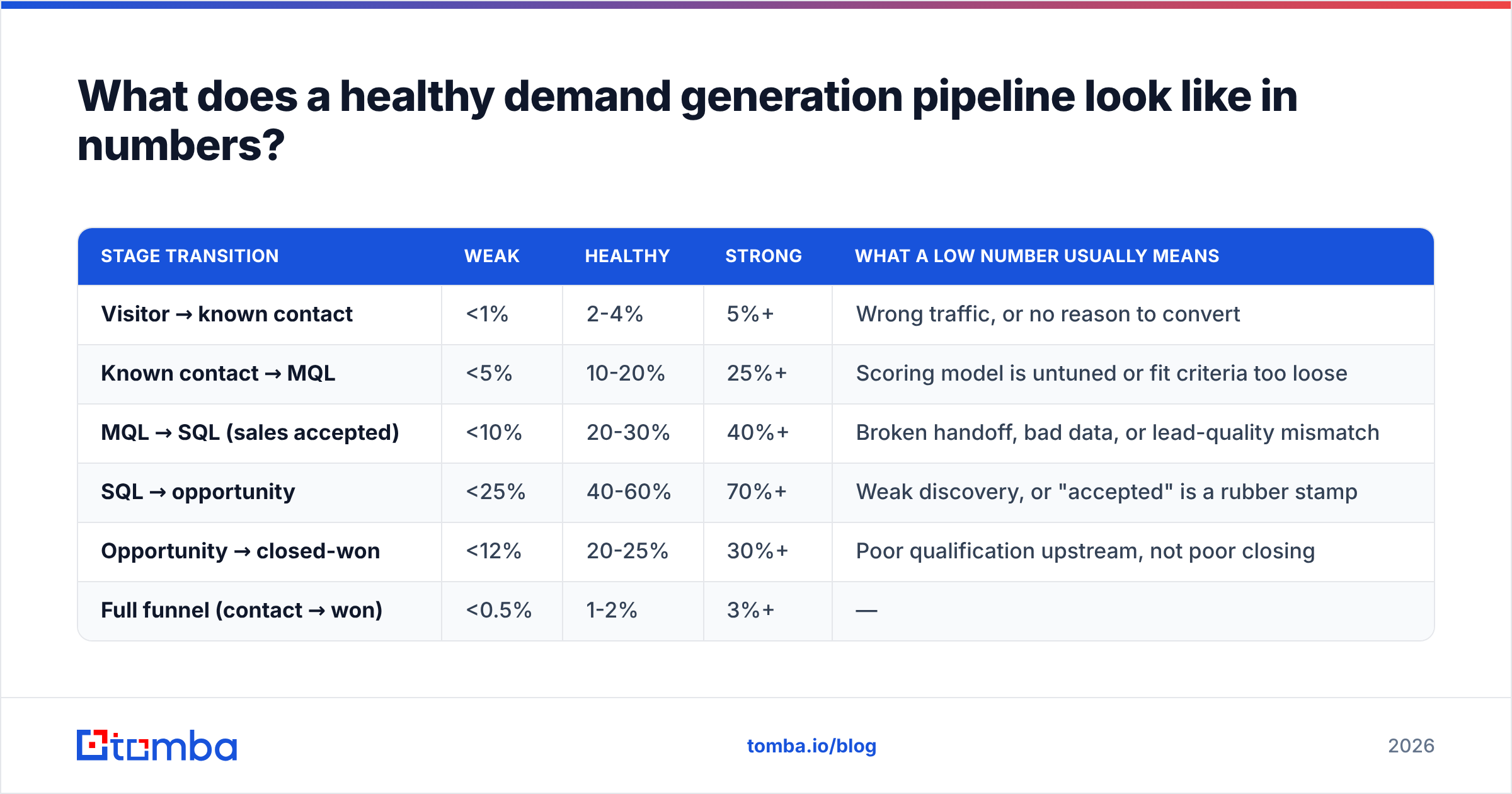
Benchmarks vary by ACV, motion, and market maturity, so treat these as diagnostic ranges rather than targets. What matters is the shape of the drop-off, not hitting a specific number.
| Stage transition | Weak | Healthy | Strong | What a low number usually means |
|---|---|---|---|---|
| Visitor → known contact | <1% | 2-4% | 5%+ | Wrong traffic, or no reason to convert |
| Known contact → MQL | <5% | 10-20% | 25%+ | Scoring model is untuned or fit criteria too loose |
| MQL → SQL (sales accepted) | <10% | 20-30% | 40%+ | Broken handoff, bad data, or lead-quality mismatch |
| SQL → opportunity | <25% | 40-60% | 70%+ | Weak discovery, or "accepted" is a rubber stamp |
| Opportunity → closed-won | <12% | 20-25% | 30%+ | Poor qualification upstream, not poor closing |
| Full funnel (contact → won) | <0.5% | 1-2% | 3%+ | — |
Run your own numbers into this table before your next planning cycle. The single most common finding: teams whose MQL→SQL sits under 10% are almost never suffering a volume problem. They are suffering a definition problem — marketing and sales are using two different mental models of "qualified," and no one has written either one down.
The second most common finding: opportunity→closed-won looks fine, but the absolute number of opportunities is tiny. That's an upstream capacity issue disguised as a sales performance issue. Gartner's research on B2B buying behavior has consistently pointed at the same underlying cause — buyers now complete most of their evaluation before talking to anyone, so pipelines that only measure post-contact stages are blind to two-thirds of the journey.
Where does the demand generation pipeline actually leak?#
Four leaks account for most of the loss, in rough order of cost.
Leak 1: the handoff gap. A lead hits MQL at 2:14 p.m. and gets a first touch at 11:00 a.m. the next day. Response-time research has been consistent for over a decade: contact within five minutes and your qualification odds improve by an order of magnitude versus an hour later. Most teams have no SLA, no alerting, and no accountability on this transition. It is the cheapest fix available and almost nobody does it.
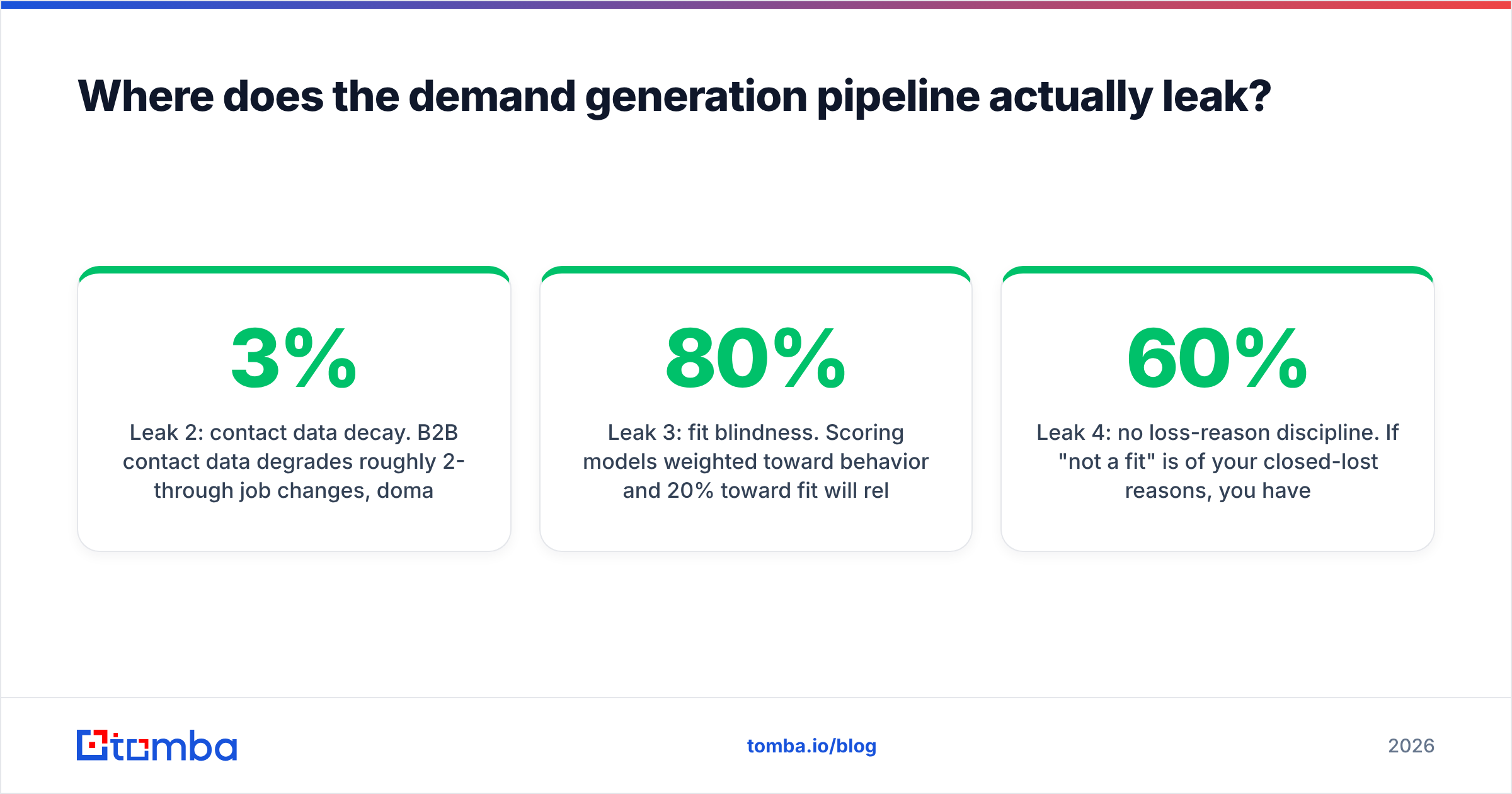
Leak 2: contact data decay. B2B contact data degrades roughly 2-3% per month through job changes, domain migrations, and restructures. Over a year, that's a quarter to a third of your database rendered wrong. A sequence sent to decayed data doesn't just fail — it damages sender reputation, which then suppresses delivery to the good contacts too. One bad list poisons the well for the whole quarter.
Leak 3: fit blindness. Scoring models weighted 80% toward behavior and 20% toward fit will reliably promote curious students, competitors, and junior researchers while ignoring a VP who visited twice. Fit should carry at least equal weight, and fit requires firmographic data you probably don't collect on your forms.
Leak 4: no loss-reason discipline. If "not a fit" is 60% of your closed-lost reasons, you have no learning loop. Force a taxonomy — wrong ICP, no budget, timing, competitor, no decision — and feed it back into stage 3 criteria quarterly.
How do you build the data layer under the pipeline?#
The pipeline runs on records. Records rot. So the data layer needs three jobs handled continuously, not once at implementation.
Acquisition. Getting contactable records for accounts showing fit or intent. Inbound forms cover a fraction; the rest comes from prospecting against a defined ICP list. An email finder that resolves a name plus company domain into a verified professional address is the workhorse here — it converts an account list into a contactable list without buying a static database that starts decaying the day you download it.
Verification. Every address entering a sequence should be checked. Bounce rates above 2-3% start dragging deliverability; above 5% you are actively harming the domain. A standing email verification step in the workflow — not a quarterly cleanup — is the difference between a sending domain that works in month nine and one that doesn't.
Enrichment. Fit scoring needs company size, industry, tech stack, and role seniority. Asking for those on a form kills conversion. Getting them from data enrichment after capture keeps the form at two fields while still giving the scoring model something real to work with.
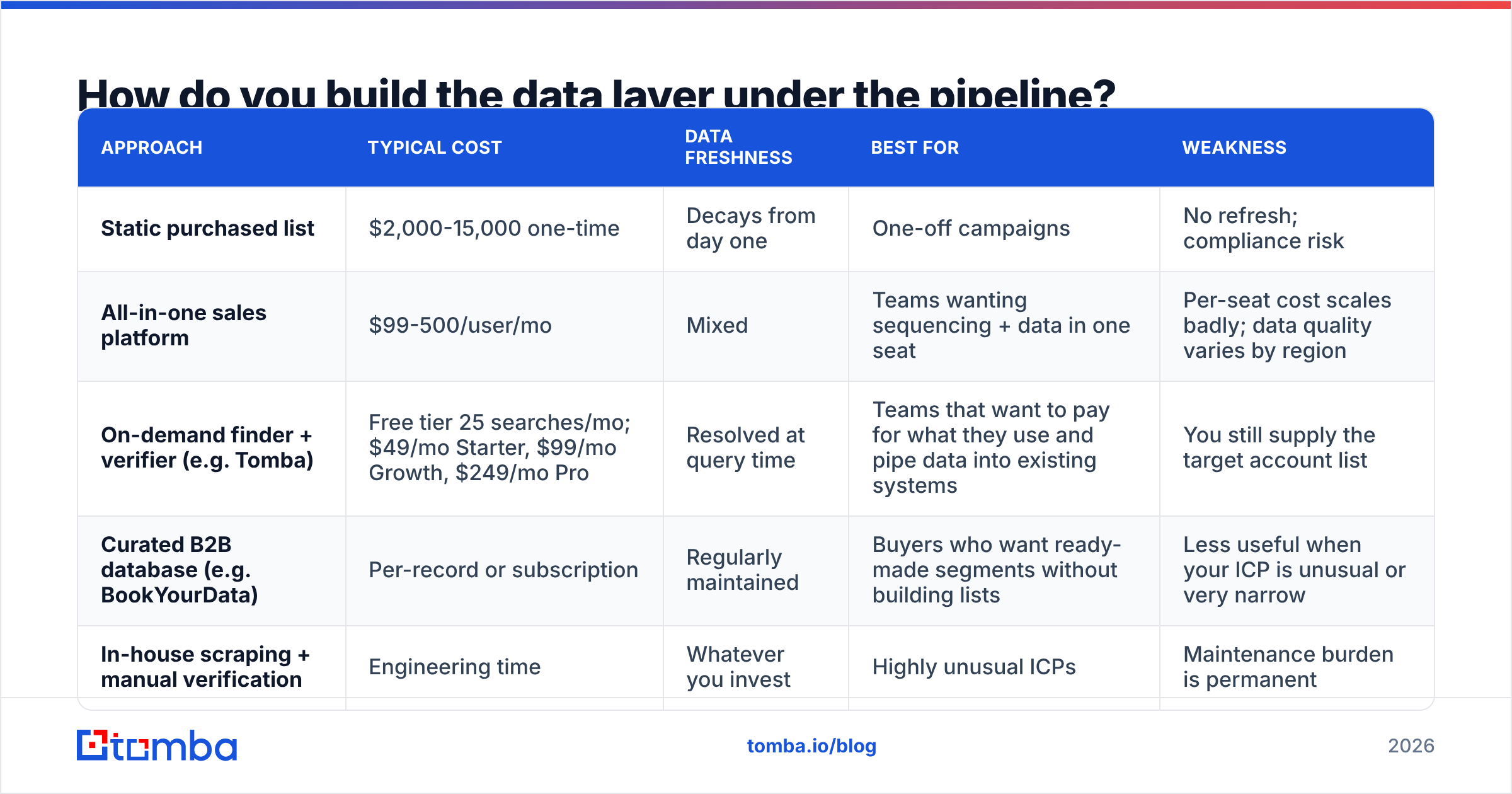
Here's how the common tooling approaches compare when you're deciding what to actually buy:
| Approach | Typical cost | Data freshness | Best for | Weakness |
|---|---|---|---|---|
| Static purchased list | $2,000-15,000 one-time | Decays from day one | One-off campaigns | No refresh; compliance risk |
| All-in-one sales platform | $99-500/user/mo | Mixed | Teams wanting sequencing + data in one seat | Per-seat cost scales badly; data quality varies by region |
| On-demand finder + verifier (e.g. Tomba) | Free tier 25 searches/mo; $49/mo Starter, $99/mo Growth, $249/mo Pro | Resolved at query time | Teams that want to pay for what they use and pipe data into existing systems | You still supply the target account list |
| Curated B2B database (e.g. BookYourData) | Per-record or subscription | Regularly maintained | Buyers who want ready-made segments without building lists | Less useful when your ICP is unusual or very narrow |
| In-house scraping + manual verification | Engineering time | Whatever you invest | Highly unusual ICPs | Maintenance burden is permanent |
Most teams end up with a combination. A curated database for broad, well-defined segments; an on-demand finder for the accounts your database vendor doesn't cover well. Full Tomba pricing is public if you want to model per-record cost against your current stack.
How do you attribute and measure the pipeline?#
Pick a model and commit, because switching models mid-year makes year-over-year comparison meaningless.
First-touch tells you what creates awareness. It over-credits top-of-funnel and is the right lens for evaluating brand and content investment.
Multi-touch (linear or W-shaped) distributes credit across the journey. It's the most honest for typical B2B, where 8-15 touches precede a deal, but it requires clean tracking across sessions and devices.
Self-reported attribution — a single open-text "How did you hear about us?" field on the demo form — routinely outperforms analytics platforms for dark-social and word-of-mouth channels, which are invisible to UTM tracking and increasingly dominant. Add it. It costs one form field.
Pipeline velocity is the metric that ties everything together:
(Number of opportunities × Average deal value × Win rate) ÷ Sales cycle length
Improve any of the four inputs and velocity rises. This is useful because it forces a genuine tradeoff conversation. Cutting sales cycle length by 20% and raising win rate by 5 points usually beats a 30% increase in raw lead volume — and costs far less. Run the model with your own numbers before approving next quarter's ad budget. If you want an external sanity check on tooling categories, G2's marketing automation category and HubSpot's marketing statistics roundup are reasonable public baselines.
What's the 90-day build sequence?#
If you're starting from a pile of disconnected tactics:
Days 1-30 — Instrument. Define the six stages in your CRM with written entry and exit criteria. Add self-reported attribution to every form. Set an SLA on the MQL→SAL transition with alerting. Do not launch anything new.
Days 31-60 — Clean. Verify the existing database. Enrich the records that survive. Rebuild the scoring model with fit weighted at least 50%. Establish your baseline conversion rates against the benchmark table above.
Days 61-90 — Build. Now add channels. Start with the two where your current customers say they found you, per self-reported attribution. Measure against the baseline you established in days 31-60.
The order matters. Adding channels before instrumentation gives you more volume and no ability to tell which volume was worth having.
Start with the data layer#
The fastest measurable improvement in most demand generation pipelines is not a new channel — it's making sure the contacts already in the system are real, current, and contactable. Verified addresses raise deliverability, deliverability raises reply rates, and reply rates raise the MQL→SQL number that's probably the weakest link in your funnel.
Tomba Email Finder resolves names and company domains into verified professional email addresses, with verification, domain search, and enrichment sitting alongside it in the same workspace. The free tier gives you 25 searches a month to test accuracy against a sample of your own accounts before committing to anything — which is exactly how you should evaluate any data vendor. Run 50 known-good contacts through it, check the hit rate, and let the number decide.
Related guides#
Ready to find emails that actually work?
Join 150,000+ professionals who stopped guessing and started sending. Free credits on signup — no credit card required.
Get the Tomba newsletter
Practical outbound tactics and product updates — once every two weeks.
About the author