The Demand Generation Playbook: 2026 Framework That Works
Most demand gen programs are lead-capture programs wearing a new label. Here's the full 2026 playbook: channel mix, budget splits, measurement, and the handoff to outbound that actually converts.
TL;DR
- Demand generation is not lead generation. Lead gen captures people already looking; demand gen creates the looking. Most teams fund the first and report it as the second.
- The 2026 mix that works for mid-market B2B: roughly 40% demand creation (content, video, community), 35% demand capture (search, review sites, retargeting), 25% direct outbound to accounts already showing intent.
- Stop optimising to MQL volume. Optimise to pipeline created and self-reported attribution ("How did you hear about us?"), because 60-80% of buyer research is invisible to your attribution model.
- Your capture layer only works if the contact data behind it is clean. Verified email addresses turn a warm signal into a booked meeting; bad data turns it into a bounce and a domain reputation problem.
- Budget reality check: a working demand gen program takes two to three quarters before pipeline contribution stabilises. Anything measured on a 30-day window will look like a failure.
What is demand generation, actually?#
Demand generation is the discipline of creating awareness and interest in a problem you solve, among people who are not currently shopping for a solution — and then capturing that interest when it converts into active buying behaviour.
Here's the analogy. Lead generation is standing at the exit of a grocery store handing coupons to people already carrying a cart. Demand generation is the food blog that made them hungry for the dish three weeks ago. Both matter. Only one of them scales, and it's not the coupon guy.
The practical distinction shows up in what you measure. A lead gen program reports form fills. A demand gen program reports how many accounts in your ICP mentioned you unprompted, how many entered a sales cycle without a gated asset, and what share of new pipeline came from sources you can't cleanly attribute. That last number being high is a sign of health, not a reporting failure.
Three components make up any complete demand generation playbook:
- Demand creation — content, podcasts, video, community, events, and paid social that reach people before they have a search query. Zero direct attribution. Highest leverage.
- Demand capture — paid search, SEO for bottom-funnel terms, G2 and Capterra presence, retargeting. These convert existing intent. They do not create it.
- Demand conversion — outbound sequences, sales follow-up, and the data infrastructure that connects a signal to a real human inbox.
Teams that skip step one and over-fund step two hit a ceiling fast: they saturate the small pool of in-market buyers, CPCs climb, and growth flatlines while spend rises.
Why do most demand generation programs fail?#
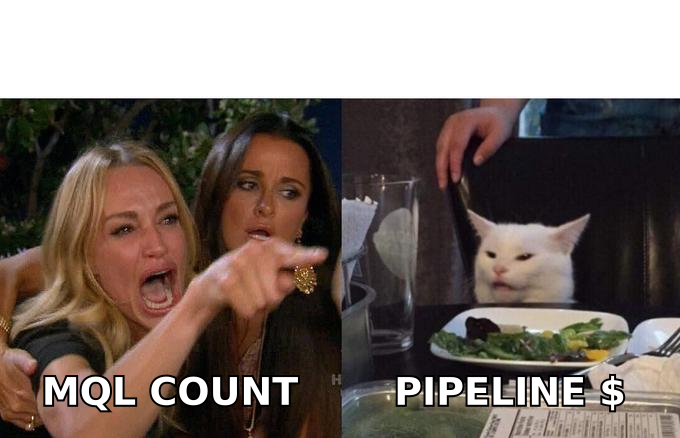
They fail because they were never demand generation programs. They were lead capture programs that got renamed during a reorg.
The failure pattern is consistent:
- Gating everything. The ebook behind a form generates 400 "leads" of which 12 are ICP. You just traded reach for a spreadsheet.
- Measuring on last-touch. Last-touch attribution credits the branded search that closed the loop, not the LinkedIn post six weeks earlier that caused it. So you defund the LinkedIn post.
- 30-day judgement windows. B2B buying cycles run 60-180 days. Judging a demand creation channel in month one guarantees you kill everything that works.
- No handoff infrastructure. Marketing generates interest, sales can't reach the right person, and both sides blame the other. This is a data problem dressed as an alignment problem.
- Content that answers questions nobody asked. "What is CRM?" content ranks for students, not buyers.
The Gartner research on B2B buying behaviour has been consistent for years: buyers spend the majority of the purchase journey doing independent research, and only a small fraction of total buying time is spent with any single supplier's sales rep. If your program only exists inside that sliver, you are competing on the smallest available surface.
What does the 2026 channel mix look like?#
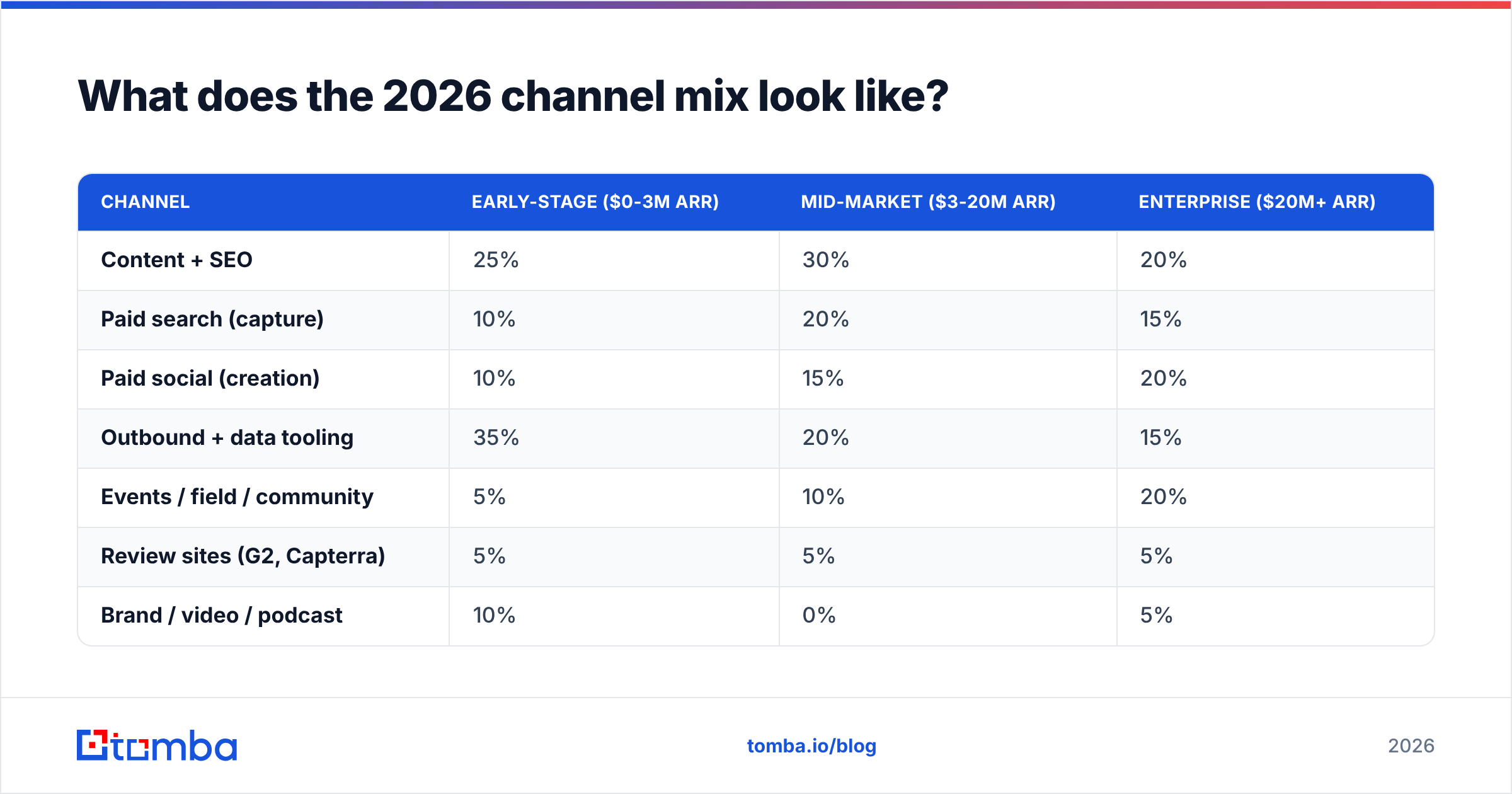
Budget allocation is where strategy becomes real. Here's how the mix compares across three common company profiles:
| Channel | Early-stage ($0-3M ARR) | Mid-market ($3-20M ARR) | Enterprise ($20M+ ARR) |
|---|---|---|---|
| Content + SEO | 25% | 30% | 20% |
| Paid search (capture) | 10% | 20% | 15% |
| Paid social (creation) | 10% | 15% | 20% |
| Outbound + data tooling | 35% | 20% | 15% |
| Events / field / community | 5% | 10% | 20% |
| Review sites (G2, Capterra) | 5% | 5% | 5% |
| Brand / video / podcast | 10% | 0% | 5% |
Read the pattern: early-stage teams over-index on outbound because they have no brand equity to capture. Mid-market shifts toward content compounding. Enterprise buys presence — events, brand, and the kind of category awareness that makes RFPs arrive unprompted.
The line that changes most with maturity is outbound. At $1M ARR, outbound is your entire pipeline. At $50M ARR, it's a targeted supplement for named accounts. But it never goes to zero, and the quality bar on it rises every year as inbox filters tighten.
How do demand creation and demand capture compare?#
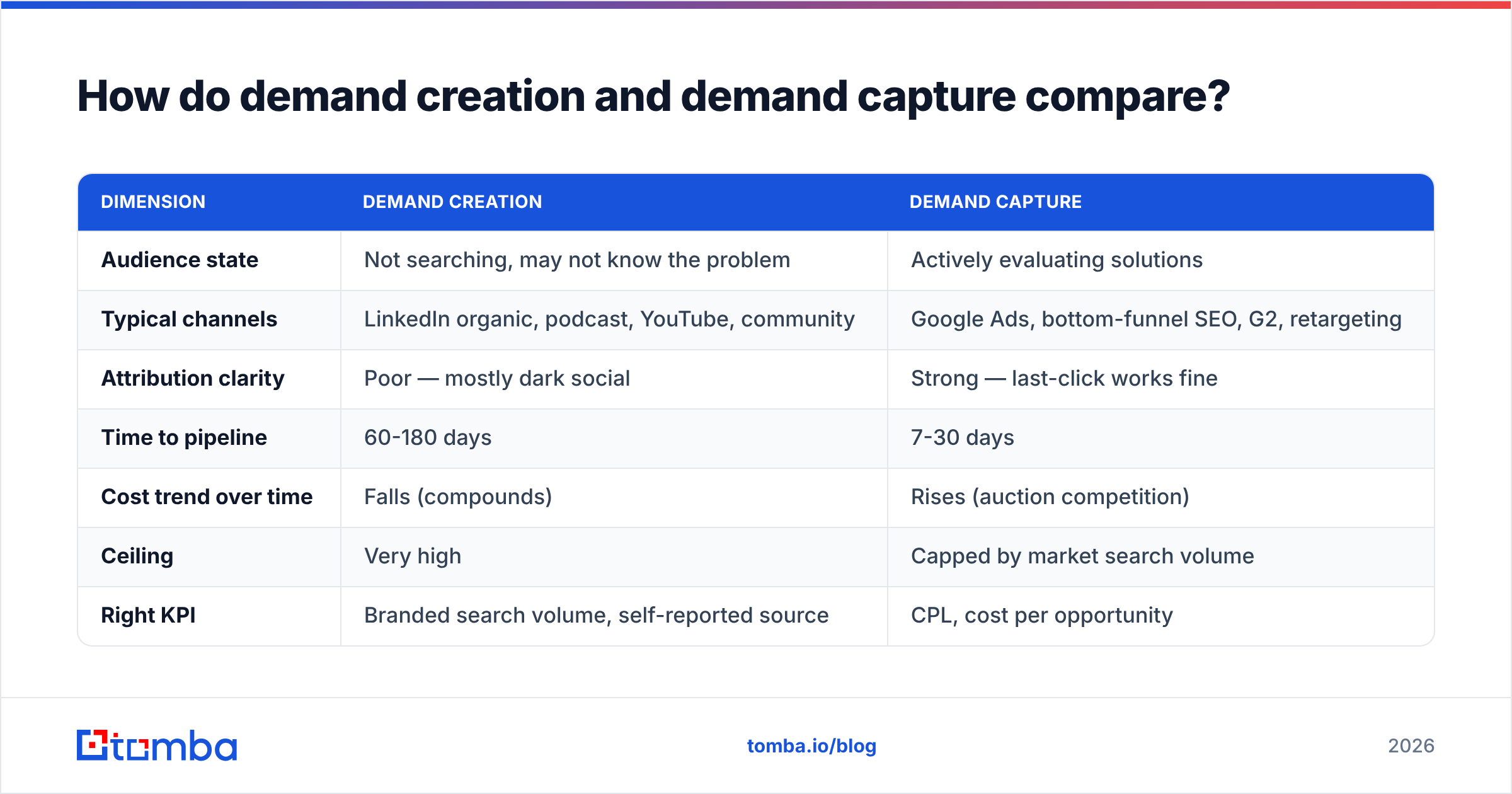
| Dimension | Demand creation | Demand capture |
|---|---|---|
| Audience state | Not searching, may not know the problem | Actively evaluating solutions |
| Typical channels | LinkedIn organic, podcast, YouTube, community | Google Ads, bottom-funnel SEO, G2, retargeting |
| Attribution clarity | Poor — mostly dark social | Strong — last-click works fine |
| Time to pipeline | 60-180 days | 7-30 days |
| Cost trend over time | Falls (compounds) | Rises (auction competition) |
| Ceiling | Very high | Capped by market search volume |
| Right KPI | Branded search volume, self-reported source | CPL, cost per opportunity |
| Failure mode | Defunded before it works | Saturates and gets expensive |
The mistake is treating these as competing budgets. They're sequential. Creation feeds capture. If your branded search volume is flat, your capture layer is fishing in a pond nobody is refilling.
What metrics actually matter in a demand generation playbook?#
Kill the MQL as a primary KPI. Keep it as a diagnostic if you must, but stop reporting it to the board.
Here is the metric stack that survives scrutiny:
- Pipeline created (dollar value, by source) — the only number the CFO cares about. Segment by self-reported source, not last-touch.
- Self-reported attribution — a single open-text "How did you hear about us?" field on your demo form. It outperforms multi-touch models for demand creation channels because it captures dark social.
- Branded search volume, month over month — the cleanest proxy for whether demand creation is working. If it's climbing, your creation layer is doing its job.
- Win rate by source — a channel producing 300 leads at a 2% win rate is worse than one producing 40 at 18%. Volume metrics hide this.
- Sales cycle length by source — demand creation channels typically produce shorter cycles because the buyer arrived pre-educated.
- Contact data health rate — bounce rate, catch-all percentage, and match rate on your enrichment. This is the plumbing metric nobody reports until deliverability collapses.
That last one deserves more attention than it gets. You can run a flawless creation strategy, generate genuine interest, and then lose it at the handoff because the contact record is three job changes stale. Running lists through an email verifier before any sequence goes out is a five-minute step that protects everything upstream of it.
How does outbound fit into a modern demand generation playbook?#
Outbound in 2026 is not a volume game. It's a precision layer that sits on top of your demand signals.
The old model — buy a list, blast 10,000 contacts, accept a 0.8% reply rate — is dead for three reasons: Google and Microsoft tightened bulk sender requirements, buyers have pattern-matched generic personalisation, and domain reputation is now a hard constraint rather than a soft one.
The model that works layers outbound onto existing intent:
- Website visitor identification — someone from your ICP read your pricing page twice. That's a signal. Tools like website visitor reveal turn anonymous traffic into a named account you can research.
- Content engagement triggers — they downloaded the buyer's guide, watched 80% of the webinar, or commented on your founder's LinkedIn post.
- Job change and hiring signals — a champion moved companies, or the target account posted a role that implies your problem.
- Technographic triggers — they just adopted a complementary tool in your stack.
Once you have the account and the signal, you need the person and their contact details. That's the mechanical part: find the right title at the right company, get a verified work email, and reach out with a message that references the actual trigger. An email finder with domain-level search handles this in seconds rather than the twenty minutes a rep would otherwise spend on LinkedIn and guesswork.
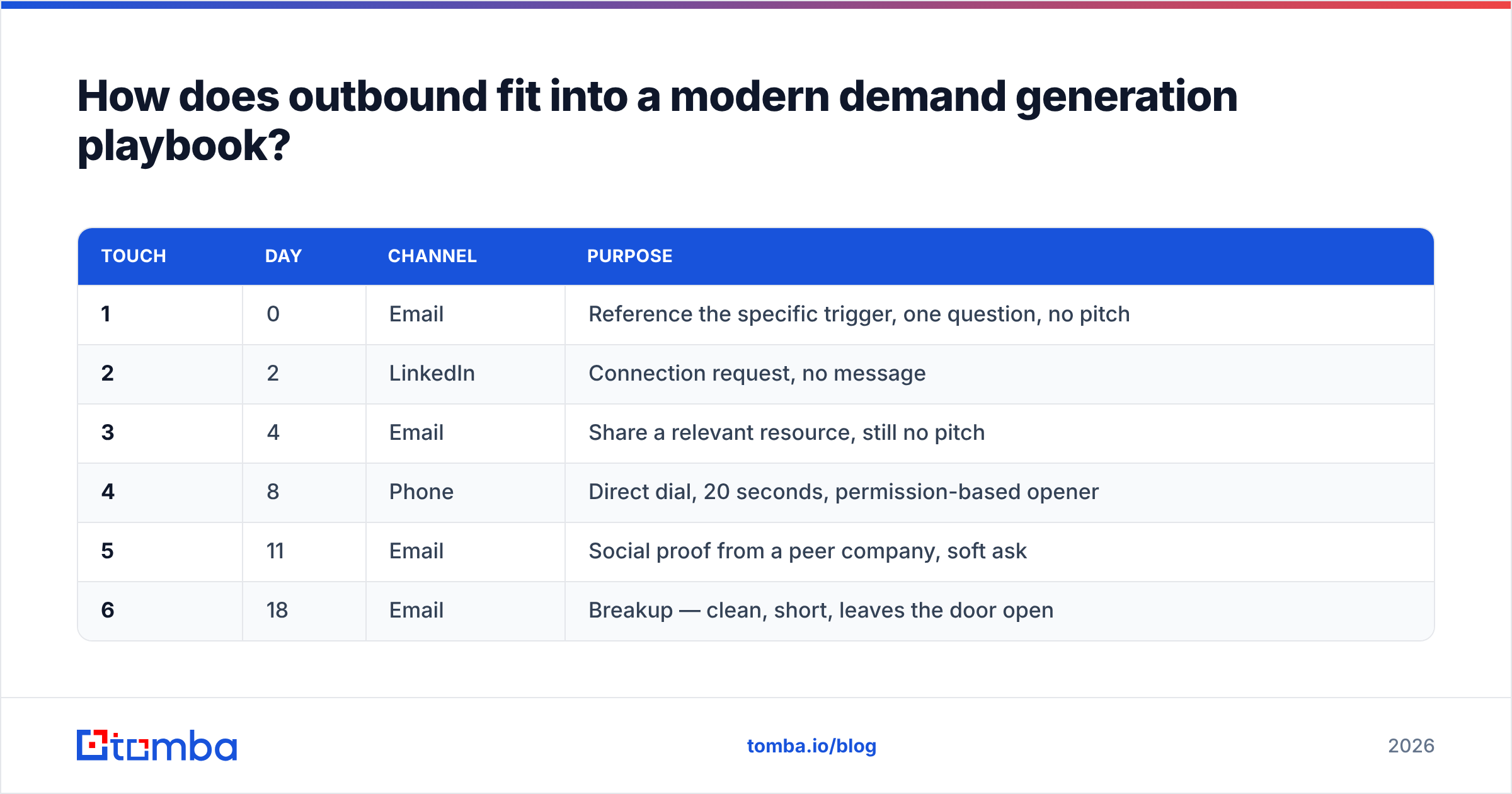
Sequence structure that holds up in 2026:
| Touch | Day | Channel | Purpose |
|---|---|---|---|
| 1 | 0 | Reference the specific trigger, one question, no pitch | |
| 2 | 2 | Connection request, no message | |
| 3 | 4 | Share a relevant resource, still no pitch | |
| 4 | 8 | Phone | Direct dial, 20 seconds, permission-based opener |
| 5 | 11 | Social proof from a peer company, soft ask | |
| 6 | 18 | Breakup — clean, short, leaves the door open |
Six touches over eighteen days across three channels. Notice what's absent: no "just bumping this to the top of your inbox," no fake urgency, no seven-paragraph value props. Keep the response rate benchmarks realistic — 5-12% reply rate on a well-triggered, well-verified list is strong performance in this market.
What infrastructure does the playbook require?#
Four layers, in build order.
Layer 1 — Analytics and attribution. A self-reported source field on every conversion form. Multi-touch attribution as a secondary view, not the primary. UTM discipline enforced at the campaign level. If you can't answer "which of our channels produced last quarter's closed-won revenue," nothing downstream matters.
Layer 2 — Content operations. A publishing cadence you can actually sustain. Two genuinely useful pieces per month beats eight thin ones. Repurpose aggressively: one long-form piece becomes five LinkedIn posts, one podcast episode, and three email newsletter sections.
Layer 3 — Data and enrichment. Your CRM decays at roughly 25-30% per year as people change jobs. A quarterly enrichment pass on your database keeps the asset from rotting. This is also where data enrichment pays for itself: a record with a verified email, direct phone, and current title converts at multiples of a name-and-company-only record.
Layer 4 — Deliverability. Authenticated sending domains (SPF, DKIM, DMARC), separate domains for outbound versus product email, warmed inboxes, and volume caps per mailbox. Skip this and every other layer becomes decorative. HubSpot's research on email marketing consistently shows deliverability as the silent killer of otherwise-sound programs.
The order matters. Teams commonly build layer 2 first because content is visible and fun, then discover in month six that they cannot prove any of it worked. Build the measurement layer first even though it's the least exciting.
How long before a demand generation playbook shows results?#
Set expectations across three horizons, and communicate them before you start spending.
Months 1-3: Infrastructure and baseline. Attribution live, content cadence established, data hygiene fixed, outbound sequences tested. Pipeline contribution from demand creation is near zero. Capture channels should be performing normally. This phase feels like nothing is happening. It is the phase most programs get cancelled in.
Months 4-6: First signal. Branded search volume starts moving. Self-reported attribution begins showing content and social channels. Outbound reply rates improve as targeting sharpens against real signals. Pipeline from creation channels appears but stays modest.
Months 7-12: Compounding. Content ranks and generates ongoing capture. Community and social produce inbound with no ad spend. Sales cycles measurably shorten for creation-sourced deals. Your cost per opportunity starts falling instead of rising.
The honest framing for leadership: demand capture is a faucet you can turn up or down this week. Demand creation is a garden. You cannot accelerate it by watering harder, and it produces nothing for a season. Fund both, judge them on different clocks.
What tools do you actually need?#
Fewer than the vendor landscape suggests. A functional stack:
- CRM — HubSpot, Salesforce, or Pipedrive. Non-negotiable, and it must be the single source of truth.
- Contact data and verification — a provider that finds and verifies work emails at ICP scale. Compare options on match rate and bounce rate, not just price per credit. Peers worth evaluating here include BookYourData for curated list purchase and Tomba for on-demand finding and verification; they solve adjacent problems and many teams use both.
- Sending and sequencing — anything that handles warmup, rotation, and reply detection.
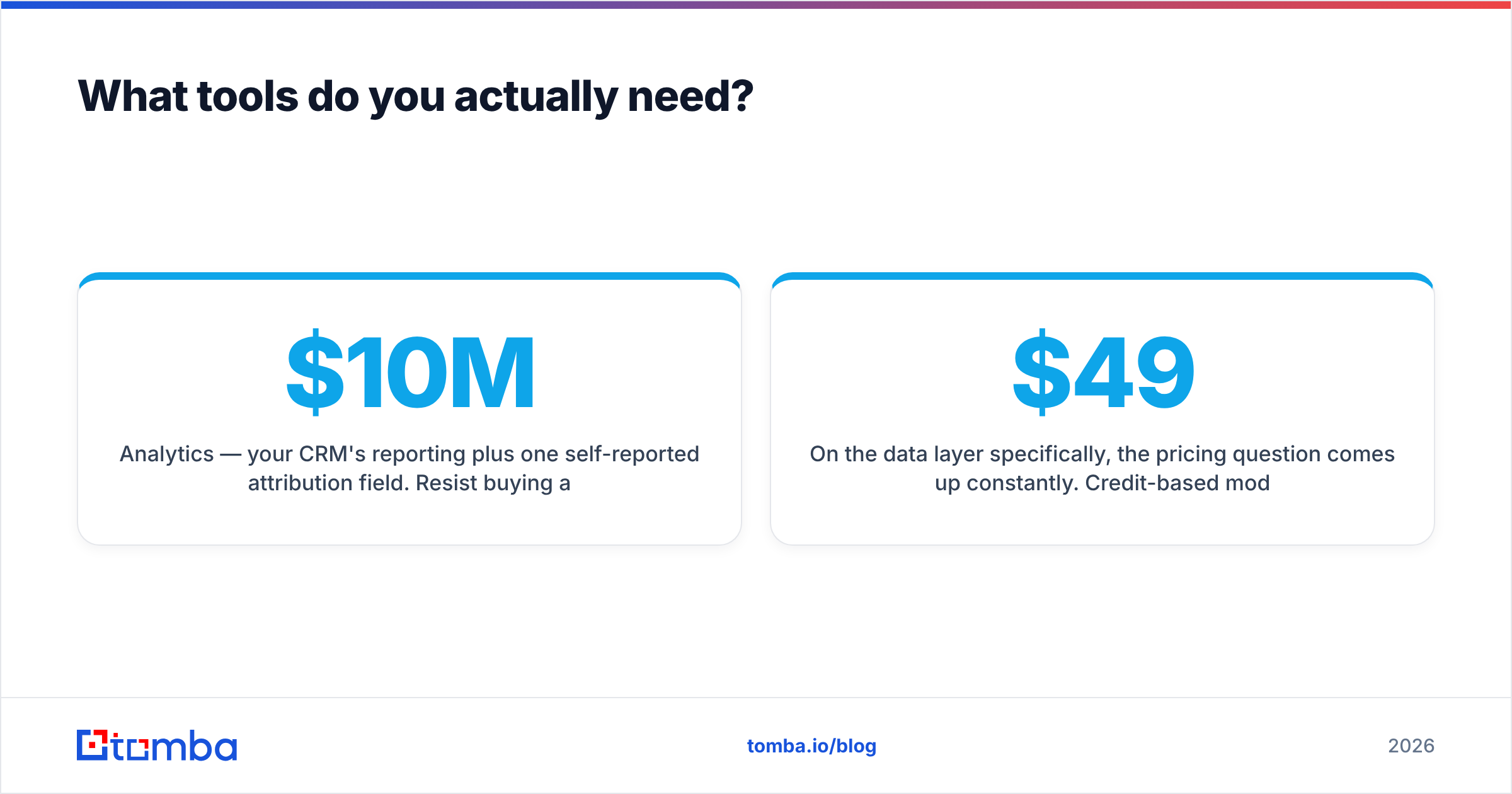
- Analytics — your CRM's reporting plus one self-reported attribution field. Resist buying an attribution platform until you're past $10M ARR.
- Review site presence — a claimed and actively managed profile on G2. Buyers check it. It's cheap capture.
On the data layer specifically, the pricing question comes up constantly. Credit-based models range widely; Tomba pricing starts with a free tier at 25 searches per month, then $49/mo for Starter, $99/mo for Growth, and $249/mo for Pro. Whatever you choose, budget for verification as a separate line item from finding — the two operations have different failure modes and you need both.
Where do most teams go wrong on execution?#
Four recurring mistakes, ranked by how much damage they do:
- Treating the playbook as sequential rather than parallel. You don't finish demand creation and then start capture. They run simultaneously from day one, with different budgets and different clocks.
- Over-personalising outbound at the expense of volume. Twenty hand-crafted emails per rep per day sounds rigorous. In practice, a strong trigger plus a light, specific opener at 60 emails/day outperforms it — provided the data is verified and the domain is healthy.
- Ignoring the existing database. Most companies have thousands of dormant contacts already in the CRM. Re-enriching and re-engaging that list is the cheapest pipeline available and almost nobody does it first.
- Reporting activity instead of outcomes. "We published 12 posts and sent 4,000 emails" is not a result. "We created $340K in pipeline at a $2,100 cost per opportunity" is.
Fix the fourth one and the first three tend to correct themselves, because activity theatre stops being rewarded.
Start with the data layer#
A demand generation playbook is only as good as its weakest handoff, and the weakest handoff is almost always the moment a real signal meets a stale contact record. You can create genuine demand, capture it efficiently, and still lose the deal because the email bounced and the rep moved on.
Fix that first. Tomba Email Finder finds verified professional email addresses by domain, name, or company — so when your demand creation work produces a signal, your team can actually reach the person behind it. Start on the free tier at 25 searches per month, run it against your current target account list, and see what your real match rate looks like before you spend another dollar on top-of-funnel.
Related guides#
Ready to find emails that actually work?
Join 150,000+ professionals who stopped guessing and started sending. Free credits on signup — no credit card required.
Get the Tomba newsletter
Practical outbound tactics and product updates — once every two weeks.
About the author