Demand Generation Retargeting: The 2026 Playbook That Works
Most retargeting budgets get spent re-serving ads to people who bounced in four seconds. Here's how to segment demand gen retargeting by intent, when to switch from ads to outbound, and the metrics that actually predict pipeline.
Demand generation retargeting works when the message matches the signal. It fails when one ad chases everyone who ever hit your site.
TL;DR
- Demand generation retargeting is not "show the ad again." It is re-engaging people who showed intent, at a depth that fits the signal.
- Most waste comes from one mistake. A 4-second bounce and a 6-minute pricing visit get treated the same.
- Build three intent tiers: passive, active, and buying. Give each one its own creative, cap, and follow-up channel.
- Unknown traffic is the biggest pool you are not using. Some 95–98% of B2B site visitors never fill in a form.
- The best move in 2026 is hybrid. Ads for the passive tier. Visitor ID plus direct outbound for the buying tier.
What is demand generation retargeting?#
Demand generation retargeting means going back to people who already touched your brand. They read the site, watched a video, opened an email, or liked a post. You follow up with a message that fits what they did.
Think of a good shop assistant. She does not greet the window shopper the way she greets the person holding a jacket at the till. Same shop, same product, very different chat. Retargeting is that read, done at scale.
Three things make it work. Pixel-based ad audiences on Meta, LinkedIn, and Google. First-party lists you upload to those platforms. And visitor ID tools that turn unknown sessions into named firms. Behavioral retargeting is over fifteen years old. The B2B version changed fast once third-party cookies died.
Here is where teams slip. They borrow the e-commerce playbook. In e-commerce the cart-abandon ad works. One person, one session, a small choice. In B2B, six to ten people decide over 90 days. Show one of them the same banner 40 times and you just wear them down.
Why do most demand generation retargeting campaigns fail?#
Five patterns cover almost every weak program. The first two are audience mistakes.
- One audience, one ad. "All site visitors, last 30 days" is not a segment. It mixes rivals, job seekers, current clients, and one keen VP of Ops. They all get the same bland brand ad.
- No frequency cap. Skip the cap and 10–15% of your views hit the same few heavy browsers. That is not reach. That is paid-for noise.
The last three are process mistakes.
- No exclusion lists. Closed-won clients, live deals, and dead leads keep eating budget. Suppression is your cheapest lever. It is also the one most teams skip.
- Clicks over pipeline. A 1.8% click rate says nothing about whether the account started to weigh you up. Ad platforms also pad B2B clicks with view-through credit.
- Dead-ending at the ad. The ad brings someone back. They read, they leave, they are unknown again. Nothing turns that visit into a person you can email.
That last one costs the most. It is worth a closer look.

How should you segment retargeting audiences by intent?#
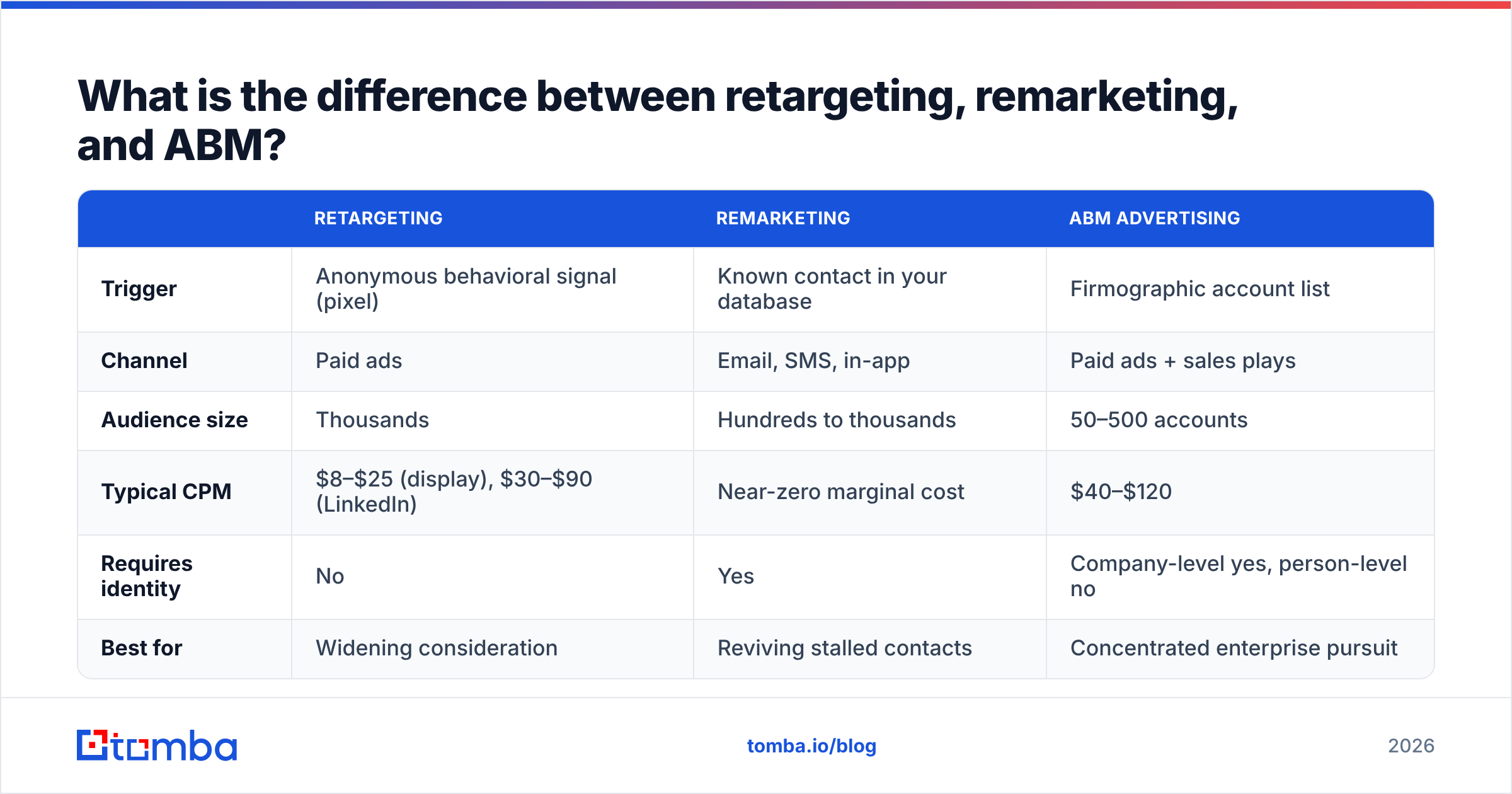
Split your demand generation retargeting pool by depth of signal, not by recency. Recency says when they looked. Depth says how hard.
| Tier | Signal | Best channel | Creative angle | Frequency cap |
|---|---|---|---|---|
| Passive | Blog visit, <60s, one page | Meta / display | Educational, no CTA pressure | 3/week |
| Active | 2+ sessions, resource download, video 75%+ | LinkedIn / YouTube | Proof: case study, benchmark, ROI | 5/week |
| Buying | Pricing page, demo page, comparison page | LinkedIn + direct outbound | Offer: trial, teardown, live demo | 8/week + 1:1 email |
| Existing pipeline | Open opportunity in CRM | Suppress from prospecting ads | Enablement content for champions | 2/week |
| Closed-won | Customer | Exclude entirely | Expansion / advocacy campaigns only | N/A |
Three things fall out of that table.
The buying tier needs a human, not a banner. Someone read your pricing page twice in five days. That is not a display problem. That is a sales chat you have not started.
Flip the budget. Most teams spend 70% passive, 25% active, 5% buying, since passive has the volume. Turn it around. The buying tier is small, so a rich per-account budget still costs little.
Exclusions are half the work. Load your client list and open deals as negative audiences. Skip that step and you pay to advertise to people who already pay you.
What is the difference between retargeting, remarketing, and ABM?#
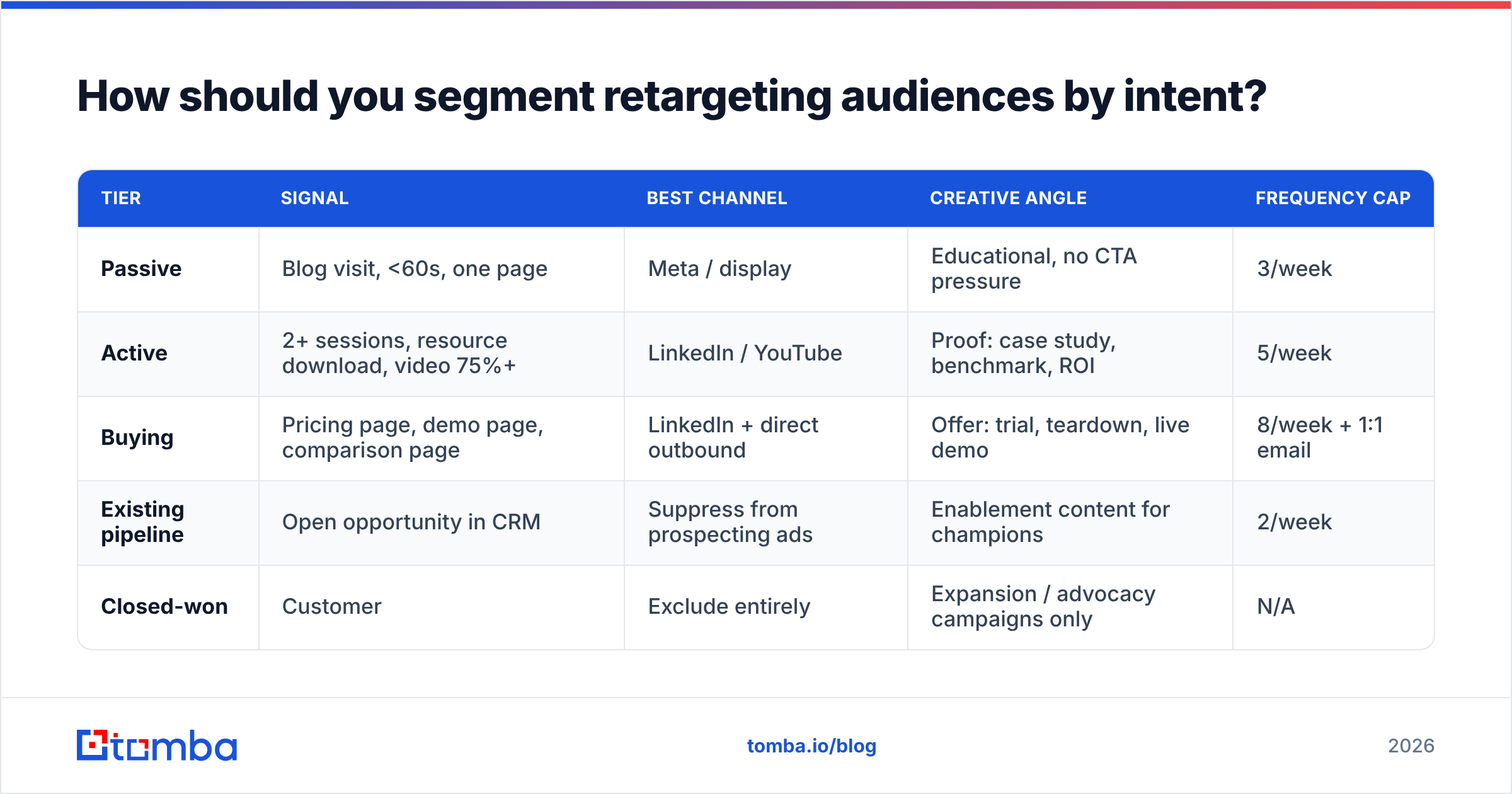
Vendor decks use the three words as if they mean one thing. They do not. Mix them up and you buy the wrong tool.
| Retargeting | Remarketing | ABM advertising | |
|---|---|---|---|
| Trigger | Anonymous behavioral signal (pixel) | Known contact in your database | Firmographic account list |
| Channel | Paid ads | Email, SMS, in-app | Paid ads + sales plays |
| Audience size | Thousands | Hundreds to thousands | 50–500 accounts |
| Typical CPM | $8–$25 (display), $30–$90 (LinkedIn) | Near-zero marginal cost | $40–$120 |
| Requires identity | No | Yes | Company-level yes, person-level no |
| Best for | Widening consideration | Reviving stalled contacts | Concentrated enterprise pursuit |
A strong demand generation retargeting program uses all three, in order. Ads build the unknown pool. Visitor ID lifts part of that pool into named accounts. Remarketing and ABM then work those accounts by email and 1:1 sales.
The bridge from column one to the other two is the piece most stacks lack.
How do you turn anonymous retargeting traffic into contactable leads?#
This is the core question. An ad can reach a browser. It cannot hand you a name. Two steps get you the account. Two more make the follow-up land.
Start with the account:
- Name the company. Reverse-IP and identity-graph tools match a session to a firm. A website visitor reveal layer sits on the site and names the firm behind each visit, page by page. Now you know a 400-person logistics firm read your pricing page three times. Not just "sessions: 3."
- Find the right person there. The firm is half the answer. You still need the buyer. A domain search turns that firm into the roles you want, with verified work emails. Think RevOps lead, head of demand gen, VP sales.
Then get the message right:
- Enrich before you write. Job title, seniority, tech stack, and headcount shape the note. Push each account through contact enrichment first. That is the gap between a note that lands and spray.
- Verify before you send. Cold mail to bad addresses turns a warm domain cold. Run each contact through an email verifier. Keep bounces under 2% to protect sender reputation.
Do this well and demand generation retargeting stops being a spend line. It becomes a pipeline motion. A visitor sees your ad, comes back, and reads pricing. Inside 24 hours she is a named contact with a checked address. The interest is still warm.

Should you retarget with ads or with outbound?#
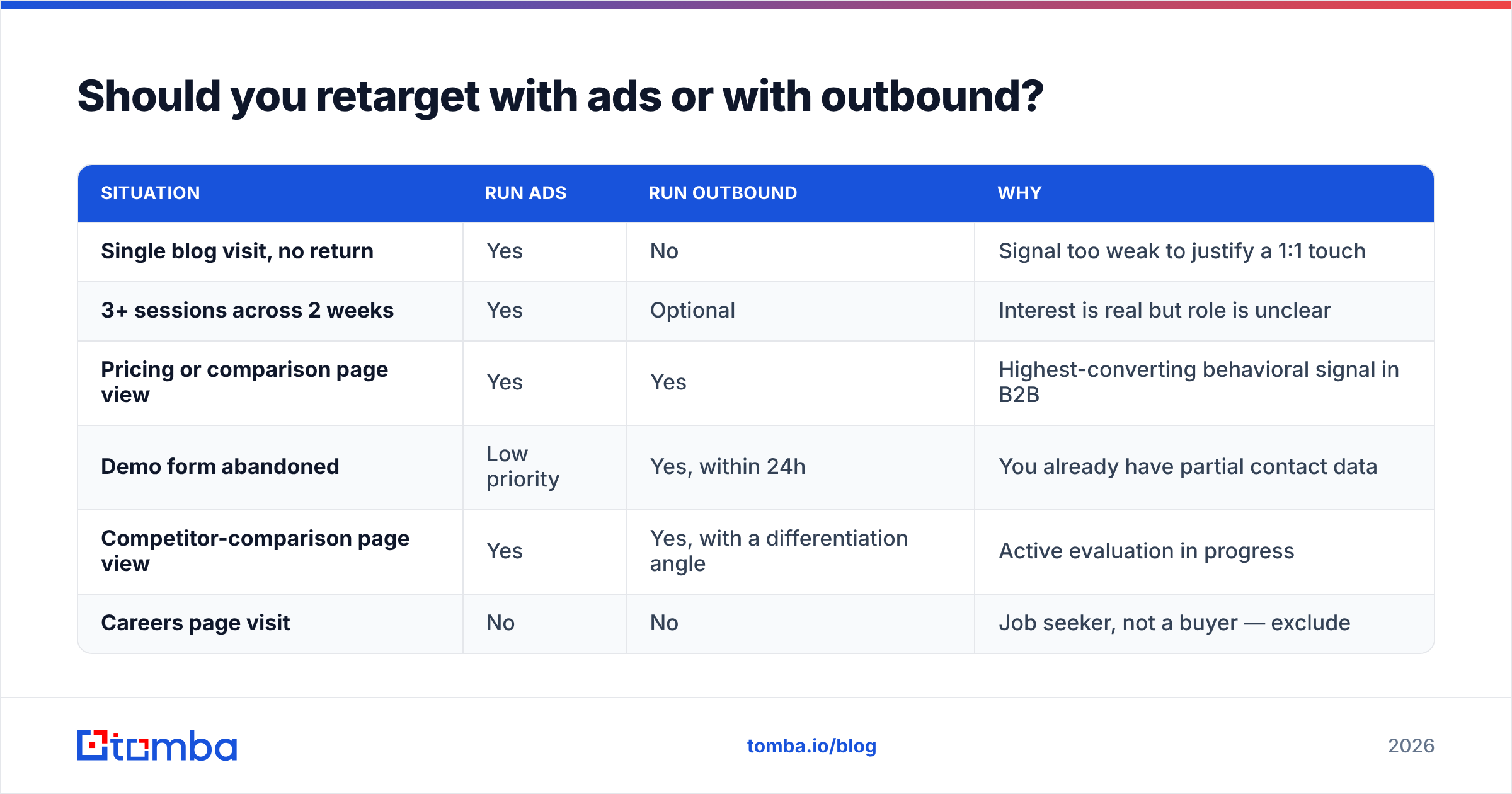
Run both. Just not at the same tier. Most demand generation retargeting teams can adopt this rule as is.
| Situation | Run ads | Run outbound | Why |
|---|---|---|---|
| Single blog visit, no return | Yes | No | Signal too weak to justify a 1:1 touch |
| 3+ sessions across 2 weeks | Yes | Optional | Interest is real but role is unclear |
| Pricing or comparison page view | Yes | Yes | Highest-converting behavioral signal in B2B |
| Demo form abandoned | Low priority | Yes, within 24h | You already have partial contact data |
| Competitor-comparison page view | Yes | Yes, with a differentiation angle | Active evaluation in progress |
| Careers page visit | No | No | Job seeker, not a buyer — exclude |
That last row is not a joke. Careers traffic can be 15–30% of all sessions at a growing firm. It quietly bloats every audience built on "all visitors."
The outbound half works only when the note is specific. "I saw you visited our website" is vague and creepy. Try this instead: "You were comparing workflow tools last week — here is a two-minute teardown of the approval-chain problem." It is useful. It also does not show how much you track.
What metrics actually predict pipeline?#
Drop click rate as your lead metric. It tracks curiosity, not intent. Watch these five instead. The first two are early signals.
- Engaged account rate. The share of target accounts with 2+ real sessions in a rolling 30 days. This one moves first.
- Return-visit depth. Pages per repeat session. A rise here tends to lead demo requests by two to four weeks.
The other three tie spend to money.
- Cost per named account. Ad spend divided by new, contactable accounts. It makes the ads-versus-visitor-ID trade clear.
- Influenced pipeline. Deals where at least one ad landed before the first sales touch. Call it influenced, never sourced. Otherwise the credit fight will eat your quarter.
- Suppression savings. Spend you avoided by cutting clients and open deals. It is often 10–20% of budget.
Need channel benchmarks? LinkedIn's ad targeting documentation is the most honest vendor source on B2B audience size. HubSpot shares fair cross-industry baselines. Treat any single "good" click rate for all of B2B as fiction. Deal size, cycle length, and market age swing that number a lot.
How much should you budget for demand generation retargeting?#
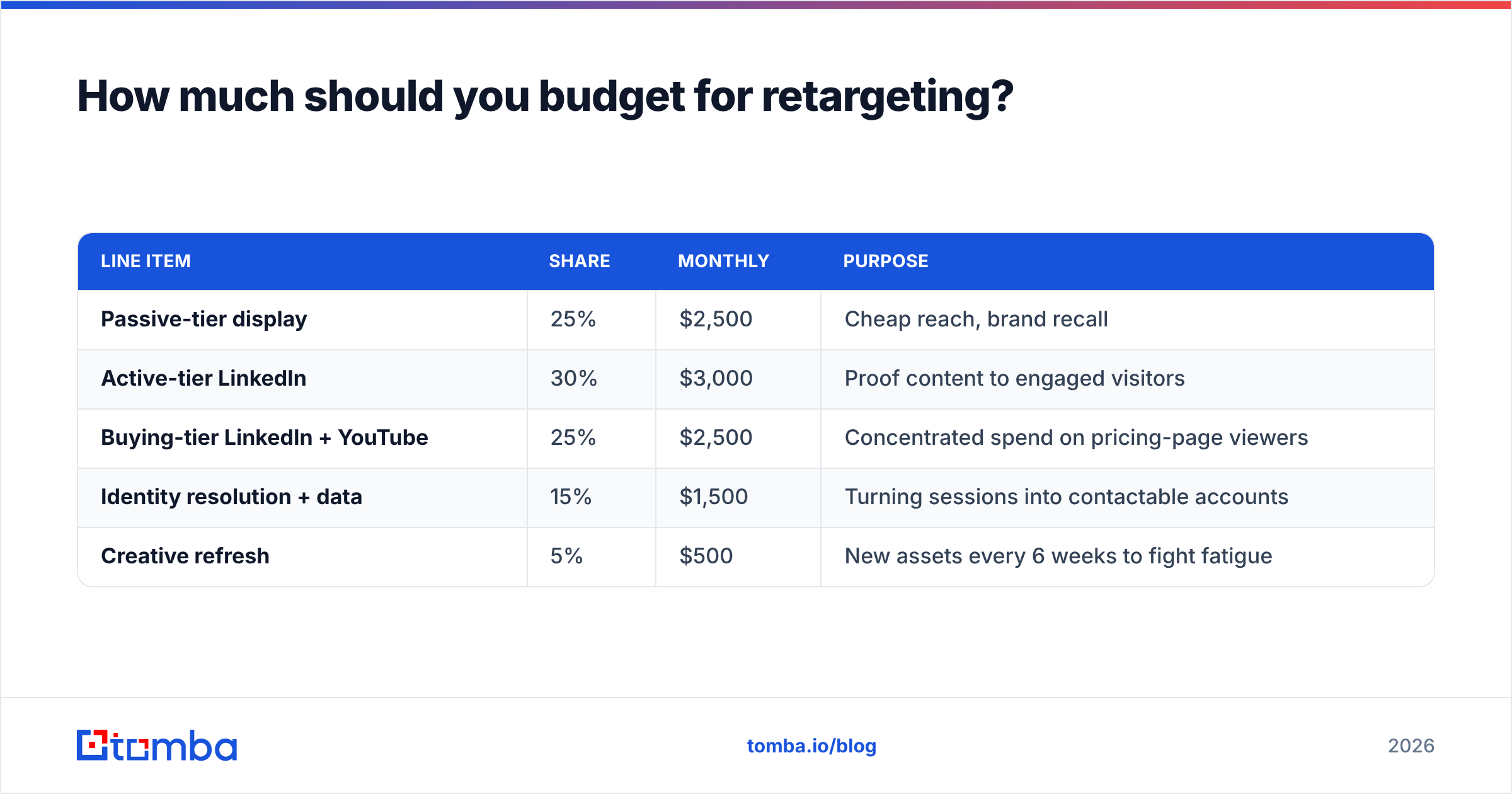
Here is a workable split for a team that spends $10,000 a month on paid demand gen.
| Line item | Share | Monthly | Purpose |
|---|---|---|---|
| Passive-tier display | 25% | $2,500 | Cheap reach, brand recall |
| Active-tier LinkedIn | 30% | $3,000 | Proof content to engaged visitors |
| Buying-tier LinkedIn + YouTube | 25% | $2,500 | Concentrated spend on pricing-page viewers |
| Identity resolution + data | 15% | $1,500 | Turning sessions into contactable accounts |
| Creative refresh | 5% | $500 | New assets every 6 weeks to fight fatigue |
Cut the 15% data line last, not first. Without it, the other 85% buys views you cannot act on. With it, every tier feeds a named list your sales team can work.
Running lean? The cheap version still works. One passive audience. One buying audience. Hard exclusions. Visitor ID on the buying tier only. That fits a $2,000 monthly budget. It still yields a weekly list of accounts worth a personal email.
What does a working retargeting sequence look like?#
Here are days 0–7 after a pricing-page visit, for one named account.
- Day 0. Session resolved to a firm. Contact found and verified. Account added to a high-intent LinkedIn audience, capped at 8 a week.
- Day 1. Direct email to the likely buyer. Name the problem, not the visit. Add one concrete asset: a benchmark, a teardown, a two-minute Loom.
- Day 3. Ad creative rotates to a client proof point in the same field. No new email.
- Day 5. Second email. Shorter, new angle. If the first was strategic, make this one practical.
- Day 7. No reply and no return visit? Drop the account to the active tier. Stop the 1:1 sequence. Pushing past this point costs more than it wins.
Step five is the hard one. Programs that never demote accounts build a costly audience of people who ignored them six months ago.
Where should you start this quarter?#
Start with exclusions. They cost nothing and pay off at once. Upload clients, open deals, and careers-page visitors as negative audiences this week.
Next, split your one "all visitors" audience into the three tiers above. Only then add visitor ID on the buying tier. That is where the extra spend earns its keep. A pricing-page visitor who becomes a named contact is worth far more than one who stays a cookie.
Stuck on step two of the bridge? You know which firms are on your site, but not who to write to. That is the gap the Tomba Email Finder closes. Point it at a domain. Get verified work emails for the roles that matter. Hand your sequence a real person, not a session.
The free tier covers 25 searches a month. Test the motion on last week's pricing-page traffic first. Paid plans start at $49/mo, and full Tomba pricing covers bulk and API access if you run demand generation retargeting at volume.
Retargeting does not fail because the ads are bad. It fails because the loop never closes. Close it.
Related guides#
Ready to find emails that actually work?
Join 150,000+ professionals who stopped guessing and started sending. Free credits on signup — no credit card required.
Get the Tomba newsletter
Practical outbound tactics and product updates — once every two weeks.
About the author