What Is a Demand Generation Specialist? 2026 Role Guide
A demand generation specialist owns pipeline, not posts. Here's what the role actually does day to day, the metrics it lives or dies on, what it pays in 2026, and when a fractional hire beats a full-time one.
TL;DR
- A demand generation specialist owns the full path from stranger to sales-accepted opportunity — paid, content, lifecycle, and data — not just "marketing activities."
- The role is measured on pipeline sourced, cost per opportunity, and MQL-to-SQL conversion. If a candidate leads with impressions and follower counts, they're a content marketer with a different title.
- US base salary in 2026 clusters around $85K–$120K for mid-level and $130K–$175K for senior/manager, with 10–20% variable tied to pipeline targets.
- The single biggest lever on their numbers isn't creative — it's contact data quality. Bad emails inflate CPL and destroy sender reputation before any campaign gets a fair test.
- Hire in-house above ~$3M ARR with a defined ICP; use fractional or agency below that.
What does a demand generation specialist actually do?#
A demand generation specialist builds and runs the system that turns people who've never heard of your company into qualified sales conversations. That's the whole job description, and everything else is implementation detail.
The confusion comes from how the title gets used. In a 12-person startup, a demand gen specialist writes the ads, builds the landing pages, loads the lists, sets up the nurture flows, and reports the numbers. In a 400-person company, the same title means someone who owns one channel — paid social, or webinars, or lifecycle email — and coordinates with four other people.
The constant across both is accountability to pipeline. A content marketer is measured on output and engagement. A product marketer is measured on positioning and launch readiness. A demand generation specialist is measured on how many qualified opportunities the sales team got this quarter and what each one cost.
Here's what that breaks down into in practice:
- Audience and ICP definition — Working with sales and RevOps to define who is actually worth spending money to reach, then translating that into targetable segments: firmographics, technographics, job titles, trigger events.
- Channel mix and budget allocation — Deciding how a $30K monthly budget splits across paid search, LinkedIn, review sites, outbound data, events, and content syndication — then reallocating monthly based on cost per opportunity, not cost per click.
- Offer and asset creation — Building the things people trade contact details for: benchmark reports, calculators, teardowns, live sessions. The good ones treat offers as products with their own conversion rates.
- Data acquisition and hygiene — Sourcing, enriching, verifying, and deduplicating contact records so campaigns hit real inboxes and CRM routing doesn't break.
- Lifecycle and nurture — Scoring, routing, and sequencing so a lead that isn't ready today gets a reason to come back in 90 days instead of rotting in a database.
- Reporting and attribution — Owning the dashboard that answers "where did last quarter's pipeline come from" without three days of spreadsheet surgery.
Notice that items 1, 4, and 6 have nothing to do with creative. That's roughly where most of the leverage sits, and it's also where most job descriptions are thinnest.
How is demand generation different from lead generation?#
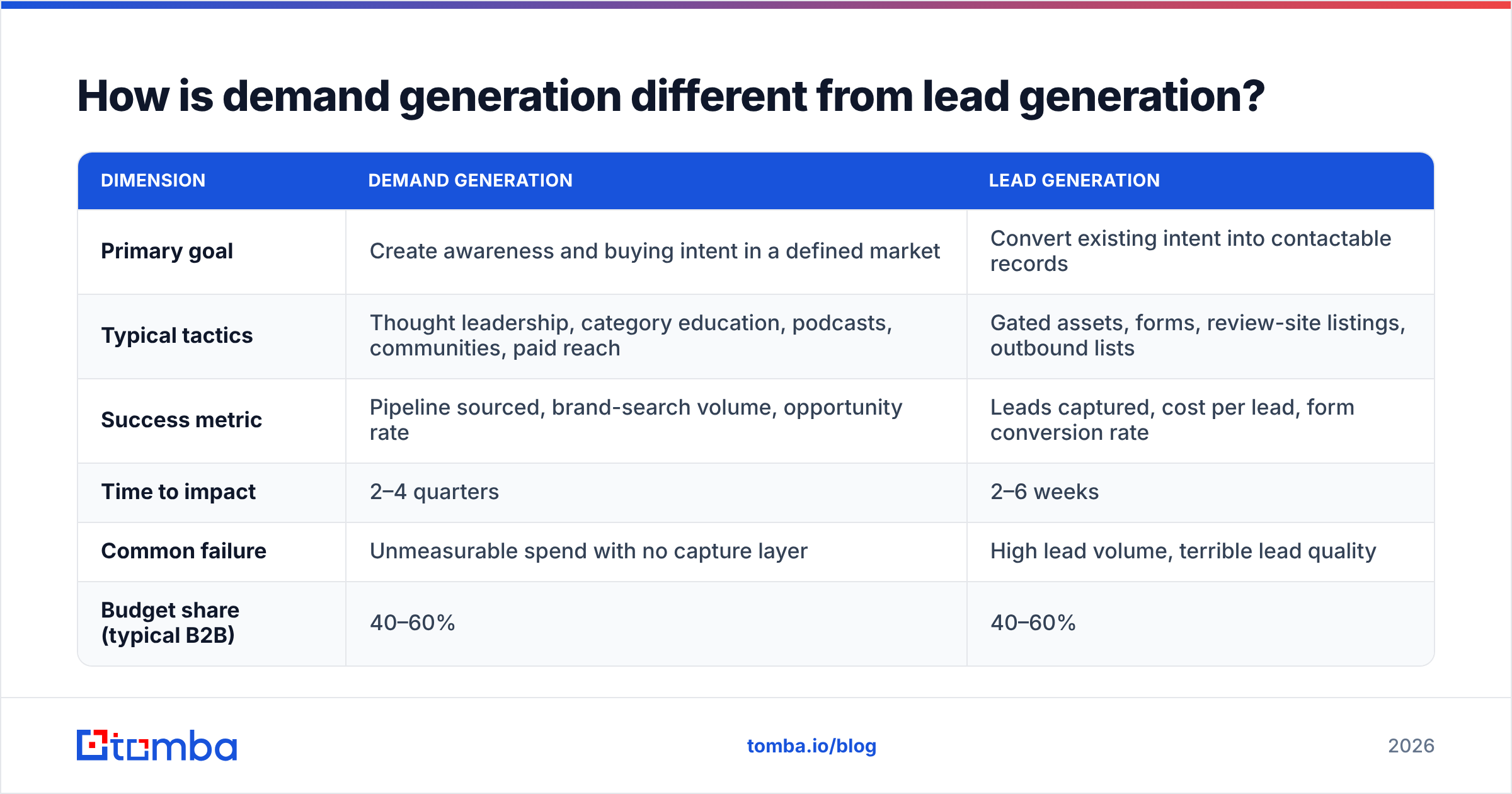
Lead generation captures interest that already exists. Demand generation creates the interest first, then captures it. Both matter, but confusing them produces a very specific failure: a team that hits its lead target every month while pipeline stays flat.
| Dimension | Demand generation | Lead generation |
|---|---|---|
| Primary goal | Create awareness and buying intent in a defined market | Convert existing intent into contactable records |
| Typical tactics | Thought leadership, category education, podcasts, communities, paid reach | Gated assets, forms, review-site listings, outbound lists |
| Success metric | Pipeline sourced, brand-search volume, opportunity rate | Leads captured, cost per lead, form conversion rate |
| Time to impact | 2–4 quarters | 2–6 weeks |
| Common failure | Unmeasurable spend with no capture layer | High lead volume, terrible lead quality |
| Budget share (typical B2B) | 40–60% | 40–60% |
In a healthy program the two are a loop, not a hierarchy. Demand creation raises the ceiling on what capture can produce; capture pays for the creation. A demand generation specialist owns both halves and is the person who notices when one is starving the other.
The practical tell during an interview: ask a candidate what they'd cut first if the budget dropped 30%. Someone who only knows capture cuts brand spend immediately and watches CPL rise six months later. Someone who understands the loop cuts the lowest-performing capture channel and protects the demand-creating asset that feeds the rest.
Why does contact data quality decide the role's outcome?#
Because every downstream number inherits it. A campaign against a list where 22% of addresses bounce doesn't just waste 22% of the budget — it drags sender reputation down, which suppresses inbox placement for the other 78%, which halves reply rates, which makes the channel look unviable when the targeting was fine all along.
This is the part of the job that no one puts in the job posting and every experienced demand gen specialist spends real time on:
- Sourcing — Pulling contacts that match the ICP definition, from a provider, an email finder, a scraped event list, or inbound form fills.
- Verification — Checking deliverability before send, not after. Running the list through an email verifier is a 10-minute step that routinely saves a quarter's sender reputation.
- Enrichment — Filling in company size, industry, tech stack, and seniority so scoring and routing rules have something to work with. Contact enrichment is what turns a raw email into a record sales will actually work.
- Deduplication and suppression — Removing existing customers, active opportunities, competitors, and anyone who unsubscribed. Skipping this is how a demand gen program generates its first angry Slack message from an account executive.
Data providers are not interchangeable, and the honest answer is that most teams use two or three. Tomba covers domain-level discovery, verification, and enrichment through one API, which suits programmatic workflows. BookYourData is a solid option when you want a pre-verified list you can buy once and use immediately without wiring anything up. Buying from a single vendor and trusting the coverage claim is the mistake, not choosing the wrong vendor.
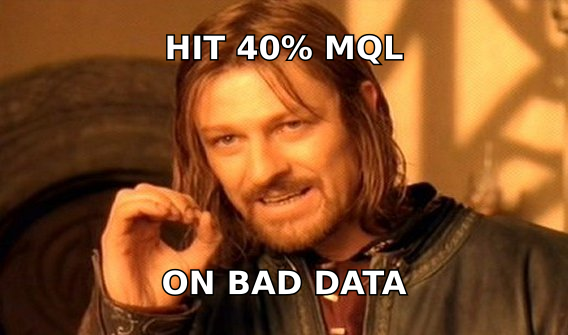
One more thing worth internalizing: a marketing qualified lead built on an unverified record isn't a lead. It's an entry in a spreadsheet that will be marked "bad data" by an SDR three weeks later, after it has already inflated your MQL count and your reported conversion rate.
What tools does a demand generation specialist need in 2026?#
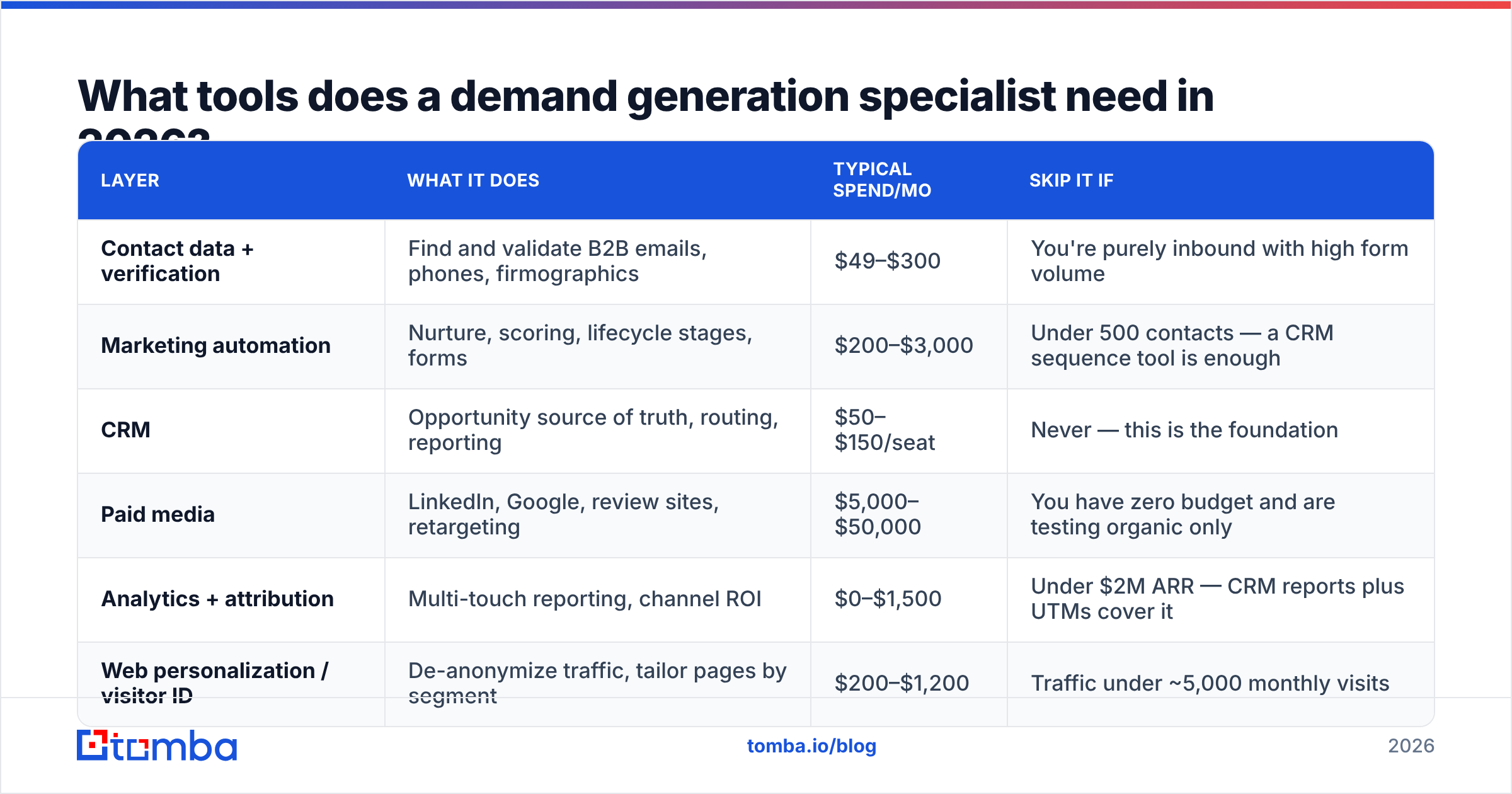
The stack has consolidated. Five years ago a mid-market demand gen team ran 14 tools; most now run six or seven and route everything through the CRM. What follows is the functional shape of a working stack — categories first, vendors second.
| Layer | What it does | Typical spend/mo | Skip it if |
|---|---|---|---|
| Contact data + verification | Find and validate B2B emails, phones, firmographics | $49–$300 | You're purely inbound with high form volume |
| Marketing automation | Nurture, scoring, lifecycle stages, forms | $200–$3,000 | Under 500 contacts — a CRM sequence tool is enough |
| CRM | Opportunity source of truth, routing, reporting | $50–$150/seat | Never — this is the foundation |
| Paid media | LinkedIn, Google, review sites, retargeting | $5,000–$50,000 | You have zero budget and are testing organic only |
| Analytics + attribution | Multi-touch reporting, channel ROI | $0–$1,500 | Under $2M ARR — CRM reports plus UTMs cover it |
| Web personalization / visitor ID | De-anonymize traffic, tailor pages by segment | $200–$1,200 | Traffic under ~5,000 monthly visits |
The category to be most skeptical about is attribution. Multi-touch attribution tools sell certainty they can't deliver in a market where buying committees average six to ten people and half the research happens in places you can't instrument. Gartner's marketing research has been consistent on this for years: self-reported attribution ("How did you hear about us?" on the demo form) plus directional channel reporting beats an expensive model that produces a precise wrong answer.
For evaluating specific vendors in any of these categories, G2's marketing automation category is the least-bad public source — filter reviews by company size, because a tool that's beloved at 20 employees is often unusable at 500.
On pricing sanity: entry-level data tooling should not be a budget line you agonize over. Tomba's pricing starts free at 25 searches per month and $49/mo at the Starter tier, which is well inside the noise for a team spending five figures on paid media.
What metrics does the role actually own?#
There are four numbers a demand generation specialist should be able to recite from memory, and a long tail of diagnostics that only matter when one of the four moves.
The four that matter:
- Pipeline sourced — Dollar value of opportunities created from marketing-sourced contacts in the period. This is the number the CFO cares about.
- Cost per opportunity (CPO) — Total program spend divided by opportunities created. More honest than cost per lead because it survives contact with sales.
- MQL-to-SQL conversion rate — The quality check. If MQLs rise and this falls, you've loosened your definition, not improved your marketing. Healthy B2B SaaS benchmarks tend to sit in the 15–30% range depending on how strict the MQL bar is.
- Pipeline velocity — How fast sourced opportunities move to closed-won. Slow velocity in one channel is a targeting problem disguised as a sales problem.
The diagnostics that explain them: landing page conversion rate, email deliverability and bounce rate, ad frequency and creative fatigue, form abandonment, sales acceptance rate by channel, and content-to-demo assist rate.
The classic argument between marketing and sales — and it happens in every company at least once a year — is about MQL quality. Marketing says it delivered 340 leads. Sales says none of them were real. Both are describing the same underlying problem from different ends.

The resolution is almost never a better scoring model. It's a shared, written definition of a qualified lead with data requirements attached: verified email, confirmed company size band, confirmed seniority, no active opportunity. Enforce that at the point of capture and the argument disappears within a quarter. HubSpot's inbound methodology resources are a reasonable starting template for writing that definition if you don't want to build it from scratch.
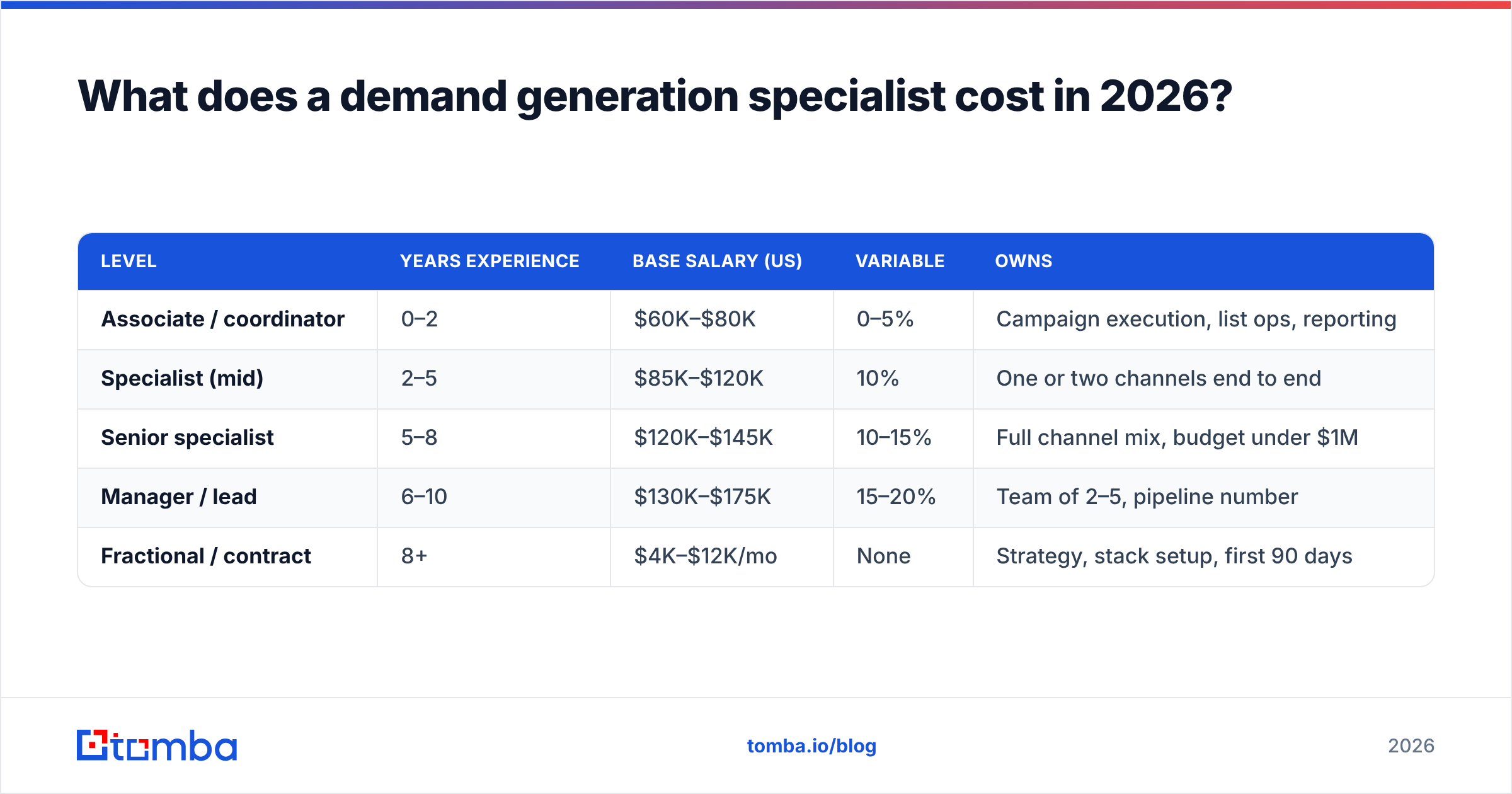
What does a demand generation specialist cost in 2026?#
Compensation varies more by company stage than by geography now that remote hiring has flattened US regional gaps. Ranges below reflect commonly reported US base salaries; treat them as a negotiating window, not a quote.
| Level | Years experience | Base salary (US) | Variable | Owns |
|---|---|---|---|---|
| Associate / coordinator | 0–2 | $60K–$80K | 0–5% | Campaign execution, list ops, reporting |
| Specialist (mid) | 2–5 | $85K–$120K | 10% | One or two channels end to end |
| Senior specialist | 5–8 | $120K–$145K | 10–15% | Full channel mix, budget under $1M |
| Manager / lead | 6–10 | $130K–$175K | 15–20% | Team of 2–5, pipeline number |
| Fractional / contract | 8+ | $4K–$12K/mo | None | Strategy, stack setup, first 90 days |
The variable component is worth arguing over during hiring. Tying 15% of comp to pipeline sourced sounds aggressive, but it aligns the role to the outcome and gives the specialist standing to push back when sales changes the qualification bar mid-quarter. Tying it to MQL count does the opposite — it rewards volume and guarantees the fight described above.
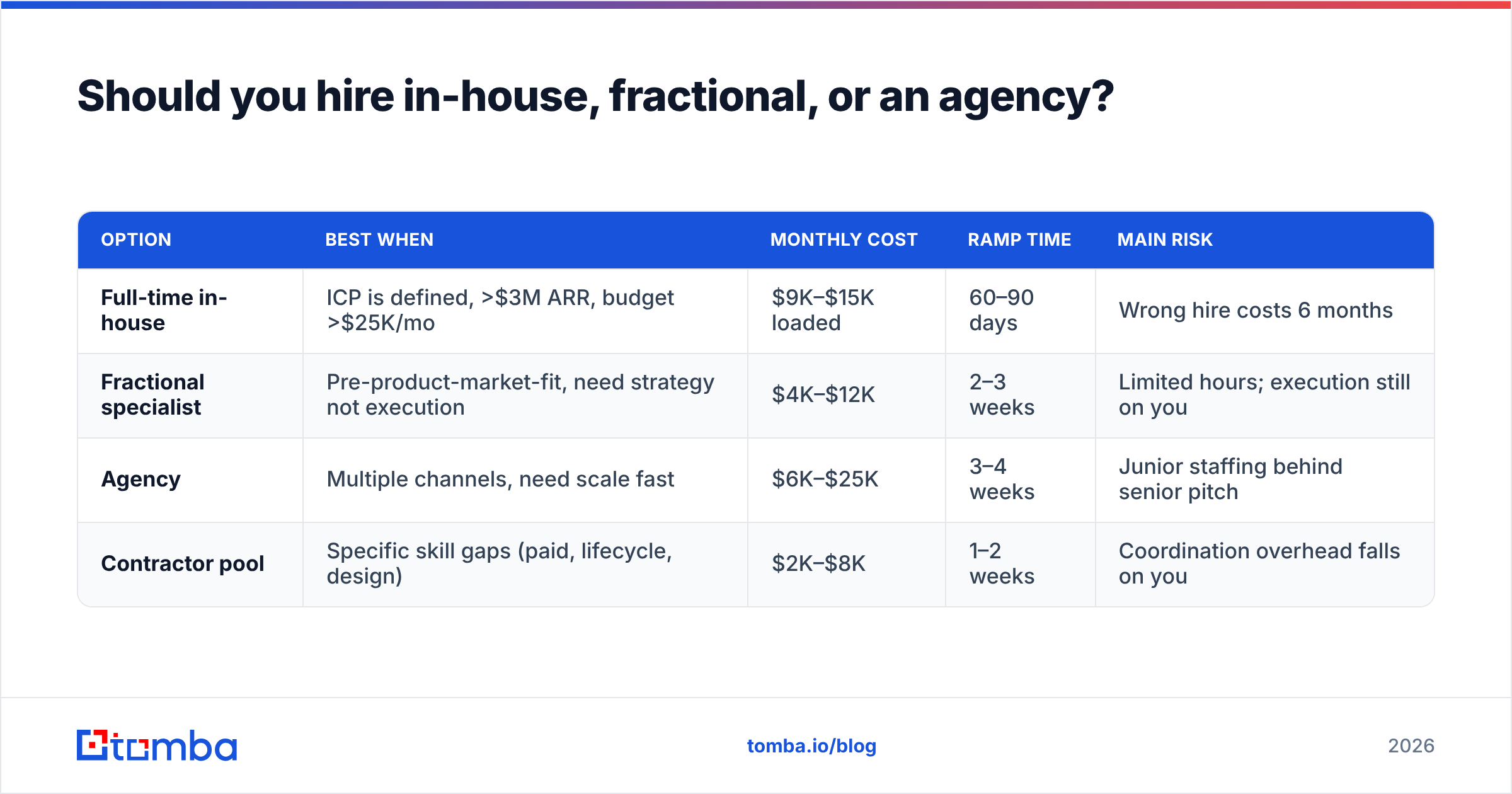
Should you hire in-house, fractional, or an agency?#
| Option | Best when | Monthly cost | Ramp time | Main risk |
|---|---|---|---|---|
| Full-time in-house | ICP is defined, >$3M ARR, budget >$25K/mo | $9K–$15K loaded | 60–90 days | Wrong hire costs 6 months |
| Fractional specialist | Pre-product-market-fit, need strategy not execution | $4K–$12K | 2–3 weeks | Limited hours; execution still on you |
| Agency | Multiple channels, need scale fast | $6K–$25K | 3–4 weeks | Junior staffing behind senior pitch |
| Contractor pool | Specific skill gaps (paid, lifecycle, design) | $2K–$8K | 1–2 weeks | Coordination overhead falls on you |
The decision rule that holds up: hire in-house when you know who your buyer is and need someone to reach more of them. Hire fractional or agency when you're still learning who your buyer is, because you don't want to spend a full-time salary on discovery work that a senior operator can compress into 90 days.
What are the most common ways this role fails?#
- Hired without a defined ICP. The specialist spends the first quarter doing customer research that should have been done before the requisition opened, and gets judged on pipeline they had no way to produce.
- No budget authority. A demand gen specialist who has to get three approvals to move $5,000 between channels cannot optimize on a monthly cycle.
- Reporting to sales without a marketing peer. This turns the role into an SDR support function, which is a legitimate job but not this one.
- Metrics inherited from the previous regime. If the board deck still tracks MQL volume, the specialist will optimize for MQL volume no matter what the offer letter said.
- Data treated as a procurement line item. Buying the cheapest list every quarter and wondering why deliverability keeps degrading is the most expensive false economy in the category.
Fixing the last one is the fastest win available to a new hire. Run the existing database through verification, suppress the dead records, enrich what's left, and re-baseline the numbers. It usually takes a week and it changes every subsequent report.
Where should a new demand generation specialist start?#
First 30 days: read closed-won deals, interview five customers and three lost prospects, audit the existing database for deliverability and completeness. Do not launch anything.
Days 30–60: rebuild the MQL definition with sales in writing, fix routing, set the four core metrics up in the CRM so they're reportable without manual work, and launch one capture channel against a verified list.
Days 60–90: add the second channel, kill anything with a cost per opportunity more than 2x the best performer, and present a budget reallocation with evidence.
That sequence works because it front-loads the unglamorous data and definition work, which is exactly the work that makes months four through twelve look good.
Build the pipeline on data that actually delivers. Whatever your channel mix looks like, every campaign a demand generation specialist runs ends at an inbox — and it only works if the address is real. The Tomba Email Finder finds verified professional emails by domain, name, or company, with verification and enrichment in the same workflow so your MQL count means something by the time it reaches sales. Start free with 25 searches a month, or move to Starter at $49/mo when the program scales.
Related guides#
Ready to find emails that actually work?
Join 150,000+ professionals who stopped guessing and started sending. Free credits on signup — no credit card required.
Get the Tomba newsletter
Practical outbound tactics and product updates — once every two weeks.
About the author