Demand Generation Strategy: The 2026 Playbook That Works
Most demand gen advice assumes an unlimited budget and a 40-person team. This is the version that works with one marketer, a data layer, and a quarter to prove it — channel mix, metrics, and a 90-day rollout included.
TL;DR
- A demand generation strategy has two halves that most teams collapse into one: demand creation (making people want the category) and demand capture (converting the people already looking). Budget them separately or the capture side will eat everything.
- The 2026 buying journey is mostly invisible. Roughly 70% of the evaluation happens before anyone fills in a form, so attribution built on last-touch will lie to you every single month.
- Channel mix should follow your ACV, not your competitor's blog. Under $10k ACV, self-serve and paid capture win. Above $50k ACV, founder-led content plus targeted outbound wins.
- Your data layer is the unglamorous part that decides everything. Bad contact data caps every downstream channel — segmentation, ads, retargeting, outbound.
- A workable 90-day rollout: 30 days instrumenting, 30 days shipping creation assets, 30 days scaling what produced pipeline. Not leads. Pipeline.
What is a demand generation strategy?#
A demand generation strategy is the plan for how you create awareness of a problem, hold attention while buyers self-educate, and convert that attention into qualified pipeline — measured in revenue, not form fills.
Think of it like farming versus fishing. Demand creation is farming: you plant content, community, and point-of-view months before harvest. Demand capture is fishing: you show up where hungry buyers already are — search, review sites, competitor comparison pages — and pull them in today. Most teams only fish, then wonder why the pond empties by Q3.
Here's the split that actually matters:
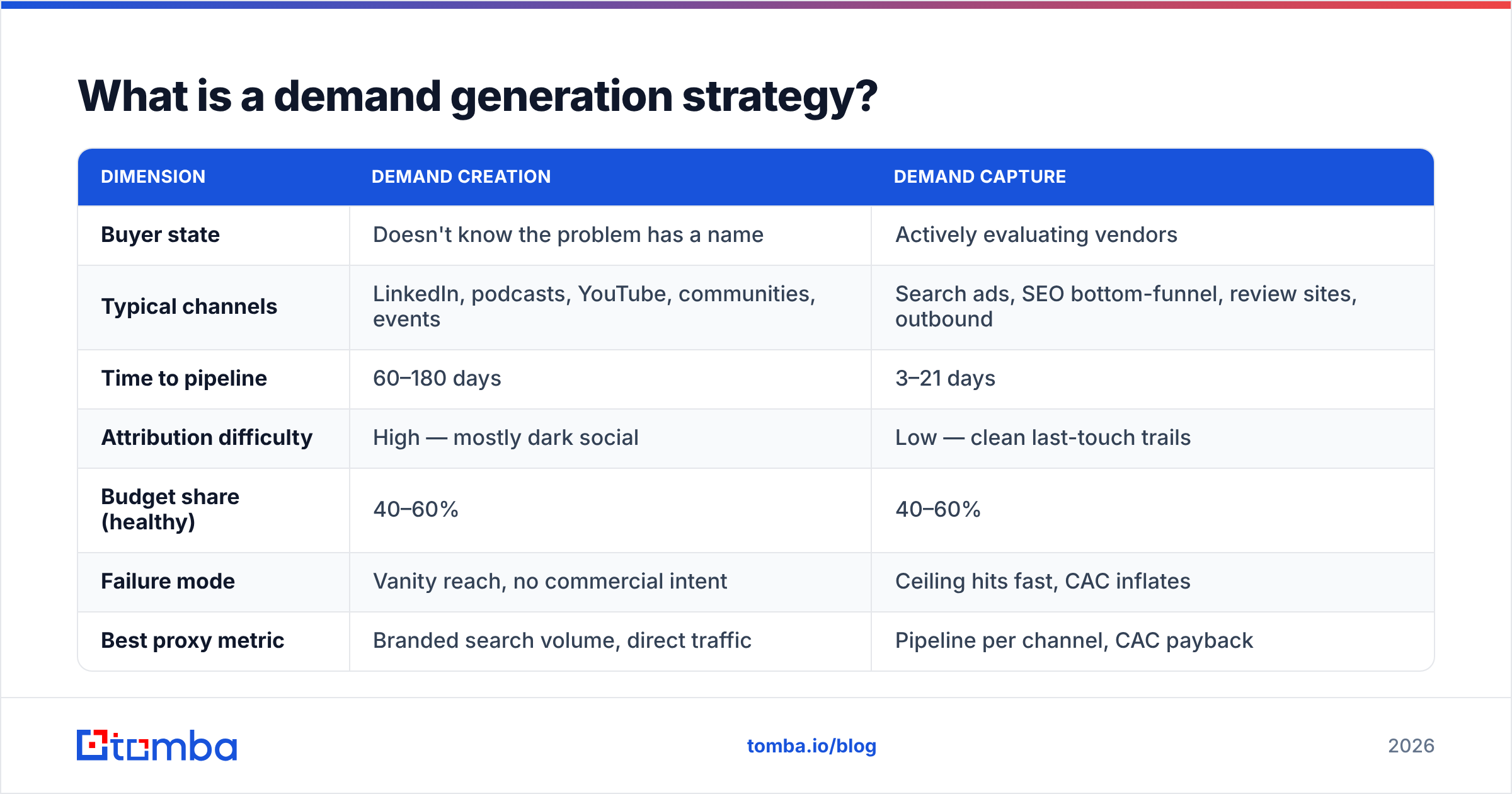
| Dimension | Demand creation | Demand capture |
|---|---|---|
| Buyer state | Doesn't know the problem has a name | Actively evaluating vendors |
| Typical channels | LinkedIn, podcasts, YouTube, communities, events | Search ads, SEO bottom-funnel, review sites, outbound |
| Time to pipeline | 60–180 days | 3–21 days |
| Attribution difficulty | High — mostly dark social | Low — clean last-touch trails |
| Budget share (healthy) | 40–60% | 40–60% |
| Failure mode | Vanity reach, no commercial intent | Ceiling hits fast, CAC inflates |
| Best proxy metric | Branded search volume, direct traffic | Pipeline per channel, CAC payback |
If you can only remember one thing: capture converts the demand creation already produced. Cut creation and your capture channels get more expensive within two quarters. That's not theory — it's why so many teams see paid CPCs "mysteriously" climb after a content freeze.
Why do most demand generation strategies fail?#
They fail for five predictable reasons, and none of them are creative problems.
- The MQL is the target. When marketing is graded on lead count, it optimizes for the cheapest form fill available. Gated ebooks produce leads that sales refuses to call. HubSpot's demand generation guide makes the same point: the handoff metric shapes the behavior upstream of it.
- Attribution decides budget. Last-touch attribution credits the branded search click, not the podcast episode that caused it. So the podcast gets cut. So branded search declines. So paid picks up the slack at 3x the cost.
- The data layer is an afterthought. You cannot segment, suppress, retarget, or personalize on top of a contact database that is 30% stale. Every channel inherits that error rate.
- Channel copying. A $200k-ACV enterprise security vendor imitating a $29/mo PLG tool's TikTok strategy is not a strategy, it's cosplay.
- No patience budget. Creation compounds. Killing it at day 60 guarantees you only ever pay for the expensive half.

How do you pick the right channel mix?#
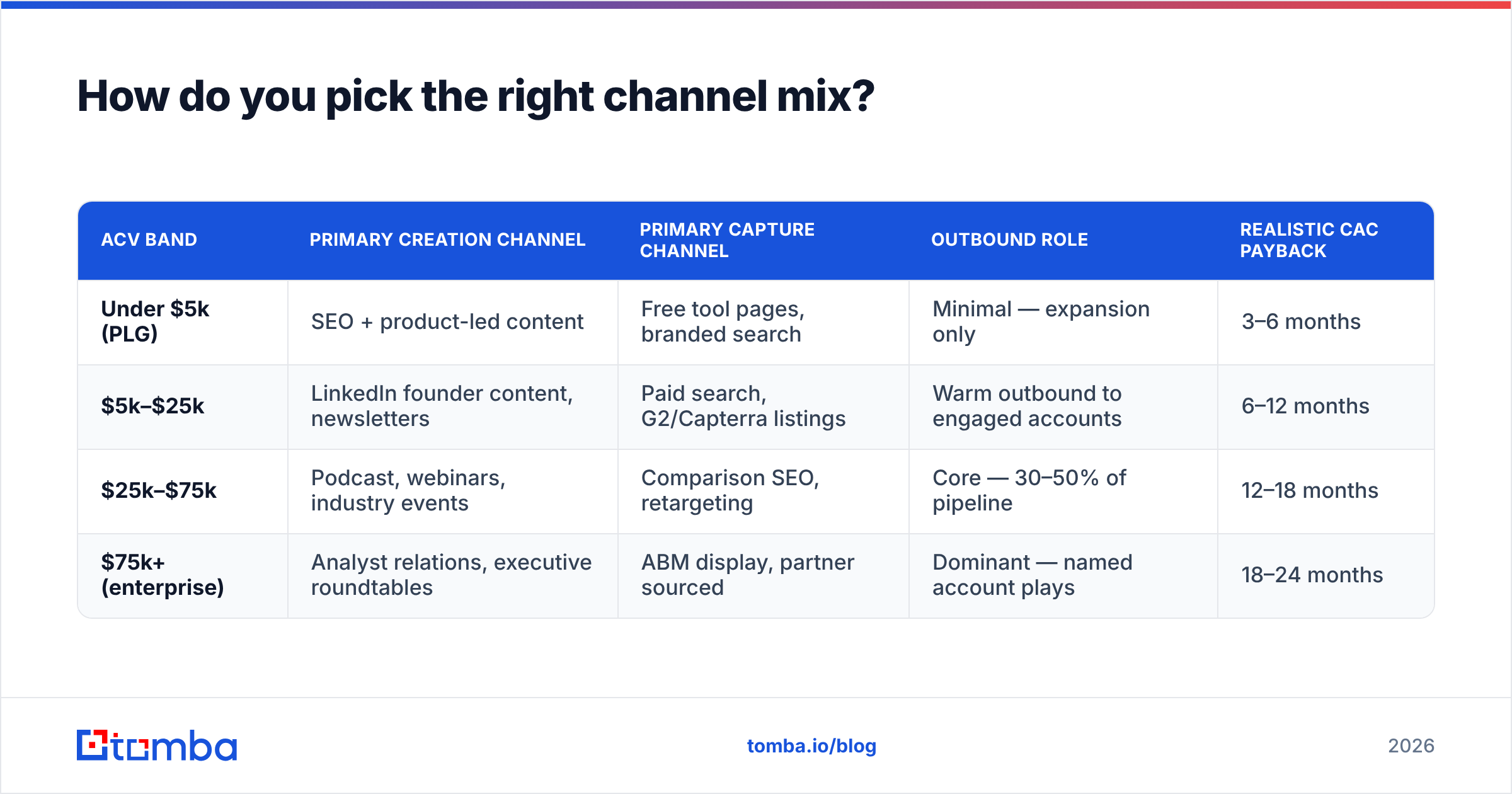
Start from average contract value and sales motion, then work backward. Channel mix is downstream of unit economics — a $400 CAC is a disaster at $500 ACV and a rounding error at $80k ACV.
| ACV band | Primary creation channel | Primary capture channel | Outbound role | Realistic CAC payback |
|---|---|---|---|---|
| Under $5k (PLG) | SEO + product-led content | Free tool pages, branded search | Minimal — expansion only | 3–6 months |
| $5k–$25k | LinkedIn founder content, newsletters | Paid search, G2/Capterra listings | Warm outbound to engaged accounts | 6–12 months |
| $25k–$75k | Podcast, webinars, industry events | Comparison SEO, retargeting | Core — 30–50% of pipeline | 12–18 months |
| $75k+ (enterprise) | Analyst relations, executive roundtables | ABM display, partner sourced | Dominant — named account plays | 18–24 months |
Two rules that hold across every band:
- Never run more than three channels at once in year one. Three channels done properly beat seven done at 40% effort. You need enough volume per channel to read a signal.
- Review sites are capture, not creation. A G2 category page captures buyers already in-market. It won't create new ones. Budget it as paid capture.
What data layer does a demand generation strategy need?#
Every channel above assumes you can reach and identify the right person. That assumption breaks constantly, and it breaks quietly.
Here's the practical stack, in order of what to fix first:
- Account identification. Know which companies are on your site before they convert. Website visitor reveal turns anonymous sessions into named accounts you can route to sales or add to a retargeting audience.
- Contact discovery. Once an account shows intent, you need the humans inside it. A domain search returns the email patterns and named contacts at a company so you're not guessing at
firstname@. - Verification before send. Bounces damage sender reputation, and reputation damage silently kills your nurture and lifecycle email too — not just cold outbound. Run every list through an email verifier before it touches a sending domain.
- Enrichment for segmentation. Firmographics, headcount, tech stack, and role seniority are what let you build the audience segments your ads and sequences depend on. Contact enrichment fills the gaps your forms deliberately don't ask for.
- Suppression and dedupe. Existing customers, open opportunities, and churned accounts should never see a net-new acquisition ad. This is the cheapest efficiency win in the entire stack and almost nobody does it.
The pattern is simple: identify the account, find the person, verify the address, enrich the record, suppress the ones you shouldn't touch. Skip any step and the channels above it start underperforming for reasons that look like creative problems but aren't.
Which tools should you actually compare?#
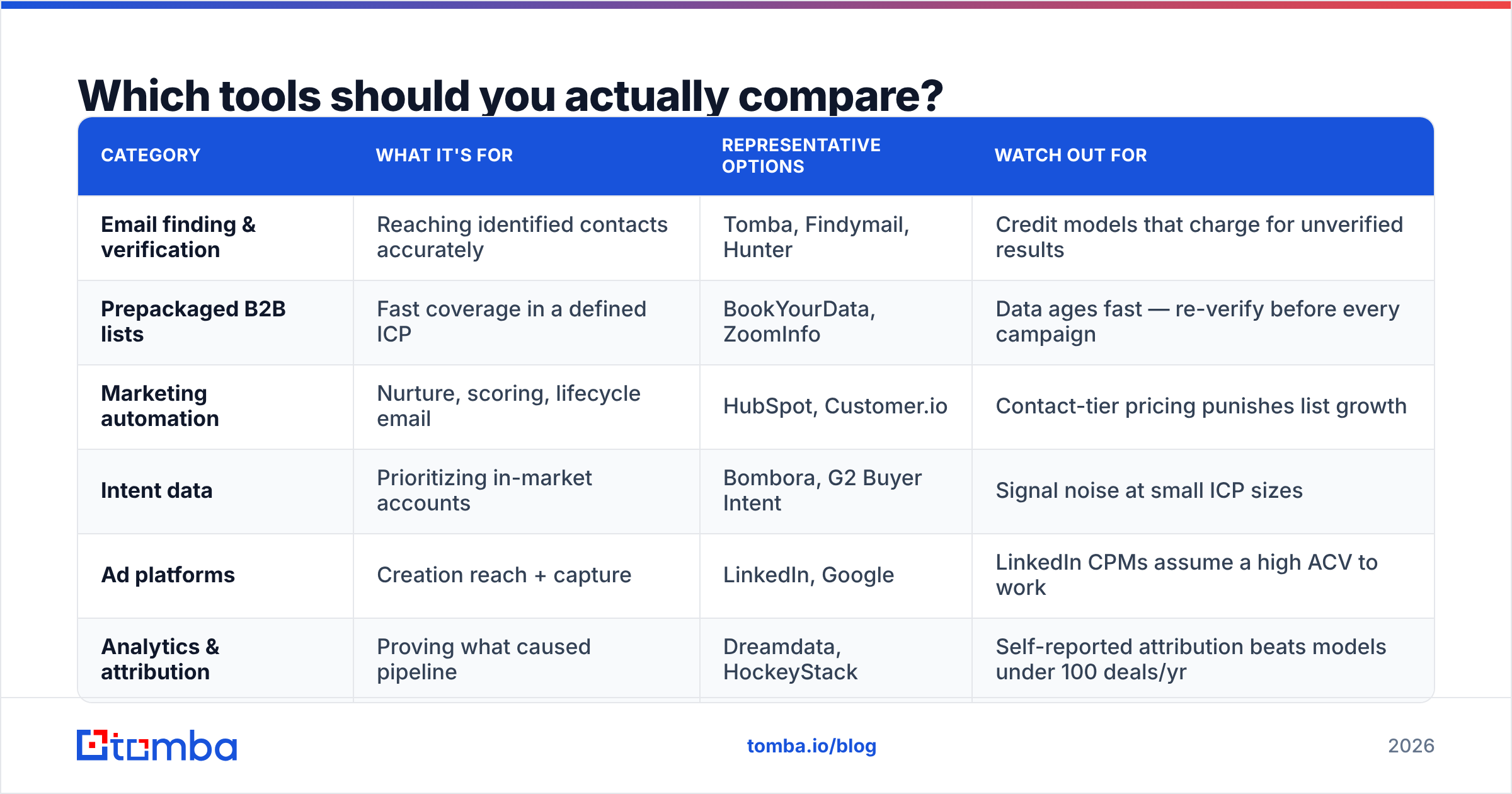
You don't need one platform to do all of this. You need a data source you trust and a system of record that everyone touches. Here's an honest read on the categories:
| Category | What it's for | Representative options | Watch out for |
|---|---|---|---|
| Email finding & verification | Reaching identified contacts accurately | Tomba, Findymail, Hunter | Credit models that charge for unverified results |
| Prepackaged B2B lists | Fast coverage in a defined ICP | BookYourData, ZoomInfo | Data ages fast — re-verify before every campaign |
| Marketing automation | Nurture, scoring, lifecycle email | HubSpot, Customer.io | Contact-tier pricing punishes list growth |
| Intent data | Prioritizing in-market accounts | Bombora, G2 Buyer Intent | Signal noise at small ICP sizes |
| Ad platforms | Creation reach + capture | LinkedIn, Google | LinkedIn CPMs assume a high ACV to work |
| Analytics & attribution | Proving what caused pipeline | Dreamdata, HockeyStack | Self-reported attribution beats models under 100 deals/yr |
BookYourData is a genuinely solid option when you want a verified list delivered to a defined ICP without building a discovery workflow first — it's a different job than an on-demand finder API. Many teams run both: a list provider for the initial ICP sweep, and a real-time email finder for the accounts that show up later through intent signals and site visits. Tomba pricing starts free at 25 searches/mo, with Starter at $49/mo and Growth at $99/mo, which makes it cheap to run alongside whatever you already have.

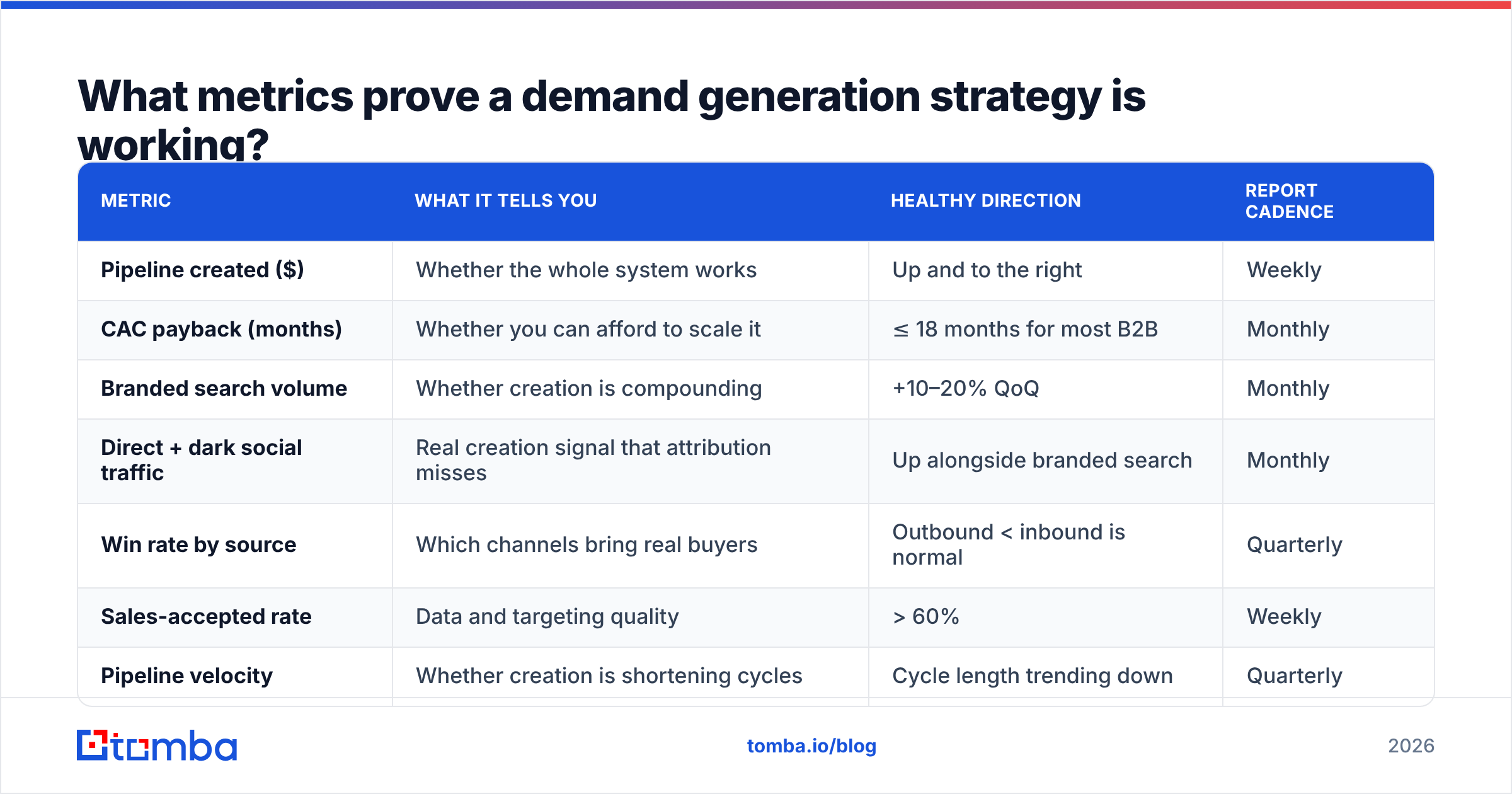
What metrics prove a demand generation strategy is working?#
Kill the MQL as a headline number. Report it internally as a diagnostic if you must, but never as the goal.
| Metric | What it tells you | Healthy direction | Report cadence |
|---|---|---|---|
| Pipeline created ($) | Whether the whole system works | Up and to the right | Weekly |
| CAC payback (months) | Whether you can afford to scale it | ≤ 18 months for most B2B | Monthly |
| Branded search volume | Whether creation is compounding | +10–20% QoQ | Monthly |
| Direct + dark social traffic | Real creation signal that attribution misses | Up alongside branded search | Monthly |
| Win rate by source | Which channels bring real buyers | Outbound < inbound is normal | Quarterly |
| Sales-accepted rate | Data and targeting quality | > 60% | Weekly |
| Pipeline velocity | Whether creation is shortening cycles | Cycle length trending down | Quarterly |
Add one qualitative input that outperforms most models: a required "How did you hear about us?" field on the demo form. Self-reported attribution catches the podcast, the Slack community, and the coworker recommendation that no pixel will ever see. Gartner's marketing research has been consistent for years that the buying journey is nonlinear and largely unobserved — your reporting should assume that instead of pretending otherwise.
What does a 90-day rollout look like?#
Days 1–30 — Instrument and clean. Define the ICP in writing with firmographic thresholds. Build the suppression list. Run your existing database through verification and see the real bounce risk. Set up account identification on the site. Agree with sales on one shared pipeline number. Do not launch anything new yet.
Days 31–60 — Ship creation and capture in parallel. Publish two creation assets a week in the format your buyers already consume, from a real human's name. Simultaneously stand up the capture layer: branded search, three bottom-funnel comparison pages, and your review-site profile. Launch one outbound sequence to accounts that showed identified intent — small volume, high personalization, verified addresses only.
Days 61–90 — Read signal, then concentrate. You will not have statistical significance. You will have directional signal: which channel produced sales-accepted opportunities, and at what cost. Move 70% of incremental budget to the winner. Keep 30% on the creation channel even if it hasn't converted yet — that's the compounding half, and cutting it is the single most common self-inflicted wound in B2B marketing.
How do outbound and demand gen fit together?#
Outbound isn't separate from demand generation — it's demand capture applied to accounts that haven't raised their hand yet. It works when it's targeted at accounts already showing signal, and it burns your domain when it's a spray across a purchased list.
The sequencing that works:
- Signal first. Site visit, content engagement, job change, funding round, or tech-stack change. No signal, no sequence.
- Verify second. Every address checked before the first send. Bounce rate above 3% starts costing you inbox placement across the whole domain.
- Relevance third. The signal should be visible in the first line of the email. If it isn't, you're writing a template, not an outbound touch.
- Volume last. Scale only after reply rate holds above 5% on a small cohort. Volume applied to a broken sequence just accelerates the damage.
For teams working from LinkedIn-sourced lists, a LinkedIn finder closes the gap between a profile you can see and an address you can actually reach — without exporting a connection dump and hoping the patterns hold.
Where should you start this week?#
Start with the data layer, because it's the constraint on everything else and it's the fastest thing to fix. Pull your current contact database, verify it, and count how many records survive. That number tells you the real ceiling on every channel in your plan — and it's usually lower than anyone expects.
Then close the loop on the accounts you're already earning. When your creation work brings a company to the site and account identification names it, you need the right person's verified address within minutes, not next quarter. That's exactly the job Tomba Email Finder is built for: find professional email addresses by domain, name, or company, verify them before they hit your sending infrastructure, and push them straight into your CRM. Start on the free tier at 25 searches a month, and scale to Starter at $49/mo when the pipeline justifies it.
Related guides#
Ready to find emails that actually work?
Join 150,000+ professionals who stopped guessing and started sending. Free credits on signup — no credit card required.
Get the Tomba newsletter
Practical outbound tactics and product updates — once every two weeks.
About the author