Demand Generation Team Structure: Roles, Ratios, Models
Most demand gen teams are org charts copied from a Series B blog post. Here's how to size, sequence, and structure yours based on ACV, motion, and pipeline math — with hiring order and real cost ranges.
TL;DR
- Demand generation team structure should follow your motion and ACV, not a template. A $6K ACV PLG company and a $180K ACV enterprise company need almost opposite first hires.
- The first four hires that reliably work: a demand gen lead, a paid/channel operator, a marketing ops or RevOps person, and a content/lifecycle owner. Brand, events, and ABM specialists come later.
- Marketing ops is the most under-hired and most leveraged role. Teams that hire it fifth spend two years cleaning attribution they never needed to break.
- Healthy ratio benchmarks: roughly 1 demand gen FTE per $2–4M in new ARR target, 1 ops person per 4–6 marketers, and 1 SDR per 1.5–2 AEs in outbound-led motions.
- Structure fails at the handoff, not the headcount. Define who owns MQL→SQL conversion before you argue about who reports to whom.
What is a demand generation team, and how is it different from marketing?#
A demand generation team owns pipeline creation. That's the whole definition, and it's narrower than "marketing."
Think of marketing as a restaurant and demand gen as the line cooks during dinner rush. Brand, PR, and product marketing set the menu and the room. Demand gen puts plates out the door on a clock, against a number, tonight. When a CMO says "we're building a demand gen function," they're saying: some part of this org now carries a pipeline quota.
That quota changes everything about the structure. A team accountable for a number needs measurement infrastructure, a channel operator who can move spend weekly, and a way to hand qualified interest to sales without leakage. A team accountable for awareness needs none of those things urgently.
Practically, a demand generation function owns:
- Paid acquisition — search, paid social, review sites (G2, Capterra), sponsorships, and retargeting.
- Organic and content-led demand — SEO, comparison pages, thought leadership that ranks and converts.
- Lifecycle and nurture — email programs, MQL-to-SQL progression, re-engagement of closed-lost.
- Outbound support — list building, contact data, sequences, and the data quality that makes them work.
- Measurement — attribution, funnel conversion reporting, and CAC/pipeline efficiency math.
Notice that four of five require data operations to function. That's why the ops hire matters far earlier than most org charts assume.
What does a demand generation team structure look like at each stage?#
Here's the honest version, based on how teams that hit pipeline targets actually staff up versus how job-board org charts imply they should.
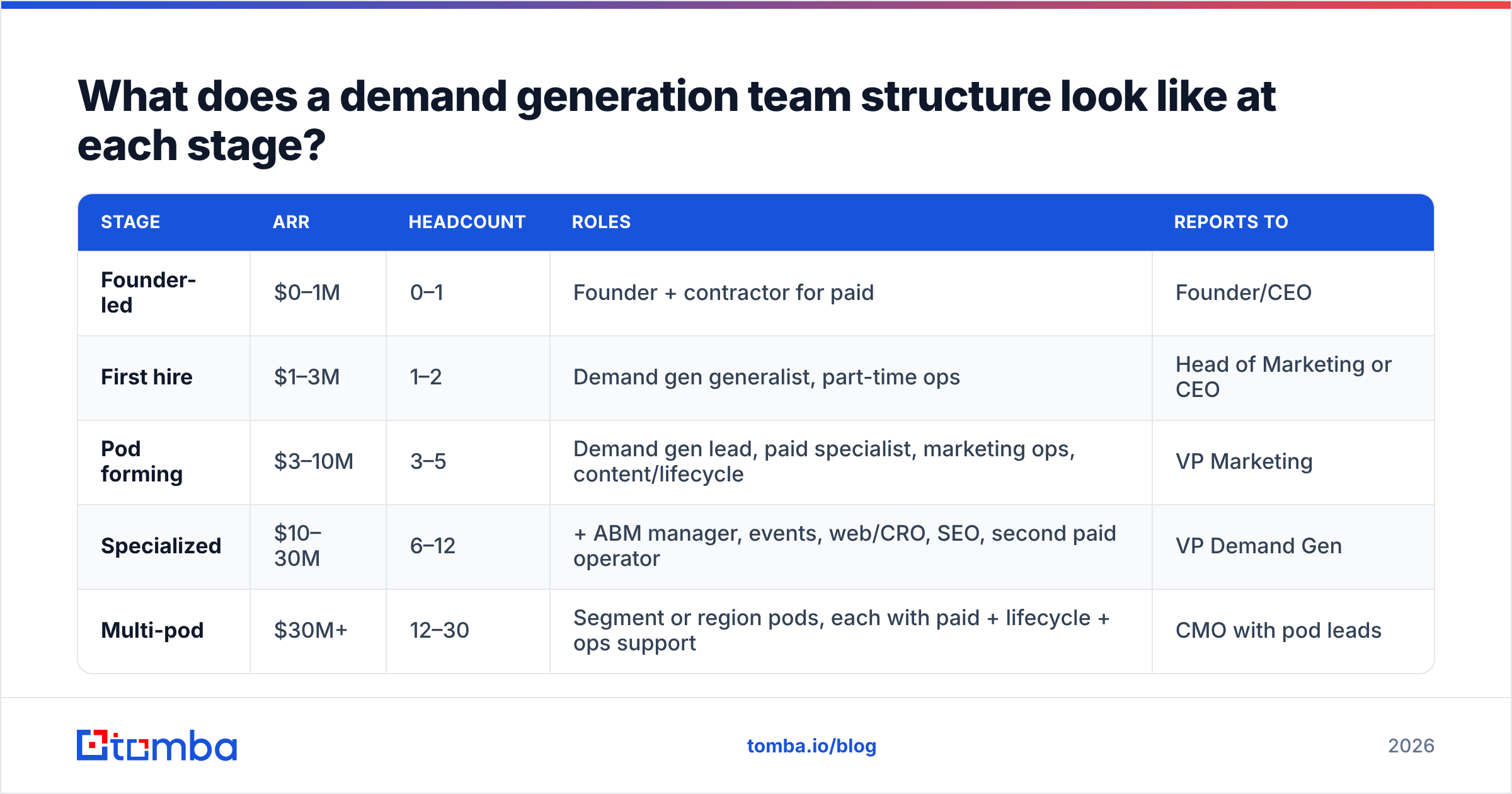
| Stage | ARR | Headcount | Roles | Reports to |
|---|---|---|---|---|
| Founder-led | $0–1M | 0–1 | Founder + contractor for paid | Founder/CEO |
| First hire | $1–3M | 1–2 | Demand gen generalist, part-time ops | Head of Marketing or CEO |
| Pod forming | $3–10M | 3–5 | Demand gen lead, paid specialist, marketing ops, content/lifecycle | VP Marketing |
| Specialized | $10–30M | 6–12 | + ABM manager, events, web/CRO, SEO, second paid operator | VP Demand Gen |
| Multi-pod | $30M+ | 12–30 | Segment or region pods, each with paid + lifecycle + ops support | CMO with pod leads |
The line that trips up most companies is the jump from "first hire" to "pod forming." At $3M ARR, the instinct is to hire another channel person because paid is working. The better move is usually the ops hire, because your first channel person is spending 40% of their week exporting CSVs and reconciling lead sources instead of optimizing campaigns.

Which roles should you hire, and in what order?#
Hiring order matters more than titles. Here's the sequence that survives contact with a real pipeline target.
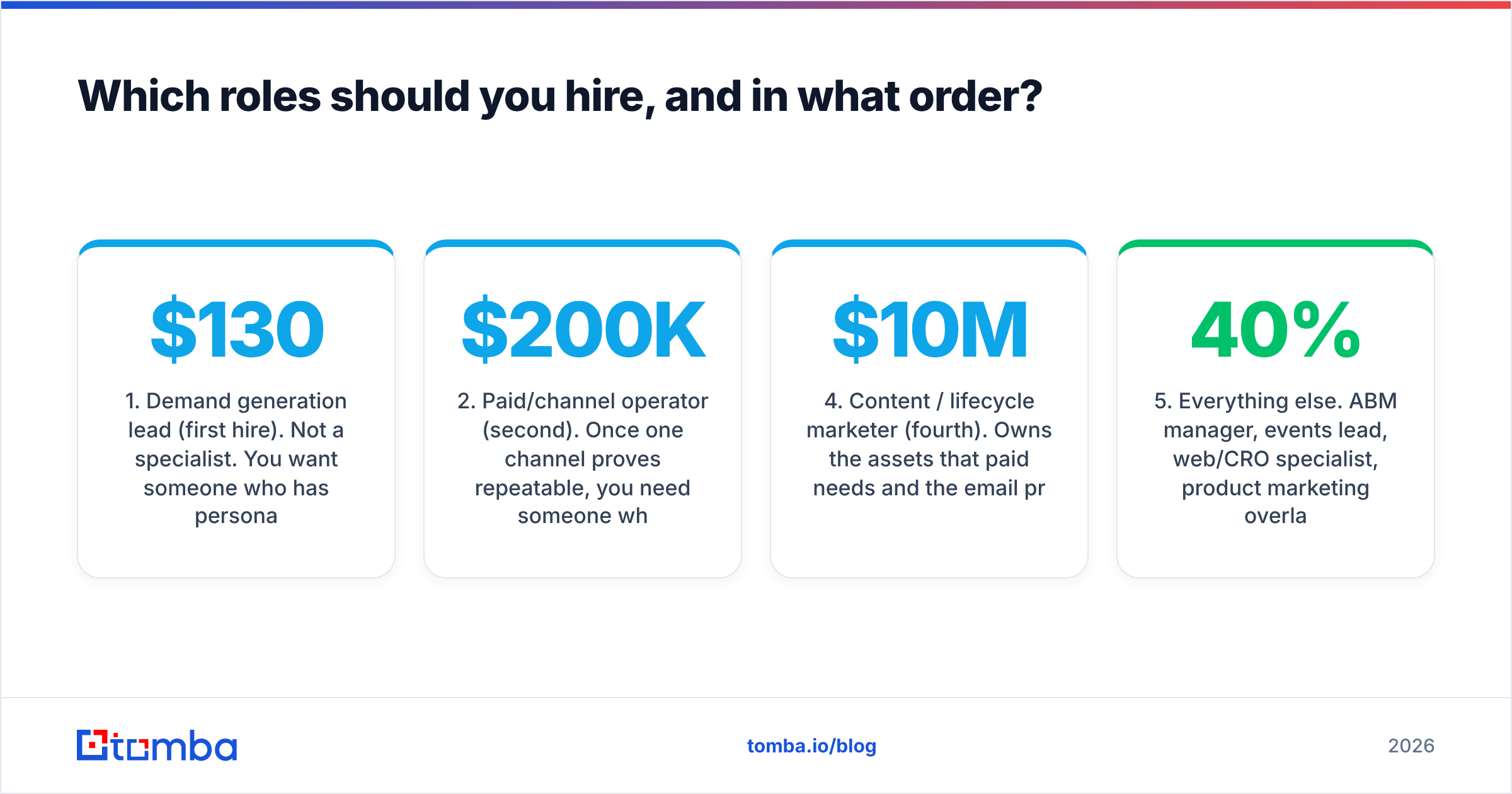
1. Demand generation lead (first hire). Not a specialist. You want someone who has personally run paid campaigns, written a nurture sequence, and built a funnel report. At this stage a "strategic" hire who briefs agencies is a liability. Expect $130–180K base in the US for someone with 5–7 years of hands-on experience.
2. Paid/channel operator (second). Once one channel proves repeatable, you need someone who lives in it daily. Search and paid social behave differently enough that most people are genuinely good at one, not both. Hire for the channel your buyers actually use — for a $200K ACV security product, that's probably review sites and events, not TikTok.
3. Marketing ops / RevOps (third — and this is the argued one). This person owns the CRM-marketing automation boundary, lead routing, scoring, deduplication, and reporting. Every week you delay this hire, you accumulate data debt that costs 3–4x more to fix later. If you can't justify a full FTE, a fractional RevOps contractor at 10 hours/week beats nothing.
4. Content / lifecycle marketer (fourth). Owns the assets that paid needs and the email programs that convert MQLs who aren't ready. In practice this role often splits into SEO/content and lifecycle/email around $10M ARR.
5. Everything else. ABM manager, events lead, web/CRO specialist, product marketing overlap, community. Each of these is a real function. None of them belongs in your first four hires unless you have an unusual motion — for example, a pure events-led enterprise business where a single conference produces 40% of pipeline.
The most common structural error is hiring #5 before #3. A company hires a shiny ABM manager, who immediately discovers the account list is stale, the firmographic data is 30% wrong, and there's no way to measure account engagement. Six months of setup work follows, done by someone hired to run programs.
How many people do you actually need? (ratios and benchmarks)#
Ratios are guardrails, not gospel. But when your team is 3x off a benchmark, something is usually structurally wrong.
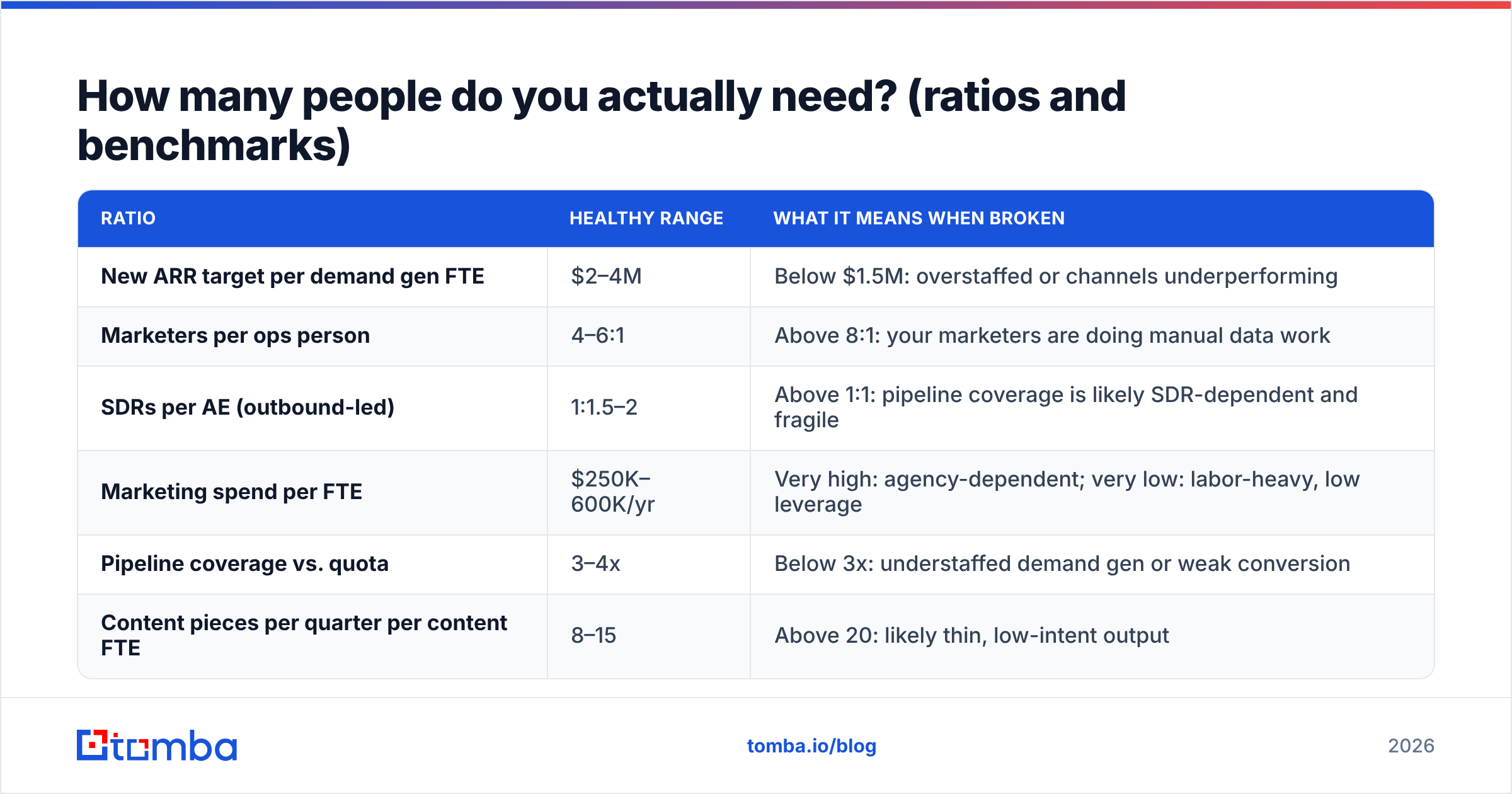
| Ratio | Healthy range | What it means when broken |
|---|---|---|
| New ARR target per demand gen FTE | $2–4M | Below $1.5M: overstaffed or channels underperforming |
| Marketers per ops person | 4–6:1 | Above 8:1: your marketers are doing manual data work |
| SDRs per AE (outbound-led) | 1:1.5–2 | Above 1:1: pipeline coverage is likely SDR-dependent and fragile |
| Marketing spend per FTE | $250K–600K/yr | Very high: agency-dependent; very low: labor-heavy, low leverage |
| Pipeline coverage vs. quota | 3–4x | Below 3x: understaffed demand gen or weak conversion |
| Content pieces per quarter per content FTE | 8–15 | Above 20: likely thin, low-intent output |
The ARR-per-FTE ratio scales inversely with ACV. Enterprise teams selling $150K+ deals often run $4–6M per demand gen head because a handful of accounts move the number. SMB and PLG teams selling $5–15K deals need more volume infrastructure and often land closer to $2M per head.
For deeper context on how these numbers roll into a broader GTM operating model, the revenue operations discipline is where ratio-setting usually lives once you're past $10M.
Should demand gen be centralized or split into pods?#
Centralize until roughly $15–25M ARR. Then pod, if — and only if — your segments have genuinely different buying behavior.
Centralized (functional) structure: everyone reports into demand gen by discipline. Paid reports to paid, content reports to content. Advantages: channel expertise compounds, budget decisions are made in one place, no duplicated tooling. Disadvantage: nobody owns a segment's pipeline number end-to-end, so accountability blurs when a segment misses.
Pod (segment or region) structure: each pod owns a segment — say, mid-market North America — with a pod lead, a paid person, and shared ops. Advantages: clear ownership, faster iteration, messaging tuned to the segment. Disadvantage: you now need 3x the tooling licenses and three people learning paid search independently.
Hybrid (most common at scale): channels stay centralized as a shared service; pods own strategy, messaging, and the pipeline number, and they "buy" channel capacity from the center. This is what most $50M+ B2B companies converge on, and it's roughly what HubSpot and similar orgs describe in their own scaling writeups.
The trigger for podding isn't headcount. It's when two segments start pulling the same person in incompatible directions — the enterprise team wants a whitepaper and a field event, the self-serve team wants landing page tests, and one marketer is trying to do both badly.
What data and tooling does the structure depend on?#
Structure and data quality are the same problem wearing two hats. A perfectly designed org running on 40%-accurate contact data will underperform a sloppy org running on clean data.
Three things break demand gen teams more than any org design flaw:
- Bad contact data. Bounced sends damage sender reputation, which quietly suppresses every nurture program you run. Before scaling send volume, run lists through an email verifier and treat anything above a 2–3% bounce rate as a blocker, not a nuisance.
- Undefined MQL→SQL handoff. If sales and marketing disagree on what "qualified" means, no reporting structure will resolve it. Write the definition down, put an SLA on follow-up time, and review disagreements weekly for the first quarter.
- Attribution nobody trusts. Pick one model, document its known blind spots, and stop relitigating it monthly. A flawed model everyone uses beats a perfect model everyone argues about.
For teams building target account lists in-house rather than buying a static database, a domain search workflow — pull every relevant contact at an account, verify, then enrich — usually costs less per usable contact than a seat-based data platform, and the data is fresher because you pull it on demand.

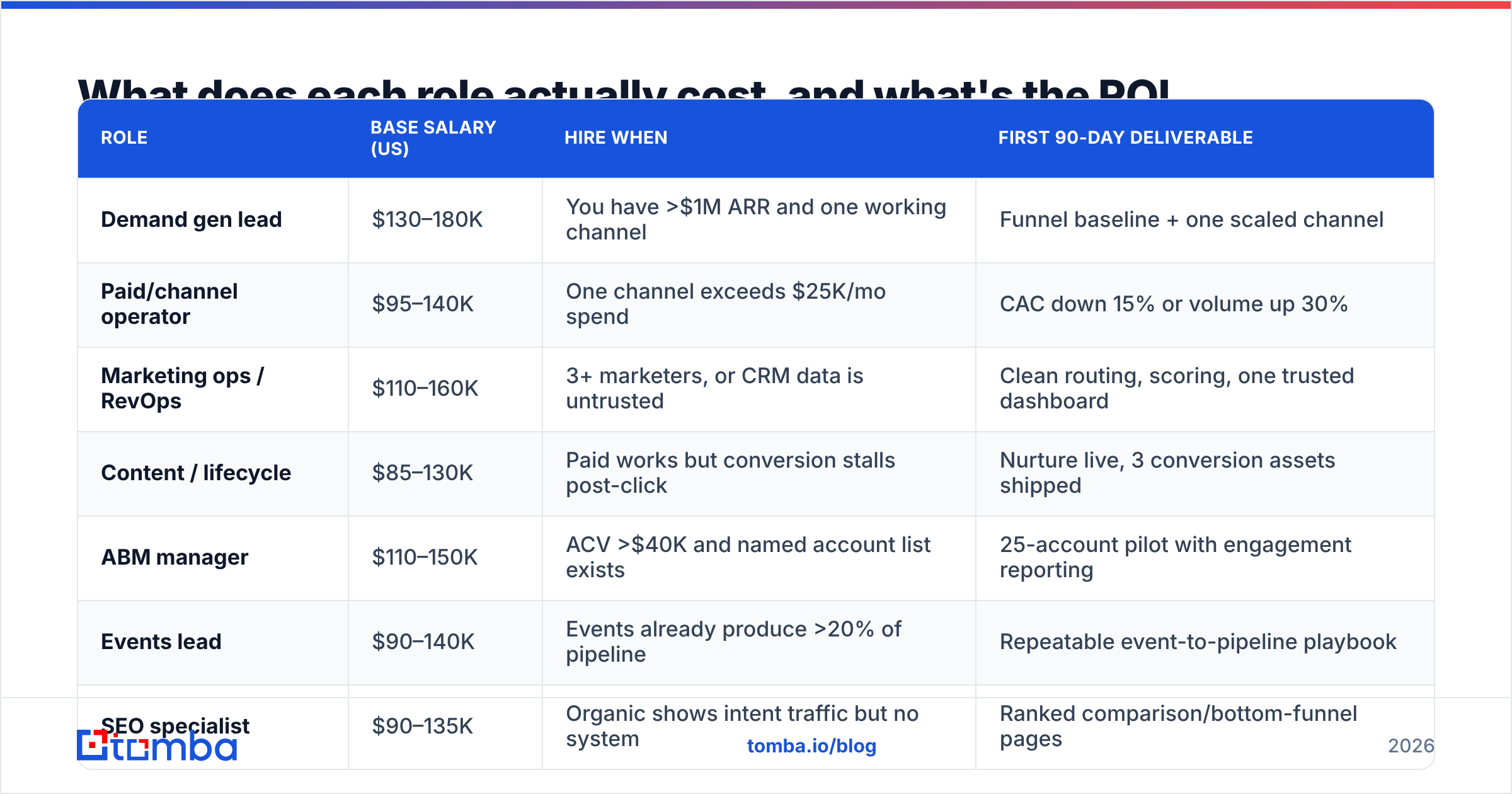
What does each role actually cost, and what's the ROI trigger?#
Budgeting the team is where most plans get vague. Here are working US ranges and the signal that justifies each hire.
| Role | Base salary (US) | Hire when | First 90-day deliverable |
|---|---|---|---|
| Demand gen lead | $130–180K | You have >$1M ARR and one working channel | Funnel baseline + one scaled channel |
| Paid/channel operator | $95–140K | One channel exceeds $25K/mo spend | CAC down 15% or volume up 30% |
| Marketing ops / RevOps | $110–160K | 3+ marketers, or CRM data is untrusted | Clean routing, scoring, one trusted dashboard |
| Content / lifecycle | $85–130K | Paid works but conversion stalls post-click | Nurture live, 3 conversion assets shipped |
| ABM manager | $110–150K | ACV >$40K and named account list exists | 25-account pilot with engagement reporting |
| Events lead | $90–140K | Events already produce >20% of pipeline | Repeatable event-to-pipeline playbook |
| SEO specialist | $90–135K | Organic shows intent traffic but no system | Ranked comparison/bottom-funnel pages |
Fully loaded cost is typically 1.25–1.4x base once you add benefits, tooling, and payroll tax. A five-person demand gen team at these ranges runs roughly $700–850K/yr in people cost before a dollar of media spend. If your annual new-ARR target is $8M, that's a defensible ratio. If it's $2M, you've built a team your business can't support yet.
Analyst research from Gartner and peer benchmarking on G2 both point at the same pattern: teams that over-hire specialists early spend more per pipeline dollar than teams that hire generalists plus ops and specialize later.
How do you know your structure is working?#
Judge the structure, not the people, on four signals:
- Time-to-decision. Can your paid operator shift $20K of budget between channels without a meeting? If not, the structure has too many approval layers for the stage you're at.
- Handoff leakage. Track MQL→SQL and SQL→opportunity conversion by source. If leakage concentrates in one source, that's a targeting problem. If it's uniform, it's a definition or SLA problem.
- Percentage of time in tooling. Ask each marketer what share of their week is spent moving data around. Above 25% means you need ops capacity, not another program hire.
- Concentration risk. If one channel produces more than 50% of pipeline, your structure is a single point of failure regardless of how clean the org chart looks.
Review these quarterly. Reorganize annually at most — every reorg costs roughly a quarter of productivity, and teams that restructure twice a year never accumulate the channel knowledge that makes demand gen compound.
One more thing worth saying plainly: headcount is the last lever, not the first. Before adding a person, check whether the constraint is actually capacity or whether it's data quality, offer strength, or a broken handoff. Adding a marketer to a broken funnel produces a busier broken funnel.
Build the data layer before you build the org chart#
The teams that scale demand generation cleanly do one unglamorous thing first: they make sure the contacts flowing into every campaign, sequence, and nurture program are real, current, and correctly attributed to the right account. Everything downstream — routing, scoring, attribution, SDR productivity — inherits that quality or that mess.
If you're building target account lists, enriching inbound leads, or feeding an outbound motion, start with Tomba Email Finder. Find verified professional emails by domain, name, or company, verify before you send, and push clean records straight into your CRM through the Tomba API or native integrations. The free tier gives you 25 searches a month to test the data quality against accounts you already know; Tomba pricing starts at $49/mo for Starter and $99/mo for Growth when you're ready to run it at team scale.
Hire the ops person. Clean the data. Then argue about the org chart.
Related guides#
Ready to find emails that actually work?
Join 150,000+ professionals who stopped guessing and started sending. Free credits on signup — no credit card required.
Get the Tomba newsletter
Practical outbound tactics and product updates — once every two weeks.
About the author