Demand Generation Tools in 2026: The Complete Stack Guide
Most demand gen stacks are three tools doing the same job and none doing the hard one. Here's how the eight categories actually fit together, what each layer costs, and where to start.
TL;DR
- Demand generation tools split into eight functional layers: audience data, intent, content/SEO, paid media, marketing automation, webinars/events, attribution, and orchestration. Most teams buy three tools in one layer and zero in another.
- The single highest-ROI spend for a team under 50 people is not an ABM platform. It is clean contact data plus one automation platform plus honest reporting.
- Intent data is real but noisy. Treat it as a prioritization signal, never as a buying signal on its own.
- Expect a functional stack to cost $500–$2,500/month at the SMB end and $8,000–$40,000/month once you add ABM and enterprise attribution.
- Budget roughly 15–20% of your demand gen tooling spend on data quality. Every downstream tool inherits your database's error rate.
What are demand generation tools?#
Demand generation tools are the software layer that creates, captures, and measures interest in your product before a sales conversation starts. That is broader than lead generation software, which mostly handles capture. Demand gen covers the top of the funnel (people who do not know you exist), the middle (people evaluating), and the measurement problem that connects both to revenue.
Think of it like a restaurant. Lead gen is the host taking reservations. Demand gen is the menu, the sign, the smell coming out the door, the review on Google, and the accountant working out which of those actually filled the tables. Different jobs, different tools.
The confusion costs money. Teams buy a sequencer, call it demand gen, and wonder why pipeline is flat. A sequencer converts existing demand. It does not create it.
What are the eight layers of a demand gen stack?#
Here is the functional breakdown. Map your current tools against it and you will usually find two layers overstuffed and two empty.
- Audience and contact data — who exists, where they work, how to reach them. Email finders, enrichment APIs, B2B databases. This is the foundation layer; error rates here compound through everything above it.
- Intent and signal — which of those accounts are researching your category right now. G2 buyer intent, Bombora, 6sense, website visitor identification.
- Content and organic — the demand-creating layer. SEO tooling, content ops, community, podcast/video distribution.
- Paid media and ads — LinkedIn Ads, Google Ads, retargeting, and the audience-sync tools that push your lists into them.
- Marketing automation — nurture, scoring, forms, lifecycle. HubSpot, Marketo, Customer.io, ActiveCampaign.
- Webinars, events, and community — the highest-intent top-of-funnel format still working in 2026.
- Attribution and analytics — multi-touch attribution, warehouse-native reporting, self-reported attribution surveys.
- Orchestration and workflow — Zapier, Make, reverse ETL, the glue that stops any of this from being manual.
Layer 1 is the one teams skip and the one that quietly breaks the other seven. A 22% bounce rate on your database does not just hurt deliverability — it corrupts your intent matching, your ad audience match rates, and every attribution number you report to the board.
Which demand generation tools are worth paying for in 2026?#
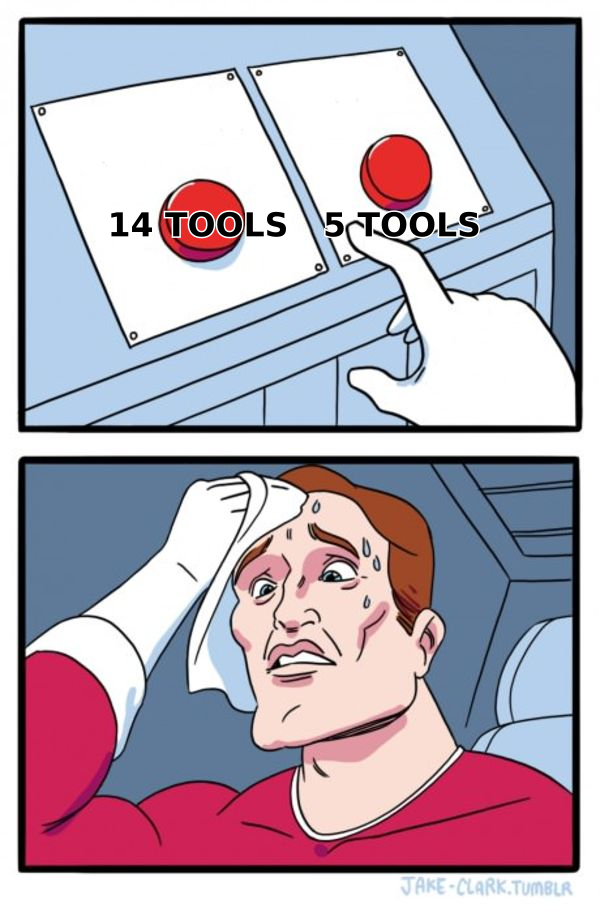
The honest answer depends on company size, but here is a comparison of the categories that most teams genuinely need, with realistic entry pricing.
| Layer | Representative tools | Entry price | What you get | Skip if |
|---|---|---|---|---|
| Contact data | Tomba, Apollo, BookYourData, Clearbit | Free–$99/mo | Verified emails, firmographics, enrichment API | You sell purely inbound PLG |
| Intent | G2 Buyer Intent, Bombora, 6sense | $1,000–$5,000/mo | Account-level research signals | ACV under $10k |
| Marketing automation | HubSpot, Customer.io, ActiveCampaign | $20–$800/mo | Nurture, scoring, forms, lifecycle | You have fewer than 500 contacts |
| Paid media ops | LinkedIn Campaign Manager, Metadata | $0 (+ad spend) | Audience sync, budget pacing | No paid budget yet |
| Webinars | Zoom Events, Goldcast, Livestorm | $79–$1,500/mo | Registration, replay, CRM sync | You run under 4 events/year |
| Attribution | Dreamdata, HockeyStack, warehouse + dbt | $1,000–$4,000/mo | Multi-touch, pipeline influence | Under 30 deals/quarter |
| Orchestration | Zapier, Make, Census | $20–$500/mo | Cross-tool workflows, reverse ETL | Everything lives in one platform |
| Website visitor ID | Tomba Reveal, Albacross, RB2B | $0–$400/mo | De-anonymize traffic to accounts | Traffic under 3k/mo |
Two things stand out. First, the data layer is by far the cheapest entry point and the highest leverage. Second, intent and attribution are the two categories where the price jump is steepest and the payback is slowest — which is why they should be the last two you buy, not the first.
How do you build a demand gen stack from scratch?#
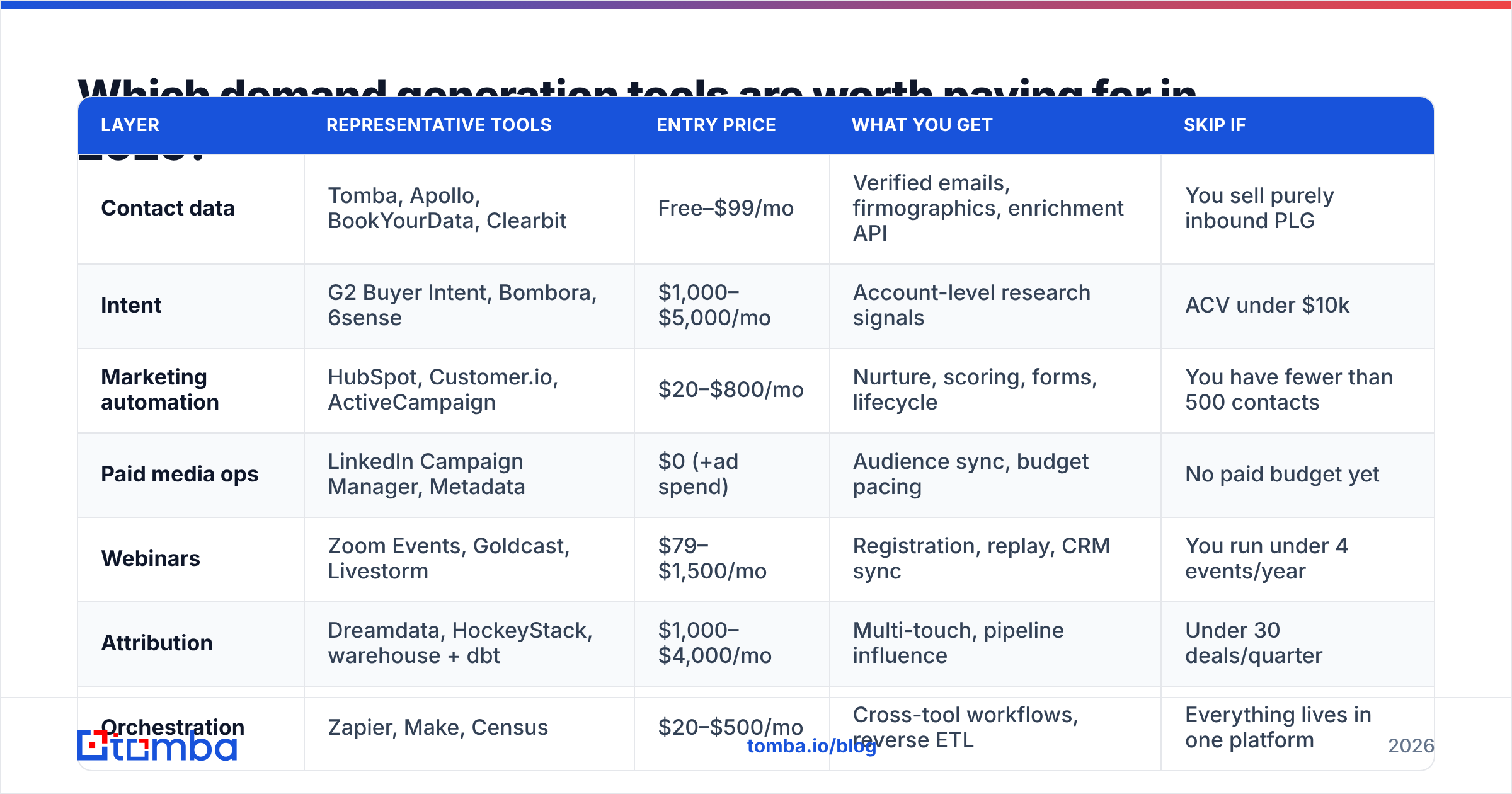
Work bottom-up. Each stage assumes the one below it is working.
Stage 1 — Get the data right (month 1, ~$50–$150/mo). Pick one source of truth for contacts and one verification step. An email finder plus an email verifier covers both. Run your existing CRM export through verification before you do anything else; most teams find 12–25% of their database is dead. That is not a rounding error — it is the difference between a 2% and a 0.4% reply rate.
Stage 2 — Add capture and automation (month 2, ~$100–$800/mo). Forms, lifecycle stages, a nurture sequence, and a scoring model that is deliberately simple. Do not build a 40-variable score in month two. Use three: fit, engagement recency, and a single high-intent action like pricing-page view.
Stage 3 — Turn on distribution (month 3+). Content, paid, webinars — in whatever order matches where your buyers already are. This is the layer that actually generates demand rather than harvesting it, and it is also the slowest to show returns. Give it two quarters before judging it.
Stage 4 — Measure honestly (month 4+). Add a self-reported attribution field to your demo form before you buy an attribution platform. It costs nothing and it is frequently more accurate than a $3,000/month multi-touch model, because it captures dark social, podcasts, and word of mouth that no pixel can see. Forrester's B2B research has been making this point for years and it still holds.
Stage 5 — Layer intent last. Once you have volume, add intent to prioritize rather than to prospect. G2's buyer intent data is the most accessible starting point because it is anchored to actual category research on review pages rather than inferred content consumption.
Is intent data actually worth it?#
Sometimes, and less often than vendors imply. Here is the mechanic: intent providers detect content consumption across a publisher network, map the IP or cookie to an account, and tell you that Account X is "surging" on your topic.
The problems are structural. IP-to-account resolution is imperfect, especially with remote work. A surge often reflects one curious intern, not a buying committee. And by the time a large-account surge is visible to you, it is visible to every competitor buying the same feed.
Use intent this way instead:
- As a tiebreaker. You have 400 accounts that fit your ICP and capacity for 80. Intent orders the list. It does not build it.
- As a timing trigger for existing relationships. A closed-lost account from nine months ago showing category surge is a genuinely good call.
- As a content signal. If accounts are surging on a subtopic you have no content for, that is a roadmap item.
- Never as a cold-outreach justification on its own. "I saw you were researching X" reads as surveillance and converts badly.
Pair intent with website visitor reveal on your own properties before buying third-party intent. First-party signal — someone on your pricing page — beats third-party inference almost every time, and it costs a fraction as much.
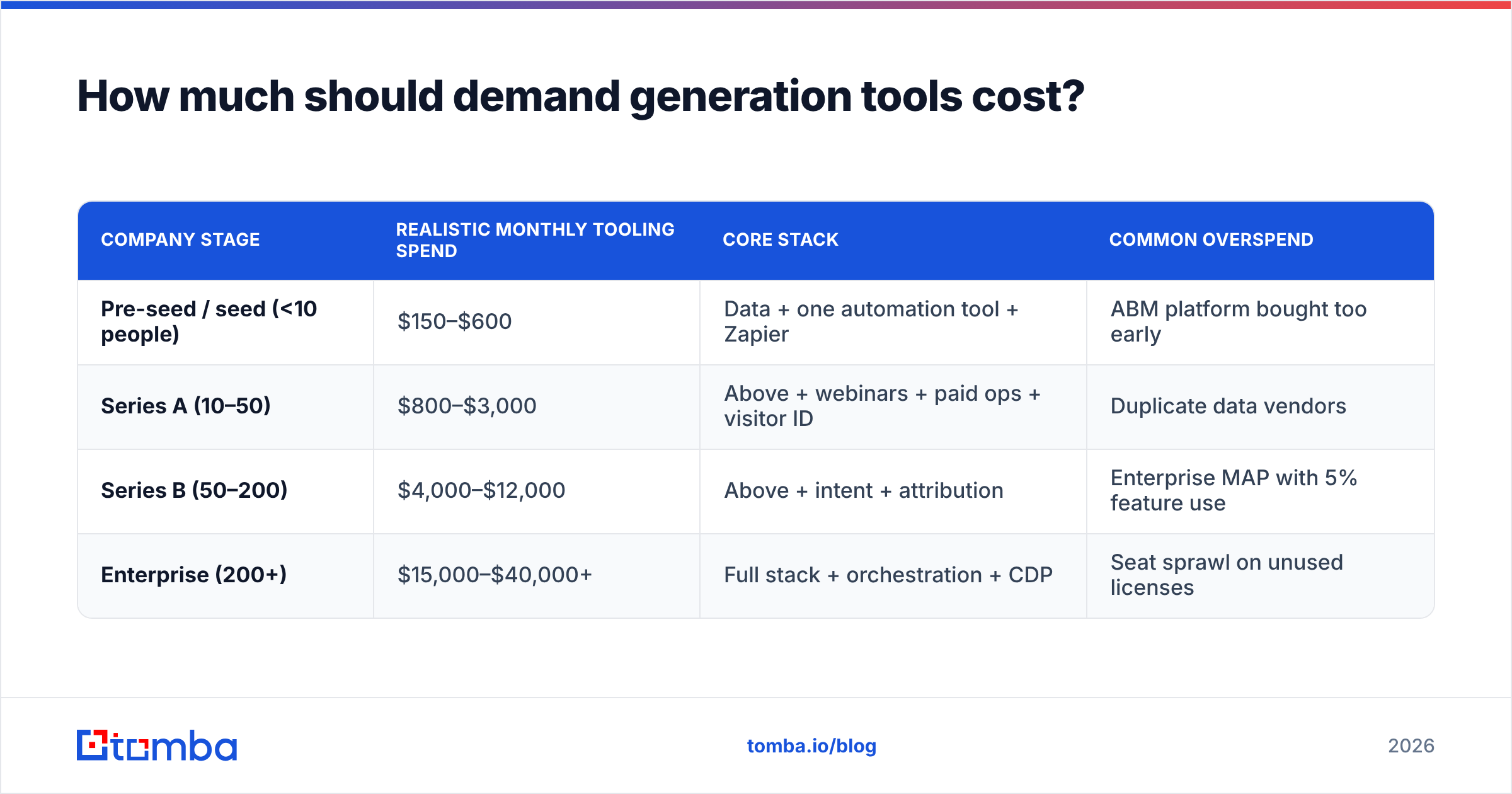
How much should demand generation tools cost?#
Benchmark against pipeline, not against headcount. A reasonable rule: total demand gen tooling should sit between 8% and 15% of your marketing budget, with the balance going to people and media.
| Company stage | Realistic monthly tooling spend | Core stack | Common overspend |
|---|---|---|---|
| Pre-seed / seed (<10 people) | $150–$600 | Data + one automation tool + Zapier | ABM platform bought too early |
| Series A (10–50) | $800–$3,000 | Above + webinars + paid ops + visitor ID | Duplicate data vendors |
| Series B (50–200) | $4,000–$12,000 | Above + intent + attribution | Enterprise MAP with 5% feature use |
| Enterprise (200+) | $15,000–$40,000+ | Full stack + orchestration + CDP | Seat sprawl on unused licenses |
The most common waste pattern is not buying an expensive tool. It is buying three tools that each partially solve the data problem — an enrichment vendor, a database subscription, and a sales-intelligence seat — and using 20% of each. Consolidate the data layer first. Tomba pricing starts free at 25 searches/month and runs $49/mo for Starter, $99/mo Growth, and $249/mo Pro, which is roughly the cost of one seat on most sales-intelligence platforms.
What should you look for when evaluating a demand gen tool?#
Run every vendor through the same five checks before the demo hypnotizes you.
- What does it replace? If the answer is "nothing, it's additive," you are adding a workflow, not removing one. That is a real cost in attention.
- What is the data lineage? Ask where the data comes from and how often it is re-verified. Vendors that will not answer this are reselling the same scraped set as everyone else. Tomba publishes its data sources, which is the minimum bar.
- Does it have a usable API? Anything that cannot be automated becomes shelfware within two quarters. Check for a real email finder API, rate limits, and sane docs — not a "contact us for API access" page.
- What is the true cost at 3x volume? Credit-based pricing looks cheap at trial volume and brutal at production volume. Model it.
- How does it exit? Can you export your data in a usable format? Contract length? Auto-renewal terms? G2 reviews filtered to one-star are more informative than the case studies.
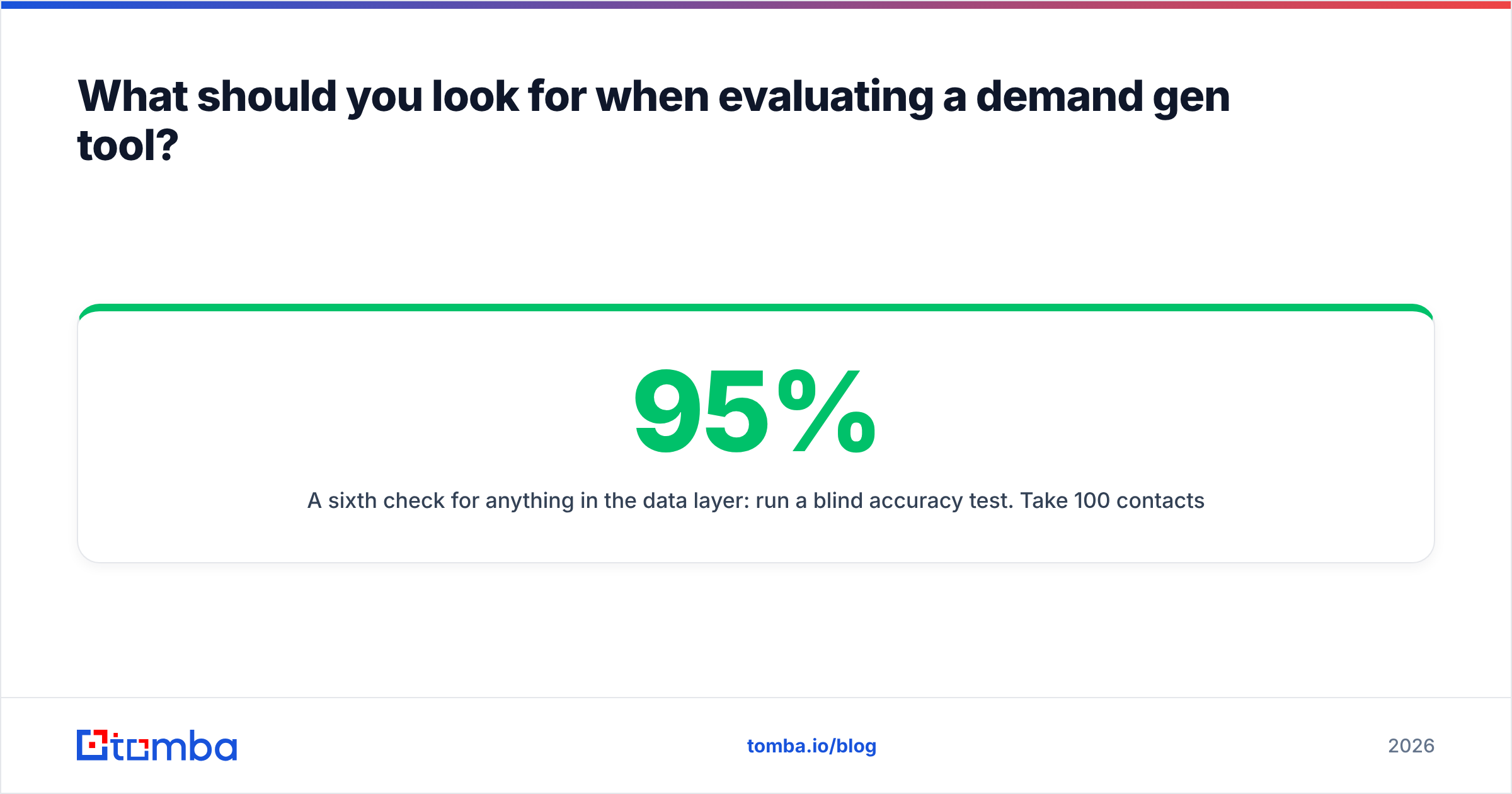
A sixth check for anything in the data layer: run a blind accuracy test. Take 100 contacts you already know are valid, strip the emails, and see what each vendor returns. Measure both hit rate and false-positive rate. A tool that returns 95% of contacts but is wrong 30% of the time is worse than one that returns 60% and is right 97% of the time, because the second one does not damage your sending domain.
What are the most common demand gen stack mistakes?#
Buying attribution before you have volume. Multi-touch attribution on 20 deals per quarter is astrology with a dashboard. Sample size matters. Use self-reported attribution until you clear roughly 100 closed-won deals per year.
Confusing activity metrics with demand. MQL volume is a capture metric. If your MQL count is up 40% and pipeline is flat, you have changed your form, not your demand.
Skipping deliverability infrastructure. No demand gen tool matters if your email lands in spam. SPF, DKIM, DMARC, and a verified list are prerequisites, not optimizations. Check your SPF record and monitor sender reputation before scaling any outbound motion.
Letting the CRM become a graveyard. Contacts decay at roughly 22–30% per year as people change jobs. Without scheduled re-enrichment, a two-year-old database is half fiction. Set a quarterly data enrichment run as a recurring calendar item, not a project.
Over-indexing on one channel. The teams that got destroyed in the last two years were the ones running a single-channel motion — pure cold email, or pure LinkedIn Ads. Channel risk is real. Three functioning channels beat one excellent one.
How do demand gen tools connect to sales?#
Badly, usually. The handoff is where most stacks leak.
The mechanical fix is straightforward: one shared definition of a qualified account, one shared field for the source, and one automated route. If a marketing tool creates a record that a rep has to manually re-enter anywhere, the integration is broken regardless of what the vendor's logo wall says.
Practical checklist for the handoff layer:
- Bidirectional CRM sync, not one-way push. Sales-side disposition needs to flow back so scoring can learn.
- Enrichment at the point of creation, so reps never see a record with a blank company size.
- Deduplication on write, not as a monthly cleanup job.
- A single owner for the handoff SLA. Shared ownership means no ownership.
Native connectors matter more than Zapier for high-volume paths. Check for direct HubSpot integration or Salesforce integration before assuming you can glue it together later — glue has latency, and latency on a hot lead costs conversion. HubSpot's own research on lead response time has consistently found that contacting inside the first hour dramatically outperforms anything slower.
Which layer should you fix first?#
The one where your error rate is highest and your cost is lowest. For nine out of ten teams, that is the data layer.
Run this diagnostic before your next tool purchase: export 500 contacts from your CRM, verify them, and calculate the invalid percentage. If it is above 10%, no amount of intent data, attribution modeling, or ad optimization will fix your pipeline — you are optimizing distribution of a broken signal. Fix the base, then build up.
If it is under 5%, your data layer is fine and your bottleneck is elsewhere: probably distribution (nobody knows you exist) or conversion (they know and do not care). Those need content and positioning work, not software.
Start with the layer everything else depends on#
Every tool above the data layer inherits your contact database's accuracy. Intent scoring on stale accounts, ad audiences with 40% match rates, attribution models tracking people who left the company — all of it traces back to the same root cause.
Start there. Tomba's Email Finder gives you verified professional emails by domain, name, or company, with a free tier at 25 searches per month to test accuracy against your own known-good list before you commit. Pair it with the email verifier for a quarterly database hygiene run, and you have the foundation the other seven layers need — for less than the cost of a single seat on most platforms you were about to evaluate.
Related guides#
Ready to find emails that actually work?
Join 150,000+ professionals who stopped guessing and started sending. Free credits on signup — no credit card required.
Get the Tomba newsletter
Practical outbound tactics and product updates — once every two weeks.
About the author