Demand Generation UK: The 2026 Playbook for B2B Teams
UK demand generation runs on different rules: GDPR/PECR consent, smaller TAM, longer buying committees. Here's how UK B2B teams actually build pipeline in 2026 — with budgets, channels and a working stack.
Demand generation UK teams face a different game to their US peers. The rules are stricter. The market is smaller. Buyers move slower. So the playbook has to change too.
TL;DR
- Demand generation UK strategy is not a translated US playbook. PECR and UK GDPR change what you can send, to whom, and how you prove it.
- The UK B2B market is small. Spray-and-pray burns your whole universe in one quarter. Precision beats volume.
- PECR's corporate subscriber rules give B2B senders more room than most teams realise. But they only cover limited companies and LLPs, not sole traders or partnerships.
- The channel mix that works: LinkedIn for reach, targeted outbound for named accounts, events and community for trust, SEO for compounding.
- Budget reality: most UK mid-market B2B teams spend £8k–£40k a month all-in. Around 60–70% of that goes to people, not tools.
What does demand generation UK actually mean?#
Demand generation is everything you do to create buying interest before a deal reaches the pipeline. Lead generation is a subset of that. It is the capture step. Demand gen covers the part where nobody has raised a hand yet.
Think of it like a pub on a quiet Tuesday. Lead generation is taking orders from the people who already walked in. Demand generation is the reason anyone walked in at all: the sign outside, the reputation, the fact your mate mentioned it last week.
Three things make the UK version different:
- The rules cap what you can do. UK GDPR and the Privacy and Electronic Communications Regulations (PECR) govern electronic marketing. PECR is the stricter of the two for email and phone. It applies on top of GDPR, not instead of it.
- The market is small. The UK has about 5.5 million registered businesses. But for most SaaS or services firms, the real target list runs to a few thousand. You can burn through it.
- Buyers behave differently. UK buyers move slower. They seek consensus, bring in procurement early, and dislike high-pressure US-style sequences. Gartner puts a typical buying group at 6–10 people, and that holds here, with more caution baked in.
Copy a Bay Area playbook wholesale and you will feel it. Twelve-touch sequences, 500 emails a day, "just bumping this" follow-ups. The result is low reply rates, high complaint rates, and a domain that struggles within six months.

Is demand generation different from lead generation?#
Yes. Mixing the two up is the main reason UK marketing teams get judged on the wrong numbers.
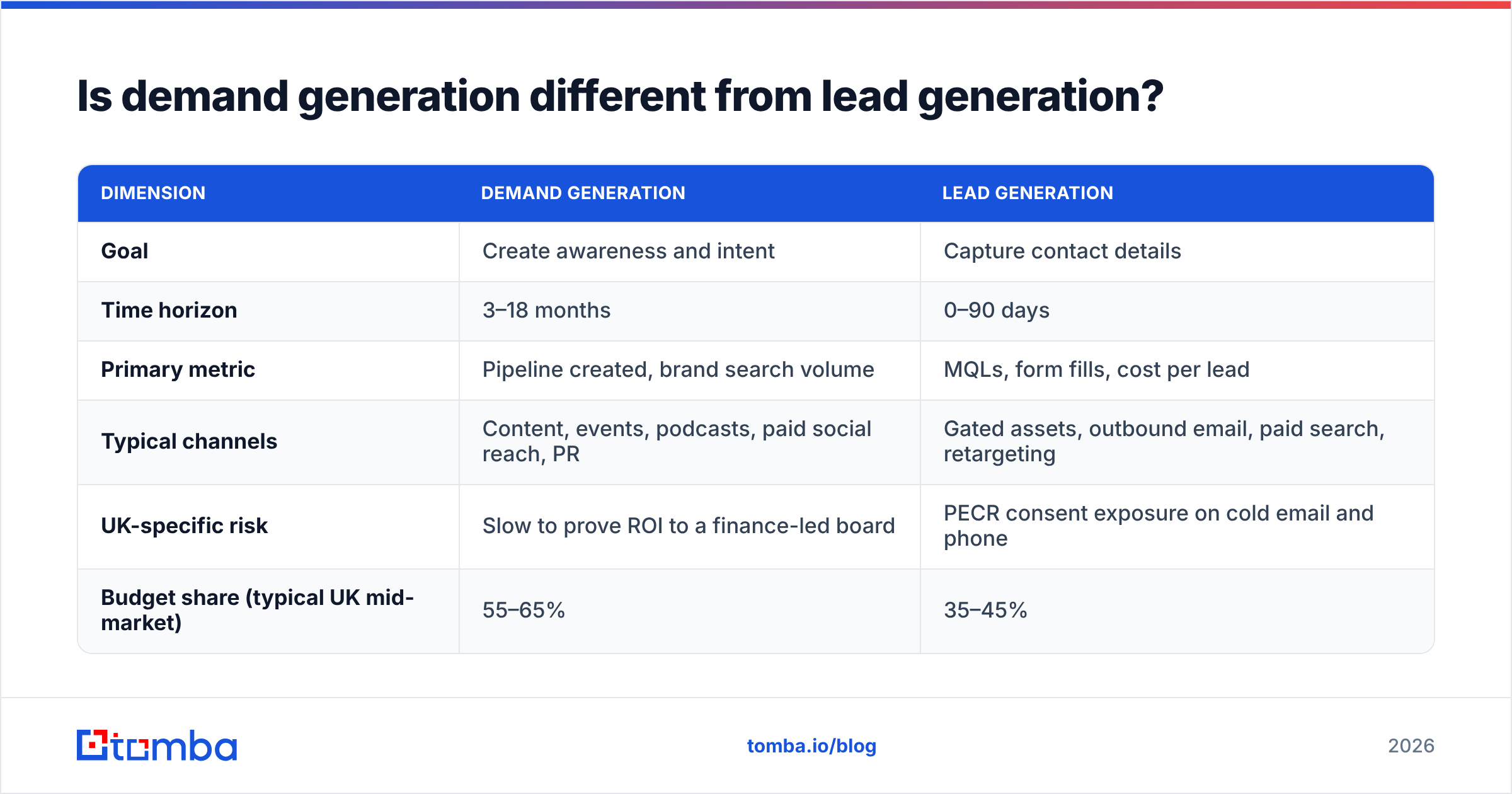
| Dimension | Demand generation | Lead generation |
|---|---|---|
| Goal | Create awareness and intent | Capture contact details |
| Time horizon | 3–18 months | 0–90 days |
| Primary metric | Pipeline created, brand search volume | MQLs, form fills, cost per lead |
| Typical channels | Content, events, podcasts, paid social reach, PR | Gated assets, outbound email, paid search, retargeting |
| UK-specific risk | Slow to prove ROI to a finance-led board | PECR consent exposure on cold email and phone |
| Budget share (typical UK mid-market) | 55–65% | 35–45% |
The practical point is simple. If your board asks how many MQLs demand gen produced this month, you have a naming problem before you have a performance problem. Demand gen creates pipeline and brand demand. Lead gen creates contacts. Report them apart.
What do UK GDPR and PECR actually allow?#
Start with the conclusion: B2B cold email to corporate subscribers is legal in the UK on a legitimate interests basis, if you meet a few conditions. It is not banned outright. It is also not a free-for-all.
Here is what matters in practice.
Corporate subscribers vs individual subscribers. PECR draws a line most teams miss. Limited companies, LLPs, government bodies and other incorporated entities count as "corporate subscribers". The consent rule for marketing email does not apply to them in the same way. Sole traders and unincorporated partnerships count as individual subscribers, so you need consent. That single line does a lot of work. It is also why knowing the company type matters as much as knowing the email.
UK GDPR still covers the personal data. Even for corporate subscribers, jane.smith@company.co.uk is personal data. You need a lawful basis, and legitimate interests works for B2B outbound. You also need a written Legitimate Interests Assessment, honesty about where the data came from, and a working opt-out on every message.
Records matter more than intentions. The ICO's direct marketing guidance is clear. You must be able to show your source, your basis, and how you handle suppression. In an audit, "we bought a list from a broker" with no paper trail is the weakest answer you can give.
Practical rules that keep UK teams safe:
- Check the company type before you send. Companies House tells you whether a target is a limited company. It is free, structured and legally load-bearing.
- Log where each contact came from. Note the source and the date. If you use an email finder, carry that source through to your CRM.
- Honour opt-outs across the whole company, not just one campaign. One unsubscribe should block that address everywhere.
- Keep a Legitimate Interests Assessment on file. One page. Purpose, need, balancing test. It takes an hour and it is your defence.
- Screen numbers against the TPS and CTPS before you call. Corporate TPS registration blocks cold sales calls to those numbers.
- Verify addresses before you send. Repeat bounces into a UK corporate mail server hurt deliverability and flag poor data hygiene.
Which channels work best for demand generation UK teams?#
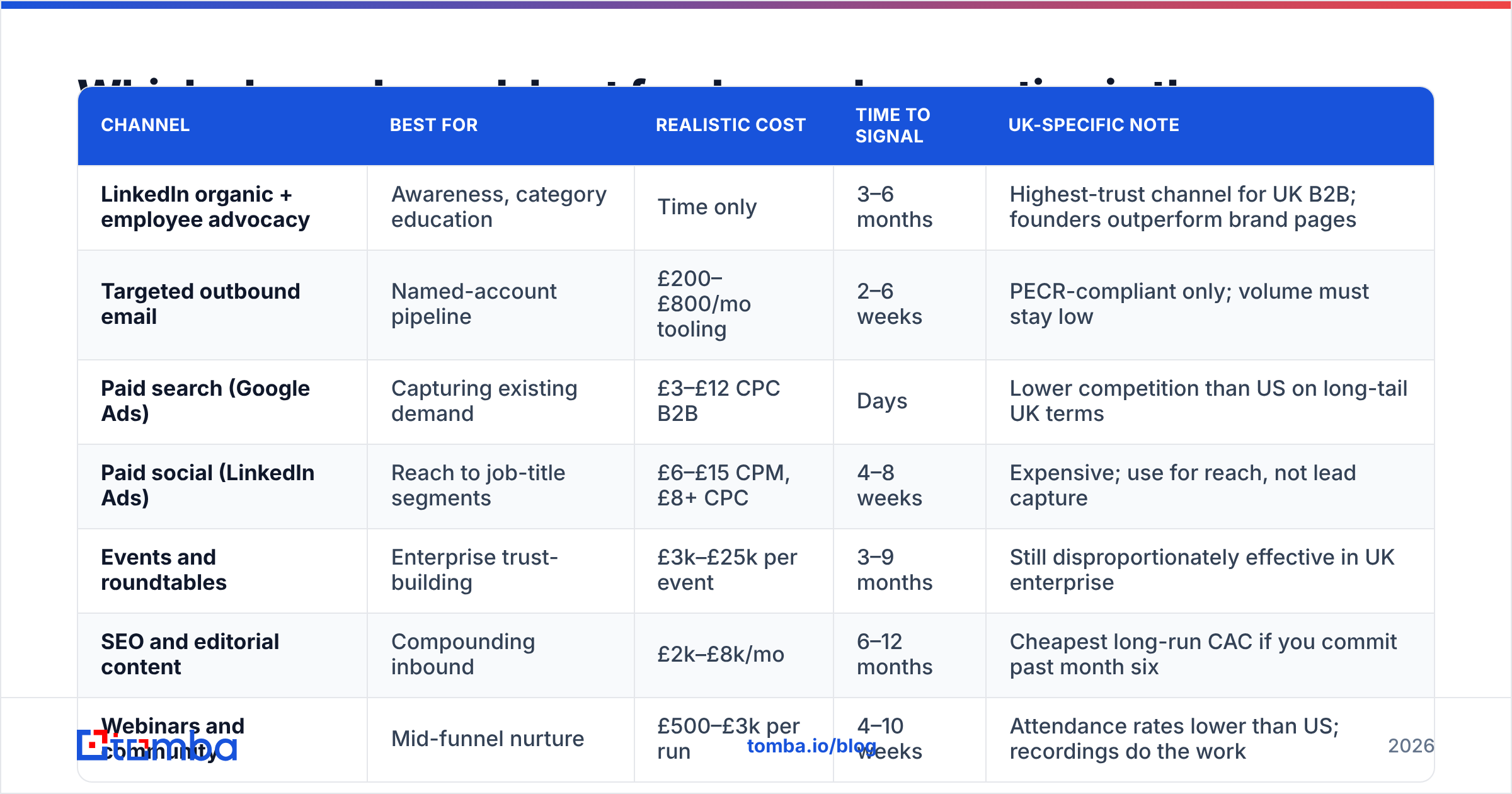
| Channel | Best for | Realistic cost | Time to signal | UK-specific note |
|---|---|---|---|---|
| LinkedIn organic + employee advocacy | Awareness, category education | Time only | 3–6 months | Highest-trust channel for UK B2B; founders outperform brand pages |
| Targeted outbound email | Named-account pipeline | £200–£800/mo tooling | 2–6 weeks | PECR-compliant only; volume must stay low |
| Paid search (Google Ads) | Capturing existing demand | £3–£12 CPC B2B | Days | Lower competition than US on long-tail UK terms |
| Paid social (LinkedIn Ads) | Reach to job-title segments | £6–£15 CPM, £8+ CPC | 4–8 weeks | Expensive; use for reach, not lead capture |
| Events and roundtables | Enterprise trust-building | £3k–£25k per event | 3–9 months | Still disproportionately effective in UK enterprise |
| SEO and editorial content | Compounding inbound | £2k–£8k/mo | 6–12 months | Cheapest long-run CAC if you commit past month six |
| Webinars and community | Mid-funnel nurture | £500–£3k per run | 4–10 weeks | Attendance rates lower than US; recordings do the work |
| Review sites (G2, Capterra) | Late-stage capture | £0–£20k/yr | 2–4 months | UK buyers check G2 before shortlisting |
Two patterns show up in how UK teams actually spend.
LinkedIn is not optional. UK B2B decision-makers cluster there more than in the US, where X and Reddit still carry weight in some sectors. Founder posts beat company page posts by a wide margin. If your CEO will not post, your organic reach has a low ceiling.
Events came back and stayed. Since 2023, small in-person roundtables of 8–15 people have produced better enterprise pipeline per pound than almost any digital channel. That holds for UK firms selling above £30k ACV. Roundtables are slow, costly and hard to scale, which is exactly why they still work.
How do you build a UK demand gen target list without breaking the rules?#
The list is the constraint. When your whole market might be 2,000 companies, list quality decides everything downstream.
Start with the shape of the market:
- Define the universe with firmographics. Industry SIC code, employee band, revenue band, region, tech stack. Companies House gives you incorporation status and filings free.
- Filter to corporate subscribers. Limited companies and LLPs first. Push sole traders down the list unless you have consent.
- Map roles, not just companies. Name the 6–10 people in the buying group: economic buyer, champion, technical evaluator, procurement.
Then build the data layer:
- Pull contacts at the domain level. A domain search returns a company's addresses and patterns in one call. That beats guessing the format for each person.
- Verify every address before it enters a sequence. Run each one through an email verifier. UK corporate domains lean heavily on Microsoft 365, so catch-all setups are common. A plain SMTP ping will not give you a clear answer.
- Enrich for a reason. Job change, funding round, new office, tech migration. One relevant fact beats five generic merge tags.

One more note on catch-all domains. Many UK enterprise mail servers accept every address at the domain, so standard checks come back "unknown". If your tool marks those as risky and you drop them, you throw away a real slice of your enterprise market. A dedicated catch-all verifier turns many of those into a clear yes or no.
What does a realistic UK demand gen budget look like?#
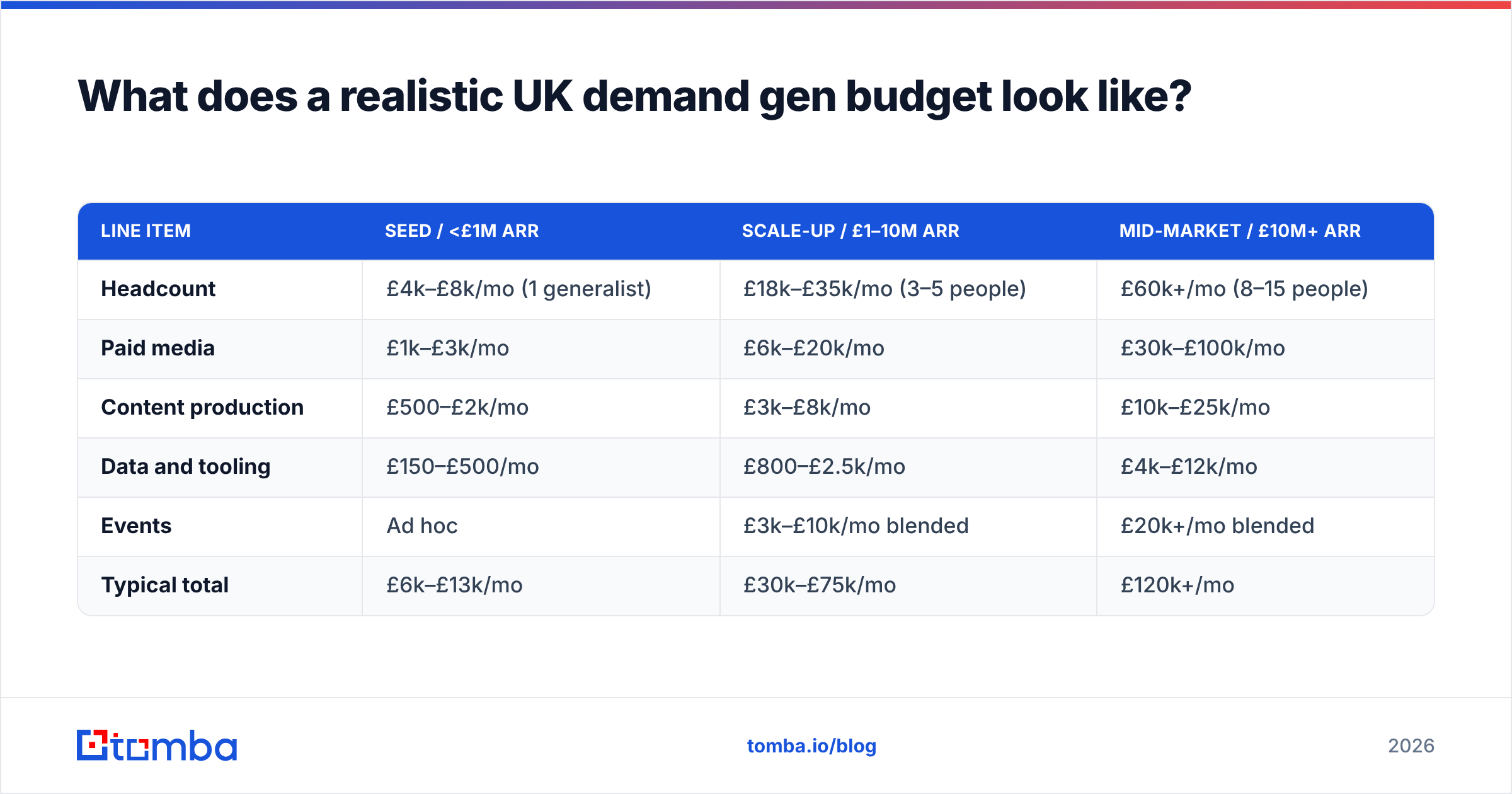
| Line item | Seed / <£1M ARR | Scale-up / £1–10M ARR | Mid-market / £10M+ ARR |
|---|---|---|---|
| Headcount | £4k–£8k/mo (1 generalist) | £18k–£35k/mo (3–5 people) | £60k+/mo (8–15 people) |
| Paid media | £1k–£3k/mo | £6k–£20k/mo | £30k–£100k/mo |
| Content production | £500–£2k/mo | £3k–£8k/mo | £10k–£25k/mo |
| Data and tooling | £150–£500/mo | £800–£2.5k/mo | £4k–£12k/mo |
| Events | Ad hoc | £3k–£10k/mo blended | £20k+/mo blended |
| Typical total | £6k–£13k/mo | £30k–£75k/mo | £120k+/mo |
Two things are worth flagging. First, tooling is the smallest line and the one teams fuss over most. Arguing for three weeks about a £200 data tool while £8k a month goes to weak LinkedIn Ads is a common trap.
Second, pay. UK demand gen salaries sit below US levels but above most of Europe. Budget roughly £45k–£70k for a demand gen manager and £85k–£120k for a head of demand gen in London. Outside the M25, less.
How should you measure UK demand generation?#
Stop putting MQLs at the top of the report. Use these instead:
- Pipeline created (£) — the one number a UK finance director will engage with.
- Brand search volume — direct and branded organic queries. The cleanest proxy for demand you created rather than captured.
- Win rate by source — a channel with fewer, better deals beats one with many bad ones.
- Sales cycle length by source — inbound from content tends to close 20–40% faster than cold outbound in UK B2B.
- Cost per opportunity, not cost per lead — bad leads are cheap to make.
- Reply rate and complaint rate on outbound — a complaint rate above 0.1% is a compliance warning, not a growth metric.
Attribution in the UK has the same flaw it has everywhere. Multi-touch models over-credit the last click and under-credit the podcast someone heard eight months ago. Self-reported attribution is unfashionable but more useful. Add a free-text "how did you hear about us?" field to the demo form. Forrester's B2B research has made this point for years, and it still holds.
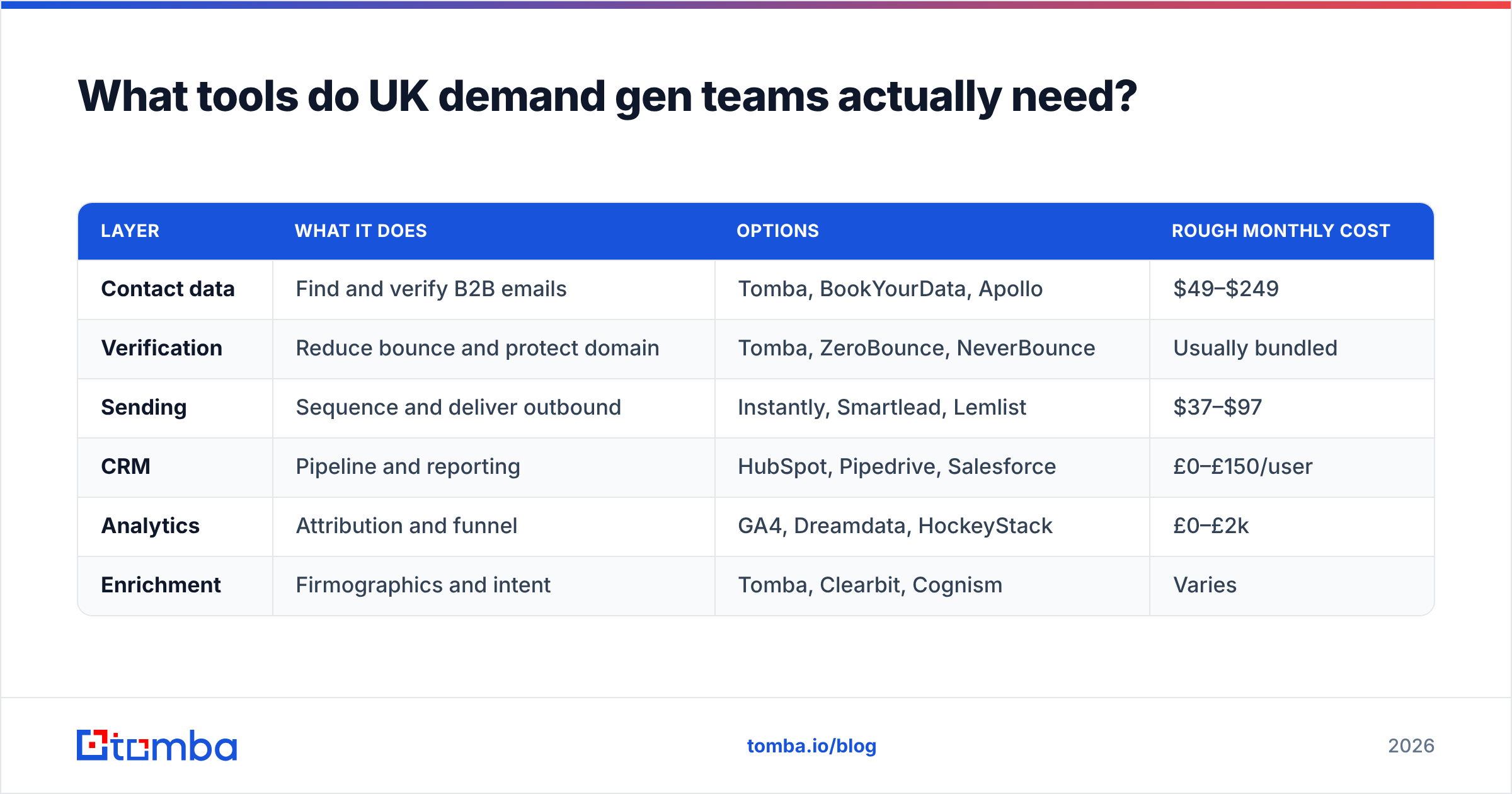
What tools do UK demand gen teams actually need?#
| Layer | What it does | Options | Rough monthly cost |
|---|---|---|---|
| Contact data | Find and verify B2B emails | Tomba, BookYourData, Apollo | $49–$249 |
| Verification | Reduce bounce and protect domain | Tomba, ZeroBounce, NeverBounce | Usually bundled |
| Sending | Sequence and deliver outbound | Instantly, Smartlead, Lemlist | $37–$97 |
| CRM | Pipeline and reporting | HubSpot, Pipedrive, Salesforce | £0–£150/user |
| Analytics | Attribution and funnel | GA4, Dreamdata, HockeyStack | £0–£2k |
| Enrichment | Firmographics and intent | Tomba, Clearbit, Cognism | Varies |
A note on data. UK coverage varies a lot between providers. Vendors that look strong on US mid-market data often thin out on UK companies below 200 employees. BookYourData works well if you want a purchased list with verification built in and prefer to pay as you go.
Tomba pricing starts with a free tier of 25 searches a month, then $49/mo Starter, $99/mo Growth and $249/mo Pro. That covers finding, verifying, catch-all resolution and data enrichment in one place, rather than stitching three vendors together.
Here is the test for any UK data vendor. Take 50 companies from your real ICP, meaning UK limited companies in your size band, and run them through a trial. Coverage and accuracy on your segment is the only benchmark that counts. Published accuracy figures are averages across a whole database, and your slice of the UK market is not average.
What should a UK demand gen team do in the first 90 days?#
Days 1–30: fix the foundation. Define your ICP tightly enough to name the companies. Audit your current list for PECR risk: company type, source, suppression. Set up SPF, DKIM and DMARC properly. Write the Legitimate Interests Assessment.
Days 31–60: build the demand surface. Get the founder posting on LinkedIn twice a week. Publish three genuinely useful pieces aimed at problems, not products. Run one small roundtable with existing customers and two prospects. Start outbound slowly: 30–50 verified contacts per day per inbox, no more.
Days 61–90: measure and cut. Look at pipeline by source, not leads. Kill the channel that produced the least qualified pipeline. Double the budget on the one that produced the most. Do not add a fourth channel until the first three work.
The classic failure is running six channels at 20% effort. Two channels at full effort will beat six at a fifth.
Where does this leave you?#
Demand generation UK rewards precision and punishes volume. The market is small, the rules are real, and buyers distrust anything that smells automated. That is good news for teams willing to do the unscalable work. A well-researched roundtable with twelve of the right people beats a hundred thousand impressions.
The one thing you cannot skip is data quality. Every channel above, from outbound and ABM to event invites, retargeting and CRM enrichment, rests on knowing who works where and whether their address is real. Get that wrong and the rest of the budget reaches nobody.
Start with the Tomba Email Finder to build a verified UK contact list from your target domains, with the source tracked. The free tier gives you 25 searches a month, so you can test coverage on your real ICP before you commit. That is how you should judge any data vendor.
Related guides#
Ready to find emails that actually work?
Join 150,000+ professionals who stopped guessing and started sending. Free credits on signup — no credit card required.
Get the Tomba newsletter
Practical outbound tactics and product updates — once every two weeks.
About the author