Demand Generation vs Demand Capture: Which Drives Pipeline?
Demand generation creates the want. Demand capture converts it. Most B2B teams overfund one and starve the other — here is how to tell which mistake you are making, and the budget split that fixes it.
TL;DR
- Demand generation vs demand capture is not either/or. It is a sequencing question, and the order shifts as you grow.
- Demand capture harvests buyers who already know they have a problem: branded search, review sites, inbound demos. It converts fast and looks great in reports.
- Demand generation creates that awareness first: content, podcasts, communities, paid social, events. It converts slowly and looks awful in last-click reports.
- Capture is capped. Only so many people search your category each quarter. Own that demand and growth stalls unless you make more.
- The practical split: 60–70% on capture until you max it out, then invert toward generation. Skip capture and you burn cash. Skip generation and you stall.
- Both motions die without good contact data. A lead you can't reach is worth zero pipeline.
What is demand capture, and why does everyone start there?#
Demand capture means intercepting buyers who are already looking. The intent exists before you show up. Your job is to be there, look credible, and be easy to buy from.
Channels that capture demand:
- Google Ads on high-intent keywords ("CRM for agencies", "Apollo alternative")
- SEO on bottom-of-funnel pages — pricing, comparison, alternatives, integrations
- Review marketplaces like G2 and Capterra
- Retargeting people who visited a pricing page
- Inbound demo requests and chat
- Affiliate and directory listings
Capture is tempting for one reason: the math works right away. You spend $4,000 on paid search. You get 40 demo requests. You close six. Every finance team on earth reads that spreadsheet. Most models reward the last touch, and capture is almost always the last touch.
The trap is that capture does not create buyers — it rations them. Say 3,000 people search your category each month and you win 60% of those clicks. Doubling ad spend will not double pipeline. It just raises your cost per click. You end up bidding against yourself and against rivals chasing the same small pool. In the demand generation vs demand capture split, capture is the half that pays this quarter and then hits a wall. Most teams hit it in year two or three.
What is demand generation, and why does it feel like a cost center?#
Demand generation is what you do to make someone want a fix before they know your category exists. You build the intent. You do not harvest it.
Channels that generate demand:
- Long-form content that reframes a problem ("your reply rate isn't a copy problem, it's a data problem")
- Paid social — LinkedIn, YouTube, Reddit — targeted at people who have never searched for you
- Podcasts, newsletters, and creator sponsorships
- Communities, Slack groups, live events, webinars
- Original research and benchmark reports
- Founder-led posting and thought leadership
Wikipedia's definition of demand generation calls it the full set of programs that drive awareness and interest. True, but it hides the accounting problem. Someone watches your YouTube video in March. In September they type your brand name into Google. That visit gets logged as "direct traffic." Your gen spend built the pipeline. Your capture channel takes the credit.
This is the core scoring flaw in demand generation vs demand capture. Bad credit is why gen budgets get cut first in a downturn. It is also why revenue drops two quarters later. The lag is real, often 60 to 180 days in B2B. The pain lands long after the person who caused it has moved on.
Demand generation vs demand capture: what actually differs?#
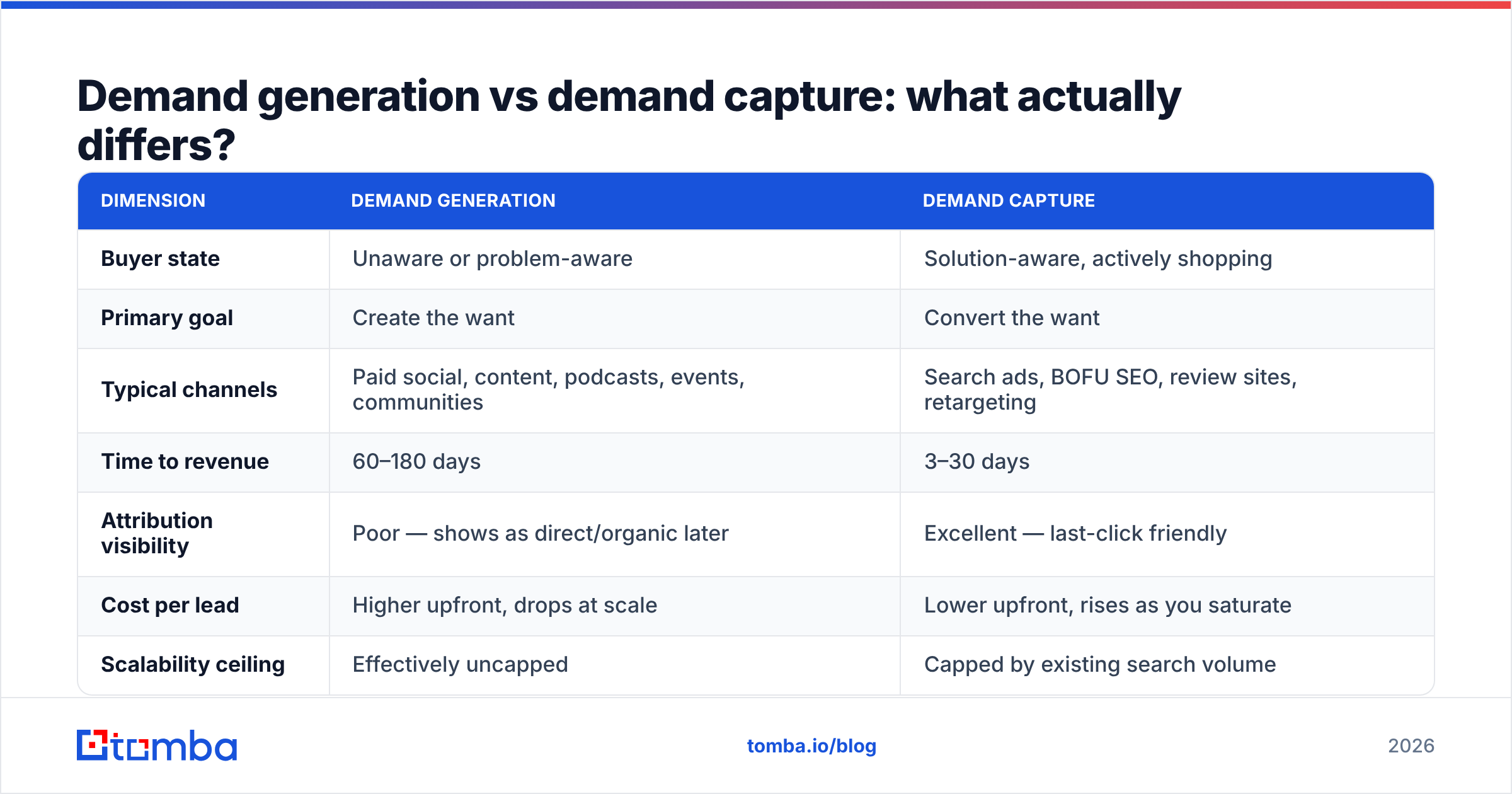
| Dimension | Demand Generation | Demand Capture |
|---|---|---|
| Buyer state | Unaware or problem-aware | Solution-aware, actively shopping |
| Primary goal | Create the want | Convert the want |
| Typical channels | Paid social, content, podcasts, events, communities | Search ads, BOFU SEO, review sites, retargeting |
| Time to revenue | 60–180 days | 3–30 days |
| Attribution visibility | Poor — shows as direct/organic later | Excellent — last-click friendly |
| Cost per lead | Higher upfront, drops at scale | Lower upfront, rises as you saturate |
| Scalability ceiling | Effectively uncapped | Capped by existing search volume |
| Main failure mode | Spend with no measurable return | Plateau, then rising CAC |
| Who it favors | Category creators, new positioning | Established categories with search volume |
| Core metric | Branded search volume, share of voice | Cost per opportunity, win rate |
That table is the whole demand generation vs demand capture debate on one screen. Read it one row at a time and the strategy writes itself. Does your category get thousands of searches a month while you win 8% of them? You have a capture problem, so stop making podcasts. Do you own the SERP already while pipeline stays flat? You have a gen problem, and more ad spend will only inflate CPCs.
Which one should you fund first?#
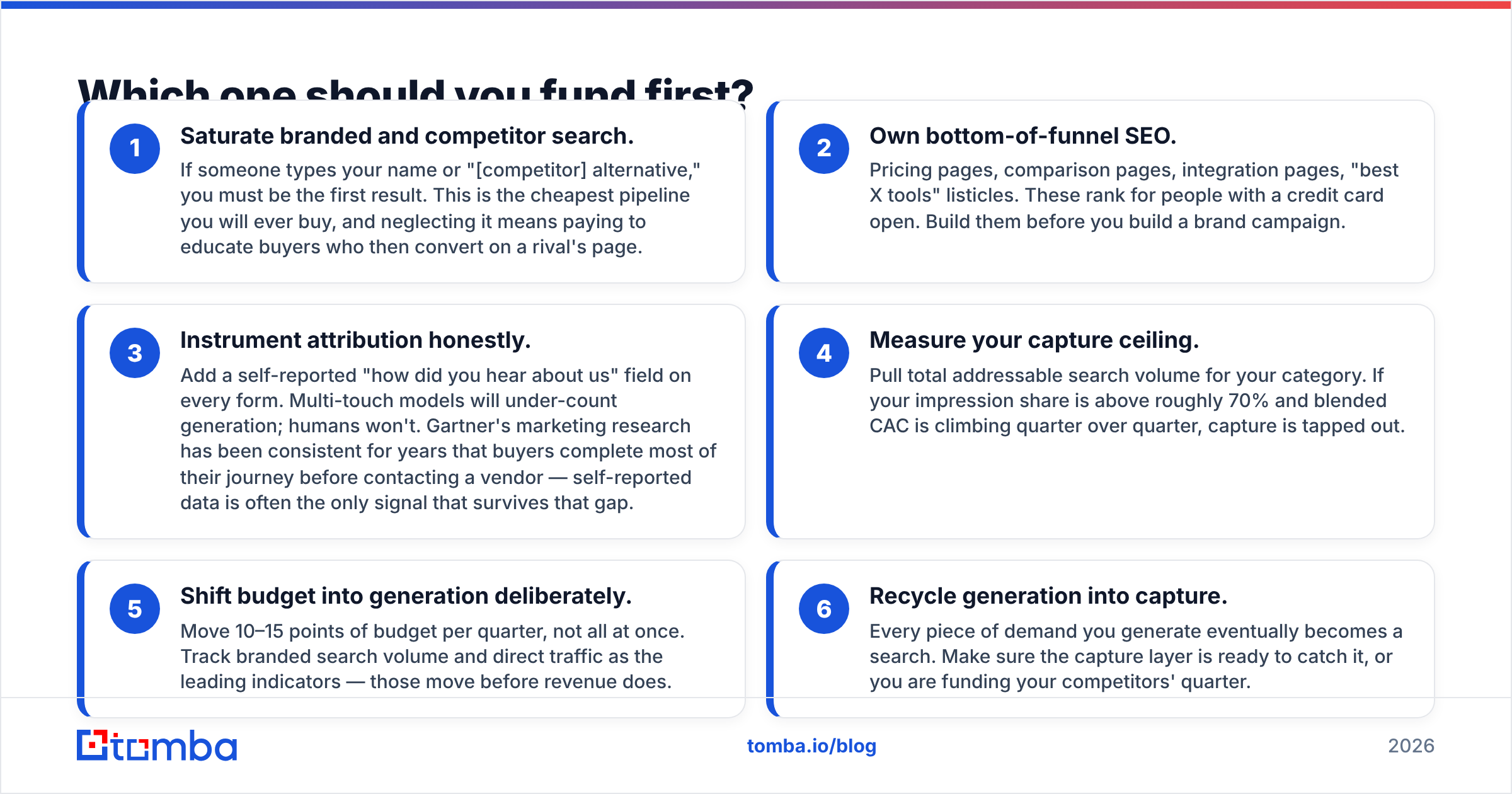
Fund capture first, almost always. Then invert. Most demand generation vs demand capture plans fail on the order, not the idea. Start with the three steps that pay back fastest:
- Saturate branded and competitor search. If someone types your name or "[competitor] alternative," you must be the first result. This is the cheapest pipeline you will ever buy. Skip it and you pay to teach buyers who then convert on a rival's page.
- Own bottom-of-funnel SEO. Pricing pages, comparison pages, integration pages, "best X tools" listicles. These rank for people with a credit card open. Build them before you build a brand campaign.
- Instrument attribution honestly. Add a "how did you hear about us" field on every form. Models will under-count gen work. Humans won't. Gartner's marketing research has said for years that buyers get most of the way through the journey before they talk to a vendor. Self-reported data is often the only signal that survives that gap.
Once those three are humming, capture stops being the growth lever. The next three steps move you toward generation on purpose:
- Measure your capture ceiling. Pull total search volume for your category. Is your impression share above roughly 70% while blended CAC climbs each quarter? Capture is tapped out.
- Shift budget into generation slowly. Move 10–15 points of budget per quarter, not all at once. Track branded search and direct traffic. Both move before revenue does.
- Recycle generation into capture. Every bit of demand you create turns into a search later. Make sure the capture layer is ready to catch it. If it is not, you are funding your rival's quarter.
Here is the blunt version. If you cannot fill your capture channels at a profit today, demand generation will not save you. It will just burn the cash more slowly.
How do you measure each one without lying to yourself?#
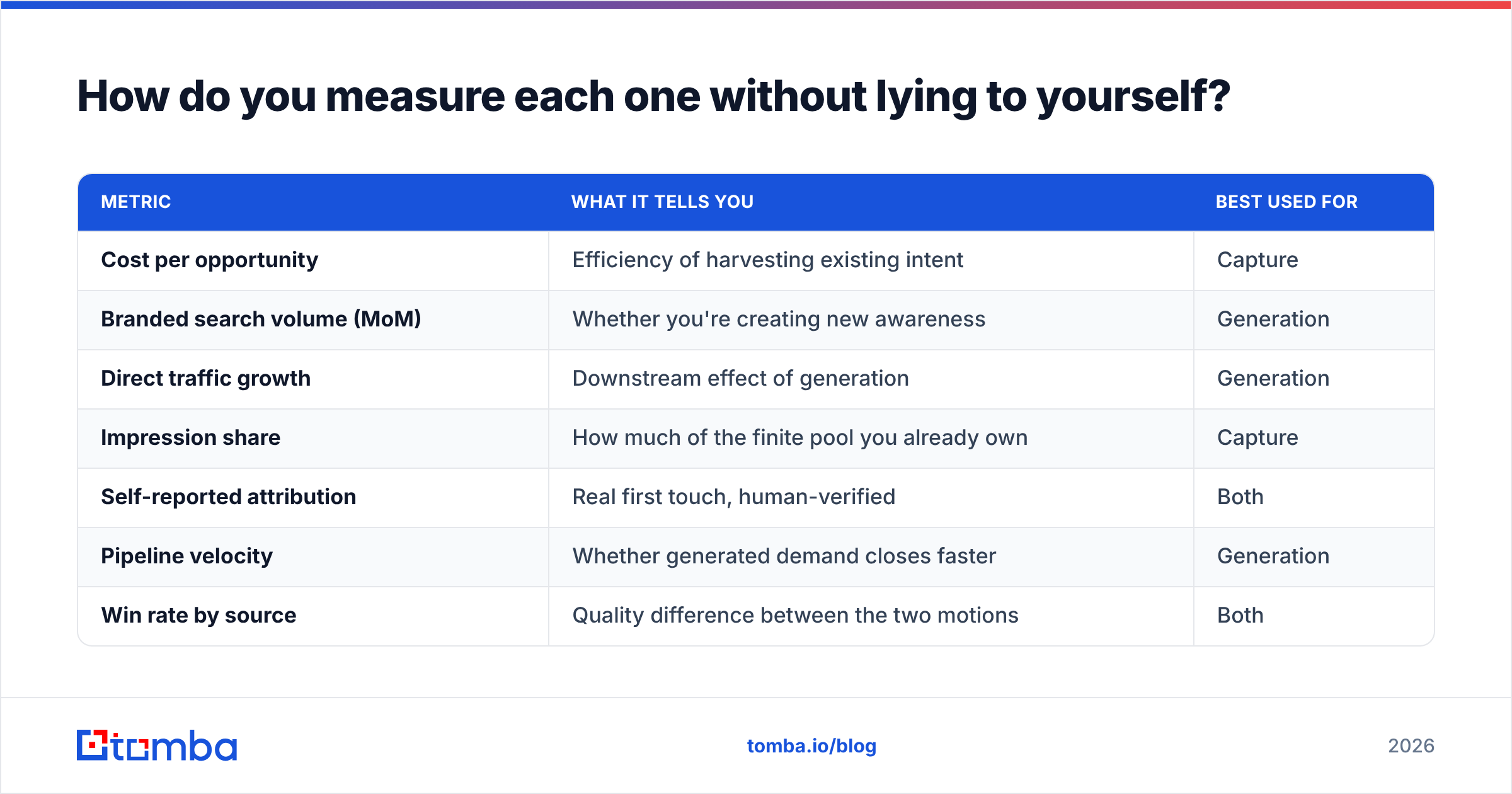
The biggest failure in demand generation vs demand capture is simple. Teams judge gen programs with capture metrics. Judging a podcast by its last-click MQLs is like judging a gym membership after one session.
| Metric | What it tells you | Best used for |
|---|---|---|
| Cost per opportunity | Efficiency of harvesting existing intent | Capture |
| Branded search volume (MoM) | Whether you're creating new awareness | Generation |
| Direct traffic growth | Downstream effect of generation | Generation |
| Impression share | How much of the finite pool you already own | Capture |
| Self-reported attribution | Real first touch, human-verified | Both |
| Pipeline velocity | Whether generated demand closes faster | Generation |
| Win rate by source | Quality difference between the two motions | Both |
| Blended CAC trend | Whether your mix is still working | Both |
Two rules make this work. First, gen gets leading signals and a longer review window, two quarters at least. Second, capture gets lagging signals, checked monthly. Mix the two cadences and you kill good programs early while bad ones live too long.
Track one more thing: reply rate on outbound sourced from each motion. Contacts who came in through generated demand tend to reply far more often than cold-pulled lists. They read your research. They follow your founder. Is your response rate stuck in the low single digits? Often you are running capture-era outbound at people who have never heard of you.
Where does outbound fit — generation or capture?#
Outbound is the awkward middle child of demand generation vs demand capture, and most teams file it wrong.
Cold outbound to a list of ICP-matched companies is demand generation with a sales-shaped delivery method. You are interrupting someone who was not looking. Measure it like gen work: longer cycle, lower instant conversion, more value in bulk.
Outbound to people who visited your pricing page, grabbed a comparison guide, or showed third-party intent is demand capture. The intent is already there. You just reach out before they fill in a form. This converts several times better, so give it your best reps.
The real difference is data. Capture-flavored outbound needs speed. You have hours, not days, before a warm signal cools. Gen-flavored outbound needs reach and accuracy across a big ICP list. Both need contacts that exist.
That is where most GTM plans leak. Teams build a lovely demand model. Then they hand sales a list where 22% of the addresses bounce. Every bounce is a wasted touch and a hit to sender reputation. It also makes the whole motion look broken when the strategy was fine.
What are the most common mistakes teams make?#
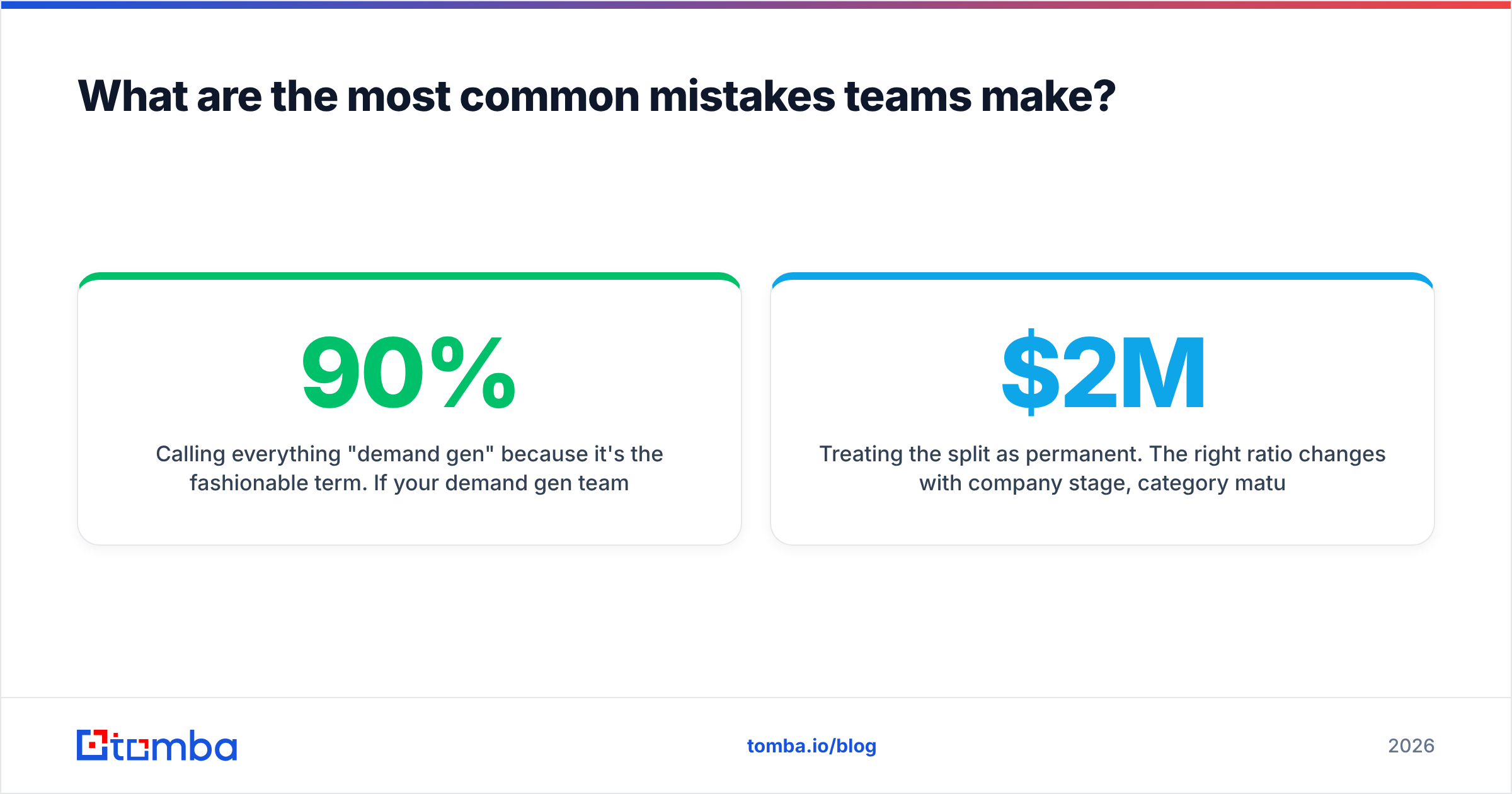
Calling everything "demand gen" because it's the fashionable term. Does your demand gen team spend 90% of its budget on Google Ads and retargeting? You have a capture team with a rebrand. That is fine. Just don't be shocked when growth stalls and nobody can say why.
Cutting generation because it "doesn't attribute." The channels that score worst are often the ones creating the demand your capture channels convert. Kill the podcast in Q1. Watch branded search drop in Q3. Watch pipeline drop in Q4. Then blame the SDR team.
Running generation before product-market fit. Building want for a product that does not retain is a costly way to grow a churn problem. Nail capture and retention first.
Ignoring the data layer entirely. Both motions end at a human you need to reach. Is your data stale, your CRM full of role-based catch-alls, and nobody verifying before send? Then the demand generation vs demand capture debate is just theater. Run a bulk pass with an email verifier before any campaign. You will strip the noisiest variable out of your reporting in an afternoon.
Treating the split as permanent. The right ratio shifts with company stage, category age, and rival pressure. Revisit it every two quarters. What worked at $2M ARR is usually wrong at $10M.
How do you connect the strategy to actual contacts?#
A demand model is a map. Contacts are the terrain. The bridge between them is less glamorous than the strategy deck. Find the accounts your gen programs are warming. Find the right people there. Check their details. Route them to the right motion.
In practice, that looks like:
- Pull the account list from your ICP definition, intent data, or the companies engaging with your content
- Find the decision-makers — use a domain search to map every reachable contact at a target company rather than guessing one name at a time
- Verify before you send, so bounce rates stay under 2% and your email deliverability survives the campaign
- Enrich for routing — seniority, department, and location decide whether a lead goes to self-serve, SDR outbound, or a nurture track
- Feed results back into the model so you learn which motion produces contacts that actually close
Teams that do this stop arguing about demand generation vs demand capture in the abstract. They can see which motion earns revenue, segment by segment. Then they move budget each quarter without the drama.
The bottom line#
Demand capture pays your bills this quarter. Demand generation decides whether you have bills worth paying in two years. Demand generation vs demand capture is not a fight between two camps. They are two halves of one system. The only real question is which half is the bottleneck right now.
Diagnose it honestly. Check your impression share. Check your branded search trend. Check whether CAC is climbing while volume stays flat. The answer is usually obvious once you look.
Whichever half you fix, both end in the same place: a real person with a real inbox. Start with accurate contacts. Use the Tomba Email Finder to turn your target account list into verified, reachable decision-makers, with 25 free searches per month and paid plans from $49/mo. See full Tomba pricing if you need bulk volume or API access. And for more tactical breakdowns like this, HubSpot's marketing blog pairs well with the data-side work Tomba handles.
Related guides#
Ready to find emails that actually work?
Join 150,000+ professionals who stopped guessing and started sending. Free credits on signup — no credit card required.
Get the Tomba newsletter
Practical outbound tactics and product updates — once every two weeks.
About the author