Demand Generation vs Lead Generation: The 2026 Guide
Demand gen creates the want. Lead gen captures the hand-raise. Most B2B teams fund one and blame the other. Here's how the two actually split, what each costs, and which to run first.
The demand generation vs lead generation debate comes down to one thing. One motion creates want. The other captures it. Here's how each works, what each costs, and which one to fund first when pipeline is flat.
TL;DR
- Demand generation creates want. It makes buyers who didn't know they had a problem realize they do. Measured in branded search, direct traffic, and self-reported attribution — not form fills.
- Lead generation captures intent that already exists. Gated content, demo requests, outbound sequences, paid search on high-intent keywords. Measured in MQLs, SQLs, and pipeline.
- They are sequential, not competing. Demand gen without capture leaks pipeline. Capture without demand gen means fighting over the same 3% of the market everyone else is emailing.
- The budget split that works for most B2B teams: 60–70% capture, 30–40% creation when you're under $5M ARR. Flip toward creation as you scale.
- Both fail on bad data. A brilliant demand program that routes to a 40%-bounce contact list produces nothing. Contact accuracy is the shared dependency.
What is demand generation, actually?#
Demand generation is the work of making people want what you sell before they're shopping for it.
Think of it like a bakery. Lead generation is the sign in the window that says "fresh bread, $4." Demand generation is the smell of baking bread drifting down the block at 7am. The sign converts people already looking for breakfast. The smell creates people looking for breakfast.
In B2B, demand gen looks like: a podcast where your CRO argues with a competitor's CRO, a LinkedIn post that names the exact operational failure your buyer had last Tuesday, an ungated benchmark report, a community, a conference talk, a comparison page that honestly says when you're the wrong choice.
None of those produce a form fill you can attribute cleanly. That's the whole problem — and the whole point. Gartner's research on B2B buying has found that buyers spend most of their journey doing research on their own. Only a small slice of that time goes to any one vendor. By the time someone fills out your form, the decision is largely made. Demand gen is how you influence that period. Lead gen is how you show up at the end of it.
What is lead generation, actually?#
Lead generation is the capture layer. It converts existing intent into a named contact with a routing path.
Concretely: gated whitepapers, webinar registrations, "book a demo" buttons, paid search on bottom-funnel keywords, review-site listings on G2 and Capterra, and outbound prospecting where you build a target list and email it.
Lead gen is measurable, controllable, and immediately reportable. That's why CFOs love it and why it dominates most B2B budgets. It's also why so many teams end up with 4,000 MQLs and 11 closed-won deals: capturing intent doesn't create intent. If only 5% of your market is in-market this quarter, no amount of capture spend manufactures the other 95%.

Demand generation vs lead generation: how do they actually differ?#
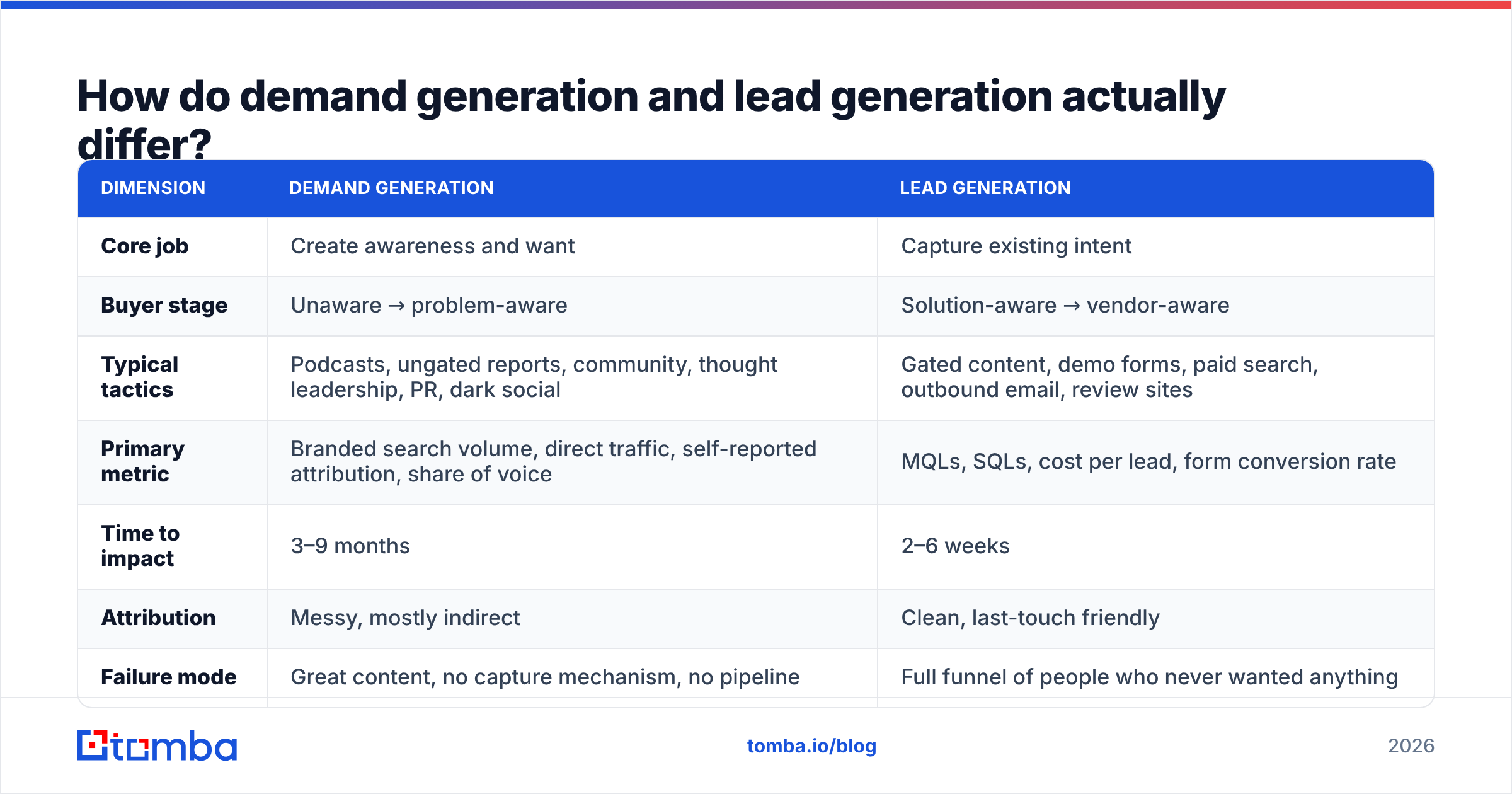
| Dimension | Demand generation | Lead generation |
|---|---|---|
| Core job | Create awareness and want | Capture existing intent |
| Buyer stage | Unaware → problem-aware | Solution-aware → vendor-aware |
| Typical tactics | Podcasts, ungated reports, community, thought leadership, PR, dark social | Gated content, demo forms, paid search, outbound email, review sites |
| Primary metric | Branded search volume, direct traffic, self-reported attribution, share of voice | MQLs, SQLs, cost per lead, form conversion rate |
| Time to impact | 3–9 months | 2–6 weeks |
| Attribution | Messy, mostly indirect | Clean, last-touch friendly |
| Failure mode | Great content, no capture mechanism, no pipeline | Full funnel of people who never wanted anything |
| Budget owner | Marketing / brand | Demand gen ops / SDR leadership |
| CAC effect | Lowers it over time | Raises it as competition bids up the same keywords |
The row that matters most is time to impact. Demand gen is a compounding asset with a lag. Lead gen is a vending machine with a rising price. Teams that cut demand gen in a tight quarter feel fine for two quarters. Then cost-per-lead climbs 40%, because nobody in the market knows who they are.
Which one should you fund first?#
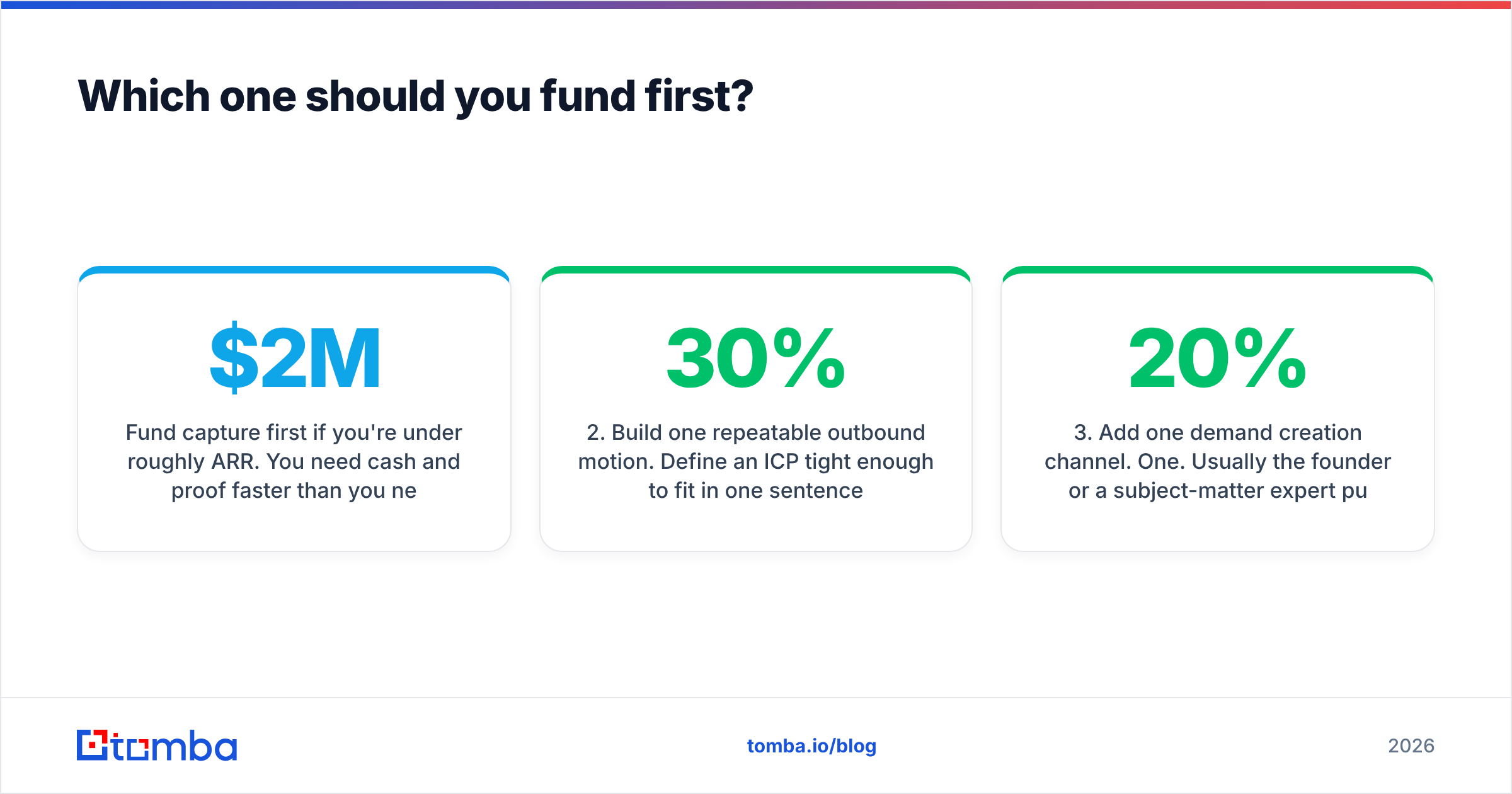
Fund capture first if you're under roughly $2M ARR. You need cash and proof faster than you need brand.
Here's the sequencing that works, in order:
- Nail the capture layer. Demo form, pricing page, one high-intent paid search campaign, review-site presence. If someone wants to buy today, make it trivially easy. This is table stakes, not strategy.
- Build one repeatable outbound motion. Define an ICP tight enough to fit in one sentence. Build a list. Verify it. Send. This is where most teams break — not on copy, but on data. A list with 30% invalid addresses destroys your sender reputation before your messaging ever gets tested.
- Add one demand creation channel. One. Usually the founder or a subject-matter expert publishing consistently on the channel where your buyers already are. Not five channels at 20% effort.
Those three are the foundation. The next three keep the system honest:
- Instrument self-reported attribution. Add a "How did you hear about us?" open text field on your demo form. Within 90 days you'll know what your dashboards can't tell you.
- Rebalance quarterly. When branded search and direct traffic start rising, shift budget toward creation. When they flatten, you underfunded it.
- Kill anything that only produces MQLs. If a channel generates leads that never convert to opportunities, it's a cost center wearing a marketing costume.
Step 2 is where the two disciplines actually merge. Your outbound list is a lead gen artifact, but the reason it works is demand gen — a prospect who's heard your name replies at a materially higher rate than one who hasn't.
How do you measure demand generation when there's no form fill?#
You measure the shadows it casts.
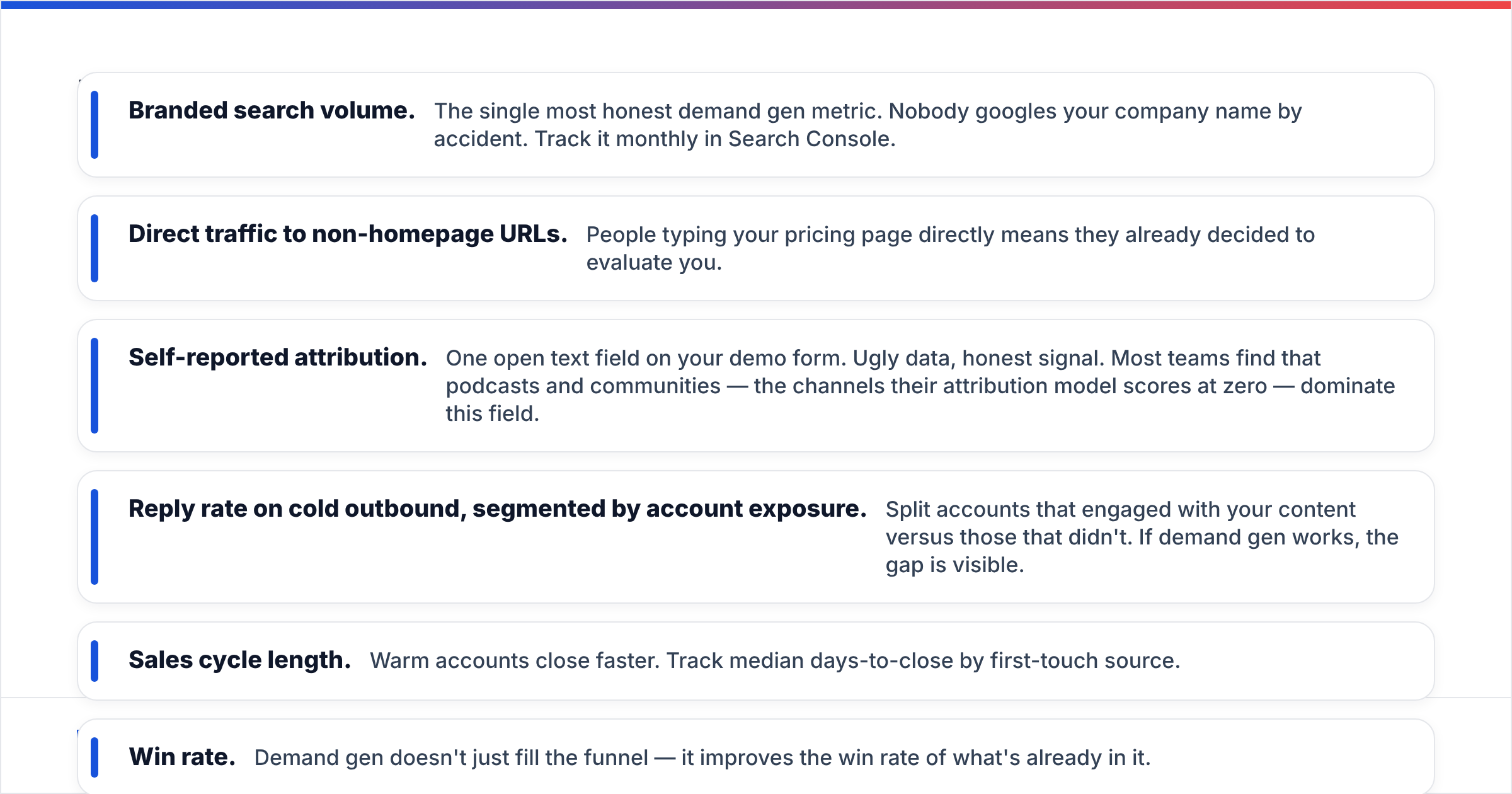
- Branded search volume. The single most honest demand gen metric. Nobody googles your company name by accident. Track it monthly in Search Console.
- Direct traffic to non-homepage URLs. People typing your pricing page directly means they already decided to evaluate you.
- Self-reported attribution. One open text field on your demo form. Ugly data, honest signal. Most teams find that podcasts and communities — the channels their attribution model scores at zero — dominate this field.
- Reply rate on cold outbound, segmented by account exposure. Split accounts that engaged with your content versus those that didn't. If demand gen works, the gap is visible.
- Sales cycle length. Warm accounts close faster. Track median days-to-close by first-touch source.
- Win rate. Demand gen doesn't just fill the funnel — it improves the win rate of what's already in it.
The trap is demanding multi-touch attribution for demand gen. It won't work. Dark social, podcast listens, and Slack community recommendations are structurally untrackable. HubSpot's research on marketing attribution is clear that no model captures every touch. Use self-reported data as your correction layer and stop pretending the dashboard is reality.
Where does contact data fit into both?#
Data is the shared substrate. Both motions die on it.
For lead generation, the connection is obvious: outbound needs valid, deliverable addresses for the right people. Build a target list from your ICP, use a domain search to pull contacts at each target account, then run every address through an email verifier before it enters a sequence. Skipping verification is how teams end up in spam folders and blame their copy.
For demand generation, the link is less obvious but just as real. Demand gen produces anonymous interest — people reading your report, listening to your podcast, lurking in your community. Turning that into something actionable requires identity resolution: matching an anonymous visitor or a partial signal to a real person at a real company. Tools like website visitor reveal and data enrichment sit exactly at that seam.
Practically, that means demand gen without a data layer stays invisible. You'll have great content, rising branded search, and no idea which twelve accounts read your report three times last week.

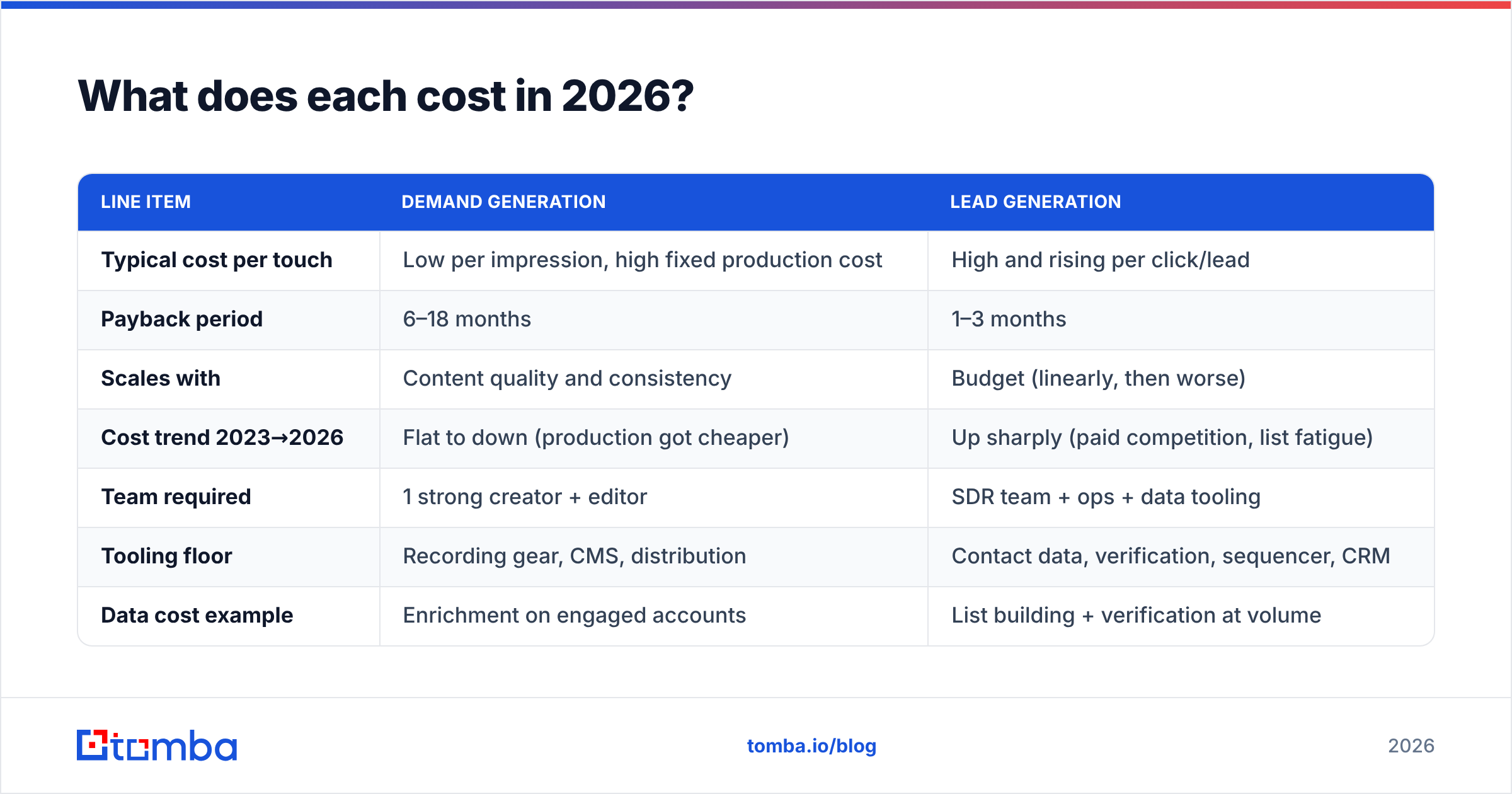
What does each cost in 2026?#
| Line item | Demand generation | Lead generation |
|---|---|---|
| Typical cost per touch | Low per impression, high fixed production cost | High and rising per click/lead |
| Payback period | 6–18 months | 1–3 months |
| Scales with | Content quality and consistency | Budget (linearly, then worse) |
| Cost trend 2023→2026 | Flat to down (production got cheaper) | Up sharply (paid competition, list fatigue) |
| Team required | 1 strong creator + editor | SDR team + ops + data tooling |
| Tooling floor | Recording gear, CMS, distribution | Contact data, verification, sequencer, CRM |
| Data cost example | Enrichment on engaged accounts | List building + verification at volume |
| Breaks when | You stop publishing | Your data decays (~25–30%/year) |
That last row is the one people underestimate. B2B contact data decays continuously as people change jobs. A list you built in January is measurably worse in July. That is why one-time data buys lose to ongoing verification. It is also why Tomba pricing starts at a free tier with 25 searches/mo and scales to Starter at $49/mo, Growth at $99/mo, and Pro at $249/mo. You're paying for freshness, not a static file.
Is "demand generation" just a rebrand of lead generation?#
Partly, yes — and it's worth being honest about that.
A lot of what gets sold as demand generation in 2026 is the same gated ebook with a nicer deck. Agencies rebranded because "lead gen" started to feel transactional. If a program's only output is still a list of form fills, it's lead gen no matter what the slide says.
The real test: does the program create want in people who weren't looking, or does it capture people who were? An ungated benchmark report distributed to 50,000 people who've never heard of you creates demand. The same report gated behind a form, promoted to your retargeting audience, captures it. Same asset, different job.
Both are legitimate. Confusing them is what causes the budget fights — marketing reports "demand gen success" from what's actually retargeting capture, sales sees no new logos, and everyone stops trusting the numbers. Aligning on which motion a program belongs to is a revenue operations problem before it's a marketing one.
How do you run both without one starving the other?#
Give them separate budgets, separate metrics, and one shared definition of pipeline.
Separate budgets stops the quarterly raid. If demand gen money can be pulled into paid search whenever the quarter looks short, it will be, every time — and the compounding never starts.
Separate metrics means demand gen is never judged on cost per lead. Judge it on branded search, self-reported attribution, and win rate on exposed accounts. Judging a 9-month-lag channel on a 30-day metric guarantees you kill it.
One shared pipeline definition keeps them honest. Both motions must eventually produce qualified opportunities. Demand gen gets a longer leash, not a permanent exemption.
A workable operating rhythm: monthly review of capture metrics, quarterly review of creation metrics, annual review of the split. Anything faster than quarterly on demand gen is noise, and you'll make bad cuts.
The teams that get this right treat the handoff as the product. Demand gen makes accounts aware. Intent signals identify which of those accounts are warming. Data tooling resolves those signals into named contacts. Outbound reaches them with context. That chain — not any single tactic — is what separates a $50 cost per opportunity from a $500 one.
Where should you start this week?#
Pick the gap, not the trend. The demand generation vs lead generation call is a diagnosis, not a preference.
If your reply rates are collapsing and your CAC is climbing, you have a demand problem — nobody knows who you are, so every email is a cold start. Fund creation.
If you're getting mentioned in communities, your branded search is healthy, and sales still complains about pipeline, you have a capture problem. Your demand is leaking. Fix routing, forms, and outbound coverage of the accounts already paying attention.
If you don't know which one you have, run the self-reported attribution field for 60 days. It'll tell you.
Whichever gap you're closing, the contact layer underneath both has to be accurate. Build your target account list, then use the Tomba Email Finder to pull verified professional addresses by domain, name, or company. The free tier gives you 25 searches a month, so you can test the data against contacts you already know before you commit to a plan. Demand gen earns you the right to be heard. Clean data makes sure the message arrives.
Related guides#
Ready to find emails that actually work?
Join 150,000+ professionals who stopped guessing and started sending. Free credits on signup — no credit card required.
Get the Tomba newsletter
Practical outbound tactics and product updates — once every two weeks.
About the author