11 Best Demandbase Alternatives for ABM Teams in 2026
Demandbase is powerful, but the seat minimums and annual contracts price out most mid-market teams. Here are 11 alternatives — intent platforms, visitor ID tools, and contact-data layers — with real pricing and honest trade-offs.
TL;DR
- Demandbase One is a genuine enterprise ABM platform — account intelligence, intent, advertising, and orchestration in one stack. It is also priced like one: expect $30,000–$100,000+ per year with an annual commitment and a mandatory onboarding fee.
- Most teams shopping for Demandbase alternatives don't need the whole platform. They need two or three of its layers: intent signals, website visitor identification, or accurate contact data to act on the accounts they already know.
- If you want a like-for-like enterprise swap, 6sense and Terminus are the direct competitors. If you want the same outcomes for a fraction of the spend, unbundle: pair a visitor-ID tool with a contact-data provider and your existing sequencer.
- Budget reality: an unbundled stack running visitor reveal + intent + contact enrichment typically lands between $200 and $900/month, versus $2,500–$8,000/month for Demandbase.
- Pick by the bottleneck you actually have. Not knowing which accounts to target is an intent problem. Not knowing who to email at those accounts is a data problem — and those cost very different amounts to solve.
Demandbase built its reputation on a real insight: B2B buying is account-based, not lead-based, and the tooling should reflect that. The problem is that the product grew into a platform, and platforms get priced for enterprises with dedicated ABM headcount. If you're a five-person demand-gen team at a Series B company, you're evaluating a tool built for a 50-person revenue org.
This post breaks down what Demandbase actually does, where each layer can be replaced, and which alternatives make sense at which budget. No vendor is perfect for everyone, and I'll say plainly where each one falls short.
What does Demandbase actually do?#
Demandbase One bundles five distinct capabilities. Understanding the bundle is the whole game, because your replacement strategy depends entirely on which layers you use.
- Account identification — resolving anonymous website traffic to company names using IP-to-company mapping and its own device graph. This is the original "Demandbase magic."
- Intent data — third-party signals from a content consumption network (via the Bombora partnership and its own B2B DSP data) telling you which accounts are researching your category right now.
- Advertising / B2B DSP — running account-targeted display ads directly through the platform, which is genuinely differentiated. Few competitors own the ad stack.
- Account and contact data — firmographics, technographics, and contact records to fill out your target list.
- Orchestration and scoring — account-level qualification models, journey stages, and CRM sync that push the right accounts to the right rep at the right time.
If you use all five and have the budget, Demandbase is defensible. Most teams I've watched evaluate it use two: identification and intent. They pay for five.
Here's the honest test: open your Demandbase instance and check which reports your team looked at last month. If it's "hot accounts by intent surge" and nothing else, you're paying platform rates for a signal feed.
Why do teams look for Demandbase alternatives?#
Four reasons come up over and over in G2 reviews and in conversations with RevOps leads.
Price and contract structure. Demandbase does not publish pricing, which is itself a signal. Reported deals cluster in the $30k–$100k+ annual range depending on modules, with a separate implementation fee and a 12-month minimum. There's no self-serve tier and no meaningful trial. For a team that wants to test ABM before committing a year of budget, that's a hard stop.
Time to value. Onboarding an ABM platform is a project, not a purchase. Expect 6–12 weeks before the data is trustworthy: CRM field mapping, account list uploads, scoring model calibration, and getting sales to actually look at the dashboard. Teams that churn usually churn because they never got past step four.
Contact data depth. This is the most consistent complaint. Demandbase is excellent at account intelligence and merely adequate at contact records. It'll tell you Acme Corp is in-market. Getting a verified, deliverable email for Acme's VP of Engineering is often a separate tool. Many Demandbase customers run a dedicated email finder alongside it for exactly this reason.
Intent-data skepticism. Third-party intent is directional, not deterministic. It tells you a company's IP range consumed relevant content — not that the specific buyer you care about did. Teams that build entire forecasts on intent surges tend to get disappointed. Forrester's own ABM research has been consistently clear that intent works best as a prioritization layer on top of fit, not as a standalone trigger.
How do the main Demandbase alternatives compare?#
Here's the landscape by category, with realistic entry pricing. Prices are list or commonly reported figures as of mid-2026 and move around — always confirm on the vendor's own page.
| Tool | Category | Entry price | Best for | Main gap |
|---|---|---|---|---|
| Demandbase One | Full ABM platform | ~$30k+/yr, annual | Enterprise ABM with in-house ad spend | Contact data depth, cost, onboarding |
| 6sense | Full ABM + predictive | ~$40k+/yr, annual | Predictive account scoring at scale | Most expensive in the set; steep learning curve |
| Terminus | ABM + advertising | ~$20k+/yr | Ad-led ABM, mid-market | Smaller data graph than 6sense |
| RollWorks | ABM advertising | ~$1,000/mo | SMB/mid-market ad-led ABM | Thin account intelligence |
| Bombora | Pure intent data | ~$25k+/yr | Feeding intent into an existing stack | No activation layer at all |
| Clearbit (HubSpot) | Enrichment + reveal | Bundled / usage-based | HubSpot-native teams | Now locked to HubSpot's roadmap |
| Albacross | Visitor identification | ~$79/mo | European traffic reveal on a budget | EU-weighted coverage |
| Vainu | Company data + signals | ~$300/mo | Nordic/EU firmographic depth | Limited North America coverage |
| Apollo.io | Contact data + sequencing | $49/user/mo | All-in-one for small teams | Data accuracy varies by region |
| BookYourData | Verified B2B contact lists | Pay-as-you-go | One-off list purchases with an accuracy guarantee | List-based, not a signal platform |
| Tomba | Email finding + enrichment | Free / $49/mo | Turning known accounts into reachable contacts | Not an intent or ad platform |
Two things stand out. First, nothing on this list is a drop-in Demandbase clone under $10k — the full-platform tier is genuinely a full-platform tier. Second, the combined cost of a visitor-ID tool plus a contact-data tool plus your existing sequencer is roughly 5–10% of a Demandbase contract.
Which alternative fits your situation?#
Rather than ranking these 1-through-11, match them to the constraint you're actually under.
If you need a true enterprise ABM platform: look at 6sense first. Its predictive model is the strongest in the category and its buying-stage prediction is more granular than Demandbase's journey stages. It's also typically more expensive and takes longer to implement. Terminus is the value option in this tier — less data science, better ad execution, friendlier contracts. Compare notes on G2's ABM platform category before you take a demo, because the review volume there tells you a lot about who serves mid-market versus enterprise.
If advertising is the point: RollWorks does account-targeted display for roughly a tenth of Demandbase's cost. You lose the account intelligence layer, but if your ABM program is "run ads at 500 target accounts and measure lift," you don't need the intelligence layer.
If you only want intent: buy intent directly. Bombora sells the same co-op data that powers several platforms in this list, and it pipes into Salesforce, HubSpot, and most CDPs. It's still enterprise-priced, but you skip paying for four modules you don't use.
If you want to identify anonymous website traffic: this is the layer that's fallen most in price. Albacross, Leadfeeder, and website visitor reveal tools all resolve company-level traffic for double-digit monthly figures. Coverage differs by geography — test all of them against a week of your own traffic before committing, and be skeptical of any vendor claiming person-level identification without consent, which is a compliance problem waiting to happen.
If the real bottleneck is contact data: this is where most ABM programs quietly die. You've got a beautiful list of 300 in-market accounts and no reliable way to reach the seven people who matter at each one. This is a much cheaper problem to solve than the vendors want you to believe.
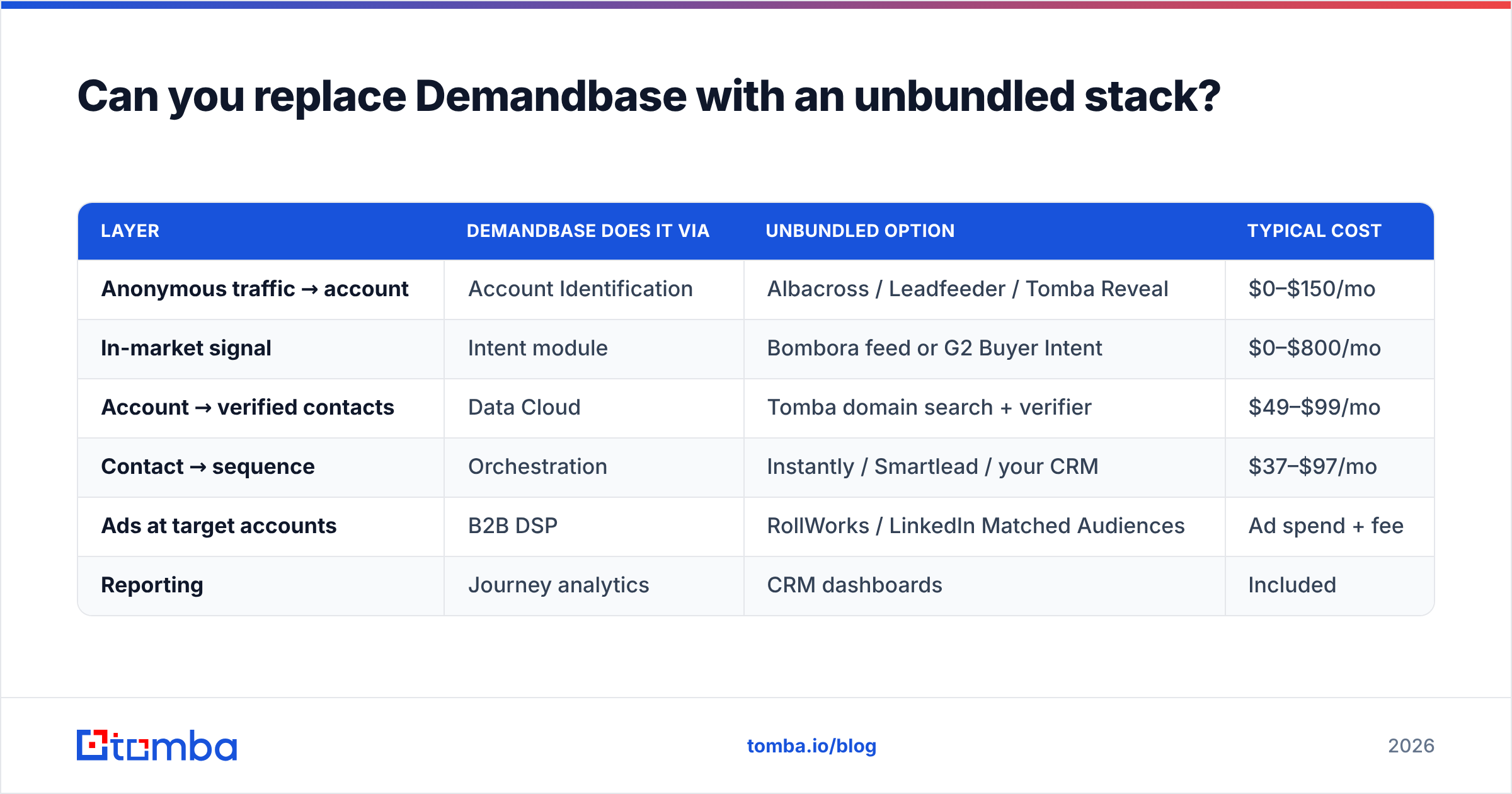
Can you replace Demandbase with an unbundled stack?#
For most teams under 200 employees, yes — and the arithmetic is not close.
Here's a working stack that covers the same jobs:
| Layer | Demandbase does it via | Unbundled option | Typical cost |
|---|---|---|---|
| Anonymous traffic → account | Account Identification | Albacross / Leadfeeder / Tomba Reveal | $0–$150/mo |
| In-market signal | Intent module | Bombora feed or G2 Buyer Intent | $0–$800/mo |
| Account → verified contacts | Data Cloud | Tomba domain search + verifier | $49–$99/mo |
| Contact → sequence | Orchestration | Instantly / Smartlead / your CRM | $37–$97/mo |
| Ads at target accounts | B2B DSP | RollWorks / LinkedIn Matched Audiences | Ad spend + fee |
| Reporting | Journey analytics | CRM dashboards | Included |
The honest trade-off: you now own the integration. Demandbase's real value is that all six rows talk to each other out of the box and attribute to the same account object. In an unbundled stack, you're joining on domain name across four tools, and if your CRM's account records are messy, that join is painful. Budget engineering or ops time accordingly.
The other honest trade-off: unbundled stacks have no single throat to choke. When intent looks wrong, you can't escalate to one CSM.
But if you have any ops capability at all, the cost delta funds a lot of integration work.
How do you actually turn target accounts into pipeline?#
This is the step every ABM platform undersells, because it's unglamorous.
An account-level signal — "Acme is surging on 'data observability'" — is not actionable. A rep can't email an account. They need names, titles, verified emails, and ideally direct dials. The gap between "account in-market" and "message sent to the right human" is where most ABM budget evaporates.
The workflow that consistently works:
- Get the account list. From intent, from visitor reveal, from your ICP filter — the source matters less than the fit criteria.
- Map the buying committee. For each account, identify 4–8 roles: economic buyer, champion, technical evaluator, and blockers. Gartner's research on B2B buying groups has put the average committee at 6–10 people for complex purchases, which means single-threading is the default failure mode.
- Find the contacts. Run each domain through a domain search to pull every discoverable address at that company along with the org's email pattern. For named individuals you already have from LinkedIn, resolve them directly.
- Verify before you send. This is non-negotiable. Sending to unverified addresses on a fresh domain is the fastest way to destroy sender reputation. Run the list through an email verifier and drop anything that isn't deliverable. Catch-all domains need their own handling — a catch-all accepts everything at the SMTP layer and tells you nothing.
- Sequence with the signal. Reference the actual trigger. "Saw your team is evaluating options in X" beats a generic value prop, and it's only credible if the signal is real.
- Measure at the account level. Count accounts engaged, not emails sent. This is the one habit worth importing from the ABM platform worldview even if you never buy one.
Steps 3 and 4 are where a dedicated data tool earns its price. At $49/month on the Starter plan, the cost of accurate contact data is a rounding error against the ad spend you're pointing at those same accounts — and a fraction of what a platform charges to bundle mediocre contact records into a six-figure contract.
What should you ask on the demo call?#
If you're still evaluating Demandbase or a full-platform competitor, these questions separate the pitch from the product:
- "What's the total first-year cost including implementation?" Get the onboarding fee in writing. It's frequently 10–20% of the annual contract.
- "What percentage of my US traffic will you resolve to a company?" Ask for a benchmark against a customer with similar traffic. Reveal rates of 30–50% are realistic; anything above 70% deserves scrutiny.
- "Where does the intent data come from, and how fresh is it?" If the answer is a co-op you could buy directly, note that.
- "How many verified, deliverable contacts do you have at these ten specific accounts?" Bring your own list. Test it live on the call.
- "What happens at renewal if we cut modules?" Module-level pricing often isn't as unbundleable as the demo implies.
- "Can we export our account and contact data if we leave?" Get it in the contract.
The last two questions are the ones vendors dislike, which is exactly why they're worth asking.
Is Demandbase still worth it in 2026?#
Yes — for a specific buyer. If you run a genuine ABM program with dedicated headcount, meaningful display budget, an enterprise CRM you trust, and a sales team that will actually change behavior based on account scores, Demandbase One is a coherent product and the integration savings are real. You can review their current module lineup on demandbase.com.
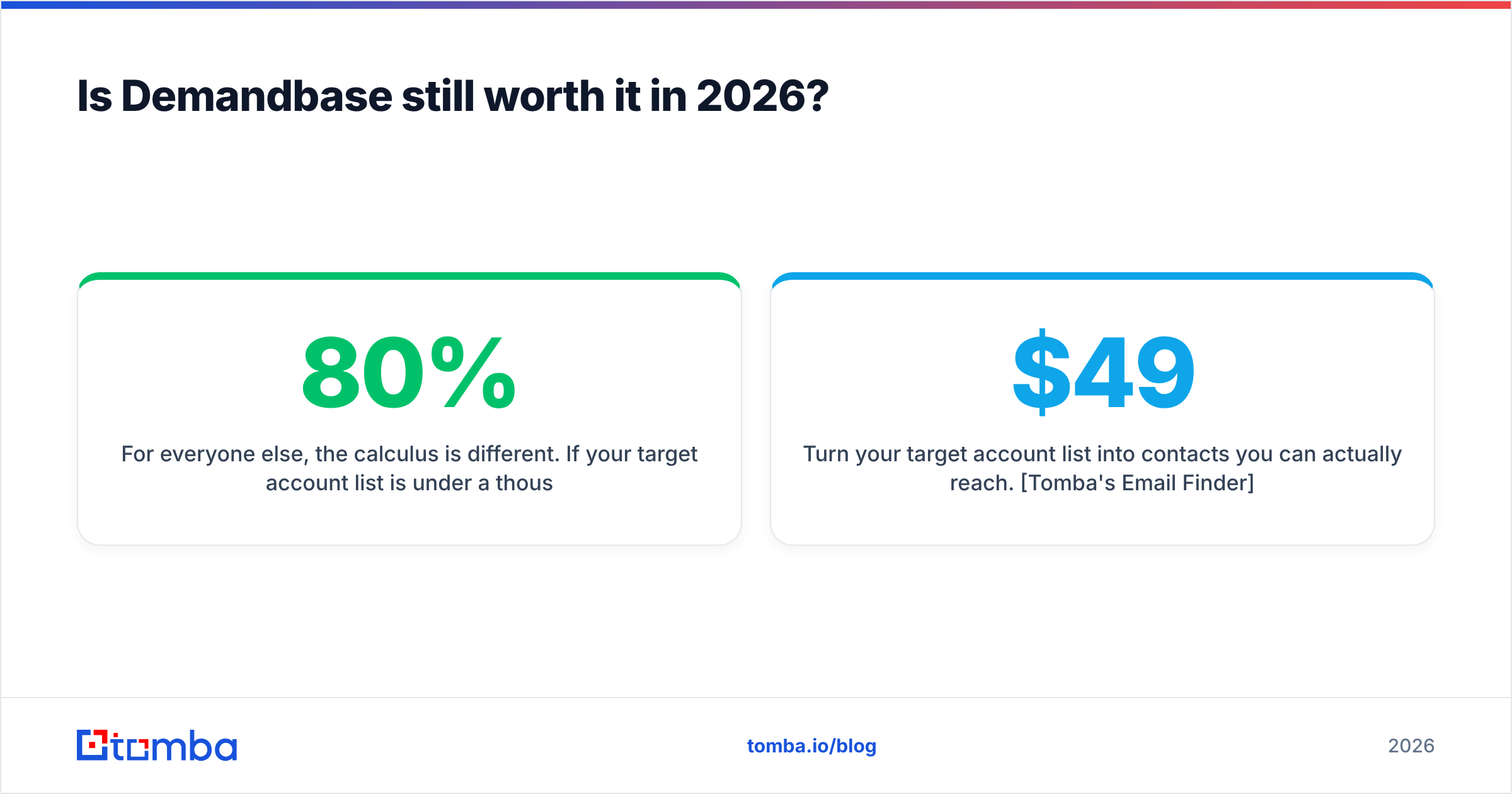
For everyone else, the calculus is different. If your target account list is under a thousand companies, if your team is under ten people, or if you can't commit to a year before seeing results, an unbundled stack gets you 80% of the outcome for well under 10% of the cost. The 20% you give up is convenience and unified attribution — real, but not six-figures real when your total marketing budget is smaller than the contract.
The question worth answering honestly: is your problem knowing which accounts to chase, or reaching the people inside them? Enterprise ABM platforms solve the first expensively and the second poorly. Most teams have the second problem.
Turn your target account list into contacts you can actually reach. Tomba's Email Finder resolves any company domain into verified, deliverable email addresses — with a built-in verifier, catch-all handling, and an API that drops into whatever ABM stack you end up building. Start free with 25 searches a month, or move to Starter at $49/month when you're running real volume. See full Tomba pricing for team plans and API limits.
Related guides#
Ready to find emails that actually work?
Join 150,000+ professionals who stopped guessing and started sending. Free credits on signup — no credit card required.
Get the Tomba newsletter
Practical outbound tactics and product updates — once every two weeks.
About the author