Demandbase Pricing 2026: Reviews, Pros and Cons Explained
Demandbase never publishes a number, so buyers negotiate blind. Here is what real customers report paying in 2026, where the platform earns its cost, where it does not, and the cheaper stack that covers the same contact data.
TL;DR
- Demandbase does not publish prices. Buyers on review sites and procurement marketplaces consistently report annual contracts in the $25,000–$75,000+ range, with mid-market deals clustering near $30k–$45k and enterprise builds running well past six figures.
- The cost is driven by modules, not seats: advertising, account intelligence, personalization, orchestration, and data each carry their own line item.
- Reviewers praise the intent data, account identification, and the Sales Intelligence layer. The most common complaints are onboarding length, contract rigidity, UI complexity, and contact-level data gaps.
- Demandbase is worth it if you run real ABM at scale — multi-touch programs, paid ABM ads, and an enterprise CRM to sync into. It is overkill if your actual need is "find and verify the right people at target accounts."
- If contact discovery is the job, a $49/mo email finder plus your existing CRM covers 80% of the outcome for roughly 1% of the spend.
What is Demandbase and who actually buys it?#
Demandbase is an account-based go-to-market platform. Think of it as air traffic control for your target account list: it watches which companies are circling your category, tells you which ones are ready to land, and coordinates ads, sales alerts, and website personalization so every team is working the same runway.
Technically, Demandbase One bundles four things that used to be separate products:
- Account identification — reverse-IP and device-graph matching that turns anonymous web traffic into named companies.
- Intent data — third-party signals showing which accounts are researching your category, plus first-party engagement scoring.
- Advertising — a B2B DSP that runs display and connected TV against your account list.
- Sales Intelligence — the former InsideView asset, delivering company data, contacts, news triggers, and CRM widgets.
The typical buyer is a marketing ops or demand gen leader at a company with a $500k+ annual programs budget, a Salesforce or HubSpot instance with clean account records, and a sales team organized around named accounts. If you do not have all three, most of what you pay for sits unused.
How much does Demandbase cost in 2026?#
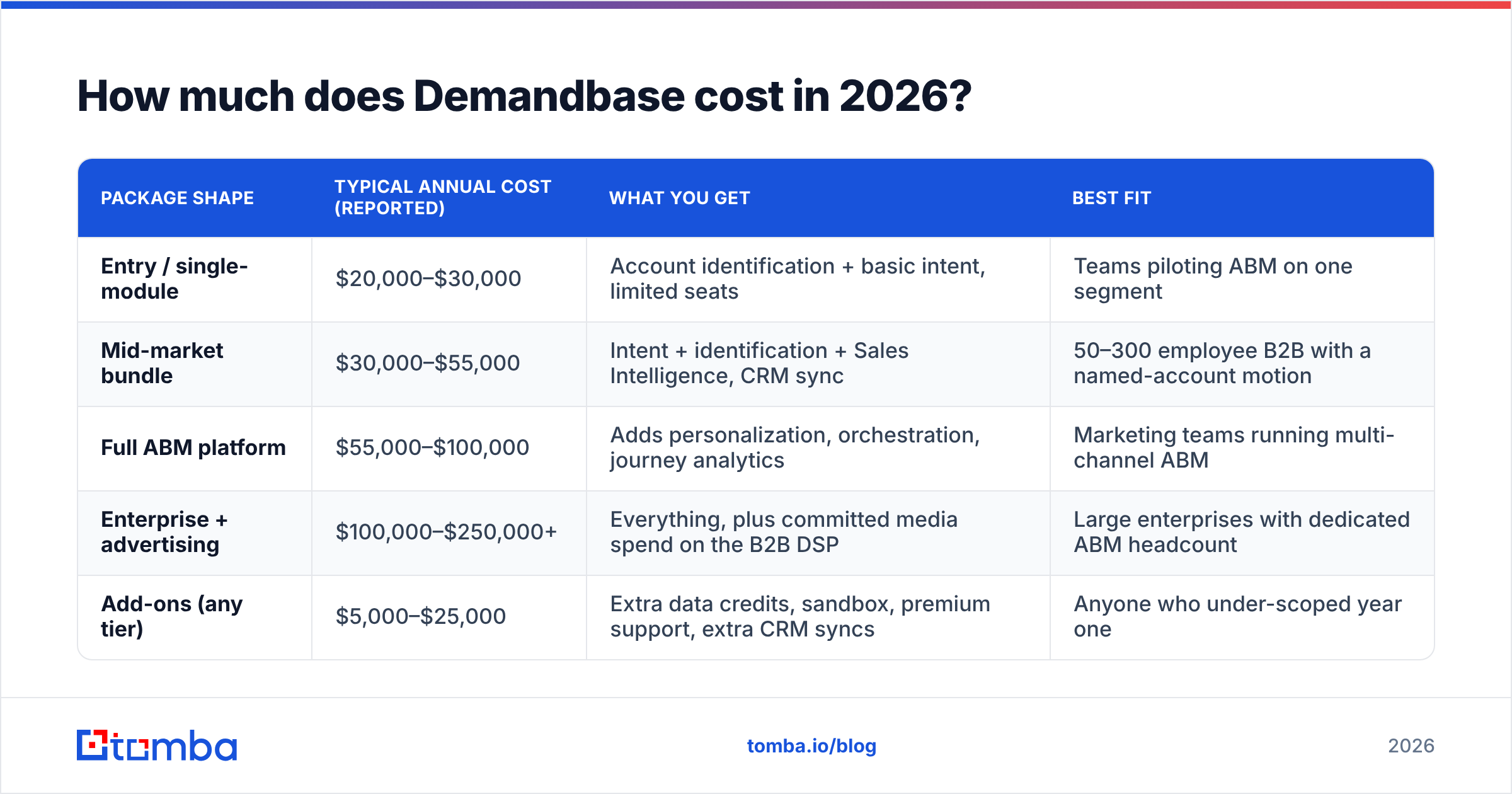
There is no public price list, and that is deliberate. Demandbase quotes per deal based on your account list size, which modules you take, ad spend commitment, and contract length. What follows is synthesized from buyer-reported figures on G2, procurement benchmarks, and peer reviews on Gartner Peer Insights — treat it as a negotiating range, not a rate card.
| Package shape | Typical annual cost (reported) | What you get | Best fit |
|---|---|---|---|
| Entry / single-module | $20,000–$30,000 | Account identification + basic intent, limited seats | Teams piloting ABM on one segment |
| Mid-market bundle | $30,000–$55,000 | Intent + identification + Sales Intelligence, CRM sync | 50–300 employee B2B with a named-account motion |
| Full ABM platform | $55,000–$100,000 | Adds personalization, orchestration, journey analytics | Marketing teams running multi-channel ABM |
| Enterprise + advertising | $100,000–$250,000+ | Everything, plus committed media spend on the B2B DSP | Large enterprises with dedicated ABM headcount |
| Add-ons (any tier) | $5,000–$25,000 | Extra data credits, sandbox, premium support, extra CRM syncs | Anyone who under-scoped year one |
Three cost mechanics matter more than the headline number:
- Annual commitment is standard. Month-to-month is rarely offered. Multi-year deals get discounts, but they also lock you into a stack decision before you have proof.
- Ad spend is usually separate. The platform fee does not include media. Budget the DSP spend on top.
- Implementation is not free. Reported onboarding fees range from a few thousand dollars to a full professional-services engagement, and time-to-value is commonly reported at 60–120 days.
Sorry — that image is a meme placeholder:

What do Demandbase reviews actually say?#
Aggregate scores across review platforms sit in the 4.3–4.4 out of 5 range, which is solid for enterprise martech. The interesting part is the shape of the feedback, not the average.
What reviewers consistently praise:
- Account identification accuracy. Reviewers who run heavy paid traffic report that the anonymous-visitor matching is among the best available, particularly for mid-to-large companies in North America.
- Intent signal quality. The combination of first-party engagement and third-party topic intent gives SDRs a defensible prioritization order instead of an alphabetical list.
- Sales Intelligence inside the CRM. The Salesforce and Dynamics widgets get repeated positive mentions — reps see news, org charts, and signals without leaving the record.
- Support responsiveness. Customer success is rated well above the enterprise-software average.
What reviewers consistently criticize:
- Complexity and learning curve. The most common phrase in critical reviews is some variant of "powerful but overwhelming." Teams without a dedicated admin under-use it.
- Contract inflexibility. Mid-term downgrades are difficult. Several reviewers describe paying for modules they stopped using.
- Contact-level data gaps. Company-level intelligence is strong. Person-level emails and direct dials are the weak point, and reviewers frequently mention supplementing with a dedicated contact-data tool.
- Reporting rigidity. Custom attribution views often require support tickets or a services engagement.
- Small-company coverage. Identification and intent both degrade for companies under ~50 employees and outside major English-speaking markets.
That fourth bullet is the one that drives real budget decisions. If you are buying a $40k ABM platform and then buying a separate email finder anyway, it is worth asking which of the two is actually producing pipeline.
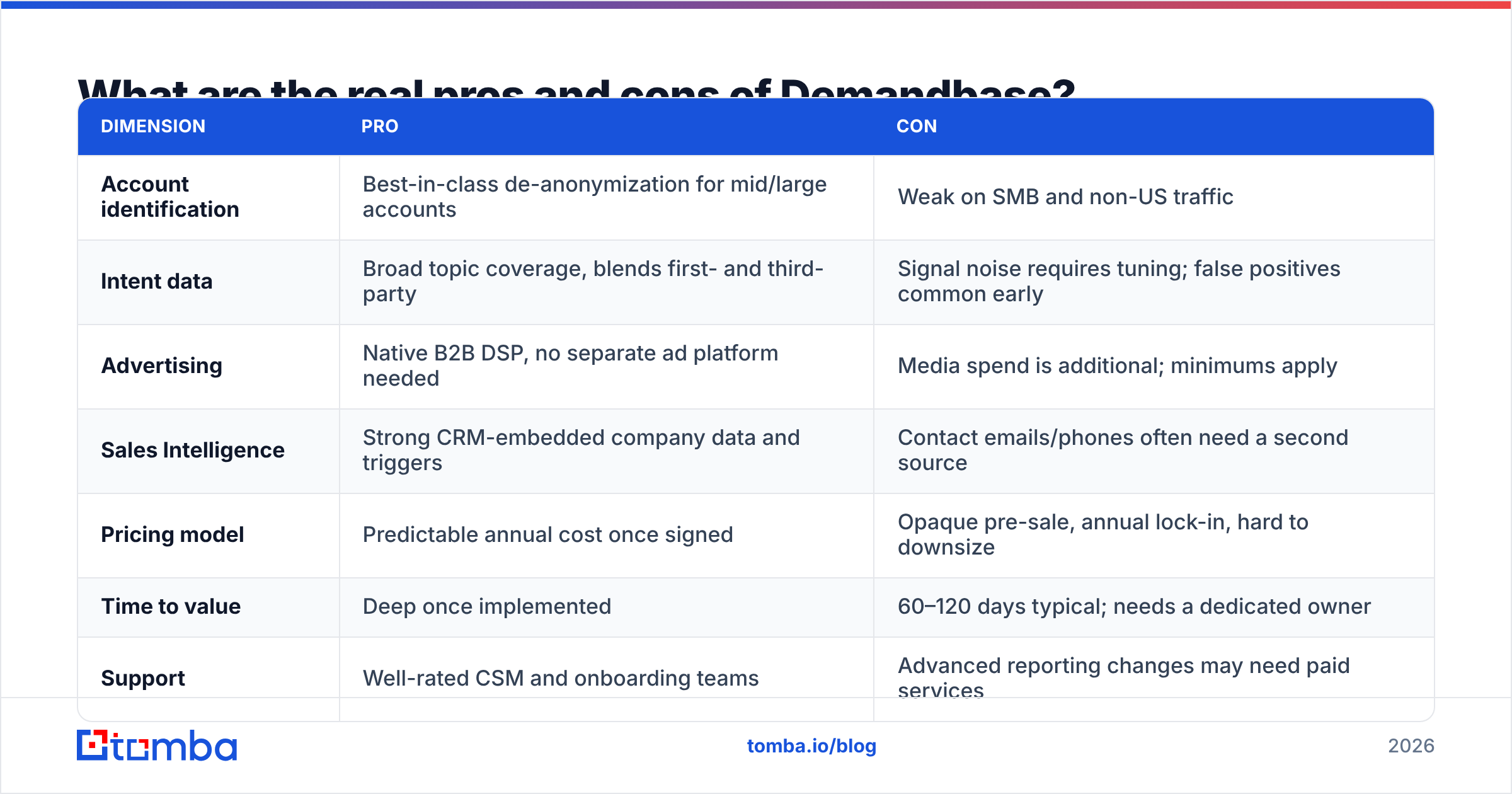
What are the real pros and cons of Demandbase?#
| Dimension | Pro | Con |
|---|---|---|
| Account identification | Best-in-class de-anonymization for mid/large accounts | Weak on SMB and non-US traffic |
| Intent data | Broad topic coverage, blends first- and third-party | Signal noise requires tuning; false positives common early |
| Advertising | Native B2B DSP, no separate ad platform needed | Media spend is additional; minimums apply |
| Sales Intelligence | Strong CRM-embedded company data and triggers | Contact emails/phones often need a second source |
| Pricing model | Predictable annual cost once signed | Opaque pre-sale, annual lock-in, hard to downsize |
| Time to value | Deep once implemented | 60–120 days typical; needs a dedicated owner |
| Support | Well-rated CSM and onboarding teams | Advanced reporting changes may need paid services |
The honest summary: Demandbase is a coordination product, not a discovery product. It tells you which accounts to care about and helps you surround them. It is not built to hand a rep the verified work email of the VP of Ops at account #37 — and reviewers say so repeatedly.
Is Demandbase worth it for your team?#
Run this five-question test before you take the demo:
- Do you have a fixed named-account list of 200+ companies? If your GTM is inbound-led or self-serve, ABM tooling has nothing to orchestrate.
- Is there a budget for ABM media on top of the platform fee? The advertising module is a major part of the value. Without media spend, you are paying platform prices for intent data alone.
- Do you have an owner with 10+ hours a week for it? Every critical review that mentions wasted spend traces back to no dedicated admin.
- Is your CRM clean at the account level? Duplicate and mismatched account records break matching, and the platform will surface that mess loudly.
- Is your bottleneck prioritization or contact data? If reps say "I don't know who to call," Demandbase helps. If they say "I have the account but not the person's email," it does not.
Answer yes to at least four and the price is defensible. Answer yes to two and you are buying an enterprise platform to solve a data problem — which is where most of the buyer's remorse in the review corpus comes from.
What are the best Demandbase alternatives by budget?#
Alternatives split into three honest categories: full ABM platforms, intent-data specialists, and contact-data tools. Comparing across categories only makes sense once you have decided which problem you are actually solving.
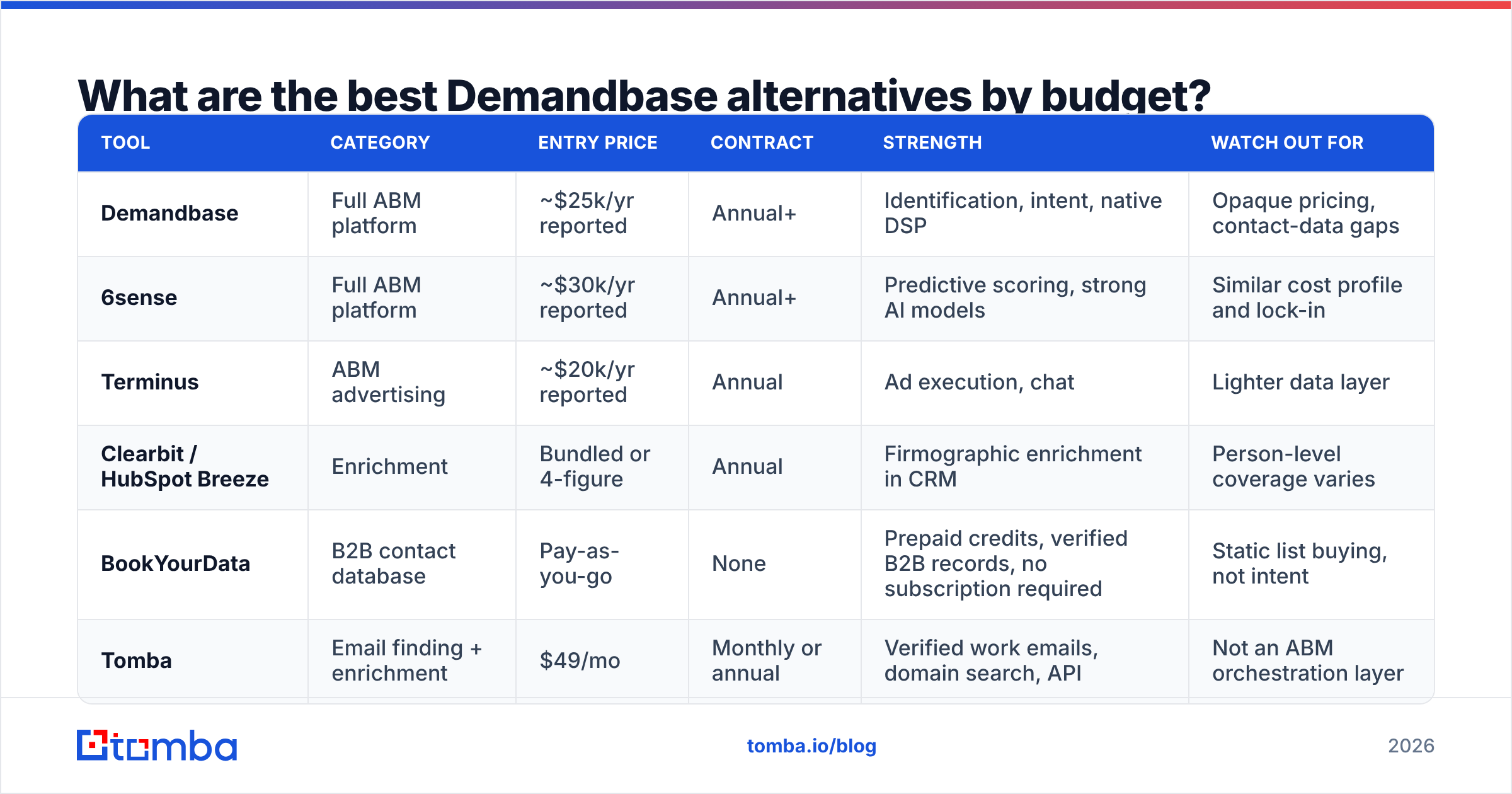
| Tool | Category | Entry price | Contract | Strength | Watch out for |
|---|---|---|---|---|---|
| Demandbase | Full ABM platform | ~$25k/yr reported | Annual+ | Identification, intent, native DSP | Opaque pricing, contact-data gaps |
| 6sense | Full ABM platform | ~$30k/yr reported | Annual+ | Predictive scoring, strong AI models | Similar cost profile and lock-in |
| Terminus | ABM advertising | ~$20k/yr reported | Annual | Ad execution, chat | Lighter data layer |
| Clearbit / HubSpot Breeze | Enrichment | Bundled or 4-figure | Annual | Firmographic enrichment in CRM | Person-level coverage varies |
| BookYourData | B2B contact database | Pay-as-you-go | None | Prepaid credits, verified B2B records, no subscription required | Static list buying, not intent |
| Tomba | Email finding + enrichment | $49/mo | Monthly or annual | Verified work emails, domain search, API | Not an ABM orchestration layer |
Two of these deserve a closer look for opposite reasons. BookYourData is a genuinely useful option when you want verified contact records without any subscription commitment — you buy credits and own the list. Tomba solves the adjacent problem: you already know the account, and you need the current, verified email for a specific person at it.
How do you replace the contact-data half of Demandbase for $49/mo?#
Here is the practical decomposition. Demandbase bundles five jobs. Only some of them require an ABM platform.
- Know which accounts are in-market — needs intent data. Keep an ABM platform or an intent vendor. No cheap substitute.
- De-anonymize website traffic — needs an identification layer. A website visitor reveal tool covers this at a fraction of the cost for most mid-market sites.
- Find the right people at those accounts — needs a contact database, not an ABM platform. Run domain search against the account domain and get the roster with role and confidence score.
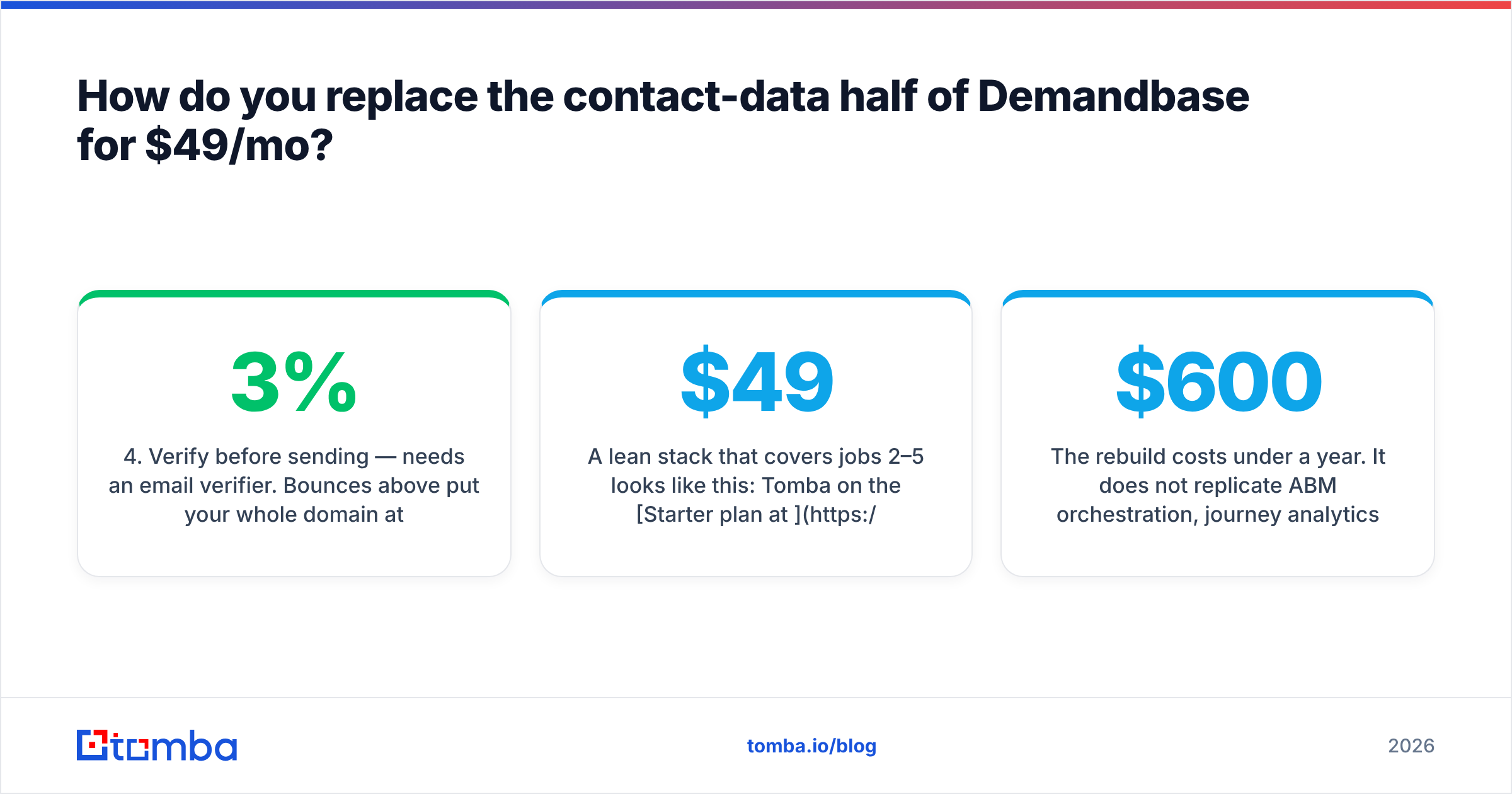
- Verify before sending — needs an email verifier. Bounces above 3% put your whole domain at risk regardless of how good your intent data is.
- Push it all into the CRM — needs an API or native connector, not a platform license.
A lean stack that covers jobs 2–5 looks like this: Tomba on the Starter plan at $49/mo for finding and verifying contacts, a HubSpot or Salesforce connector to sync records, and whatever intent source you already trust. You keep the coordination logic in your CRM instead of renting a second system of record.
The rebuild costs under $600 a year. It does not replicate ABM orchestration, journey analytics, or the DSP — and you should not pretend otherwise. What it does replace is the part of Demandbase that reviewers say is weakest anyway: getting an accurate, deliverable email address for a named human at a named company.
For teams doing this at volume, the Tomba API handles the same workflow programmatically — pass a domain and a name, get back a verified address with a confidence score, write it to the CRM. That is a two-hour integration, not a 90-day implementation.
What should you negotiate if you do buy Demandbase?#
If the five-question test says yes, do not sign the first quote. Buyers who reported the best outcomes did four things:
- Scope modules down for year one. Start with identification and intent. Add personalization and orchestration in year two once you have a workflow that deserves them.
- Ask for a mid-term downgrade clause. The single most common regret in reviews is paying for shelfware. Get it in writing.
- Negotiate implementation into the platform fee, or cap it. Services fees are frequently the most flexible line.
- Buy at quarter end or fiscal year end. Enterprise martech discounting is seasonal and the difference is not small.
And separate your contact-data budget from your ABM budget. Bundling them makes the platform look like it is doing more work than it is, and it makes renewal negotiations harder because you cannot isolate which component produced pipeline.
The bottom line#
Demandbase pricing is a real five-figure commitment for a real enterprise capability. If you run coordinated, multi-channel ABM against a fixed account list with a dedicated owner, the platform earns its cost and the reviews back that up. If your team's actual bottleneck is "we know the accounts, we just can't reach the right person," you are about to spend $40,000 to solve a $600 problem.
Test the cheap half first. Take a list of 50 target accounts, run them through Tomba's Email Finder with the free tier's 25 searches, and see how many verified, deliverable contacts you get back before you book a single ABM demo. If your reps start booking meetings off that list, you have just learned something valuable about what you actually needed to buy — and the Starter plan at $49/mo will keep the pipeline moving while you decide whether the enterprise platform is the next step or a distraction.
Related guides#
Ready to find emails that actually work?
Join 150,000+ professionals who stopped guessing and started sending. Free credits on signup — no credit card required.
Get the Tomba newsletter
Practical outbound tactics and product updates — once every two weeks.
About the author