Demandbase vs 6sense: Which ABM Platform Wins in 2026?
Both platforms promise to tell you which accounts are in-market. They get there differently, price differently, and fail differently. Here's the honest breakdown before you sign a six-figure contract.
Demandbase vs 6sense is the shortlist most B2B teams land on. Both claim to find the accounts that are ready to buy. Both cost six figures. This guide covers where each one wins, what they really cost, and who should walk away from both.
TL;DR
- 6sense wins on predictive AI and buying-stage modeling. Its account identification and intent scoring are why most RevOps teams shortlist it. If your question is "who is in-market right now," 6sense answers it with more confidence.
- Demandbase wins on advertising and account-based orchestration. Its DSP is native, not bolted on. And its account intelligence layer (post-InsideView) gives sales more usable context inside the CRM.
- Both are six-figure decisions. Real annual spend lands between $60k and $150k+, depending on seats, ad budget, and data volume. Neither publishes list pricing.
- Neither is a contact-data provider. Both surface accounts and personas. You still need verified email and phone data to reach anyone. That gap is where a dedicated email finder sits.
- If you have fewer than ~15 reps or under $2M ARR, skip both. Intent data without the headcount to work it is expensive shelfware.
What are Demandbase and 6sense actually competing on?#
Both sell the same promise. Find the accounts researching your category before they fill in a form. Then aim ads, sales outreach, and marketing at those accounts.
Think of a security camera in the parking lot outside your store. You can't see faces. But you can see the logos on the vans, how often they circle the block, and which aisle they head for once inside. Demandbase vs 6sense, at heart, is a choice between two versions of that camera — plus the analyst who tells you which van is about to buy.
Where they diverge is what they do with the footage.
6sense is built around a predictive engine. It takes in web activity on your site, third-party intent from Bombora and its own network, tech stack data, and CRM history. Then it gives each account a buying stage — Target, Awareness, Consideration, Decision, Purchase — plus a fit score. The pitch is simple: trust the model, work the accounts it flags.
Demandbase started as an ad-targeting company, and it still shows. Account identification is strong. But the real edge is orchestration. You run display and connected TV ads against a defined account list. Then you hand warm accounts to sales with a full company dossier attached. The 2020 InsideView and DemandMatrix acquisitions gave it a native company data layer. 6sense licenses part of that same layer from partners.
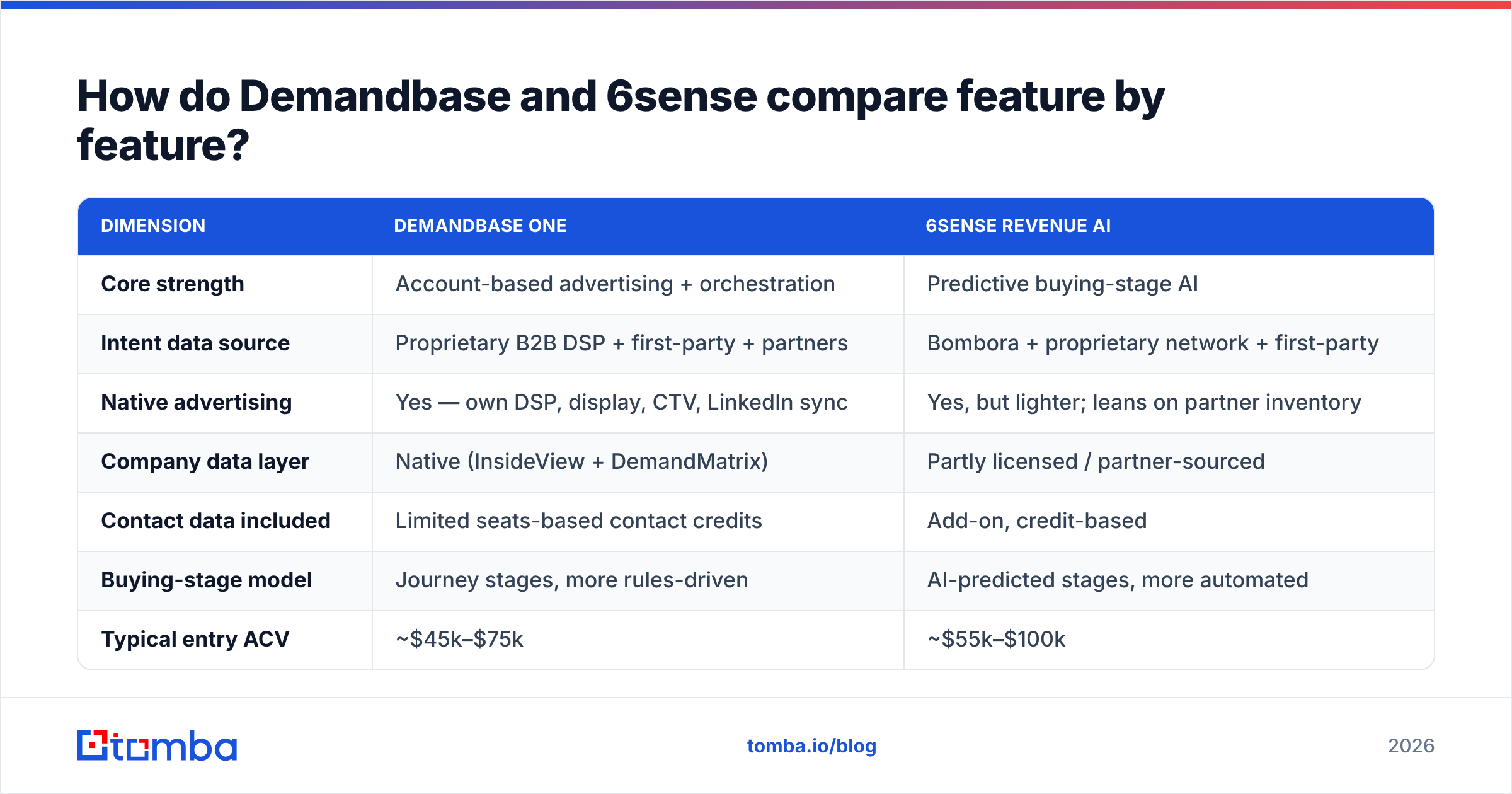
Demandbase vs 6sense: how do they compare feature by feature?#
| Dimension | Demandbase One | 6sense Revenue AI |
|---|---|---|
| Core strength | Account-based advertising + orchestration | Predictive buying-stage AI |
| Intent data source | Proprietary B2B DSP + first-party + partners | Bombora + proprietary network + first-party |
| Native advertising | Yes — own DSP, display, CTV, LinkedIn sync | Yes, but lighter; leans on partner inventory |
| Company data layer | Native (InsideView + DemandMatrix) | Partly licensed / partner-sourced |
| Contact data included | Limited seats-based contact credits | Add-on, credit-based |
| Buying-stage model | Journey stages, more rules-driven | AI-predicted stages, more automated |
| Typical entry ACV | ~$45k–$75k | ~$55k–$100k |
| Implementation time | 6–10 weeks | 8–14 weeks |
| Best-fit team size | 15+ reps, marketing-led ABM | 25+ reps, RevOps-heavy motion |
| CRM depth | Strong Salesforce, solid HubSpot | Strong Salesforce, strong Dynamics |
The table hides one thing worth saying plainly: in Demandbase vs 6sense, feature parity is closer in 2026 than either vendor's battlecard admits. Demandbase has improved its predictive scoring. 6sense has improved its ad delivery. The real question is which side of the workflow your team lives on.

Which platform has better intent data?#
Short answer: 6sense, by a little, for predicting when. Demandbase, by a little, for explaining why.
6sense's model is a black box by design. You get a stage and a score. The argument is that the model has seen more buying cycles than your team ever will. Teams that commit to it report a real lift: Decision-stage accounts convert better than their own hand-built lists. Teams that half-commit report noise.
Demandbase shows more of its work. You can see which keywords, which pages, and which tech signals pushed an account up the list. If you have to justify spend to a CFO, that transparency is worth a lot.
Three things neither vendor will volunteer:
- Intent data is directional, not deterministic. A spike means someone at the company researched your category. It does not mean the person you're emailing knows the project exists. Expect a good share of flagged accounts to be researchers, consultants, or competitors.
- Both lean on the same third-party sources. Bombora's co-op feeds a large slice of the B2B intent market. If two vendors show you the same account surge, that is often the same data twice — not independent confirmation.
- Coverage varies by region. US coverage is good on both. EMEA is weaker. Since GDPR, matching an IP to a company in Germany and France often fails. Ask for a coverage test on your traffic before you sign.
Maybe you just want to know which companies visit your site. A lighter website visitor reveal tool does that for a fraction of the cost, with no platform contract.
How much do Demandbase and 6sense actually cost?#
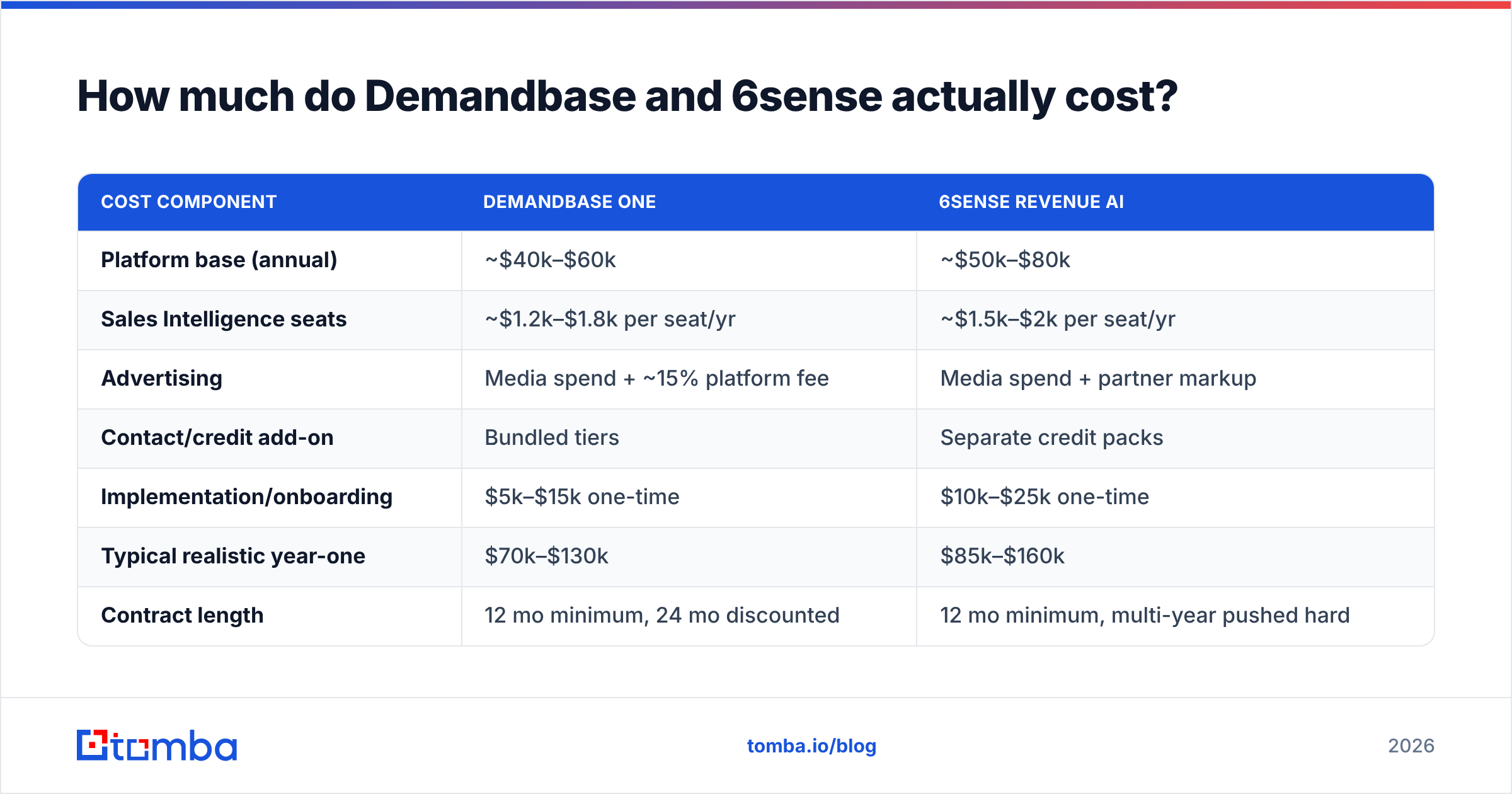
Neither publishes pricing. That alone tells you something. Both quote on four things: seat count, contact credits, ad spend they manage, and which modules you turn on.
| Cost component | Demandbase One | 6sense Revenue AI |
|---|---|---|
| Platform base (annual) | ~$40k–$60k | ~$50k–$80k |
| Sales Intelligence seats | ~$1.2k–$1.8k per seat/yr | ~$1.5k–$2k per seat/yr |
| Advertising | Media spend + ~15% platform fee | Media spend + partner markup |
| Contact/credit add-on | Bundled tiers | Separate credit packs |
| Implementation/onboarding | $5k–$15k one-time | $10k–$25k one-time |
| Typical realistic year-one | $70k–$130k | $85k–$160k |
| Contract length | 12 mo minimum, 24 mo discounted | 12 mo minimum, multi-year pushed hard |
These ranges come from reported deal sizes and buyer reviews on G2 and Capterra. Your quote will vary. Both vendors cut prices at the end of a quarter and the end of a fiscal year. That is not a rumor. It is a reliable pattern.
The ramp is what surprises buyers. Neither platform pays off in month one. Budget two quarters before the pipeline numbers look credible. And make sure whoever signs the deal is still around for that review.
Do you actually need an ABM platform at all?#
This is the question most comparison posts skip.
An ABM platform earns its cost only when three things are true at once:
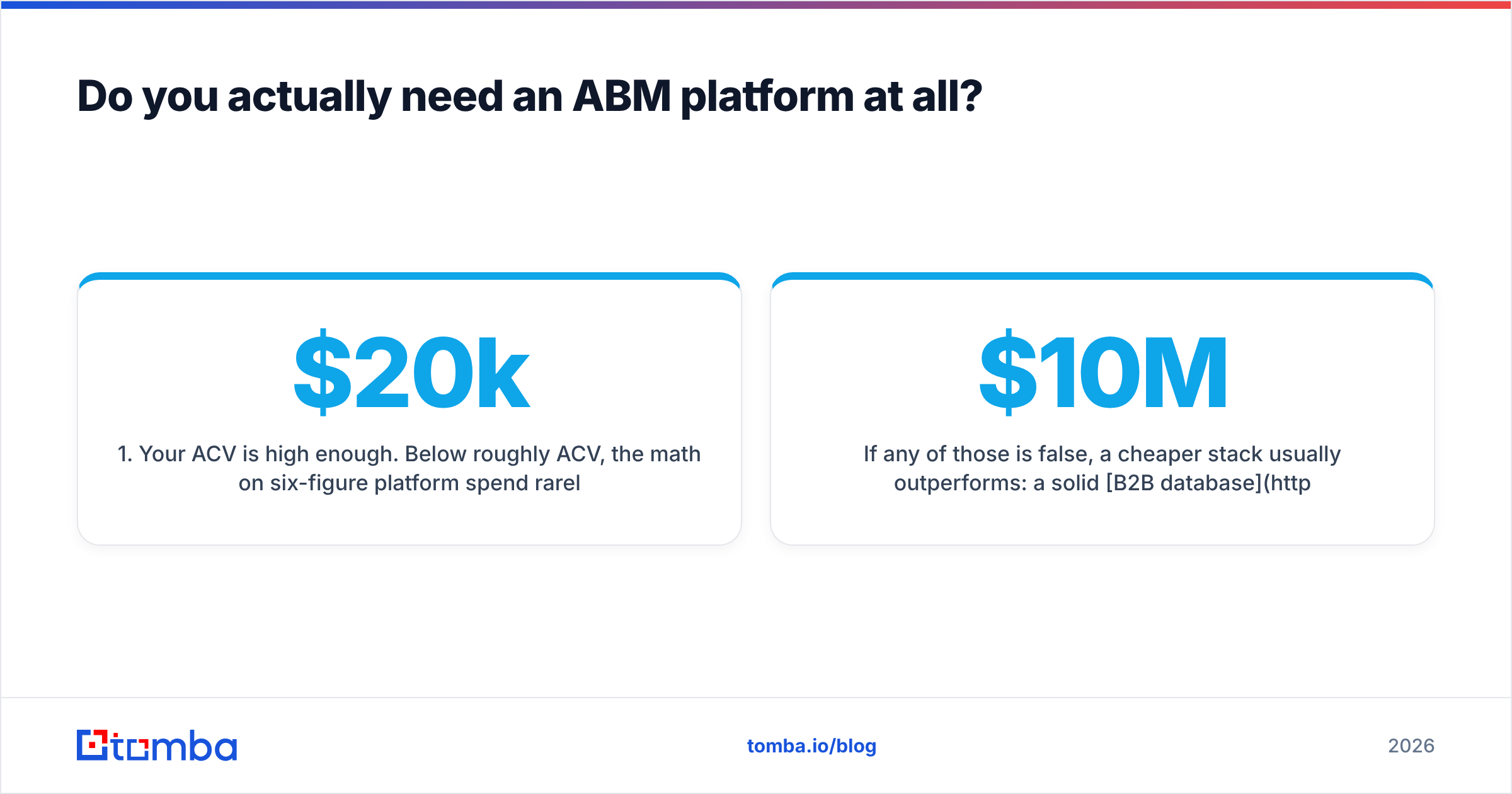
- Your ACV is high enough. Below roughly $20k ACV, the math on six-figure platform spend rarely closes. You need volume economics, not account economics.
- Your sales team is big enough to act on signals. Intent data creates work. If ten reps are already at capacity, flagging 400 in-market accounts changes nothing.
- Marketing and sales already agree on an account list. ABM software does not create alignment. It amplifies whatever alignment or dysfunction you already have.
If any of those is false, a cheaper stack usually wins. That means a solid B2B database for finding accounts and contacts, a light intent feed, a sequencer, and a real territory plan. Plenty of teams at $10M–$30M ARR run exactly that. They beat peers paying $120k for a tool they open twice a month.
Want a wider view of how ABM fits into go-to-market? HubSpot's account-based marketing guide and analyst coverage from Gartner are both neutral starting points.
Which one integrates better with your existing stack?#
Both are Salesforce-first. If you run Salesforce, either one works. The difference is how deep the two-way sync goes, and how much RevOps setup it takes.
- Salesforce — Both excellent. 6sense's package is more opinionated; it wants to own the account scoring fields. Demandbase maps more flexibly to your existing schema.
- HubSpot — Demandbase has the edge. 6sense's HubSpot integration works, but it lags on custom objects.
- Microsoft Dynamics — 6sense has the edge, with more mature native objects and workflows.
- Marketo / Eloqua — Roughly equal. Both push audiences and pull engagement data reliably.
- LinkedIn Ads — Both sync matched audiences. Demandbase's list hygiene tends to produce higher match rates, thanks to its native company data.
- Outreach / Salesloft — Both push priority accounts into sequences. Neither gives you verified email data good enough for cold outbound. So most teams add an enrichment layer anyway.
That last point matters more than the integration checkbox. An ABM platform tells you which account, and often which persona. Reaching that person still takes a working email address. Bundled contact data is the most complained-about part of both products. Run flagged accounts through a domain search or a verify pass first. It keeps stale records from burning your sender reputation.
What do real users complain about?#
Review-site patterns and buyer conversations point to the same short list:
Demandbase complaints
- The UI feels like several acquired products stitched together; navigation is not intuitive
- Reporting takes more manual setup than expected
- Contact data quality is uneven outside North America
- Support response times swing sharply by contract tier
6sense complaints
- The predictive model is hard to explain to executives who want to see the logic
- Contact credits run out faster than teams forecast
- The learning curve is steep; most teams underuse the platform for two quarters
- Renewal comes with hard pressure to sign multi-year
Shared complaints
- Attribution reporting is generous toward the platform's own influence
- Onboarding needs dedicated RevOps headcount that neither vendor prices into the quote
- Renewal pricing climbs without a matching jump in delivered value
None of these rule a vendor out. All of them are worth raising during the sales cycle, in writing, with the answers attached to the contract.
Demandbase vs 6sense: which should you choose in 2026?#
Choose 6sense if: you have a RevOps team that will act on the scores, a Salesforce or Dynamics backbone, 25+ reps, and leaders willing to trust a model over rep instinct. Its predictive layer is the strongest in the category. Teams that fully adopt it see the biggest gain.
Choose Demandbase if: advertising is central to your ABM program, you need clear signal explanations to win internal buy-in, you're on HubSpot, or marketing drives the account strategy. Its native DSP and company data make it the cleaner fit for marketing-led teams.
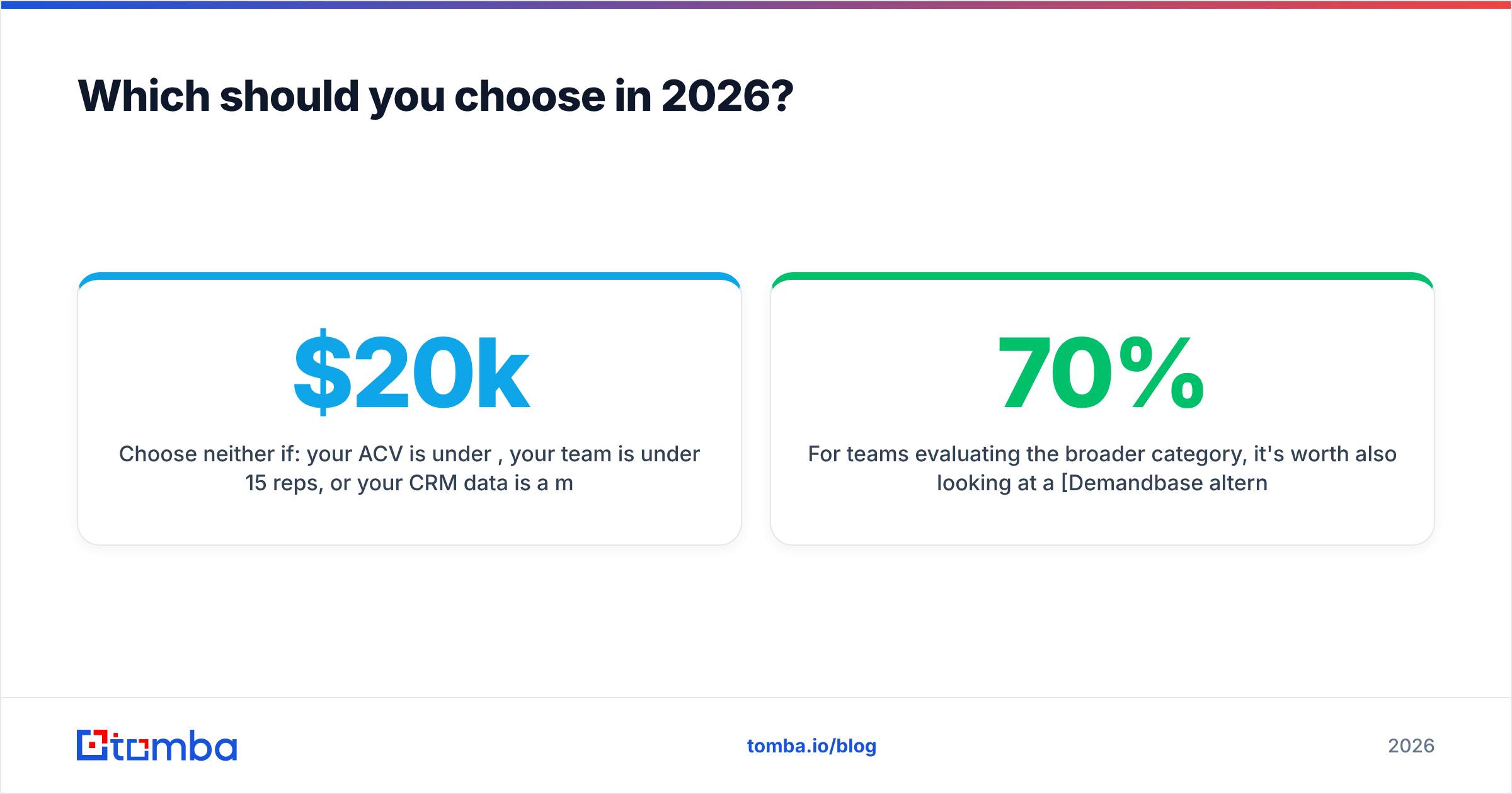
Choose neither if: your ACV is under $20k, your team is under 15 reps, or your CRM data is a mess. Fix the foundation first. An ABM platform on top of bad account data produces expensive, confident nonsense.
Before you commit, look at a Demandbase alternative or a 6sense alternative too. The mid-market has gotten crowded. Several smaller tools now cover 70% of the use case at 20% of the cost.
What's the fastest way to test the value before signing?#
Run a manual pilot for six weeks. Seriously.
- Pick 200 target accounts that match your best-customer profile.
- Pull the buying committee — 3–5 titles per account.
- Find and verify contact data for each, so your outreach actually lands.
- Run a coordinated sequence across email, LinkedIn, and phone.
- Measure meetings booked per 100 accounts.
If the manual run books meetings, an ABM platform will scale it. If it books silence, the platform will scale the silence — faster, and for more money. The test costs a few thousand dollars and gives you an honest answer.
Step three is where most pilots stall. It is also the least glamorous part. You can name the account, name the person, and still have no way to reach them.
Start there. Tomba's Email Finder turns a company domain and a name into a verified professional email address. The free tier gives you 25 searches a month, enough to run your pilot list. Paid plans start at $49/mo when you're ready to scale. Check the full Tomba pricing to compare cost per verified contact against what an ABM platform's bundled credits deliver. That gap is usually the most persuasive slide in your business case.
Related guides#
// get started
Find, verify and enrich your first contacts today
Start on the free plan with 25 searches a month, then scale when your team is ready.
Free plan · No credit card required · GDPR & CCPA
// about the author