Demandbase vs Terminus: Which ABM Platform Wins in 2026?
Demandbase and Terminus both promise account-based revenue, but they solve different problems at very different price points. Here's the honest breakdown of data, ads, pricing, and who each one actually fits.
Demandbase vs Terminus comes down to one question. Is your bottleneck knowing which accounts to work, or reaching them? Here is the honest breakdown of data, ads, pricing, and fit.
TL;DR
- Demandbase is the heavier, data-first platform. You get its own intent network, account identification, ABM advertising, and a sales-intelligence layer that aims to replace ZoomInfo-style tools. Enterprise pricing to match.
- Terminus (now part of DemandScience after the 2024 deal) is the ad-execution specialist. It runs multi-channel ABM ads, chat, and email experiences. It has long been friendlier to mid-market budgets and faster to stand up.
- Neither tool gives you clean contact-level emails. Both identify accounts. You still need a verified contact layer before SDRs can send anything.
- Expect $40k–$100k+/year for Demandbase and roughly $20k–$60k/year for Terminus. Both are annual-commit. Both add onboarding fees that never appear on the website.
- Pick Demandbase if data and account scoring are the bottleneck. Pick Terminus if distribution is the bottleneck. Budget separately for contact data either way.
What are Demandbase and Terminus, actually?#
Both are account-based marketing (ABM) platforms. That means software that treats a company as the unit of targeting instead of a single lead. Think of it like advertising to a whole office building rather than mailing one person inside it.
Demandbase started as an account identification company. The job was simple: figure out which company a website visitor belongs to, then act on it. Over a decade it absorbed Engagio (account engagement scoring), DemandMatrix (technographics), and InsideView (company data). It rebranded the bundle as "Demandbase One." The pitch today is one system that identifies accounts, scores intent, serves ads, and feeds enriched company records to your CRM.
Terminus came at ABM from the advertising side. Its first product bought display inventory against a target account list, back when that was genuinely hard to do. It later added chat, email signature marketing (via the Sigstr deal), and web personalization. In 2024, DemandScience acquired Terminus and folded it into a larger B2B data and demand-generation group.
That history matters, because it predicts where each product is strong. Demandbase invests in the data graph. Terminus invests in the channels.
Demandbase vs Terminus: how do they compare head to head?#
| Dimension | Demandbase | Terminus |
|---|---|---|
| Core strength | Account identification + proprietary intent data | Multi-channel ABM ad execution |
| Intent data | First-party (Demandbase network) + Bombora option | Primarily third-party / partner-sourced |
| Ad channels | Display, CTV, LinkedIn, native | Display, CTV, LinkedIn, native, email signature |
| Chat / conversational | Yes (Demandbase Conversations) | Yes (Terminus Chat) |
| Sales intelligence layer | Yes — contact and company records, Chrome extension | Limited; leans on partner data |
| CRM/MAP integrations | Salesforce, HubSpot, Marketo, Dynamics, Eloqua | Salesforce, HubSpot, Marketo, Pardot |
| Typical entry price | ~$40k–$60k/yr | ~$20k–$30k/yr |
| Realistic enterprise spend | $100k+/yr with data modules | $50k–$60k/yr with full channel bundle |
| Free trial | No — demo and pilot only | No — demo only |
| Time to first campaign | 4–8 weeks | 2–4 weeks |
| Best for | RevOps teams that need one data spine | Demand-gen teams that need reach fast |
Two things stand out. First, the price gap is real. But it is narrower than vendor sales decks suggest, once you add Demandbase's optional data modules or Terminus's full channel bundle. Second, no row in that table says "verified contact emails." Neither platform is built to deliver them at the quality an outbound team needs.

Is Demandbase worth the premium?#
Demandbase earns its price in one scenario. Your problem is knowing which accounts to work, not reaching them.
Its account identification is among the strongest in the category. Say 4,000 companies visit your site each month and you can only name 800 of them. Demandbase usually lifts that hit rate by a wide margin. The gain compounds, too, because every play downstream depends on it: retargeting, SDR alerts, account scoring. Demandbase also runs its own intent network instead of reselling one third-party feed. That gives it signal other vendors cannot copy.
Where it disappoints buyers:
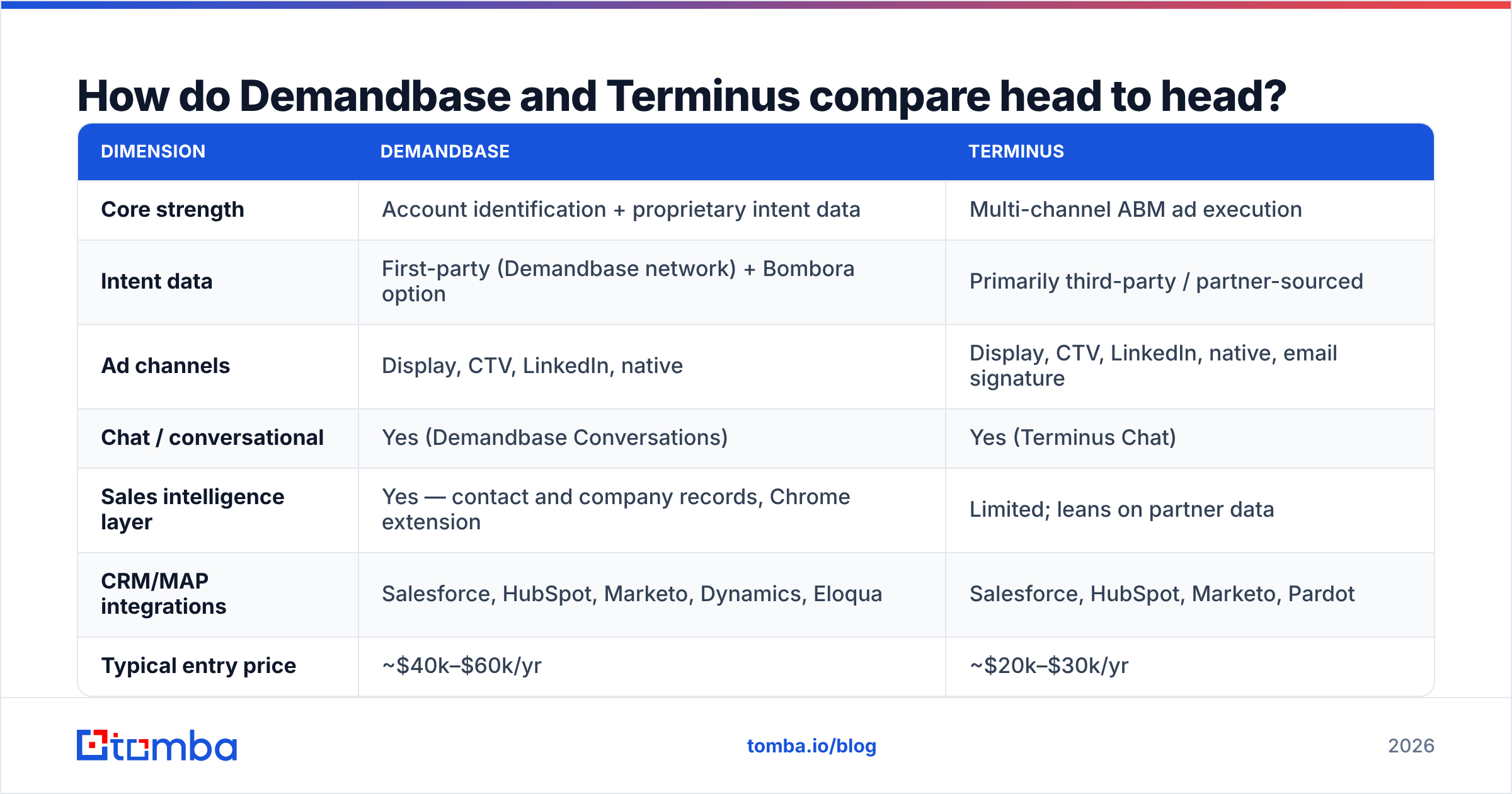
- Onboarding is a project, not a setup. Plan 6–8 weeks with a dedicated owner. Teams that hand it to a part-time marketer let the contract lapse unused.
- Contact-level data is the weak link. The company graph is strong. Individual emails and direct dials are not, especially outside North America and outside tech.
- Pricing is opaque and modular. The base quote rarely includes the pieces you were shown. Ask which SKUs were in the demo.
- Attribution reporting starts internal fights. Demandbase's own influence model looks rosier than your finance team's. Agree on the measurement standard before renewal, not after.
Read the ABM category reviews on G2. The theme repeats: high marks for data quality, lower marks for ease of use and time to value.
Is Terminus the better mid-market choice?#
For most companies under ~$50M ARR, yes. There is one caveat about the DemandScience deal.
Terminus is faster to value. You upload a target account list and connect Salesforce or HubSpot. Ads are running against those accounts within a couple of weeks. The email signature product is an underrated line item. Every message your 200 employees already send becomes an impression on a target account, and it costs nothing extra in media spend. No other platform here does that as well.
The caveats:
- Roadmap uncertainty. Terminus now sits inside a larger portfolio. Ask your rep which modules are in active development and which are in maintenance. Get the answer into the contract if it matters to you.
- Thinner native intent. Terminus leans on partner-sourced intent rather than its own network. If intent signal is why you are buying ABM, this is the wrong side of the comparison.
- Reporting depth. It is fine for channel performance and weak for account-journey analysis. Teams that want cohort-level pipeline attribution end up exporting to a BI tool.
If your bottleneck is "we know the 500 accounts, we just can't get in front of them," Terminus does that job for a lot less money.
What do both platforms leave you to solve?#
The contact layer. This is the most common surprise after purchase. It is not a vendor failing. It is how these tools are built.
ABM platforms are built around account resolution. They map an IP, cookie, or firmographic signal to a company. Resolving a person to a deliverable, verified email address is a different problem. So when Demandbase or Terminus flags Acme Corp for surging intent on "data warehouse migration," you still have to answer:
- Who at Acme owns that decision?
- What is their real email address, in Acme's real format?
- Will that address bounce, or is the domain catch-all?
- Do I have a mobile number for the follow-up call?
Both platforms hand you some contacts. In practice, coverage and accuracy are patchy enough that outbound teams route around them. That is why an email finder and a dedicated email verifier sit next to the ABM platform, not instead of it.
How should you layer contact data on top of ABM?#
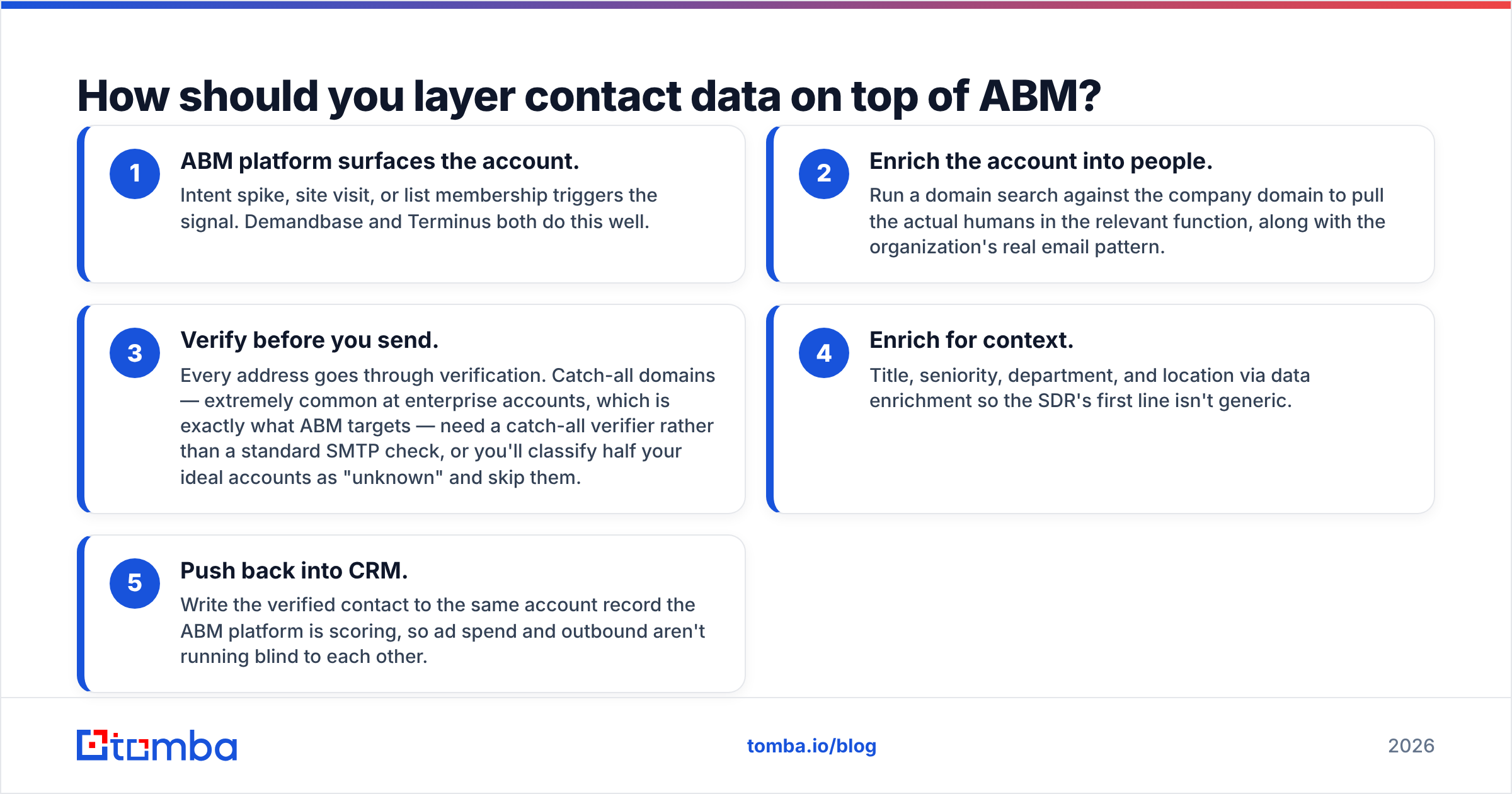
Here is the sequence that works, in order:
- ABM platform surfaces the account. An intent spike, site visit, or list membership fires the signal. Demandbase and Terminus both do this well.
- Turn the account into people. Run a domain search against the company domain. You get the humans in the relevant function, plus the company's real email pattern.
- Verify before you send. Every address goes through verification. Catch-all domains are everywhere at enterprise accounts, which is exactly what ABM targets. They need a catch-all verifier rather than a standard SMTP check. Skip that step and you will mark half your best accounts "unknown" and pass on them.
- Enrich for context. Add title, seniority, department, and location via data enrichment so the SDR's first line is not generic.
- Push back into CRM. Write the verified contact to the same account record the ABM platform is scoring. Then ad spend and outbound stop running blind to each other.
Step 3 is where most programs quietly leak money. Say you pay $60k a year to identify 500 in-market accounts, then bounce 20% of the emails you send them. You have just damaged your sender reputation with the exact domains you most need to reach. Bounce damage is not spread evenly. It lands on your highest-value targets.
What does the total stack actually cost?#
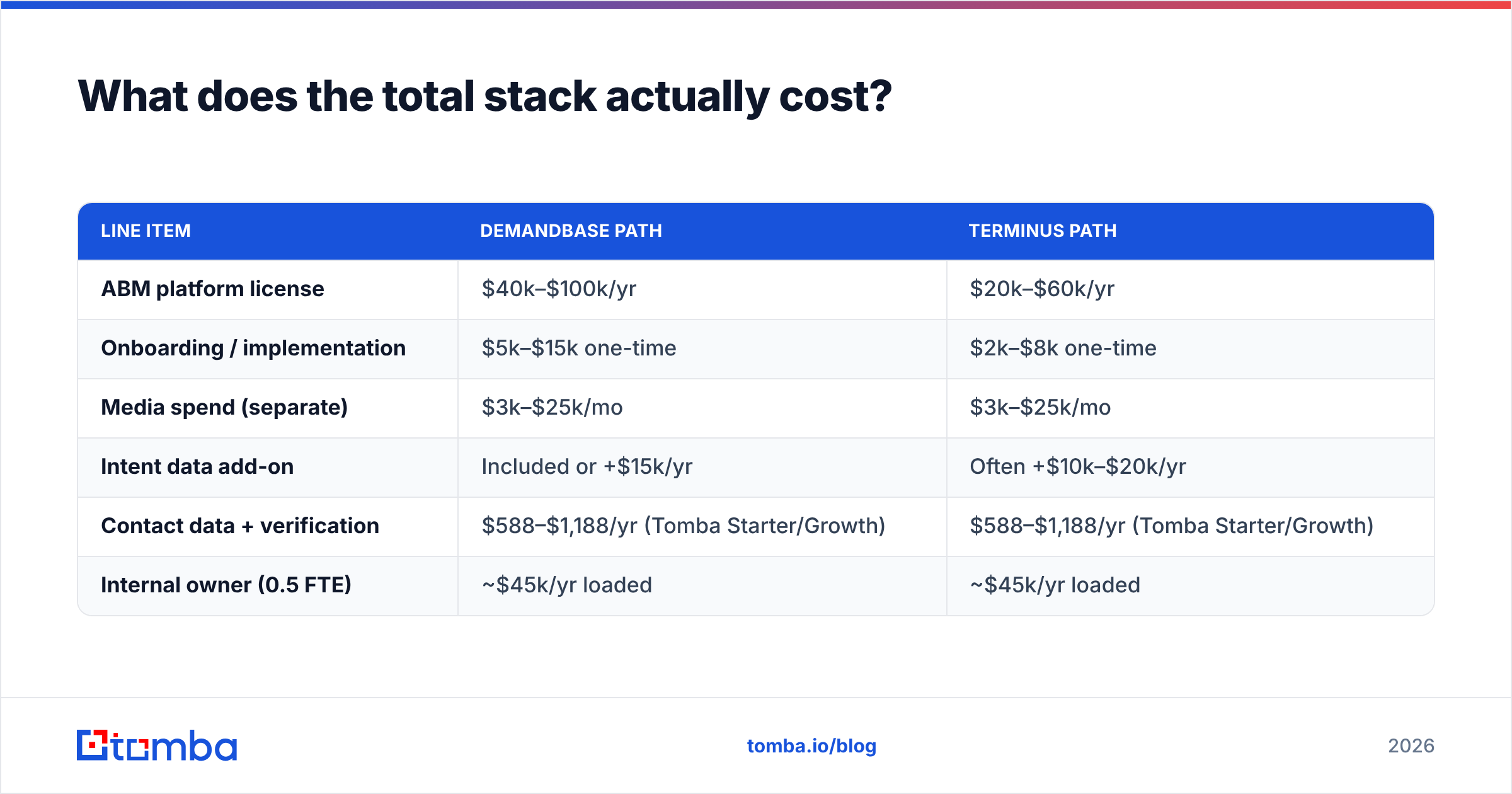
| Line item | Demandbase path | Terminus path |
|---|---|---|
| ABM platform license | $40k–$100k/yr | $20k–$60k/yr |
| Onboarding / implementation | $5k–$15k one-time | $2k–$8k one-time |
| Media spend (separate) | $3k–$25k/mo | $3k–$25k/mo |
| Intent data add-on | Included or +$15k/yr | Often +$10k–$20k/yr |
| Contact data + verification | $588–$1,188/yr (Tomba Starter/Growth) | $588–$1,188/yr (Tomba Starter/Growth) |
| Internal owner (0.5 FTE) | ~$45k/yr loaded | ~$45k/yr loaded |
The contact-data row is the cheapest line. It is also the one that decides whether the rest converts. Tomba pricing starts free at 25 searches a month, then $49/mo Starter, $99/mo Growth, and $249/mo Pro. Next to a six-figure ABM commitment, that is a rounding error. It is also the layer that turns an account signal into a message someone actually receives.
Note what the table leaves out: the internal owner. Gartner's research on martech has found the same thing for years. Companies use only a fraction of what they license, and ABM platforms are among the worst offenders. If nobody owns the platform half-time, buy the cheaper one.
Demandbase vs Terminus: which should you choose?#
Choose Demandbase if:
- You're enterprise or upper mid-market with a defined ICP of 1,000+ accounts
- Account identification and intent quality are your genuine bottleneck
- You have RevOps capacity to own the implementation
- You can justify $75k+ all-in for year one
Choose Terminus if:
- You're mid-market with a target list you already trust
- Distribution — getting seen by known accounts — is the bottleneck
- You want a first campaign live in under a month
- Email signature marketing fits your headcount (100+ employees makes it compelling)
Choose neither yet if:
- Your target account list isn't defined, or is defined by gut feel
- You haven't proven a message converts in outbound at small scale
- Your CRM data is dirty enough that account matching will fail on ingest
That last case is more common than vendors admit. ABM software amplifies the list discipline you already have. If the account and contact records are stale, both platforms will amplify the staleness at $60k a year. Clean the data first. Bulk verify what is in the CRM, dedupe, and confirm the accounts are real. Then buy the platform.
What's the fastest way to test ABM before committing?#
Run a manual pilot for one quarter. Pick 100 accounts. Build the contact list yourself with a domain search and a verification pass. Run LinkedIn ads against the company list. Add a coordinated outbound sequence and a hand-written executive touch. Track meetings sourced.
If 100 accounts done by hand produce meetings, the platform will scale it and the spend is justified. If they do not, no amount of intent data fixes a targeting or messaging problem. And you learned that for a few hundred dollars instead of a signed annual contract.
Where Tomba fits#
Whichever side of the Demandbase vs Terminus decision you land on, the account signal has to become a person with a working email address before revenue happens. That is the job Tomba's Email Finder does. Give it a company domain and a name. Get back a verified professional email with a confidence score, at roughly 1% of what the big platforms cost. Pair it with the verifier so nothing bounces against the accounts you spent six figures identifying.
Start on the free tier with 25 searches. Test it against the accounts your ABM platform already flags. Then see how many of them your contact data was quietly missing.
Related guides#
Ready to find emails that actually work?
Join 150,000+ professionals who stopped guessing and started sending. Free credits on signup — no credit card required.
Get the Tomba newsletter
Practical outbound tactics and product updates — once every two weeks.
About the author