9 Best DemandScience Alternatives for B2B Data in 2026
DemandScience sells leads by the contract, not by the record. If CPL pricing, annual minimums, or thin lead quality are stalling your pipeline, here are nine alternatives compared on data accuracy, cost model, and time to first list.
TL;DR
- DemandScience is a demand-generation vendor, not a self-serve database. You buy leads on a cost-per-lead (CPL) contract, usually annual, usually with a minimum commitment.
- Most teams searching for DemandScience alternatives want one of three things: lower cost per usable contact, control over targeting, or the ability to verify records before they hit the CRM.
- If you want demand (content syndication, MQL delivery), your alternatives are agencies like Anteriad, Intentsify, or Bombora-powered programs.
- If you want data (emails, phones, firmographics you query yourself), your alternatives are Cognism, ZoomInfo, Apollo, BookYourData, UpLead, Lusha, or Tomba.
- The cheapest switch is usually the self-serve route: you pay per record you actually pull, not per lead someone else decides to send you.
What does DemandScience actually sell?#
DemandScience (formerly PureB2B) is a B2B demand-generation company. Its core business is delivering marketing-qualified leads to enterprise marketing teams — typically through content syndication, where your whitepaper gets promoted across a publisher network and the people who download it become leads you pay for.
Alongside that, DemandScience runs a contact-data platform (Klarity) and an intent-data layer that scores accounts based on research behavior. You can read the current positioning on demandscience.com.
That model works well for one specific buyer: a marketing team with a quarterly MQL number, a real content library, and budget approved in advance. It works badly for almost everyone else — and that mismatch is why "DemandScience alternatives" is a search anyone runs about eleven months into a twelve-month contract.
The important distinction before you shortlist anything:
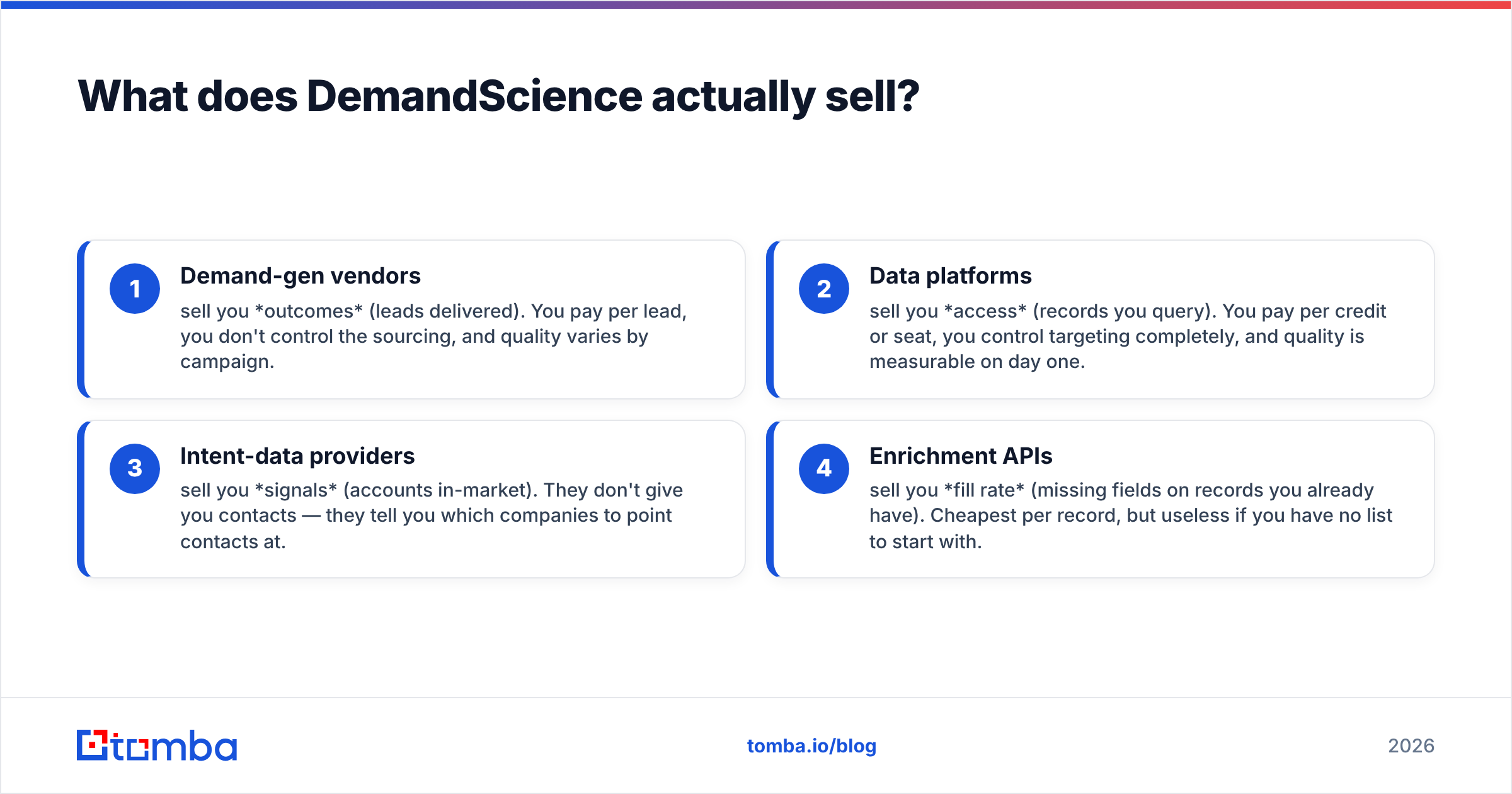
- Demand-gen vendors sell you outcomes (leads delivered). You pay per lead, you don't control the sourcing, and quality varies by campaign.
- Data platforms sell you access (records you query). You pay per credit or seat, you control targeting completely, and quality is measurable on day one.
- Intent-data providers sell you signals (accounts in-market). They don't give you contacts — they tell you which companies to point contacts at.
- Enrichment APIs sell you fill rate (missing fields on records you already have). Cheapest per record, but useless if you have no list to start with.
Picking the wrong category is the single most common reason a replacement disappoints. If you replace a CPL contract with a credit-based database and nobody on your team is doing the targeting work, you have not solved the problem — you have moved it.
Why do teams look for DemandScience alternatives?#
Across review sites like G2 and in-house post-mortems, the same five complaints repeat about the CPL demand-gen model in general:
- Lead quality is uneven. A whitepaper download is a low-intent act. A meaningful share of delivered leads are researchers, students, or people at companies who will never buy. Sales gets a list, sales tells you the list is bad, marketing defends the CPL.
- You can't see the sourcing. With a publisher network, you're trusting the vendor's process. When a lead is stale you have no way to audit it yourself.
- Annual minimums. Contracts are committed spend. If your ICP shifts in Q2, you're still buying Q1's ICP through Q4.
- Slow feedback loops. Leads arrive in batches. You find out a targeting parameter was wrong two weeks after you set it.
- Nothing to keep. When the contract ends, you have a CSV of past leads. You don't have a repeatable motion or a tool your reps use daily.
None of that means DemandScience is a bad vendor. It means the CPL model concentrates risk on you and control on them. If you'd rather flip that ratio, you're looking for a different category.

What should you compare before switching?#
Score every candidate on these six axes before you look at a price sheet. Most teams look only at #1 and #6, then get surprised by #3.
- Verified accuracy, not claimed accuracy. Every vendor claims 95%+. The number that matters is your bounce rate on your ICP. Run 200 records through a neutral email verifier before signing anything.
- Coverage in your specific geography and segment. North American mid-market coverage is a solved problem. EMEA, APAC, sub-50-employee companies, and non-English domains are where databases diverge hard.
- Cost model — commitment vs consumption. Annual minimum, seat license, or pay-per-credit. Consumption pricing is the only model where a slow quarter costs you less money.
- Credit refund policy on bad data. Do you get the credit back on an invalid record, or do you eat it? Over a year this is a 10–20% swing in effective cost.
- Compliance posture. GDPR/CCPA handling, opt-out processing, and documented sourcing. Ask where the data comes from and get the answer in writing.
- Time to first usable list. Self-serve tools: minutes. Contract vendors: weeks, including legal, onboarding, and campaign setup.
Which DemandScience alternatives are worth shortlisting in 2026?#
Here's the shortlist, grouped by what they actually replace.
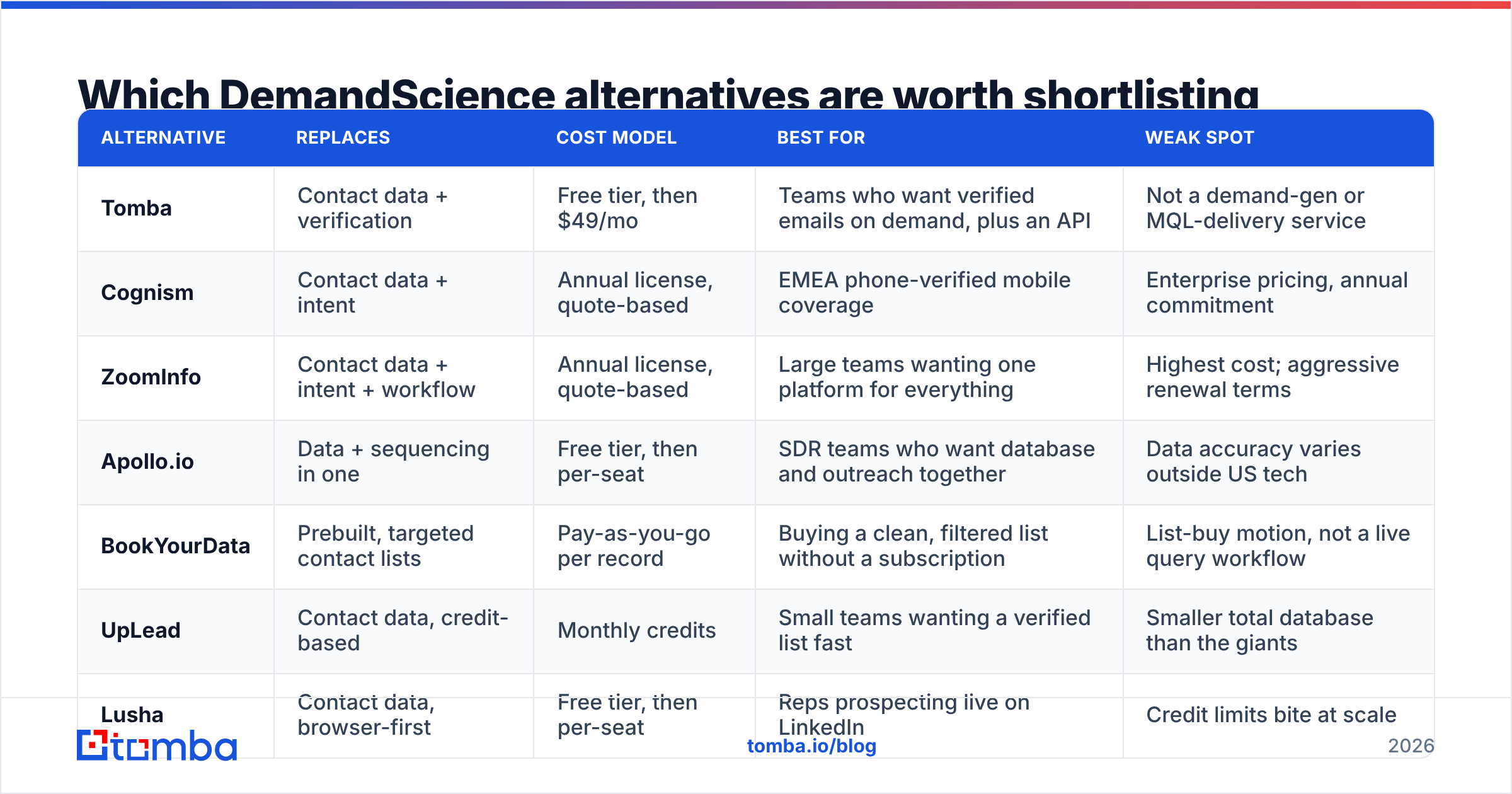
| Alternative | Replaces | Cost model | Best for | Weak spot |
|---|---|---|---|---|
| Tomba | Contact data + verification | Free tier, then $49/mo | Teams who want verified emails on demand, plus an API | Not a demand-gen or MQL-delivery service |
| Cognism | Contact data + intent | Annual license, quote-based | EMEA phone-verified mobile coverage | Enterprise pricing, annual commitment |
| ZoomInfo | Contact data + intent + workflow | Annual license, quote-based | Large teams wanting one platform for everything | Highest cost; aggressive renewal terms |
| Apollo.io | Data + sequencing in one | Free tier, then per-seat | SDR teams who want database and outreach together | Data accuracy varies outside US tech |
| BookYourData | Prebuilt, targeted contact lists | Pay-as-you-go per record | Buying a clean, filtered list without a subscription | List-buy motion, not a live query workflow |
| UpLead | Contact data, credit-based | Monthly credits | Small teams wanting a verified list fast | Smaller total database than the giants |
| Lusha | Contact data, browser-first | Free tier, then per-seat | Reps prospecting live on LinkedIn | Credit limits bite at scale |
| Bombora | Intent signals only | Annual subscription | Adding intent to an existing data stack | Provides no contacts at all |
| Anteriad / Intentsify | Content syndication + MQL delivery | CPL contract | Teams that genuinely want the DemandScience model, done differently | Same structural risks as any CPL deal |
Two notes on reading that table. First, Bombora is not a like-for-like swap — it's a signal layer you bolt onto a data provider. Second, if you land on Anteriad or Intentsify, you haven't changed models, you've changed vendors. That's a legitimate choice if your complaint was execution rather than structure.
Tomba#
Tomba sits at the "data, self-serve, consumption-priced" end. You give it a domain or a name plus company, and it returns a verified professional email. The email finder and domain search cover the two common shapes of prospecting work: one person at a time, or every relevant contact at a target account.
Pricing: free tier at 25 searches/month, Starter at $49/mo, Growth at $99/mo, Pro at $249/mo, Enterprise custom. See current Tomba pricing for credit allocations. There's no annual minimum, which is the entire point relative to a CPL contract.
Where it fits: you have targeting logic (a list of accounts, a job-title filter, a trigger event) and you need contactable records for it. Where it doesn't: you have no targeting logic and want someone else to generate demand for you. Tomba is not that.
Cognism#
The strongest DemandScience alternative if your problem is European coverage. Cognism's differentiator is phone-verified mobile numbers and a documented GDPR/notification process across EU markets — see cognism.com. Pricing is annual and quote-based, so you're trading one commitment for another, but you get direct control over targeting instead of receiving batches.
ZoomInfo#

The maximalist option: contact data, intent, conversation intelligence, workflow automation. If you're consolidating four vendors into one and have the budget, it's defensible. If you're leaving DemandScience because annual commitments hurt, ZoomInfo is not the escape hatch — it's the same shape at a larger size.
Apollo.io#
Apollo bundles a database with a sequencer, which appeals to SDR teams tired of paying twice. The trade-off is data quality variance: strong on US software companies, patchier elsewhere. Many teams run Apollo for sequencing and a separate finder for accuracy on high-value accounts. If you're evaluating that split, our Apollo alternative breakdown covers the overlap.
BookYourData#
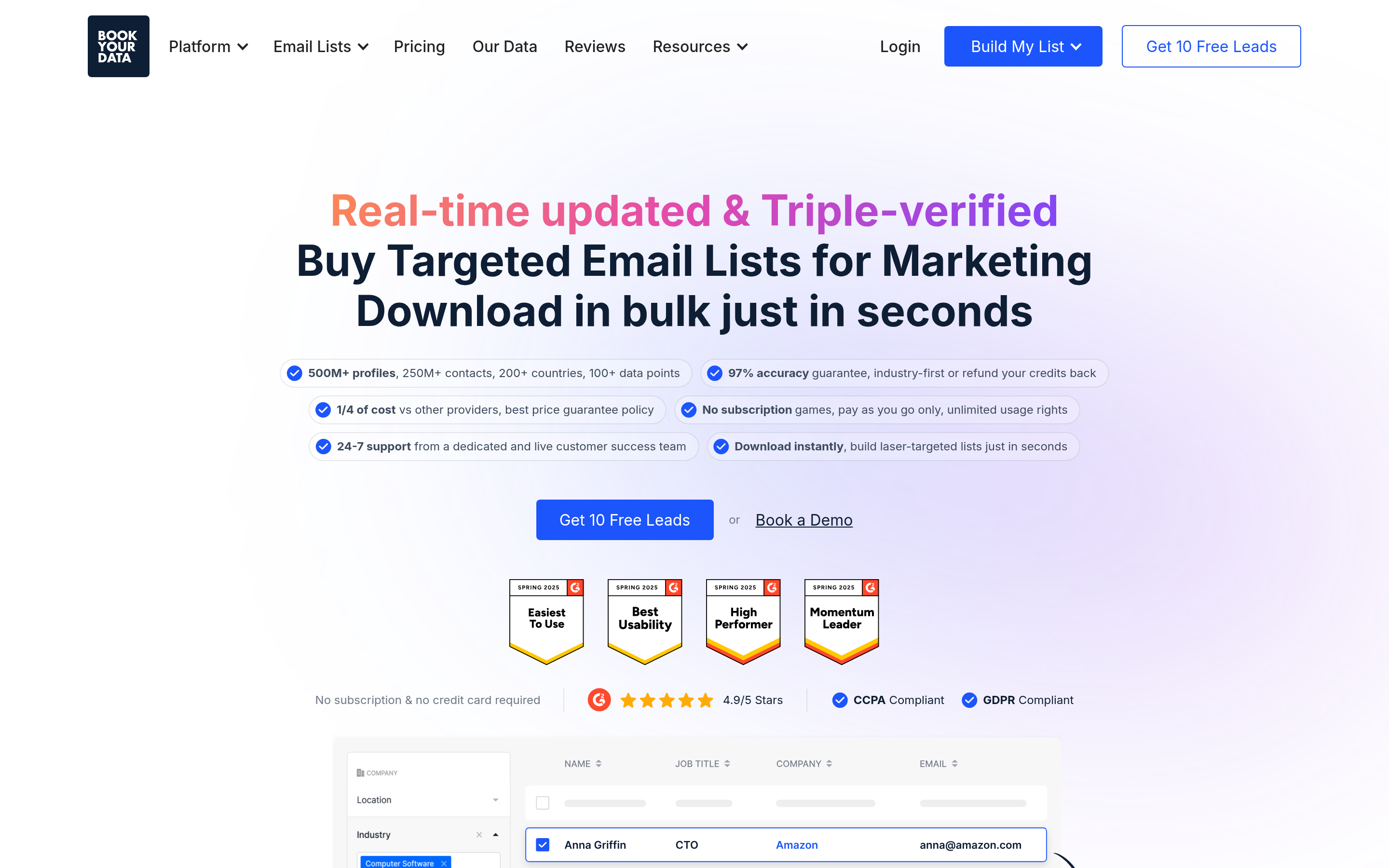
A different, genuinely useful model: you build a filtered list in the browser — industry, title, geography, company size — see the count, and buy exactly those records pay-as-you-go. No subscription, no annual minimum. For a one-off campaign into a well-defined segment, that's often the fastest path from "we need a list" to "we have a list," and the accuracy guarantee is stated up front. It's a list-purchase motion rather than a continuous query workflow, so it complements a live finder more than it replaces one.
UpLead and Lusha#
Both are credit-based, self-serve, and priced for small teams. UpLead leans toward list building with verification at export. Lusha leans toward the browser extension and live LinkedIn prospecting. Neither has the raw database size of ZoomInfo, and both get expensive per record at high volume — but both start on the same day you sign up.
How do the pricing models really compare?#
This is where the switch either pays for itself or doesn't. Normalize everything to cost per usable contact — records that are valid, in-ICP, and reachable.
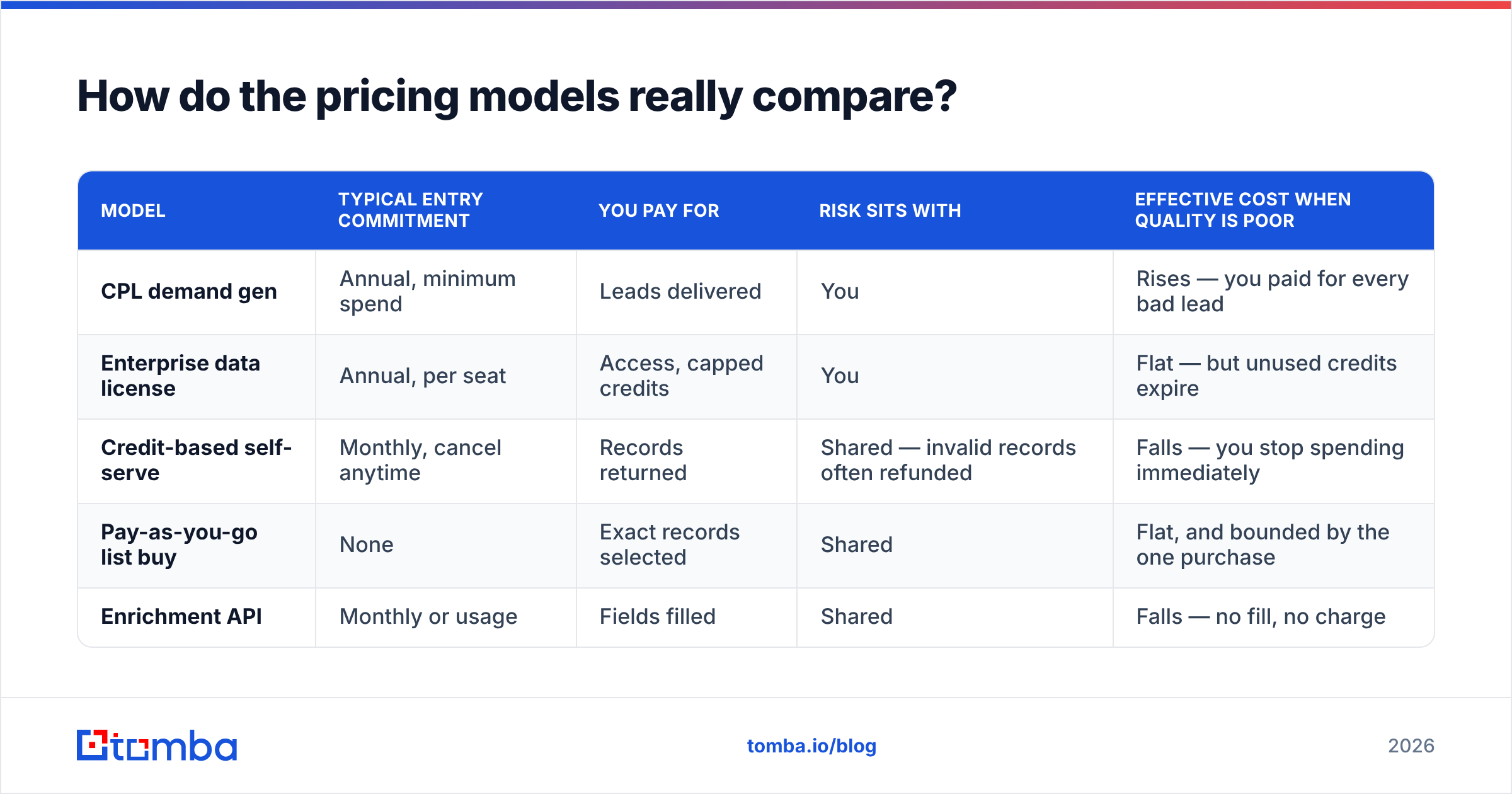
| Model | Typical entry commitment | You pay for | Risk sits with | Effective cost when quality is poor |
|---|---|---|---|---|
| CPL demand gen | Annual, minimum spend | Leads delivered | You | Rises — you paid for every bad lead |
| Enterprise data license | Annual, per seat | Access, capped credits | You | Flat — but unused credits expire |
| Credit-based self-serve | Monthly, cancel anytime | Records returned | Shared — invalid records often refunded | Falls — you stop spending immediately |
| Pay-as-you-go list buy | None | Exact records selected | Shared | Flat, and bounded by the one purchase |
| Enrichment API | Monthly or usage | Fields filled | Shared | Falls — no fill, no charge |
Run the arithmetic on your own last twelve months. A CPL contract at $40 per lead with a 35% usable rate is $114 per usable contact. A $99/month credit plan that returns 2,000 verified emails at an 80% usable rate is roughly $0.06. Those are not the same product — the CPL lead expressed some interest — but that gap buys a lot of SDR time, and interest expressed by a whitepaper download is doing less work than the price implies.

The clause that catches people is the annual minimum. If you commit to $120K and use 60% of it, your real cost per lead is not the number on the rate card. Check whether unused spend rolls over before you renew — most of the time it does not.
Is a self-serve data tool actually better than a lead-gen agency?#
Not universally. Here's the honest split.
Stay with a CPL / demand-gen vendor if: you have a marketing team with an MQL quota, a genuine content library worth syndicating, budget approved annually, and no internal capacity to run targeting. Outsourcing demand generation is a real service and doing it yourself is not free.
Switch to self-serve data if: your reps are the ones sourcing accounts anyway, your ICP changes more than once a year, you want to verify records before they touch the CRM, or you can't defend the cost per usable contact to finance.
Run both if: syndication fills top-of-funnel while your outbound team works a named-account list. This is the most common end state at companies above roughly 50 employees, and there's no contradiction in it.
One thing self-serve gives you that CPL never does: a feedback loop measured in hours. You pull 50 contacts, verify them, send, and see reply rates the same week. Then you change the filter and do it again. With batched lead delivery, that loop is a month long, and a month is enough time to burn a quarter.
How do you migrate off DemandScience without losing pipeline?#
Six steps, in order. Don't skip step two — it's the only one that produces evidence.
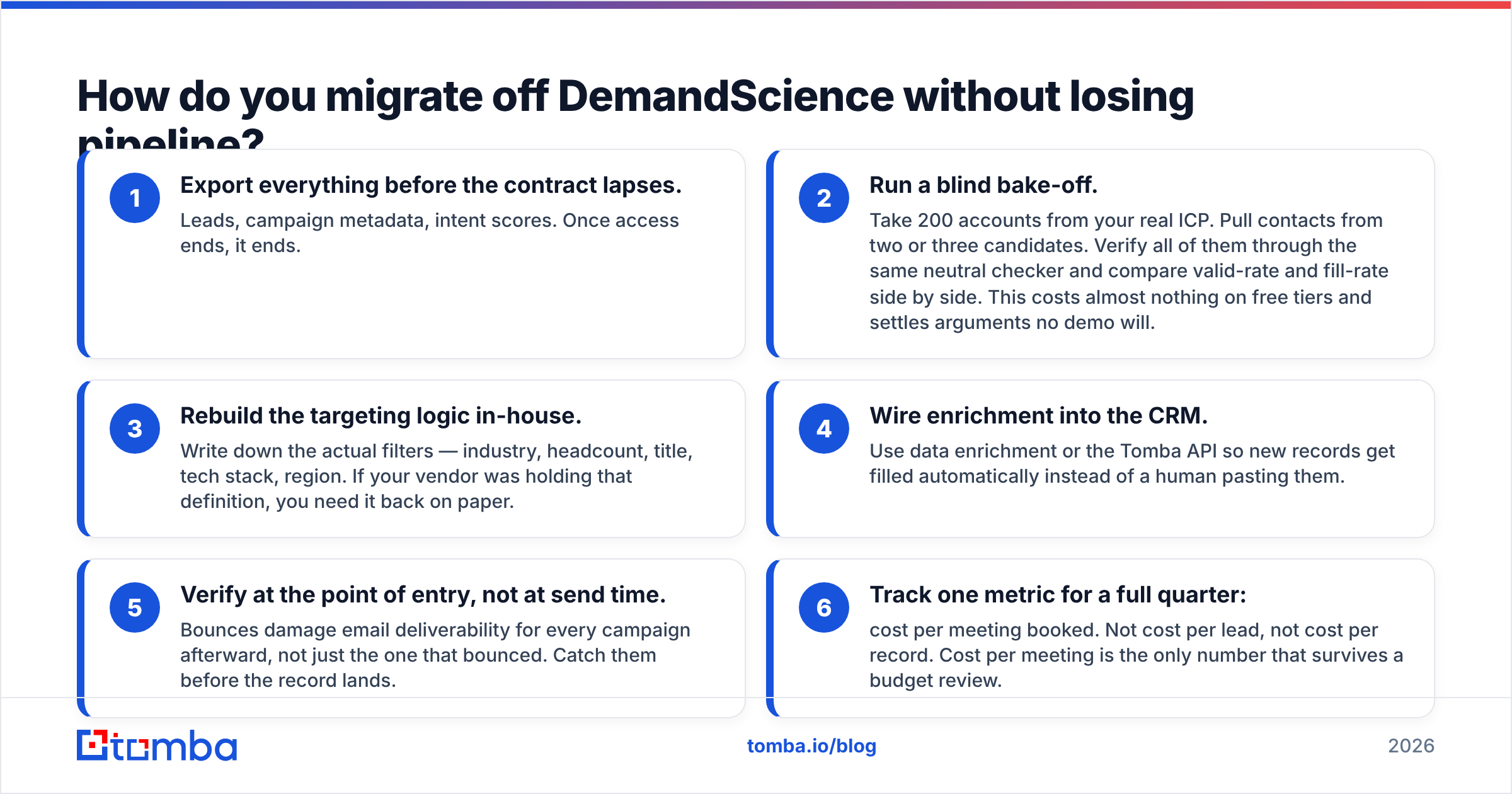
- Export everything before the contract lapses. Leads, campaign metadata, intent scores. Once access ends, it ends.
- Run a blind bake-off. Take 200 accounts from your real ICP. Pull contacts from two or three candidates. Verify all of them through the same neutral checker and compare valid-rate and fill-rate side by side. This costs almost nothing on free tiers and settles arguments no demo will.
- Rebuild the targeting logic in-house. Write down the actual filters — industry, headcount, title, tech stack, region. If your vendor was holding that definition, you need it back on paper.
- Wire enrichment into the CRM. Use data enrichment or the Tomba API so new records get filled automatically instead of a human pasting them.
- Verify at the point of entry, not at send time. Bounces damage email deliverability for every campaign afterward, not just the one that bounced. Catch them before the record lands.
- Track one metric for a full quarter: cost per meeting booked. Not cost per lead, not cost per record. Cost per meeting is the only number that survives a budget review.
Budget four to six weeks of overlap. Running the new stack alongside the last month of the old contract costs a little extra and removes the risk of a dead quarter.
Frequently asked questions#
Is DemandScience the same as a B2B database? No. It's primarily a demand-generation service that delivers leads, with a contact-data platform alongside it. A pure database like ZoomInfo, Cognism, or Tomba gives you query access; DemandScience's core product gives you delivered leads.
What's the cheapest DemandScience alternative? For contact data, the credit-based self-serve tools — most have free tiers you can test today, and a paid entry point around $49–$99/month. For MQL delivery there is no cheap alternative; CPL is CPL.
Can I replace intent data without paying for a separate vendor? Partially. Website visitor identification catches the accounts already researching you, which is a large share of what generic intent data would surface. Third-party intent still adds accounts researching your category elsewhere.
Do I need a verifier if my data provider already verifies? Yes, for anything high value. A second check catches records that went stale between the provider's last refresh and your send date, and it's the only way to compare vendors on the same yardstick.
Where should you start?#
Start with the bake-off, not the contract. Take 200 accounts from your real ICP, pull contacts with the Tomba Email Finder, verify them, and compare the valid rate against the last batch DemandScience delivered. The free tier covers 25 searches, and Starter at $49/mo covers a full test campaign — no annual minimum, no legal review, no waiting on a campaign launch date.
If the numbers favor staying, you'll have proof for your renewal negotiation. If they favor switching, you'll already be halfway migrated.
Related guides#
Ready to find emails that actually work?
Join 150,000+ professionals who stopped guessing and started sending. Free credits on signup — no credit card required.
Get the Tomba newsletter
Practical outbound tactics and product updates — once every two weeks.
About the author