DemandScience Pricing Reviews Pros and Cons (2026 Guide)
DemandScience sells intent data and lead generation on annual contracts with quote-only pricing. Here is what buyers actually pay, what reviewers complain about, and when a cheaper email finder does the job instead.
This guide breaks down DemandScience pricing reviews pros and cons in one place. You get what buyers actually pay, what reviewers praise, what they complain about, and when a cheaper tool does the job instead.
TL;DR
- DemandScience does not publish pricing. Every deal is quote-only, and buyers consistently report annual commitments in the $15,000–$60,000+ range depending on lead volume, intent topics, and whether content syndication is bundled in.
- The core product is not an email finder. It is a demand-generation service: intent signals, curated audiences, and cost-per-lead (CPL) content syndication delivered to your CRM.
- Reviews on G2 and Capterra skew positive on support and audience targeting, and negative on lead quality variance, contract rigidity, and slow ramp time.
- It fits enterprise demand-gen teams with a defined MQL quota and budget. It badly overserves a two-person SDR team that just needs verified contact data.
- If your actual problem is "I have a list of companies and need valid work emails," a self-serve tool at $49/mo solves it for roughly 1% of a DemandScience contract.
What is DemandScience and what are you actually buying?#
DemandScience (formerly PureB2B, and the parent of Klarity and Leadiro before consolidation) is a B2B demand generation vendor, not a contact database you log into and search. That distinction drives almost everything about the pricing model.
When you sign with DemandScience, you are typically buying one or more of these:
- Content syndication leads — you supply a whitepaper or webinar, they promote it to their publisher network, and you get billed per lead delivered (CPL). This is the bread-and-butter motion.
- Intent data — signals showing which accounts are researching topics relevant to your category, sourced from their publisher and co-op network.
- Curated audience lists — filtered contact records matching a target ICP, delivered as files or pushed into a CRM.
- Klarity — a self-serve-ish prospecting layer where you build lists from their database, priced separately with credit tiers.
- Managed program services — an account team that runs the campaign, handles lead QA, and reports on delivery.
The mental model: DemandScience is closer to hiring an agency with a data warehouse attached than to buying a SaaS seat. You do not "use" it the way you use a search box. You brief it, then leads arrive.
That is worth understanding before you evaluate the price. The comparison most buyers make — DemandScience vs. an email finder — is apples to oranges on the surface. Underneath, both compete for the same budget line: how do we get qualified contacts into the pipeline this quarter?
What does DemandScience pricing actually look like in 2026?#
There is no public price list. DemandScience routes everything through sales, and pricing is assembled per program. That is standard for CPL vendors, but it makes budgeting painful.
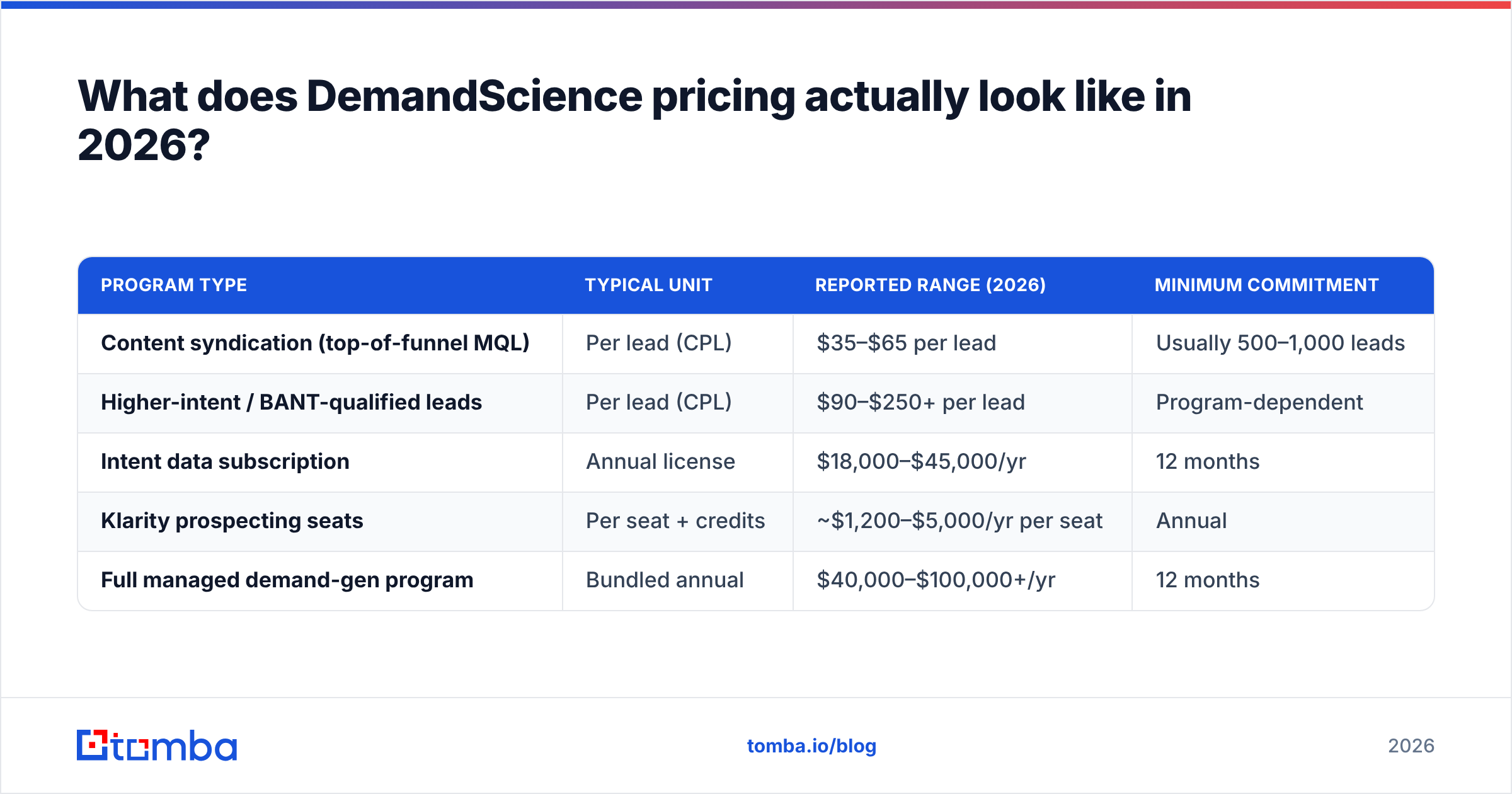
From publicly discussed contract structures, review-site commentary, and how CPL demand-gen deals are typically priced across the category, here is the shape of what buyers encounter:
| Program type | Typical unit | Reported range (2026) | Minimum commitment |
|---|---|---|---|
| Content syndication (top-of-funnel MQL) | Per lead (CPL) | $35–$65 per lead | Usually 500–1,000 leads |
| Higher-intent / BANT-qualified leads | Per lead (CPL) | $90–$250+ per lead | Program-dependent |
| Intent data subscription | Annual license | $18,000–$45,000/yr | 12 months |
| Klarity prospecting seats | Per seat + credits | ~$1,200–$5,000/yr per seat | Annual |
| Full managed demand-gen program | Bundled annual | $40,000–$100,000+/yr | 12 months |
Treat these as directional, not quoted. Two things move the number more than anything else: geography (EMEA and APAC leads price higher than North America) and qualification depth. A raw content download is cheap. A BANT-verified, phone-confirmed lead is not.
The structural facts you can rely on:
- Annual contracts are the norm. Month-to-month is rarely offered on the intent or managed side.
- No free tier. There is no self-serve trial where you validate the data before you commit budget.
- Lead replacement policies exist but are negotiated. Ask explicitly what happens to leads you reject — how many you can reject, on what grounds, and whether they are replaced or credited.
- Overage and pacing clauses matter. If your program under-delivers, does the contract roll or expire? Get this in writing.
What questions to force into the quote conversation#
- What is the exact CPL by geography and job-title tier?
- What percentage of leads can I reject, and what is the replacement SLA?
- Is the email address verified at delivery, or at collection time weeks earlier?
- Which publishers are in the network for my category? Can I suppress specific ones?
- Do I own the data after the contract ends, or is it licensed?
That last one catches people. Some demand-gen contracts license data for the term rather than transferring it outright.
What do DemandScience reviews say — the pros?#
Most write-ups of DemandScience pricing reviews pros and cons stop at the star rating. The themes underneath matter more.
Aggregate sentiment across G2 and Capterra lands DemandScience in the "solid, not spectacular" band. The strongest praise clusters around a few themes.
1. Account management is genuinely hands-on. This is the single most consistent positive. Reviewers describe named CSMs who respond quickly, adjust targeting mid-flight, and flag pacing issues early. For a marketing team without a demand-gen ops person, that support layer has real value.
2. Audience targeting granularity is strong. Filtering by firmographics, install base technology, job function, and seniority works well in practice. Teams selling into narrow verticals report that the ICP matching holds up better than generic list vendors.
3. Volume delivery is reliable. If you contract for 1,000 leads, you generally get 1,000 leads on schedule. Delivery mechanics — CRM push, file drops, HubSpot and Salesforce integrations — are described as smooth.
4. Global coverage is real. EMEA and APAC delivery is a genuine strength versus North-America-heavy competitors. If your expansion market is Germany or Singapore, this matters.
5. Compliance posture is taken seriously. GDPR and CCPA consent documentation is provided per lead. For regulated industries, that de-risks the buy compared to scraped lists.
What do DemandScience reviews say — the cons?#
The criticisms are just as consistent, and they cluster tightly.
1. Lead quality variance is the number-one complaint. The recurring story: leads match the ICP filters but are not in-market, have never heard of you, and respond to outreach with confusion. Content-syndication leads downloaded a whitepaper. That is a weak intent signal, and sales teams that expect BANT-level readiness get frustrated fast.
2. Contract rigidity. Annual commitment, no meaningful trial, and limited ability to pause or reallocate spend mid-term. Several reviewers describe wanting to shift budget from syndication to intent data and hitting friction.
3. Slow ramp. Program setup, creative approval, publisher matching, and first delivery can take three to six weeks. If you need pipeline this month, this is not the lever.
4. Data freshness questions. Contact records collected months earlier may have gone stale by delivery. Job changes in B2B run roughly 20–30% a year in sales and marketing roles. A lead captured in January and delivered in April carries real decay risk.
This is why teams increasingly run delivered lists through an independent email verifier before loading them into a sequence. A $20 verification pass can save a domain from a bounce-driven reputation hit.
5. Attribution ambiguity. Intent signals come from a co-op network, so it is hard to audit why an account was flagged as in-market. You are trusting the model.
6. Sales-led everything. Want to know the price? Book a call. Want to add 200 leads? Book a call. For teams used to self-serve tooling, the friction is grating.
Is DemandScience worth it compared to self-serve data tools?#
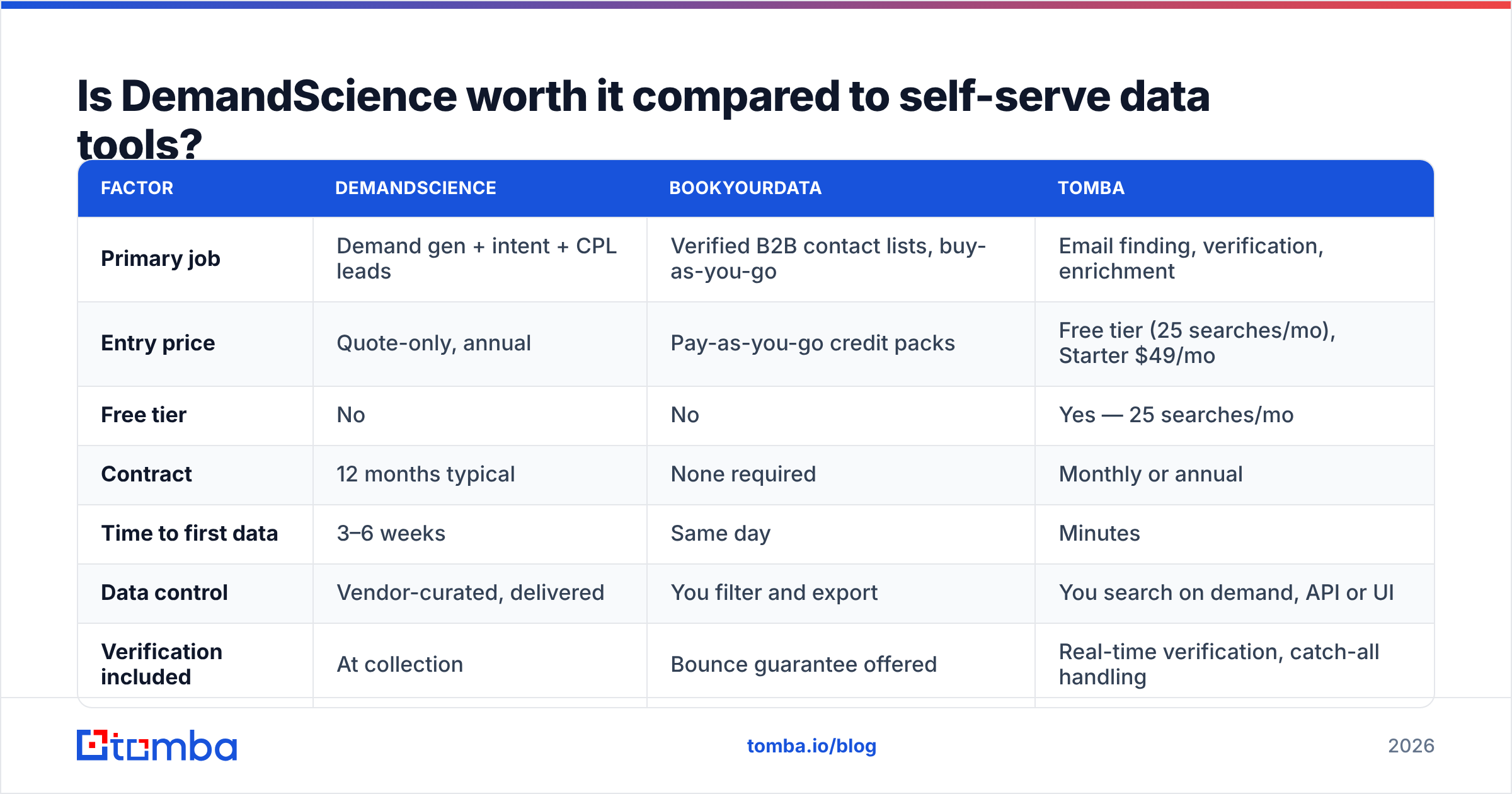
Here is where the honest comparison lives. These tools do different jobs. The right answer depends on whether you need demand created or contacts found.
| Factor | DemandScience | BookYourData | Tomba |
|---|---|---|---|
| Primary job | Demand gen + intent + CPL leads | Verified B2B contact lists, buy-as-you-go | Email finding, verification, enrichment |
| Entry price | Quote-only, annual | Pay-as-you-go credit packs | Free tier (25 searches/mo), Starter $49/mo |
| Free tier | No | No | Yes — 25 searches/mo |
| Contract | 12 months typical | None required | Monthly or annual |
| Time to first data | 3–6 weeks | Same day | Minutes |
| Data control | Vendor-curated, delivered | You filter and export | You search on demand, API or UI |
| Verification included | At collection | Bounce guarantee offered | Real-time verification, catch-all handling |
| Best for | Enterprise demand-gen with MQL quota | Teams wanting clean prepackaged lists fast | Teams sourcing contacts continuously at scale |
| API access | Limited / program-based | Available | Full API, CLI, MCP |
BookYourData occupies a useful middle ground here. You get prepackaged, verified lists without a 12-month signature, which solves the "I need 5,000 clean contacts by Friday" problem. Neither a demand-gen contract nor a per-search tool handles that as directly. If you buy in periodic bulk rather than looking up contacts daily, it deserves a look.
Tomba sits at the other end: continuous, on-demand lookup. You paste a domain, get the verified pattern and contacts, and move on. Tomba pricing runs Free (25 searches/mo), Starter $49/mo, Growth $99/mo, Pro $249/mo, and Enterprise custom — no sales call required to see the number.

When should you actually buy DemandScience?#
Buy it if all of these are true:
- You have a marketing-sourced MQL quota and a budget line specifically for demand generation, not just data.
- You have gated content worth syndicating — a real whitepaper, benchmark report, or webinar, not a two-page PDF.
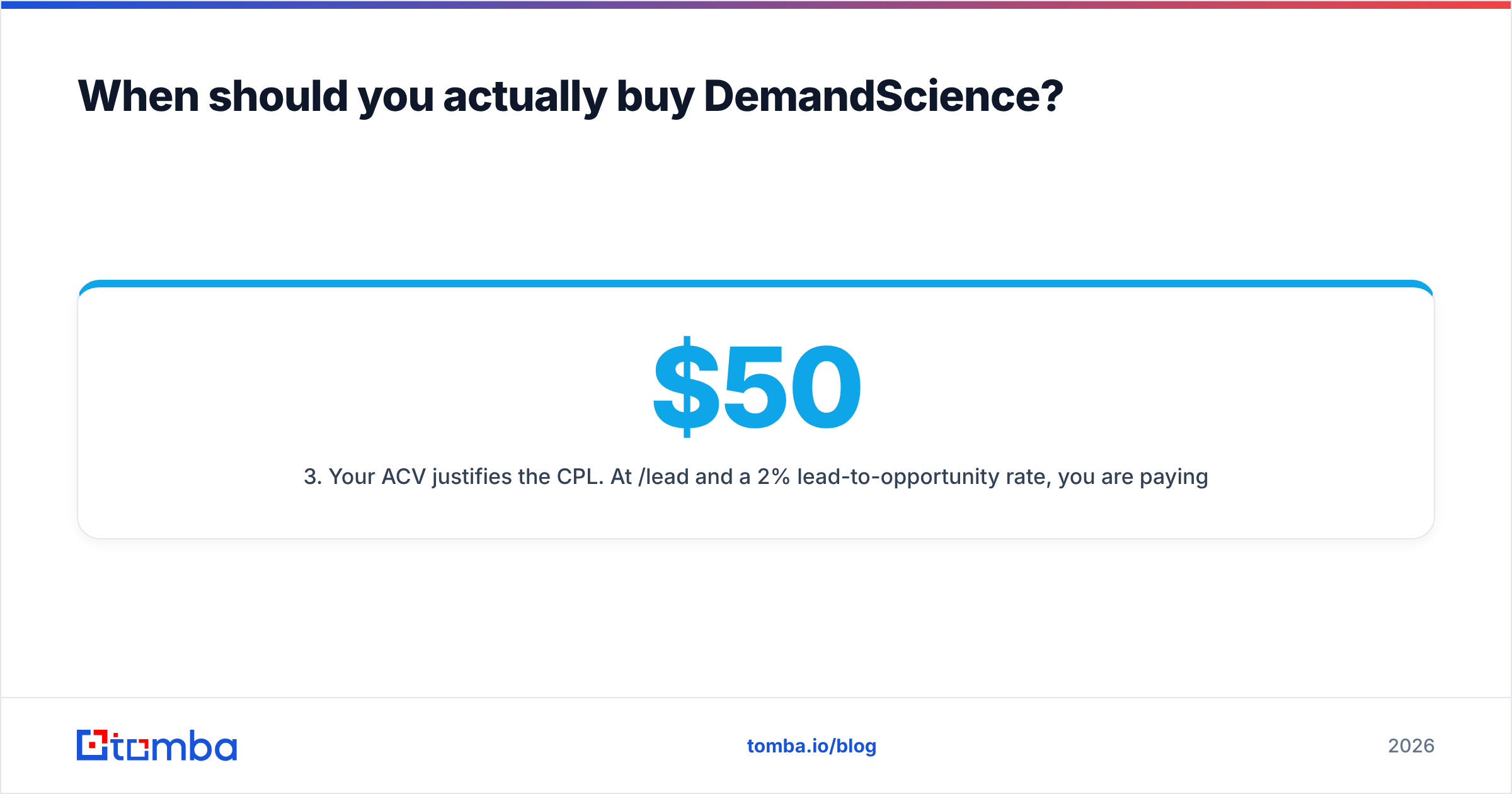
- Your ACV justifies the CPL. At $50/lead and a 2% lead-to-opportunity rate, you pay $2,500 per opportunity before sales cost. That works at $80k ACV. It does not work at $5k ACV.
- You have a nurture engine ready. Top-of-funnel syndication leads are cold. Without a sequenced nurture path, they die in the CRM and you will conclude the vendor sold you junk.
- You need EMEA or APAC reach you cannot build in-house.
Skip it if:
- You are pre-product-market-fit and still testing which ICP responds.
- Your team is under ten people and every dollar needs same-quarter attribution.
- You already have a target account list and just need contact data for it.
- You want to test before committing — there is no path to do that here.
That fourth bullet is the most common misfire. Plenty of teams sign a demand-gen contract when they only needed to find the six right people at 400 companies they had already identified. That is a domain search problem, not a demand-generation problem. The price difference between the two is roughly two orders of magnitude.
How do you evaluate the data quality before signing?#
You cannot get a free trial, but you can get a sample. Negotiate for one, then run it through an objective test rather than eyeballing it.
- Request a 50–100 record sample matching your exact ICP filters, with emails included. Vendors resist this. Push anyway. A vendor confident in the data will find a way.
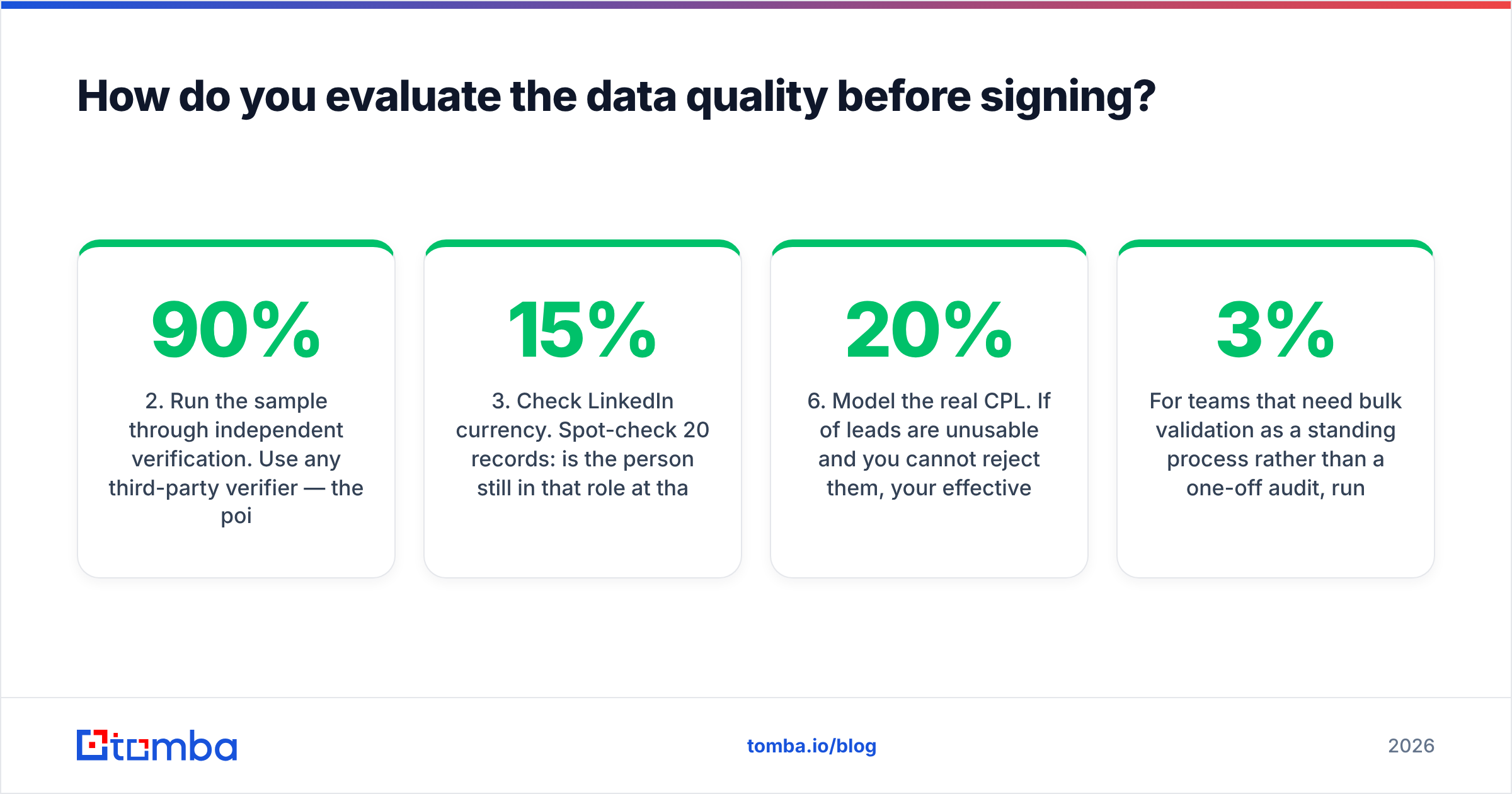
- Run the sample through independent verification. Use any third-party verifier. The point is that it is not the vendor's own tool. Measure the valid rate, the catch-all rate, and the hard-bounce rate. Anything under 90% deliverable on a fresh sample is a red flag.
- Check LinkedIn currency. Spot-check 20 records: is the person still in that role at that company? A 15%+ mismatch rate means the underlying records are stale.
- Test title accuracy, not just presence. "Director" in the record and "Director of Facilities" in reality are not the same buyer.
- Ask when each record was last confirmed. Not "last updated" — that can mean a cosmetic field change. Confirmed.
- Model the real CPL. If 20% of leads are unusable and you cannot reject them, your effective CPL is 25% higher than quoted. Build that into the business case.
This discipline applies to any data vendor, including free-tier tools. The difference is cost. With self-serve tooling you can run this test in an afternoon for nothing. With a quote-only vendor it becomes a negotiation.
Some teams need bulk validation as a standing process, not a one-off audit. Running lists through a bulk verify workflow before every campaign is cheaper than the reputation damage from one bad send. Bounce rates above 3% start hurting email deliverability in ways that take weeks to repair.
What are the strongest DemandScience alternatives?#
It depends on which job you are hiring for:
If you want intent data specifically: Bombora, 6sense, and Demandbase are the established comparison set. Bombora's co-op is the widest. 6sense bundles intent with predictive scoring and orchestration at a higher price.
If you want content syndication: Integrate, Madison Logic, and NetLine compete directly. NetLine is the most transparent on pricing mechanics.
If you want prepackaged verified contact lists without a contract: BookYourData is a strong pick. Pay-as-you-go, a bounce guarantee, and no annual commitment remove the biggest objection buyers raise about the enterprise demand-gen model.
If you want to find and verify contacts on demand: This is the Tomba lane. Search by domain, name, or company. Verify in real time, handle catch-all domains explicitly, and enrich records via API. No sales call, no annual lock-in, and a free tier to test the data first.
If you want an all-in-one sales platform: Apollo and ZoomInfo bundle data with sequencing. Both carry their own contract and data-quality tradeoffs. Read an Apollo alternative breakdown before committing.
DemandScience pricing reviews pros and cons: the honest verdict#
It is fairly priced for what it is, and badly matched to what most buyers think they are getting. That tension sits under every DemandScience pricing reviews pros and cons debate.
DemandScience sells demand creation. If you have a mature funnel, gated content, a nurture engine, and an MQL number to hit, the CPL math can work and the account team earns its keep. Reviewers who describe it positively almost always fit that profile.
The unhappy reviewers wanted something else: fresh, verified contact data they could act on today, on a budget they could control month to month. That is a different product category. No amount of account management fixes the mismatch.
Before you take the call, write down one sentence: "The problem I am solving is ___." If the blank says "we need more people in the top of the funnel," DemandScience is a legitimate candidate. If it says "we know who to contact and can't reach them," you are shopping in the wrong aisle — and you will spend five figures to learn it.
Start with the cheaper test. If your bottleneck is finding verified work emails for accounts you have already targeted, try the Tomba Email Finder before you sign anything annual. The free tier gives you 25 searches a month to check the data quality yourself, Starter is $49/mo, and no sales call sits between you and the answer.
Run 100 of your target accounts through it this week. If the hit rate solves your problem, you just saved a five-figure contract. If it does not, you will walk into the DemandScience call knowing exactly what gap you are paying to fill.
Related guides#
Ready to find emails that actually work?
Join 150,000+ professionals who stopped guessing and started sending. Free credits on signup — no credit card required.
Get the Tomba newsletter
Practical outbound tactics and product updates — once every two weeks.
About the author