11 Best Demoboost Alternatives for Interactive Demos in 2026
Demoboost is solid, but it is not the only interactive demo platform worth your budget. Here are 11 alternatives compared on pricing, capture method, analytics, and who each one actually fits.

TL;DR
- Demoboost is a strong enterprise-leaning interactive demo platform, but pricing starts in the four-figure-per-month range and most teams under 20 reps overpay for governance features they never touch.
- The best Demoboost alternatives split into three buckets: HTML-capture platforms (Navattic, Storylane, Reprise), screenshot/click-through builders (Arcade, Supademo, Folio), and full sales-enablement suites (Consensus, Walnut).
- If you want the cheapest credible path, Supademo and Arcade both have real free tiers. If you need product-qualified-lead routing into your CRM, Navattic and Storylane are the strongest mid-market picks.
- Demo tooling only pays off if demo viewers become contactable leads — that means enriching anonymous viewers with work emails and phone numbers before your SDR follows up.
- Skip the "AI demo generator" marketing. Every vendor now claims it; what actually differs is capture fidelity, editing speed, and analytics depth.
What is Demoboost and why do teams look for alternatives?#
Demoboost is an interactive demo platform. You capture your product's UI, stitch screens into guided flows, and publish them as embeddable demos for your website, sales emails, or in-app onboarding. It sits in the same category as Navattic, Storylane, Reprise, and Walnut — collectively the "demo automation" space that Gartner has been tracking under sales engagement tooling since roughly 2022.
The product is genuinely capable. Demoboost leans enterprise: multi-language demos, granular permissions, demo libraries governed by a central RevOps or presales team, and CRM sync. If you have a 40-person presales org that needs 200 reusable demo modules with version control, that architecture makes sense.
The reasons teams shop for alternatives are consistent:
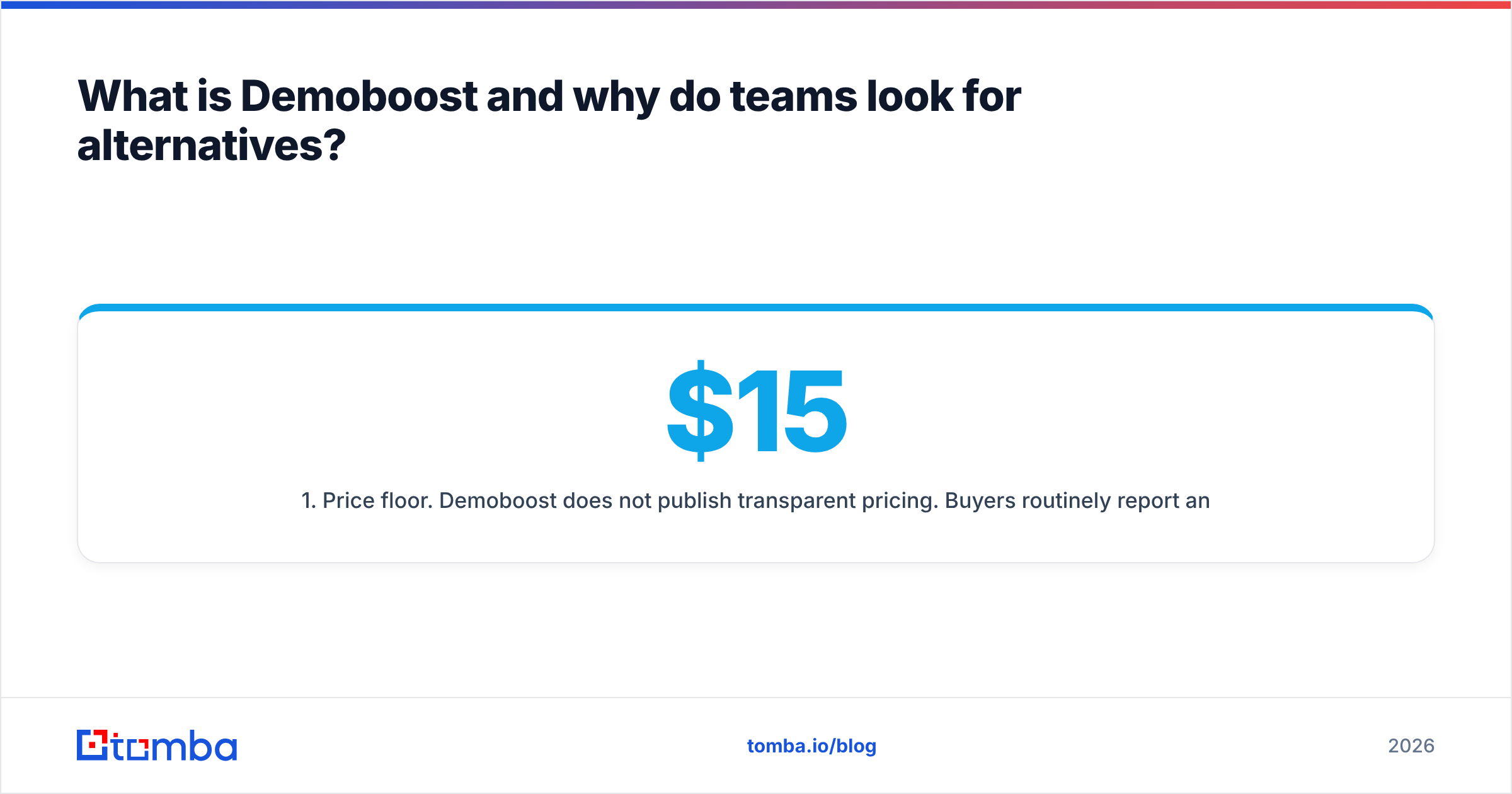
- Price floor. Demoboost does not publish transparent pricing. Buyers routinely report annual contracts in the $15,000–$40,000 range depending on seats and demo volume. For a five-person sales team, that is hard to justify against a $500/year alternative.
- Time-to-first-demo. Enterprise governance adds steps. Teams that just want a click-through demo on the pricing page today find the setup overhead heavy.
- Capture method mismatch. Demoboost's strength is deep, data-driven demo environments. If your product is a simple SaaS dashboard, a screenshot-based tool captures it in ten minutes with no engineering involvement.
- Contract inflexibility. Annual-only commitments with seat minimums are a common complaint across the enterprise end of this category.
- Analytics you cannot act on. Knowing that 340 people watched your demo is useless if you cannot identify who they were or reach them.
That last point is the one most teams underestimate, and it is where your demo stack overlaps with your data stack. We will come back to it.
How do the main Demoboost alternatives compare?#
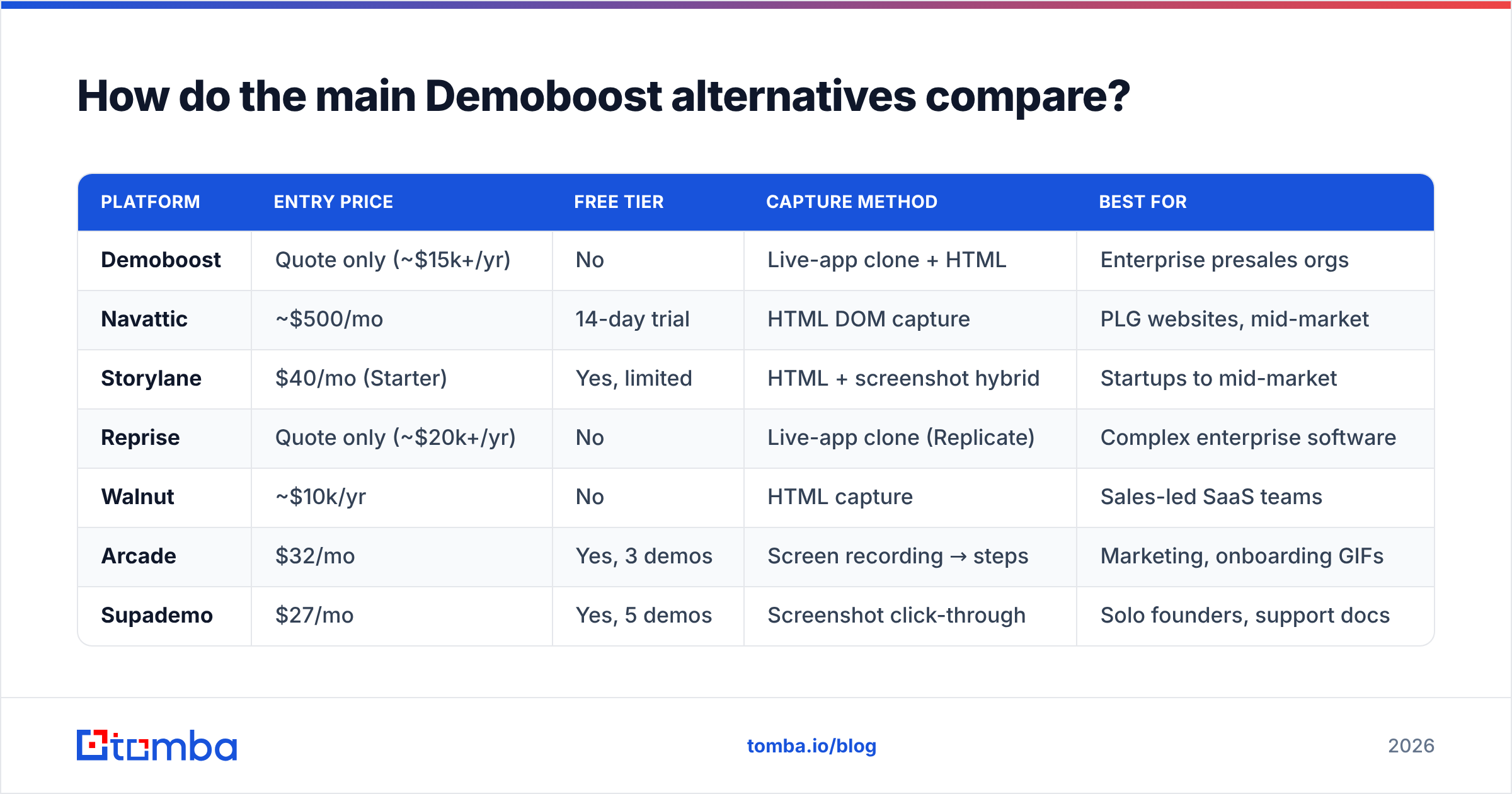
Here is the honest side-by-side. Pricing reflects publicly listed entry plans as of early 2026; enterprise tiers are quote-only across the board.
| Platform | Entry price | Free tier | Capture method | Best for |
|---|---|---|---|---|
| Demoboost | Quote only (~$15k+/yr) | No | Live-app clone + HTML | Enterprise presales orgs |
| Navattic | ~$500/mo | 14-day trial | HTML DOM capture | PLG websites, mid-market |
| Storylane | $40/mo (Starter) | Yes, limited | HTML + screenshot hybrid | Startups to mid-market |
| Reprise | Quote only (~$20k+/yr) | No | Live-app clone (Replicate) | Complex enterprise software |
| Walnut | ~$10k/yr | No | HTML capture | Sales-led SaaS teams |
| Arcade | $32/mo | Yes, 3 demos | Screen recording → steps | Marketing, onboarding GIFs |
| Supademo | $27/mo | Yes, 5 demos | Screenshot click-through | Solo founders, support docs |
| Consensus | Quote only | No | Video + interactive hybrid | Buying-committee demos |
| Folio (Tolstoy) | ~$50/mo | Yes | Screenshot | Lightweight product tours |
| Guideflow | $30/mo | Yes | HTML + screenshot | Budget-conscious teams |
| Saleo | Quote only | No | Live-data injection | Demo data problems |
Two things jump out. First, the price gap between the screenshot tier and the enterprise tier is roughly 30x. Second, "capture method" is the single variable that determines whether a tool will work for your product — more than features, more than price.
Which capture method should you actually pick?#
Think of it like photographing a house. A screenshot tool takes still photos and lets viewers click hotspots between them — fast, cheap, and it breaks the moment someone expects to type something. An HTML capture tool copies the actual house frame so you can walk through rooms and interact with real elements. A live-clone tool rebuilds the house with working plumbing, which is why it costs the most.
Match the method to your product:
- Screenshot / click-through (Supademo, Folio, Arcade) — Best when your product is visually simple and the demo is 5–12 steps. Setup takes minutes. Weakness: no free-form input, and screenshots go stale every time your UI ships a change.
- HTML DOM capture (Navattic, Storylane, Walnut, Guideflow) — Captures the real DOM, so hover states, dropdowns, and typed input work. This is the sweet spot for most B2B SaaS. Weakness: heavy JS apps and canvas-based UIs capture badly.
- Live-app clone (Reprise Replicate, Demoboost) — A sandboxed instance of your actual application. Handles multi-step workflows, real calculations, and complex data. Weakness: cost, setup time, and usually an engineering dependency.
- Live-data injection (Saleo) — Sits on top of your real app and overwrites the data layer so demo accounts look impressive. Solves the "our sandbox has three fake customers named Test Test" problem specifically.
- Video-hybrid (Consensus) — Pre-recorded video branches based on what the viewer says they care about. Best for demos consumed asynchronously by a buying committee of six people.
If you are unsure, HTML DOM capture is the safest default. It covers roughly 80% of B2B SaaS use cases and every mid-market vendor in that row offers a trial you can test in an afternoon.
Is Navattic or Storylane the better Demoboost replacement?#
For most teams leaving Demoboost over price, this is the real decision.
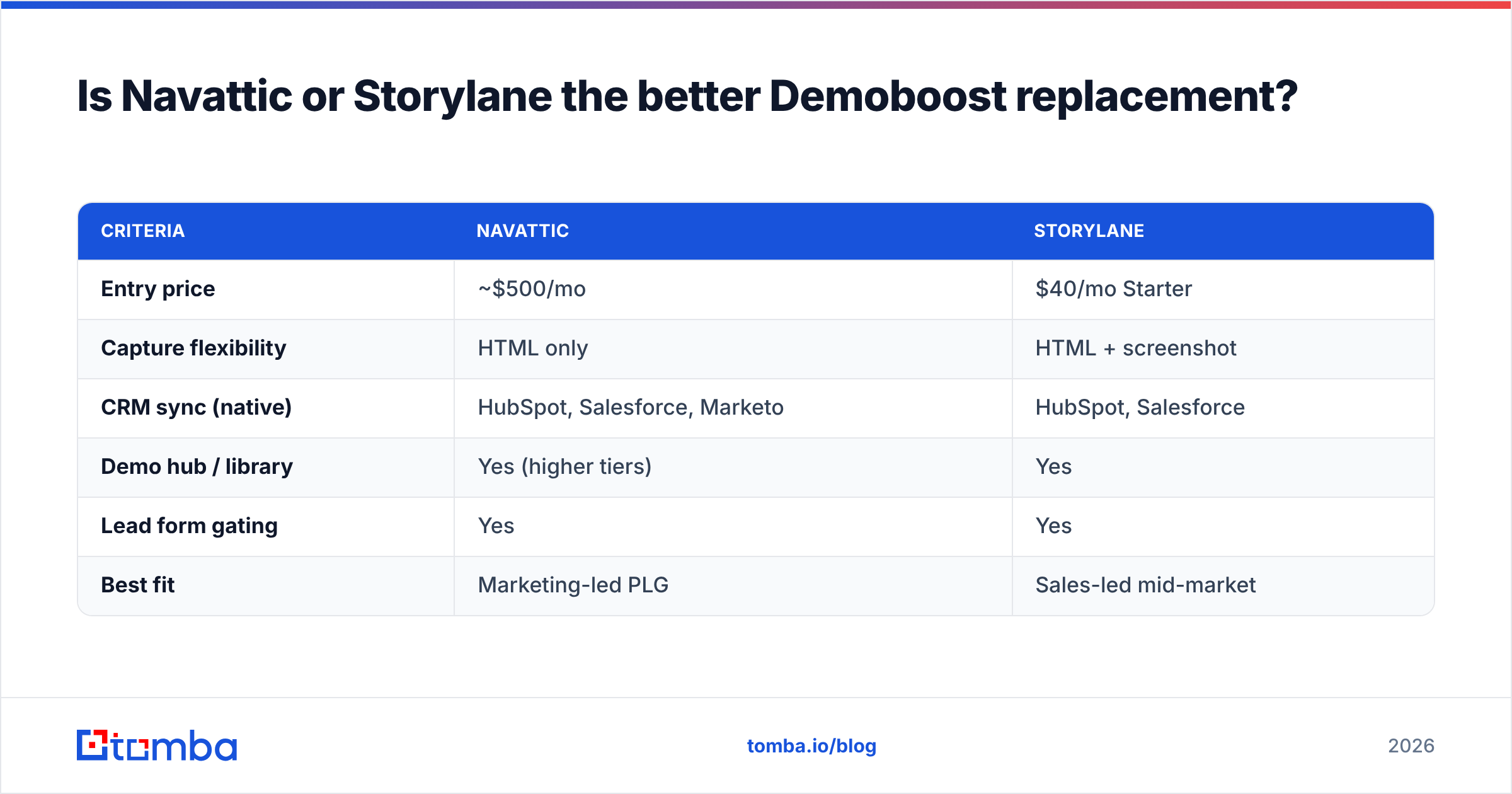
Navattic is the more polished website-conversion play. Its analytics are built around the funnel: demo starts, step completions, drop-off points, and a "hot lead" signal that fires into HubSpot or Salesforce. If your primary use case is a "See it in action" button on your homepage that feeds pipeline, Navattic is the stronger pick. Its editor is opinionated but fast, and the published demos load quickly — a real factor for page-speed-sensitive marketing sites.
Storylane is the better value and the more flexible builder. It supports both HTML capture and screenshot flows in the same product, which means you are not stuck when one page of your app refuses to capture. Storylane's pricing starts far lower, and it ships a usable free tier for evaluation. Its multi-demo "demo hub" feature is close to what Demoboost charges enterprise money for.
| Criteria | Navattic | Storylane |
|---|---|---|
| Entry price | ~$500/mo | $40/mo Starter |
| Capture flexibility | HTML only | HTML + screenshot |
| CRM sync (native) | HubSpot, Salesforce, Marketo | HubSpot, Salesforce |
| Demo hub / library | Yes (higher tiers) | Yes |
| Lead form gating | Yes | Yes |
| Best fit | Marketing-led PLG | Sales-led mid-market |
Rule of thumb: if a demo is a marketing asset, pick Navattic. If a demo is a sales asset a rep sends after a call, pick Storylane. If it needs to be both and you have budget, that is when Demoboost's governance layer starts earning its price back.
What about the budget end — Arcade, Supademo, and Guideflow?#
These three cover the "we need something on the site by Friday" scenario, and they are far better than the category's reputation suggests.
Arcade is really a screen-recording tool that outputs interactive step-throughs. It is beloved by marketing and product teams for changelog posts, social clips, and onboarding. It is weaker as a sales asset because analytics are shallow and CRM integration is limited on lower tiers.
Supademo is the cheapest credible option with real analytics. It captures via browser extension, supports branching, AI voiceover, and multi-demo showcases. For a solo founder or a 3-person team, it does 80% of what Demoboost does for roughly 2% of the price.
Guideflow sits between the two — HTML capture at a screenshot-tool price, with a generous free tier. Editing is less refined than Storylane's, but it clears the bar for a website demo.
The honest caveat: none of these three will satisfy an enterprise security review, and none handle complex multi-user workflows. If your buyer's InfoSec team sends you a 90-question questionnaire, you are back in Demoboost/Reprise territory.
Does an interactive demo actually generate pipeline?#
Only if you can act on who watched it. This is the gap almost every demo-platform comparison ignores.
A published interactive demo generates three types of viewer:
- Identified viewers — they filled out the lead gate. Easy. Your CRM has them.
- Partially identified viewers — they gave a work email but nothing else. You have a string, not a person.
- Anonymous viewers — the majority. You have an IP, a company (maybe), and a session recording. No contact.
Bucket three is where the pipeline is. Industry research consistently shows most B2B buyers complete a large share of their evaluation before contacting a vendor — Gartner's B2B buying research has been making this point for years. Those buyers are precisely the ones clicking through your demo anonymously.
The fix is a two-step data play:
- Identify the account. Use website visitor reveal to turn anonymous demo traffic into company names. Tomba's website visitor reveal handles the de-anonymization layer.
- Find the human. Once you know the account, you need the person who fits the buyer persona. A domain search returns the verified work emails at that company, filtered by department and seniority, so your SDR follows up with the VP of Ops rather than a generic info@ inbox.
Then verify before you send. Demo-sourced follow-up sequences bounce hard when the list is unverified, and bounce rate feeds directly into email deliverability. Running the list through an email verifier first is a ten-minute step that protects the domain you spent two years warming.
How do you evaluate these tools without wasting a quarter?#
Run a two-week bake-off with a fixed scorecard. Do not let vendors drive the agenda.
Week one — capture test. Pick the single hardest screen in your product (the one with the modal, the chart, or the drag-and-drop). Try to capture it in three tools. Most vendors will fail on at least one of these; that failure tells you more than any feature matrix.
Week two — publish test. Ship one real demo per tool to a real audience segment. Measure:
- Time-to-publish — from first capture to live URL, in minutes.
- Completion rate — percentage of starters who reach the final step.
- Load time — measure it yourself; embedded demos can add 800ms+ to a landing page.
- Lead capture rate — form fills per 100 demo starts.
- Edit cost — how long it takes to update the demo after a UI change. This is the hidden recurring cost nobody quotes.
Then check third-party reviews for the shortlist, not the long list. G2's demo automation category is the most useful public source for current user sentiment, and Capterra is worth a cross-check for pricing complaints that vendors do not advertise.
One more thing worth budgeting: whichever platform you choose, the demo is a top-of-funnel asset. If your outbound motion is weak, a better demo will not fix it. Teams often get more incremental pipeline from cleaning up their B2B database and targeting than from upgrading demo tooling — the demo converts interest, it does not create it.
Which Demoboost alternative should you choose?#
Short answers by situation:
- Enterprise presales team, 20+ seats, complex product — Stay on Demoboost, or evaluate Reprise. The governance and live-clone capability genuinely differentiate.
- Marketing-led PLG company — Navattic. Best-in-class website conversion analytics.
- Mid-market sales-led SaaS, cost-conscious — Storylane. Best capability-per-dollar in the category.
- Startup under 10 people — Supademo or Guideflow. Both have real free tiers.
- Onboarding, docs, and changelog content — Arcade.
- Async buying-committee demos — Consensus.
- Your demo data looks bad, not your demo flow — Saleo. Different problem, different tool.
And regardless of platform: instrument the follow-up. A demo platform tells you a stranger from a Fortune 500 subsidiary spent four minutes on your integrations screen. That is a buying signal with no name attached to it. Turning it into a booked meeting requires a name, a verified work email, and ideally a direct line.
That is the layer Tomba fills. Use the Tomba Email Finder to turn demo-sourced companies and names into verified, deliverable work emails — with a free tier at 25 searches per month and paid plans starting at $49/month on the Starter tier (Growth $99/mo, Pro $249/mo). Check the full Tomba pricing if you need bulk volume or API access for automated enrichment on every demo completion. Your demo tool creates the signal; make sure something on your side can actually answer it.
Related guides#
Ready to find emails that actually work?
Join 150,000+ professionals who stopped guessing and started sending. Free credits on signup — no credit card required.
Get the Tomba newsletter
Practical outbound tactics and product updates — once every two weeks.
About the author