Deterministic Matching in 2026: The Complete B2B Data Guide
Deterministic matching connects records using exact identifiers like email and domain. Here's how it works, when to use it, and how it compares to probabilistic matching.
TL;DR
- Deterministic matching joins two records only when a shared key — an email, domain, user ID, or phone number — matches exactly. No guessing.
- It delivers near-perfect precision when your identifiers are clean, which makes it the backbone of CRM dedup, lead enrichment, and identity resolution.
- Its weakness is recall: typos, missing fields, and formatting drift cause true matches to slip through.
- Probabilistic matching fills that gap by scoring fuzzy similarity, but it trades certainty for coverage and needs tuning.
- The strongest B2B data stacks run a deterministic-first, probabilistic-fallback waterfall — and feed it verified, standardized identifiers up front.
What is deterministic matching?#
Deterministic matching is the practice of linking two data records only when one or more exact identifiers agree. If record A and record B both carry the email jane@acme.com, they are the same person. If they don't share an exact key, they don't match. That's the whole rule.
Think of it like matching socks by their laundry tag. If two socks have the same printed serial number, they're a pair — no debate. You're not eyeing the color or the fabric and estimating; you're reading a unique label. That certainty is the entire appeal.
In technical terms, deterministic matching is a form of record linkage where the match function is binary. You define a key (or a hierarchy of keys), normalize both sides, and compare for equality. The output is a hard yes or no, not a confidence score.
This is why deterministic logic sits underneath so much of the modern data stack: customer data platforms use it to unify profiles, CRMs use it to prevent duplicate contacts, and enrichment tools use it to attach firmographic data to the right company.

Which keys make a good deterministic match?#
Not all identifiers are equal. A deterministic system is only as reliable as the keys it trusts. The best keys are unique, stable, and standardized.
- Email address — The gold standard for person-level B2B matching. It's globally unique and rarely shared. Normalize case and strip aliases before comparing.
- Company domain — The anchor for account-level matching.
acme.commaps cleanly to one organization, which is why domain search is a common first step in account resolution. - Phone number — Strong once you strip formatting and normalize to E.164. Weak when shared across a team line.
- Government or platform IDs — Tax IDs, DUNS numbers, LinkedIn member IDs. Extremely reliable when present, but often missing in raw data.
- Composite keys — First name + last name + company domain. Useful when no single unique field exists, though it edges toward the fuzzy end of the spectrum.
The practical lesson: a deterministic match on a weak key (like name alone) is worse than a probabilistic match on strong signals. Choose keys that are genuinely unique to the entity you're resolving.
How does deterministic matching compare to probabilistic matching?#
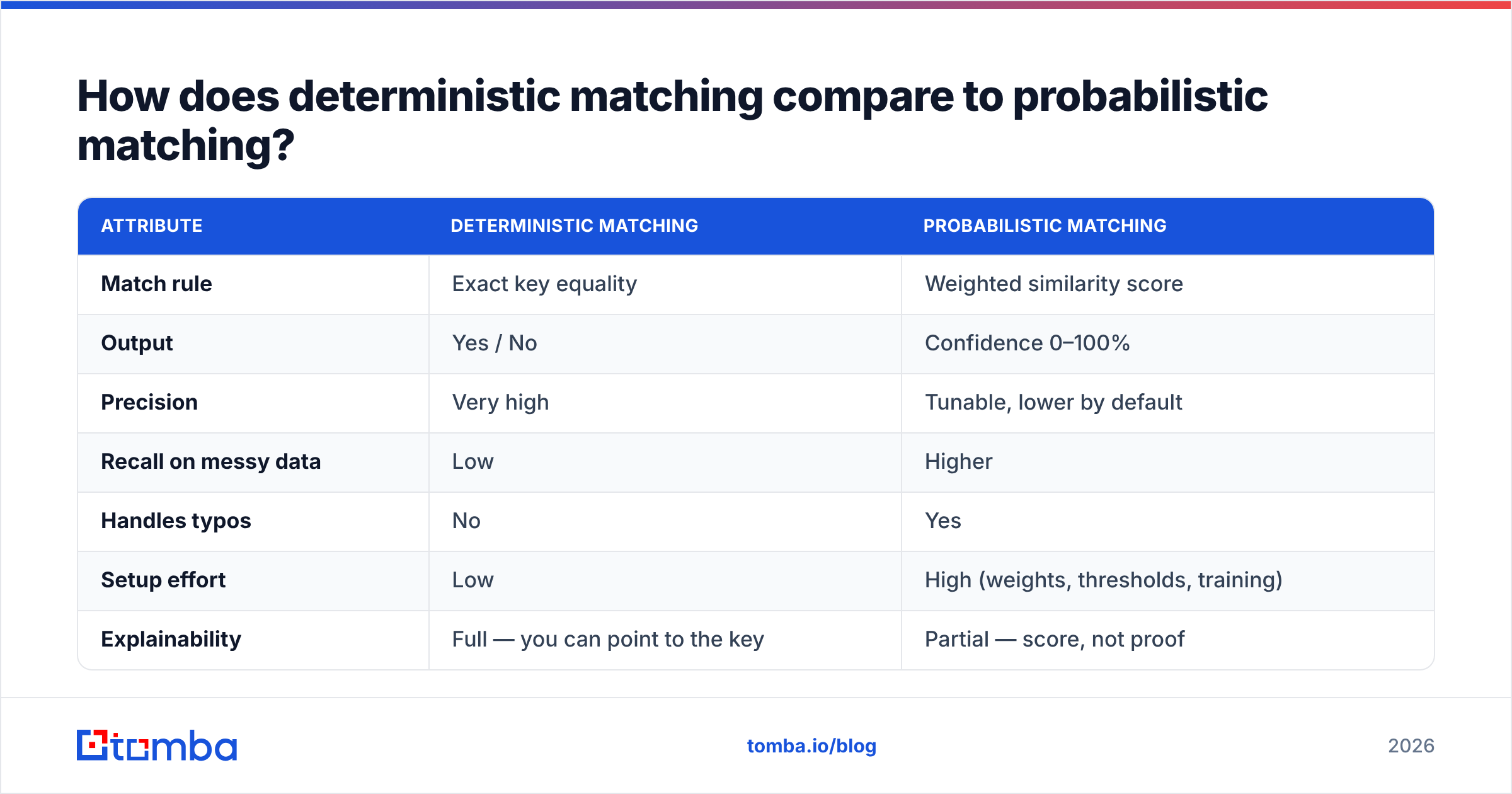
The two approaches are complements, not rivals. Deterministic matching answers "are these definitely the same?" while probabilistic matching answers "how likely is it that these are the same?"
| Attribute | Deterministic matching | Probabilistic matching |
|---|---|---|
| Match rule | Exact key equality | Weighted similarity score |
| Output | Yes / No | Confidence 0–100% |
| Precision | Very high | Tunable, lower by default |
| Recall on messy data | Low | Higher |
| Handles typos | No | Yes |
| Setup effort | Low | High (weights, thresholds, training) |
| Explainability | Full — you can point to the key | Partial — score, not proof |
| Best for | Clean IDs, compliance, dedup | Fuzzy names, sparse fields, dedup at scale |
The takeaway is that deterministic matching wins on trust and auditability. When a match must survive a compliance review or a sales rep's skepticism, "these two rows share a verified email" beats "our model scored this 0.87." Probabilistic matching wins on coverage — it catches the "Bob Smith" vs "Robert Smith at the same company" cases that exact logic misses.
Most mature systems, as vendors like HubSpot document in their deduplication tooling, blend the two. You lead with deterministic rules for the certain matches, then let probabilistic scoring mop up the ambiguous remainder.
When should you use deterministic matching?#
Reach for deterministic matching whenever a wrong match is more expensive than a missed match. Precision-critical workflows include:
- CRM deduplication — Merging two contact records is destructive. You want certainty before you collapse them, so exact email matching is the safe default.
- Lead-to-account mapping — Routing a new lead to the right account by domain is deterministic by nature and avoids misattributed pipeline.
- Suppression and compliance — Honoring unsubscribe and do-not-contact lists demands exact matching. A fuzzy match here creates legal risk.
- Enrichment joins — When you attach firmographic or contact data, you want it landing on the correct record. Feeding clean keys into data enrichment keeps the join honest.
- Billing and entitlements — Linking a user to a paid account should never be a probability.
If your identifiers are clean and unique, deterministic matching is not just adequate — it's the correct choice. The complexity of a probabilistic model only pays off when your data is messy enough to need it.
Why does deterministic matching fail, and how do you fix it?#
Deterministic matching fails for one reason: the keys don't line up even when the entities are the same. The math is unforgiving, so the burden shifts to data quality. Here are the common failure modes and their fixes.
Formatting drift. Jane@Acme.com and jane@acme.com are the same mailbox but different strings to a naive comparator. Fix it by lowercasing, trimming whitespace, and canonicalizing before you compare.
Sub-addressing and aliases. jane+newsletter@acme.com routes to jane@acme.com. Strip plus-tags and known alias patterns during normalization.
Stale or invalid keys. A key that's exact but dead — a bounced email, a disconnected number — produces confident matches on garbage. This is where validation earns its keep. Running addresses through an email verifier before matching removes dead keys from the pool, and a phone validator does the same for numbers.
Missing keys. You can't match on a field that isn't there. This is the single biggest recall killer, and the only real fix is to source more complete identifiers up front rather than patch after the fact.
Catch-all ambiguity. On catch-all domains, an address can look valid without being real, which weakens email as a deterministic key. A catch-all verifier helps you flag those domains so you don't over-trust them.

What does a deterministic matching pipeline look like?#
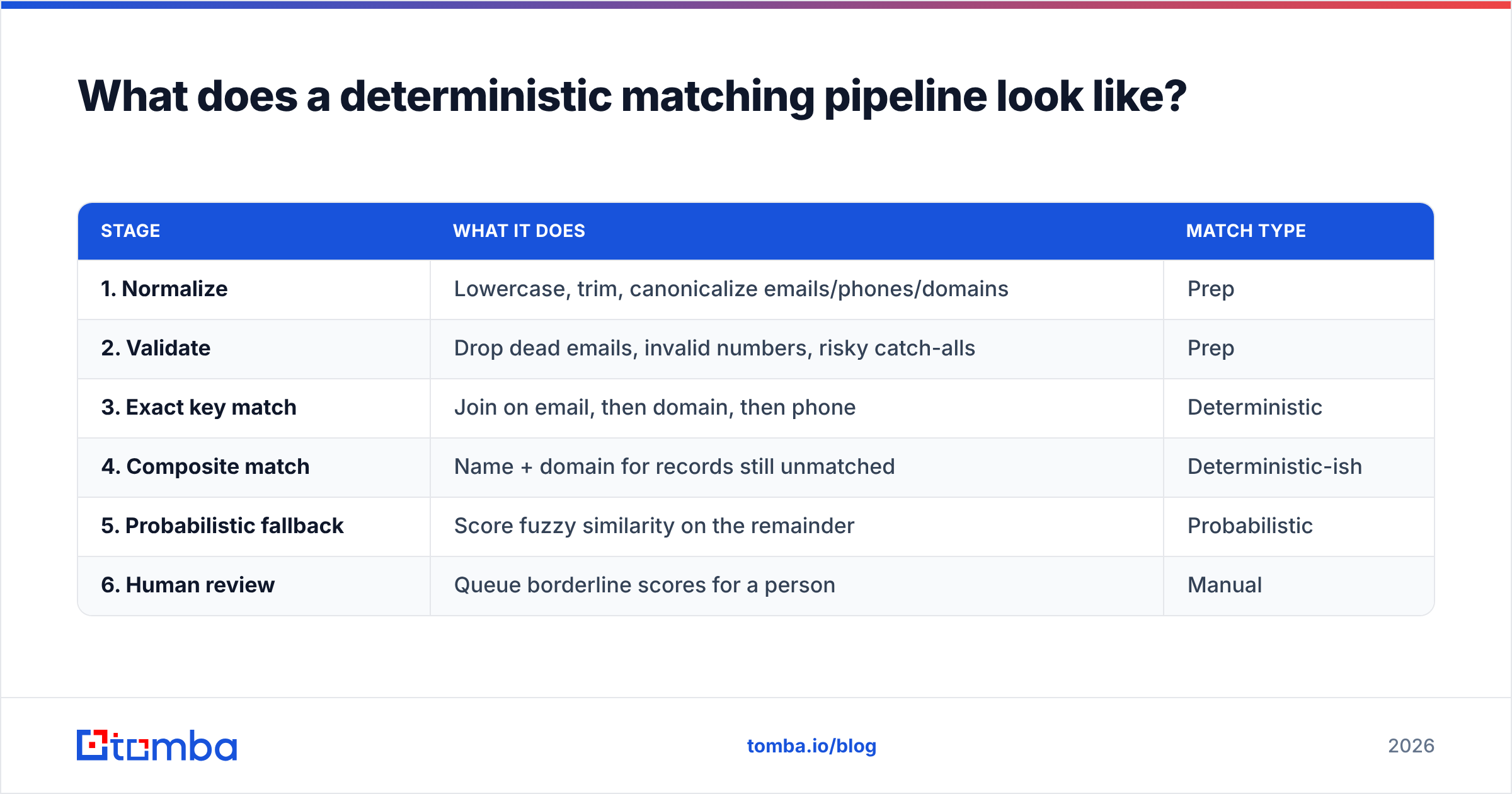
A production-grade matching pipeline is a waterfall: cheap, certain checks first; expensive, fuzzy checks only for what's left over. Here's the shape most teams converge on.
| Stage | What it does | Match type |
|---|---|---|
| 1. Normalize | Lowercase, trim, canonicalize emails/phones/domains | Prep |
| 2. Validate | Drop dead emails, invalid numbers, risky catch-alls | Prep |
| 3. Exact key match | Join on email, then domain, then phone | Deterministic |
| 4. Composite match | Name + domain for records still unmatched | Deterministic-ish |
| 5. Probabilistic fallback | Score fuzzy similarity on the remainder | Probabilistic |
| 6. Human review | Queue borderline scores for a person | Manual |
Stages 1 and 2 are where most of the accuracy is won or lost. Garbage keys produce either false matches or false misses, and no clever matching logic downstream can recover data that was never clean. That's why treating validation as a prerequisite — not an afterthought — is the highest-leverage move in the entire pipeline.
Stage 3 is the deterministic core. Order your keys by reliability: try email first because it's the most unique, fall back to domain for account-level linkage, then phone. Each rung down the ladder trades a little precision for a little recall.
By the time you reach stage 5, you're only running the expensive probabilistic model on the small slice of records that survived every exact check. That keeps your compute cost low and your audit trail clean, because the majority of your matches carry a hard, explainable reason.
How do you keep deterministic keys clean at scale?#
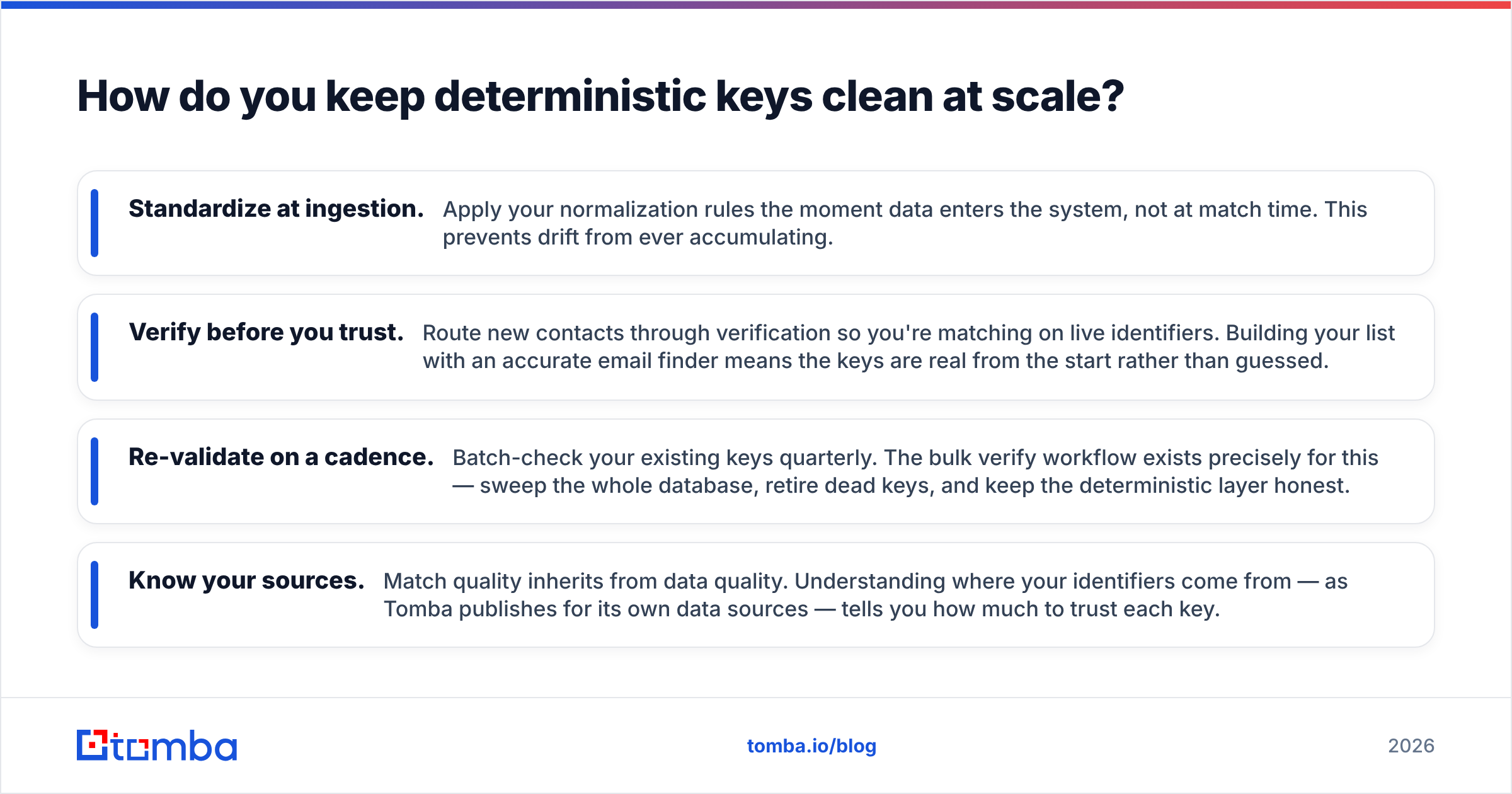
The answer is to standardize on entry and re-verify on a schedule. Keys decay: people change jobs, emails bounce, numbers get reassigned. A key that matched perfectly last quarter can be dead today.
- Standardize at ingestion. Apply your normalization rules the moment data enters the system, not at match time. This prevents drift from ever accumulating.
- Verify before you trust. Route new contacts through verification so you're matching on live identifiers. Building your list with an accurate email finder means the keys are real from the start rather than guessed.
- Re-validate on a cadence. Batch-check your existing keys quarterly. The bulk verify workflow exists precisely for this — sweep the whole database, retire dead keys, and keep the deterministic layer honest.
- Know your sources. Match quality inherits from data quality. Understanding where your identifiers come from — as Tomba publishes for its own data sources — tells you how much to trust each key.
Peer-reviewed vendor comparisons on directories like G2 consistently show the same pattern: the tools that win on "match rate" are usually the ones that verify identifiers before matching, not the ones with the fanciest models. Clean inputs beat clever algorithms.
Is deterministic matching still relevant in an AI-driven data stack?#
Yes — arguably more than ever. AI and probabilistic models are excellent at generating candidate matches, but they're bad at being trusted blindly. Deterministic matching is what you use to confirm what a model suggests, because it produces a reason a human can inspect.
The near-term future is layered: probabilistic and machine-learning models cast a wide net for candidates, and deterministic rules act as the verification gate that decides which candidates actually merge. A model might surface that two records probably belong together; a shared verified email is what lets you commit the merge without a second thought.
That division of labor — models for recall, exact keys for precision — is why deterministic matching isn't going anywhere. It's the part of the system you can defend in an audit, explain to a customer, and trust when the stakes are high.
The bottom line#
Deterministic matching is the precision engine of B2B data work. It's simple, explainable, and near-flawless when your identifiers are clean — and useless when they aren't. That single dependency is the real lesson: your match rate is downstream of your data quality. Verify your emails, standardize your domains, validate your phones, and the exact-match layer will carry the majority of your workload without complaint.
If you want deterministic matching that actually holds up, start where every reliable key starts — with an accurate, verified identifier. The Tomba Email Finder returns real, deliverable professional emails you can use as exact keys, and pairs with built-in verification so you're matching on live data, not guesses. Check the Tomba pricing plans — a free tier gives you 25 searches a month to test it against your own records before you commit.
Related guides#
Ready to find emails that actually work?
Join 150,000+ professionals who stopped guessing and started sending. Free credits on signup — no credit card required.
Get the Tomba newsletter
Practical outbound tactics and product updates — once every two weeks.
About the author