What Is a Development Sales Representative? 2026 Guide
A development sales representative fills the top of your pipeline. Here's what the role does, how it's measured, the pay, and the tools that make quota reachable in 2026.
TL;DR
- A development sales representative (often called an SDR or BDR) owns the top of the funnel: prospecting, qualifying, and booking meetings for closers — they rarely carry a closing quota themselves.
- The role is measured on activity and outcomes: emails and calls out, connect rate, qualified meetings booked, and pipeline created — not revenue closed.
- Base pay in 2026 sits around $50K–$65K with OTE (on-target earnings) of $75K–$95K in most North American SaaS markets.
- The biggest lever on SDR performance is data quality. Bad contact data quietly burns a third of a rep's day.
- The winning stack pairs a solid CRM with an accurate email finder, a verifier, and light automation — so reps spend time talking to people, not hunting for addresses.
What is a development sales representative?#
A development sales representative is the person who starts the sales conversation. Think of them as the scout ahead of the main army: they find the right accounts, confirm the accounts are worth pursuing, and hand a warm, qualified opportunity to an account executive who closes it.
The title shows up in a few flavors, and the differences matter when you're hiring or job-hunting:
- SDR (Sales Development Representative) — usually handles inbound leads: people who filled out a form, downloaded a guide, or requested a demo. Their job is to respond fast, qualify, and route.
- BDR (Business Development Representative) — usually handles outbound: cold accounts that have never heard of you. They build target lists and run cold email and cold calls.
- Development sales representative — a blended, increasingly common title covering both motions, especially at companies that don't want two separate teams.
- MDR (Market Development Representative) — a marketing-aligned variant focused on nurturing early-stage interest into sales-ready leads.
The through-line is the same: this role creates pipeline. It does not, in most orgs, own the deal to signature. That single fact explains almost everything about how the job is structured, measured, and paid.
What does a development sales representative actually do all day?#
Strip away the jargon and the day is four repeating loops: research, reach out, qualify, hand off.
- Research (list building). Identify accounts that match your ideal customer profile, then find the right human inside each account — usually a specific title, not a generic inbox. This is where a good email finder turns an hour of manual digging into a few minutes.
- Outreach (sequences). Run multi-touch cadences across email, phone, and LinkedIn. A typical sequence is 8–12 touches over two to three weeks.
- Qualification (discovery). When someone replies or picks up, run a light discovery framework (BANT, MEDDIC-lite, or a custom set of questions) to confirm fit, need, and timing.
- Handoff. Book the meeting, brief the account executive, and log everything in the CRM so nothing gets dropped.
The uncomfortable truth: reps who miss quota usually aren't lazy. They're spending the day fighting bad data — bounced emails, wrong titles, disconnected numbers — instead of talking to buyers. That's the failure mode this whole article is really about.
How is a development sales representative measured?#
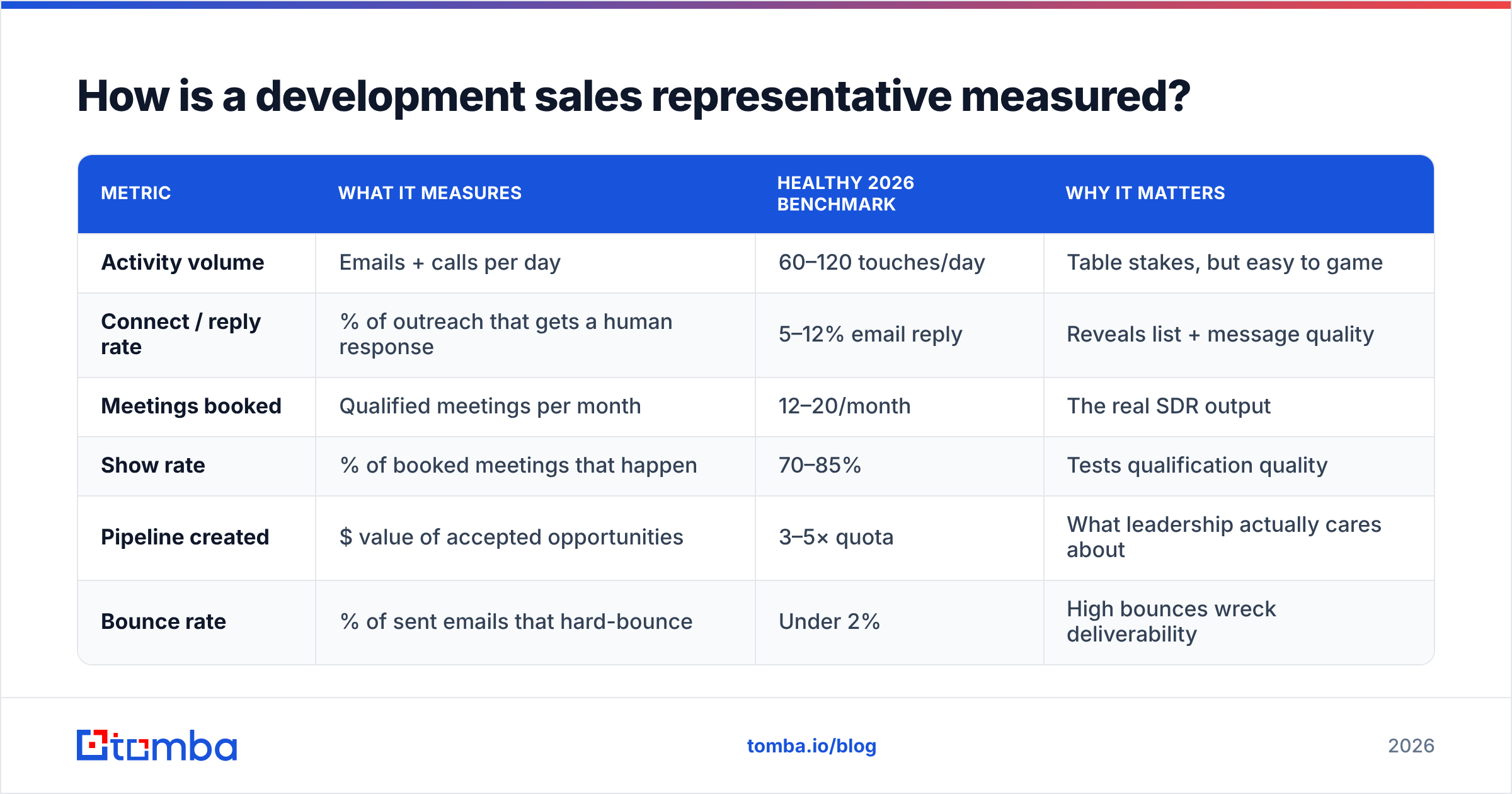
The role is measured on leading indicators, because the lagging indicator (closed revenue) belongs to someone else. Here's how the metrics stack up, and which ones actually predict success.
| Metric | What it measures | Healthy 2026 benchmark | Why it matters |
|---|---|---|---|
| Activity volume | Emails + calls per day | 60–120 touches/day | Table stakes, but easy to game |
| Connect / reply rate | % of outreach that gets a human response | 5–12% email reply | Reveals list + message quality |
| Meetings booked | Qualified meetings per month | 12–20/month | The real SDR output |
| Show rate | % of booked meetings that happen | 70–85% | Tests qualification quality |
| Pipeline created | $ value of accepted opportunities | 3–5× quota | What leadership actually cares about |
| Bounce rate | % of sent emails that hard-bounce | Under 2% | High bounces wreck deliverability |
Notice the last row. Bounce rate looks like a technical footnote, but it's a career metric. A rep blasting an unverified list past a 3–4% bounce rate is slowly poisoning the whole domain's sender reputation, which drags down every other rep's inbox placement. Verifying contacts before sending — with a dedicated email verifier — is the cheapest insurance in the stack.
How much does a development sales representative earn in 2026?#
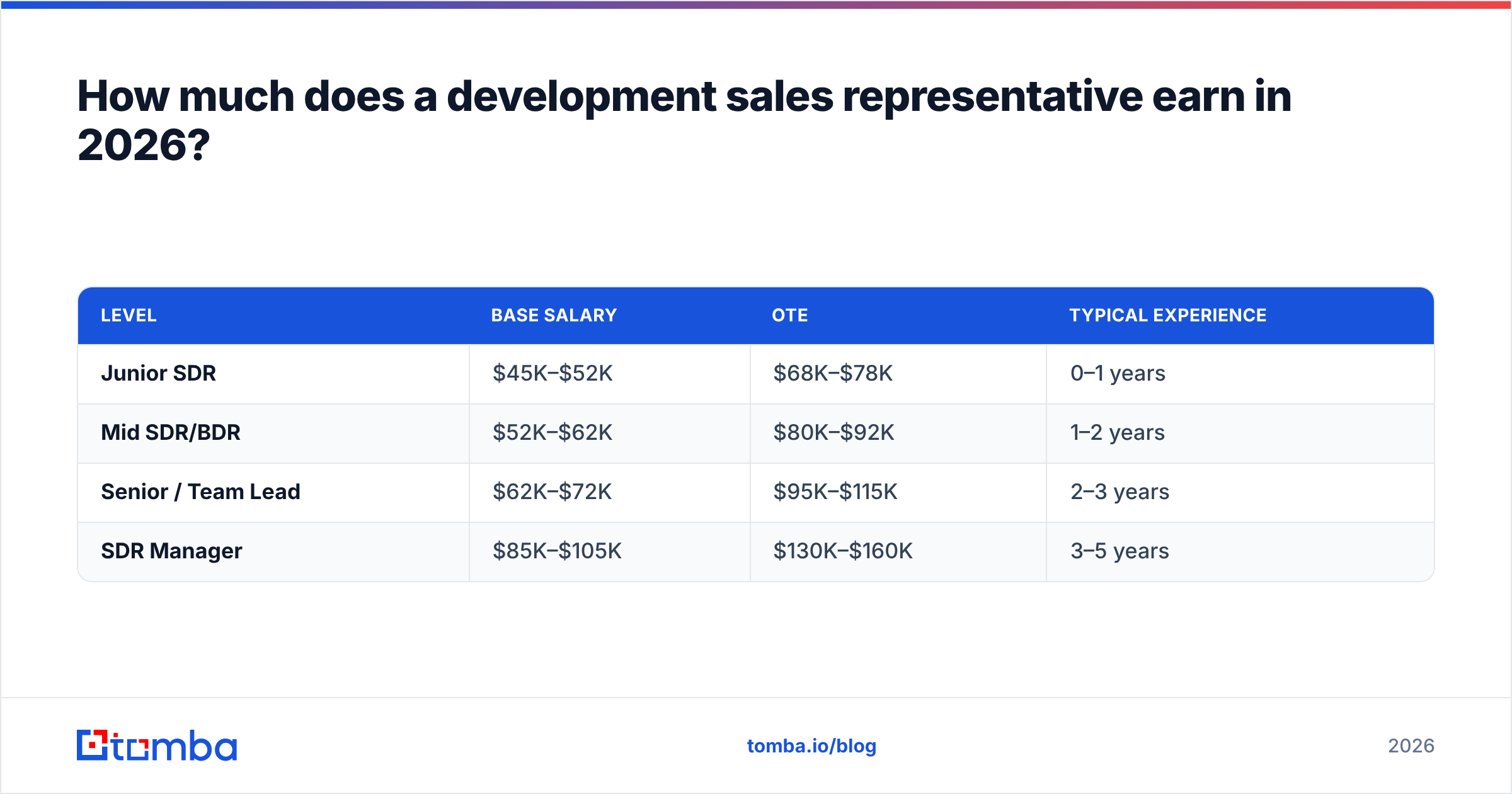
Compensation is almost always split into base salary plus variable commission, expressed as OTE (on-target earnings — what you make if you hit 100% of quota).
| Level | Base salary | OTE | Typical experience |
|---|---|---|---|
| Junior SDR | $45K–$52K | $68K–$78K | 0–1 years |
| Mid SDR/BDR | $52K–$62K | $80K–$92K | 1–2 years |
| Senior / Team Lead | $62K–$72K | $95K–$115K | 2–3 years |
| SDR Manager | $85K–$105K | $130K–$160K | 3–5 years |
Two things to know before you accept an offer. First, the base-to-variable ratio is usually 60/40 or 70/30 — a heavy variable component means your take-home swings hard with performance, and performance swings hard with data quality. Second, the SDR seat is a launchpad, not a destination: most reps target promotion to account executive within 18–24 months. The ones who get there fastest are the ones who booked the most qualified meetings, which loops back — again — to the quality of their prospecting data.
For a fuller breakdown of how sales comp is structured across roles, HubSpot's sales salary research is a solid neutral reference: see HubSpot's sales compensation resources and cross-check role benchmarks on G2.
Is a development sales representative the same as an account executive?#
No — and conflating them is the most expensive hiring mistake in early-stage sales. They're different jobs with different skills, metrics, and personalities.
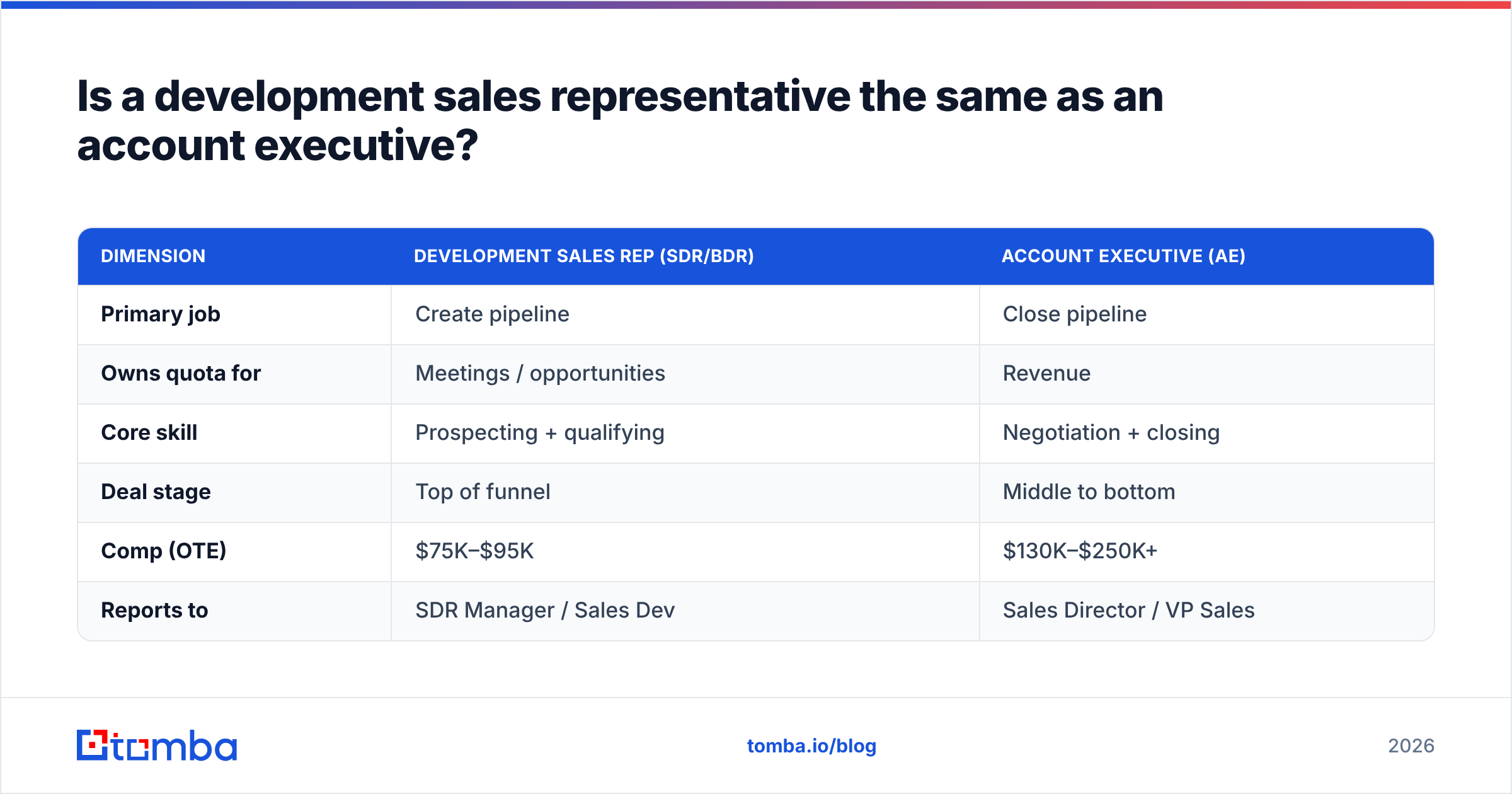
| Dimension | Development Sales Rep (SDR/BDR) | Account Executive (AE) |
|---|---|---|
| Primary job | Create pipeline | Close pipeline |
| Owns quota for | Meetings / opportunities | Revenue |
| Core skill | Prospecting + qualifying | Negotiation + closing |
| Deal stage | Top of funnel | Middle to bottom |
| Comp (OTE) | $75K–$95K | $130K–$250K+ |
| Reports to | SDR Manager / Sales Dev | Sales Director / VP Sales |
The healthiest teams treat the SDR-to-AE handoff as a formal, documented process — not a Slack message and a shrug. When it works, the AE walks into a meeting already knowing the prospect's role, pain, and timeline. When it fails, the AE burns the first ten minutes re-qualifying, and the show-to-close rate craters. If your funnel leaks between these two roles, fix the handoff before you hire more of either.
What tools does a development sales representative need in 2026?#
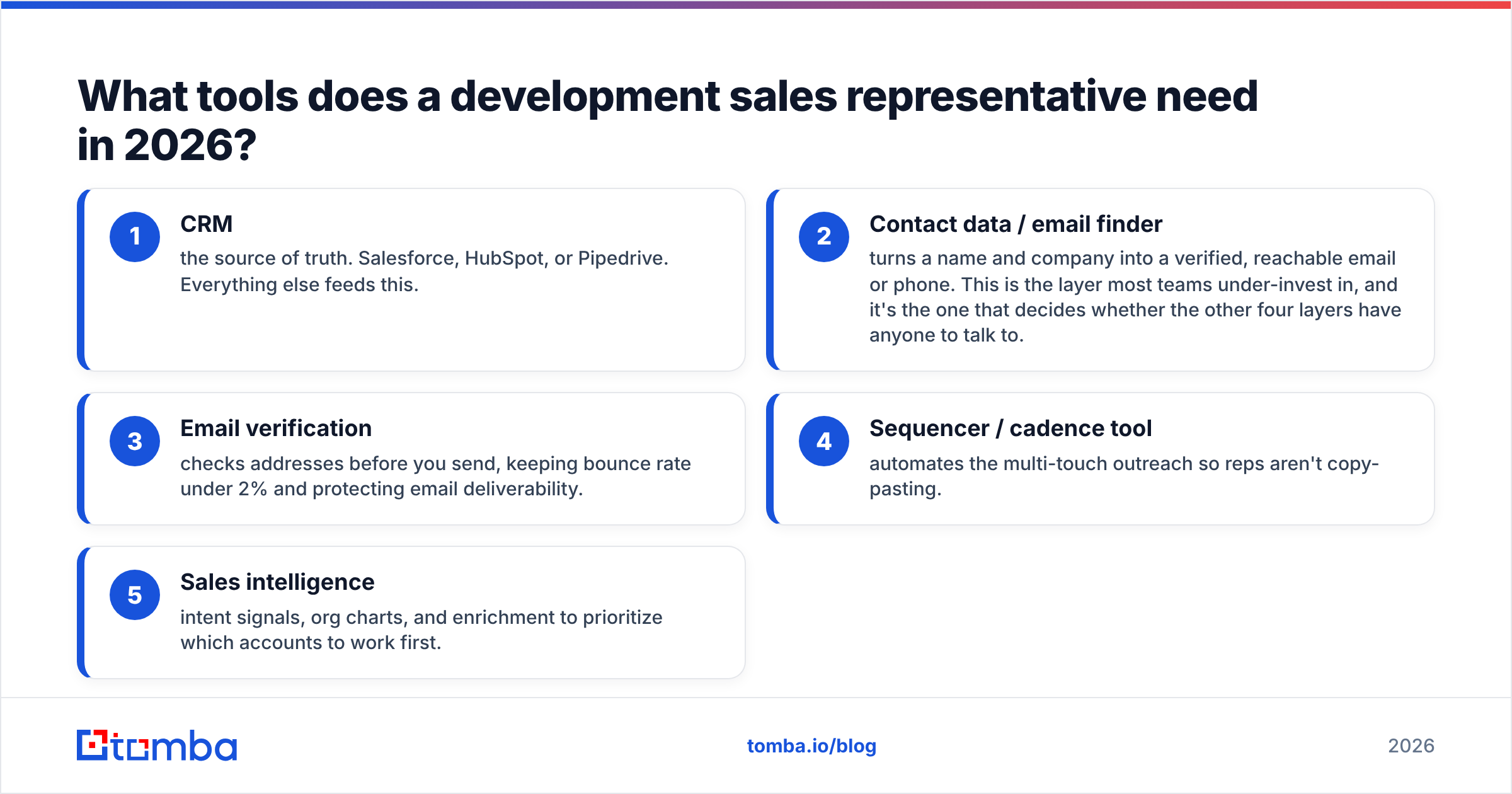
The modern SDR stack has consolidated into five layers. You don't need the most expensive tool in each — you need accurate, connected tools that don't fight each other.
- CRM — the source of truth. Salesforce, HubSpot, or Pipedrive. Everything else feeds this.
- Contact data / email finder — turns a name and company into a verified, reachable email or phone. This is the layer most teams under-invest in, and it's the one that decides whether the other four layers have anyone to talk to.
- Email verification — checks addresses before you send, keeping bounce rate under 2% and protecting email deliverability.
- Sequencer / cadence tool — automates the multi-touch outreach so reps aren't copy-pasting.
- Sales intelligence — intent signals, org charts, and enrichment to prioritize which accounts to work first.
Where Tomba fits is layers 2 and 3. You can find professional emails by name, company, or domain search, verify them in bulk, and enrich the record with a job title and LinkedIn before the address ever enters a sequence. For teams that live in spreadsheets, the bulk email finder processes an entire target list at once, and the data enrichment layer fills the gaps your CRM left blank. Pricing is transparent — a free tier for testing, then paid plans on the Tomba pricing page — so you can validate accuracy on your own list before committing.
How do you build a repeatable prospecting workflow?#
A development sales representative doesn't need heroics — they need a boring, repeatable loop that runs every day. Here's a workflow that holds up under quota pressure:
- Define the target segment on Monday. Pull 50–100 accounts matching your ICP by industry, size, and a trigger event (new funding, a new hire, a tech-stack change).
- Find the right contact at each account — the specific decision-maker, not
info@. Use an email finder to resolve the name-to-address in seconds instead of guessing formats. - Verify every address in bulk before it touches a sequence. Anything risky or catch-all gets flagged, not sent blindly.
- Enrich the record with title, LinkedIn, and phone so your first line can be personalized and your fallback channel is ready.
- Load into the sequencer and run an 8–10 touch cadence across email, phone, and LinkedIn.
- Qualify and hand off the replies, logging every outcome so next week's list gets smarter.
The compounding advantage here is data hygiene. Each week your verified, enriched contacts feed cleaner reporting, which sharpens targeting, which lifts reply rates. Reps who skip steps 3 and 4 get a short-term activity boost and a long-term deliverability tax. Google's own guidance on bulk sending — see the Gmail Postmaster / bulk-sender guidelines — makes the cost of a dirty list explicit: cross a spam-complaint threshold and your inbox placement collapses for everyone on the domain.
What skills separate top development sales representatives?#
Volume is a floor, not a ceiling. The reps who get promoted share a specific set of habits:
- Research discipline. They spend the first 20 minutes on an account understanding it, so the outreach lands as relevant instead of generic. Tools do the grunt work; judgment does the targeting.
- Message brevity. Their cold emails are three sentences, one ask, no fluff. If you want a starting point, Tomba's cold email templates library is a practical reference for structure.
- Channel fluency. They don't rely on email alone. When email goes quiet, they use a verified phone finder number and pick up the phone.
- Data skepticism. They assume every list is dirty until verified, because they've been burned by a 6% bounce rate before.
- CRM rigor. They log everything. A meeting that isn't in the CRM didn't happen, and pipeline you can't see, you can't forecast.
The pattern is consistent: the best development sales representatives treat data as a first-class part of the job, not an afterthought their ops team handles. They know a perfect message sent to a wrong or dead address is worth exactly zero.
Common mistakes that sink SDR performance#
- Buying a giant list and blasting it. High volume, unverified, no personalization. It spikes bounces, tanks reputation, and gets the domain filtered.
- Optimizing for activity instead of outcomes. 200 emails a day to bad contacts looks productive and produces nothing.
- Skipping verification to "save time." The time you save is dwarfed by the deliverability damage and the meetings you never book because half your sends bounced.
- Ignoring the handoff. Booking a meeting the AE can't work is a vanity metric.
- No feedback loop. If disqualified leads never inform the next list, the same mistakes repeat weekly.
Each of these is a data or process problem, not a motivation problem — which is good news, because process problems are fixable with the right stack and a little discipline.
The bottom line#
A development sales representative is the engine that fills your pipeline, and the engine runs on data. The role is measured on qualified meetings and pipeline created, pays a solid $75K–$95K OTE with a clear path to account executive, and lives or dies by the accuracy of the contacts it works. Get the data layer right and everything downstream — reply rates, show rates, deliverability, morale — improves at once.
If you're building or scaling an SDR team in 2026, start where the leverage is highest: the contact data. Use the Tomba Email Finder to turn target accounts into verified, reachable decision-makers, verify every address before it enters a sequence, and let your reps spend their day on conversations instead of guesswork. Spin up the free tier, test the accuracy on your own list, and see how much of your reps' day you get back.
Related guides#
Ready to find emails that actually work?
Join 150,000+ professionals who stopped guessing and started sending. Free credits on signup — no credit card required.
Get the Tomba newsletter
Practical outbound tactics and product updates — once every two weeks.
About the author