Dialpad vs Quo (2026): Which Business Phone System Wins?
An honest, side-by-side breakdown of Dialpad vs Quo for sales teams in 2026 — AI features, pricing, call quality, and which one actually fits your outbound motion.
Choosing a business phone system in 2026 is really a choice about how your reps spend their day. Dialpad and Quo both promise AI-assisted calling, cleaner call quality, and fewer tools to babysit — but they solve slightly different problems, and picking the wrong one quietly taxes every dial your team makes.
This is a neutral, hands-on comparison. No winner is crowned before the evidence. By the end you'll know which platform fits an outbound-heavy sales floor, which fits a support-and-ops team, and where each one leaves you doing extra work.
TL;DR: Dialpad vs Quo at a glance#
- Dialpad is the mature, AI-native unified communications platform (voice, video, messaging, contact center) with real-time transcription, live coaching, and deep CRM integrations. Best for teams that want one polished stack.
- Quo is the leaner, faster-to-deploy challenger focused on high-volume outbound dialing and simple call workflows. Best for SDR teams that live in the dialer and want lower per-seat cost.
- Pricing: Dialpad starts higher but bundles AI into most tiers; Quo undercuts on price but charges for advanced analytics and some integrations.
- The real differentiator isn't the software — it's the phone numbers you feed it. A great dialer calling wrong or stale numbers still fails. Data quality decides your connect rate.
- Verdict: Pick Dialpad for an all-in-one AI communications hub; pick Quo for a cost-efficient outbound dialing engine. Either way, clean your contact data first.
What is Dialpad?#
Dialpad is an AI-powered cloud communications platform. Think of it as the Swiss Army knife of business phone systems: it handles inbound and outbound calls, video meetings, team messaging, and a full contact center under one login. Its headline feature is Dialpad Ai, which transcribes calls live, surfaces action items, flags sentiment, and even whispers suggested responses to reps while they're still talking.
For sales teams, that means call notes write themselves and managers can coach from a live dashboard instead of pulling recordings after the fact. Dialpad has been building this AI layer for years, so it feels integrated rather than bolted on. You can read more about the platform on the official Dialpad site.
The trade-off is that all that capability comes with more surface area to configure, and pricing climbs as you add contact-center features.
What is Quo?#
Quo is a newer, sales-first cloud phone system built around one idea: get reps dialing faster with less friction. It strips the platform down to the essentials — a fast power dialer, local presence, call recording, basic AI transcription, and a clean activity log that syncs to your CRM.
Where Dialpad wants to be your entire communications backbone, Quo wants to be the best possible dialer for an SDR or BDR team. That focus shows up as lower per-seat pricing and a setup you can finish in an afternoon. The cost of that simplicity is a thinner feature set: fewer native integrations, lighter analytics, and no full contact-center suite if you later need one.

How do Dialpad and Quo compare feature by feature?#
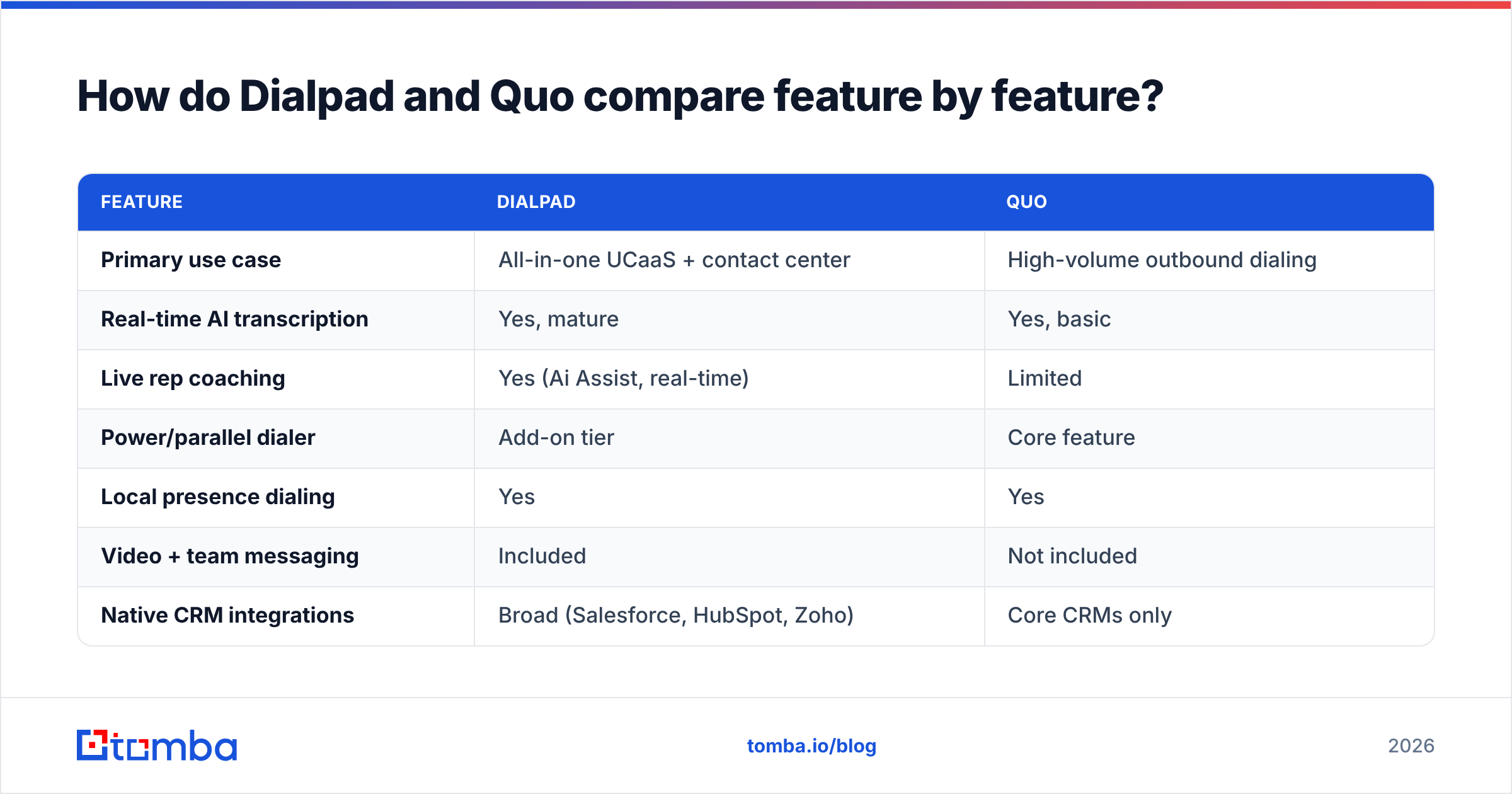
Here's the core-concept breakdown. Both tools cover the basics — VoIP calling, recording, and CRM logging — so the differences that matter are in AI depth, dialing speed, and how much the platform scales beyond pure outbound.
| Feature | Dialpad | Quo |
|---|---|---|
| Primary use case | All-in-one UCaaS + contact center | High-volume outbound dialing |
| Real-time AI transcription | Yes, mature | Yes, basic |
| Live rep coaching | Yes (Ai Assist, real-time) | Limited |
| Power/parallel dialer | Add-on tier | Core feature |
| Local presence dialing | Yes | Yes |
| Video + team messaging | Included | Not included |
| Native CRM integrations | Broad (Salesforce, HubSpot, Zoho) | Core CRMs only |
| Advanced analytics | Included mid-tier and up | Paid add-on |
| Setup complexity | Moderate | Low |
| Starting price | Higher | Lower |
The pattern is clear: Dialpad wins on breadth and AI maturity; Quo wins on dialing focus and cost. Neither is objectively better — they're optimized for different teams.
Which one has better AI features?#
Dialpad, clearly — for now. Its AI has a multi-year head start and shows it. Real-time transcription is accurate even on noisy calls, the sentiment analysis is genuinely useful for spotting deals going sideways, and live coaching lets a manager intervene mid-call. Post-call summaries land in your CRM automatically, which saves reps the 3–5 minutes of note-taking that usually gets skipped anyway.
Quo's AI is competent but lighter. You get transcription and searchable call logs, which covers 80% of what most SDR teams actually use. What you don't get is the real-time coaching layer or the deeper analytics that help sales managers spot coaching trends across a team.
If AI-driven coaching and QA are central to how you run your floor, Dialpad is worth the premium. If you just want accurate call records synced to your CRM, Quo does that without the extra spend.
How do Dialpad and Quo pricing compare?#
Pricing is where the two platforms diverge most, and where you should be honest about what you'll actually use.
Dialpad's entry tier bundles AI transcription and unlimited calling, but contact-center features, advanced integrations, and higher analytics sit in pricier tiers. For a 10-rep team wanting the full AI experience, budget accordingly — the sticker price understates the real cost once you add seats and premium features.
Quo undercuts on the base seat, which is attractive at scale. A 25-seat SDR team can see meaningful monthly savings. But watch the add-ons: advanced analytics and some integrations are billed separately, so the gap narrows if you need those.
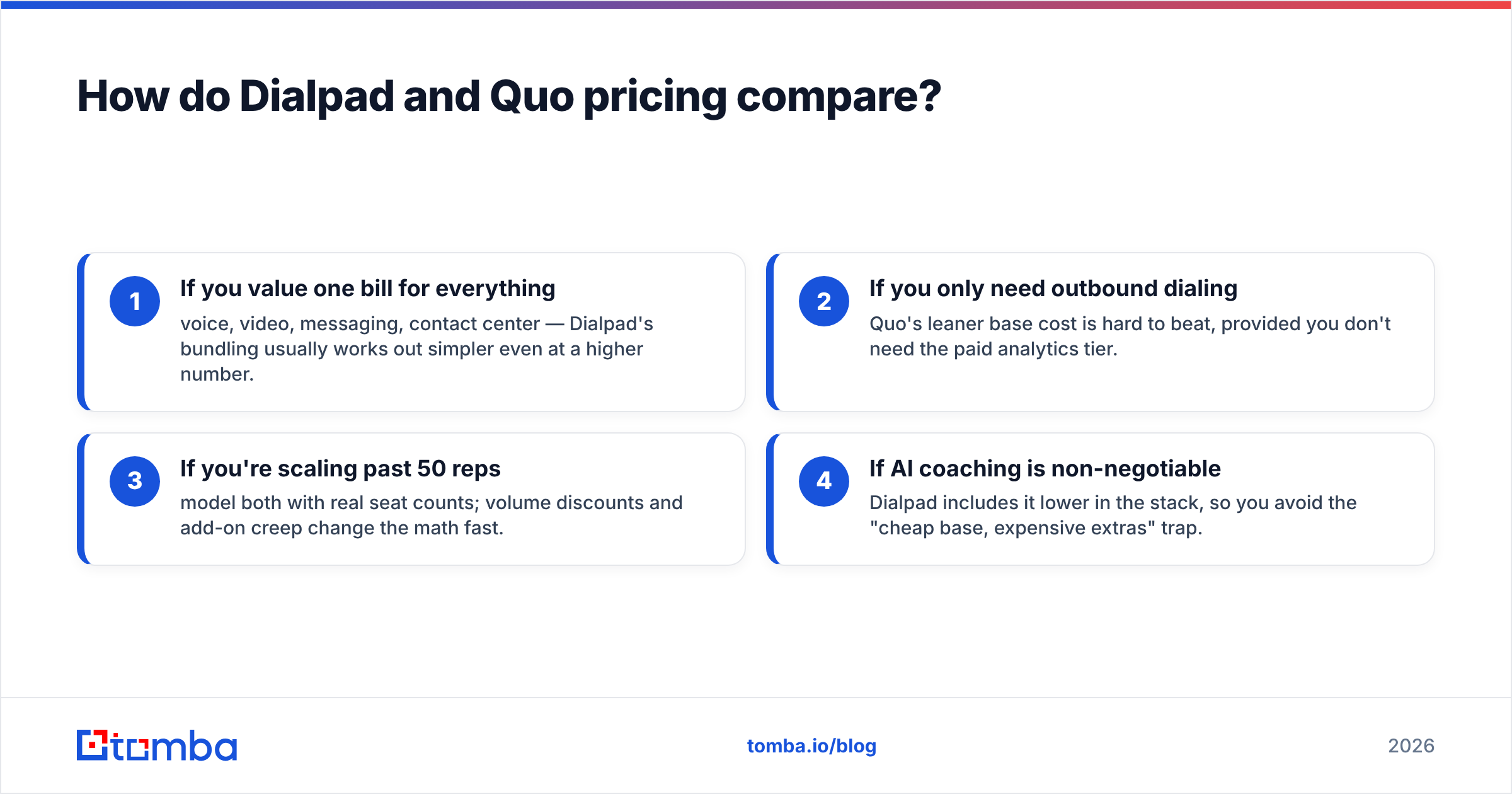
- If you value one bill for everything — voice, video, messaging, contact center — Dialpad's bundling usually works out simpler even at a higher number.
- If you only need outbound dialing — Quo's leaner base cost is hard to beat, provided you don't need the paid analytics tier.
- If you're scaling past 50 reps — model both with real seat counts; volume discounts and add-on creep change the math fast.
- If AI coaching is non-negotiable — Dialpad includes it lower in the stack, so you avoid the "cheap base, expensive extras" trap.
Always run a live pilot before committing. Published pricing rarely matches your negotiated rate at volume — a lesson B2B buyers relearn constantly, and one G2 reviews tend to confirm across both vendors.
Which is better for call quality and reliability?#
Both run on modern cloud infrastructure, so on a good network their call quality is comparable and clear. Dialpad has the longer track record and more global points of presence, which matters if you have international reps or call across regions. Quo is solid in its core markets but has a smaller footprint.
Reliability, though, is only half the equation. The other half is whether you're dialing the right number in the first place. This is where most teams silently bleed productivity: a pristine dialer connected to a CRM full of outdated or wrong phone numbers still produces dead calls, voicemail loops, and wrong-person conversations.
That's a data problem, not a software problem — and no phone system fixes it for you. Before you obsess over which dialer is 2% clearer, make sure your B2B phone numbers are current and verified. A verified number list will lift your connect rate more than any dialer swap.

Which should you pick for outbound sales?#
For a pure outbound SDR/BDR motion, Quo's focus is a genuine advantage. The dialer is fast, local presence works well, and the lower per-seat cost means you can staff more reps for the same budget. Setup is quick enough that you're dialing the same week you sign.
For a blended team — reps who also take inbound, run demos over video, and hand off to a support function — Dialpad's all-in-one design avoids stitching multiple tools together. The AI coaching also pays off faster on teams where ramping new reps is a constant cost.
Here's the honest tie-breaker: your outbound results depend far more on list quality than on which of these two you choose. Both platforms will dial whatever numbers you load. If those numbers are wrong, both fail equally. Enrich and verify your list first, then let the dialer do its job.
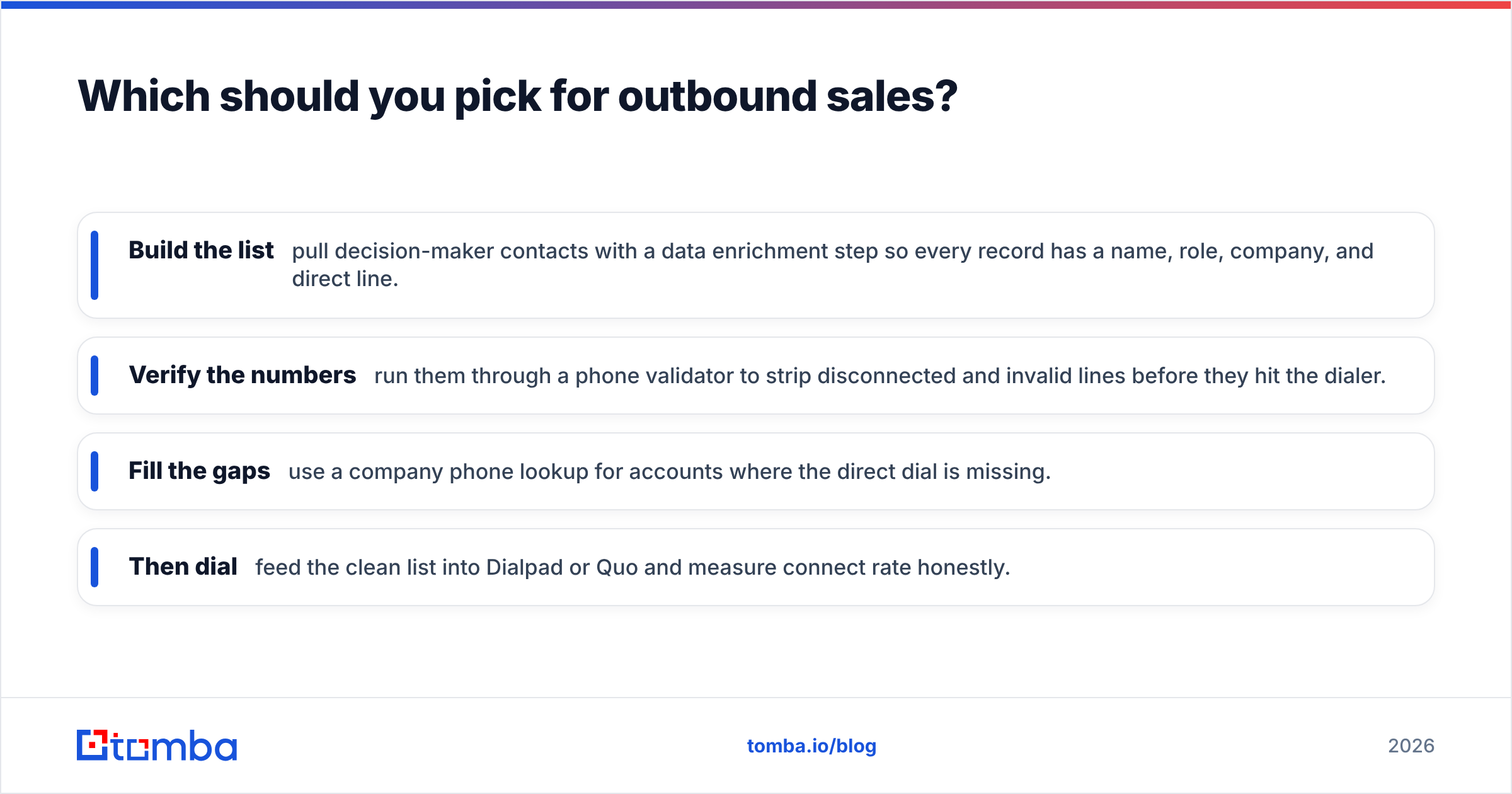
A practical stack looks like this:
- Build the list — pull decision-maker contacts with a data enrichment step so every record has a name, role, company, and direct line.
- Verify the numbers — run them through a phone validator to strip disconnected and invalid lines before they hit the dialer.
- Fill the gaps — use a company phone lookup for accounts where the direct dial is missing.
- Then dial — feed the clean list into Dialpad or Quo and measure connect rate honestly.
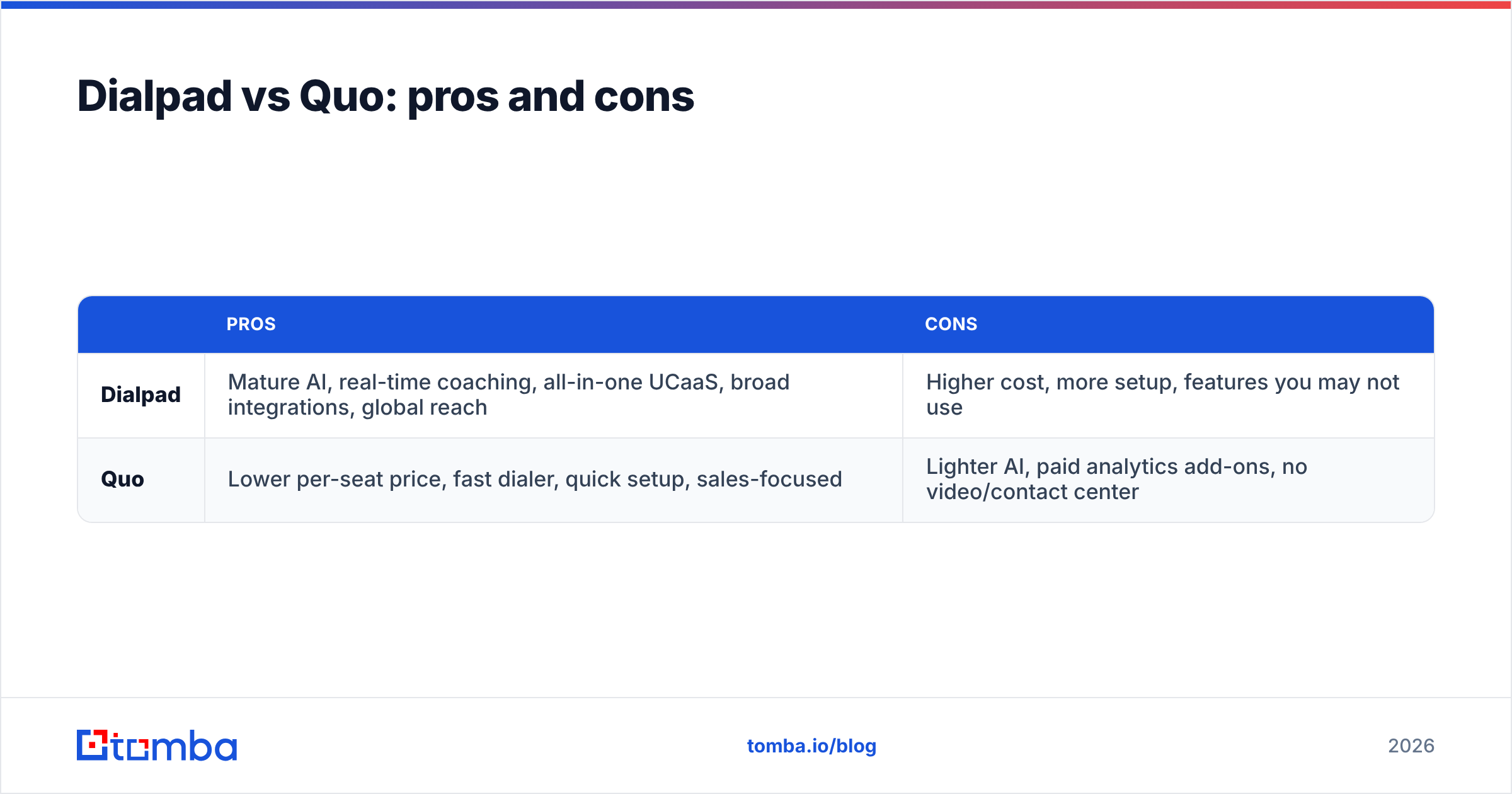
Dialpad vs Quo: pros and cons#
| Pros | Cons | |
|---|---|---|
| Dialpad | Mature AI, real-time coaching, all-in-one UCaaS, broad integrations, global reach | Higher cost, more setup, features you may not use |
| Quo | Lower per-seat price, fast dialer, quick setup, sales-focused | Lighter AI, paid analytics add-ons, no video/contact center |
If your team is communications-diverse and coaching-driven, Dialpad's breadth justifies the price. If you're a lean outbound engine watching cost per seat, Quo delivers where it counts and skips what you won't miss.
How do integrations affect the decision?#
Integrations quietly decide whether a phone system saves time or creates busywork. Dialpad connects natively to Salesforce, HubSpot, Zoho, and a wide app catalog, so call activity, recordings, and AI summaries flow into your CRM without manual export. Quo covers the core CRMs cleanly but has a shorter list overall — fine for most SDR stacks, limiting if you run a niche or homegrown system.
Whichever you choose, the workflow only works if the contact records those integrations sync are accurate. A phone system logging calls against stale CRM data just automates the mess faster. Pair your dialer with a proper enrichment and verification layer — many teams route new leads through Tomba's integrations into HubSpot or Salesforce so records arrive complete, then let Dialpad or Quo handle the calling. For a deeper look at how sales stacks fit together, industry analysts like Gartner track the UCaaS and revenue-tooling space in detail.
The verdict: Dialpad or Quo?#
Pick Dialpad if you want a single, AI-mature platform for voice, video, messaging, and contact center, and you'll use the real-time coaching and analytics to run a tighter floor. The premium buys genuine capability, not just brand.
Pick Quo if you're an outbound-first team that lives in the dialer, wants faster setup, and needs to keep cost per seat low. You'll trade some AI depth and breadth for a leaner, cheaper, focused tool.
But here's the point both vendors would rather you forget: the phone system is the last mile. Your connect rate, your conversation quality, and your pipeline are set upstream — by how good your contact data is before a single call goes out. The best dialer in the world can't rescue a bad list.
That's where Tomba fits, whichever platform you land on. Use the Tomba Email Finder and its companion phone and enrichment tools to build verified, decision-maker-ready lists, then load them into Dialpad or Quo with confidence that every dial has a real person on the other end. Start free with 25 searches a month, and see full Tomba pricing when you're ready to scale. Fix the data first — the phone system is the easy part.
Related guides#
Ready to find emails that actually work?
Join 150,000+ professionals who stopped guessing and started sending. Free credits on signup — no credit card required.
Get the Tomba newsletter
Practical outbound tactics and product updates — once every two weeks.
About the author