Dialpad vs Vonage (2026): Full Comparison for Sales Teams
Dialpad's AI-native calling vs Vonage's flexible UCaaS-plus-CPaaS stack. We break down pricing, features, call quality, and which one actually fits an outbound sales team in 2026.
Choosing a business phone system in 2026 usually comes down to two very different bets. Dialpad bets that AI baked into every call is the future. Vonage bets that flexibility — voice, video, messaging, and programmable APIs under one roof — wins the enterprise. If you run or support a sales team, the right pick depends less on marketing pages and more on how each platform handles high-volume calling, coaching, and integrations.
This is a neutral, hands-on comparison. Neither vendor sponsored it, and where one clearly beats the other, we say so.
TL;DR: Dialpad vs Vonage in 30 seconds#
- Dialpad is the AI-first choice. Real-time transcription, live coaching, and sentiment analysis ship in the core plans, which makes it a strong fit for outbound sales and support teams that live on the phone.
- Vonage is the flexibility play. It combines a unified communications suite (UCaaS) with a mature programmable communications platform (CPaaS/APIs), so developers and larger orgs can build custom flows.
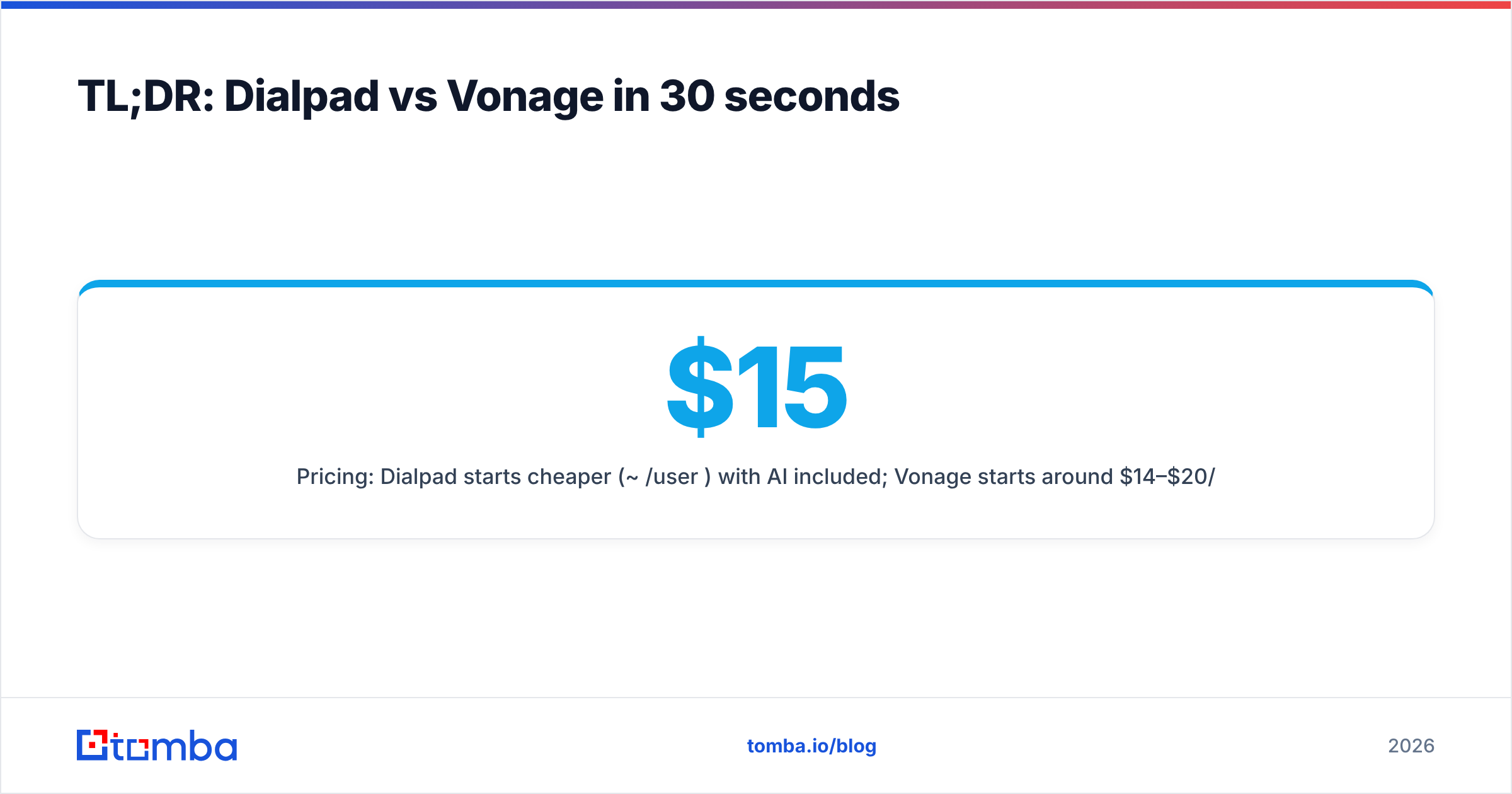
- Pricing: Dialpad starts cheaper (~$15/user/mo) with AI included; Vonage starts around $14–$20/user/mo but pushes many features into add-ons, so real cost creeps up.
- Call quality: Both are reliable. Dialpad's proprietary AI voice network edges ahead on transcription accuracy; Vonage's global carrier footprint edges ahead on international reach.
- Best for: Pick Dialpad if AI coaching and simplicity matter most. Pick Vonage if you need CPaaS APIs, deep customization, or a global contact-center build.
What is Dialpad, and who is it for?#
Dialpad is an AI-native cloud communications platform. It bundles business phone (voice), video meetings, team messaging, and a contact-center product into one interface, with its "Ai" layer running across all of them. The pitch is simple: every call is transcribed live, coached in real time, and summarized automatically, so reps and managers spend less time on notes and more time selling.
Dialpad's sweet spot is the mid-market sales or support team that wants AI features without stitching together three vendors. Because transcription, call summaries, and sentiment tracking are native rather than bolted on, onboarding is fast and the learning curve is gentle. If your reps are making dozens of calls a day and you want to coach them at scale, that native AI is the headline reason to look at Dialpad. You can see the full feature list on the official Dialpad site.

The trade-off: Dialpad is opinionated. You get its way of doing AI voice, and while that way is excellent, it's less of a build-your-own-workflow toolkit than Vonage's API-driven approach.
What is Vonage, and who is it for?#
Vonage is really two products wearing one badge. There's Vonage Business Communications (VBC) — the UCaaS suite with phone, video, and messaging aimed at everyday business users. And there's the Vonage Communications Platform — a CPaaS layer of programmable APIs (voice, SMS, verification, video) that developers use to embed communications directly into their own apps.
That dual identity is Vonage's biggest advantage and its biggest source of confusion. A company that needs to send two-factor SMS codes, build an in-app calling feature, or route a custom IVR can do all of it on Vonage. A company that just wants reliable desk phones and a softphone can also do that — but may find the platform heavier than a purpose-built SMB tool. You can review the current lineup on the official Vonage site.
Vonage suits larger organizations, developer-heavy teams, and global operations that value carrier reach and programmability over out-of-the-box AI coaching.
Dialpad vs Vonage: head-to-head comparison table#
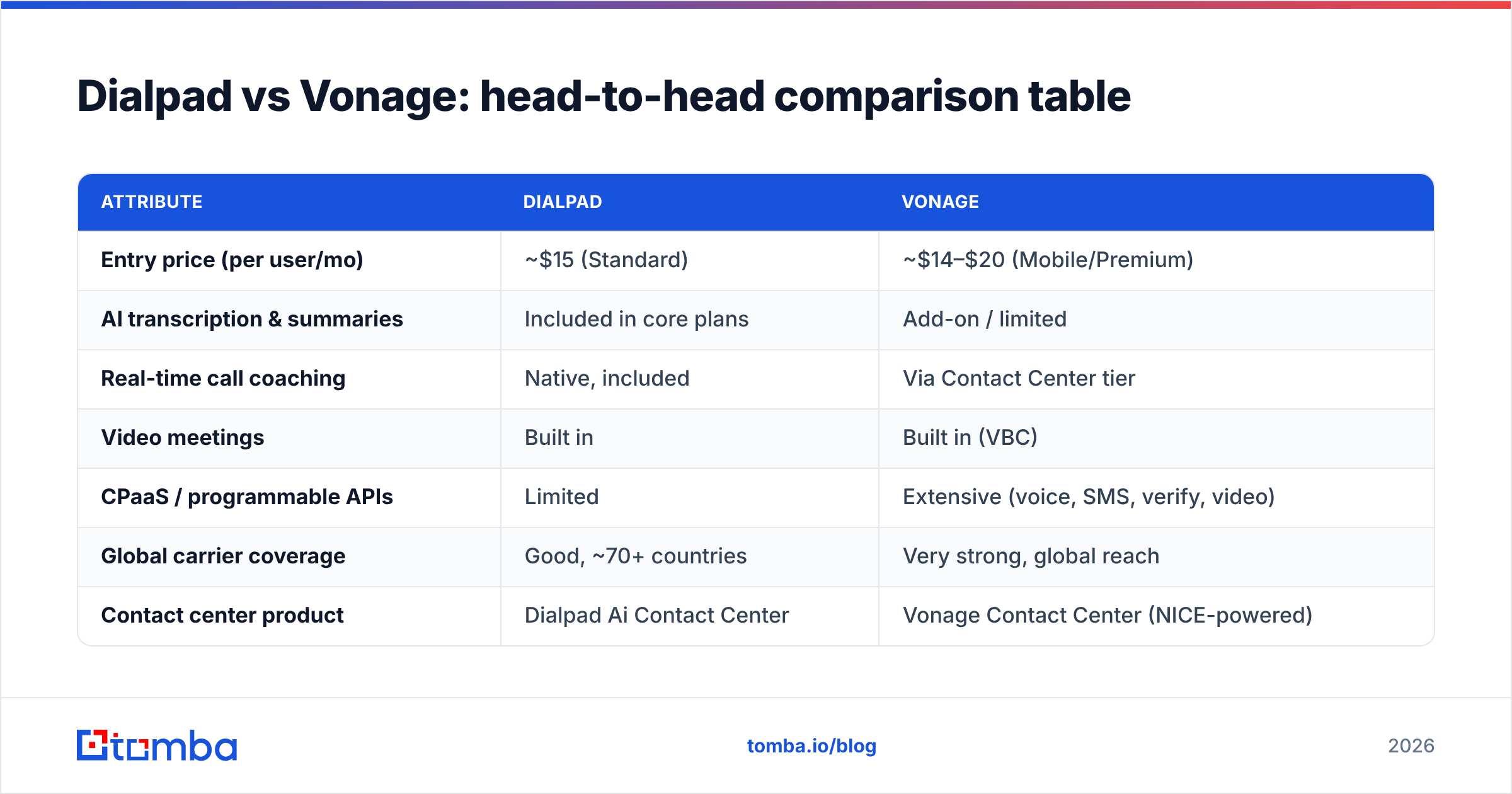
Here's the side-by-side on the attributes that actually drive a buying decision for a sales org.
| Attribute | Dialpad | Vonage |
|---|---|---|
| Entry price (per user/mo) | ~$15 (Standard) | ~$14–$20 (Mobile/Premium) |
| AI transcription & summaries | Included in core plans | Add-on / limited |
| Real-time call coaching | Native, included | Via Contact Center tier |
| Video meetings | Built in | Built in (VBC) |
| CPaaS / programmable APIs | Limited | Extensive (voice, SMS, verify, video) |
| Global carrier coverage | Good, ~70+ countries | Very strong, global reach |
| Contact center product | Dialpad Ai Contact Center | Vonage Contact Center (NICE-powered) |
| Ease of setup | Fast, low learning curve | Moderate; more configuration |
| Best-fit buyer | AI-first sales/support teams | Developers, global enterprises |
Prices and packaging shift often, so confirm current tiers on each vendor's pricing page before committing. The pattern above, though, has held steady: Dialpad front-loads AI value into cheaper plans, while Vonage front-loads flexibility and pushes advanced features into higher tiers or usage-based API pricing.
Is Dialpad better than Vonage for AI features?#
Yes — for most teams, Dialpad wins on AI, and it isn't especially close on the out-of-the-box experience.
Dialpad built its own AI voice model and speech recognition, so features like live transcription, automatic call summaries, real-time assist cards, and sentiment analysis are core to the product rather than premium extras. A new rep can get a live "battle card" suggestion mid-call, and a manager can scan sentiment trends across the whole team without listening to a single recording.
Vonage has invested heavily in AI too — including conversational AI and AI-powered routing through its platform and the NICE-powered contact center — but much of that power lives in higher tiers or requires configuration through APIs. For a developer building a custom experience, that's a feature. For a 12-person sales team that wants coaching turned on by Friday, it's friction.
If AI-assisted selling is your primary reason to switch phone systems, Dialpad is the more direct route. If you want to build bespoke AI communications flows into your own product, Vonage's programmability pulls ahead.
Which has better pricing and value?#
Dialpad is generally cheaper to start and easier to predict; Vonage can be more cost-effective at scale but harder to forecast.
Consider how each structures value:
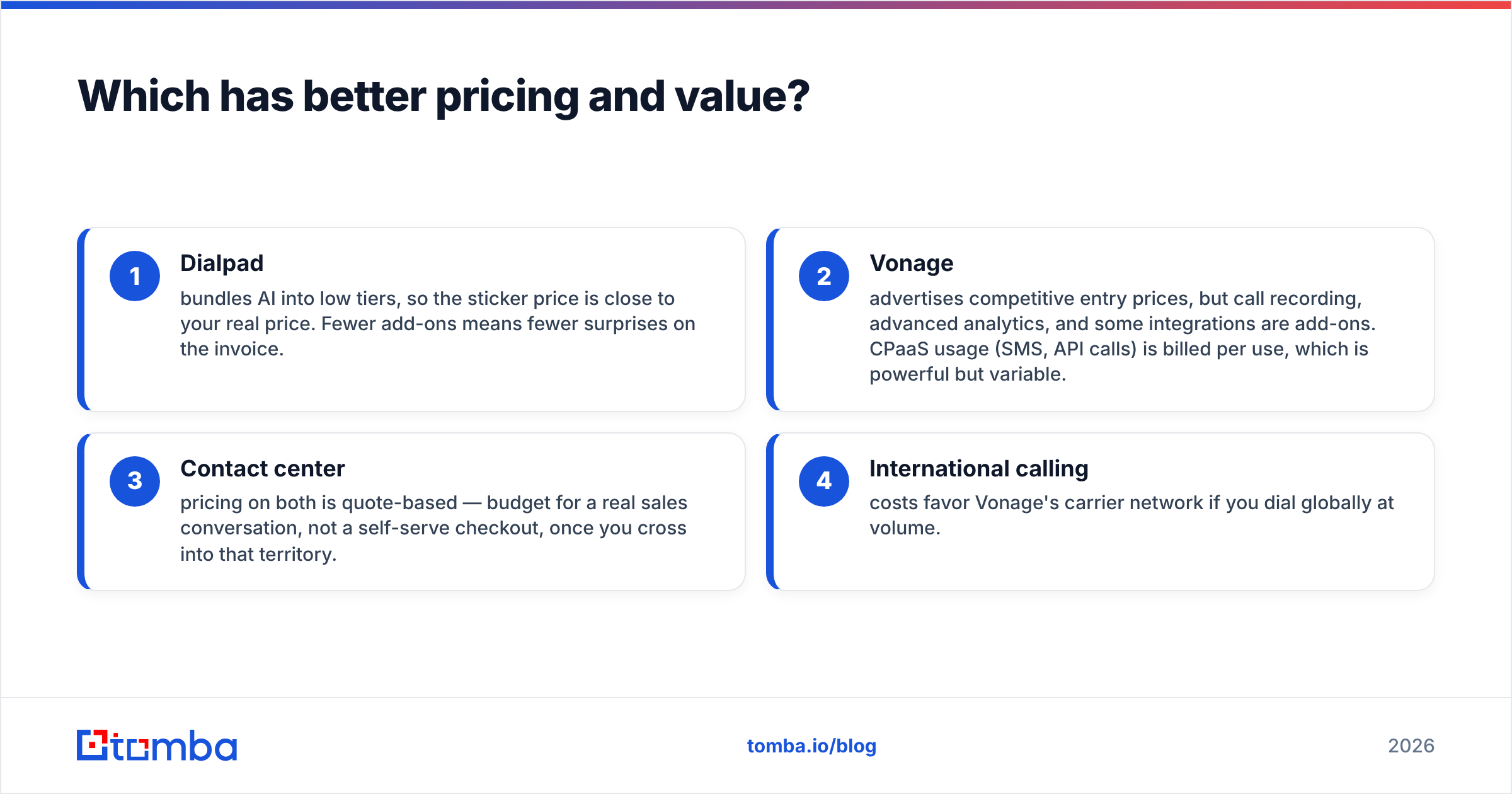
- Dialpad bundles AI into low tiers, so the sticker price is close to your real price. Fewer add-ons means fewer surprises on the invoice.
- Vonage advertises competitive entry prices, but call recording, advanced analytics, and some integrations are add-ons. CPaaS usage (SMS, API calls) is billed per use, which is powerful but variable.
- Contact center pricing on both is quote-based — budget for a real sales conversation, not a self-serve checkout, once you cross into that territory.
- International calling costs favor Vonage's carrier network if you dial globally at volume.
For a straightforward outbound team in one or two regions, Dialpad usually delivers lower total cost of ownership. For a global enterprise blending user seats with programmable messaging, Vonage's à la carte model can win — if you model the usage carefully. Compare that logic to how transparent SaaS pricing should look, like Tomba pricing, where tiers map cleanly to volume with no metered surprises.
How do call quality and reliability compare?#
Both are enterprise-grade, and neither will embarrass you on a client call. The differences are at the edges.
Dialpad routes calls over its own AI-optimized voice infrastructure and consistently scores well on transcription accuracy — which matters because bad transcripts poison downstream AI summaries and coaching. Vonage leans on a broad global carrier network with strong uptime guarantees and excellent international routing, which is why global contact centers gravitate toward it.
Independent reviews on G2 put both platforms in a similar reliability band, with users praising Dialpad's mobile app and AI, and praising Vonage's flexibility and support for complex deployments. The honest takeaway: choose based on features and cost, because raw call quality is a near-tie for most buyers.
What both tools can't do: fix bad prospect data#
Here's the part no phone-system comparison mentions. The best dialer in the world is worthless if you're calling wrong numbers and dead inboxes. Dialpad and Vonage move conversations; they don't source the people you should be conversing with.
That's a separate layer of your stack. Before a rep ever hits "call," someone has to find the right contact, confirm the direct dial, and verify the email for follow-up. Feed either phone system clean, current data and your connect rates climb; feed it a stale CRM export and even AI coaching can't save the call.
A few pieces close that gap:
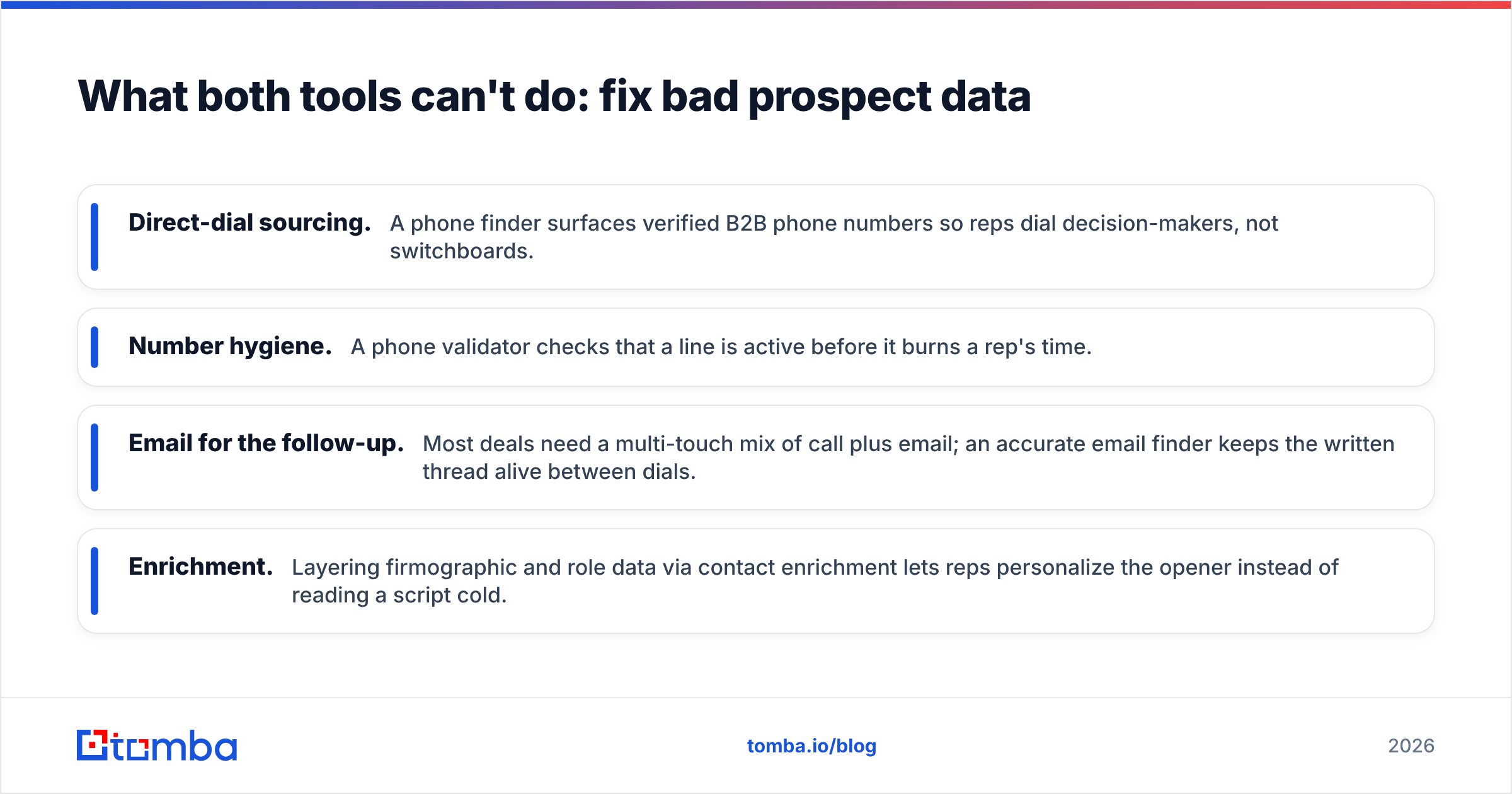
- Direct-dial sourcing. A phone finder surfaces verified B2B phone numbers so reps dial decision-makers, not switchboards.
- Number hygiene. A phone validator checks that a line is active before it burns a rep's time.
- Email for the follow-up. Most deals need a multi-touch mix of call plus email; an accurate email finder keeps the written thread alive between dials.
- Enrichment. Layering firmographic and role data via contact enrichment lets reps personalize the opener instead of reading a script cold.
Get this layer right and the Dialpad-vs-Vonage question becomes what it should be — a preference about how you talk to prospects, not whether you can reach them.
Dialpad vs Vonage: pros and cons#
Dialpad pros
- Native AI transcription, summaries, and real-time coaching in core plans
- Lower, more predictable entry pricing
- Fast setup and a clean, modern interface
- Strong mobile experience for field reps
Dialpad cons
- Limited programmable/CPaaS capabilities
- Opinionated workflows; less custom build-your-own
- International reach is good but not best-in-class
Vonage pros
- Powerful CPaaS APIs for custom voice, SMS, and verification
- Excellent global carrier coverage
- Deep customization and enterprise contact-center options
- One vendor for both user seats and developer tooling
Vonage cons
- Advanced features live in add-ons or higher tiers
- Usage-based billing is harder to forecast
- Steeper configuration and learning curve for non-technical teams
Which should you choose in 2026?#
Decide by your primary constraint, not the longer feature list.
Choose Dialpad if you run a sales or support team that wants AI coaching, live transcription, and predictable pricing with minimal setup. It's the better fit for most SMB and mid-market outbound teams that want value on day one.
Choose Vonage if you have developers, need programmable communications APIs, run a global operation, or are building a complex contact center where flexibility and carrier reach matter more than turnkey AI.
There's no universally "better" tool here — only a better fit. Dialpad optimizes for AI-assisted conversations out of the box; Vonage optimizes for programmable, global-scale communications you can bend to any workflow.
The bottom line#
Dialpad and Vonage solve the same headline problem — cloud business communications — from opposite philosophies. Dialpad leads with AI and simplicity; Vonage leads with flexibility and programmability. Match that philosophy to your team's reality and you'll be happy with either.
But remember the layer above the dialer. Whichever phone system you land on, its connect rate is capped by the quality of the contacts you load into it. Start every outbound motion with verified, current data: use the Tomba Email Finder to find and confirm the right professional contacts by name, company, or domain, then hand those clean numbers and emails to Dialpad or Vonage. The phone system moves the conversation — Tomba makes sure there's a real person on the other end. Try it free with 25 searches a month and give your reps a list worth calling.
Related guides#
Ready to find emails that actually work?
Join 150,000+ professionals who stopped guessing and started sending. Free credits on signup — no credit card required.
Get the Tomba newsletter
Practical outbound tactics and product updates — once every two weeks.
About the author