The Difference Between B2B and B2C: A 2026 Sales Guide
B2B and B2C aren't just different audiences — they run on different sales cycles, data, and metrics. Here's what actually changes, and how to build a go-to-market motion that fits your model.
Ask ten founders to explain the difference between B2B and B2C and you'll get ten versions of "one sells to businesses, the other sells to people." That's true, and it's also nearly useless once you're deciding how to actually sell. The real gap shows up in your sales cycle, your data, your pricing, and the metrics your board cares about.
This guide breaks down where the two models genuinely diverge in 2026 — and, more importantly, what each difference means for how you find buyers, build a pipeline, and close.
TL;DR#
- B2B sells to organizations with buying committees, long cycles, and high-value contracts. B2C sells to individuals with short, emotion-driven decisions and lower price points.
- The biggest operational difference isn't the audience — it's the number of decision-makers and the length of the cycle.
- B2B lives or dies on accurate contact data and targeting; B2C lives on reach, brand, and volume.
- Metrics differ: B2B optimizes CAC, LTV, and pipeline velocity; B2C optimizes conversion rate, AOV, and repeat purchase.
- Some businesses run both motions (B2B2C) — and need tooling that supports precise prospecting and mass marketing at once.
What is B2B and what is B2C?#
B2B (business-to-business) means one company sells products or services to another company. Think a payroll platform selling to HR departments, or a logistics firm selling freight capacity to manufacturers. The buyer is an organization, and the person signing off is spending the company's money to solve a company's problem.
B2C (business-to-consumer) means a company sells directly to individual people for personal use. A streaming subscription, a pair of running shoes, a food-delivery app — the buyer spends their own money to satisfy their own want or need.
That sounds clean, but the labels hide the part that matters. A $12 SaaS tool a solo freelancer buys with a credit card behaves a lot like B2C, even though it's technically business software. A $40,000 luxury watch sold through a personal advisor behaves a lot like B2B, even though it's a consumer product. The model is defined less by who buys and more by how the decision gets made.
What is the core difference between B2B and B2C?#
The core difference between B2B and B2C is the structure of the buying decision. B2C is usually one person deciding quickly on emotion and immediate value. B2B is usually a group deciding slowly on logic, risk, and ROI.
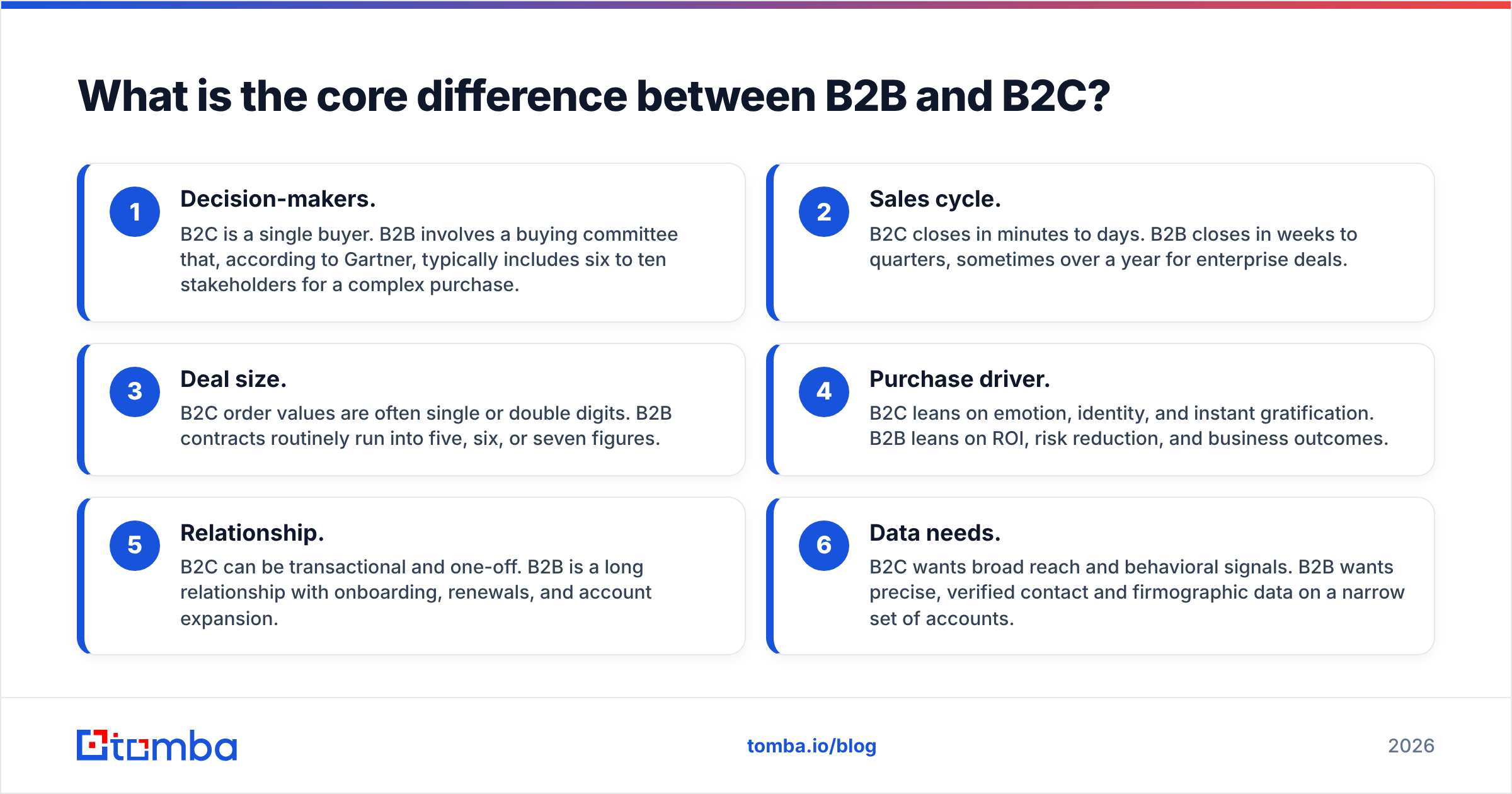
Everything else — pricing, marketing channels, content, data needs — flows downstream from that single fact. Here are the six dimensions where it shows up most:
- Decision-makers. B2C is a single buyer. B2B involves a buying committee that, according to Gartner, typically includes six to ten stakeholders for a complex purchase.
- Sales cycle. B2C closes in minutes to days. B2B closes in weeks to quarters, sometimes over a year for enterprise deals.
- Deal size. B2C order values are often single or double digits. B2B contracts routinely run into five, six, or seven figures.
- Purchase driver. B2C leans on emotion, identity, and instant gratification. B2B leans on ROI, risk reduction, and business outcomes.
- Relationship. B2C can be transactional and one-off. B2B is a long relationship with onboarding, renewals, and account expansion.
- Data needs. B2C wants broad reach and behavioral signals. B2B wants precise, verified contact and firmographic data on a narrow set of accounts.
How do B2B and B2C compare side by side?#
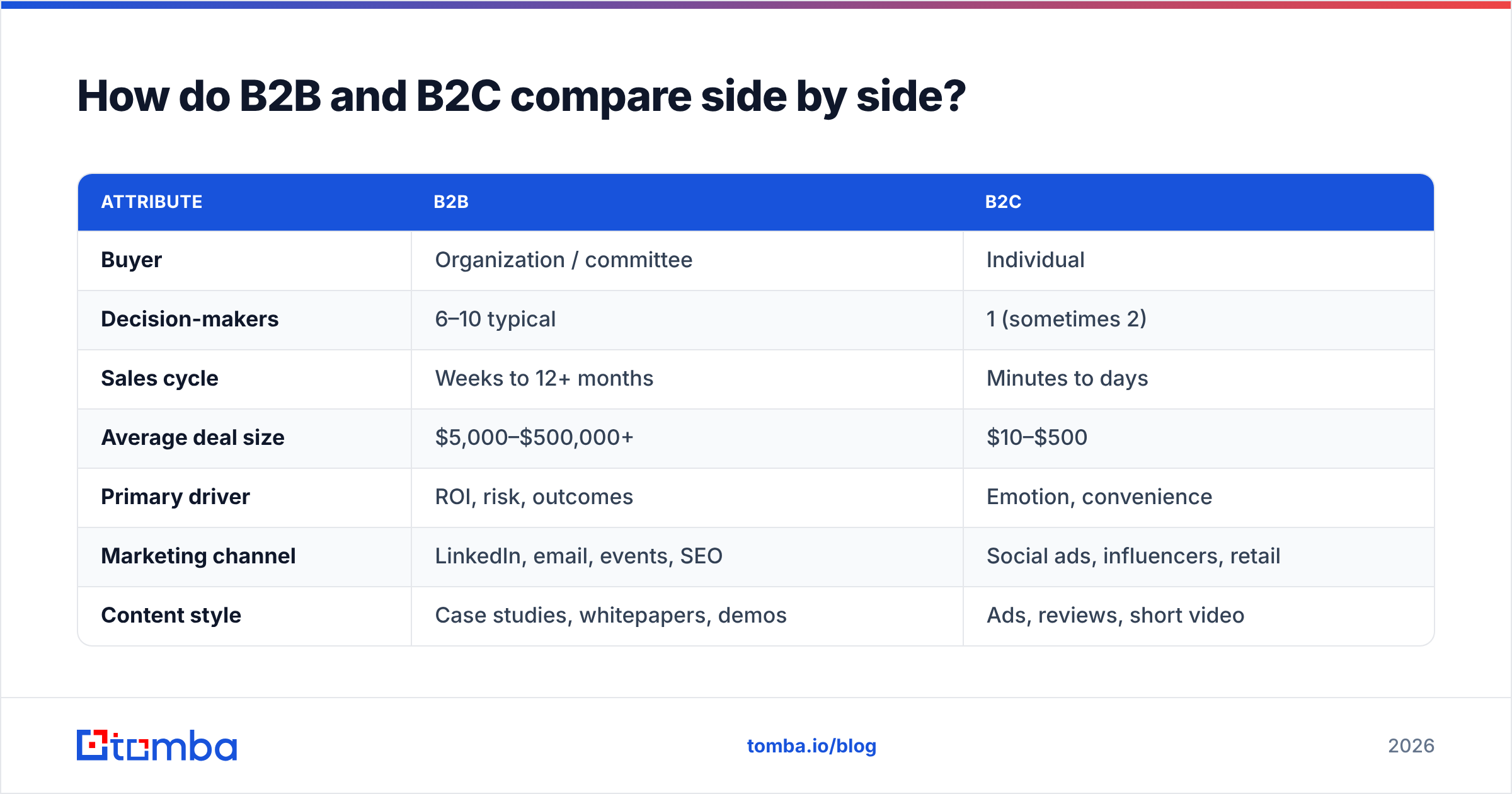
Here's the full picture in one view. Treat it as a diagnostic: if your business scores mostly in the left column, run a B2B motion; mostly right, run a B2C motion.
| Attribute | B2B | B2C |
|---|---|---|
| Buyer | Organization / committee | Individual |
| Decision-makers | 6–10 typical | 1 (sometimes 2) |
| Sales cycle | Weeks to 12+ months | Minutes to days |
| Average deal size | $5,000–$500,000+ | $10–$500 |
| Primary driver | ROI, risk, outcomes | Emotion, convenience |
| Marketing channel | LinkedIn, email, events, SEO | Social ads, influencers, retail |
| Content style | Case studies, whitepapers, demos | Ads, reviews, short video |
| Relationship | Long-term, renewal-based | Often transactional |
| Key metric | CAC, LTV, pipeline velocity | Conversion rate, AOV, retention |
| Data priority | Accurate, verified, targeted | Broad, behavioral, volume |
Notice the pattern: B2B optimizes for precision on a small audience, while B2C optimizes for efficiency at massive scale. That distinction decides which tools and tactics actually pay off.
How does the sales process differ between B2B and B2C?#
In B2C, the "sales process" is often just a well-designed funnel: an ad captures attention, a landing page builds desire, and a checkout button closes the deal. There's rarely a human in the loop. The work is in creative, pricing psychology, and removing friction from the path to purchase.
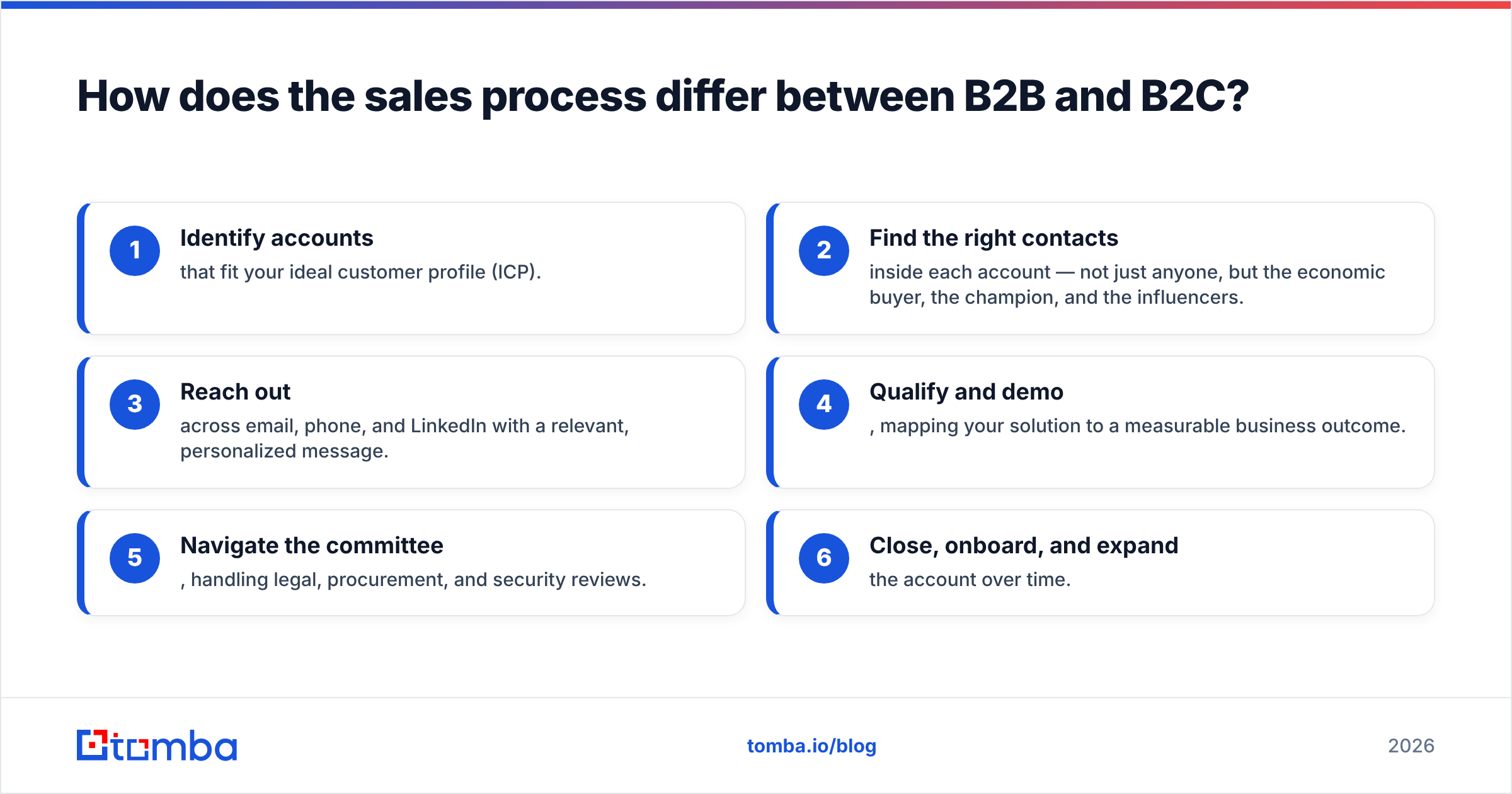
In B2B, the process is a relationship built by people. A typical motion looks like this:
- Identify accounts that fit your ideal customer profile (ICP).
- Find the right contacts inside each account — not just anyone, but the economic buyer, the champion, and the influencers.
- Reach out across email, phone, and LinkedIn with a relevant, personalized message.
- Qualify and demo, mapping your solution to a measurable business outcome.
- Navigate the committee, handling legal, procurement, and security reviews.
- Close, onboard, and expand the account over time.
Step two is where most B2B outbound quietly fails. You can nail your ICP and still stall because your contact data is stale, generic, or unverified. If half your outreach bounces or lands in the wrong inbox, your beautifully crafted sequence never gets read. That's why accurate email verification and a reliable email finder are foundational to B2B in a way they simply aren't for B2C.
Do B2B and B2C use marketing differently?#
Yes — and the difference is bigger than the channels they pick.
B2C marketing is built for reach and repetition. The goal is to put a memorable brand in front of as many qualified individuals as possible, then convert on emotion and convenience. Instagram, TikTok, retail placement, influencer partnerships, and broad paid social do the heavy lifting. Success is measured in impressions, click-through rate, and cost per acquisition across large audiences.
B2B marketing is built for relevance and trust. Because the audience is small and the deal is large, wasting spend on the wrong people is expensive. B2B leans on account-based strategies, LinkedIn, targeted cold email, SEO for high-intent queries, webinars, and case studies that de-risk a serious purchase. HubSpot's research on inbound marketing consistently shows that educational, problem-solving content outperforms hard-sell tactics in long-cycle B2B.
The tooling reflects this. A B2C team invests in creative and ad platforms. A B2B team invests in a clean B2B database and enrichment, because the entire motion depends on reaching a specific list of humans at specific companies. Get the data wrong and no amount of clever copy saves you.
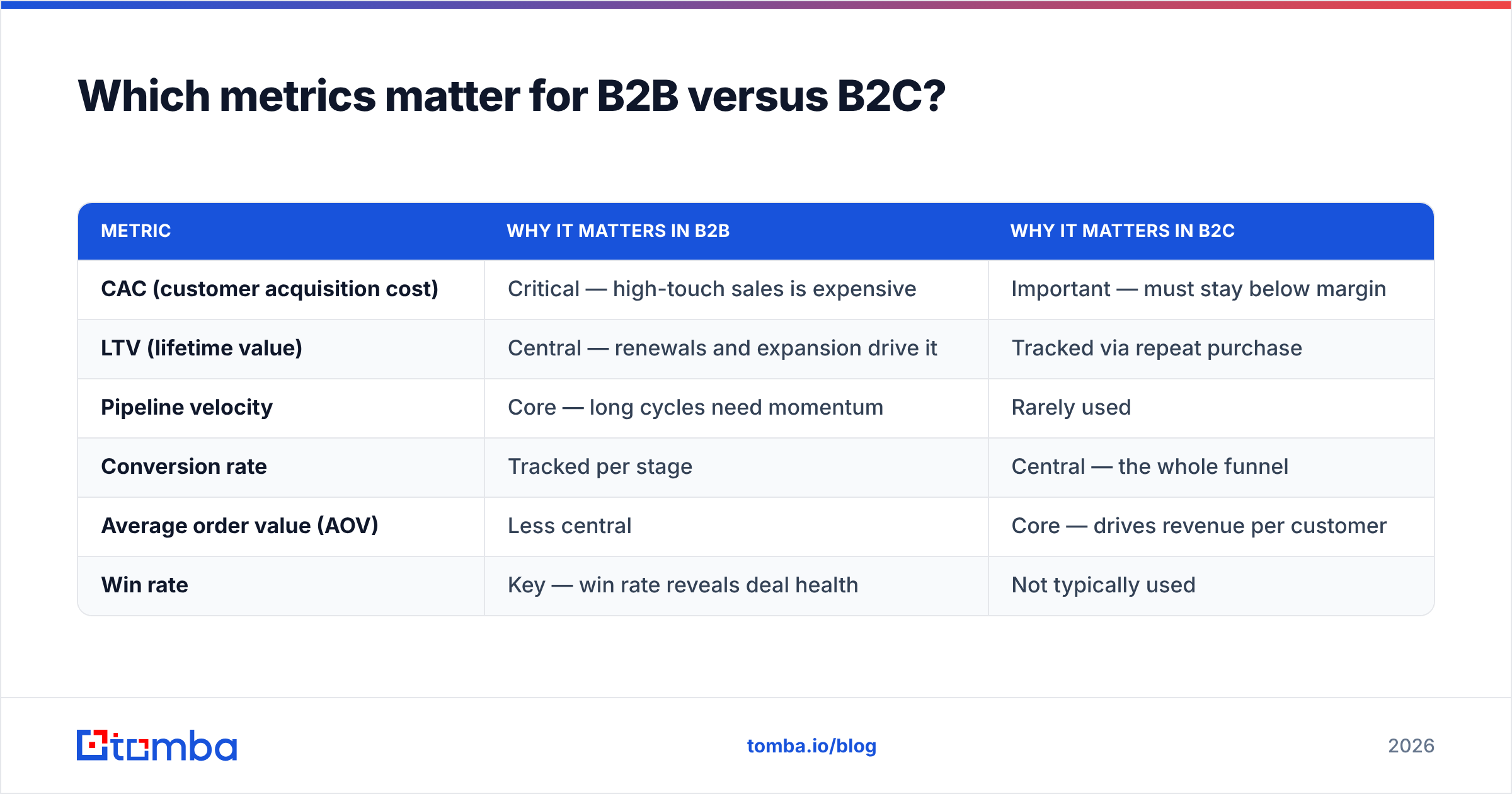
Which metrics matter for B2B versus B2C?#
You can't manage what you don't measure, and the two models watch almost entirely different dashboards.
| Metric | Why it matters in B2B | Why it matters in B2C |
|---|---|---|
| CAC (customer acquisition cost) | Critical — high-touch sales is expensive | Important — must stay below margin |
| LTV (lifetime value) | Central — renewals and expansion drive it | Tracked via repeat purchase |
| Pipeline velocity | Core — long cycles need momentum | Rarely used |
| Conversion rate | Tracked per stage | Central — the whole funnel |
| Average order value (AOV) | Less central | Core — drives revenue per customer |
| Win rate | Key — win rate reveals deal health | Not typically used |
The takeaway: B2B teams obsess over the health and speed of a small number of large deals, while B2C teams obsess over the efficiency of a huge number of small ones. If you're borrowing a playbook from the wrong model, your metrics will quietly mislead you.
Can a business be both B2B and B2C?#
Absolutely — and it's more common than the neat two-column framing suggests. This hybrid is often called B2B2C, and it comes in a few shapes:
- Platforms like Shopify sell software to businesses (B2B) that in turn sell to consumers (B2C).
- Marketplaces like Amazon serve both individual shoppers and third-party sellers.
- Prosumer tools — design apps, note-taking software, VPNs — sell the same product to individuals and to enterprise teams, with different pricing and motions for each.
Running both is powerful but demanding. Your B2C side needs volume and brand; your B2B side needs precision targeting and a real sales process. Many teams try to force one set of tools across both and end up underserving each. The fix is to keep the motions separate where it counts: mass channels for consumers, and a focused prospecting stack — domain search, verification, and contact enrichment — for the business accounts that carry most of the revenue.
How do you choose the right model — and the right tools?#
Start by answering one question honestly: how does your customer actually decide to buy?
If the answer is "one person, quickly, on emotion or convenience," you're running B2C. Invest in brand, creative, frictionless checkout, and broad-reach channels. Your data problem is understanding behavior at scale.
If the answer is "several people, over weeks or months, based on ROI and risk," you're running B2B. Invest in a tight ICP, multichannel outreach, and — before anything else — the ability to reliably reach the right humans. Your data problem is accuracy on a narrow, high-value target list.
For most B2B and B2B2C teams, that means the single highest-leverage investment is contact data you can trust. A verified email that reaches the actual decision-maker is worth more than a hundred guesses that bounce. Compare Tomba pricing against how much a single stalled enterprise deal costs you, and the math on getting data right is not close.
The bottom line#
The difference between B2B and B2C isn't really about businesses versus people — it's about how buying decisions get made. B2C is a fast, single, emotional decision optimized through reach and frictionless funnels. B2B is a slow, committee-driven, logical decision optimized through precise targeting and trust. Pick the playbook that matches your buyer, measure the metrics that model rewards, and don't run one model's tactics on the other's dashboard.
If your motion is B2B or B2B2C, the whole thing rests on reaching the right person at the right company. Tomba's Email Finder turns a name and a domain into a verified, ready-to-contact email — so your outreach reaches decision-makers instead of bouncing. Start free with 25 searches a month, and scale up as your pipeline does.
Related guides#
Ready to find emails that actually work?
Join 150,000+ professionals who stopped guessing and started sending. Free credits on signup — no credit card required.
Get the Tomba newsletter
Practical outbound tactics and product updates — once every two weeks.
About the author