The Difference Between Prospecting and Lead Generation
Prospecting and lead generation get used as if they mean the same thing. They don't. Here's how each works, who owns it, and how to run them together without wasting pipeline.
Prospecting and lead generation are not synonyms, even though most sales decks treat them like they are. Confuse the two and you end up with reps cold-calling marketing's newsletter subscribers, or marketing measuring itself on activity that never becomes revenue. This guide draws a clean line between them, then shows how they actually work as one pipeline.
TL;DR — Prospecting vs Lead Generation#
- Lead generation is a mostly inbound, marketing-owned motion that attracts interested people at scale and captures their contact info (content, ads, SEO, webinars, gated assets).
- Prospecting is a mostly outbound, sales-owned motion where a rep proactively identifies and reaches specific accounts that have shown no prior interest.
- The core split: lead generation waits for hand-raisers and nurtures volume; prospecting hunts named targets one at a time.
- They are sequential and parallel — inbound leads still need qualifying (a prospecting skill), and outbound prospects can be warmed by marketing.
- Both fail without accurate contact data. A wrong email or dead phone number kills either motion before the message lands.
What is lead generation?#
Lead generation is the process of attracting strangers and converting them into known contacts who have expressed some interest in your company. Think of it like fishing with a net: you cast wide, and whoever swims in gives you their name and email in exchange for something valuable.
The mechanics are almost always inbound or scaled:
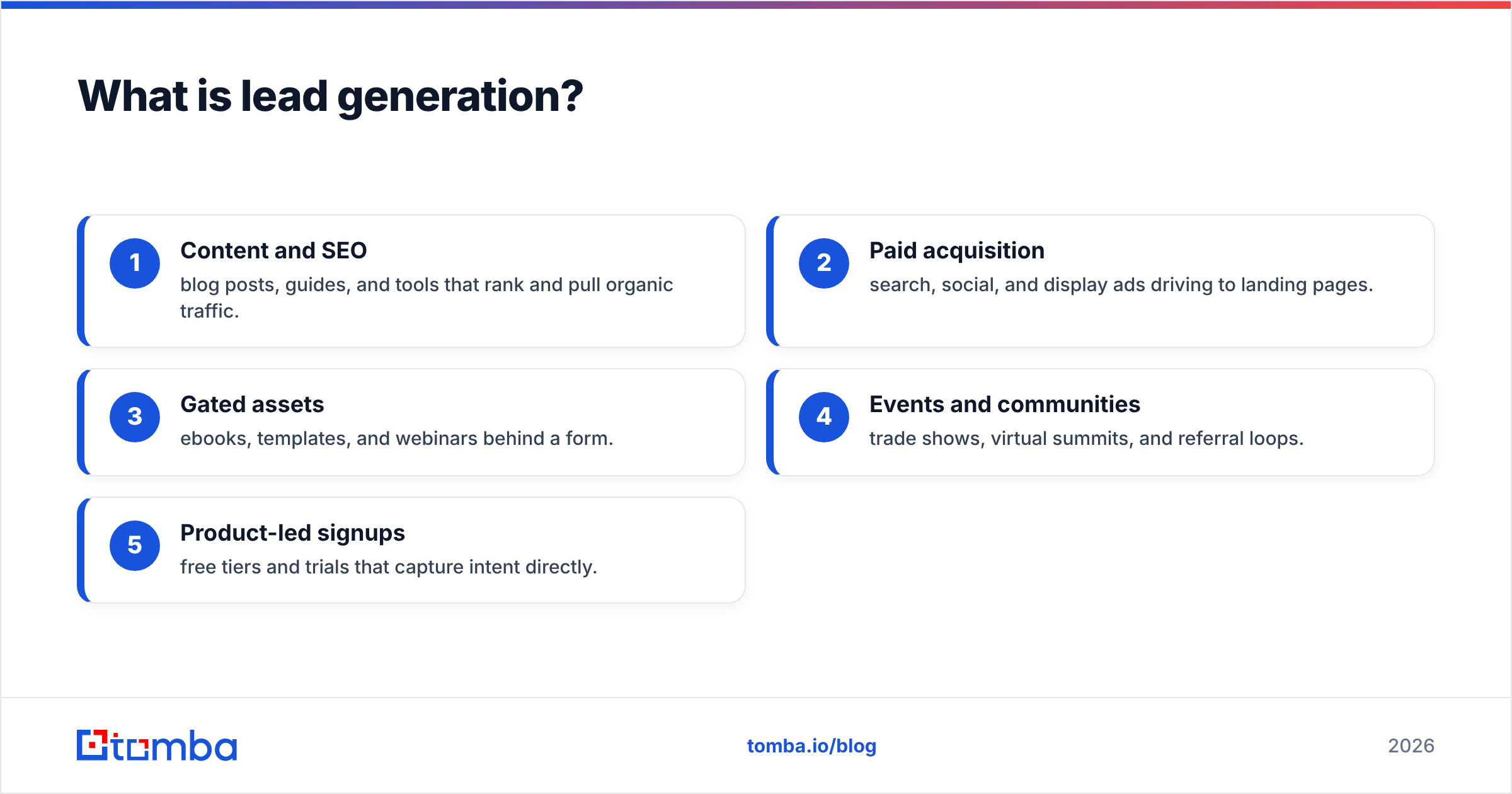
- Content and SEO — blog posts, guides, and tools that rank and pull organic traffic.
- Paid acquisition — search, social, and display ads driving to landing pages.
- Gated assets — ebooks, templates, and webinars behind a form.
- Events and communities — trade shows, virtual summits, and referral loops.
- Product-led signups — free tiers and trials that capture intent directly.
The output is a lead: a contact record with enough information to follow up. Some are ready to buy; most are not. That is why marketing teams layer on scoring, tagging each lead as a marketing qualified lead or something colder. Volume is the point — lead generation is judged on how many qualified contacts it feeds into the funnel, and at what cost per lead.
HubSpot frames lead gen as the top of the flywheel: attract, then convert interest into contact data you're allowed to nurture. See their lead generation overview for the canonical inbound definition.

What is prospecting?#
Prospecting is the sales-led process of proactively identifying specific accounts and people who fit your ideal customer profile, then reaching out — usually before they've heard of you. If lead generation is a net, prospecting is a spear: one target, chosen on purpose, pursued directly.
A rep prospecting a territory typically:
- Builds a target list from an ICP (industry, headcount, tech stack, role).
- Finds the decision-maker and their direct contact details.
- Researches a trigger — a funding round, a new hire, a product launch worth referencing.
- Runs multi-touch outreach across email, phone, and LinkedIn.
- Qualifies fast to protect pipeline, disqualifying poor fits early.
Prospecting is outbound by nature. Nobody filled out a form. The rep decided this account is worth pursuing, so the burden of relevance sits entirely on the outreach. That's why prospecting lives or dies on data accuracy: you need the right person's real email, not a guess. Tools like the Tomba Email Finder exist precisely because a spear that misses the target is wasted effort. Salesforce's prospecting guide covers the account-selection discipline in more depth.
What is the difference between prospecting and lead generation?#
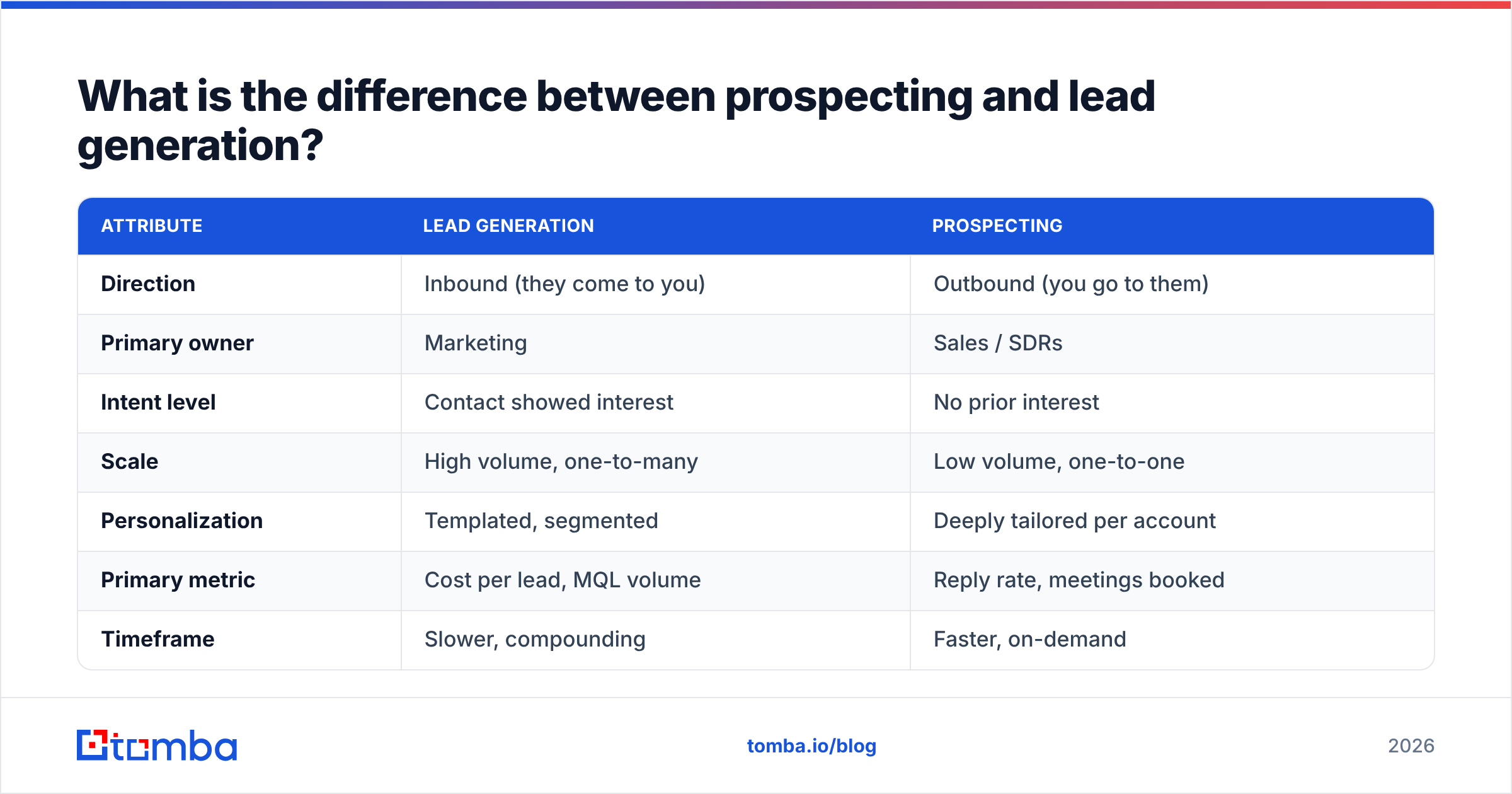
The difference between prospecting and lead generation comes down to direction, ownership, and intent. Lead generation pulls interested strangers toward you at scale; prospecting pushes you toward specific, chosen accounts one at a time. Here's the full breakdown.
| Attribute | Lead Generation | Prospecting |
|---|---|---|
| Direction | Inbound (they come to you) | Outbound (you go to them) |
| Primary owner | Marketing | Sales / SDRs |
| Intent level | Contact showed interest | No prior interest |
| Scale | High volume, one-to-many | Low volume, one-to-one |
| Personalization | Templated, segmented | Deeply tailored per account |
| Primary metric | Cost per lead, MQL volume | Reply rate, meetings booked |
| Timeframe | Slower, compounding | Faster, on-demand |
| Data need | Form-captured, self-reported | Sourced and verified externally |
| Typical tools | CMS, ad platforms, forms | Email finder, dialer, CRM sequences |
Read the table as two ends of one funnel, not two competing strategies. Lead generation optimizes for volume of interest. Prospecting optimizes for precision on named accounts. A healthy revenue engine needs both, because each covers the other's blind spot: lead gen can't guarantee you'll reach your dream 100 accounts, and prospecting can't fill a pipeline with thousands of contacts by hand.
Is prospecting better than lead generation?#
Neither is better — they solve different problems, and the right mix depends on your deal size and sales motion. High-volume, low-ACV businesses lean on lead generation because they can't afford a rep hand-crafting outreach for a $40/month subscription. Enterprise teams selling six-figure contracts lean on prospecting because a single named account can be worth an entire quarter of inbound leads.
Use this rough guide:
- Lean lead generation when: deals are small, the buying audience is broad, sales cycles are self-serve, and you can produce content that ranks.
- Lean prospecting when: deals are large, the total addressable market is narrow and nameable, and buyers rarely search for a solution proactively.
- Blend both when: you have a defined ICP and enough marketing reach to warm those accounts before a rep calls.
The mistake isn't picking one — it's pretending you only do one. Most teams run inbound and outbound simultaneously and just fail to connect them.

How do prospecting and lead generation work together?#
They work together as a single pipeline where lead generation feeds volume and prospecting adds precision — and each hands off to the other. The handoff is where most revenue leaks, so make it explicit.
Inbound lead → prospecting qualification. A lead fills out a form. That doesn't mean they're ready. An SDR still has to research the account, confirm fit, and reach the actual decision-maker — classic prospecting skills applied to an inbound record. The form often captures a personal Gmail, so the rep uses domain search to find the buyer's real work address and route the conversation to the right people.
Outbound prospect → nurture. A rep identifies a target account that isn't ready to talk. Instead of burning the relationship, they hand the contact to marketing for retargeting and content nurture — lead-gen tactics applied to an outbound-sourced contact. When the prospect eventually raises a hand, the rep already has context.
Shared data layer. Both motions write to the same CRM, and both depend on the same thing: correct contact data. Before any list goes into a sequence, run it through an email verifier so bounces don't wreck your sender reputation. Whether a contact came from a webinar (lead gen) or a cold list (prospecting), an invalid address is dead weight either way. Gartner's research on buyer behavior shows buyers spend only a fraction of their journey talking to any vendor — which means both your inbound follow-up and your outbound timing have to be sharp, and built on data that actually reaches a human.
Here's the combined flow in practice:
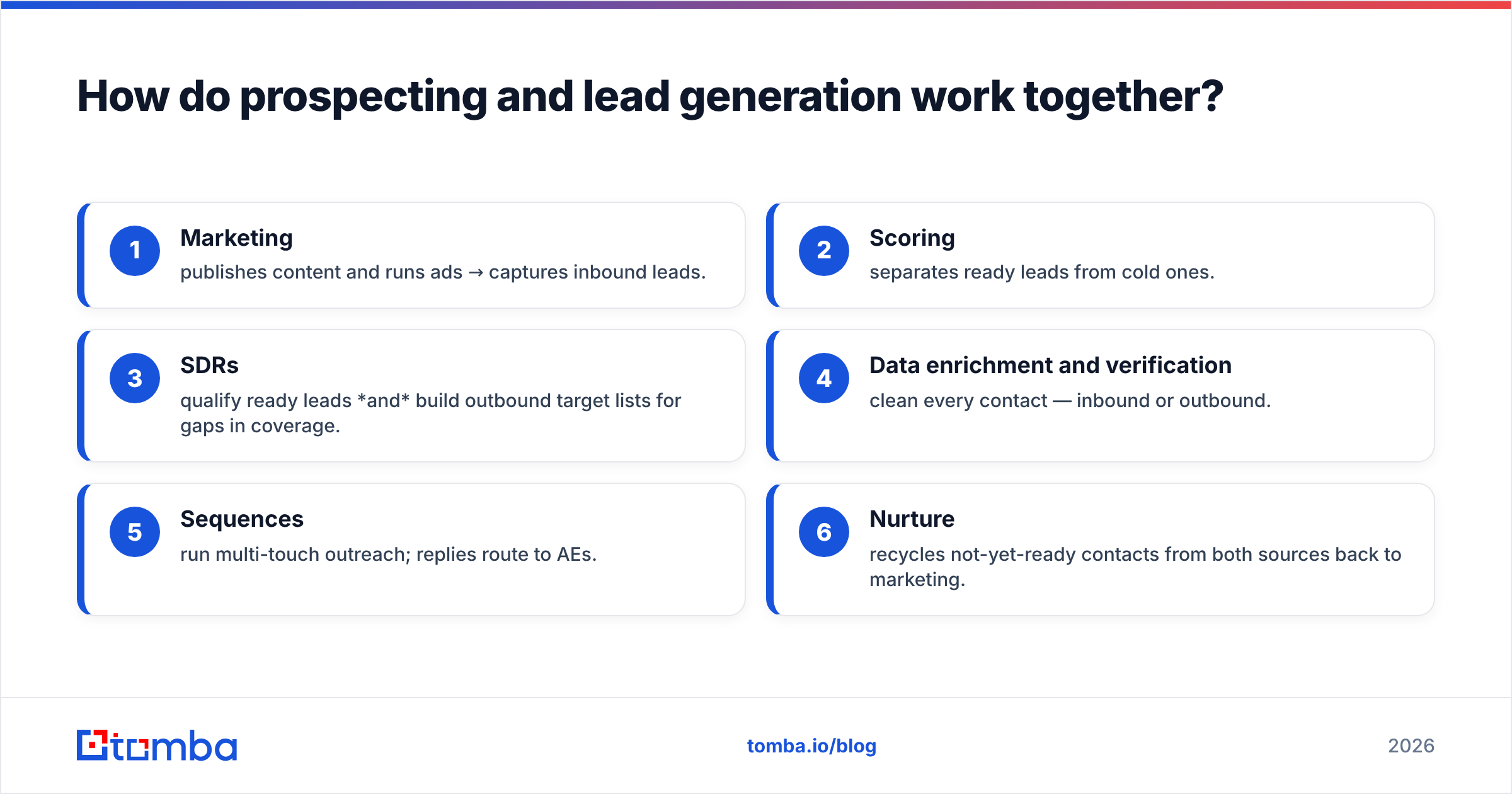
- Marketing publishes content and runs ads → captures inbound leads.
- Scoring separates ready leads from cold ones.
- SDRs qualify ready leads and build outbound target lists for gaps in coverage.
- Data enrichment and verification clean every contact — inbound or outbound.
- Sequences run multi-touch outreach; replies route to AEs.
- Nurture recycles not-yet-ready contacts from both sources back to marketing.
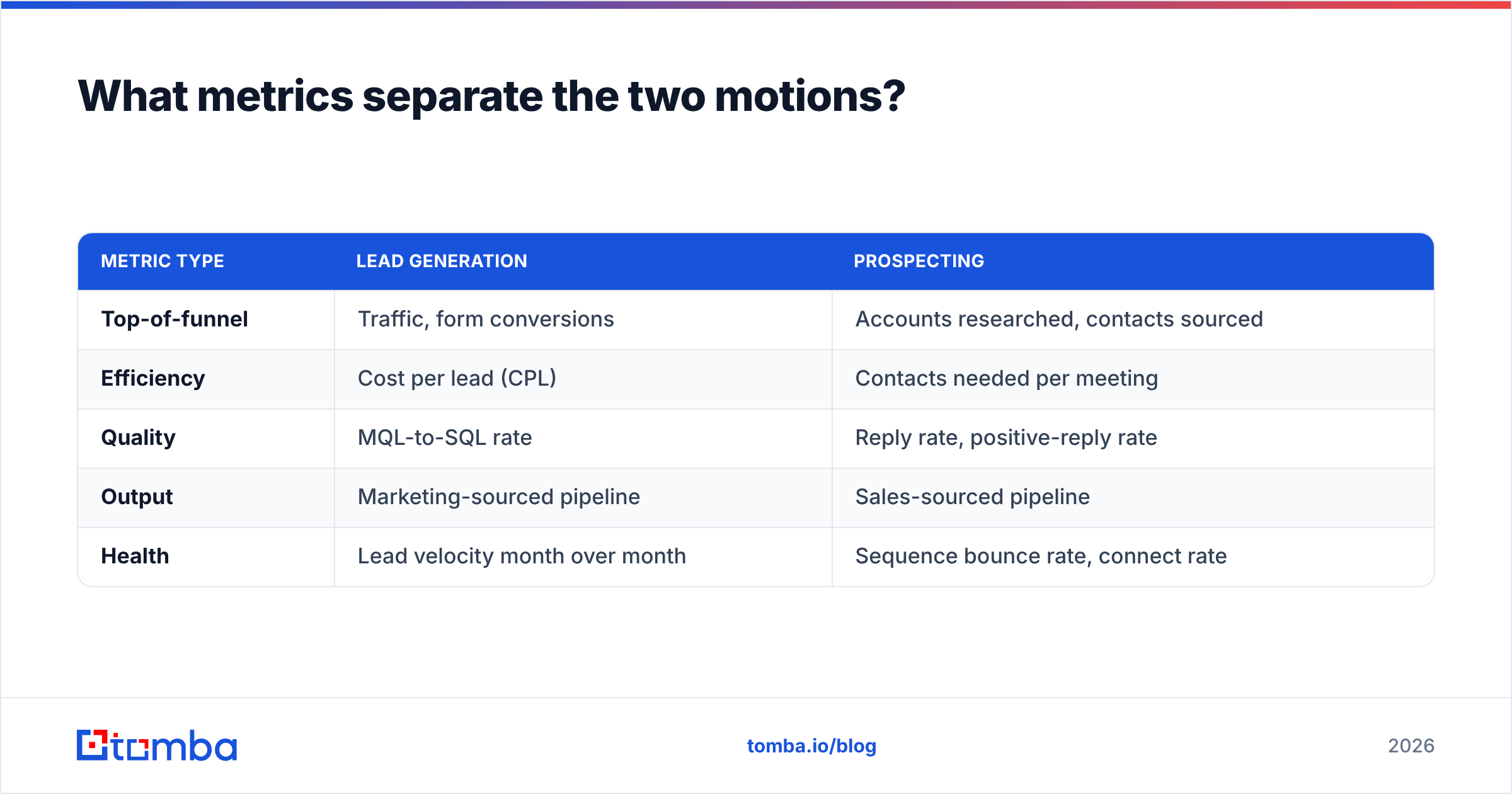
What metrics separate the two motions?#
Measuring prospecting with lead-gen metrics (or vice versa) is how teams end up optimizing the wrong thing. Keep the scoreboards distinct.
| Metric type | Lead Generation | Prospecting |
|---|---|---|
| Top-of-funnel | Traffic, form conversions | Accounts researched, contacts sourced |
| Efficiency | Cost per lead (CPL) | Contacts needed per meeting |
| Quality | MQL-to-SQL rate | Reply rate, positive-reply rate |
| Output | Marketing-sourced pipeline | Sales-sourced pipeline |
| Health | Lead velocity month over month | Sequence bounce rate, connect rate |
Notice the bounce-rate line under prospecting. Outbound is the motion most exposed to bad data, because you sourced the emails yourself rather than having contacts type them in. A 20% bounce rate doesn't just waste sends — it drags your domain reputation down and lowers deliverability for the good addresses too. That is a data-quality problem, not a copywriting one, and no subject-line tweak fixes it.
What tools do you need for each?#
Lead generation and prospecting share a CRM but otherwise use different toolkits. Roughly:
- Lead generation stack — CMS and SEO tooling, ad platforms, landing-page builders, form and pop-up tools, marketing automation for nurture, and analytics for attribution.
- Prospecting stack — an ICP-based list builder, an email finder for contact discovery, an email verifier to protect deliverability, a dialer or LinkedIn tool, and a sequencer to run cadences.
The one component both motions absolutely require is trustworthy contact data. Lead gen needs it to enrich thin form fills; prospecting needs it to build lists from scratch. For teams running outbound at any real volume, a bulk email finder turns a list of companies and names into verified, ready-to-sequence contacts without manual lookup — which is the difference between an SDR spending their day selling versus their day guessing addresses. You can compare plan tiers on the Tomba pricing page to match volume to budget.
Common mistakes when blending the two#
Even teams that understand the difference between prospecting and lead generation trip over the execution. Watch for these:
- Treating every inbound lead as sales-ready. Most aren't. Score first, then prospect the ones that fit.
- Cold-emailing your newsletter list. Subscribers opted into content, not a sales pitch. Blurring this tanks unsubscribe rates and trust.
- Skipping verification on inbound data. People typo their own emails and use throwaway addresses. Verify inbound just like you verify outbound.
- Measuring outbound with CPL. Prospecting cost-per-meeting behaves nothing like marketing's cost-per-lead. Different math, different targets.
- No recycling loop. Prospects who say "not now" should return to nurture, not the trash. Half your future pipeline is in the "not yet" pile.
Fix the handoffs and the two motions compound. Ignore them and you pay twice for the same pipeline.
Frequently asked questions#
Is lead generation part of prospecting, or the other way around? Neither fully contains the other. Lead generation is a marketing motion that creates inbound leads; prospecting is a sales motion that pursues chosen accounts. They overlap when a rep applies prospecting-style qualification to an inbound lead, but they start from opposite directions.
Can one person do both? In small teams, yes — a founder or full-cycle rep often runs content and cold outreach. As you scale, they split: marketing owns lead generation, SDRs own prospecting. The data layer stays shared.
Which delivers pipeline faster? Prospecting, usually. You can build a list and start outreach today, whereas lead generation compounds over months. Lead gen wins on long-term efficiency and cost per lead once it's warmed up.
Does prospecting still work in 2026? Yes, when it's precise. Spray-and-pray outbound is dead, but targeted prospecting to a well-defined ICP with verified contact data and a real trigger still books meetings — because you're reaching a real person with a relevant reason to talk.
Where Tomba fits#
Both motions break at the same point: bad contact data. Inbound leads arrive with typos and personal addresses; outbound lists start empty. The Tomba Email Finder closes that gap — turn a name and domain into a verified professional email, enrich thin inbound records, and build clean outbound lists that don't bounce. Start on the free tier (25 searches a month), and scale into Starter at $49/month once your prospecting motion proves out. Whichever side of the funnel you're working, get the data right first — everything downstream depends on it.
Related guides#
Ready to find emails that actually work?
Join 150,000+ professionals who stopped guessing and started sending. Free credits on signup — no credit card required.
Get the Tomba newsletter
Practical outbound tactics and product updates — once every two weeks.
About the author