Difference Between Sales and Marketing: A 2026 Guide
Sales and marketing are not the same job — one builds demand, the other closes it. Here's how the two teams differ, where they overlap, and how to run them as a single revenue engine in 2026.
Ask ten founders to explain the difference between sales and marketing, and you will get ten answers that all sound right and mostly contradict each other. That fuzziness is expensive. When the two functions blur, leads fall through cracks, budgets get spent twice, and nobody can say which dollar produced which deal.
This guide draws a clean line between the two, shows exactly where they overlap, and explains how to wire them into one revenue engine instead of two departments that email each other in frustration.
TL;DR#
- Marketing creates and captures demand at scale; sales converts that demand into signed revenue one relationship at a time. That is the core difference between sales and marketing.
- Marketing is one-to-many and measured over weeks or quarters. Sales is one-to-one and measured deal by deal.
- They share the same pipeline. The friction almost always lives at the handoff — when a lead becomes "ready" and who owns it next.
- Alignment is not a personality problem. It is a definitions-and-data problem: shared lead criteria, shared metrics, shared CRM.
- The best-run teams treat the funnel as one continuous system, not a relay race with a dropped baton in the middle.
What is the difference between sales and marketing?#
The short version: marketing brings people to the door, and sales walks them through it.
Marketing owns the top and middle of the funnel. Its job is to make the right buyers aware you exist, build trust before a conversation ever happens, and hand over prospects who already understand the problem you solve. Think of marketing as the restaurant's sign, menu, and aroma drifting down the street — it gets the right people hungry and pointed at the door.
Sales owns the bottom of the funnel. Its job is to take an interested human, understand their specific situation, handle objections, negotiate, and get a signature. Sales is the waiter who reads the table, recommends the dish, and closes the check.
Both are trying to grow revenue. The difference between sales and marketing is how and at what scale they do it. Marketing works one-to-many with content, ads, and campaigns. Sales works one-to-one with calls, demos, and tailored follow-up. Confuse the two and you will ask a campaign to close a deal or ask a rep to build a brand — both fail.
What does marketing actually do?#
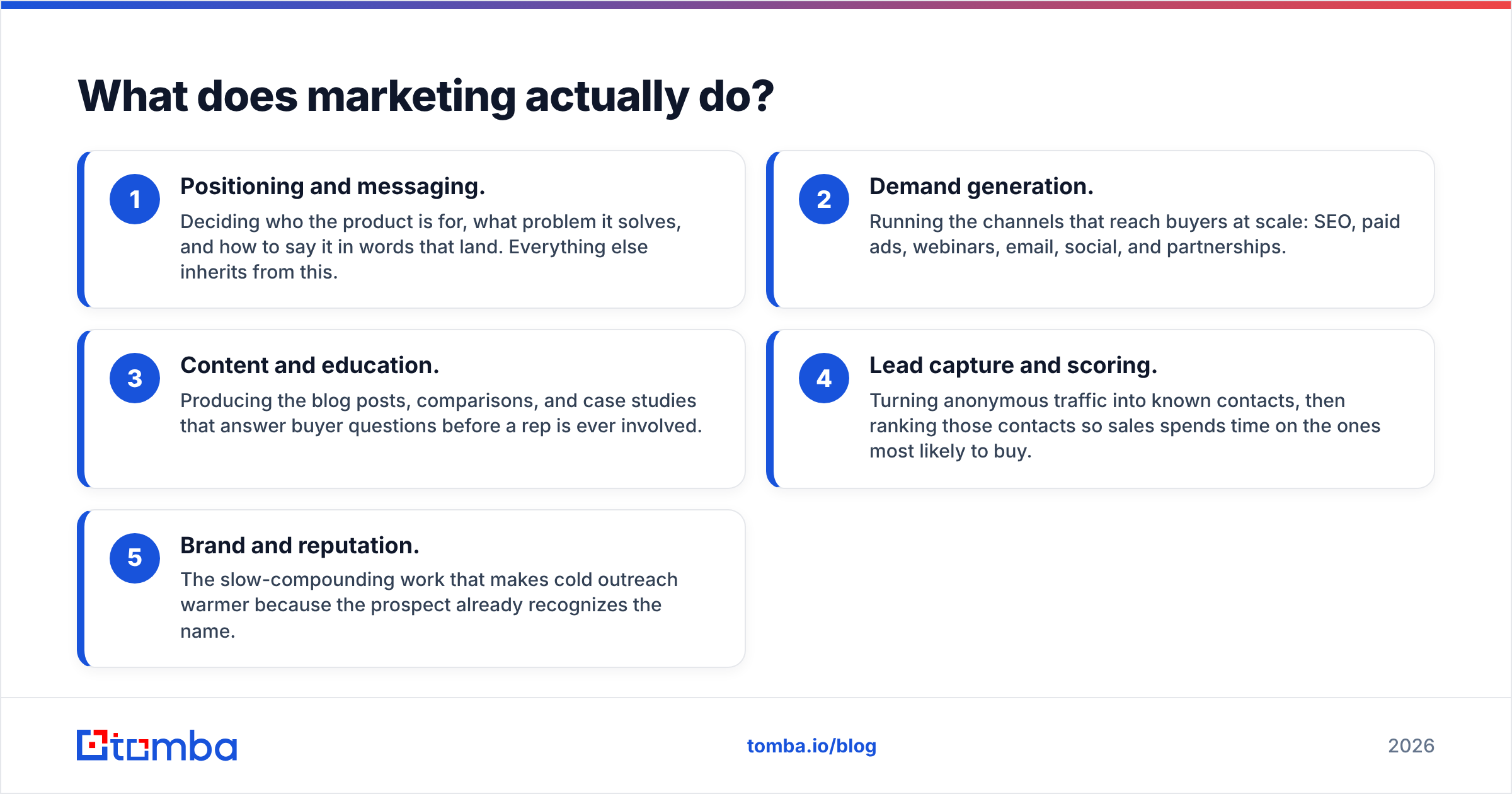
Marketing's mandate is demand — creating it where it doesn't exist and capturing it where it does. In practice that breaks into a few concrete jobs:
- Positioning and messaging. Deciding who the product is for, what problem it solves, and how to say it in words that land. Everything else inherits from this.
- Demand generation. Running the channels that reach buyers at scale: SEO, paid ads, webinars, email, social, and partnerships.
- Content and education. Producing the blog posts, comparisons, and case studies that answer buyer questions before a rep is ever involved.
- Lead capture and scoring. Turning anonymous traffic into known contacts, then ranking those contacts so sales spends time on the ones most likely to buy.
- Brand and reputation. The slow-compounding work that makes cold outreach warmer because the prospect already recognizes the name.
A well-run marketing engine is judged on volume and quality: enough qualified pipeline, at an acceptable cost, that sales can actually close. A useful benchmark for "qualified" is the marketing qualified lead — a contact whose behavior says they are worth a rep's time, not just a name on a list.
What does sales actually do?#
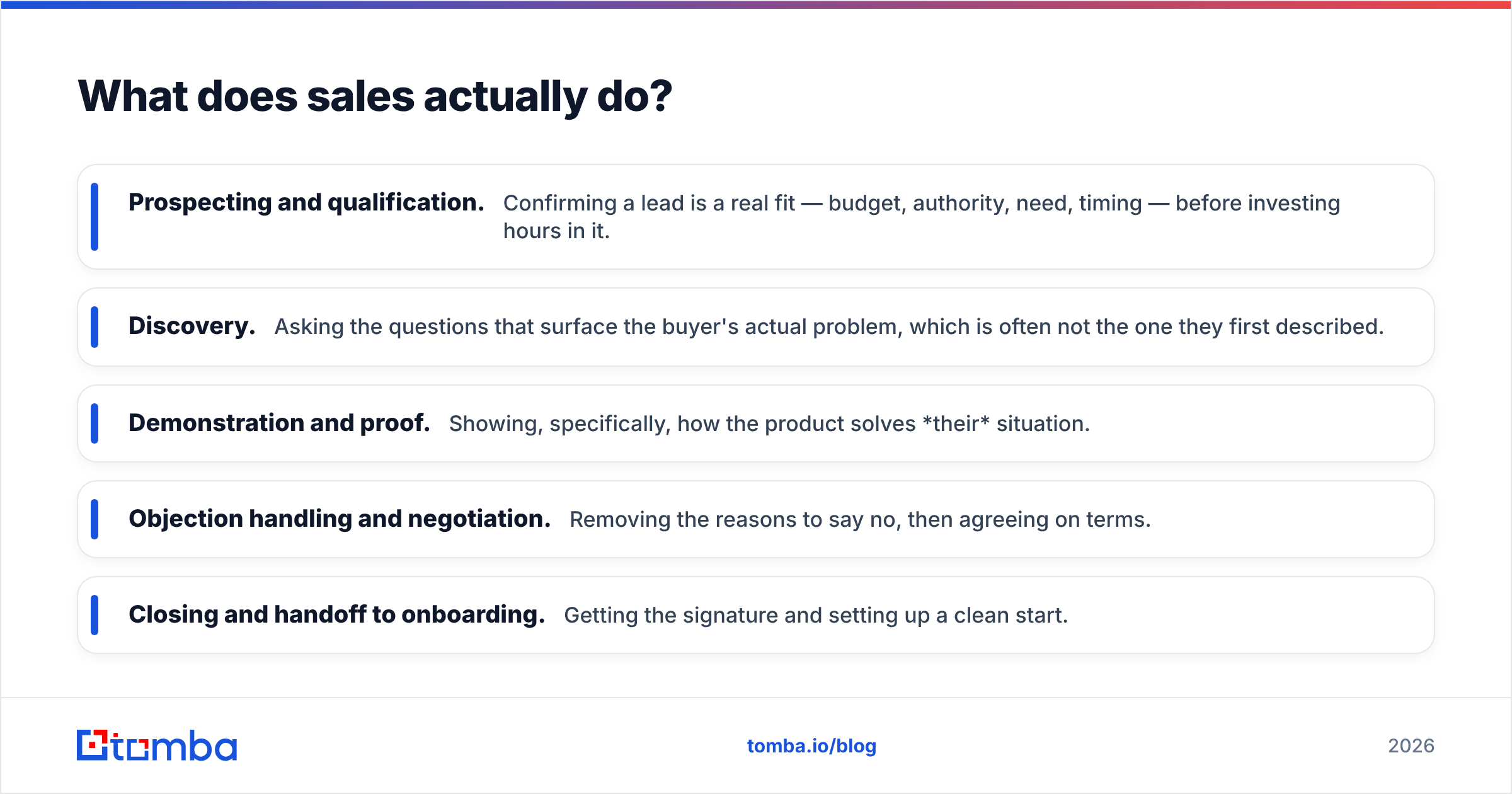
Sales turns interest into revenue. Where marketing is measured in reach and pipeline, sales is measured in closed deals and dollars. The core jobs:
- Prospecting and qualification. Confirming a lead is a real fit — budget, authority, need, timing — before investing hours in it.
- Discovery. Asking the questions that surface the buyer's actual problem, which is often not the one they first described.
- Demonstration and proof. Showing, specifically, how the product solves their situation.
- Objection handling and negotiation. Removing the reasons to say no, then agreeing on terms.
- Closing and handoff to onboarding. Getting the signature and setting up a clean start.
Good sales teams also feed the top of the funnel by doing their own sales prospecting — building targeted lists, finding the right contact, and reaching out directly rather than waiting for marketing to deliver every lead. That overlap is exactly where the two functions start to blend.
Sales vs marketing: a side-by-side comparison#
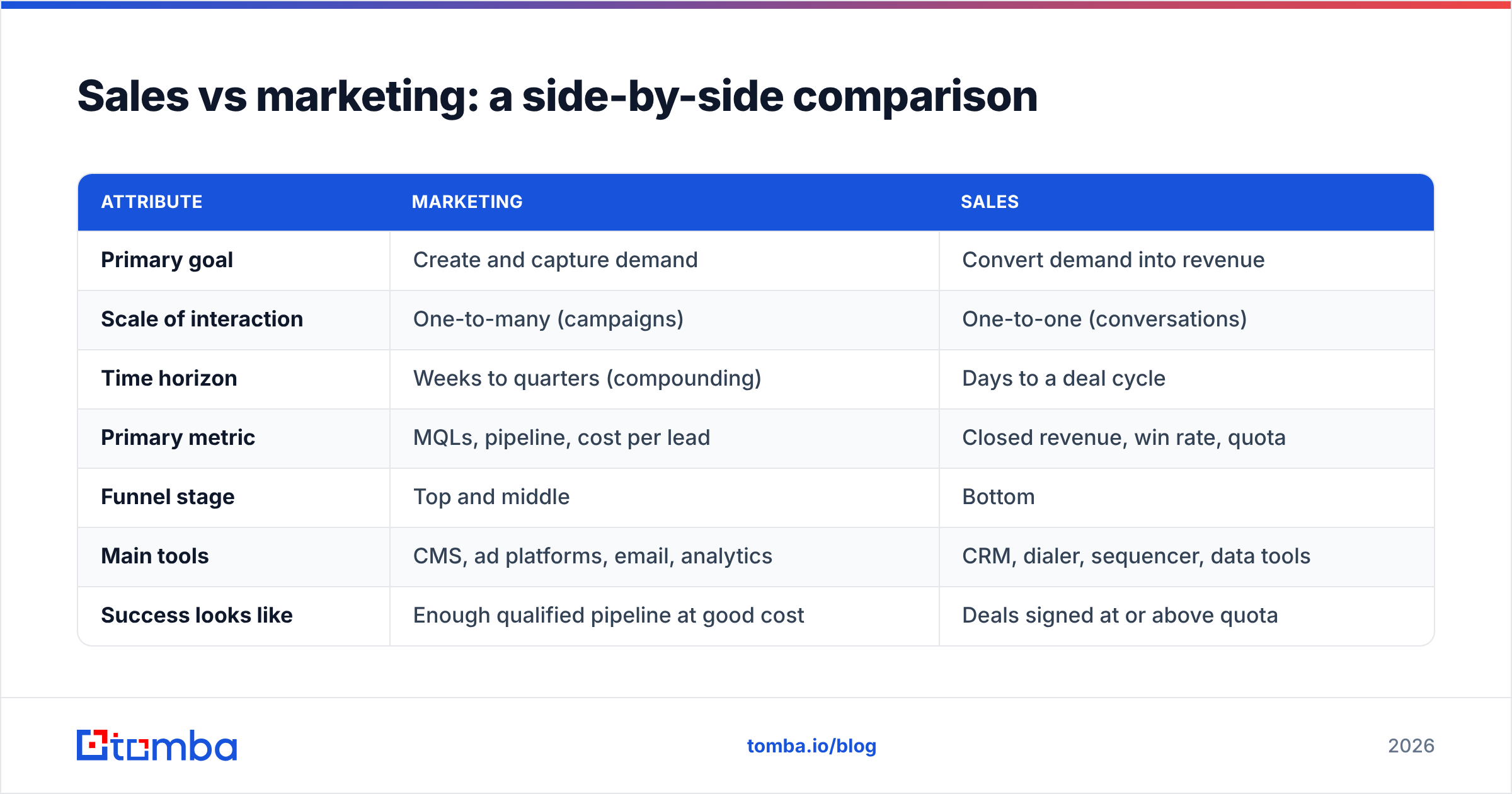
The fastest way to internalize the difference between sales and marketing is to line them up attribute by attribute.
| Attribute | Marketing | Sales |
|---|---|---|
| Primary goal | Create and capture demand | Convert demand into revenue |
| Scale of interaction | One-to-many (campaigns) | One-to-one (conversations) |
| Time horizon | Weeks to quarters (compounding) | Days to a deal cycle |
| Primary metric | MQLs, pipeline, cost per lead | Closed revenue, win rate, quota |
| Funnel stage | Top and middle | Bottom |
| Main tools | CMS, ad platforms, email, analytics | CRM, dialer, sequencer, data tools |
| Success looks like | Enough qualified pipeline at good cost | Deals signed at or above quota |
| Fails when asked to | Close individual deals | Build a brand from scratch |
Read the table as two halves of one motion, not two rival teams. Marketing's "success" line — qualified pipeline at a good cost — is literally the raw material for sales' "success" line. When one column wins at the other's expense, revenue loses.
Where do sales and marketing overlap?#
The clean line above gets blurry on purpose in three places, and that is healthy.
Lead scoring and qualification. Marketing decides what makes a lead "qualified," but sales lives with the consequences. If the two disagree on the definition, marketing celebrates volume while sales complains about junk. The fix is a shared, written definition both teams sign off on.
Account-based motions. In account-based marketing and modern GTM, marketing and sales target the same named accounts together — marketing warms the buying committee with ads and content while sales works individual stakeholders. There is no clean handoff here; it is genuinely joint work.
Outbound and enrichment. Cold outbound needs marketing-quality data and sales-quality personalization. Both teams pull from the same contact records, so both care about accuracy. Bad data wastes an ad impression and a rep's morning. This is why shared data enrichment — keeping contact records complete, current, and deduplicated — sits squarely in the overlap.

Why does sales and marketing alignment matter?#
Because misalignment is one of the most expensive, least visible leaks in a B2B business.
When the two teams operate on different definitions and disconnected tools, you get the classic symptoms: marketing reports thousands of "leads" that sales quietly ignores, sales invents its own outreach because inbound feels weak, and finance can't attribute revenue to either. Industry research has consistently tied tight alignment to materially higher win rates and revenue growth — HubSpot and Gartner both publish ongoing work on how "smarketing" and a unified revenue view reduce this friction. You don't need the exact percentage to feel the point: two teams rowing in sync beat two teams rowing against each other.
The organizational answer that has emerged is revenue operations — a function that owns the shared process, data, and tooling across marketing, sales, and success so the whole funnel is measured as one system. RevOps exists precisely because the handoff between sales and marketing was too important to leave ungoverned.
How do you align sales and marketing in 2026?#
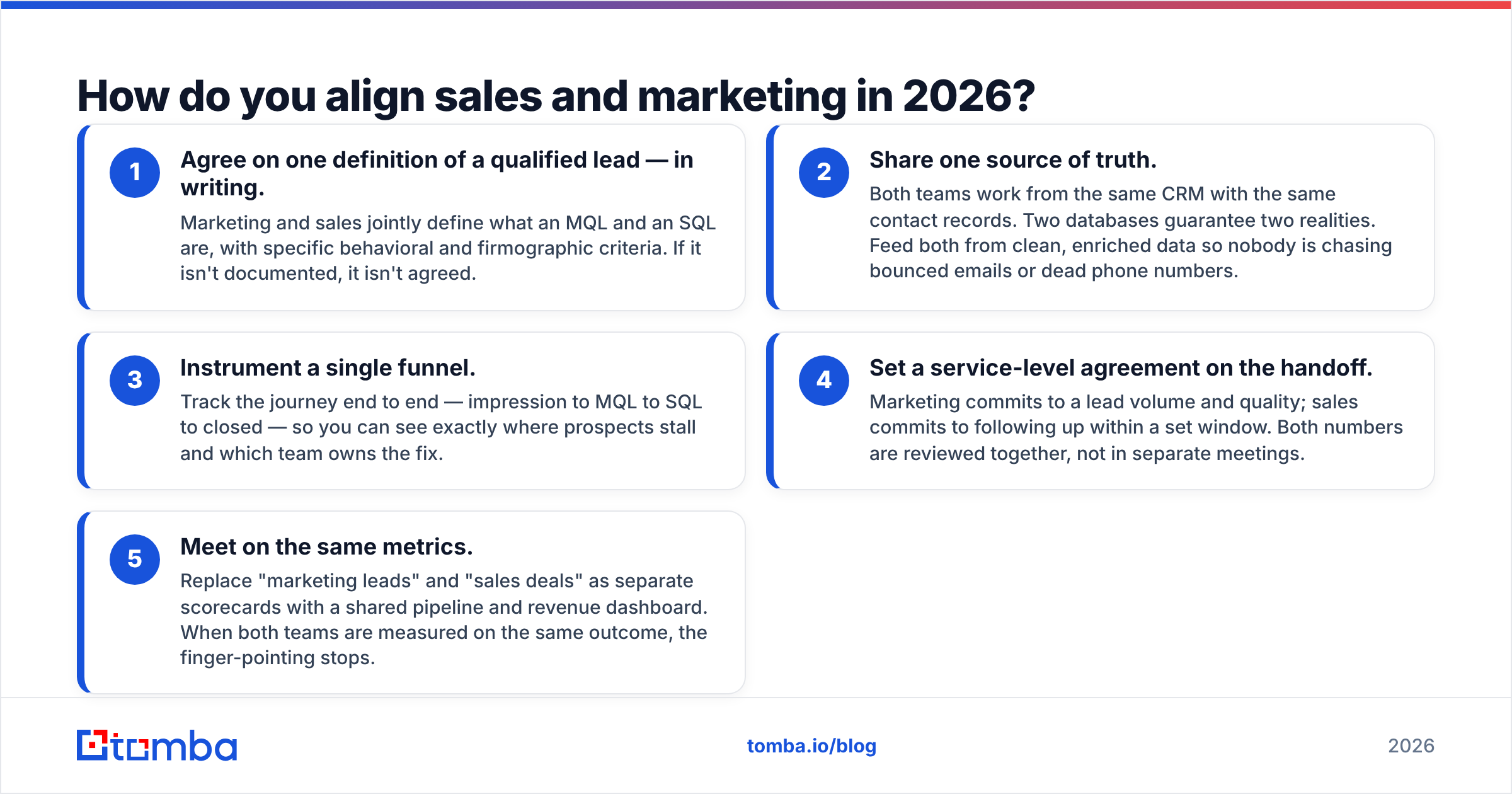
Alignment is built, not declared. Five concrete moves do most of the work:
- Agree on one definition of a qualified lead — in writing. Marketing and sales jointly define what an MQL and an SQL are, with specific behavioral and firmographic criteria. If it isn't documented, it isn't agreed.
- Share one source of truth. Both teams work from the same CRM with the same contact records. Two databases guarantee two realities. Feed both from clean, enriched data so nobody is chasing bounced emails or dead phone numbers.
- Instrument a single funnel. Track the journey end to end — impression to MQL to SQL to closed — so you can see exactly where prospects stall and which team owns the fix.
- Set a service-level agreement on the handoff. Marketing commits to a lead volume and quality; sales commits to following up within a set window. Both numbers are reviewed together, not in separate meetings.
- Meet on the same metrics. Replace "marketing leads" and "sales deals" as separate scorecards with a shared pipeline and revenue dashboard. When both teams are measured on the same outcome, the finger-pointing stops.
None of this requires reorganizing the company. It requires shared definitions, shared data, and a shared scoreboard — the three things misaligned teams are always missing.
Sales vs marketing: which one does your business need first?#
If you are early and nobody knows you exist, you have a demand problem — lead with marketing to build awareness and a repeatable source of interest. If you have inbound interest piling up and nobody is converting it, you have a conversion problem — invest in sales capacity and process. Most growing companies discover they need both, staggered: enough marketing to keep the pipeline full, enough sales to keep it moving.
The mistake is treating the choice as permanent. The ratio shifts as you grow, and the healthiest teams revisit it every quarter with the shared funnel data from the section above — not with whichever department argued loudest.
Frequently asked questions#
Is marketing part of sales, or is sales part of marketing? Neither. They are peer functions under one revenue goal. Marketing generates and qualifies demand; sales converts it. RevOps increasingly sits above both to keep them aligned.
Can one person do both in a small company? Yes, and most founders do at first. But be honest about the mode switch: writing a campaign (one-to-many) and running a discovery call (one-to-one) are different skills, and doing both means neither gets your full attention. Systematize the marketing side early so selling doesn't eat it.
What's the single biggest cause of sales-marketing friction? Disagreement over lead quality, rooted in an undocumented definition of "qualified." Fix the definition and most of the friction dissolves.
Put clean data under both teams#
Whatever your split between sales and marketing, both run on the same fuel: accurate contact data. A campaign to a dead inbox and a rep dialing a stale number are the same waste twice. That is the one place tightening up pays off for both columns of the table above at once.
Start there. Use the Tomba Email Finder to build verified, up-to-date contact lists your marketing campaigns and your sales reps can both trust — find the right person by name or domain, confirm the address is deliverable, and hand sales a list that doesn't bounce. Check the Tomba pricing plans, including a free tier to test it on your next campaign, and give both teams one clean source of truth to work from. When the data is shared and accurate, the handoff between sales and marketing stops being a leak and starts being a relay that actually completes.
Related guides#
Ready to find emails that actually work?
Join 150,000+ professionals who stopped guessing and started sending. Free credits on signup — no credit card required.
Get the Tomba newsletter
Practical outbound tactics and product updates — once every two weeks.
About the author