The Real Difference Between Upsell and Cross Sell (2026)
Upsell and cross-sell both grow revenue from existing customers, but they work in opposite ways. Here's the real difference, when to use each, and how to avoid killing the relationship.
Upsell and cross-sell get used interchangeably in sales meetings and pitch decks. But the difference between upsell and cross sell is real, and confusing them costs you revenue and, worse, customer trust. This guide draws a hard line between the two. It shows you when each one works and gives you a simple way to pick the right play.
TL;DR#
- Upsell = selling the customer a better, bigger, or more premium version of what they're already buying (upgrade the plan, add seats, move to enterprise).
- Cross-sell = selling the customer a different, complementary product alongside what they already have (add a phone-finder to an email plan, bundle a warranty with a laptop).
- The core test: if the offer replaces or upgrades the original purchase, it's an upsell. If it sits next to the original purchase, it's a cross-sell.
- Both work best when timed to a moment of realized value — not bolted onto the first invoice.
- The single biggest lever for both is clean customer data: knowing what someone already owns, how they use it, and what logically comes next.
What Is the Difference Between Upsell and Cross Sell?#
The difference between upsell and cross sell comes down to one word: direction.
An upsell moves the customer up the same product ladder. They wanted a mid-tier plan. You show them why the higher tier solves their problem more completely. Same category, more value, higher price.
A cross-sell moves the customer sideways into an adjacent product. They bought one thing. You offer a second thing that makes the first thing work better. Different category, complementary value, extra line item.
Think of it like a restaurant. Upselling is the server asking if you'd like the 12-ounce steak instead of the 8-ounce — same dish, bigger version. Cross-selling is the server asking if you'd like a glass of wine and a dessert with that steak — different items that round out the meal. One deepens the purchase you already made. The other broadens the basket.

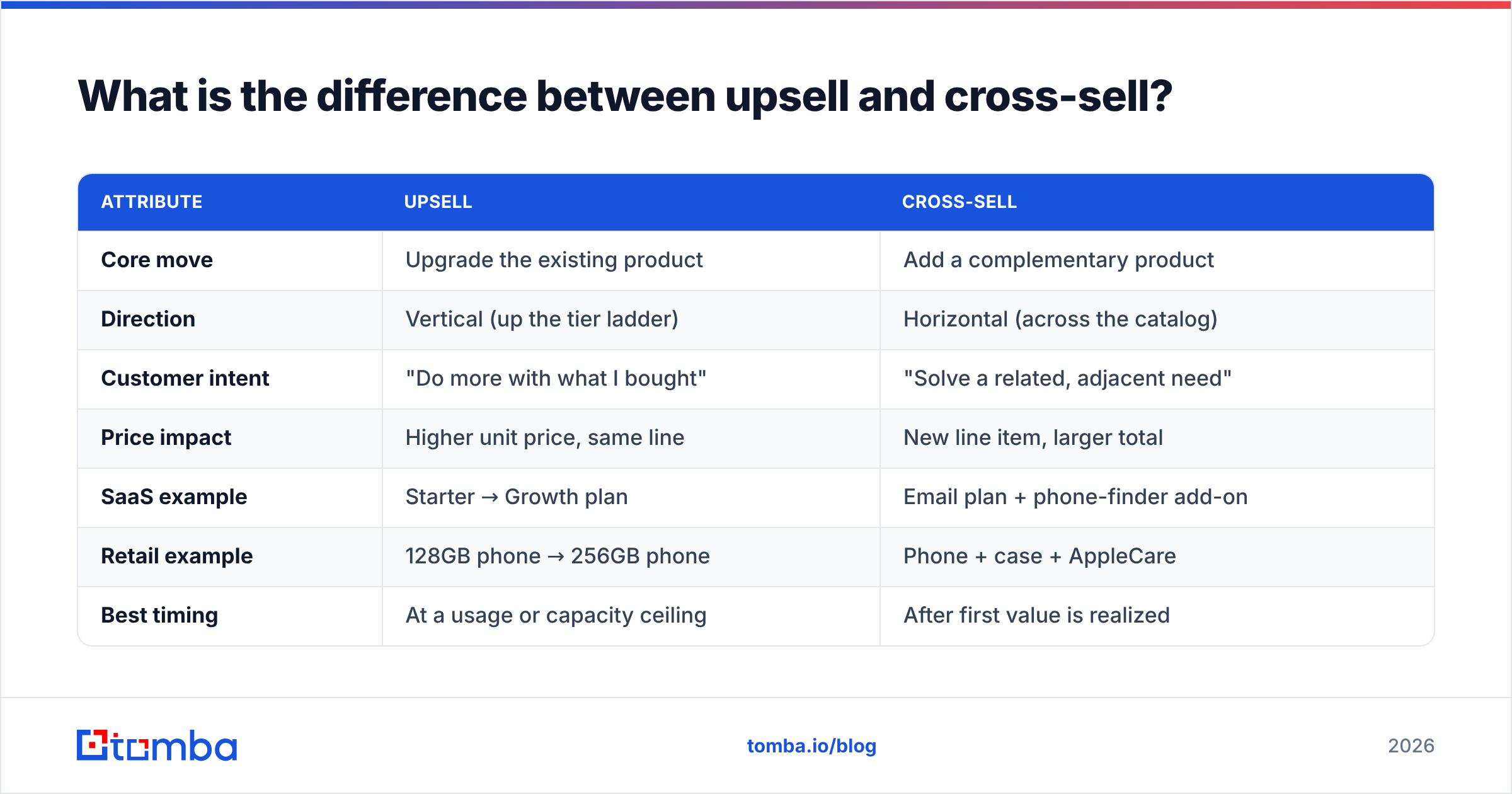
Here's the distinction in a table you can screenshot for your next enablement session:
| Attribute | Upsell | Cross-Sell |
|---|---|---|
| Core move | Upgrade the existing product | Add a complementary product |
| Direction | Vertical (up the tier ladder) | Horizontal (across the catalog) |
| Customer intent | "Do more with what I bought" | "Solve a related, adjacent need" |
| Price impact | Higher unit price, same line | New line item, larger total |
| SaaS example | Starter → Growth plan | Email plan + phone-finder add-on |
| Retail example | 128GB phone → 256GB phone | Phone + case + AppleCare |
| Best timing | At a usage or capacity ceiling | After first value is realized |
| Risk if mistimed | Feels like a paywall | Feels like clutter |
Upsell vs cross-sell: which drives more revenue?#
Short answer: upsell usually wins on margin per deal, cross-sell usually wins on account stickiness. You want both, but for different reasons.
Upselling tends to produce a larger single jump in contract value because you're moving someone to a tier you've already priced for expansion. According to HubSpot's sales research, expansion revenue from existing customers is consistently cheaper to win than net-new logos — the trust is already there.
Cross-selling, on the other hand, is how you make an account hard to leave. Every complementary product a customer adopts is another integration, another workflow, another reason not to churn. Gartner's work on customer growth repeatedly ties multi-product adoption to higher retention and lifetime value.
The mistake teams make is treating this as an either/or. In practice, the sequence matters:
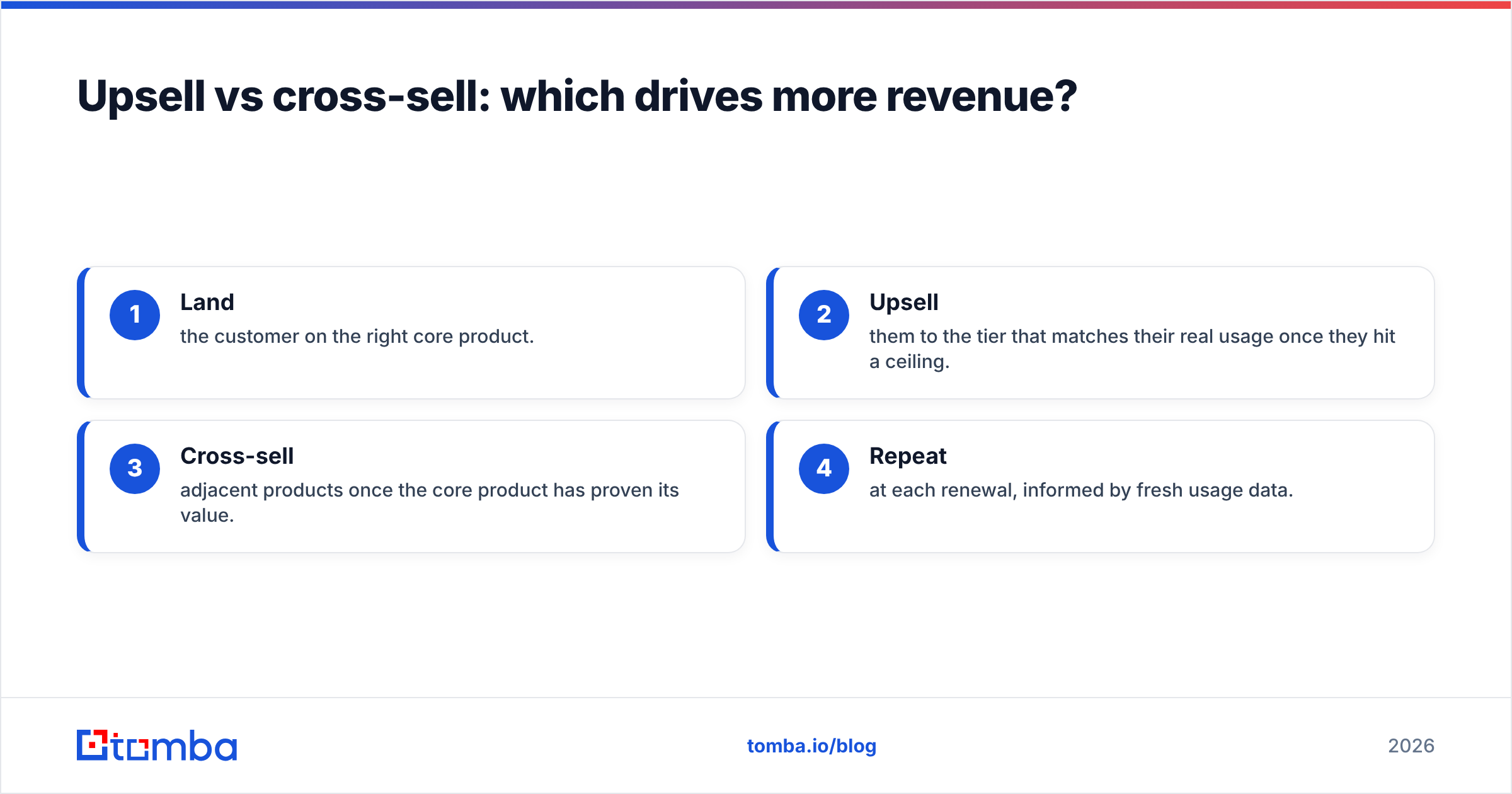
- Land the customer on the right core product.
- Upsell them to the tier that matches their real usage once they hit a ceiling.
- Cross-sell adjacent products once the core product has proven its value.
- Repeat at each renewal, informed by fresh usage data.
Run that loop with discipline and your net revenue retention takes care of itself. Your win rate on expansion deals climbs because you're offering the right thing at the right moment, not spraying the whole catalog at everyone.
When should you upsell vs cross-sell?#
Timing separates a helpful recommendation from an annoying one. The same offer can feel like great service or a cash grab depending on when it lands.
Upsell when:
- The customer hits a hard limit — seats maxed out, storage full, API calls throttled. The upgrade solves a pain they're already feeling.
- Usage signals outgrow the plan — they're using premium-adjacent features on a basic plan, or logging in daily on a light-touch tier.
- A renewal is approaching — a natural moment to right-size the contract to actual consumption.
- They ask for something the higher tier includes — the upsell writes itself.
Cross-sell when:
- The core product has delivered a visible win — the first purchase paid off, so a complementary one is an easy yes.
- You spot a gap in their workflow — they found emails but have no way to verify them, or no phone numbers to back up the outreach.
- The adjacent product removes friction — it plugs a hole they're currently solving with a clumsy workaround or a second vendor.
- Onboarding reveals an unmet need — kickoff calls surface adjacent problems you happen to solve.
The through-line: both plays should feel like the logical next step, not a surprise. That only happens when you actually know the customer's current state — which is a data problem before it's a sales problem.
Why does clean data decide whether upsell or cross-sell works?#
Because you cannot recommend the right next step to someone you don't understand. Every mistimed offer traces back to stale or missing data — the upsell to a customer who's already maxed out, the cross-sell of a product they bought three months ago.
Strong expansion motions run on three data layers:
- Ownership data — what does the account already have? Selling someone a product they already own is the fastest way to torch credibility.
- Usage data — how heavily are they using it, and where are they hitting walls? This is your upsell trigger.
- Firmographic and contact data — who are the other buyers and teams inside the account you haven't reached yet? This is your cross-sell expansion map.
That last layer is where a lot of expansion revenue quietly leaks. You landed one champion, but the adjacent department that needs your complementary product? You don't have their contacts, so you never make the offer. This is exactly where data enrichment earns its keep — filling in the missing decision-makers, verifying that the contacts in your CRM are still real, and turning a single-threaded account into a multi-threaded one you can expand across.
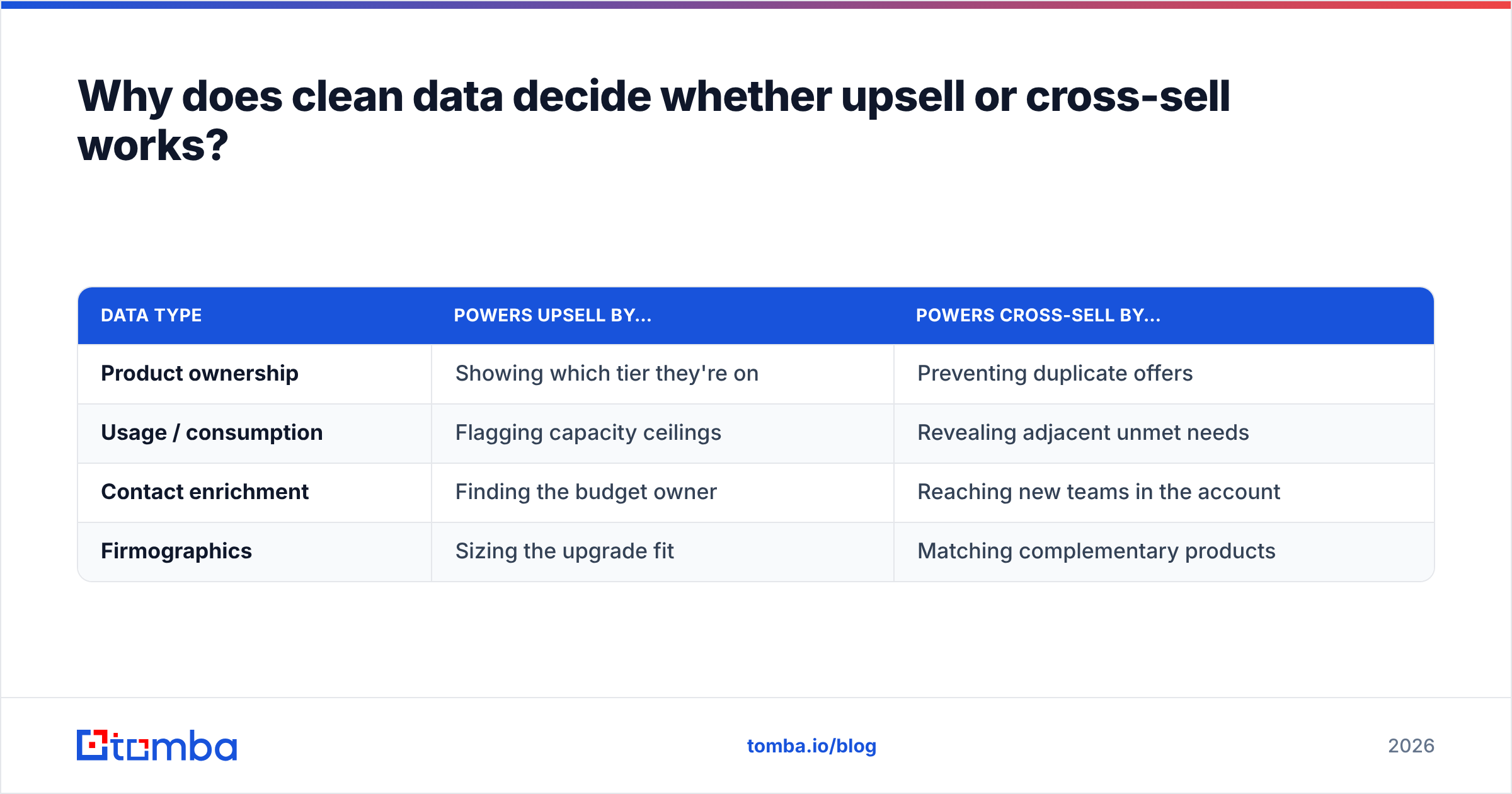
Here's how the data maps to each play:
| Data type | Powers upsell by… | Powers cross-sell by… |
|---|---|---|
| Product ownership | Showing which tier they're on | Preventing duplicate offers |
| Usage / consumption | Flagging capacity ceilings | Revealing adjacent unmet needs |
| Contact enrichment | Finding the budget owner | Reaching new teams in the account |
| Firmographics | Sizing the upgrade fit | Matching complementary products |
Feed a rep this context and expansion conversations get shorter and warmer. Skip it, and every offer is a guess — which customers feel, and resent.
What are common upsell and cross-sell mistakes?#
Even teams that understand the difference between upsell and cross sell still trip over execution. The usual suspects:
- Leading with the offer, not the value. Pitching a bigger plan before the current one has delivered results reads as greedy. Earn the expansion.
- Ignoring the timing signals. An upsell email that arrives the day someone downgraded is a data failure, not a sales failure.
- Over-bundling on the cross-sell. Offering five add-ons at once paralyzes the buyer. Recommend the one that fits, like Salesforce's guidance on relevant recommendations stresses.
- Selling to the wrong contact. The champion who bought the core product may not own budget for the add-on. Without enriched contact data, you pitch a dead end.
- Treating it as a one-time push. Expansion is a loop tied to renewals and usage milestones, not a quarterly campaign you blast and forget.
- Measuring the wrong thing. If you only track first-deal ACV, you'll under-invest in the cross-sell motions that quietly protect retention and lift lifetime value.
Avoiding these is less about clever scripting and more about knowing your customer's real state at the moment you make the ask — again, a data discipline.
How do you build a repeatable upsell and cross-sell motion?#
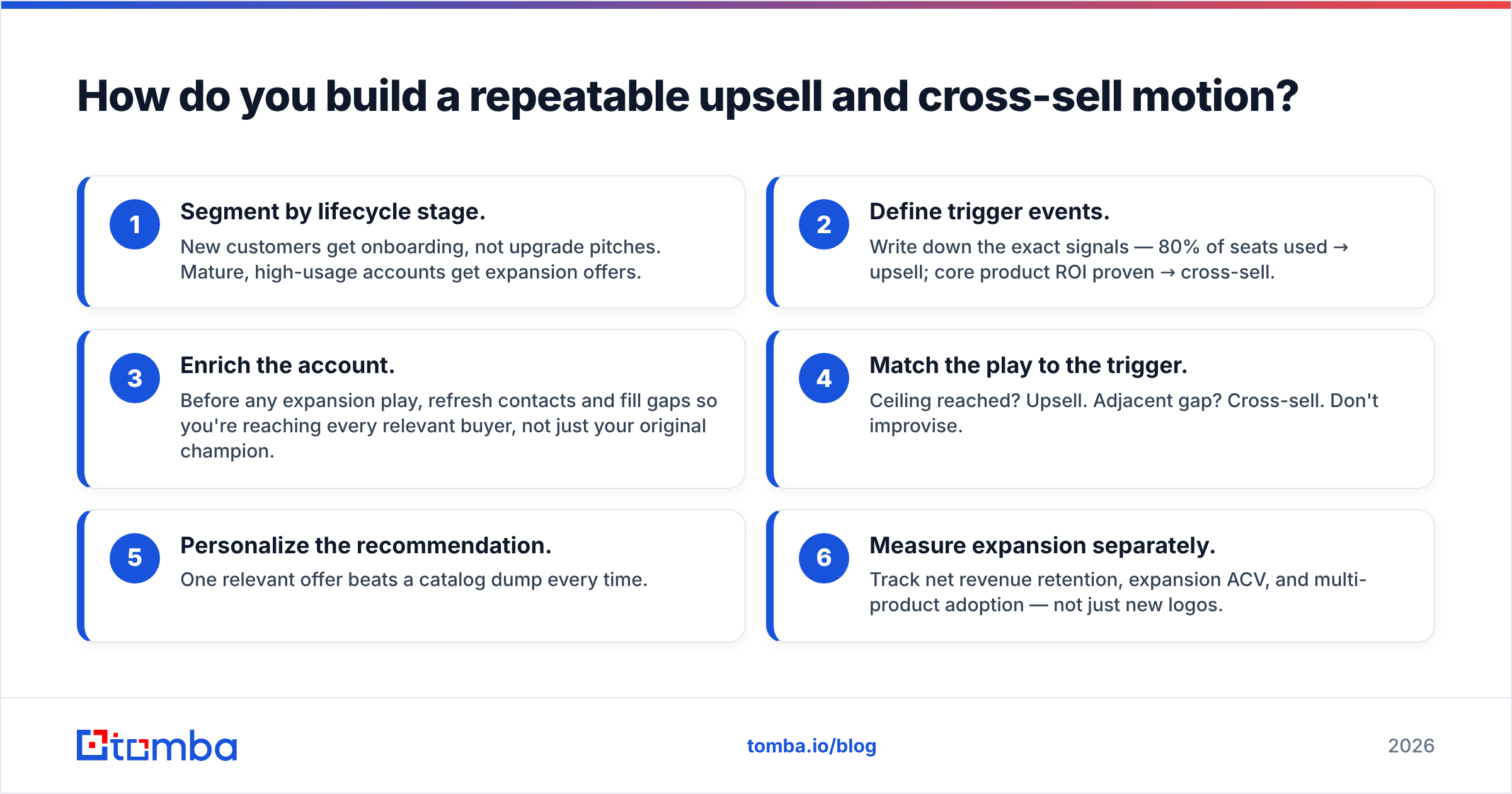
Turn the ad-hoc "hey, want to upgrade?" into a system:
- Segment by lifecycle stage. New customers get onboarding, not upgrade pitches. Mature, high-usage accounts get expansion offers.
- Define trigger events. Write down the exact signals — 80% of seats used → upsell; core product ROI proven → cross-sell.
- Enrich the account. Before any expansion play, refresh contacts and fill gaps so you're reaching every relevant buyer, not just your original champion.
- Match the play to the trigger. Ceiling reached? Upsell. Adjacent gap? Cross-sell. Don't improvise.
- Personalize the recommendation. One relevant offer beats a catalog dump every time.
- Measure expansion separately. Track net revenue retention, expansion ACV, and multi-product adoption — not just new logos.
Do this consistently and expansion stops being luck. It becomes a forecastable line in your revenue model, which is the whole point of a mature sales process built on data rather than vibes.
The bottom line#
Upsell moves a customer up to a better version of what they have. Cross-sell moves them sideways into a complementary product that makes the original purchase work harder. Upsell tends to win on margin. Cross-sell tends to win on retention. Both depend on timing, and timing depends on knowing your customer's real state — what they own, how they use it, and who else inside the account you haven't reached yet.
That last part is where most expansion revenue leaks, and it's a solvable data problem. If your CRM is full of stale contacts and single-threaded accounts, start there. Tomba's Email Finder helps you find and verify the additional decision-makers inside every account — the department heads, budget owners, and adjacent teams you need to reach before any upsell or cross-sell can land. Fill in the missing contacts, enrich what you already have, and turn one champion into a full account you can expand across. Start free with 25 searches a month and expand from there.
Related guides#
Ready to find emails that actually work?
Join 150,000+ professionals who stopped guessing and started sending. Free credits on signup — no credit card required.
Get the Tomba newsletter
Practical outbound tactics and product updates — once every two weeks.
About the author