Different Sales Styles in 2026: 6 Types and When to Use Each
Not every rep sells the same way — and that's a good thing. Here are the six different sales styles, their strengths, blind spots, and how to match the right style to the right deal.
Ask ten sales leaders to define "a great rep" and you get ten different answers. One swears by the smooth relationship builder who never loses a client. Another only hires aggressive closers. A third quietly points at the numbers and says the top performer barely talks — they just send the right thing at the right time.
They're all partly right. Selling isn't one skill; it's a set of styles, and the best teams field a mix. This guide breaks down the different sales styles, where each one wins, where each one quietly loses deals, and how to build a process that gets the most out of whichever style your reps naturally lean toward.
TL;DR#
- There are roughly six recognizable sales styles: the Challenger, the Relationship Builder, the Hard Worker, the Lone Wolf, the Reactive Problem Solver, and the Consultative/Analytical seller.
- No single style wins every deal — fit depends on deal complexity, buyer type, and sales cycle length.
- Research popularized by The Challenger Sale found Challengers over-index among top performers in complex B2B, while pure Relationship Builders under-perform there.
- Style is only half the equation. Bad data sinks even the best style — a brilliant Challenger pitch sent to a wrong or unverified contact still bounces.
- The practical move: hire for a mix of styles, coach the blind spots, and standardize the boring inputs (accurate contact data, verified emails, clean CRM) so style is the variable, not chaos.
What are the different sales styles?#
A "sales style" is the default posture a rep takes toward a buyer — how they build trust, control the conversation, and drive to a decision. It's part personality, part training, part habit. Most reps have one dominant style and a secondary one they switch into under pressure.
The most widely cited framework comes from CEB's (now Gartner) research behind The Challenger Sale, which sorted thousands of B2B reps into five profiles. Add the classic Consultative/Analytical seller that solution-selling programs produce, and you get the six styles most teams recognize in the wild.
Here's the core-concept breakdown:
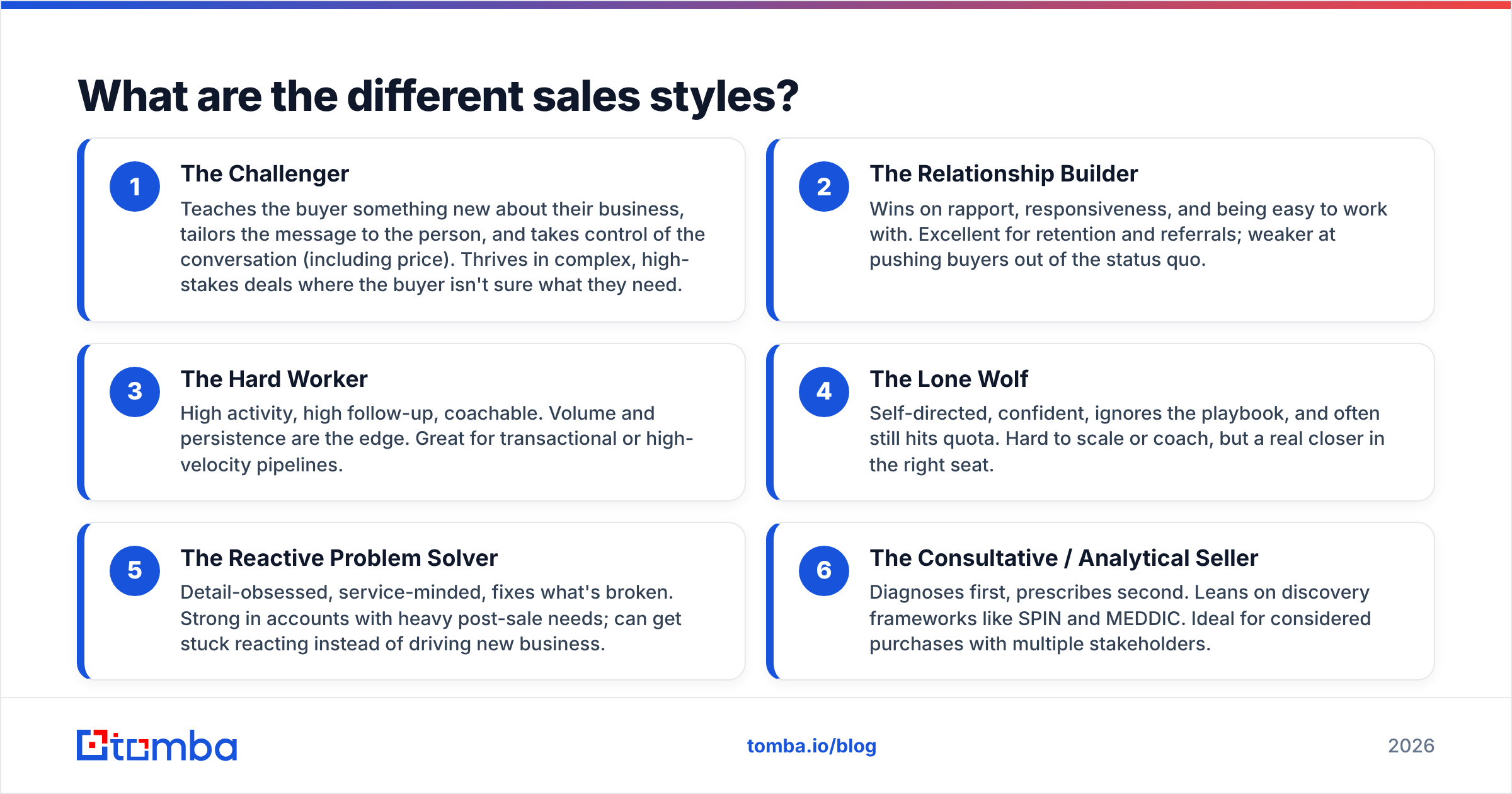
- The Challenger — Teaches the buyer something new about their business, tailors the message to the person, and takes control of the conversation (including price). Thrives in complex, high-stakes deals where the buyer isn't sure what they need.
- The Relationship Builder — Wins on rapport, responsiveness, and being easy to work with. Excellent for retention and referrals; weaker at pushing buyers out of the status quo.
- The Hard Worker — High activity, high follow-up, coachable. Volume and persistence are the edge. Great for transactional or high-velocity pipelines.
- The Lone Wolf — Self-directed, confident, ignores the playbook, and often still hits quota. Hard to scale or coach, but a real closer in the right seat.
- The Reactive Problem Solver — Detail-obsessed, service-minded, fixes what's broken. Strong in accounts with heavy post-sale needs; can get stuck reacting instead of driving new business.
- The Consultative / Analytical Seller — Diagnoses first, prescribes second. Leans on discovery frameworks like SPIN and MEDDIC. Ideal for considered purchases with multiple stakeholders.

How do the sales styles compare?#
Style differences aren't just personality trivia — they change which deals a rep should own, how you comp them, and how you coach them. Here's a side-by-side.
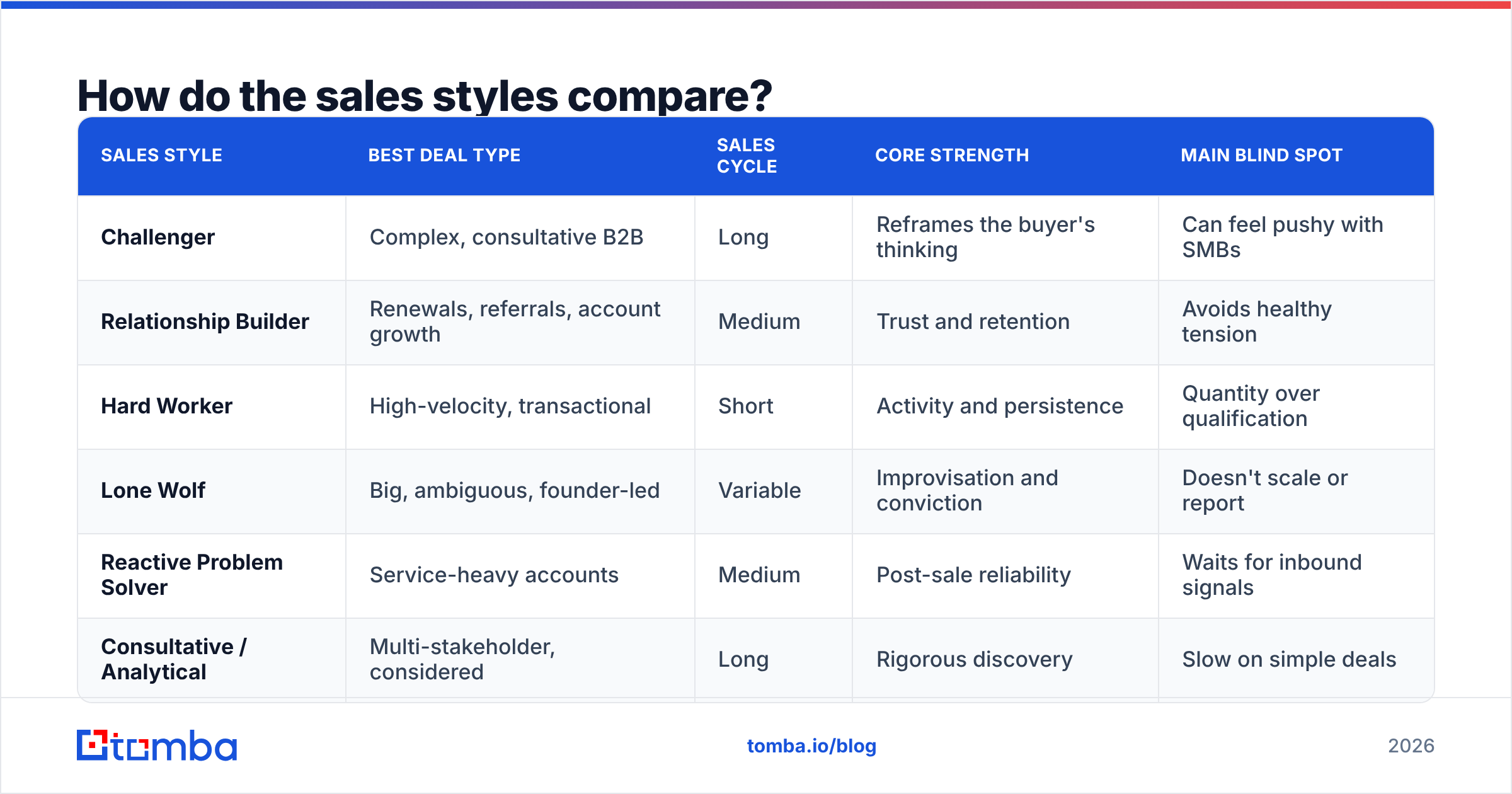
| Sales style | Best deal type | Sales cycle | Core strength | Main blind spot |
|---|---|---|---|---|
| Challenger | Complex, consultative B2B | Long | Reframes the buyer's thinking | Can feel pushy with SMBs |
| Relationship Builder | Renewals, referrals, account growth | Medium | Trust and retention | Avoids healthy tension |
| Hard Worker | High-velocity, transactional | Short | Activity and persistence | Quantity over qualification |
| Lone Wolf | Big, ambiguous, founder-led | Variable | Improvisation and conviction | Doesn't scale or report |
| Reactive Problem Solver | Service-heavy accounts | Medium | Post-sale reliability | Waits for inbound signals |
| Consultative / Analytical | Multi-stakeholder, considered | Long | Rigorous discovery | Slow on simple deals |
The takeaway from the underlying research is uncomfortable for a lot of managers: in complex sales, the Relationship Builder — the profile many teams hire for by default — was the lowest performing group, while Challengers were the highest. In transactional sales, the gap narrows and the Hard Worker and Lone Wolf hold their own. So "which style is best?" is the wrong question. The right question is "best for what?"
Which sales style closes the most deals?#
Short answer: the Challenger, in complex B2B — but only when the fundamentals are clean.
The Challenger's edge is teaching. Instead of asking "what keeps you up at night?" and mirroring the answer, a Challenger walks in with a point of view: "Here's a problem you probably don't realize is costing you, and here's why the usual fix makes it worse." That reframe creates urgency the buyer didn't have. In a world where buyers are 60–70% through their decision before they talk to sales — a figure HubSpot and others have repeatedly documented — being the rep who changes how the buyer thinks is worth more than being the rep they like most.
But style is a multiplier, not a foundation. A Challenger's tailored insight is only as good as the person receiving it. If your data says the VP of Operations is the economic buyer and it's actually the CFO, the whole reframe lands on the wrong desk. This is where a lot of "style" debates miss the point — the input quality decides whether style even gets a chance. Reaching the right contact with a verified address is the unglamorous prerequisite to every clever framework, which is exactly why teams pair a strong methodology with a reliable email finder instead of guessing at addresses.

Should you hire one style or a mix?#
Hire a mix, then deploy by deal type.
The instinct to clone your best rep is understandable and usually wrong. A team of six Lone Wolves will hit a great quarter and then implode when none of them update the CRM or mentor the new hire. A team of six Relationship Builders will have the happiest customers and the flattest new-logo growth. Diversity of style is a portfolio: it hedges against the blind spot that any single style carries.
A practical way to structure it:
- Inbound / high-velocity queue → Hard Workers and Relationship Builders. Speed and rapport convert warm interest.
- Complex outbound / enterprise → Challengers and Consultative sellers. Reframing and rigorous discovery win multi-stakeholder deals.
- Strategic / ambiguous whales → a Lone Wolf paired with an analytical sidekick who documents everything.
- Post-sale expansion → Reactive Problem Solvers and Relationship Builders who keep accounts healthy.
The connective tissue across all of them is shared, trustworthy inputs. When every rep — regardless of style — works from the same clean account list, the same verified contacts, and the same enriched firmographics, you can actually tell whether a miss was a style problem or a data problem. Standardizing that layer with tools like data enrichment and a consistent email verifier step turns "style" into a controlled variable instead of an excuse.
How do you coach each sales style?#
Coaching works when you amplify the strength and patch the specific blind spot — not when you try to turn one style into another.
- Challenger → Keep the insight, dial the tension. Pair them with call reviews so the "teaching" doesn't tip into lecturing. Give them the freshest market data so their reframes stay sharp.
- Relationship Builder → Teach them one controlled moment of tension per deal: the willingness to say "I don't think you should buy yet, and here's why." Rapport plus a spine is a top performer.
- Hard Worker → Redirect volume toward qualified volume. More activity into the wrong accounts just scales waste; more activity into well-targeted, verified contacts scales revenue.
- Lone Wolf → Don't cage them, instrument them. Require the minimum reporting that lets the team learn from their wins, and give them tools that log activity automatically.
- Reactive Problem Solver → Add a proactive motion. Block time for outbound so they're not purely inbound-driven, and hand them a pre-built target list so starting is frictionless.
- Consultative / Analytical → Speed them up on simple deals with templates and qualification shortcuts so their rigor doesn't stall low-complexity wins.
Notice the recurring theme: every coaching note gets easier when reps aren't spending 30% of their week hunting for contact details or scrubbing bad lists. That's process, not personality. Feeding the whole team accurate contacts through a bulk email finder or a fast domain search removes the busywork that flattens every style's numbers equally.
Which sales methodologies match which styles?#
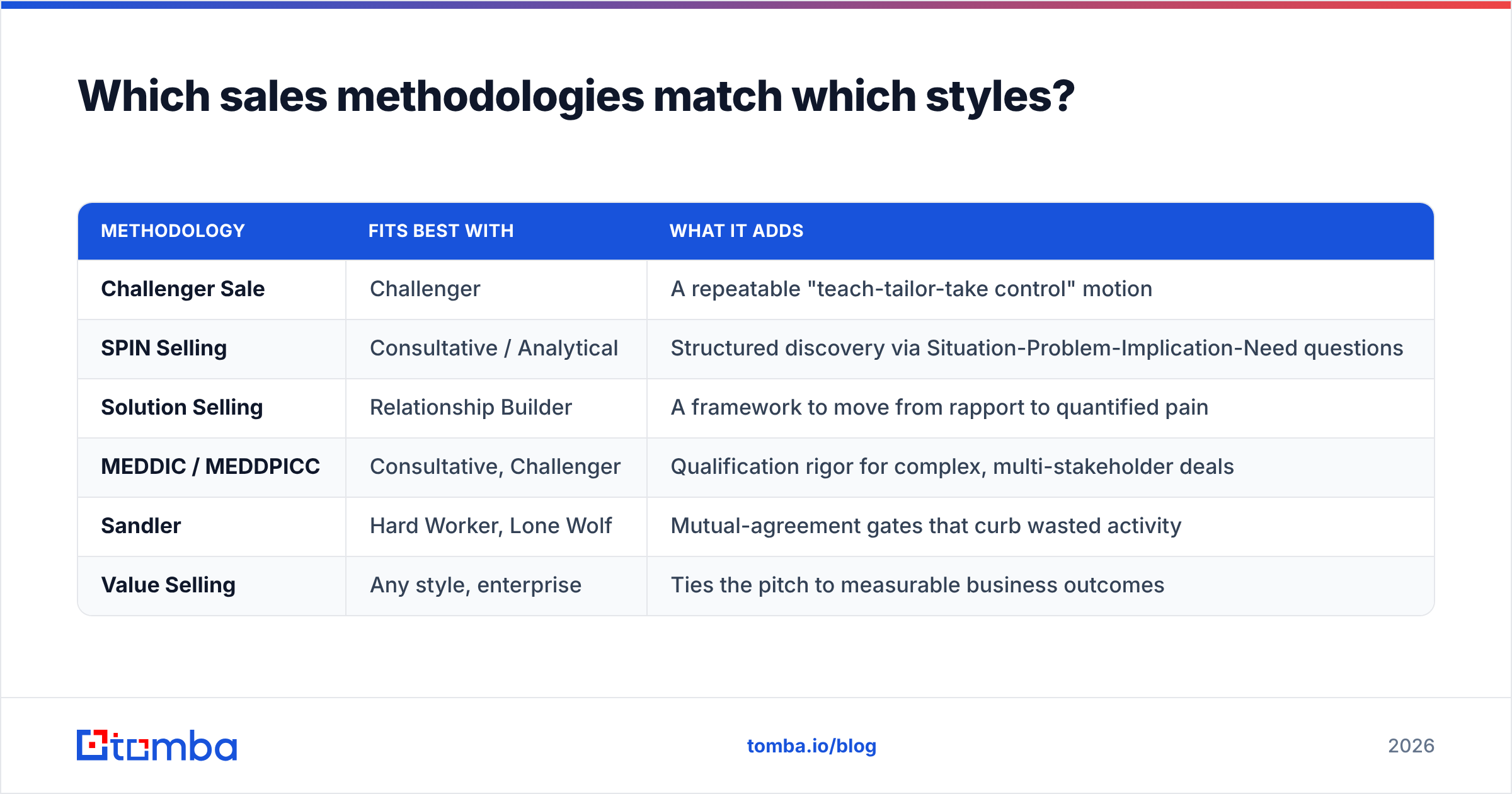
Styles are innate; methodologies are learnable systems you layer on top. The best pairing amplifies a rep's natural posture instead of fighting it.
| Methodology | Fits best with | What it adds |
|---|---|---|
| Challenger Sale | Challenger | A repeatable "teach-tailor-take control" motion |
| SPIN Selling | Consultative / Analytical | Structured discovery via Situation-Problem-Implication-Need questions |
| Solution Selling | Relationship Builder | A framework to move from rapport to quantified pain |
| MEDDIC / MEDDPICC | Consultative, Challenger | Qualification rigor for complex, multi-stakeholder deals |
| Sandler | Hard Worker, Lone Wolf | Mutual-agreement gates that curb wasted activity |
| Value Selling | Any style, enterprise | Ties the pitch to measurable business outcomes |
You don't adopt all six. Pick the methodology that fixes your team's most common failure — no qualification rigor? MEDDIC. Weak discovery? SPIN — and train the whole team on it so pipeline reviews use a shared language. G2 and Capterra reviews of sales-training programs are a useful sanity check before you commit budget to one system over another.
What actually separates top performers across every style?#
Two things, and neither is charisma.
First, disciplined qualification. Top performers in every style category walk away from bad-fit deals faster. The Lone Wolf does it on instinct, the Analytical seller does it with MEDDIC, but they both do it. Chasing unqualified pipeline is the single most expensive habit in sales, and it's style-agnostic.
Second, clean inputs. The best reframe, the warmest relationship, and the most persistent follow-up all collapse if they're aimed at the wrong person or a dead inbox. Deliverability and contact accuracy are the invisible floor under every style. A rep who sounds brilliant on a demo but works off a list that's 20% invalid is quietly capping their own ceiling. This is why the highest-performing teams treat verified contact data as infrastructure, not a nice-to-have — and why pairing methodology with a reliable data layer consistently beats obsessing over personality alone.
If you're benchmarking that data layer, compare accuracy and coverage the way you'd compare any vendor: look at match rates, verification depth, and honest pricing rather than logos. You can start with Tomba pricing as one reference point, but the principle holds no matter which provider you choose.
How do you build a team that uses every style well?#
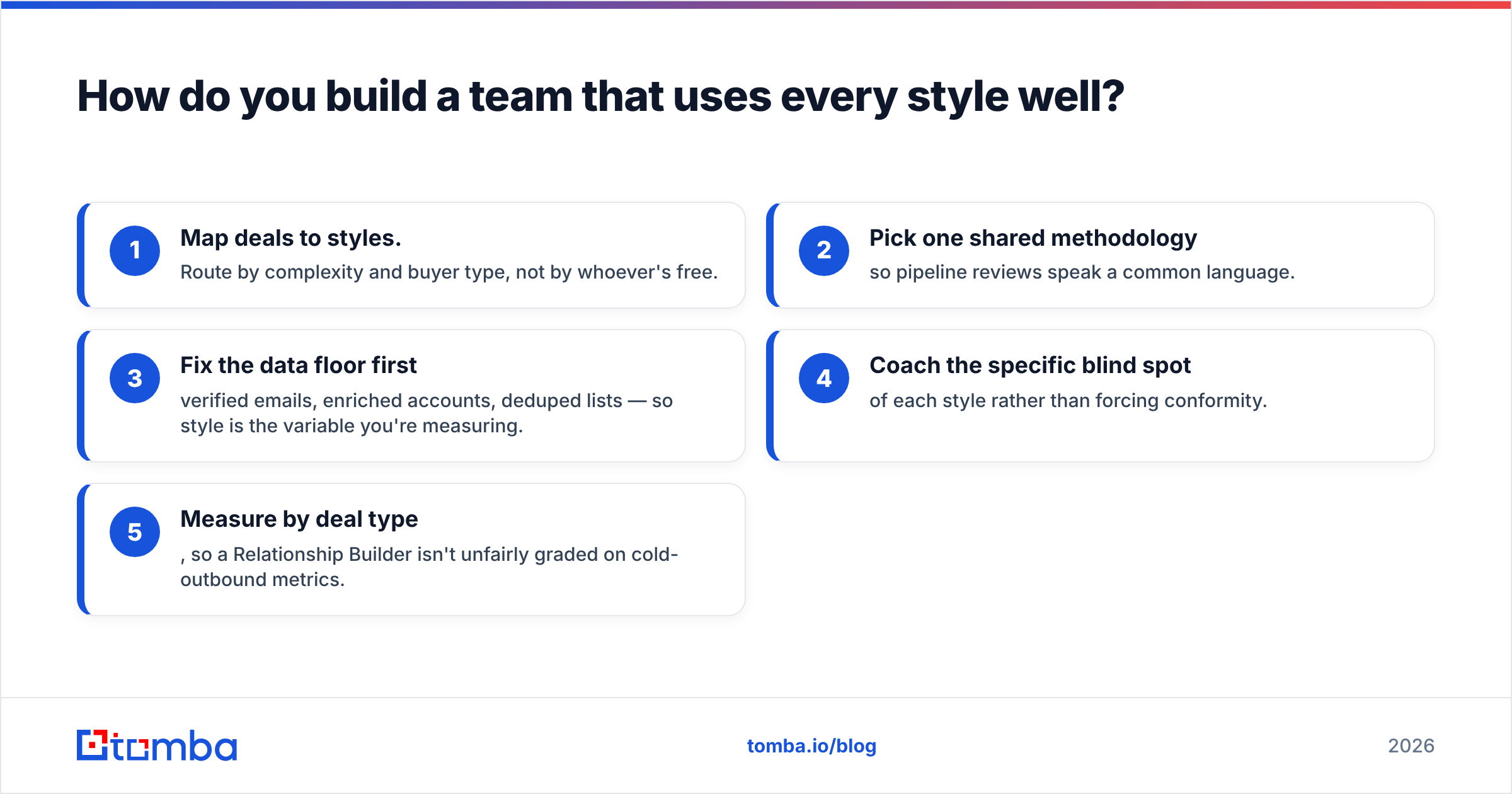
Standardize the inputs, vary the styles, coach the blind spots. In practice:
- Map deals to styles. Route by complexity and buyer type, not by whoever's free.
- Pick one shared methodology so pipeline reviews speak a common language.
- Fix the data floor first — verified emails, enriched accounts, deduped lists — so style is the variable you're measuring.
- Coach the specific blind spot of each style rather than forcing conformity.
- Measure by deal type, so a Relationship Builder isn't unfairly graded on cold-outbound metrics.
Do those five and "different sales styles" stops being a source of chaos and becomes a genuine competitive advantage — a team that can win the transactional sprint and the enterprise marathon.
Start with the input every style depends on#
Whatever style your reps lean toward, they all need the same thing before the pitch: the right person's real, verified contact details. That's the one input no methodology can fake around. Tomba's Email Finder gives your whole team accurate, verified professional emails by name, company, or domain — so your Challengers reframe the right buyer, your Relationship Builders reach the real decision-maker, and your Hard Workers stop pouring volume into dead addresses. Start free with 25 searches a month, then scale on the Starter plan at $49/mo when the pipeline heats up. Get the data right, and let style do the rest.
Related guides#
Ready to find emails that actually work?
Join 150,000+ professionals who stopped guessing and started sending. Free credits on signup — no credit card required.
Get the Tomba newsletter
Practical outbound tactics and product updates — once every two weeks.
About the author