The Different Types of Sales Explained: B2B, B2C, and Beyond
B2B, B2C, transactional, consultative, inbound, outbound — the different types of sales aren't interchangeable. Here's how each model works, who it fits, and how to pick the right motion for your team in 2026.
Not all selling is the same. The way you close a $30 subscription is nothing like the way you land a $400,000 enterprise contract, and treating them the same way is how quotas get missed. This guide maps the different types of sales — by customer, by motion, by complexity — so you can name the model you're actually running and stop borrowing tactics that were built for a different game.
TL;DR — The Different Types of Sales at a Glance#
- Sales splits along three axes: who you sell to (B2B, B2C, B2B2C, D2C), how the deal moves (inbound vs outbound), and how complex it is (transactional vs consultative vs enterprise).
- B2B sales means longer cycles, multiple stakeholders, and higher deal values; B2C sales is faster, more emotional, and higher volume.
- Transactional selling wins on speed and price; consultative selling wins on trust and problem-solving; enterprise selling wins on relationships and orchestration.
- Inbound attracts buyers who already raised a hand; outbound creates demand by reaching cold prospects first — most modern teams run both.
- The model you pick decides everything downstream: your comp plan, your tooling, and the data you need to prospect.
What Are the Main Different Types of Sales?#
The short answer: sales is categorized three ways, and any real sales job is a combination of all three.
Think of it like transportation. "Getting somewhere" is one idea, but a bike, a delivery van, and a freight train solve completely different problems at different scales. Sales models work the same way — the label tells you the distance, the cargo, and the speed you should expect.
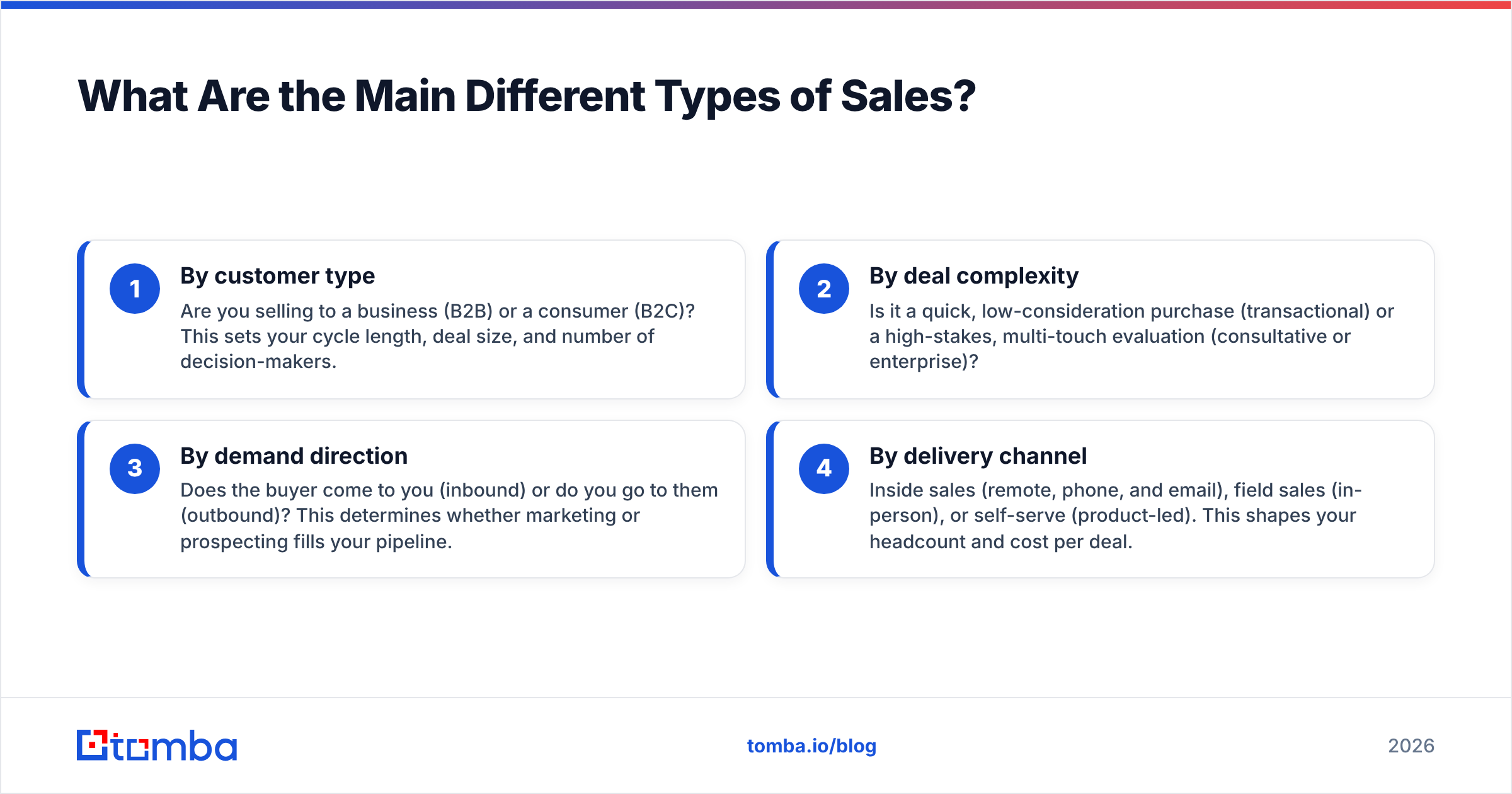
Here are the three axes that define every sales motion:
- By customer type — Are you selling to a business (B2B) or a consumer (B2C)? This sets your cycle length, deal size, and number of decision-makers.
- By deal complexity — Is it a quick, low-consideration purchase (transactional) or a high-stakes, multi-touch evaluation (consultative or enterprise)?
- By demand direction — Does the buyer come to you (inbound) or do you go to them (outbound)? This determines whether marketing or prospecting fills your pipeline.
- By delivery channel — Inside sales (remote, phone, and email), field sales (in-person), or self-serve (product-led). This shapes your headcount and cost per deal.
Once you can place your role on all four, you know which playbook to run. Mixing them up — say, using a transactional, high-velocity script on a six-figure enterprise committee — is the fastest way to stall a deal.
What's the Difference Between B2B and B2C Sales?#
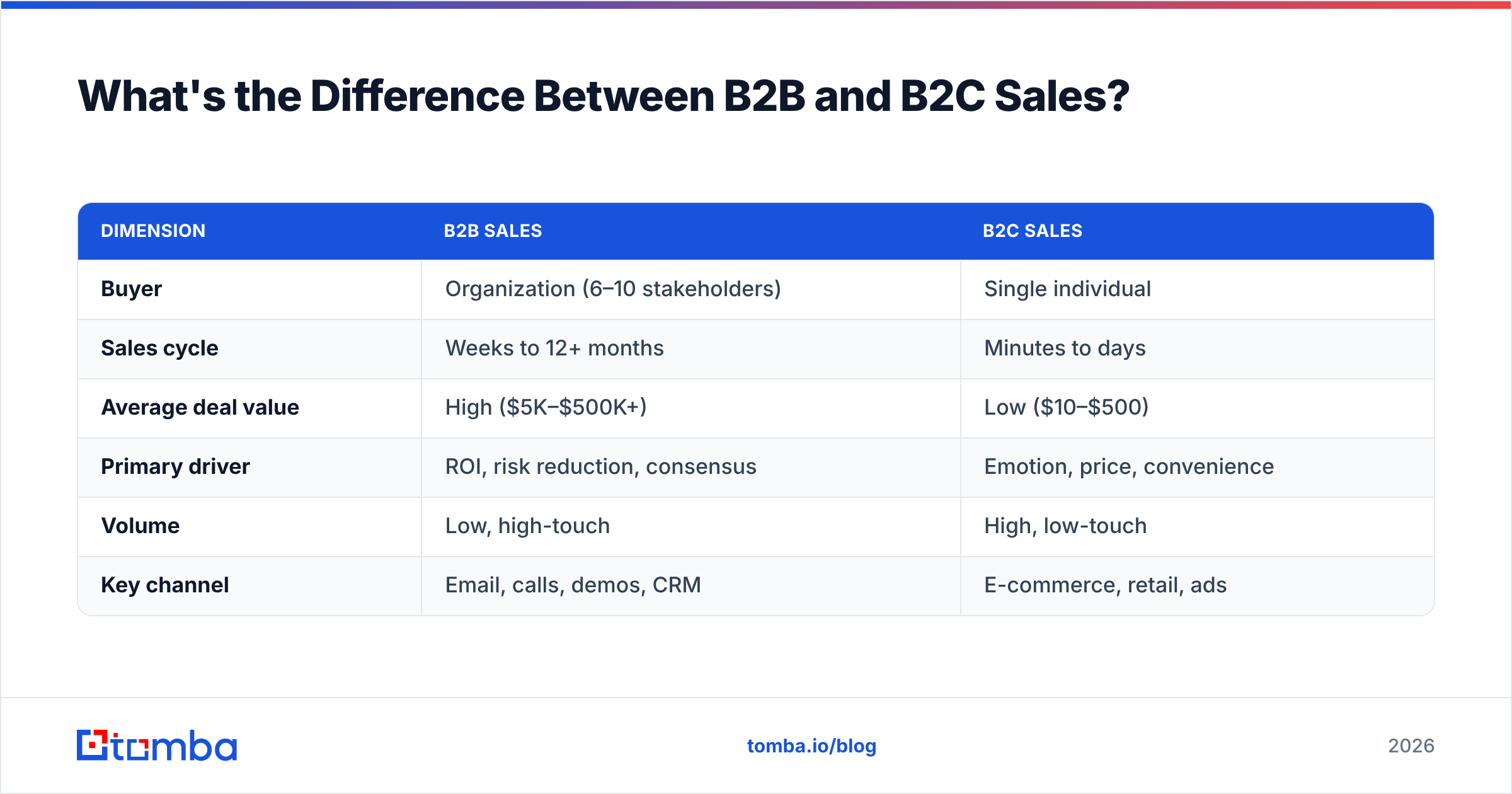
B2B sells to organizations; B2C sells to individuals — and almost everything else flows from that one distinction.
In B2B (business-to-business) sales, you're rarely selling to one person. According to Gartner research, a typical buying group for a complex B2B solution involves six to ten decision-makers, each armed with their own information and priorities. That means longer cycles, formal procurement, and a heavy emphasis on ROI. Deal values are high, volume is low, and relationships matter more than impulse.
In B2C (business-to-consumer) sales, you're selling to a single person making a personal decision. Cycles are short — sometimes seconds — and emotion, convenience, and price drive the purchase. Volume is high, individual deal value is usually low, and the "sales process" is often the checkout page.
There are hybrids worth naming: B2B2C (you sell through a business that reaches consumers), and D2C (direct-to-consumer, cutting out retailers). But the B2B/B2C split remains the primary fork in the road.
)
| Dimension | B2B Sales | B2C Sales |
|---|---|---|
| Buyer | Organization (6–10 stakeholders) | Single individual |
| Sales cycle | Weeks to 12+ months | Minutes to days |
| Average deal value | High ($5K–$500K+) | Low ($10–$500) |
| Primary driver | ROI, risk reduction, consensus | Emotion, price, convenience |
| Volume | Low, high-touch | High, low-touch |
| Key channel | Email, calls, demos, CRM | E-commerce, retail, ads |
If you're in B2B, your biggest early bottleneck is usually reaching the right people at all. That's where a reliable email finder and phone finder earn their keep — you can't run a multi-stakeholder motion if you can't get the stakeholders' contact details.
Transactional vs. Consultative vs. Enterprise: How Does Complexity Change Selling?#
Deal complexity decides how much selling actually happens between "hello" and "signed."
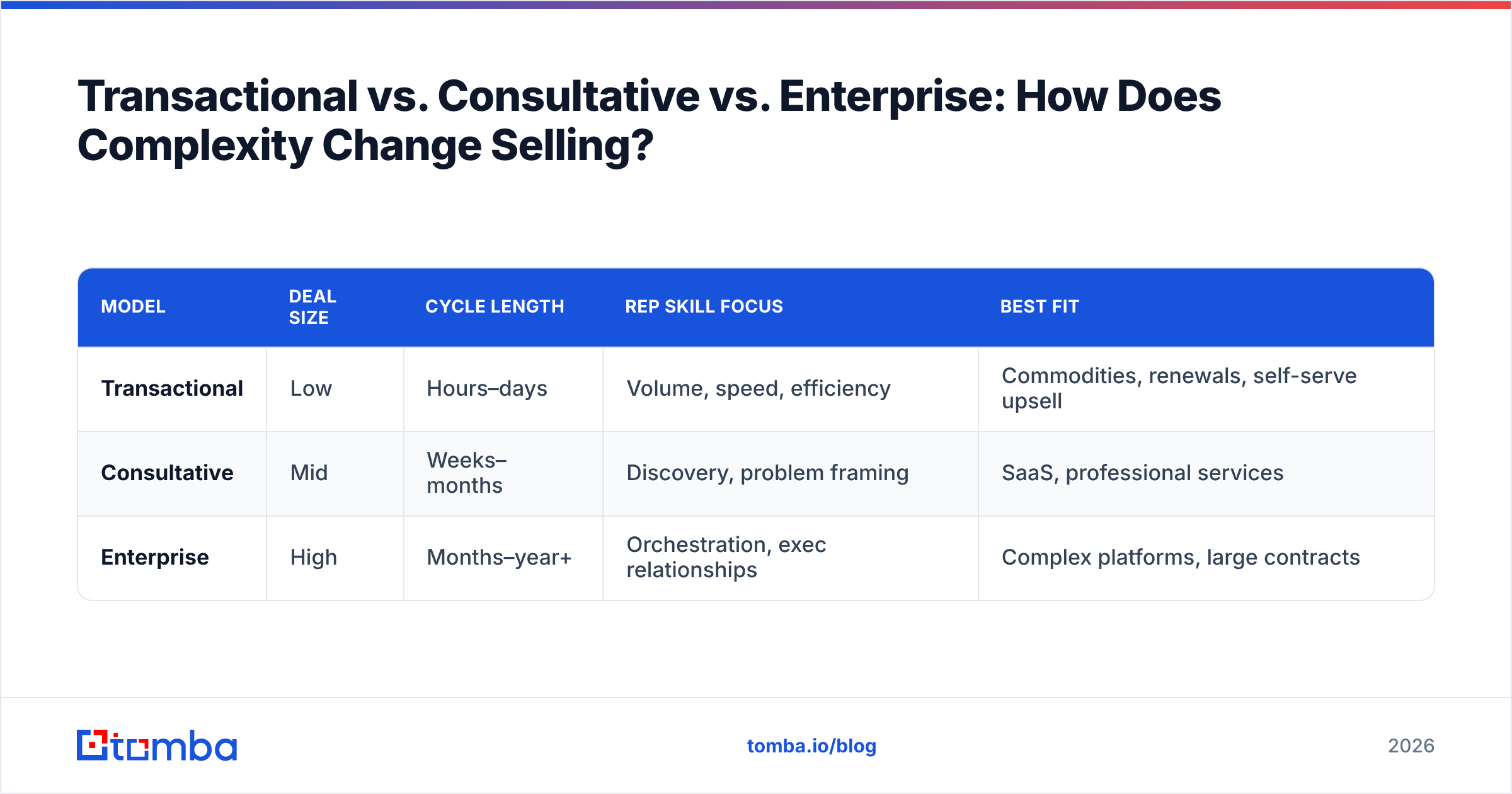
Transactional selling is high-velocity and low-consideration. The buyer already knows what they want; your job is to make buying fast, frictionless, and slightly cheaper than the alternative. Think office supplies, basic software subscriptions, or renewals. Reps handle many deals a day, and success is a numbers game.
Consultative selling (also called solution selling) flips the script. Instead of pitching a product, you diagnose a problem. You ask questions, uncover pain, and position your offer as the fix. Cycles are longer, deal sizes larger, and trust is the currency. Most modern B2B SaaS lives here. HubSpot's sales methodology overview is a solid primer if you want to go deeper on the framework.
Enterprise (or complex) selling is consultative selling at maximum difficulty. You're orchestrating multiple stakeholders, navigating procurement and legal, building business cases, and often selling across a year or more. Account-based strategy, executive sponsorship, and meticulous pipeline management are non-negotiable.
The mistake teams make is applying a transactional mindset to a consultative or enterprise deal — pushing for a fast close when the buyer needs education and consensus. It reads as pushy and kills trust.
| Model | Deal size | Cycle length | Rep skill focus | Best fit |
|---|---|---|---|---|
| Transactional | Low | Hours–days | Volume, speed, efficiency | Commodities, renewals, self-serve upsell |
| Consultative | Mid | Weeks–months | Discovery, problem framing | SaaS, professional services |
| Enterprise | High | Months–year+ | Orchestration, exec relationships | Complex platforms, large contracts |
Inbound vs. Outbound Sales: Which Direction Fills the Pipeline?#
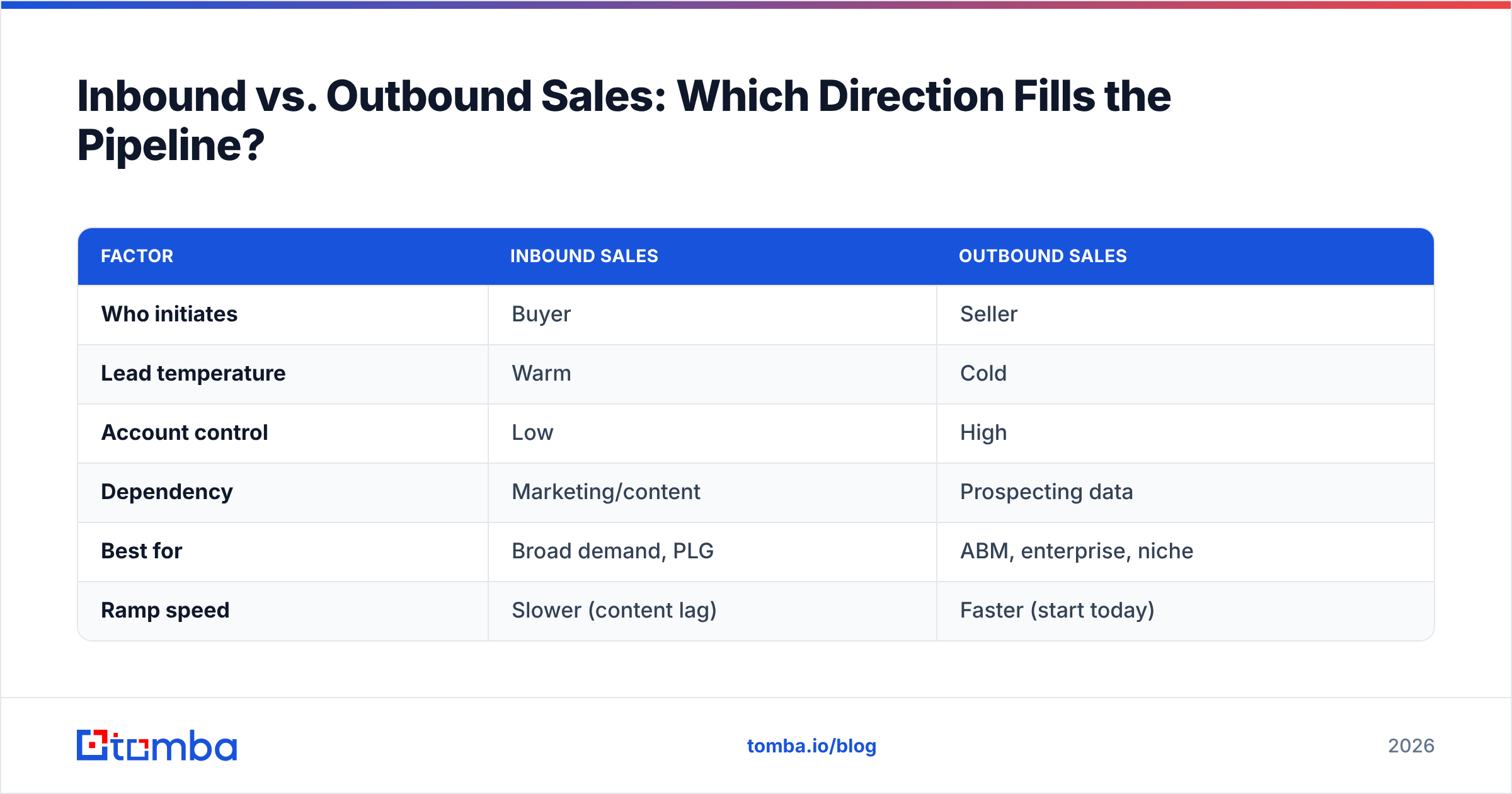
Inbound waits for the hand to go up; outbound goes and finds the hand. Both are legitimate — the best teams run them together.
Inbound sales engages buyers who already showed intent: they downloaded a guide, requested a demo, or started a free trial. The lead is warmer, the conversion rate higher, and the rep's job is to qualify and guide rather than convince from scratch. The catch: you're dependent on marketing to generate volume, and you can't control who shows up.
Outbound sales is proactive. Reps identify a target account, find the right contact, and initiate the conversation cold — through email, calls, or LinkedIn. Outbound gives you control over exactly which accounts you pursue, which is essential for account-based and enterprise motions. The catch: it's harder, rejection is constant, and it lives or dies on data quality.
That data-quality point is the whole game. Outbound built on stale or guessed contact info is just noise — you burn sender reputation, waste rep hours, and never reach the decision-maker.
)
Before a single email goes out, verified contacts matter more than clever copy. Running your list through an email verifier and pulling contacts with domain search is the difference between a campaign that lands in the inbox and one that lands in spam. Pair that with sales automation to keep the volume sustainable.
| Factor | Inbound Sales | Outbound Sales |
|---|---|---|
| Who initiates | Buyer | Seller |
| Lead temperature | Warm | Cold |
| Account control | Low | High |
| Dependency | Marketing/content | Prospecting data |
| Best for | Broad demand, PLG | ABM, enterprise, niche |
| Ramp speed | Slower (content lag) | Faster (start today) |
What About Inside Sales vs. Field Sales?#
This axis is about where selling happens, and it's shifted hard in the last decade.
Inside sales happens remotely — phone, email, video, and screen-share. It's cost-efficient, scales fast, and now covers the majority of B2B selling, including deals that used to require a plane ticket. A single inside rep can run more conversations in a day than a field rep runs in a week.
Field sales (outside sales) is in-person: on-site meetings, conferences, and relationship-building over lunch. It's expensive per rep, but for very large or relationship-driven deals, face time still closes what a Zoom call can't.
The modern reality is hybrid. Most "field" reps now do the bulk of their work inside and reserve travel for the moments that genuinely move a deal — a final negotiation, an executive briefing, a strategic account review.
What Are Some Specialized Sales Models Worth Knowing?#
Beyond the big axes, a few named models come up constantly:
- Account-Based Sales (ABS) — Sales and marketing jointly target a short list of high-value accounts with personalized outreach. It's outbound + consultative + enterprise fused into one coordinated motion.
- Channel / Partner Sales — You sell through third parties (resellers, VARs, affiliates) instead of directly. It scales reach without scaling headcount, at the cost of margin and control.
- Product-Led Sales (PLG) — The product itself drives acquisition via free trials or freemium, and sales steps in to expand usage into paid contracts. Common in developer and SaaS tools.
- Subscription / Renewal Sales — The sale never really ends; retention and expansion are the job. Customer success and sales blur together here.
None of these are exotic — they're just combinations of the axes above, tuned for a specific business model.
How Do You Choose the Right Sales Model?#
Match the model to your deal, not to your ambition. Start with two questions: How much does the average deal cost the buyer? and How many people have to say yes?
- Low price, one buyer → transactional, inbound-leaning, self-serve or inside sales. Optimize for velocity.
- Mid price, small committee → consultative, blended inbound/outbound, inside sales. Optimize for discovery.
- High price, large committee → enterprise/ABS, outbound-heavy, hybrid inside/field. Optimize for orchestration.
Whatever model you land on, the foundation is the same: you need accurate contact data to reach the right people, and a repeatable process to move them forward. Outbound and enterprise motions especially collapse without clean, verified prospect information — no methodology survives a bounced email. You can validate the whole approach against a source like Salesforce's guide to sales models before you commit headcount to it.
Which Type of Sales Are You Actually Running?#
Here's the honest test: describe your last five deals. If they varied wildly in size, cycle, and stakeholder count, you're probably running multiple models at once — and each deserves its own playbook, comp plan, and tooling. Naming them is the first step to running each one well.
Across every model on this list, one variable is constant: you can't sell to someone you can't reach. Whether you're running high-velocity inbound or a year-long enterprise pursuit, the pipeline starts with finding — and verifying — the right person's contact details.
That's exactly what Tomba's Email Finder is built for. Find professional email addresses by domain, name, or company, verify them before you send, and feed clean data into whatever sales motion you run. Start free with 25 searches a month, then scale up on Tomba's plans — Starter at $49/mo — as your pipeline grows. Pick your sales model, then give it the data it needs to actually close.
Related guides#
Ready to find emails that actually work?
Join 150,000+ professionals who stopped guessing and started sending. Free credits on signup — no credit card required.
Get the Tomba newsletter
Practical outbound tactics and product updates — once every two weeks.
About the author